REVIEW 2 major objections 4 minor 57 references
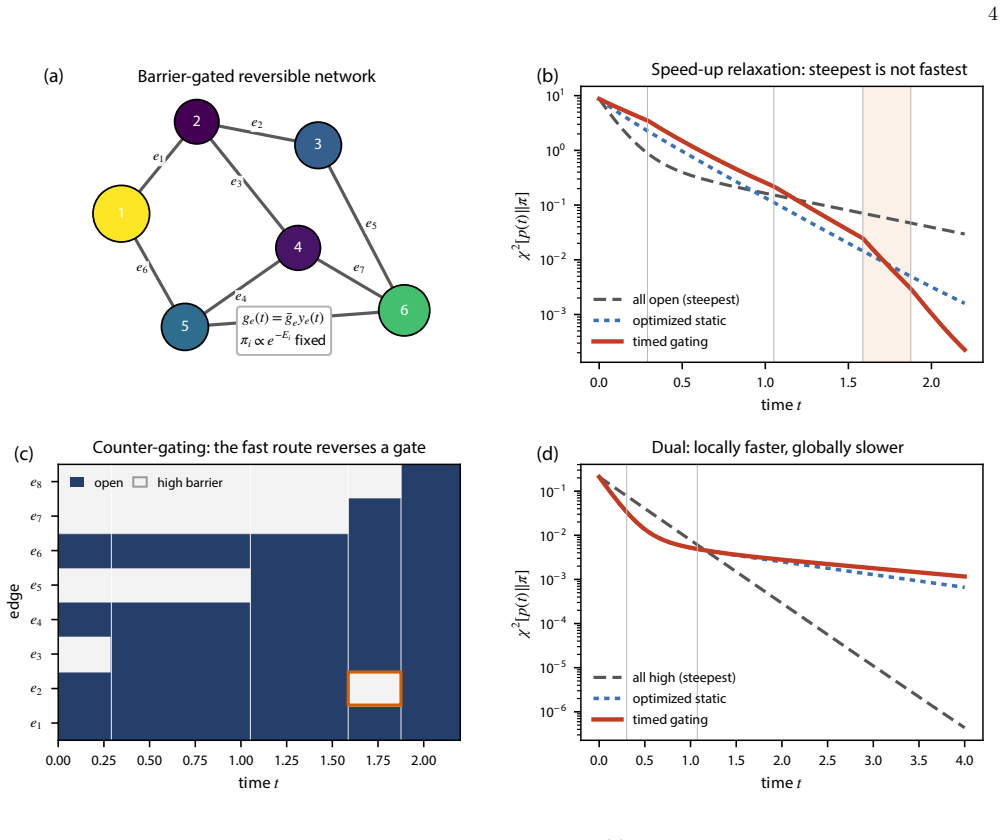
Raising selected barriers on a timed schedule can drive a system to equilibrium faster than opening every gate at once.
Reviewed by Pith at T0; open to challenge. T0 means a machine referee read the full paper against a public rubric. the ladder, T0–T4 →
T0 review · grok-4.5
2026-07-14 02:28 UTC pith:ZIMGNAVS
load-bearing objection Counter-intuitive barrier schedules beat all-open at finite time via noncommutative mode reprojection; the analytics are solid, the headline numbers are best-found not certified global. the 2 major comments →
Slow is fast: raising barriers to accelerate thermal relaxation
The pith
A machine-rendered reading of the paper's core claim, the machinery that carries it, and where it could break.
Core claim
Although the all-open-gate policy maximizes local conductance, the instantaneous decay rate of every convex f-divergence, and every relaxation eigenvalue, a finite-time bang-bang schedule that transiently raises selected barriers can still reach equilibrium sooner. The resource is noncommutative eigenvector rotation: timed switching reprojects residual amplitude across modes. Noncommutativity is necessary; when the generators commute every schedule collapses to a static time-averaged landscape that cannot beat the intuitive extremes.
What carries the argument
Noncommutative eigenvector rotation under bang-bang barrier schedules. Because the rank-one edge generators do not commute, the time-ordered product of the instantaneous generators can reproject residual amplitudes among decaying modes; Pontryagin's principle shows the optima are bang-bang and that negative score functions certify beneficial counter-gating.
Load-bearing premise
The large numerical speed-ups are best-found schedules on one six-state network; the search is credible but does not certify that the global optimum has been found.
What would settle it
On the same six-state network, exhibit a static landscape or an admissible time-dependent schedule whose terminal chi-square residual is smaller than the reported timed-gating value; or construct a network of noncommuting generators for which every bang-bang schedule fails to beat all-open.
Editorial analysis
A structured set of objections, weighed in public.
Referee Report
Summary. The manuscript studies finite-time control of thermal relaxation for reversible Markov networks by scheduling barrier heights (conductances) while keeping the equilibrium π fixed. It proves that the intuitive all-open strategy is optimal at three levels: highest local conductance, maximal instantaneous decay of every convex f-divergence, and maximal spectrum via Weyl monotonicity. It then shows that noncommutativity of the edge generators allows time-ordered bang-bang schedules to reproject residual amplitudes across modes, producing faster terminal relaxation (or, dually, stronger free-energy retention) than any static landscape. A no-go theorem establishes that commuting generators collapse every schedule to a time-averaged static landscape, so noncommutativity is necessary. Numerical evidence on a six-state network reports large best-found gains (130 imes vs all-open, 7 imes vs best static) that employ counter-gating; stage-permutation tests isolate time order as the resource. Barrier control performs no work on the reduced system and only re-times a fixed dissipation budget.
Significance. If the claims hold, the work supplies a clean, reversible-class control principle that synthesizes Mpemba-like modal advantages on demand by kinetic scheduling rather than by initial-state engineering or by breaking detailed balance. The three independent optimality certificates for all-open, the commuting no-go theorem, the Pontryagin derivation of bang-bang structure, and the stage-ordering diagnostics are analytically solid and of broad interest to stochastic thermodynamics, Markov-state modeling, and finite-time control. The open data/code release and the explicit thermodynamic accounting (fixed total dissipation, zero housekeeping heat) strengthen the contribution. The main quantitative limitation is that the headline numerical factors are best-found rather than certified global optima, but the qualitative mechanism is already supported by the analytic results and by the permutation test.
major comments (2)
- End Matter C and the abstract/Fig. 1 caption: the factors 130 and 7.05 (and the dual retention factors) are explicitly best-found values from multistart L-BFGS-B on a 20-slice grid; the text states that the checks 'support numerical credibility but do not certify global optimality.' Because these numbers are the central quantitative illustration of the finite-time advantage, the manuscript should either (i) rephrase every claim of 'reduces by a factor of 130' as 'best-found reduction of at least …' or (ii) supply a tighter lower-bound certificate (e.g., via the first-variation score of End Matter A applied to a refined schedule, or a longer multistart/ensemble report). The analytic mechanism does not depend on the precise magnitude, but the present wording overstates what has been proven.
- End Matter A (counter-gating certificate) and the six-state example: the necessity of counter-gating is proven only under the simple-slow-mode and nonzero-overlap assumptions, and only for asymptotic outperformance of all-open. The manuscript should state more clearly whether the observed open–high–open excursion of edge e2 is required by that certificate or is merely one successful schedule. A short remark on how often the first-variation score G_open_e becomes negative across the 40-state ensemble would strengthen the claim that counter-gating is generic rather than network-specific.
minor comments (4)
- Fig. 1(c) and the accompanying text: the orange box highlighting the temporary high-barrier interval of e2 is helpful, but the caption should explicitly list the five stage durations so that the schedule can be reconstructed without the data repository.
- Eq. (8) and End Matter B: the connection form A = U^T ẊU is introduced without a brief reminder that it is skew-symmetric; a one-line note would aid readers less familiar with moving-frame spectral decompositions.
- References: the recent fluctuation–response gradient estimation work (arXiv:2510.03900) is cited as a future experimental route; a short clause noting that the present adjoint is exactly the continuum limit of that response would tighten the link.
- Typographical: 'Steepest is not fastest' (Fig. 1b title) is effective, but the main text occasionally switches between χ^{2} and 'residual' without re-stating the equivalence; a single clarifying sentence near Eq. (2) would help.
Circularity Check
No significant circularity; all load-bearing claims derive self-containedly from the master equation, spectral theory, and Pontryagin, with numerical gains as open-box optimization outputs against explicit baselines.
full rationale
The three optimality certificates for all-open (local conductance via ge, instantaneous decay of every convex f-divergence via the term-by-term nonnegativity of -Ḋf, and Weyl monotonicity of the full spectrum of L[y]) follow directly from the definitions L[y]=∑ye Le with 0<ye≤1 and Le≽0, without external input or self-reference. The no-go theorem (End Matter A) is an elementary consequence of simultaneous diagonalization when the Le commute, reducing every schedule to the static time average which is then dominated by the extremes. Bang-bang structure is the standard nonsingular conclusion of Pontryagin’s principle for affine controls (Eqs. 9–11). Counter-gating necessity under the simple-slow-mode assumption is likewise a direct spectral argument. The reported 130×/7× (and dual) factors are best-found numerical values obtained by multistart L-BFGS-B over the full admissible box against the explicit baselines all-open, best static, and time-averaged static; they are not fitted parameters renamed as predictions, nor do they rest on load-bearing self-citations. Prior Mpemba citations supply only background context and are not used to force uniqueness or smuggle an ansatz. The derivation chain is therefore independent and non-circular.
Axiom & Free-Parameter Ledger
free parameters (4)
- ymin_e (gate lower bounds) =
0.05 (accel), 0.30 (delay)
- Target horizon T =
2.2 / 4.0
- Six-state network energies and edge set
- Number of time slices / stage structure =
20 slices
axioms (6)
- domain assumption Continuous-time master equation on a finite connected graph with rates obeying detailed balance w.r.t. a fixed Boltzmann distribution π.
- domain assumption Barrier control enters only through symmetric edge conductances ge = ḡe ye with ye ∈ [ymin_e, 1], leaving state energies and π fixed.
- standard math Weyl monotonicity of eigenvalues for positive-semidefinite perturbations (Lopen − L[y] ⪰ 0 implies ordered rates are maximized by all-open).
- standard math Pontryagin minimum principle for terminal-cost optimal control with affine controls yields bang-bang nonsingular extremals.
- domain assumption Barrier modulation is slow relative to intrawell equilibration so that the reduced Markov description remains valid and no extra coarse-graining dissipation appears.
- domain assumption ymin_e > 0 so every instantaneous generator remains irreducible and the system eventually reaches π under any schedule.
read the original abstract
For a reversible system relaxing to equilibrium, the obvious fastest strategy is to lower all kinetic barriers (open all gates). We find that such intuition holds at three levels: the all-open-gate strategy achieves the highest local conductance, it maximizes the instantaneous speed of approach in every $f$-divergence, and it simultaneously maximizes all relaxation eigenvalues. Nevertheless, we show that a counter-intuitive finite-time optimum lies beyond this intuition and operates at a fourth level, invisible to all three: eigenvector rotation. Noncommutativity enables timed schedules to reproject residual amplitudes across relaxation modes, thereby achieving faster relaxation. Optimal schedules are bang--bang. In our illustrative example, the best-found schedule also employs counter-gating, transiently raising selected barriers, and reduces the terminal residual by a factor of $130$ relative to all-open, and by $7$ relative to the best static landscape. A no-go theorem shows that noncommutativity is necessary: commuting generators collapse every schedule to a static time-averaged landscape, worse than the intuitive static control. In the reverse problem, the dual schedule preserves nonequilibrium free energy far more effectively than intuitively keeping all barriers at maximum heights. Whether accelerating or delaying relaxation, barrier control performs no work on the reduced Markov system; it only re-times a fixed total dissipation budget.
Figures

Reference graph
Works this paper leans on
-
[1]
Lu and O
Z. Lu and O. Raz, Nonequilibrium thermodynamics of the Markovian Mpemba effect and its inverse, Proc. Natl. Acad. Sci. U.S.A.114, 5083 (2017)
2017
-
[2]
Klich, O
I. Klich, O. Raz, O. Hirschberg, and M. Vucelja, Mpemba index and anomalous relaxation, Phys. Rev. X9, 021060 (2019). 6
2019
-
[3]
Kumar and J
A. Kumar and J. Bechhoefer, Exponentially faster cooling in a colloidal system, Nature584, 64 (2020)
2020
-
[4]
Bechhoefer, A
J. Bechhoefer, A. Kumar, and R. Ch´ etrite, A fresh under- standing of the Mpemba effect, Nat. Rev. Phys.3, 534 (2021)
2021
-
[5]
H. A. Kramers, Brownian motion in a field of force and the diffusion model of chemical reactions, Physica7, 284 (1940)
1940
-
[6]
H¨ anggi, P
P. H¨ anggi, P. Talkner, and M. Borkovec, Reaction-rate theory: Fifty years after Kramers, Rev. Mod. Phys.62, 251 (1990)
1990
-
[7]
N. A. Sinitsyn and I. Nemenman, Universal geometric theory of mesoscopic stochastic pumps and reversible ratchets, Phys. Rev. Lett.99, 220408 (2007)
2007
-
[8]
Rahav, J
S. Rahav, J. Horowitz, and C. Jarzynski, Directed flow in nonadiabatic stochastic pumps, Phys. Rev. Lett.101, 140602 (2008)
2008
-
[9]
V. Y. Chernyak and N. A. Sinitsyn, Pumping restriction theorem for stochastic networks, Phys. Rev. Lett.101, 160601 (2008)
2008
-
[10]
I. A. Mart´ ınez, A. Petrosyan, D. Gu´ ery-Odelin, E. Trizac, and S. Ciliberto, Engineered swift equilibration of a Brow- nian particle, Nat. Phys.12, 843 (2016)
2016
-
[11]
Gu´ ery-Odelin, A
D. Gu´ ery-Odelin, A. Ruschhaupt, A. Kiely, E. Tor- rontegui, S. Mart´ ınez-Garaot, and J. G. Muga, Shortcuts to adiabaticity: Concepts, methods, and applications, Rev. Mod. Phys.91, 045001 (2019)
2019
-
[12]
C. A. Plata, A. Prados, E. Trizac, and D. Gu´ ery-Odelin, Taming the time evolution in overdamped systems: Short- cuts elaborated from fast-forward and time-reversed pro- tocols, Phys. Rev. Lett.127, 190605 (2021)
2021
-
[13]
Schmiedl and U
T. Schmiedl and U. Seifert, Optimal finite-time processes in stochastic thermodynamics, Phys. Rev. Lett.98, 108301 (2007)
2007
-
[14]
Aurell, C
E. Aurell, C. Mej´ ıa-Monasterio, and P. Muratore- Ginanneschi, Optimal protocols and optimal transport in stochastic thermodynamics, Phys. Rev. Lett.106, 250601 (2011)
2011
-
[15]
D. A. Sivak and G. E. Crooks, Thermodynamic metrics and optimal paths, Phys. Rev. Lett.108, 190602 (2012)
2012
-
[16]
P. R. Zulkowski, D. A. Sivak, G. E. Crooks, and M. R. DeWeese, Geometry of thermodynamic control, Phys. Rev. E86, 041148 (2012)
2012
-
[17]
Prados, Optimizing the relaxation route with optimal control, Phys
A. Prados, Optimizing the relaxation route with optimal control, Phys. Rev. Research3, 023128 (2021)
2021
-
[18]
Gonz´ alez-Adalid Pemart´ ın, E
I. Gonz´ alez-Adalid Pemart´ ın, E. Momp´ o, A. Lasanta, V. Mart´ ın-Mayor, and J. Salas, Shortcuts of freely relaxing systems using equilibrium physical observables, Phys. Rev. Lett.132, 117102 (2024)
2024
-
[19]
Beato and G
N. Beato and G. Teza, Relaxation control of open quantum systems, Phys. Rev. Lett.136, 070401 (2026)
2026
-
[20]
Kumar, R
A. Kumar, R. Ch´ etrite, and J. Bechhoefer, Anomalous heating in a colloidal system, Proc. Natl. Acad. Sci. U.S.A. 119, e2118484119 (2022)
2022
-
[21]
Ichiki and M
A. Ichiki and M. Ohzeki, Violation of detailed balance accelerates relaxation, Phys. Rev. E88, 020101(R) (2013)
2013
-
[22]
Kaiser, R
M. Kaiser, R. L. Jack, and J. Zimmer, Acceleration of convergence to equilibrium in Markov chains by breaking detailed balance, J. Stat. Phys.168, 259 (2017)
2017
-
[23]
Gal and O
A. Gal and O. Raz, Precooling strategy allows exponen- tially faster heating, Phys. Rev. Lett.124, 060602 (2020)
2020
-
[24]
S. S. Chittari and Z. Lu, Geometric approach to nonequi- librium hasty shortcuts, J. Chem. Phys.159, 084106 (2023)
2023
-
[25]
G. Teza, R. Yaacoby, and O. Raz, Relaxation shortcuts through boundary coupling, Phys. Rev. Lett.131, 017101 (2023)
2023
-
[26]
Qian, Relative entropy: Free energy associated with equilibrium fluctuations and nonequilibrium deviations, Phys
H. Qian, Relative entropy: Free energy associated with equilibrium fluctuations and nonequilibrium deviations, Phys. Rev. E63, 042103 (2001)
2001
-
[27]
Vaikuntanathan and C
S. Vaikuntanathan and C. Jarzynski, Dissipation and lag in irreversible processes, Europhys. Lett.87, 60005 (2009)
2009
-
[28]
Esposito and C
M. Esposito and C. Van den Broeck, Second law and Landauer principle far from equilibrium, Europhys. Lett. 95, 40004 (2011)
2011
-
[29]
S. M. Ali and S. D. Silvey, A general class of coefficients of divergence of one distribution from another, J. R. Stat. Soc. Ser. B28, 131 (1966)
1966
-
[30]
Csisz´ ar, Information-type measures of difference of probability distributions and indirect observations, Studia Sci
I. Csisz´ ar, Information-type measures of difference of probability distributions and indirect observations, Studia Sci. Math. Hungar.2, 299 (1967)
1967
-
[31]
Van Vu and H
T. Van Vu and H. Hayakawa, Thermomajorization Mpemba effect, Phys. Rev. Lett.134, 107101 (2025)
2025
-
[32]
G. Teza, J. Bechhoefer, A. Lasanta, O. Raz, and M. Vucelja, Speedups in nonequilibrium thermal relax- ation: Mpemba and related effects, Phys. Rep.1164, 1 (2026)
2026
-
[33]
N. G. van Kampen,Stochastic Processes in Physics and Chemistry, 3rd ed. (North-Holland, Amsterdam, 2007)
2007
-
[34]
Schnakenberg, Network theory of microscopic and macroscopic behavior of master equation systems, Rev
J. Schnakenberg, Network theory of microscopic and macroscopic behavior of master equation systems, Rev. Mod. Phys.48, 571 (1976)
1976
-
[35]
See Supplemental Material for additional derivations and numerical information, including the KL and χ2 Dirichlet identities, the long-time f-divergence limit, the three-state example and reproduction script, complete protocols and stage-ordering data, optimization and finite-difference procedures, horizon and ensemble tests, and robustness analyses
-
[36]
Bhatia,Matrix Analysis(Springer, New York, 1997)
R. Bhatia,Matrix Analysis(Springer, New York, 1997)
1997
-
[37]
G. Teza, R. Yaacoby, and O. Raz, Eigenvalue crossing as a phase transition in relaxation dynamics, Phys. Rev. Lett.130, 207103 (2023)
2023
-
[38]
L. S. Pontryagin, V. G. Boltyanskii, R. V. Gamkrelidze, and E. F. Mishchenko,The Mathematical Theory of Op- timal Processes(Interscience, New York, 1962)
1962
-
[39]
Bechhoefer,Control Theory for Physicists(Cambridge University Press, Cambridge, 2021)
J. Bechhoefer,Control Theory for Physicists(Cambridge University Press, Cambridge, 2021)
2021
-
[40]
Liberzon,Calculus of Variations and Optimal Control Theory(Princeton University Press, Princeton, 2012)
D. Liberzon,Calculus of Variations and Optimal Control Theory(Princeton University Press, Princeton, 2012)
2012
-
[41]
Sch¨ attler and U
H. Sch¨ attler and U. Ledzewicz,Geometric Optimal Con- trol: Theory, Methods and Examples(Springer, New York, 2012)
2012
-
[42]
Magnus, On the exponential solution of differential equations for a linear operator, Commun
W. Magnus, On the exponential solution of differential equations for a linear operator, Commun. Pure Appl. Math.7, 649 (1954)
1954
-
[43]
Blanes, F
S. Blanes, F. Casas, J. A. Oteo, and J. Ros, The Magnus expansion and some of its applications, Phys. Rep.470, 151 (2009)
2009
-
[44]
Seifert, Stochastic thermodynamics, fluctuation theo- rems and molecular machines, Rep
U. Seifert, Stochastic thermodynamics, fluctuation theo- rems and molecular machines, Rep. Prog. Phys.75, 126001 (2012)
2012
-
[45]
Alipour, A
S. Alipour, A. Chenu, A. T. Rezakhani, and A. del Campo, Shortcuts to adiabaticity in driven open quantum systems: Balanced gain and loss and non-Markovian evolution, Quantum4, 336 (2020). 7
2020
-
[46]
Prinz, H
J.-H. Prinz, H. Wu, M. Sarich, B. Keller, M. Senne, M. Held, J. D. Chodera, C. Sch¨ utte, and F. No´ e, Markov models of molecular kinetics: Generation and validation, J. Chem. Phys.134, 174105 (2011)
2011
-
[47]
Shiraishi, K
N. Shiraishi, K. Funo, and K. Saito, Speed limit for clas- sical stochastic processes, Phys. Rev. Lett.121, 070601 (2018)
2018
-
[48]
Ito and A
S. Ito and A. Dechant, Stochastic time evolution, infor- mation geometry, and the Cram´ er–Rao bound, Phys. Rev. X10, 021056 (2020)
2020
-
[49]
J. Lyu, K. J. Ray, and J. P. Crutchfield, Optimal compu- tation from fluctuation responses, arXiv preprint (2025), arXiv:2510.03900 [cond-mat.stat-mech]
arXiv 2025
-
[50]
slow is fast: raising barriers to accelerate thermal relaxation
Y. Wang and Z. Lu, Data and code for “slow is fast: raising barriers to accelerate thermal relaxation” (2026), link will be available after acceptance
2026
-
[51]
C. R. Harriset al., Array programming with NumPy, Nature585, 357 (2020)
2020
-
[52]
Virtanenet al., SciPy 1.0: Fundamental algorithms for scientific computing in Python, Nat
P. Virtanenet al., SciPy 1.0: Fundamental algorithms for scientific computing in Python, Nat. Methods17, 261 (2020)
2020
-
[53]
N. J. Higham,Functions of Matrices: Theory and Com- putation(SIAM, Philadelphia, 2008)
2008
-
[54]
R. H. Byrd, P. Lu, J. Nocedal, and C. Zhu, A limited memory algorithm for bound constrained optimization, SIAM J. Sci. Comput.16, 1190 (1995)
1995
-
[55]
D. R. Jones, C. D. Perttunen, and B. E. Stuckman, Lips- chitzian optimization without the Lipschitz constant, J. Optim. Theory Appl.79, 157 (1993). END MA TTER A. No-go theorem and counter-gating certificates.— Suppose the Le are real symmetric, positive semidefi- nite, and pairwise commuting, they are simultaneously orthogonally diagonalizable, with eige...
1993
-
[56]
If the stage generators commuted, every ordering would have the same endpoint as the static time-average
Dashed, dotted, and dash-dotted lines mark the corresponding pointwise extreme (all-open for acceleration and all-high for delay), the best-found static landscape, and the time-averaged static landscape ¯ye = T −1R T 0 ye dt. If the stage generators commuted, every ordering would have the same endpoint as the static time-average. quasi-Newton descent (L-B...
-
[57]
followed by 80 multistart L-BFGS-B refinements, and satisfy the Karush–Kuhn–Tucker conditions with interior gradients below 1.6 × 10⁻¹¹. The static problem is only eight-dimensional; DIRECT evaluates it 1 .2 × 104 times, and the delay static optimum is a vertex of the control box with strictly positive KKT margins (2 .86 × 10−5). At the longest accelerati...
discussion (0)
Sign in with ORCID, Apple, or X to comment. Anyone can read and Pith papers without signing in.