REVIEW 3 major objections 5 minor 86 references
This paper argues that Media Bias/Fact Check, a widely used source of media-bias ratings, is methodologically unsound and that misinformation research should stop relying on it.
Reviewed by Pith at T0; open to challenge. T0 means a machine referee read the full paper against a public rubric. the ladder, T0–T4 →
A single-person, methodologically untested media rating site (MBFC) is commonly mischaracterized as an independent fact-checking organization in ~3.5–7.4% of misinformation papers, and this audit argues it should not be used as ground truth.
T0 review reviewed 2026-08-02 challenge →
load-bearing objection A well-evidenced methodological warning about MBFC wrapped in a literature census whose strongest negative claim outruns the data. the 3 major comments →
Stop using Media Bias/Fact Check in research
The pith
A machine-rendered reading of the paper's core claim, the machinery that carries it, and where it could break.
The reading
Core claim
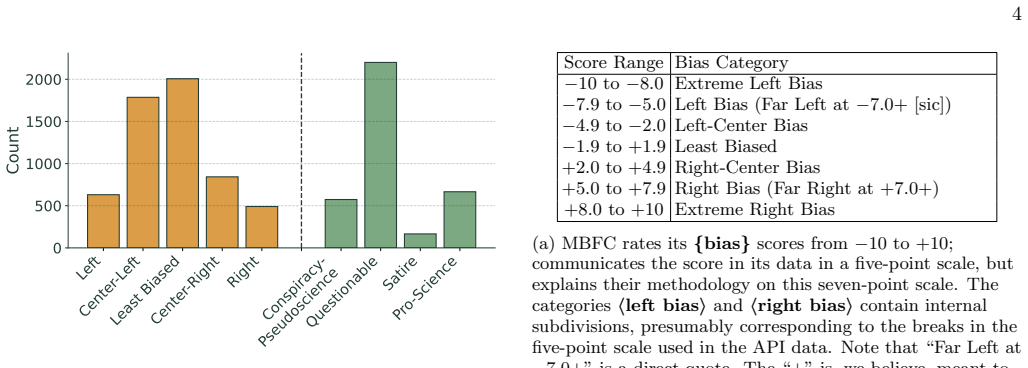
The paper's central claim is that MBFC's data is specious rather than neutral: it quantifies the results of a decades-long political campaign to discredit the press, then presents those results as simple facts about the world. The evidence comes from two sides: a close reading of MBFC's currently published rubrics (e.g., a {bias} score 35% determined by an {economic system} scale that would classify Nazi Germany or Saudi Arabia as leftist), and a literature analysis showing that 372 papers invoke MBFC, frequently describing it as an 'independent fact-checking organization' despite MBFC's own description as a one-person hobby with a disclaimer that its method is not tested science. The author
What carries the argument
The argument rests on two mechanisms. First, a methodological audit of MBFC's public documentation and API output, exposing unexplained percentage weights, irregular binning of raw scores that are never exposed to users, nested override logic in the credibility rubric, and conceptual slippage between {bias} and {factual reporting}. Second, a snowball citation sample seeded from Scopus records, extended through metadata databases, that scans manuscript texts for MBFC mentions and analyzes the surrounding context with NLP to characterize how the literature describes the tool. The audit shows the data cannot be independently verified; the literature survey shows it is nevertheless used uncritic
Load-bearing premise
The strong empirical claim that no paper in the literature adequately describes MBFC as one person's opinion rests on the snowball sample being complete, but manuscript text was unavailable for 61% of the papers in the database, so the claim could be an artifact of missing data rather than the true state of the literature.
What would settle it
A single peer-reviewed paper that (a) cites MBFC, (b) explicitly states that MBFC is the opinion of one individual, and (c) nonetheless justifies using it with a critical engagement with its limitations would falsify the paper's strongest negative claim. Alternatively, an archived pre-2025 version of MBFC's dataset with the raw scores would undercut the claim that the data is unauditable.
If this is right
- Any study that uses MBFC ratings as ground truth for training or validating fake-news classifiers inherits a single individual's untested, politically situated judgments and risks encoding them into automated moderation systems.
- Highly cited papers that rely on MBFC—including several that define 'reliable' and 'questionable' sources—should be re-examined for how their conclusions change if MBFC's labels are not accepted.
- Composite datasets and commercial products that bundle MBFC propagate the same specious ground truth, sometimes beyond the point where provenance is traceable.
- Existing misinformation research that uses MBFC cannot simply be corrected; the underlying measurements are unarchived for pre-2025 data, so comparisons across time are impossible.
- The field needs alternative, transparent, and independently auditable source-rating schemes before MBFC is retired.
Where Pith is reading between the lines
- An editorial extension: the same structural critique may apply to other media-quality ratings (e.g., those built on small panels or proprietary rubrics) if they too hide their scoring procedures; a comparative audit of such systems would test whether MBFC is uniquely bad or representative of a wider problem.
- If the paper's claim about hegemony is taken seriously, even an 'improved' MBFC that added transparency and citations could not fully fix the problem, because the underlying categories (liberal, biased, factual) are themselves politically contested; a purely procedural fix would not address the conceptual issue.
- One testable extension: replicate the literature survey using full-text search through Google Scholar or publisher APIs rather than relying on PDFs and OCR; this should find papers that the snowball missed and directly test the paper's claim that no paper adequately describes MBFC as one person's opinion.
- Another extension: examine whether downstream models trained on MBFC labels produce systematically different accuracy or harm outcomes when re-trained on alternative ratings, which would quantify the real-world cost of using MBFC.
Editorial analysis
A structured set of objections, weighed in public.
Referee Report
Summary. The paper audits Media Bias/Fact Check (MBFC), a widely used source of media bias and credibility ratings, and argues that it is unsuitable as a basis for academic research. The authors document from MBFC's own pages and archives that its methodology uses unexplained weighting, arbitrary binning, inaccessible raw scores, nested credibility logic, and economically/politically contentious category definitions; they note MBFC's explicit disclaimer that it is not a tested scientific method. They then report a snowball literature search in which 372 of 10,642 papers (3.50%) in their database reference MBFC, with higher percentages in a misinformation-focused subset, and argue that the literature overwhelmingly misdescribes MBFC as an independent fact-checking organization rather than as one individual's opinion. They conclude by urging researchers to stop using MBFC and by interpreting the dataset's acceptance through a Gramscian/hegemony framework.
Significance. If the paper's central methodological critique stands, it is a valuable and overdue caution about a widely used dataset. The authors deserve credit for grounding the critique in primary sources: MBFC's own methodology pages, archived versions, and public disclaimers are quoted and dated, and the internal inconsistencies they identify (e.g., the three incompatible bias scales, the unexplained bin boundaries, the composite credibility logic) are concrete and verifiable. The paper also usefully documents how often MBFC is misdescribed in the literature. However, the strongest empirical claim—that no paper anywhere has adequately described or critically justified MBFC—rests on a sampling procedure with a large unexamined fraction, and the accuracy claim is supported by illustrative examples rather than a systematic validation. These issues limit the strength of the paper's abstract and conclusions, though they do not undermine the core point that MBFC's methodology is not transparent enough to serve as uncritical ground truth.
major comments (3)
- [Abstract; Section III B] The abstract states: "We identified no papers that adequately describe MBFC as the opinions of a single person or critically engage with its methodology." This negative existential is load-bearing for the paper's empirical claim that the literature "rarely examines MBFC carefully," but the sampling method cannot support it. Section III B reports that manuscript text was unavailable for 61% of the 10,642 papers, and the snowball algorithm terminates branches whose PDFs cannot be fetched. Papers behind paywalls, with OCR failures, or citing MBFC in ways not captured by the seed/metadata pipeline are invisible to the search. The paper itself acknowledges "we expect that 3.50% is an underestimate," yet the unqualified "no papers" phrase is retained. The conclusion should be restricted to "no papers in our searchable sample," or the authors should supplement the snowball procedure with a targ
- [Abstract; Section V C] The abstract claims MBFC's data is "not neutral or accurate." The non-neutrality and lack of reproducibility are well documented, but "not accurate" is a stronger empirical claim. The evidence in Section V C consists of selected internal inconsistencies and counterexamples (Saudi Arabia, Huffington Post, state-owned economies) rather than a systematic comparison of MBFC ratings against an independent benchmark or a formal test of rubric application. It is possible that the paper's intended meaning is that accuracy cannot be verified because raw scores are inaccessible and the methodology is inconsistent. That claim is supported and would be sufficient for the policy recommendation. The authors should either provide a systematic accuracy evaluation or reframe the conclusion as "MBFC's accuracy cannot be established and its ratings exhibit internal inconsistencies," rather than asserting i
- [Sections V B–V D] The Gramscian/hegemony interpretation is presented as an explanation for MBFC's design and scholarly acceptance, and the abstract includes the claim that MBFC is "a computationally legible account of hegemony." This is a theoretically grounded interpretation, not an empirical result of the audit in Sections II–IV. The paper does not define observable criteria that would distinguish the hegemony explanation from alternative explanations (e.g., convenience, lack of better data, or simple negligence). Since the historical narrative and ideological framing are not required for the central methodological conclusion, they should be clearly labeled as an interpretive hypothesis rather than as a finding derived from the documented evidence. This separation would also make the paper's argument easier for readers who accept the methodology critique but do not subscribe to the specific theoretical
minor comments (5)
- [Section II] Typographical and formatting issues: "outlet's" should be "outlets"; "wisely used" in Section III B should presumably be "widely used"; "plaintly" in Section V D should be "plainly"; "Hufftingon post" in reference [48] should be "Huffington Post"; "MNSIT" in Section V D should be "MNIST."
- [Section III B; Table IV] The phrase "terminating the snowball sample for that branch" is slightly misleading: if a PDF cannot be fetched, the algorithm stops following that paper's citations, so the sample is biased toward papers whose full text is openly available. This should be stated explicitly in the main text, not only in the limitations discussion.
- [Figure 4] The label "MBFC would be here" is unclear. It appears to indicate where MBFC-referencing papers would rank if they were highly cited, but the figure does not show a concrete position. Consider adding a marker or a more descriptive caption.
- [Section II C; reference [26]] The list of "countries with which the United States has strained or hostile relations" is presented without selection criteria. Since the subsequent observation that almost all of these countries receive "total oppression" is used as evidence, the criteria for inclusion in this list should be specified to avoid the appearance of cherry-picking.
- [Section IV A] The NLP context-window method excludes contexts containing a digit directly before an alias, which is reasonable for footnotes, but this also means that some relevant methodological discussions occurring in footnotes are not analyzed. The paper does rely on qualitative reading as well, but this limitation should be acknowledged near the NLP methods description.
Circularity Check
No significant circularity: the critique is grounded in MBFC's own published rubrics and an independent snowball audit, with no fitted parameter or self-citation forming the derivation.
full rationale
The paper's central claim is that MBFC's methodology does not meet academic standards. The load-bearing evidence for this claim is external and directly quoted: MBFC's own 'About' page disclaimer ('not a tested scientific method'), its methodology page's unexplained weighted rubrics (e.g., 'Economic System (35%)...'), its inaccessible raw scores, and its arbitrary binning. Those are observations of MBFC's own outputs and descriptions, not quantities derived from the paper's own model or fitted to its own conclusions. The literature-audit claim that 3.50% (372) of papers in the sample use MBFC is based on a snowball sample seeded from Scopus and expanded via OpenAlex, Crossref, and OpenCitations; it is an empirical count, not a quantity whose construction already assumes the paper's conclusion. The paper explicitly acknowledges the audit's incompleteness ('We expect that 3.50% is an underestimate'; 'for 61% of papers, we are unable to fetch the actual manuscript text'), which is a limitation on the strength of the universal negative claim but not a circularity. The one self-citation, [33], is used only for a contextual lexical observation ('Consistent with our previous work [33], the proper nouns show that studies that mention MBFC focus on social media'), not as proof of the central methodological critique, so it is not load-bearing. No equation or fitted parameter is reused as a 'prediction,' and no result is defined in terms of its own conclusion. The paper is self-contained against an external target object (MBFC's website and API) and an independently constructed literature database; any weakness in the 'no papers adequately describe MBFC' claim stems from sample coverage, not from circular derivation.
Axiom & Free-Parameter Ledger
free parameters (1)
- Citation rank distribution power-law exponent α =
1.93
axioms (3)
- domain assumption The snowball sampling procedure, seeded from Scopus records for 'Media Bias/Fact Check' and extended via OpenAlex/Crossref/OpenCitations, reaches near-saturation for papers using MBFC.
- domain assumption MBFC's published methodology pages accurately reflect its actual internal scoring and data-generation process.
- ad hoc to paper The Gramscian/Marxist conception of hegemony and the historiography of the 'liberal media' critique provide a valid explanatory framework for MBFC's design and scholarly acceptance.
Cite this review
Pith. "Pith review of Stop using Media Bias/Fact Check in research." pith.science (2026). https://pith.science/paper/3NJBYNZP
@misc{pith2026260712108,
  author       = {Pith},
  title        = {Pith review of: Stop using Media Bias/Fact Check in research},
  year         = {2026},
  howpublished = {\url{https://pith.science/paper/3NJBYNZP}},
  note         = {Machine review of arXiv:2607.12108}
}
read the original abstract
Media Bias/Fact Check (MBFC) purports to quantify the bias, credibility, and factuality of reporting for roughly 10,000 media sources, and the resulting data is commonly used in misinformation research. In the present study, we show that MBFC's methodology does not meet basic standards of rigor for academic research. Despite its widespread prevalence, studies using MBFC rarely examine it carefully, often describing it in ways that contradict its ``About'' page, or treating it as authoritative despite MBFC's disclaimer that it is ``not a tested scientific method... [but] a simple guide to the idea of a source's bias.'' We identified no papers that adequately describe MBFC as the opinions of a single person or critically engage with its methodology in order to justify proceeding with its use. We argue that MBFC's data is not neutral or accurate, but a computationally legible account of hegemony, a specious dataset for uncritical research that mistakes the familiarity of the concepts it quantifies with accuracy. Our study concludes with a call for academic researchers to stop using MBFC. MBFC's data quantifies the results of political processes, including campaigns to discredit the press, and presents them as simple facts about the world, thus reproducing the crisis misinformation scholarship exists to address.
Figures


Reference graph
Works this paper leans on
-
[1]
For each paper, find both inbound and outbound citations
-
[2]
For both the resulting inbound and outbound cita- tions, use metadata databases OpenAlex, Crossref, and OpenCitations to find metadata and a link to a PDF version of the paper
-
[3]
Fetch the PDF, if possible
-
[4]
Scan the manuscript text of the paper for references to MBFC
-
[5]
Me- dia Bias/Fact Check
If the paper contains a reference to MBFC, return to step 1. We then run the sampler to its natural end, i.e., until no new papers are found to re-seed the algorithm. Choose a seed paper Find inbound and outbound citations Query for metadata & PDF link Download PDF (if available) Scan PDF text for “MBFC” Reference to MBFC found?Add citing andcited papers ...
2016
-
[6]
Horawalavithana, R
S. Horawalavithana, R. De Silva, N. Weerasekara, N. G. Kin Wai, M. Nabeel, B. Abayaratna, C. Elvitigala, P. Wi- jesekera, and A. Iamnitchi, Vaccination trials on hold: Malicious and low credibility content on Twitter during the AstraZeneca COVID-19 vaccine development, Com- putational and Mathematical Organization Theory 29, 448 (2022)
2022
-
[7]
Singh, L
L. Singh, L. Bode, C. Budak, K. Kawintiranon, C. Pad- den, and E. K. Vraga, Understanding high- and low- quality url sharing on COVID-19 Twitter streams, Jour- nal of Computational Social Science 3, 343 (2020)
2020
-
[8]
Zhang, L
Y. Zhang, L. Wang, J. J. H. Zhu, and X. Wang, Conspir- acy vs science: A large-scale analysis of online discussion cascades, World Wide Web 24, 585 (2021)
2021
-
[9]
G. Etta, M. Cinelli, A. Galeazzi, C. M. Valensise, W. Quattrociocchi, and M. Conti, Comparing the im- pact of social media regulations on news consumption, IEEE Transactions on Computational Social Systems 10 (2022)
2022
-
[10]
Cinelli, G
M. Cinelli, G. De Francisci Morales, A. Galeazzi, W. Quattrociocchi, and M. Starnini, The echo cham- ber effect on social media, Proceedings of the National Academy of Sciences 118, e2023301118 (2021)
2021
-
[11]
Cinelli, W
M. Cinelli, W. Quattrociocchi, A. Galeazzi, C. M. Valen- sise, E. Brugnoli, A. L. Schmidt, P. Zola, F. Zollo, and A. Scala, The COVID-19 social media infodemic, Scien- tific Reports 10, 16598 (2020)
2020
-
[12]
Gallotti, F
R. Gallotti, F. Valle, N. Castaldo, P. Sacco, and M. De Domenico, Assessing the risks of ‘infodemics’ in response to COVID-19 epidemics, Nature Human Be- haviour 4, 1285 (2020)
2020
-
[13]
Bovet and H
A. Bovet and H. A. Makse, Influence of fake news in Twitter during the 2016 US presidential election, Nature Communications 10, 7 (2019)
2016
-
[14]
Wunsch, C
G. Wunsch, C. Gourbin, and F. Russo, Big Data, Demog- raphy, and Causality, Open Journal of Social Sciences12, 181 (2024)
2024
-
[15]
Odhner, Mediabiasfactcheck.com as a tool for lateral reading (2024), accessed: 2026-04-03
K. Odhner, Mediabiasfactcheck.com as a tool for lateral reading (2024), accessed: 2026-04-03
2024
-
[16]
Wichita State University Libraries, Evaluating news sources (n.d.), libGuide; Accessed: 2026-04-03
2026
-
[17]
USC Upstate Library, Know your news (2025), libGuide; Accessed: 2026-04-03
2025
-
[18]
Marx and F
K. Marx and F. Engels, The german ideology (1845)
-
[19]
M. Gruppi, B. D. Horne, and S. Adalı, NELA-GT- 2020: A Large Multi-Labelled News Dataset for The Study of Misinformation in News Articles (2021), arXiv:2102.04567 [cs]
Pith/arXiv arXiv 2020
-
[20]
H. Lin, J. Lasser, S. Lewandowsky, R. Cole, A. Gully, D. G. Rand, and G. Pennycook, High level of correspon- dence across different news domain quality rating sets, PNAS Nexus 2, 1 (2023)
2023
-
[21]
Nørregaard, B
J. Nørregaard, B. D. Horne, and S. Adalı, NELA-GT- 16 2018: A Large Multi-Labelled News Dataset for the Study of Misinformation in News Articles, Proceedings of the International AAAI Conference on Web and So- cial Media 13, 630 (2019)
2018
-
[22]
Ground News, Ground news rating system, https://gr ound.news/rating-system (2026), accessed: 2026-04-03
2026
-
[23]
D. M. Van Zandt, Media bias/fact check, Website (2025), accessed: 2025-11-05
2025
-
[24]
D. M. Van Zandt, Media Bias/Fact Check: Methodology, https://web.archive.org/web/20251112074011/htt ps://mediabiasfactcheck.com/methodology/ (2025)
arXiv 2025
-
[25]
Gramsci, Selections from the Prison Notebooks, edited by Q
A. Gramsci, Selections from the Prison Notebooks, edited by Q. Hoare and G. Nowell Smith (International Publish- ers, New York, 1971)
1971
-
[26]
Kolakowski, Main Currents of Marxism: The Founders, The Golden Age, The Breakdown (Clarendon Press, Oxford, 1978)
L. Kolakowski, Main Currents of Marxism: The Founders, The Golden Age, The Breakdown (Clarendon Press, Oxford, 1978)
1978
-
[27]
D. V. Zandt, Methodology (2026)
2026
-
[28]
D. M. Van Zandt, Media Bias/Fact Check: Methodology, https://web.archive.org/web/20190203144044/htt ps://mediabiasfactcheck.com/methodology/ (2019)
arXiv 2019
-
[29]
D. M. Van Zandt, Media Bias/Fact Check: Methodology, https://web.archive.org/web/20240131160330/htt ps://mediabiasfactcheck.com/methodology/ (2024)
arXiv 2024
-
[30]
Elsevier, Scopus, https://www.scopus.com (2004), ac- cessed: 2026-04-03
2004
-
[31]
D. V. Zandt, Country methodology, https://mediabia sfactcheck.com/country- methodology/ (2023), ac- cessed: 2026-01-05
2023
-
[32]
Enemies of the United States (2026)
2026
-
[33]
W. Ammar, D. Groeneveld, C. Bhagavatula, I. Beltagy, M. Crawford, D. Downey, J. Dunkelberger, A. Elgohary, S. Feldman, V. Ha, R. Kinney, S. Kohlmeier, K. Lo, T. Murray, H.-H. Ooi, M. Peters, J. Power, S. Skjons- berg, L. L. Wang, C. Wilhelm, Z. Yuan, M. van Zuylen, and O. Etzioni, Construction of the literature graph in semantic scholar (2018), arXiv:1805...
Pith/arXiv arXiv 2018
-
[34]
Priem, H
J. Priem, H. Piwowar, and R. Orr, Openalex: A fully- open index of scholarly works, authors, venues, institu- tions, and concepts (2022)
2022
-
[35]
S. Peroni and D. Shotton, Opencitations, an in- frastructure organization for open scholarship (2019), arXiv:1906.11964 [cs.DL]
Pith/arXiv arXiv 2019
-
[36]
Raza and C
S. Raza and C. Ding, Fake news detection based on news content and social contexts: A transformer-based ap- proach, International Journal of Data Science and An- alytics 13, 335 (2022)
2022
-
[37]
Google, Google scholar (2026)
2026
-
[38]
P. Qi, Y. Zhang, Y. Zhang, J. Bolton, and C. D. Manning, Stanza: A python natural language processing toolkit for many human languages, in Proceedings of the 58th An- nual Meeting of the Association for Computational Lin- guistics: System Demonstrations (2020) pp. 101–108
2020
-
[39]
A. J. Ruiz Iglesias, D. Bennett, J. W. Zimmerman, C. M. Danforth, and P. S. Dodds, False memories to fake news: The evolution of the term ”misinformation” in academic literature (2026), arXiv:2602.22395 [cs.LG]
Pith/arXiv arXiv 2026
-
[40]
Flamino, A
J. Flamino, A. Galeazzi, S. Feldman, M. W. Macy, B. Cross, Z. Zhou, M. Serafino, A. Bovet, H. A. Makse, and B. K. Szymanski, Political polarization of news me- dia and influencers on Twitter in the 2016 and 2020 US presidential elections, Nature Human Behaviour 7, 904 (2023)
2016
-
[41]
X. Zhou and R. Zafarani, A survey of fake news: Funda- mental theories, detection methods, and opportunities, arXiv preprint arXiv:1812.00315 (2018), v2, last re- vised 17 Jul 2020
Pith/arXiv arXiv 2018
-
[42]
Grieco, Cable news fact sheet (2023)
E. Grieco, Cable news fact sheet (2023)
2023
-
[43]
A. J. Bauer, Making the Liberal Media: How Conser- vatives Built a Movement Against the Press (Columbia University Press, New York, 2026)
2026
-
[44]
the Liberal Media
D. Greenberg, The Idea of “the Liberal Media” and Its Roots in the Civil Rights Movement, The Sixties 1, 167 (2008)
2008
-
[45]
E. S. Herman, The Myth of the Liberal Media: An Edward Herman Reader (Peter Lang, New York, 1999)
1999
-
[46]
E. S. Herman and N. Chomsky, Manufacturing consent: The Political Economy of the Mass Media (Pantheon Books, New York, 1988)
1988
-
[47]
Hart, Meet the Myth-Makers (1998)
P. Hart, Meet the Myth-Makers (1998)
1998
-
[48]
D. M. Van Zandt, Media bias/fact check: Hufftingon post (2026)
2026
-
[49]
Black, IBM and the Holocaust: The Strategic Alliance Between Nazi Germany and America’s Most Powerful Corporation, Expanded Edition (Dialog Press, Washing- ton, DC, 2002)
E. Black, IBM and the Holocaust: The Strategic Alliance Between Nazi Germany and America’s Most Powerful Corporation, Expanded Edition (Dialog Press, Washing- ton, DC, 2002)
2002
-
[50]
Z. Elward, Fascist Corporativism and the Myth of the New State: The Construction of the Totalitarian State in Italy , Master’s thesis, Central European University (2023), submitted in partial fulfillment of the require- ments for the degree of Masters of Arts
2023
-
[51]
Forbes, Saudi Arabia (2023), accessed: 2026-03-01
2023
-
[52]
Saudi Arabian Oil Company (Saudi Aramco), Who we are (2018), archived version; accessed 2026-03-01
2018
-
[53]
D. M. Van Zandt, Media bias/fact check: Arab news, Website (2025), accessed: 2026-06-12
2025
-
[54]
Friedman, Capitalism and Freedom (University of Chicago Press, Chicago, 1962)
M. Friedman, Capitalism and Freedom (University of Chicago Press, Chicago, 1962)
1962
-
[55]
indicative planning
(though, without citations, we cannot be sure). Un- like the dismissive posture taken towards the aforemen- tioned socialist tradition, free market absolutism is pre- sented on its own terms. The rubric does not engage with arguments that markets are not spontaneous, but political creations [56, 57], often coerced into being with military force, and, in t...
2016
-
[56]
Engels, The principles of communism (1847)
F. Engels, The principles of communism (1847)
-
[57]
Marx, Critique of the gotha programme (1875), writ- ten in 1875; first published in 1891
K. Marx, Critique of the gotha programme (1875), writ- ten in 1875; first published in 1891
-
[58]
V. I. Lenin, The State and Revolution: The Marxist The- ory of the State and the Tasks of the Proletariat in the Revolution (Marxists Internet Archive, Online, 1917)
1917
-
[59]
N. P. Trong, A number of theoretical and practical issues on socialism and the path to socialism in vietnam (2021)
2021
-
[60]
National People’s Congress of the People’s Republic of China, Constitution of the People’s Republic of China (2023)
2023
-
[61]
F. A. Hayek, A Free-Market Monetary System (Institute of Economic Affairs, London, 1976)
1976
-
[62]
Polanyi, The Great Transformation: The Political and Economic Origins of Our Time (Beacon Press, Boston, 1944)
K. Polanyi, The Great Transformation: The Political and Economic Origins of Our Time (Beacon Press, Boston, 1944)
1944
-
[63]
E. P. Thompson, The Making of the English Working Class (Victor Gollancz Ltd., London, 1963)
1963
-
[64]
Bevins, The Jakarta Method: Washington ’s Anti- communist Crusade and the Mass Murder Program that Shaped Our World (PublicAffairs, New York, 2020)
V. Bevins, The Jakarta Method: Washington ’s Anti- communist Crusade and the Mass Murder Program that Shaped Our World (PublicAffairs, New York, 2020)
2020
-
[65]
Klein, The Shock Doctrine: The Rise of Disaster Cap- italism (Metropolitan Books, 2007)
N. Klein, The Shock Doctrine: The Rise of Disaster Cap- italism (Metropolitan Books, 2007)
2007
-
[66]
Graeber, Debt: The First 5,000 Years (Melville House, Brooklyn, NY, 2011)
D. Graeber, Debt: The First 5,000 Years (Melville House, Brooklyn, NY, 2011)
2011
-
[67]
Prashad, Washington Bullets: A History of the CIA, Coups, and Assassinations (NYU Press, New York, 2020)
V. Prashad, Washington Bullets: A History of the CIA, Coups, and Assassinations (NYU Press, New York, 2020)
2020
-
[68]
Golub, Charles de gaulle’s economic policy in 1965– 17 1969 (2025), sSRN Working Paper
G. Golub, Charles de gaulle’s economic policy in 1965– 17 1969 (2025), sSRN Working Paper
1965
-
[69]
Coletta, The defense budget through administrations (2021)
E. Coletta, The defense budget through administrations (2021)
2021
-
[70]
House Committee on Appropriations Democrats, Repub- licans advance largest pentagon budget in history while cutting billions from domestic investments (2026)
2026
-
[71]
J. M. Cypher, The origins and evolution of military key- nesianism in the united states, Journal of Post Keynesian Economics 38, 449 (2015)
2015
-
[72]
POLITICO Staff, Election results 2016: Live presidential map by state, county and district (2016)
2016
-
[73]
Pew Research Center, Social media fact sheet (2025)
2025
-
[74]
R. M. Webb and L. Kurtz, Politics v. science: How pres- ident trump’s war on science impacted public health and environmental regulation, Progress in Molecular Biology and Translational Science 188, 65 (2022)
2022
-
[75]
T. M. Porter, Trust in Numbers: The Pursuit of Objec- tivity in Science and Public Life (Princeton University Press, Princeton, NJ, 1995)
1995
-
[76]
H. Lin, J. Lasser, S. Lewandowsky, R. Cole, A. Gully, D. G. Rand, and G. Pennycook, High level of correspon- dence across different news domain quality rating sets, PNAS Nexus 2, pgad286 (2023)
2023
-
[77]
Ad Fontes Media, Methodology (2026), accessed: 2026- 06-09
2026
-
[78]
de Tocqueville, L’Ancien R´ egime et la R´ evolution (Michel L´ evy Fr` eres, Paris, 1856)
A. de Tocqueville, L’Ancien R´ egime et la R´ evolution (Michel L´ evy Fr` eres, Paris, 1856)
-
[79]
Chen, Australia’s conservative Liberal Party abandons net zero policy, Reuters (2025), accessed 2026-01-16
C. Chen, Australia’s conservative Liberal Party abandons net zero policy, Reuters (2025), accessed 2026-01-16
2025
-
[80]
Hume, Of the first principles of government, inEssays, Moral, Political, and Literary (1777)
D. Hume, Of the first principles of government, inEssays, Moral, Political, and Literary (1777)
This paper was first reviewed by deepseek-v4-flash on August 2, 2026.
discussion (0)
Sign in with ORCID, Apple, or X to comment. Anyone can read and Pith papers without signing in.