REVIEW 3 major objections 6 minor 2 cited by
Post-2016 misinformation research inherits its core model from 1980s false-memory science that emerged during the Satanic panic, not just from social media.
Reviewed by Pith at T0; open to challenge. T0 means a machine referee read the full paper against a public rubric. the ladder, T0–T4 →
Modern misinformation research inherits its core model from 1980s Satanic-panic-era memory research, not just from social media.
T0 review reviewed 2026-08-02 challenge →
load-bearing objection Plausible and thought-provoking genealogical claim that post-2016 misinformation research inherits its core model from 1980s memory science, but the corpus evidence is exploratory and doesn't yet nail the attribution. the 3 major comments →
False memories to fake news: The evolution of the term "misinformation" in academic literature
The pith
A machine-rendered reading of the paper's core claim, the machinery that carries it, and where it could break.
The reading
Core claim
The paper's central claim is that the post-2016 misinformation paradigm owes more to the 1980s misinformation-effect research lineage than is generally acknowledged. Tracking papers that contain "misinformation" in their metadata, the authors identify a stable pre-2016 community of memory-science papers built around experiments showing that exposure to misleading post-event information can distort memory. This community predates social-media misinformation research, was the largest well-established pre-2016 strand, and is now being absorbed into the modern paradigm through concepts like prebunking and inoculation. The paper reads this lineage as rooted in scientific responses to the Satanic
What carries the argument
The central mechanism is a bibliometric genealogy built from an author-sharing network of 13,339 papers with the word "misinformation" in their metadata from 2011 to 2023. Edges between papers are weighted by the inverse of the product of their author counts so that papers with many authors do not dominate. A community-detection algorithm partitions the network into research clusters; the largest stable pre-2016 cluster is the false-memory and misinformation-effect community, while other clusters are tiny until after 2016. Comparing term frequencies before and after 2016 surfaces words like "memory," "recall," "women," and "children" that are unexplained by social-media-centric histories, an
Load-bearing premise
The entire lineage claim rests on treating a keyword search for "misinformation" and the largest author-sharing communities as a faithful map of the field's intellectual history; if the keyword or the community partition leaves out other substantial pre-2016 strands, the claimed ancestry does not follow.
What would settle it
If a separate substantial pre-2016 community of papers (for example, in political communication or public health) used "misinformation" and shaped post-2016 work, or if the pre-2016 frequency of terms like "memory" and "recall" is spread across many communities rather than concentrated in the false-memory lineage, the central claim would be weakened.
If this is right
- Accepted histories of misinformation that begin with social media and 2016 are incomplete; the field's intellectual roots extend to 1980s memory science.
- The modern paradigm's focus on individual content, sources, and consumers—rather than media structure or political economy—is a legacy of the lab-based misinformation-effect model.
- Intervention concepts like prebunking and inoculation are direct descendants of older techniques for protecting memory from post-event misinformation.
- The parallel between the Satanic panic and the current QAnon-era panic suggests a recurring pattern in how science responds to moral panics, including scientists acting as boundary-keepers of epistemic authority.
- Defining misinformation as posts linking to unreliable domains inherits the older model's simplifying assumptions, which fit awkwardly with the scale and design of social-media platforms.
Where Pith is reading between the lines
- If the lineage claim is right, post-2016 correction interventions may be implicitly testing a memory-suppression model; a direct comparison with platform-design interventions would reveal whether that focus is a limiting choice.
- The keyword-based method could be extended to "disinformation" and "fake news" corpora to see whether those terms share the same false-memory ancestry or have different intellectual roots.
- The paper's boundary-work framing suggests a measurable prediction: misinformation papers will disproportionately treat platform companies and audiences as objects to be corrected rather than as interlocutors whose design choices shape the problem.
- One could examine citation patterns over time: if the lineage thesis is correct, post-2016 papers should increasingly cite memory-science work when introducing "misinformation," even outside psychology venues.
Editorial analysis
A structured set of objections, weighed in public.
Referee Report
Summary. The paper studies the evolution of the term "misinformation" in academic literature by analyzing a Scopus export of papers with "misinformation" in any metadata field from 2011 to 2023. It identifies pre-2016 and post-2016 term-frequency shifts, constructs author-sharing networks with Louvain community detection, and finds a pre-existing community (#1432, the "Loftus community") centered on the misinformation effect and false-memory research. The authors argue that this lineage, which they trace to the Satanic panic of the 1980s, is the only well-established pre-2016 scientific strand of misinformation research and that the post-2016 social-media-focused paradigm inherits its core model—individuals receive false content, memory/belief is corrupted, and interventions correct it—from that source. They discuss theoretical commitments, simplifying assumptions, and parallels between the Satanic panic and contemporary misinformation crises, concluding with limitations (single keyword, proprietary data, single data source).
Significance. If the lineage claim held, the paper would be a valuable corrective to standard histories that date misinformation research to social media and the 2016 election. It would show that a central cognitive model predates the current paradigm and that its origins are entangled with the Satanic panic, with implications for how the field frames its problems. The paper is clearly written, historically engaged, candid about its limitations (Section D), and does not argue circularly: its identification of the Loftus community is grounded in author-sharing and external citation examples. However, the empirical support is exploratory; the central attribution is not yet established by the data presented. The paper's contribution, if the recommended distributional tests are added, would be a useful historical and conceptual analysis rather than a definitive bibliometric demonstration.
major comments (3)
- [Section III, Fig. 3, Table I] The claim that #1432 is 'the only well-established pre-2016-paradigm strain ... one that explains the pre-2016 frequency shifts in terms' is the load-bearing step, but is unsupported. The shift terms in Fig. 3 (memory, women, children, recall, patients, event) are computed over the full corpus, not conditionally on #1432. No evidence shows these terms are concentrated in #1432 or that #1432 accounts for a substantial share of their occurrences. Table I lists different top TF-IDF terms for #1432, and the Otgaar et al. abstract is anecdotal. These words are common in health/psychology/legal papers that use 'misinformation' incidentally, so the shifts may reflect non-Loftus strands. Report a distributional test (e.g., log-odds of each shift term in #1432 vs. the rest, with uncertainty, and the proportion of pre-2016 occurrences in #1432) before sustaining the attribution.
- [Section II B, Fig. 4(a)] The conclusion that no other pre-2016 strand was 'well-established' rests on selecting the two largest communities per year and on Louvain resolution. Of 8033 communities, 6797 are singletons; small but coherent pre-2016 strands could be split or absorbed by the algorithm. No sensitivity analysis is given (different resolution, author-level network, or a size threshold for pre-2016 communities). Section D admits other strands, but the 'only' in Section III is stronger than the evidence permits. A robustness check or a more limited claim is needed.
- [Section II A, Fig. 3] The term-shift analysis selects the 9 most extreme positive and negative frequency differences and a bigram threshold of >100, with no sensitivity analysis. The narrative that pre-2016 terms are 'unexplained' depends on which tokens survive these thresholds; please show stability across k and threshold, or at least report how Figure 3's word lists change.
minor comments (6)
- [Section II A] Define 'metadata' precisely and clarify that the bag-of-words analysis uses titles and abstracts only, while corpus selection used all metadata fields.
- [Section II B] Spell out how shared authorship is counted in the edge weight, especially when two papers share multiple authors.
- [Figure 4 caption] 'Two biggest communities of each year' is ambiguous; clarify whether selection is by annual community size and why 'all the biggest communities in 2023' equals the top 10.
- [Sections III and IV A] Typos: 'complimentary' should be 'complementary' in both occurrences; 'Alshaabiet al.' is malformed in the Figure 1 caption.
- [Section IV A] The word 'nihilogony' appears without definition; consider a gloss or replacement.
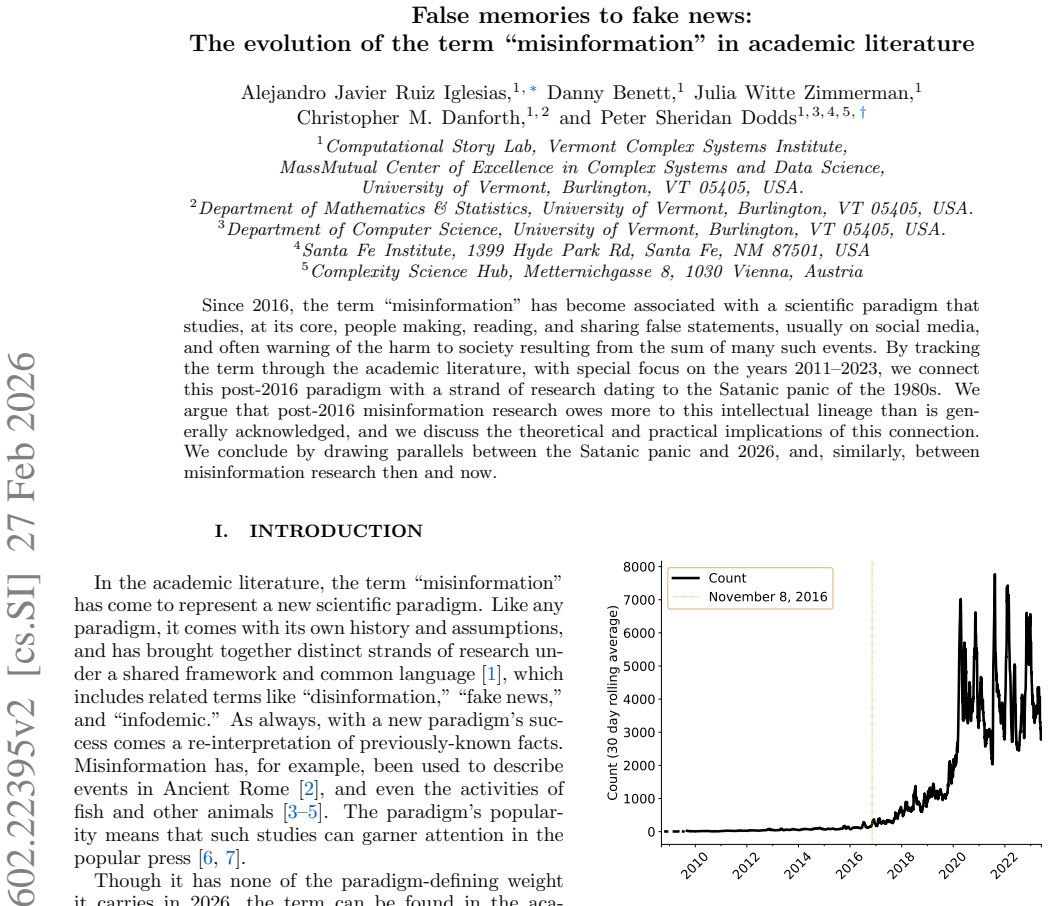
- [Figure 1] Clarify that the Twitter data come from Alshaabi et al. and are used only as an illustration, since the main analysis is restricted to Scopus.
Circularity Check
No circular derivation; the central lineage claim rests on external corpus and citation evidence, with only minor non-load-bearing self-citations.
full rationale
The paper's central claim—that post-2016 misinformation research owes more to the Loftus/misinformation-effect lineage than is usually acknowledged—is an empirical historical claim, not a fitted model output. The derivation chain runs from a Scopus corpus of papers with 'misinformation' in metadata, through author-sharing Louvain communities, TF-IDF terms, frequency shifts, and citation flows (e.g., Table II), to a narrative about intellectual lineage. None of these steps is forced by construction: the pre-2016 shift terms are computed over the whole corpus, and the paper attempts to connect them to community #1432 through illustrative abstracts and citation evidence rather than through an equation that makes the conclusion tautological. The single-keyword design and the possibility of unidentified pre-2016 strands are candidly acknowledged in Section D ('Our methodology also depends entirely on a single keyword... There may be other, important strands of pre-2016 research that we have not identified.'), which is a validity limitation rather than a circularity. The paper's self-citations—Storywrangler [8] for Twitter counts in Figure 1 and the doomscrolling reference [38]—are data/analogy and are not load-bearing for the main lineage claim. Overall, the central result is checked against an external corpus and independent scholarship, so there is no significant circularity; the score of 2 reflects only minor self-reference, not any reduction of the conclusion to its inputs.
Axiom & Free-Parameter Ledger
free parameters (5)
- Number of extreme term-frequency tokens =
9 (k=9)
- Bigram frequency threshold =
count > 100
- Split year / exclusion of 2016 =
2016 excluded
- Community selection size =
top 2 per year, top 10 in 2023
- Author-network edge weighting =
W = 1/(len(P1.authors) * len(P2.authors))
axioms (4)
- domain assumption The set of papers containing 'misinformation' in Scopus metadata is a valid proxy for the misinformation paradigm
- domain assumption Louvain communities of papers connected by shared authors represent distinct intellectual strands
- domain assumption Changes in word frequencies before vs. after 2016 trace the conceptual provenance of the post-2016 paradigm
- domain assumption The historical account of the Satanic panic and recovered-memory therapy is sufficiently reliable for the genealogy
Cite this review
Pith. "Pith review of False memories to fake news: The evolution of the term "misinformation" in academic literature." pith.science (2026). https://pith.science/paper/X6XCKZ3N
@misc{pith2026260222395,
  author       = {Pith},
  title        = {Pith review of: False memories to fake news: The evolution of the term "misinformation" in academic literature},
  year         = {2026},
  howpublished = {\url{https://pith.science/paper/X6XCKZ3N}},
  note         = {Machine review of arXiv:2602.22395}
}
read the original abstract
Since 2016, the term "misinformation" has become associated with a scientific paradigm that studies, at its core, people making, reading, and sharing false statements, usually on social media, and often warning of the harm to society resulting from the sum of many such events. By tracking the term through the academic literature, with special focus on the years 2011--2023, we connect the post-2016 paradigm with a strand of research dating to the Satanic panic of the 1980s. We argue that post-2016 misinformation research owes more to this intellectual lineage than is generally acknowledged, and we discuss the theoretical and practical implications of this connection. We conclude by drawing parallels between the Satanic panic and 2026, and, similarly, between misinformation research then and now.
Figures


Forward citations
Cited by 2 Pith papers
-
Stop using Media Bias/Fact Check in research
A single-person, methodologically untested media rating site (MBFC) is commonly mischaracterized as an independent fact-checking organization in ~3.5–7.4% of misinformation papers, and this audit argues it should not ...
-
Stop using Media Bias/Fact Check in research
Media Bias/Fact Check fails academic rigor standards and should not be used in research because it presents political outcomes as neutral facts about media quality.
Reference graph
Works this paper leans on
-
[1]
T. S. Kuhn,The Structure of Scientific Revolutions, 1st ed. (University of Chicago Press, Chicago, IL, 1962)
1962
-
[2]
Posetti and A
J. Posetti and A. Matthews, A Short Guide to the History of ‘Fake News’ and Disinformation (2018), published: PDF file, International Center for Journalists (ICFJ)
2018
-
[3]
A. K. Fahimipour, M. A. Gil, M. R. Celis, G. F. Hein, B. T. Martin, and A. M. Hein, Wild animals sup- press the spread of socially transmitted misinformation, Proceedings of the National Academy of Sciences120, e2215428120 (2023), publisher: Proceedings of the Na- tional Academy of Sciences
2023
-
[4]
L.-W. Kong, L. Gallart, A. G. Grassick, J. W. Love, A. Nayak, and A. M. Hein, A brief natural history of misinformation, Journal of The Royal Society Interface 22, 20250161 (2025)
2025
-
[5]
G. L. Norbury, C. J. Price, M. C. Latham, S. J. Brown, A. D. M. Latham, G. E. Brownstein, H. C. Ricardo, N. J. McArthur, and P. B. Banks, Misinformation tactics pro- tect rare birds from problem predators, Science Advances 7, eabe4164 (2021)
2021
-
[6]
Zimmer, For Real, a Natural History of Misinforma- tion, The New York Times (2025)
C. Zimmer, For Real, a Natural History of Misinforma- tion, The New York Times (2025)
2025
-
[7]
Arnold, Misinformation is an inevitable biological re- ality across nature, researchers argue (2025)
P. Arnold, Misinformation is an inevitable biological re- ality across nature, researchers argue (2025)
2025
-
[8]
Alshaabi, J
T. Alshaabi, J. L. Adams, M. V. Arnold, J. R. Minot, D. R. Dewhurst, A. J. Reagan, C. M. Danforth, and P. S. Dodds, Storywrangler: A massive exploratorium for so- ciolinguistic, cultural, socioeconomic, and political time- lines using twitter, Science Advances7, eabe6534 (2021)
2021
-
[9]
R. L. Huenemann, Combating food misinformation and quackery, Journal of the American Dietetic Association 32, 623 (1956)
1956
-
[10]
John, Information and misinformation gained from fasting blood sugar alone in diabetes therapy., Ohio medicine: Journal of the Ohio State Medical Association 53, 1284 (1957)
H. John, Information and misinformation gained from fasting blood sugar alone in diabetes therapy., Ohio medicine: Journal of the Ohio State Medical Association 53, 1284 (1957)
1957
-
[11]
Gindin, A model of the Soviet firm, Economics of Plan- ning10, 145 (1970)
S. Gindin, A model of the Soviet firm, Economics of Plan- ning10, 145 (1970)
1970
-
[12]
Michel, Categorical approach to distributed systems, expressibility and knowledge, inProc Annu ACM Symp Princ Distrib Comput(Publ by ACM, 1989) pp
R. Michel, Categorical approach to distributed systems, expressibility and knowledge, inProc Annu ACM Symp Princ Distrib Comput(Publ by ACM, 1989) pp. 129–143
1989
-
[13]
E. F. Loftus and J. Z. Klemfuss, Misinformation – past, present, and future, Psychology, Crime & Law30, 312 (2024)
2024
-
[14]
E. F. Loftus and J. C. Palmer, Reconstruction of automo- bile destruction: An example of the interaction between language and memory, Journal of Verbal Learning and Verbal Behavior13, 585 (1974)
1974
-
[15]
E. F. Loftus, Planting misinformation in the human mind: A 30-year investigation of the malleability of mem- ory, Learning & Memory (Cold Spring Harbor, N.Y.)12, 361 (2005)
2005
-
[16]
Eysenbach, Infodemiology: The epidemiology of (mis)information, The American Journal of Medicine 113, 763 (2002)
G. Eysenbach, Infodemiology: The epidemiology of (mis)information, The American Journal of Medicine 113, 763 (2002)
2002
-
[17]
Sutton, L
J. Sutton, L. Palen, and I. Shklovski, Backchannels on the Front Lines: Emergent Uses of Social Media in the 2007 Southern California Wildfires, Proceedings of ISCRAM 2008 - 5th International Conference on Information Sys- tems for Crisis Response and Management (2008). 13
2007
-
[18]
C. Chew and G. Eysenbach, Pandemics in the age of Twitter: Content analysis of tweets during the 2009 H1N1 outbreak, PLoS ONE5, 10.1371/jour- nal.pone.0014118 (2010)
doi:10.1371/jour- 2009
-
[19]
O. Oh, K. Kwon, and H. Rao, An exploration of social media in extreme events: Rumor theory and twitter dur- ing the haiti earthquake, ICIS 2010 Proceedings (2010)
2010
-
[20]
Broda and J
E. Broda and J. Str¨ omb¨ ack, Misinformation, Disinforma- tion, and Fake News: Lessons from an Interdisciplinary, Systematic Literature Review, Annals of the Interna- tional Communication Association48, 139 (2024)
2024
-
[21]
J. Donovan, EXPRESS: A Short History of Misinformation-at-scale and Efforts to Mitigate It, Journal of Public Policy and Marketing0, 10.1177/07439156251384249 (2025)
-
[22]
Mir´ o-Llinares and J
F. Mir´ o-Llinares and J. C. Aguerri, Misinformation about fake news: A systematic critical review of empirical stud- ies on the phenomenon and its status as a ‘threat’, Euro- pean Journal of Criminology20, 356 (2023), publisher: SAGE Publications
2023
-
[23]
Hearst, QAnon and the Rebirth of the Satanic Panic in the Digital Age (2022), publisher: Communication, Culture & Technology
M. Hearst, QAnon and the Rebirth of the Satanic Panic in the Digital Age (2022), publisher: Communication, Culture & Technology
2022
-
[24]
Elsevier B.V., Scopus,https://www.scopus.com(2025), bibliographic data retrieved January 8, 2026
2025
-
[25]
V. D. Blondel, J.-L. Guillaume, R. Lambiotte, and E. Lefebvre, Fast unfolding of communities in large net- works, Journal of Statistical Mechanics: Theory and Ex- periment2008, P10008 (2008)
2008
-
[26]
R. Kones, Is prevention a fantasy, or the future of medicine? A panoramic view of recent data, status, and direction in cardiovascular prevention, Therapeutic Ad- vances in Cardiovascular Disease5, 61 (2011), 21183531
2011
-
[27]
Otgaar, C
H. Otgaar, C. de Ruiter, N. Sumampouw, B. Erens, and P. Muris, Protecting Against Misinformation: Examining the Effect of Empirically Based Investigative Interview- ing on Misinformation Reporting, Journal of Police and Criminal Psychology36, 758 (2020)
2020
-
[28]
N. M. Brashier and D. L. Schacter, Aging in an Era of Fake News, Current directions in psychological science 29, 316 (2020)
2020
-
[29]
they must not directly challenge people’s worldview
to Lewandowskyet al.[30]. From the former: Based on combating misinformation, Lewandowsky et al. made narrow rec- ommendations for future cognitive research, including the generalization of inocula- tion techniques [...] Unfortunately, while Lewandowsky et al. acknowledged that world views matter, they argued against addressing worldviews. They stated tha...
2016
-
[30]
prebunk- ing
opens with a reference to misinformation effect re- search, in which ”changing a memory of a stop sign to a yield sign was a remarkable demonstration of the power of misinformation.” Despite some inevitable friction, the varying concep- tions of misinformation are, by and large, complimen- tary, allowing for bridging concepts. They are often, for example ...
2016
-
[31]
R. H. Grady, P. H. Ditto, and E. F. Loftus, Nevertheless, partisanship persisted: Fake news warnings help briefly, but bias returns with time, Cognitive Research: Princi- ples and Implications6, 52 (2021)
2021
-
[32]
Murphy, E
G. Murphy, E. F. Loftus, R. H. Grady, L. J. Levine, and C. M. Greene, False Memories for Fake News During Ire- land’s Abortion Referendum, Psychological Science30, 1449 (2019)
2019
-
[33]
source” paper to a “target
give us a typical example (reproduced with citations removed): Although misinformation (i.e., information that is erroneous or misleading) can circu- late exceedingly fast due to advances in social technologies and large-scale information cas- cades, the roots of fake news go back to the days before the Printing Revolution, when word-of-mouth was the prim...
2016
-
[34]
I. E. Hyman and M. C. Jalbert, Misinformation and worldviews in the post-truth information age: Commen- tary on Lewandowsky, Ecker, and Cook., Journal of Ap- plied Research in Memory and Cognition6, 377
-
[35]
post-truth
S. Lewandowsky, U. K. H. Ecker, and J. Cook, Be- yond misinformation: Understanding and coping with the “post-truth” era., Journal of Applied Research in Memory and Cognition6, 353
-
[36]
Chomsky and E
N. Chomsky and E. S. Herman,Manufacturing Consent: The Political Economy of the Mass Media(Pantheon Books, New York, 1988)
1988
-
[37]
sources” to inside the Loftus community “targets
took great pains to thoroughly describe and theo- rize the many design decisions that went into television, we have yet to read a comparable account to, for exam- ple, the Twitter user experience in misinformation liter- ature, though other researchers have brought this line of work to the study of social media [41]. When misinfor- mation researchers do t...
2016
-
[38]
Faedda, D
S. Faedda, D. Marengo, and M. Coscia, Fake memories: A meta-analysis on the effect of fake news on the cre- ation of false memories and false beliefs, Memory, Mind & Media3, e17 (2024)
2024
-
[39]
R. H. Grady, P. H. Ditto, E. F. Loftus, L. J. Levine, R. L. Greenspan, and D. P. Relihan, From Primary to Presidency: Fake News, False Memory, and Changing Attitudes in the 2016 Election, Journal of Social and Po- litical Psychology11, 6 (2023)
2016
-
[40]
P´ erez-Escolar, D
M. P´ erez-Escolar, D. Lilleker, and A. Tapia-Frade, A Sys- tematic Literature Review of the Phenomenon of Disin- formation and Misinformation, Media and Communica- tion11, 76 (2023)
2023
-
[41]
R. Scharlach and B. Hallinan, The value affordances of social media engagement features, AoIR Selected Papers of Internet Research 10.5210/spir.v2023i0.13491 (2023)
-
[42]
Williams,Television: Technology and Cultural Form, 3rd ed
R. Williams,Television: Technology and Cultural Form, 3rd ed. (Routledge)
-
[43]
Price, A
M. Price, A. C. Legrand, Z. M. F. Brier, K. van Stolk- Cooke, K. Peck, P. S. Dodds, C. M. Danforth, and Z. W. Adams, Doomscrolling during COVID-19: The negative association between daily social and traditional media consumption and mental health symptoms during the COVID-19 pandemic, Psychological Trauma: Theory, Research, Practice, and Policy14, 1338 (2022)
2022
-
[44]
Cinelli, W
M. Cinelli, W. Quattrociocchi, A. Galeazzi, C. M. Valen- sise, E. Brugnoli, A. L. Schmidt, P. Zola, F. Zollo, and A. Scala, The COVID-19 social media infodemic, Scien- tific Reports10, 16598 (2020), 33024152
2020
-
[45]
McLuhan,Understanding Media: The Extensions of Man(McGraw-Hill / New American Library, New York, 1964)
M. McLuhan,Understanding Media: The Extensions of Man(McGraw-Hill / New American Library, New York, 1964)
1964
-
[46]
A. M. Guess, B. Nyhan, and J. Reifler, Exposure to un- trustworthy websites in the 2016 US election, Nature Hu- man Behaviour4, 472 (2020)
2016
-
[47]
Eichhorn,Content, The MIT Press Essential Knowl- edge Series (MIT Press, 2022)
K. Eichhorn,Content, The MIT Press Essential Knowl- edge Series (MIT Press, 2022)
2022
-
[48]
Flamino, A
J. Flamino, A. Galeazzi, S. Feldman, M. W. Macy, B. Cross, Z. Zhou, M. Serafino, A. Bovet, H. A. Makse, and B. K. Szymanski, Political polarization of news me- dia and influencers on Twitter in the 2016 and 2020 US presidential elections, Nature Human Behaviour7, 904 (2023), 36914806
2016
-
[49]
Bovet and H
A. Bovet and H. A. Makse, Influence of fake news in Twitter during the 2016 US presidential election, Nature Communications10, 7 (2019)
2016
-
[50]
Y. Han, P. Turrini, M. Bazzi, G. Andrighetto, E. Polizzi, and M. D. Domenico, Measuring the co-evolution of on- line engagement with (mis)information and its visibility at scale (2025), 2506.06106
Pith/arXiv arXiv 2025
-
[51]
R. Emerson,Unmask Alice: LSD, Satanic Panic, and the Imposter Behind the World’s Most Notorious Diaries (BenBella Books, 2024) discussed in a 2025 Utah State University Honors Book Lab (Summer 2025) by Katie Luder
2024
-
[52]
Allen, B
J. Allen, B. Howland, M. Mobius, D. Rothschild, and D. J. Watts, Evaluating the fake news problem at the scale of the information ecosystem, Science Advances6, eaay3539 (2020)
2020
-
[53]
Tremblay-P´ epin,Intrigues: Petit manuel pour une critique des relations publiques, edited by L
S. Tremblay-P´ epin,Intrigues: Petit manuel pour une critique des relations publiques, edited by L. ´Editeur (Montr´ eal, Qu´ ebec, Canada, 2025) french
2025
-
[54]
Ellul,Propaganda: The Formation of Men ’s Attitudes (Vintage Books, New York, 1973)
J. Ellul,Propaganda: The Formation of Men ’s Attitudes (Vintage Books, New York, 1973)
1973
-
[55]
T. M. Porter, How Science Became Technical, Isis100, 292 (2009), publisher: University of Chicago Press
2009
-
[56]
Shaw, Where was skepticism in Media? : Pack jour- nalism and hysteria marked early coverage of the Mc- Martin case
D. Shaw, Where was skepticism in Media? : Pack jour- nalism and hysteria marked early coverage of the Mc- Martin case. Few journalists stopped to question the believability of the prosecution’s charges. - Los Angeles Times, The Los Angeles Times
-
[57]
Shewan, Conviction of Things Not Seen: The 14 Uniquely American Myth of Satanic Cults (2015)
D. Shewan, Conviction of Things Not Seen: The 14 Uniquely American Myth of Satanic Cults (2015)
2015
-
[58]
Reinhold, The longest trial — a post-mortem; collapse of child-abuse case: So much agony for so little, The New York Times Accessed via New York Times archive
R. Reinhold, The longest trial — a post-mortem; collapse of child-abuse case: So much agony for so little, The New York Times Accessed via New York Times archive
-
[59]
Linder, The McMartin Preschool Abuse Trial (2007), Social Science Research Network:1030559
D. Linder, The McMartin Preschool Abuse Trial (2007), Social Science Research Network:1030559
2007
-
[60]
Schreiber, L
N. Schreiber, L. D. Bellah, Y. Martinez, K. A. McLaurin, R. Strok, S. Garven, and J. M. Wood, Suggestive inter- viewing in the mcmartin preschool and kelly michaels daycare abuse cases: A case study, Social Influence1, 16 (2006)
2006
-
[61]
D. T. Nguyen, N. P. Nguyen, and M. T. Thai, Sources of misinformation in Online Social Networks: Who to suspect?, inMILCOM 2012 - 2012 IEEE Military Com- munications Conference(2012) pp. 1–6
2012
-
[62]
Dickey, The Suburban Uncanny, Los Angeles Review of Books (2019)
C. Dickey, The Suburban Uncanny, Los Angeles Review of Books (2019)
2019
-
[63]
Goffard, Wild claims of mass child molestation rocked an L.A
C. Goffard, Wild claims of mass child molestation rocked an L.A. beach town. Truth was the first ca- sualty, https://www.latimes.com/california/story/2024- 07-17/crimes-of-the-times-mcmartin-preschool (2024)
2024
-
[64]
Benton and D
B. Benton and D. Peterka-Benton, Everything Old is Q Again: An Analysis of the Resurgent #PIZZAGATE Myth in Social Media, Popular Culture Studies Journal (2025)
2025
-
[65]
E. F. Loftus, The reality of repressed memories, Amer- ican Psychologist48, 518 (1993), place: US Publisher: American Psychological Association
1993
-
[66]
V. ˇStˇ etka, F. Brandao, S. Mihelj, F. T´ oth, D. Hallin, D. Rothberg, P. Ferracioli, and B. Klimkiewicz, Have people ‘had enough of experts’ ? The impact of populism and pandemic misinformation on institutional trust in comparative perspective, Information, Communication & Society28, 1039 (2025), publisher: Routledge eprint: https://doi.org/10.1080/1369...
arXiv 2025
-
[67]
Feeld, QAnon Hasn’t Disappeared
J. Feeld, QAnon Hasn’t Disappeared. It’s in America’s Bloodstream., Jacobin (2025)
2025
-
[68]
L. T. Zagzebski, Introduction, inEpistemic Authority: A Theory of Trust, Authority, and Autonomy in Belief (Oxford University Press, Oxford, 2012) pp. 1–3
2012
-
[69]
T. F. Gieryn,Cultural Boundaries of Science: Credibility on the Line(University of Chicago Press, Chicago, IL, 1999)
1999
-
[70]
S. S. Aky¨ uz, The Impact of Misinformation and Prefer- ences of News Sources on Institutional Trust Perception in the COVID-19 Process, inImpact of Infodemic on Or- ganizational Performance(IGI Global Scientific Publish- ing, 2021) pp. 291–310
2021
-
[71]
Poudel, Curated Realities: The Intersection of Algo- rithmic Curation, Bias, and Framing in Digital Media (2025)
A. Poudel, Curated Realities: The Intersection of Algo- rithmic Curation, Bias, and Framing in Digital Media (2025)
2025
-
[72]
Harvey weinstein trial hears from expert on unreliable memories, The Guardian (2020)
2020
-
[73]
Marsh and G
A. Marsh and G. Lorge, How the Truth Gets Twisted, Stanford Magazine (2012)
2012
-
[74]
False memory
B. B. C. News, ‘Ghislaine Maxwell trial: “False memory” expert testifies for defence’, BBC News (2021)
2021
-
[75]
Otgaar, M
H. Otgaar, M. L. Howe, L. Patihis, H. Merckelbach, S. J. Lynn, S. O. Lilienfeld, and E. F. Loftus, The Return of the Repressed: The Persistent and Problematic Claims of Long-Forgotten Trauma, Perspectives on Psychological Science14, 1072 (2019)
2019
-
[2016]
misinformation
These communities ultimately converge on recog- nizable misinformation research, though each brings their own concepts and framings. In #4645, we can see re- search that began with an interest in cognition in its most general terms, then in the impact of branding on phar- maceuticals. From there, it moves into how social media users talk about autism, unt...
2016
This paper was first reviewed by deepseek-v4-flash on August 2, 2026.
discussion (0)
Sign in with ORCID, Apple, or X to comment. Anyone can read and Pith papers without signing in.