REVIEW 3 major objections 5 minor 40 references
Standard spatial attention yields no consistent accuracy advantage over uniform full-range mixing in traffic forecasting, while costing O(N^2) instead of O(N).
Reviewed by Pith at T0; open to challenge. T0 means a machine referee read the full paper against a public rubric. the ladder, T0–T4 →
T0 review · deepseek-v4-flash
2026-08-02 06:29 UTC pith:6P7BKESV
load-bearing objection Clean controlled ablation, but the conclusion overstates: under flow-only inputs, standard attention consistently wins, so the 'no consistent advantage' claim is scoped to the full representation only. the 3 major comments →
Do We Really Need Adaptive Global Spatial Attention for Traffic Forecasting?
The pith
A machine-rendered reading of the paper's core claim, the machinery that carries it, and where it could break.
Core claim
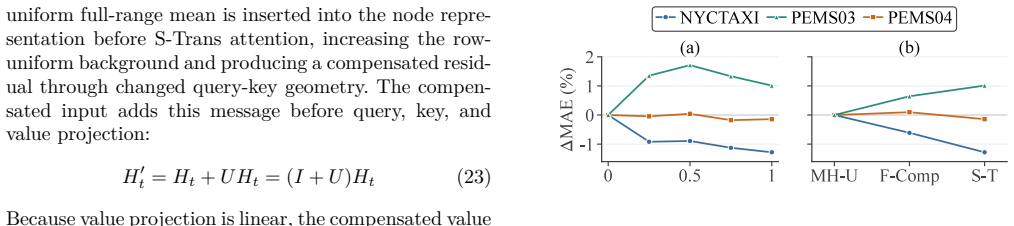
The central claim is that adaptive global spatial attention—softmax attention over all node pairs—does not consistently outperform a fixed row-uniform global mixer (each node receives the arithmetic mean of all node representations) for traffic forecasting. In a controlled framework where only the spatial mixing module changes, the learned attention variant yields relative MAE changes between -1.58% and +1.26% versus uniform mixing across four road-sensor and two grid-demand datasets; the sign flips, so there is no consistent advantage. The paper further decomposes spatial attention into a row-uniform global background plus a zero-row-sum non-uniform residual, and shows empirically that the
What carries the argument
The controlled ablation framework isolates the spatial mixing module while fixing input representation, temporal encoder, and output head. The decisive comparison is U-Trans, a row-uniform aggregation matrix with entries A_ij = 1/N implemented as an O(N) node-mean broadcast, against S-Trans, an input-dependent multi-head softmax attention matrix built from queries and keys over all N nodes. The decomposition A_t = U + Δ_t, where Δ_t has zero row sums, splits attention into a shared global background and a non-uniform residual; residual-strength interpolation (RI-Trans) and front global-mean injection then test the residual's predictive role and show that it is dataset-dependent.
Load-bearing premise
The conclusion rests on the assumption that the implemented standard spatial attention is a fair, sufficiently tuned representative of adaptive global attention under the fixed hyperparameter protocol; if that variant is under-tuned or if the fixed temporal encoder and rich input representation already capture global context, the absence of an advantage may not generalize to other attention designs.
What would settle it
Re-running the controlled comparison on a dataset with pronounced, spatially structured local propagation—or a synthetic network with long-range correlated shocks—where a properly tuned standard spatial attention beats uniform full-range mixing by more than 2% relative MAE with non-overlapping confidence intervals across at least three seeds would falsify the claim that the non-uniform residual is not consistently beneficial.
If this is right
- If uniform full-range mixing is a strong global spatial baseline, future traffic forecasting models can drop dense O(N^2) attention for global interaction without consistent forecast loss.
- The saved computation can be reallocated to input representation or temporal modeling, which the paper shows matters more than adaptive pairwise weighting.
- Dataset-dependent residual effects mean that attention is not harmful per se, but its value must be demonstrated per dataset rather than assumed.
- Because the attention residual operates on node-local fluctuations and cancels the shared global state, adding more global context through attention cannot improve the estimate of the common background.
- Public-baseline comparisons suggest a simple row-uniform mixer is competitive with graph-based and Transformer-based models, shifting the burden of proof to designs that add complex spatial modules.
Where Pith is reading between the lines
- The result likely extends beyond traffic: any forecasting task with shared network-level trends and many nodes may do as well with mean broadcasting as with learned pairwise attention; this could be tested on energy, crowd, or supply-chain networks.
- The decomposition suggests a testable hypothesis: if node-local fluctuations are approximately noise with no spatial structure, the attention residual has nothing useful to learn, so uniform mixing should win; if local structure is strong and informative, attention should win. A synthetic experiment with controlled spatial autocorrelation could confirm this mechanism.
- The inference-only interpolation shows that post-hoc reduction of attention strength degrades performance because the trained model has co-adapted to its attention weights; retrained uniform baselines remain competitive, so co-adaptation deserves attention when interpreting attention-removal studies.
- The O(N) versus O(N^2) gain is most valuable at very large sensor counts; the paper's largest dataset has 1024 nodes, so scaling to tens of thousands of nodes is the natural stress test for the efficiency claim.
Editorial analysis
A structured set of objections, weighed in public.
Referee Report
Summary. The paper asks whether global spatial information in traffic forecasting requires adaptive pairwise attention or can be captured by a simple uniform full-range aggregation operator. It builds a controlled framework that keeps input representation, temporal encoder, and output head fixed and varies only the spatial mixing module: No-SAB, I-Trans, UD-Trans, U-Trans, and S-Trans. Across six benchmarks (four PEMS sensor networks and two grid datasets), U-Trans matches or improves on S-Trans in most configurations; the reported relative MAE changes of S-Trans vs U-Trans are -1.58% to +1.26%, and U-Trans has O(N) node-scale spatial-mixing complexity versus O(N^2). The paper also proposes a decomposition of row-stochastic attention into a uniform background plus a zero-row-sum residual, with a hypothesized latent shared state, and uses interpolation/front mean-injection diagnostics to argue the residual has dataset-dependent effects.
Significance. If correct, this is a valuable negative result for traffic-forecasting architecture design: it suggests global context can often be supplied by a simple row-uniform mixer, and it provides a clean experimental template for isolating spatial-mixing choices. The controlled setup, five-seed reporting, released code, spatial-depth and embedding robustness checks, and the exact A = U + Delta identity are strengths. The main caveat is that the headline is currently stated more broadly than the evidence, especially in light of the flow-only ablation.
major comments (3)
- [Conclusion / Appendix C] Appendix C, Tables 7-12, show that in the flow-only setting S-Trans obtains lower MAE than U-Trans on all six datasets (e.g., PEMS03 16.7475 vs 16.8536; T-DRIVE 23.3364 vs 23.8803). The main text states 'S-Trans exhibits a consistent cross-dataset advantage only under the flow-only setting,' but the Conclusion asserts 'embedding ablations across all six benchmarks show the same cross-dataset pattern under the full and partially ablated configurations considered in this work.' If 'same cross-dataset pattern' means 'no consistent advantage,' the statement is contradicted by the flow-only tables; if it means something weaker, it needs to be restated. This is load-bearing because it delimits the central claim: under a representation the paper itself varies, adaptive attention is indeed consistently beneficial. Please revise the conclusion/abstract to scope the claim to the full (or all non-f
- [Table 2 / Experimental Settings] No significance tests are reported, and most mean differences in Table 2 are within one standard deviation (e.g., PEMS04: 18.12 +/- 0.02 vs 18.13 +/- 0.03; PEMS08: 13.33 +/- 0.06 vs 13.37 +/- 0.03). The claim 'no consistent advantage' is a negative/equivalence-type claim; mean directions alone are insufficient. If the five seeds are shared across models, report paired per-seed comparisons (e.g., paired t-test or Wilcoxon, or bootstrap CIs on per-dataset differences); if not, state that and use appropriate tests. Also quantify the flow-only 6/6 win direction (e.g., sign test p = 0.031), which would strengthen the paper's own finding. This is needed before the abstract's categorical statement can be accepted.
- [Implementation / External validity] The central comparison fixes hyperparameters to STAEformer's settings and uses a single S-Trans instantiation. This is methodologically clean for internal comparison, but the paper's title and abstract generalize to 'adaptive global spatial attention.' S-Trans is not tuned under the new framework, and no alternative spatial-attention design is tested; the absence of consistent advantage may reflect the chosen training protocol or one specific attention parameterization. Please either restrict the claims to 'the evaluated S-Trans implementation under STAEformer-style hyperparameters' throughout (including the abstract), or add a small sensitivity study (e.g., varying heads, dropout, learning rate, or comparing with a second standard attention variant) to support the broader wording.
minor comments (5)
- [Appendix C] The embedding ablation tables report only mean MAE/RMSE/MAPE without standard deviations or seed-level spread; adding them would help judge the reliability of the flow-only result and other comparisons.
- [Tables 4-5] The public-baseline comparison mixes numbers taken from published papers with the authors' own runs. Please state which settings are matched (e.g., data splits, evaluation horizons, normalization) and how protocol differences might affect the comparison; if the table is intended as indicative, say so.
- [Equation (14) / Section 4] The text says RI-Trans becomes MH-U-Trans when r=0, but earlier it is shown that MH-U-Trans is mathematically equivalent to U-Trans. For clarity, state that r=0 corresponds to the row-uniform U-Trans behavior.
- [Main Test / Table 2] The sentence 'Table 2 shows the same cross-dataset finding for RMSE and MAPE' is too strong; for example, PEMS04 RMSE moves slightly in the opposite direction to MAE (30.03 vs 30.01). Clarify that the pattern refers to the absence of a consistent directional advantage rather than identical signs on every metric.
- [Figure 3 / Appendix E] The interpolation and front-compensation plots report five-seed means; adding confidence intervals or seed-wise points would make the dataset-dependent pattern easier to assess.
Circularity Check
No significant circularity: the attention decomposition is a mathematical identity and the central claim rests on controlled ablations, not on fitted predictions or self-citation.
full rationale
This paper is a controlled empirical ablation study and does not exhibit circular reasoning at the level of its central claim. The attention decomposition A_t = U + Δ_t with Δ_t 1 = 0 (Eq. 18) is a mathematical identity for any row-stochastic attention matrix, not a fitted or predicted quantity; Eq. (20) merely exploits the zero row-sum property. The latent-state decomposition v_{j,t} = g_t + ε_{j,t} (Eq. 16) is explicitly labeled a hypothesis, and the main claim—S-Trans shows no consistent advantage over U-Trans—rests on direct endpoint comparisons (Table 2) and embedding ablations (Appendix C), not on that hypothesis. The RI-Trans interpolation and front-injection diagnostics are independently trained experiments, not constructions equivalent to their inputs. The O(N) versus O(N^2) complexity claim is an implementation property, not a fitted result. The STAEformer hyperparameter protocol is an external, non-self citation and does not smuggle in the conclusion. The paper does cite Shao et al. 2022a/b (overlapping author Zhao Zhang), but only as related-work context; these citations are not load-bearing. The internal tension between Appendix C (flow-only input shows a consistent S-Trans advantage) and the Conclusion's statement that 'embedding ablations across all six benchmarks show the same cross-dataset pattern' is a reporting/consistency concern that affects the strength of the generalization claim, not circularity in the derivation chain. No fitted parameter is renamed as a prediction, no uniqueness theorem is imported, and no ansatz is smuggled in via self-citation.
Axiom & Free-Parameter Ledger
free parameters (5)
- residual strength r =
0, 0.25, 0.5, 0.75, 1
- mask threshold for grid metrics =
10
- UD-Trans hop count k =
5
- free-flow speed quantile =
0.95
- spatial layer count Ls =
1 on PEMS03/04/08/NYCTAXI, 3 on PEMS07/T-DRIVE
axioms (5)
- standard math Any row-stochastic attention matrix decomposes as U + Delta with Delta*1 = 0.
- standard math Row-wise softmax is invariant to row-wise constant logit shifts.
- ad hoc to paper Value-projected node representations decompose into a latent shared global state plus node-local fluctuation.
- domain assumption The six datasets and the fixed STAEformer-derived protocol are representative enough to test adaptive attention fairly.
- domain assumption The fixed temporal encoder and input representation are strong enough that a benefit of adaptive spatial attention would be visible.
invented entities (1)
-
latent shared global state g_t
no independent evidence
read the original abstract
Existing traffic forecasting models commonly focus on extracting spatial dependencies, particularly global spatial information, which characterizes the representations obtained through interactions between each node and all nodes across the traffic network. However, the underlying mechanism by which global information is modeled and extracted remains insufficiently investigated. Whether global information must be extracted by high-degree-of-freedom adaptive attention or can be captured by a simple global aggregation operator remains unclear. For this purpose, we design a controlled ablation framework that replaces only the spatial mixing module to test attention-based global interaction. Across six traffic benchmarks, standard spatial attention yields relative MAE changes of $-1.58\%$ to $+1.26\%$ compared with uniform full-range mixing, and we observe no consistent advantage for standard spatial attention, while uniform full-range mixing reduces node-scale spatial-mixing complexity from $O(N^2)$ to $O(N)$. We further propose a hypothesized model that decomposes spatial attention into a row-uniform global background and a non-uniform residual. The residual shows dataset-dependent effects. Overall, uniform full-range mixing provides a strong global spatial baseline, while the non-uniform attention residual is not consistently beneficial across datasets.
Figures




Reference graph
Works this paper leans on
-
[1]
Adaptive Graph Convolutional Recurrent Network for Traffic Forecasting , url =
Bai, Lei and Yao, Lina and Li, Can and Wang, Xianzhi and Wang, Can , booktitle =. Adaptive Graph Convolutional Recurrent Network for Traffic Forecasting , url =
-
[2]
GCNet: Non-Local Networks Meet Squeeze-Excitation Networks and Beyond , year=
Cao, Yue and Xu, Jiarui and Lin, Stephen and Wei, Fangyun and Hu, Han , booktitle=. GCNet: Non-Local Networks Meet Squeeze-Excitation Networks and Beyond , year=
-
[3]
SimpleTM: A Simple Baseline for Multivariate Time Series Forecasting , url =
Chen, Hui and Luong, Viet and Mukherjee, Lopamudra and Singh, Vikas , booktitle =. SimpleTM: A Simple Baseline for Multivariate Time Series Forecasting , url =
-
[4]
Proceedings of the AAAI Conference on Artificial Intelligence , author=
Designing Specialized Two-Dimensional Graph Spectral Filters for Spatial-Temporal Graph Modeling , volume=. Proceedings of the AAAI Conference on Artificial Intelligence , author=. 2025 , month=. doi:10.1609/aaai.v39i11.33251 , abstractNote=
-
[5]
Proceedings of the AAAI Conference on Artificial Intelligence , author=
Graph Neural Controlled Differential Equations for Traffic Forecasting , volume=. Proceedings of the AAAI Conference on Artificial Intelligence , author=. 2022 , month=. doi:10.1609/aaai.v36i6.20587 , abstractNote=
-
[6]
Proceedings of the Twenty-Eighth International Joint Conference on Artificial Intelligence,
GSTNet: Global Spatial-Temporal Network for Traffic Flow Prediction , author =. Proceedings of the Twenty-Eighth International Joint Conference on Artificial Intelligence,. 2019 , month =. doi:10.24963/ijcai.2019/317 , url =
-
[7]
Proceedings of the 31st ACM SIGKDD Conference on Knowledge Discovery and Data Mining V.1 , pages =
Fang, Yuchen and Liang, Yuxuan and Hui, Bo and Shao, Zezhi and Deng, Liwei and Liu, Xu and Jiang, Xinke and Zheng, Kai , title =. Proceedings of the 31st ACM SIGKDD Conference on Knowledge Discovery and Data Mining V.1 , pages =. 2025 , isbn =. doi:10.1145/3690624.3709177 , abstract =
arXiv 2025
-
[8]
Proceedings of the 27th ACM SIGKDD Conference on Knowledge Discovery & Data Mining , pages =
Fang, Zheng and Long, Qingqing and Song, Guojie and Xie, Kunqing , title =. Proceedings of the 27th ACM SIGKDD Conference on Knowledge Discovery & Data Mining , pages =. 2021 , isbn =. doi:10.1145/3447548.3467430 , abstract =
arXiv 2021
-
[9]
Proceedings of the AAAI Conference on Artificial Intelligence , author=
Attention Based Spatial-Temporal Graph Convolutional Networks for Traffic Flow Forecasting , volume=. Proceedings of the AAAI Conference on Artificial Intelligence , author=. 2019 , month=. doi:10.1609/aaai.v33i01.3301922 , abstractNote=
-
[10]
Learning Dynamics and Heterogeneity of Spatial-Temporal Graph Data for Traffic Forecasting , year=
Guo, Shengnan and Lin, Youfang and Wan, Huaiyu and Li, Xiucheng and Cong, Gao , journal=. Learning Dynamics and Heterogeneity of Spatial-Temporal Graph Data for Traffic Forecasting , year=
-
[11]
Jindong Han and Weijia Zhang and Hao Liu and Tao Tao and Naiqiang Tan and Hui Xiong , title =. Proc. 2024 , url =. doi:10.14778/3641204.3641217 , timestamp =
arXiv 2024
-
[12]
Proceedings of the AAAI Conference on Artificial Intelligence , author=
STD-PLM: Understanding Both Spatial and Temporal Properties of Spatial-Temporal Data with PLM , volume=. Proceedings of the AAAI Conference on Artificial Intelligence , author=. 2025 , month=. doi:10.1609/aaai.v39i11.33286 , abstractNote=
-
[13]
Proceedings of the IEEE/CVF International Conference on Computer Vision (ICCV) , month =
Nam, Hyeon-Woo and Kim, Yu-Ji and Heo, Byeongho and Han, Dongyoon and Oh, Seong Joon and Oh, Tae-Hyun , title =. Proceedings of the IEEE/CVF International Conference on Computer Vision (ICCV) , month =. 2023 , pages =
2023
-
[14]
Proceedings of the AAAI Conference on Artificial Intelligence , author=
PDFormer: Propagation Delay-Aware Dynamic Long-Range Transformer for Traffic Flow Prediction , volume=. Proceedings of the AAAI Conference on Artificial Intelligence , author=. 2023 , month=. doi:10.1609/aaai.v37i4.25556 , abstractNote=
-
[15]
Proceedings of the Third Learning on Graphs Conference , pages =
Enhancing Topological Dependencies in Spatio-Temporal Graphs With Cycle Message Passing Blocks , author =. Proceedings of the Third Learning on Graphs Conference , pages =. 2025 , editor =
2025
-
[16]
FN et: Mixing Tokens with F ourier Transforms
Lee-Thorp, James and Ainslie, Joshua and Eckstein, Ilya and Onta \ n \'o n, Santiago. FN et: Mixing Tokens with F ourier Transforms. Proceedings of the 2022 Conference of the North American Chapter of the Association for Computational Linguistics: Human Language Technologies. 2022. doi:10.18653/v1/2022.naacl-main.319
-
[17]
International Conference on Learning Representations , year =
Li, Yaguang and Yu, Rose and Shahabi, Cyrus and Liu, Yan , title =. International Conference on Learning Representations , year =
-
[18]
Information Fusion , volume =
Lin, Jiaqi and Ren, Qianqian and Lv, Xingfeng and Xu, Hui and Liu, Yong , title =. Information Fusion , volume =. 2025 , doi =
2025
-
[19]
Liu, Hangchen and Dong, Zheng and Jiang, Renhe and Deng, Jiewen and Deng, Jinliang and Chen, Quanjun and Song, Xuan , title =. Proceedings of the 32nd ACM International Conference on Information and Knowledge Management , pages =. 2023 , isbn =. doi:10.1145/3583780.3615160 , abstract =
arXiv 2023
-
[20]
2023 , eprint=
Do We Really Need Graph Neural Networks for Traffic Forecasting? , author=. 2023 , eprint=
2023
-
[21]
Less but More: Linear Adaptive Graph Learning Empowering Spatiotemporal Forecasting , url =
Ma, Jiaming and Wang, Binwu and Wang, Guanjun and Yang, Kuo and Zhou, Zhengyang and Wang, Pengkun and Wang, Xu and Wang, Yang , booktitle =. Less but More: Linear Adaptive Graph Learning Empowering Spatiotemporal Forecasting , url =
-
[22]
Proceedings of the AAAI Conference on Artificial Intelligence , author=
FC-GAGA: Fully Connected Gated Graph Architecture for Spatio-Temporal Traffic Forecasting , volume=. Proceedings of the AAAI Conference on Artificial Intelligence , author=. 2021 , month=. doi:10.1609/aaai.v35i10.17114 , abstractNote=
- [23]
-
[24]
Proceedings of the 31st ACM International Conference on Information & Knowledge Management , pages =
Shao, Zezhi and Zhang, Zhao and Wang, Fei and Wei, Wei and Xu, Yongjun , title =. Proceedings of the 31st ACM International Conference on Information & Knowledge Management , pages =. 2022 , isbn =. doi:10.1145/3511808.3557702 , abstract =
arXiv 2022
-
[25]
MLP-Mixer: An all-MLP Architecture for Vision , url =
Tolstikhin, Ilya O and Houlsby, Neil and Kolesnikov, Alexander and Beyer, Lucas and Zhai, Xiaohua and Unterthiner, Thomas and Yung, Jessica and Steiner, Andreas and Keysers, Daniel and Uszkoreit, Jakob and Lucic, Mario and Dosovitskiy, Alexey , booktitle =. MLP-Mixer: An all-MLP Architecture for Vision , url =
-
[26]
Proceedings of the Thirty-Third International Joint Conference on Artificial Intelligence,
Make Bricks with a Little Straw: Large-Scale Spatio-Temporal Graph Learning with Restricted GPU-Memory Capacity , author =. Proceedings of the Thirty-Third International Joint Conference on Artificial Intelligence,. 2024 , month =. doi:10.24963/ijcai.2024/264 , url =
-
[27]
Non-local Neural Networks , year=
Wang, Xiaolong and Girshick, Ross and Gupta, Abhinav and He, Kaiming , booktitle=. Non-local Neural Networks , year=
-
[28]
and Poor, H
Wang, Zepu and Nie, Yuqi and Liu, Yang and Mulvey, John M. and Poor, H. Vincent and Boukerche, Azzedine and Nguyen, Nam H. and Sun, Peng , title =. IEEE Transactions on Intelligent Transportation Systems , volume =. 2026 , doi =
2026
-
[29]
Proceedings of the 36th International Conference on Machine Learning , pages =
Simplifying Graph Convolutional Networks , author =. Proceedings of the 36th International Conference on Machine Learning , pages =. 2019 , editor =
2019
-
[30]
Proceedings of the Twenty-Eighth International Joint Conference on Artificial Intelligence,
Graph WaveNet for Deep Spatial-Temporal Graph Modeling , author =. Proceedings of the Twenty-Eighth International Joint Conference on Artificial Intelligence,. 2019 , month =. doi:10.24963/ijcai.2019/264 , url =
-
[31]
Wu, Zonghan and Pan, Shirui and Long, Guodong and Jiang, Jing and Chang, Xiaojun and Zhang, Chengqi , title =. Proceedings of the 26th ACM SIGKDD International Conference on Knowledge Discovery & Data Mining , pages =. 2020 , isbn =. doi:10.1145/3394486.3403118 , abstract =
arXiv 2020
-
[32]
2020 , eprint=
Spatial-Temporal Transformer Networks for Traffic Flow Forecasting , author=. 2020 , eprint=
2020
-
[33]
Proceedings of the Twenty-Seventh International Joint Conference on Artificial Intelligence,
Spatio-Temporal Graph Convolutional Networks: A Deep Learning Framework for Traffic Forecasting , author =. Proceedings of the Twenty-Seventh International Joint Conference on Artificial Intelligence,. 2018 , month =. doi:10.24963/ijcai.2018/505 , url =
-
[34]
Proceedings of the AAAI Conference on Artificial Intelligence , author=
Are Transformers Effective for Time Series Forecasting? , volume=. Proceedings of the AAAI Conference on Artificial Intelligence , author=. 2023 , month=. doi:10.1609/aaai.v37i9.26317 , abstractNote=
-
[35]
Joe and Zhao, Hongwei , title =
Zhang, Zijian and Huang, Ze and Hu, Zhiwei and Zhao, Xiangyu and Wang, Wanyu and Liu, Zitao and Zhang, Junbo and Qin, S. Joe and Zhao, Hongwei , title =. Proceedings of the 32nd ACM International Conference on Information and Knowledge Management , pages =. 2023 , isbn =. doi:10.1145/3583780.3614969 , abstract =
arXiv 2023
-
[36]
Proceedings of the AAAI Conference on Artificial Intelligence , author=
GMAN: A Graph Multi-Attention Network for Traffic Prediction , volume=. Proceedings of the AAAI Conference on Artificial Intelligence , author=. 2020 , month=. doi:10.1609/aaai.v34i01.5477 , abstractNote=
-
[37]
Proceedings of the AAAI Conference on Artificial Intelligence , author=
Spatial-Temporal Synchronous Graph Convolutional Networks: A New Framework for Spatial-Temporal Network Data Forecasting , volume=. Proceedings of the AAAI Conference on Artificial Intelligence , author=. 2020 , month=. doi:10.1609/aaai.v34i01.5438 , abstractNote=
-
[38]
Urban Traffic Prediction from Spatio-Temporal Data Using Deep Meta Learning , booktitle =
Zheyi Pan and Yuxuan Liang and Weifeng Wang and Yong Yu and Yu Zheng and Junbo Zhang , editor =. Urban Traffic Prediction from Spatio-Temporal Data Using Deep Meta Learning , booktitle =. 2019 , url =. doi:10.1145/3292500.3330884 , timestamp =
arXiv 2019
-
[39]
Dynamic Spatial-Temporal Representation Learning for Traffic Flow Prediction , year=
Liu, Lingbo and Zhen, Jiajie and Li, Guanbin and Zhan, Geng and He, Zhaocheng and Du, Bowen and Lin, Liang , journal=. Dynamic Spatial-Temporal Representation Learning for Traffic Flow Prediction , year=
-
[40]
Performance Measurement System (. n.d. , howpublished =
discussion (0)
Sign in with ORCID, Apple, or X to comment. Anyone can read and Pith papers without signing in.