REVIEW 6 minor 1 references
Ultrafast light can both map and nonthermally switch topological quantum states by coupling charge, spin, and lattice on femtosecond timescales.
Reviewed by Pith at T0; open to challenge. T0 means a machine referee read the full paper against a public rubric. the ladder, T0–T4 →
T0 review · grok-4.5
2026-07-15 05:18 UTC pith:PIFBY3CU
load-bearing objection Solid, well-scoped review of ultrafast topology work; useful reference, not a new result.
Research on topological materials using ultrafast spectroscopy
The pith
A machine-rendered reading of the paper's core claim, the machinery that carries it, and where it could break.
Core claim
Ultrafast pump-probe methods resolve the distinct relaxation pathways of photoexcited surface and bulk states and, under intense excitation, can drive reversible topological phase transitions through electronic, lattice, and magnetic-order mechanisms, thereby establishing nonthermal optical control of topological quantum states.
What carries the argument
Optical pump-probe spectroscopy (including magneto-optical Kerr effect and terahertz variants) that tracks transient reflectivity, spin polarization, coherent phonons, and magnons, thereby separating surface, bulk, and magnetic contributions on femtosecond-to-nanosecond timescales.
Load-bearing premise
That ordinary reflectivity and Kerr signals can be cleanly assigned to topological surface or Dirac/Weyl carriers rather than bulk and non-topological bands, even though the paper notes that bulk response often dominates without selective mid-infrared or terahertz excitation.
What would settle it
A controlled mid-infrared or terahertz pump-probe experiment that isolates a pure surface or Weyl-node response and fails to recover the claimed surface-bulk separation, long-lived population inversion, or light-driven topological switch reported for that material family.
Editorial analysis
A structured set of objections, weighed in public.
Referee Report
Summary. This is a review of ultrafast pump-probe spectroscopy applied to topological materials. It surveys nonmagnetic and magnetic topological insulators (Bi2Se3 family, MnBi2nTe3n+1, EuIn2As2), Dirac and Weyl semimetals (Cd3As2, TaAs, Co3Sn2S2 and related systems), and photoinduced topological phase transitions. The central claim is that femtosecond optical methods can resolve nonequilibrium charge, spin, and lattice dynamics of topological states and, under strong drive, control topology via three pathways—electronic (Floquet/shift-current), lattice (coherent phonons), and magnetic-order mechanisms—thereby offering nonthermal optical control of quantum phases. The manuscript is organized as techniques (§2), material classes (§3–§4), light-induced transitions (§5), and outlook (§6), with extensive citation of OPOP, MOKE, THz, and related experiments.
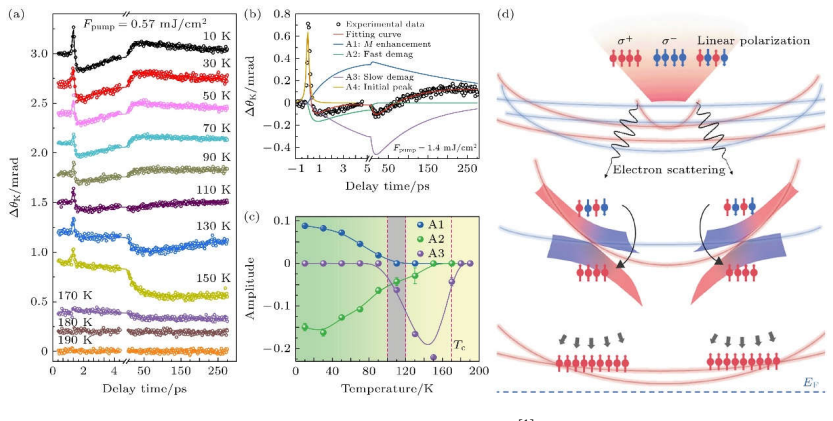
Significance. If the synthesis holds, the paper is a useful English-language reference that organizes a large and rapidly growing literature around a clear taxonomy of relaxation pathways and photoinduced topological control. Strengths include explicit experimental caveats (bulk vs surface dominance in conventional OPOP; need for mid-IR/THz selective excitation), concrete case studies tied to figures (Bi2Se3 THz conductivity, MnBi2Te4 phonon hardening near TN, TaAs wavelength-dependent lifetimes, Co3Sn2S2 magnetization enhancement), and a forward-looking agenda for multidimensional spectroscopy plus theory. As a translated Acta Phys. Sin. review, its value is primarily as a structured survey and entry point rather than as a source of new primary data or derivations.
minor comments (6)
- Throughout: residual translation artifacts and incomplete math rendering (e.g., “/R R Δ”, “1 1 g A”, “T N ~ 25 K”, broken subscripts in phonon labels and figure captions) should be cleaned for the English version so that mode labels and equations are unambiguous.
- §2, Eq. (1)–(2): the Kramers–Kronig / joint-density-of-states discussion is useful but dense; a short sentence stating when ΔR/R is dominated by bulk vs surface response would help non-specialists before the Bi2Se3 caveats in §3.1.
- §4.2: the sentence fragment “additional chirality degree of freedom associated with Weyl fermions…” appears to miss a leading word (“The”); fix for readability.
- §5.3 and Fig. 10: several magnetic-order-driven transitions (e.g., MnBi2Te4 AFM–FM via breathing mode, EuAgAs Dirac-to-Weyl) are still largely theoretical or fluence-dependent interpretations; a brief explicit “experiment vs theory” flag in the text would match the careful caveats used in §3.1.
- References: a few entries show duplicated author/title lines (e.g., Zhao J M 2011 Physics); normalize the bibliography for the English edition.
- Figures 2–10: ensure all panel labels and energy units (meV, eV, GHz) are fully legible in the translated layout; some captions still mix Chinese-style notation with English.
Circularity Check
No significant circularity: literature review synthesizing external and author experimental results without closed-loop derivations or fitted-as-prediction claims.
full rationale
This is an English-translated review (Acta Phys. Sin.) that organizes published ultrafast pump-probe, MOKE, THz, and related results on topological insulators, Dirac/Weyl semimetals, and magnetic topological materials, plus three classes of photoinduced topological transitions. There is no primary derivation chain, no fitted parameter re-labeled as a prediction, no uniqueness theorem imported from the authors to force a choice, and no ansatz smuggled in via self-citation. Equations in §2 (e.g., ΔR/R linked to Δε via Kramers–Kronig and joint density of states) are standard textbook relations, not self-referential. Author-group citations (e.g., Liu et al. on EuIn2As2 and EuAgAs ultrafast dynamics) appear as ordinary experimental inputs among a large external literature; they do not load-bear the organizational conclusions by construction. The paper’s own caveats (bulk often dominates OPOP signals; mid-IR/THz selective excitation needed) further show it does not redefine bulk-dominated data as pure topological predictions. Score 0 is therefore the correct, proportionate finding for a self-contained review of this type.
Axiom & Free-Parameter Ledger
axioms (4)
- domain assumption Symmetry-protected Dirac/Weyl/nodal-line band features dominate the distinctive ultrafast responses discussed.
- domain assumption Transient reflectivity/transmissivity and MOKE can be related to nonequilibrium electronic, lattice, and spin distributions via dielectric-function and multi-temperature models.
- ad hoc to paper Photoinduced topological transitions can be classified into electronic, lattice, and magnetic-order mechanisms.
- domain assumption Coherent phonon initial phase distinguishes ISRS (sine-like) from DECP (cosine-like) generation.
read the original abstract
Topological materials, characterized by symmetry-protected nontrivial band structures such as Dirac cones and Weyl nodes, host diverse quantum phenomena, with potential applications in quantum transport, spintronics, and nonlinear optics. Ultrafast pump-probe spectroscopy has emerged as a powerful tool for exploring nonequilibrium dynamics in these systems. Its femtosecond resolution allows charge, spin, orbital, and lattice interactions to be tracked on their intrinsic timescales, thereby revealing key coupling mechanisms in topological phases. This review summarizes progress in ultrafast spectroscopic studies of topological insulators, topological semimetals, and magnetic topological materials. We first discuss the relaxation pathways of photoexcited surface and bulk electronic states, emphasizing electron-phonon scattering, surface-bulk charge transfer, and ultrafast spin conversion. We then examine population inversion in Dirac and Weyl semimetals, spin-polarization dynamics associated with tilted Weyl bands, and the effects of magnetic order on topological states, including coherent phonon and magnon excitations, magnetically driven topological transitions, and terahertz emission. We further review photoinduced topological phase transitions driven by electronic correlations, lattice distortions, and magnetic order under intense optical excitation, highlighting routes toward nonthermal control of quantum phases. Finally, we outline future directions that combine multidimensional ultrafast spectroscopy with temporal, energy, momentum, and spin resolution and advanced theoretical modeling to establish a unified picture of nonequilibrium topological states. This review aims to provide a useful reference for ultrafast studies of topological quantum materials and to advance their applications in high-speed, low-power information processing, spintronics, and quantum technologies.
Figures


Reference graph
Works this paper leans on
-
[1]
Lu X, Lin Z, Pi H, Zhang T, Li G, Gong Y , Yan Y , Ruan X, Li Y , Zhang H, Li L, He L, Wu J, Zhang R, Weng H, Zeng C, Xu Y 2024 Nat
[1]. Lu X, Lin Z, Pi H, Zhang T, Li G, Gong Y , Yan Y , Ruan X, Li Y , Zhang H, Li L, He L, Wu J, Zhang R, Weng H, Zeng C, Xu Y 2024 Nat. Commun. 15 2410 [2]. Bartram F M, Li M, Liu L, Xu Z, Wang Y , Che M, Li H, Wu Y , Xu Y , Zhang J, Yang S, Yang L 2023 Sci. Bull. 68 2734 [3]. Ning H, Mehio O, Lian C, Li X, Zoghlin E, Zhou P, Cheng B, Wilson S D, Wong B...
2024
discussion (0)
Sign in with ORCID, Apple, or X to comment. Anyone can read and Pith papers without signing in.