REVIEW 4 major objections 6 minor 28 references
DeepCormack: Fermi surface tomography using model-based data-driven algorithms
T0 review · 4 major / 6 minor · reviewed 2026-08-02 · deepseek-v4-flash
Pith's one-line read Augmenting the modified Cormack method with neural networks at three stages recovers Fermi-surface momentum densities from twenty times fewer annihilation counts, with an SVD/DMD generator supplying training data from one DFT reference.
desk verdict A well-executed learned reconstruction for a niche but important materials characterization problem; the headline speed-up is real on synthetic data but remains conditional until tested on real ACAR experiments. read the letter →
The pith
A machine-rendered reading of the paper's core claim, the machinery that carries it, and where it could break.
The reading
What carries the argument
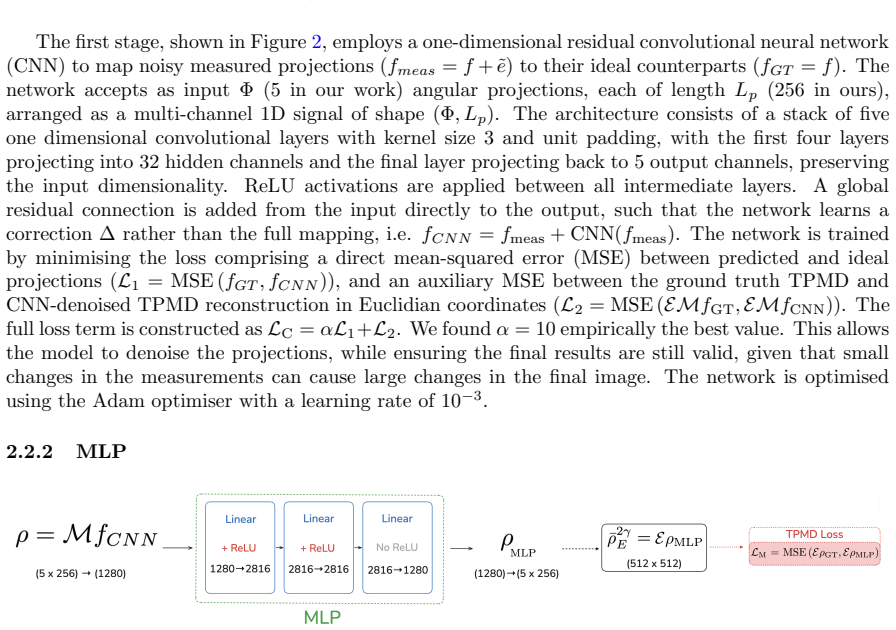
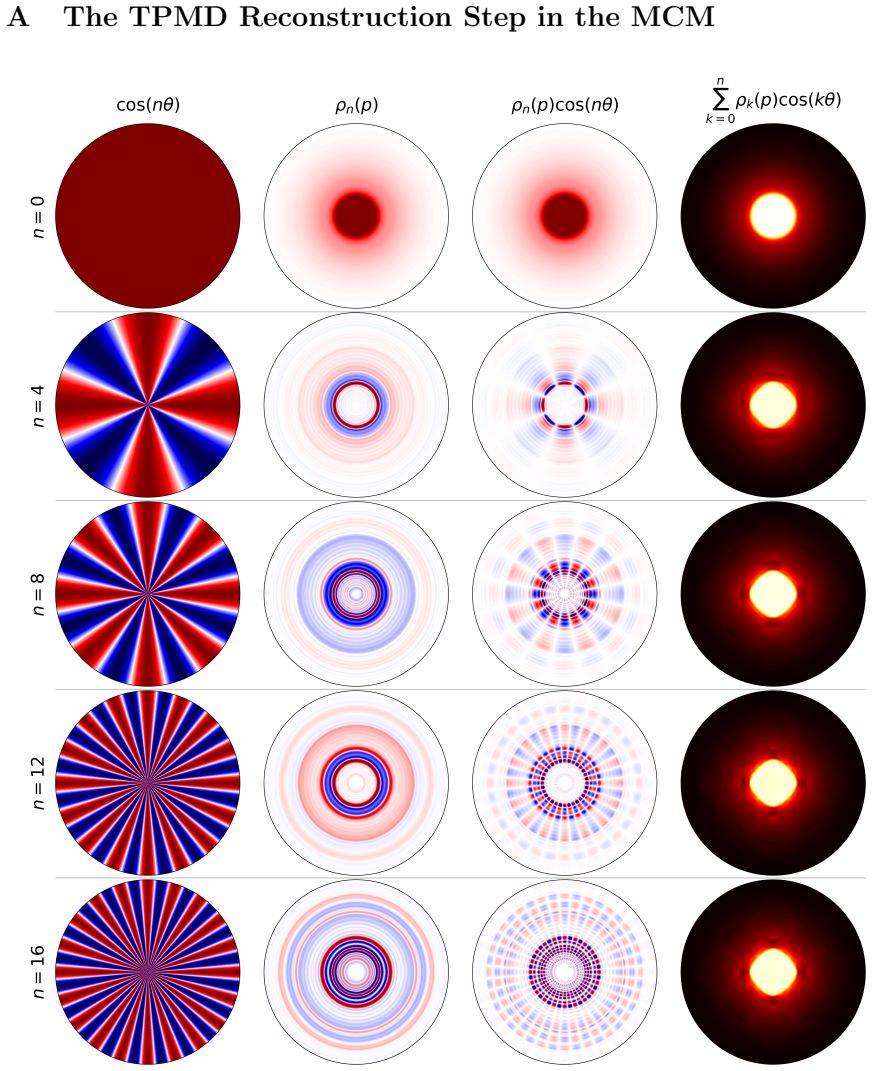
The engine is the modified Cormack method (MCM) itself, written as an operator chain O Z W S^-1 P^-1 C: C interpolates projections onto polar coordinates, P is a symmetry-truncated Fourier transform keeping only harmonics multiple of the crystal's rotational order (4 for FCC), S expands into Chebyshev sine series, W weights the coefficients, Z builds Zernike polynomials, and O recombines radial density functions into the two-photon momentum density. DeepCormack inserts learned components around this operator—a 1D CNN before the MCM, an MLP after the radial-density step, and a UNet on the final Euclidean image, optionally conditioned on the log count level to signal noise. The other load-bear
What would settle it
Run DeepCormack, trained on a copper-derived DMD dataset, on real 10M-count 2D-ACAR projections of a material whose Fermi surface is known from other methods and whose DFT reference was not used in training; if the reconstruction does not match or beat MCM on 200M-count data at the level claimed here, the method's practical value fails. A cheaper falsification: expand the paper's own out-of-distribution test to several materials with multiple Fermi-surface sheets and check whether the degradation seen for ZrZn2 is systematic.
Extended reading notes
Core claim
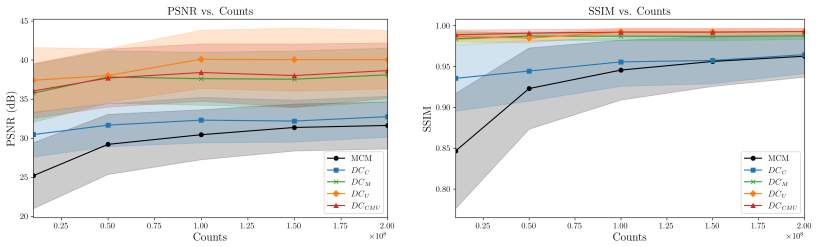
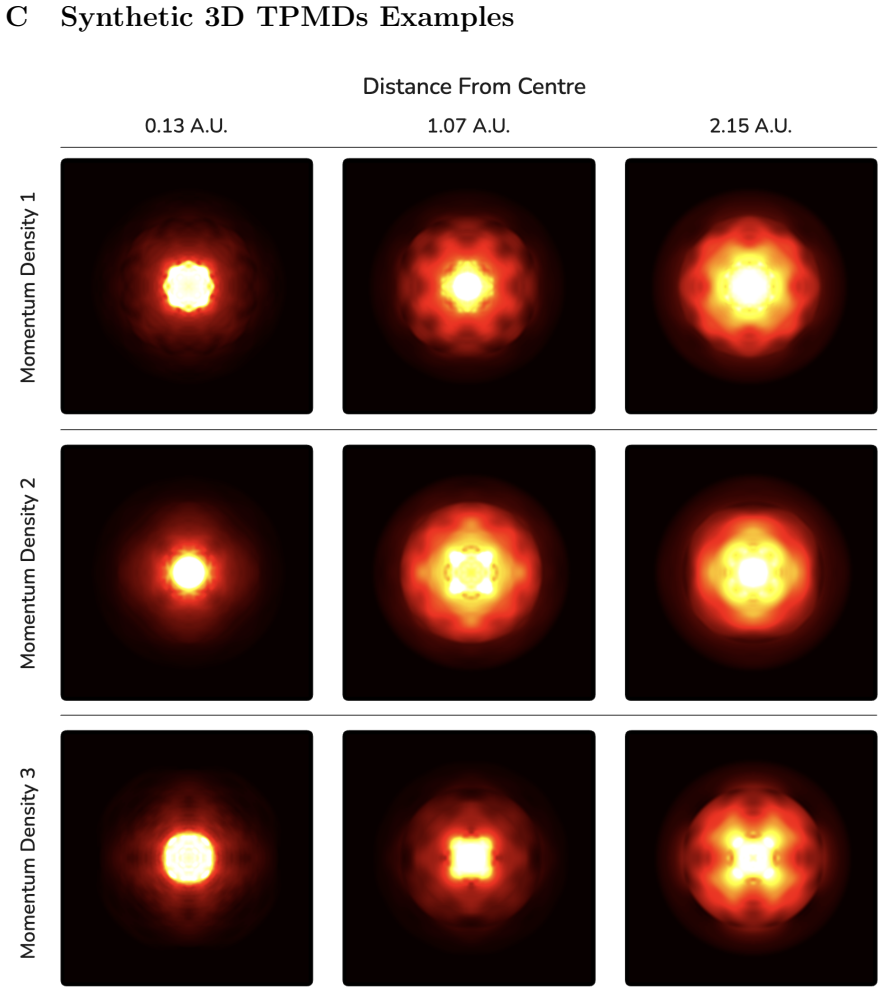
On its own terms, the paper establishes that the modified Cormack method can be wrapped in a supervised learning stack—a 1D CNN that denoises the measured projections, an MLP that refines the radial density functions, and a UNet that corrects the reconstructed TPMD image—and that the combined model remains accurate at count levels an order of magnitude below standard practice. The discovery that makes this trainable is the SVD/DMD synthetic-data generator: it turns one DFT-derived reference volume into arbitrarily many paired ground-truth / degraded-measurement training examples. The authors report 40.69 dB PSNR for the best configuration on synthetic test data at 200M counts versus 32.38 dB
Load-bearing premise
The headline gains rest on the assumption that the synthetic training distribution—built from one copper DFT reference plus a hand-calibrated noise model (+60% convolution width, 40% of true counts matched to one ZrZn2 experiment)—is representative enough of the target material's true momentum density and measurement noise that the learned reconstruction transfers to real data.
Editorial extensions
If this is right
- A 10M-count per projection ACAR scan is sufficient for DeepCormack to reconstruct a momentum density comparable to or better than MCM at 200M counts, so acquisition can be cut by roughly an order of magnitude while keeping or improving quality.
- Even at standard 200M counts, DeepCormack improves PSNR by about 8.5 dB on in-distribution synthetic data, so Fermi-surface features—especially at high momentum away from the slice centre—should be recovered more faithfully.
- Because the synthetic training data comes from a DFT reference, the practical workflow becomes: run a DFT calculation of the target material (about a day), generate training data, then collect a shorter experimental measurement; the paper recommends this sample-specific pairing rather than a generic pretrained model.
- With shorter scans, collecting more than 5 projections at proportionally lower counts becomes viable; the paper argues this richer angular sampling could further improve reconstruction quality, benefiting configurations that exploit multiple input channels.
- The operator formulation of MCM links ACAR tomography to the standard inverse-problems literature, so improvements from that community (e.g., learned regularisation, uncertainty quantification) can be applied directly to Fermi surface reconstruction.
Reading between the lines
- If the speed-up transfers to real samples, 2D-ACAR could shift from a months-long, one-material measurement to a screening tool for a series of alloys or dopings: the per-sample overhead is reduced to one DFT reference and a shorter scan.
- The SVD/DMD generator is a general recipe: any tomography problem with a known reference volume and a smooth slice-to-slice evolution could use the same two-step sampling-plus-evolution scheme to generate training data, not just Fermi surface reconstruction.
- A directly testable extension is to train on multiple DFT references simultaneously and measure out-of-distribution robustness; the paper's own OOD results imply generalization should improve with diversity, but they do not test it.
- The choice of PSNR/SSIM as evaluation metrics may understate or misstate the real goal (Fermi surface geometry); retraining or at least evaluation with a Fermi-surface-aware metric such as gradient of the LCW occupation could change the relative ranking of configurations.
Signed reviews
Editorial analysis
A structured set of objections, weighed in public.
Referee Report
Summary. The paper proposes DeepCormack, a family of learned reconstruction modules (1D CNN, MLP, 2D UNet, optionally FiLM-conditioned) inserted at different stages of the modified Cormack method (MCM) for 2D-ACAR Fermi surface tomography. To obtain training data without months of measurements, the authors generate synthetic 3D TPMD volumes from a single DFT copper reference: SVD sampling of Chebyshev coefficients produces central slices, and DMD/Koopman evolution produces slice-to-slice variation; measurement effects (detector blur, momentum sampling function, Poisson noise) are then simulated. The method is evaluated on synthetic DMD test data, on the copper reference, and on out-of-distribution ZrZn2 data, at count levels from 10M to 200M, using PSNR/SSIM and qualitative Fermi-surface images. The headline result is that the best combined model DCCMU reaches 38.22 dB PSNR at 10M counts on the DMD test set, exceeding MCM at 200M (32.38 dB), a gain of about 8.5 dB at 200M. However, on ZrZn2 the same configuration falls below MCM (32.51–32.82 dB vs. 33.96 dB at 200M), and the paper recommends per-sample DFT training rather than demonstrating transfer to experimental data.
Significance. If the reported gains transferred to real ACAR measurements, DeepCormack could substantially reduce acquisition times (weeks to months) or improve reconstruction quality for Fermi-surface studies. The operator-based reformulation of MCM and the SVD/DMD data-generation pipeline from a single DFT reference are useful and potentially transferable contributions. The paper is also commendably honest: it reports all configurations, including failures on out-of-distribution ZrZn2, and explicitly discusses the distribution-matching limitation. That said, the central practical claim is currently supported only by in-distribution synthetic experiments with a hand-calibrated noise model; the generalization evidence is negative for the flagship configuration on the only truly OOD sample.
major comments (4)
- [§3.3.3, Tables 1 and 4] The central speed-up claim is contradicted by the paper's own OOD experiment. In Table 4 (ZrZn2), DCCMU at 10M gives 32.32 dB PSNR, below MCM at 200M (33.96 dB), and at 200M DCCMU gives 32.82 dB vs. 33.96 dB for MCM. The abstract's statements that DeepCormack 'remains stable at reduced counts' and 'enables significantly faster acquisition times' hold for the in-distribution DMD set and for Cu, but not for a sample outside the training distribution. Since real ACAR materials are necessarily outside any training set unless a per-sample DFT is computed—a workflow recommended but not tested here—the practical claim needs to be rephrased as conditional and supported by real-data validation.
- [§3.1, noise simulator calibration] The noise simulator is calibrated by hand to a single ZrZn2 experiment using +60% convolution widths and 40% effective counts. No second experiment or independent material is used to check whether these parameters generalize; every training sample and every test measurement (DMD, Cu, ZrZn2) is passed through this same simulator. The learned models may therefore be fitting simulator-specific artifacts (e.g., the particular MSF, blur, and effective count rescaling) rather than the physics of ACAR. A real-data reconstruction, or at minimum a held-out experimental noise calibration, is needed before the reported dB gains can be translated into expected experimental performance.
- [§2.3 and §3.2] The training/test protocol makes the headline result in-distribution by construction. Section 2.3 generates all synthetic volumes by SVD/DMD from one DFT copper reference, and the DMD test set is drawn from the same generative pipeline. The copper test is the same reference density used to construct the SVD/DMD models. Hence the +8.5 dB PSNR gain over MCM at 200M (Table 2) demonstrates that the networks reproduce the generative model's manifold, not that they generalize to unseen physics. The ZrZn2 experiment is the only OOD test, and there the flagship DCCMU falls below MCM; this should be stated prominently in the abstract and conclusion.
- [§4, evaluation metrics] The quantitative evaluation is in p-space TPMD using PSNR/SSIM, not the downstream Fermi surface in k-space, as acknowledged in §4. Because the LCW step and gradient extraction are nonlinear, a 8.5 dB PSNR gain does not guarantee a proportionally improved Fermi surface. Qualitative Fermi-surface figures are shown, but no quantitative downstream metric is provided. Adding a metric defined on the recovered Fermi surface (e.g., error in high-symmetry plane contours or extracted Fermi-surface features) would materially strengthen the claim that DeepCormack improves Fermiology, not only image quality.
minor comments (6)
- [Tables 1 and 4] Tables 1 and 4 report different PSNR values for the same DCCMU/ZrZn2/200M condition (32.51 dB vs. 32.82 dB). Please clarify the evaluation protocol (e.g., slice range, test realization) or explain the discrepancy.
- [Figure captions and Discussion] Figure captions 2–4 contain 'Workflow of the The...' typos; the Discussion contains 'wile' (for 'while') and 'desiged' (for 'designed'). A copyedit pass is needed.
- [§2.3] The text says 20 ideal projections in [0°,45°] are used to approximate the ground truth copper density, while the experimental pipeline uses 5 projections. Clarify that the 20 projections are used only for SVD/DMD coefficient extraction and not for the learned reconstruction experiments.
- [§3.1 and Figure 6] Figure 6 uses 165M counts for the experimental comparison, while Tables 1–4 use 200M. State whether 165M is the experimental total and how the 40% effective-count factor is applied to the simulated data at each count level.
- [Tables 3 and 4 captions] The captions for Tables 3 and 4 both refer to 'Figure 9' for the PSNR/SSIM plots; the ZrZn2 results appear to be shown in Figure 11. Check all cross-references.
- [Notation, §3.2] The configuration names such as 'CNNPT + MLPPT → UNet' are difficult to parse. Define the arrow notation and the acronyms (e.g., 'PT' = pre-trained) once at first use, and consider a small table mapping configuration names to pipeline stages.
Circularity Check
No significant circularity: the reported gains are in-distribution synthetic evaluations, and the paper explicitly conditions real-data generalization on distribution match.
full rationale
The derivation chain is not circular. The MCM is written in operator notation, the DeepCormack components are trained on synthetic paired data generated by SVD/DMD from a copper DFT reference, and the test results are empirical comparisons under the same simulation pipeline. No equation defining the reconstruction is equivalent to the fitted network output by construction, and no fitted parameter is renamed as a prediction. The DMD test set being in the same distribution as the training data is a limitation of external validity, not circularity: the paper states this explicitly ('these results are obtained on synthetic DMD data drawn from the same distribution as the training data, which naturally favours all models evaluated here') and also states that real experimental data will differ and that generalization depends on the training distribution matching the sample. The noise-model calibration to one ZrZn2 experiment (+60% convolution, 40% counts) is a hand-adjusted simulation parameter, but it is used to generate synthetic measurements for comparison, not to claim an experimental prediction; the paper identifies the OOD performance drop of DCCMU, which further shows the evaluation is not forced. Self-citations such as the DFT reference [1] and the ZrZn2 experiment [24] supply reference data and context, but they are not invoked as a load-bearing uniqueness theorem or as evidence for the learned gain. The comparison against MCM under the same simulated conditions is a fair empirical benchmark, and the paper's main claims are appropriately scoped to synthetic test data with an explicit recommendation for sample-specific training. No circular step meeting the quoted-evidence threshold is present.
Assumptions & free parameters
free parameters (5)
- SVD truncation K for central slices =
K=15
- DMD truncation K =
K=24
- Noise simulator calibration =
+60% convolution widths, 40% of true counts
- CNN loss weighting alpha =
alpha=10
- SVD latent Gaussian parameters mu_k, Lambda_k =
fitted to copper slices
assumptions (6)
- domain assumption ACAR forward model is a Radon transform with additive noise and slice-by-slice independence
- domain assumption Crystal symmetry restricts Fourier expansion to harmonics n ≡ 0 mod |G|
- standard math Zernike/Chebyshev expansion truncated at finite order converges sufficiently for real TPMDs
- domain assumption DFT-calculated copper momentum density is a reliable reference ground truth for generating training data
- ad hoc to paper DMD/Koopman linear-evolution assumption captures slice-to-slice TPMD variation
- ad hoc to paper Calibrated noise model generalizes to future experiments
Cite this review
Pith. "Pith review of DeepCormack: Fermi surface tomography using model-based data-driven algorithms." pith.science (2026). https://pith.science/paper/SQC6RYRF
@misc{pith2026260713107,
  author       = {Pith},
  title        = {Pith review of: DeepCormack: Fermi surface tomography using model-based data-driven algorithms},
  year         = {2026},
  howpublished = {\url{https://pith.science/paper/SQC6RYRF}},
  note         = {Machine review of arXiv:2607.13107}
}
read the original abstract
The experimental reconstruction of the 3D two-photon momentum density (TPMD) via angular correlation of electron-positron annihilation radiation (ACAR) is a particularly useful method for studying material Fermi surfaces. It does not rely on low temperatures, UHV conditions, or strong magnetic fields, and enables the study of the spin-resolved electronic structure of materials. Yet, it remains a challenging inverse problem. Typically, 10^8 positron annihilation events are measured for 3--6 projections of the TPMD at different angles. The standard reconstruction approach is an ACAR adaptation of Cormack's method (the MCM) that leverages the inherent symmetry in the crystal's structure. However, the poor signal-to-noise ratio means collecting data of sufficient quality for Fermi surface studies can take months per sample. We present DeepCormack, a family of data-driven model-based reconstruction algorithms that augments the MCM by integrating supervised deep-learning models (CNN, MLP, and UNet) at various stages. To overcome the lack of large experimental training sets, we propose a method which leverages singular value decomposition with dynamic mode decomposition to generate realistic synthetic TPMD volumes, requiring only a single reference momentum density computed via density functional theory. On test data, DeepCormack improves reconstruction quality over MCM by about 8.5 dB PSNR at 200M counts and remains stable at reduced counts, enabling significantly faster acquisition times. Generalisation to experimental data depends strongly on how well the training distribution from the reference momentum density matches the sample. We therefore recommend pairing DeepCormack with a DFT calculation of the target material to create sample-specific training data. Our proposed method offers either much higher quality reconstructions, or enables significantly faster ones, on the order of weeks.
Figures


Figures from the paper (14 more)






Reference graph
Works this paper leans on
-
[1]
Calculating electron momentum densities and compton profiles using the linear tetrahedron method.Journal of Physics: Condensed Matter, 26(49):495501, nov 2014
D Ernsting, D Billington, T D Haynes, T E Millichamp, J W Taylor, J A Duffy, S R Giblin, J K Dewhurst, and S B Dugdale. Calculating electron momentum densities and compton profiles using the linear tetrahedron method.Journal of Physics: Condensed Matter, 26(49):495501, nov 2014
2014
-
[2]
John Wiley & Sons, Inc, 8th ed
Charles Kittel.Introduction to Solid State Physics. John Wiley & Sons, Inc, 8th ed. edition, 2005
2005
-
[3]
Life on the edge: a beginner’s guide to the Fermi surface.Physica Scripta, 91(5):053009, apr 2016
S B Dugdale. Life on the edge: a beginner’s guide to the Fermi surface.Physica Scripta, 91(5):053009, apr 2016
2016
-
[4]
S. B. Dugdale. Probing the Fermi surface by positron annihilation and Compton scattering.Low Temperature Physics, 40(4):328–338, April 2014
2014
-
[5]
Kontrym-Sznajd
G. Kontrym-Sznajd. Fermiology via the electron momentum distribution (review article).Low Temperature Physics, 35(8):599–609, aug 2009
2009
-
[6]
S.B. Dugdale. Fermi surface measurements. In Tapash Chakraborty, editor,Encyclopedia of Condensed Matter Physics (Second Edition), pages 815–832. Academic Press, Oxford, second edition edition, 2024
2024
-
[7]
R. J. Hughes, S. B. Dugdale, Zs. Major, M. A. Alam, T. Jarlborg, E. Bruno, and B. Ginatempo. Evolution of the fermi surface and the oscillatory exchange coupling across cr and cr-based alloys. Phys. Rev. B, 69:174406, May 2004
2004
-
[8]
Positron annihilation and Fermi surface studies: a new approach.Journal of Physics F: Metal Physics, 3(3):561–570, March 1973
D G Lock, V H C Crisp, and R N West. Positron annihilation and Fermi surface studies: a new approach.Journal of Physics F: Metal Physics, 3(3):561–570, March 1973
1973
Show all 28 references
-
[9]
PhD thesis, Technische Universit¨ at M¨ unchen, 2023
Josef Helmut Ketels.2D-ACAR and Compton Scattering: Investigation of the Electronic Structure of Pd and LaB6. PhD thesis, Technische Universit¨ at M¨ unchen, 2023
2023
-
[10]
The bristol HIDAC 2D-ACAR spectrometer.Journal of Physics: Conference Series, 443:012083, June 2013
S B Dugdale, J Laverock, C Utfeld, M A Alam, T D Haynes, D Billington, and D Ernsting. The bristol HIDAC 2D-ACAR spectrometer.Journal of Physics: Conference Series, 443:012083, June 2013
2013
-
[11]
Reconstruction techniques in angular correlation of positron annihilation experi- ments.Journal of Physics: Condensed Matter, 1(SA):SA1–SA16, july 1989
L M Pecora. Reconstruction techniques in angular correlation of positron annihilation experi- ments.Journal of Physics: Condensed Matter, 1(SA):SA1–SA16, july 1989
1989
-
[12]
Louis M. Pecora. 3d tomographic reconstruction from 2d data using spherical harmonics.IEEE Transactions on Nuclear Science, 34(2):642–650, 1987
1987
-
[13]
The effect of regularization on the reconstruction of ACAR data.Journal of Physics: Conference Series, 505:012047, April 2014
J A Weber, H Ceeh, C Hugenschmidt, M Leitner, and P B¨ oni. The effect of regularization on the reconstruction of ACAR data.Journal of Physics: Conference Series, 505:012047, April 2014
2014
-
[14]
Weber, Andreas Bauer, Peter B¨ oni, Hubert Ceeh, Stephen B
Josef A. Weber, Andreas Bauer, Peter B¨ oni, Hubert Ceeh, Stephen B. Dugdale, David Ernsting, Wolfgang Kreuzpaintner, Michael Leitner, Christian Pfleiderer, and Christoph Hugenschmidt. Spin-resolved fermi surface of the localized ferromagnetic Heusler compound cu 2MnAl measure...
2015
-
[15]
Fermi surface determination from momentum density projections.New Journal of Physics, 18(6):063033, 2016
Michael Leitner, Josef Andreas Weber, and Hubert Ceeh. Fermi surface determination from momentum density projections.New Journal of Physics, 18(6):063033, 2016
2016
-
[16]
A. M. Cormack. Representation of a function by its line integrals, with some radiological appli- cations.Journal of Applied Physics, 34(9):2722–2727, sept 1963
1963
-
[17]
A. M. Cormack. Representation of a function by its line integrals, with some radiological appli- cations. II.Journal of Applied Physics, 35(10):2908–2913, oct 1964
1964
-
[18]
Reconstruction of densities from their projections, with applications in radiological physics.Physics in Medicine &; Biology, 18(2):195–207, mar 1973
A M Cormack. Reconstruction of densities from their projections, with applications in radiological physics.Physics in Medicine &; Biology, 18(2):195–207, mar 1973
1973
-
[19]
Kontrym-Sznajd
G. Kontrym-Sznajd. Three-dimensional image reconstruction with application in positron anni- hilation.physica status solidi (a), 117(1):227–240, 1990. 23
1990
-
[20]
Deep filtered back projection for CT reconstruction.IEEE Access, 12:20962–20972, 2024
Xi Tan, Xuan Liu, Kai Xiang, Jing Wang, and Shan Tan. Deep filtered back projection for CT reconstruction.IEEE Access, 12:20962–20972, 2024
2024
-
[21]
Data- and physics-driven deep learning based reconstruction for fast MRI: Fundamentals and methodologies
Jiahao Huang, Yinzhe Wu, Fanwen Wang, Yingying Fang, Yang Nan, Cagan Alkan, Daniel Abra- ham, Congyu Liao, Lei Xu, Zhifan Gao, Weiwen Wu, Lei Zhu, Zhaolin Chen, Peter Lally, Neal Bangerter, Kawin Setsompop, Yike Guo, Daniel Rueckert, Ge Wang, and Guang Yang. Data- and physics-...
2025
-
[22]
Solving inverse prob- lems using data-driven models.Acta Numerica, 28:1–174, 2019
Simon Arridge, Peter Maass, Ozan ¨Oktem, and Carola-Bibiane Sch¨ onlieb. Solving inverse prob- lems using data-driven models.Acta Numerica, 28:1–174, 2019
2019
-
[23]
Kiss, Ander Biguri, Zakhar Shumaylov, Ferdia Sherry, K
Maximilian B. Kiss, Ander Biguri, Zakhar Shumaylov, Ferdia Sherry, K. Joost Batenburg, Carola- Bibiane Sch¨ onlieb, and Felix Lucka. Benchmarking learned algorithms for computed tomography image reconstruction tasks.Applied Mathematics for Modern Challenges, 3(0):1–43, 2025
2025
-
[24]
Major, S
Zs. Major, S. B. Dugdale, R. J. Watts, G. Santi, M. A. Alam, S. M. Hayden, J. A. Duffy, J. W. Taylor, T. Jarlborg, E. Bruno, D. Benea, and H. Ebert. Direct observation of the multisheet fermi surface in the strongly correlated transition metal compound zrzn 2.Phys. Rev. Lett.,...
2004
-
[25]
McCann, Emmanuel Froustey, and Michael Unser
Kyong Hwan Jin, Michael T. McCann, Emmanuel Froustey, and Michael Unser. Deep convolu- tional neural network for inverse problems in imaging.IEEE Transactions on Image Processing, 26(9):4509–4522, 2017
2017
-
[26]
Courville
Ethan Perez, Florian Strub, Harm de Vries, Vincent Dumoulin, and Aaron C. Courville. FiLM: Visual reasoning with a general conditioning layer.CoRR, abs/1709.07871, 2017
2017 arXiv
-
[27]
FiLM-ensemble: Probabilistic deep learning via feature-wise linear modulation, 2022
Mehmet Ozgur Turkoglu, Alexander Becker, H¨ useyin Anil G¨ und¨ uz, Mina Rezaei, Bernd Bischl, Rodrigo Caye Daudt, Stefano D’Aronco, Jan Dirk Wegner, and Konrad Schindler. FiLM-ensemble: Probabilistic deep learning via feature-wise linear modulation, 2022
2022
-
[28]
Brunton, Marko Budiˇ si´ c, Eurika Kaiser, and J
Steven L. Brunton, Marko Budiˇ si´ c, Eurika Kaiser, and J. Nathan Kutz. Modern Koopman theory for dynamical systems, 2021. 24 A The TPMD Reconstruction Step in the MCM Figure 14:The final step of the MCM reconstruction process for copper, which has four-fold symmetry. The rad...
2021
Reviewed August 2, 2026 · model on record in the stance chip above.
Discussion (0). Continue with ORCID to comment.