REVIEW 5 major objections 5 minor 77 references
Interacting viscous generalized QCD ghost dark energy with a hybrid expansion law reconstructs a late-time-accelerating f(G) gravity that is thermodynamically consistent and compatible with cosmic-chronometer data.
Reviewed by Pith at T0; open to challenge. T0 means a machine referee read the full paper against a public rubric. the ladder, T0–T4 →
T0 review · deepseek-v4-flash
2026-08-02 06:25 UTC pith:WB3ZQBPB
load-bearing objection The paper's central reconstruction equation has a sign error that forces ρ_eff = 0, so the main claim of a viable reconstructed f(G) framework collapses; the rest is a standard, well-referenced but modest model-building exercise. the 5 major comments →
Reconstruction of f(G) Gravity from an Interacting Viscous Generalized QCD Ghost Dark Energy Model: Cosmology and Thermodynamics: Cosmology and Thermodynamics
The pith
A machine-rendered reading of the paper's core claim, the machinery that carries it, and where it could break.
Core claim
The central claim is that the combined system—interacting viscous generalized ghost dark energy embedded in f(G) gravity—admits a smooth reconstruction of the Gauss–Bonnet correction f(G) under the hybrid expansion law, and that this reconstructed theory behaves as a viable dark-energy model: it produces a late-time de Sitter attractor, is classically stable for suitable parameters, satisfies the generalized second law of thermodynamics (with both Bekenstein–Hawking and Barrow entropy), and is consistent with cosmic-chronometer Hubble data. The calculation equates the geometric f(G) terms in the modified Friedmann equations to the ghost dark-energy density, yielding a second-order differenti
What carries the argument
The load-bearing elements are (1) the hybrid expansion law a(t)=a0 t^m e^{λt}, which fixes H(t)=m/t+λ and smoothly joins the matter era (t^{2/3}) to the de Sitter era; (2) the master reconstruction equation f(G)−G f_G + 24 H^3 dot f_G = ρ_ghost = αH+βH^2, which converts the ghost dark-energy density into a second-order ODE for f(G); and (3) the power-law ansatz f(G)=μG^n, chosen to mimic the numerically reconstructed function and to make the effective fluid, sound speed, and entropy analytically tractable. Barrow entropy S_B ∝ (A/A0)^((1+Δ)/2) generalizes the horizon entropy and is used to check the generalized second law.
Load-bearing premise
The model's central assumption is that the scale factor is exactly a(t)=a0 t^m e^{λt}; this hybrid form is chosen because it reproduces the early matter-dominated and late de Sitter limits, but it is not derived from the interacting viscous dynamics, and all subsequent results—the reconstructed f(G), the effective equation of state, the entropy law, and the Hubble fit—inherit whatever error this assumption introduces.
What would settle it
Solve the coupled conservation equations for ρ_m and ρ_ghost numerically without imposing the hybrid expansion law and check whether the resulting H(t) has the form m/t+λ; alternatively, test the reconstructed H(z) against an independent dataset such as BAO. A significant deviation would falsify the model's reconstruction and its claimed consistency.
If this is right
- The reconstructed f(G) remains smooth and monotonic across both early- and late-time regimes, so a single Gauss–Bonnet modification can cover the full expansion history.
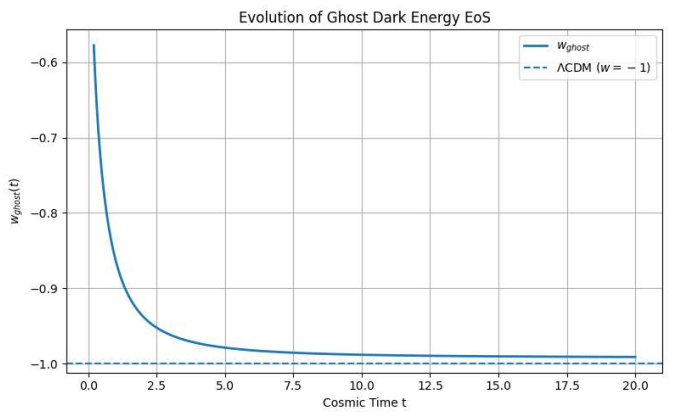
- The effective equation of state starts in the quintessence region and asymptotically settles at (or just below) −1, giving a stable late-time de Sitter-like attractor with a possible phantom crossing.
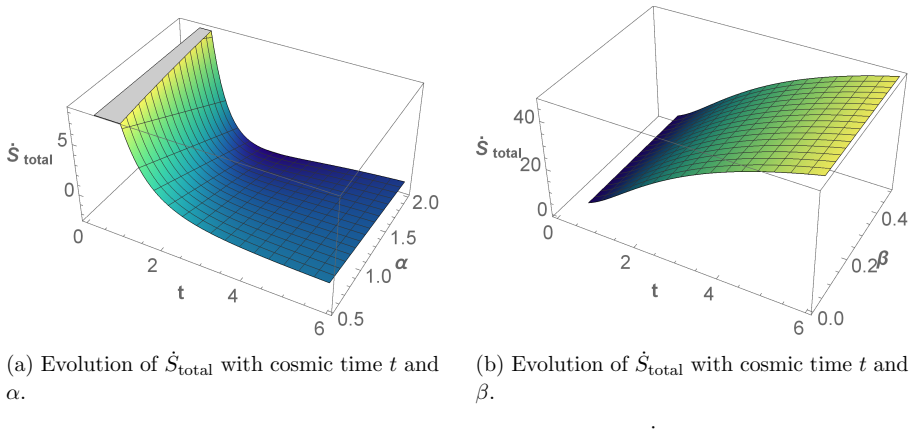
- Total entropy production is non-negative for the chosen parameters, so the generalized second law holds; the result persists when Bekenstein–Hawking entropy is replaced by Barrow entropy with Δ in [0,1].
- The model fits 31 cosmic-chronometer H(z) measurements with reduced chi-square 0.55, suggesting current observational compatibility.
- Interaction and viscosity shift the ghost equation of state away from the non-viscous result, so dissipative and dark-sector exchange effects leave observable signatures in the expansion history.
Where Pith is reading between the lines
- Because the hybrid expansion law is assumed rather than derived from the interaction and viscosity, the reconstruction is essentially a consistency test of that ansatz; a different interpolation between the matter era and de Sitter would generally yield a different f(G) and could change the stability and entropy conclusions.
- The power-law f(G)=μG^n is one of many possible fits to the numerically reconstructed curve; the specific predictions (such as the exact timing of the phantom crossing) are therefore not robust features of the underlying model.
- The observational case rests on a single dataset (31 cosmic chronometers); combining with BAO, supernova, or CMB distance data would test whether the same parameters remain viable and would sharpen the reduced chi-square claim.
- A direct check of the generalized second law over the full allowed parameter space (including extreme values of Δ, α, β, and the viscosity coefficients) would strengthen the thermodynamic conclusion beyond the plotted ranges.
Editorial analysis
A structured set of objections, weighed in public.
Referee Report
Summary. The manuscript claims to reconstruct f(G) gravity from an interacting viscous generalized QCD ghost dark energy model. The reconstruction uses a hybrid expansion a(t)=a0 t^m e^{λt} that interpolates between a matter-dominated power law and late-time de Sitter behavior. The f(G) function is first obtained numerically from a master reconstruction equation and then replaced by a power-law ansatz f(G)=μG^n. The authors study the effective equation of state, squared sound speed, thermodynamics with Bekenstein-Hawking and Barrow entropies, and compare H(z) with 31 cosmic chronometer measurements, concluding that the model is viable and thermodynamically consistent.
Significance. If correct, the paper would provide a fairly comprehensive phenomenological package: a concrete f(G) for a viscous interacting ghost dark energy model that is classically stable, satisfies the generalized second law of thermodynamics, and is consistent with cosmic chronometer data. The paper is explicit about the phenomenological status of the bulk viscosity and about the effective nature of the power-law parameters, which is good practice. However, the central reconstruction equation has a sign error that makes the effective energy density vanish identically, and independent algebra errors appear in the stability and thermodynamic sections. The H(z) agreement is a fit with many free parameters rather than a predictive test. In its present form the manuscript does not support the main conclusion.
major comments (5)
- [§6, Eq. (36) vs Eqs. (8)/(35)] The master reconstruction equation is inconsistent with the paper's own definition of ρ_eff. Eq. (8) defines ρ_eff = ρ_ghost + Gf_G − f(G) − 24H^3 ẏf_G. Eq. (36) states f(G)−Gf_G+24H^3 ẏf_G = ρ_ghost, which is equivalent to Gf_G−f(G)−24H^3 ẏf_G = −ρ_ghost. Substituting this into Eq. (8)/(35) gives ρ_eff = 0. Thus the geometric terms cancel the ghost dark energy instead of reproducing it. The correct equation that equates the geometric part to ρ_ghost is f(G)−Gf_G+24H^3 ẏf_G = −ρ_ghost. Eq. (45) inherits the same sign error. Consequently, the numerical reconstruction of §6 describes a model with no effective dark-energy fluid, and the subsequent use of ρ_eff in the equation of state, stability, and thermodynamics is invalidated.
- [§8.1, Eq. (56) and §10] The power-law f(G)=μG^n is introduced as 'reconstruction-inspired' and its parameters are described as 'effective fitting parameters' (§8.1). It is not derived from the reconstruction equation, and the numerical reconstruction it is supposed to mimic is based on the incorrect Eq. (36). The comparison with cosmic chronometer data in §10 uses this power-law together with the hybrid expansion to fit 31 data points. With ten free parameters in the model, the reported χ^2_ν = 0.55 is a measure of the quality of a fit, not an independent test of the reconstructed f(G). It therefore cannot offset the reconstruction error.
- [§8, Eqs. (53)–(55)] The time derivatives of ρ_eff and p_eff are algebraically wrong. The derivative of G f_G − f(G) is G ̈f_G (the ẏf_G terms cancel), but Eqs. (53) and (54) contain G ẏf_G instead. The error propagates into the squared sound speed Eq. (55), so the classical stability conclusion is not supported. The same kind of derivative mistake is likely to affect the numerical stability analysis if it is based on these formulae.
- [§9, Eq. (75)] The expression for ẏG has an extra 2H^3ẏH term. From G=24H^2(ẏH+H^2), the correct derivative is ẏG = 24[4H^3ẏH + 2HẏH^2 + H^2̈H]. Eq. (75) gives 24[4H^3ẏH + 2HẏH(H^2+ẏH) + H^2̈H] = 24[6H^3ẏH+2HẏH^2+H^2̈H]. This error enters ρ_eff and p_eff via Eqs. (70)–(71) and hence the fluid entropy rate (74); the positivity of ẏS_total shown in Figs. 6–7 and the GSLT conclusion are therefore not reliable.
- [§5, Eq. (27)] The claim that the hybrid expansion law is 'derived' from the model is overstated. The asymptotic analysis only gives a∝t^{2/3} for t→0 and a∝e^{λt} for t→∞; the product form a(t)=a0 t^m e^{λt} is then 'chosen for further analysis' (end of §5). This is a phenomenological ansatz with two free parameters (m,λ), and all subsequent results depend on it. The paper should explicitly acknowledge this as an assumption rather than a reconstruction from the interacting viscous dynamics.
minor comments (5)
- [Title/heading] The title repeats 'Cosmology and Thermodynamics: Cosmology and Thermodynamics'.
- [§9.1] Unresolved citation placeholders '[?,?,?]' appear in the Barrow entropy discussion.
- [General] Typos and spacing issues: 'amooth', 'consder', 'negarive', 'pictirially', 'hgher', 'dstage', and inconsistent 'FR W' vs. FLRW.
- [Eq. (9)] The pressure expression has '16H2 ẏf_G' instead of '16H^3 ẏf_G' as in Eq. (5); presumably a typesetting error.
- [Eq. (34)] Eq. (34) is very long and unwieldy; the accompanying text (and later approximations such as Eq. (78)) would benefit from a clear identification of the limiting regime in which the interaction term is neglected.
Circularity Check
The central viability claim rests on a self-chosen expansion law whose late-time limit is presented as a prediction, and on a Hubble-parameter 'agreement' that is an in-sample χ² fit of an ansatz; the sign error in the master reconstruction equation is a separate consistency problem.
specific steps
-
self definitional
[Section 5, Eq. (27); Section 7, Eq. (50)]
"In the opposite limit t → ∞ ... the effective equation of state goes to w_eff → −1 ... we can take Hdot→0 ... a(t)∝e^{λt}. Thus, combining the two regimes, the functional form that can reproduce both limits is a(t)=a0 t^m e^{λt}. ... the hybrid scale factor is chosen for further analysis. ... Equation (50) represents the asymptotic effective equation of state ... This behaviour indicates that the reconstructed modified Gauss–Bonnet gravity naturally admits a stable late-time cosmological attractor."
The late-time de Sitter behavior (w_eff→−1) was inserted through the assumed exponential factor in Eq. (27): with H→λ and Hdot→0, w_eff goes to −1 by definition. The same limit is then reported in Section 7 as an asymptotic prediction ('stable late-time cosmological attractor') of the reconstructed model. Since the hybrid law was chosen explicitly to satisfy w_eff≈0 early and w_eff→−1 late, recovering these limits later is a restatement of the ansatz, not a dynamical consequence of the reconstructed f(G).
-
fitted input called prediction
[Section 8.1, Eq. (56); Section 10, Eqs. (83)-(85), Fig. 8]
"the parameters μ and n may be considered as effective fitting parameters rather than fundamental parameters ... The model parameters are then constrained by minimizing the standard chi-square statistic, χ2 = Σ [H_rec(z_i)−H_obs(z_i)]²/σ_i² ... The parameter values corresponding to the minimum χ2 are adopted for the comparison with the observational Hubble data. ... The fitting yields χ2_min = 14.31 and a reduced chi-square of χ2_ν = 0.55. Hence, it is a satisfactory agreement between the reconstructed model and the observational Hubble data."
The §10 'agreement' is not an independent prediction: H_rec is built from the power-law f(G)=μG^n whose parameters are explicitly called effective fitting parameters, and they are optimized against the same 31 cosmic-chronometer points via Eq. (85). A small reduced χ² after minimizing on those very points measures in-sample fit quality; it does not test the model against independent data. The conclusion that the model is 'consistent with the observed cosmic expansion history' therefore reduces to restating that the fitted ansatz fits the data used for the fit.
full rationale
The main constructional circularities are (i) the hybrid expansion law Eq. (27) is chosen to force the early matter-dominated and late de Sitter limits, and those same limits are later exhibited as asymptotic predictions of the reconstructed f(G) model; and (ii) the cosmic-chronometer 'support' in §10 is a χ² fit of the reconstruction-inspired f(G)=μG^n to the same 31 data points, with μ,n explicitly labeled effective fitting parameters, so the reported agreement is statistically forced rather than predictive. The Barrow-entropy GSLT and stability plots are demonstrations for selected parameter values, not independent validations. I did not find a load-bearing self-citation chain: the cited [32] and [78] works are external and the Barrow-entropy framework is not used to justify the reconstruction. Note separately (a correctness issue, not counted as circularity) that Eq. (36) has the opposite sign from what Eq. (35) requires if geometric terms are to equal ρ_ghost; solving Eq. (36) as written would give ρ_eff=0, which is an internal-consistency failure rather than a circular reduction. Because the algebraic reconstruction and thermodynamic expressions have independent content but the central observational and asymptotic claims reduce by construction, the circularity score is 6.
Axiom & Free-Parameter Ledger
free parameters (10)
- α =
1.0 (representative); varied in CC fit (not reported)
- β =
0.10 (representative); 0.02–0.5 in Fig. 6
- b² =
0.03
- ξ0 =
0.01
- ξ1 =
0.005
- m =
2/3 (representative; varied 0.6–0.8)
- λ =
0.75 (representative; varied 0.6–0.9)
- C =
0.5
- μ =
0.1 (fitting parameter)
- n =
1.2 (fitting parameter; varied 0.6–1.2)
axioms (9)
- domain assumption FLRW flat metric with line element (1)
- domain assumption f(G) gravity action (2)
- domain assumption Ghost DE density ρ_ghost = αH + βH² (Eq. 10)
- domain assumption Bulk viscosity ξ = ξ0 + ξ1H (Eq. 12)
- domain assumption Interaction Q = 3b²H(ρm + ρghost) (Eq. 15)
- ad hoc to paper Hybrid expansion law a(t)=a0 t^m e^{λt} (Eq. 27)
- ad hoc to paper Power-law f(G)=μG^n (Eq. 56)
- domain assumption Barrow entropy form (Eq. 79)
- domain assumption Apparent horizon radius R_A=1/H, temperature T=H/(2π)
read the original abstract
In this work, we investigate an interacting viscous generalized QCD ghost dark energy model in the framework of reconstructed $f(G)$ gravity proposed in Phys.\ Lett.\ B 631, 1--6 (2005). The interaction between dark matter and dark energy together with bulk viscosity is incorporated to describe a more realistic cosmic evolution. A hybrid expansion law is adopted to reconstruct the modified Gauss-Bonnet function, which naturally connects the early matter-dominated epoch with the present accelerated expansion of the universe. Since an exact analytical reconstruction is difficult, the $f(G)$ function is obtained numerically in both the early- and late-time regimes. Motivated by the numerical reconstruction, a reconstruction-inspired power-law form of $f(G)$ is also considered to examine the cosmological implications of the model. The results show that the reconstructed $f(G)$ function evolves smoothly throughout the cosmic history, while the effective equation of state gradually approaches the de Sitter phase at late times. The thermodynamic behavior of the model is further examined using Barrow entropy following Eur.\ Phys.\ J.\ C 81, 644 (2021). The non-negative evolution of the total entropy shows the validity of the generalized second law of thermodynamics. The study finally concludes that the interacting viscous generalized QCD ghost dark energy model in reconstructed $f(G)$ gravity provides a viable and thermodynamically consistent framework for explaining the late-time accelerated expansion of the universe.
Figures




Reference graph
Works this paper leans on
-
[1]
Observational evidence from su- pernovae for an accelerating universe and a cosmological constant,
A. G. Riess, A. V. Filippenko, P. Challiset al., “Observational evidence from su- pernovae for an accelerating universe and a cosmological constant,” Astron. J.116, 1009–1038 (1998). https://doi.org/10.1086/300499
doi:10.1086/300499 1998
-
[2]
Measurements of Ω and Λ from 42 high-redshift supernovae,
S. Perlmutter, G. Aldering, G. Goldhaberet al., “Measurements of Ω and Λ from 42 high-redshift supernovae,” Astrophys. J.517, 565–586 (1999). https://doi.org/10.1086/307221
doi:10.1086/307221 1999
-
[3]
K. Bamba, S. Capozziello, S. Nojiri and S. D. Odintsov, “Dark energy cosmology: the equivalent description via different theoretical models and cosmography tests,” As- trophys. Space Sci.342, 155–228 (2012). https://doi.org/10.1007/s10509-012-1181-8
-
[4]
E. J. Copeland, M. Sami and S. Tsujikawa, “Dynamics of dark energy,” Int. J. Mod. Phys. D15, 1753–1936 (2006). https://doi.org/10.1142/S021827180600942X
-
[5]
Modified gravity and cosmol- ogy,
T. Clifton, P. G. Ferreira, A. Padilla and C. Skordis, “Modified gravity and cosmol- ogy,” Phys. Rep.513, 1–189 (2012). https://doi.org/10.1016/j.physrep.2012.01.001
-
[6]
E. Abdalla, G. F. Abell´ an, A. Aboubrahimet al., “Cosmology intertwined: A re- view of the particle physics, astrophysics, and cosmology associated with the cos- mological tensions and anomalies,” J. High Energy Astrophys.34, 49–211 (2022). https://doi.org/10.1016/j.jheap.2022.04.002
-
[7]
Is dark en- ergy an effective manifestation of non-equilibrium thermodynamics? – insights from DESI,
S. Bhattacharjee, S. Halder, J. de Haro, S. Pan and E. N. Saridakis, “Is dark en- ergy an effective manifestation of non-equilibrium thermodynamics? – insights from DESI,” Class. Quantum Grav.43, 115005 (2026). https://doi.org/10.1088/1361- 6382/ae6f65
doi:10.1088/1361- 2026
-
[8]
The quintom theory of dark energy after DESI DR2,
Y. Cai, X. Ren, T. Qiu, M. Li and X. Zhang, “The quintom theory of dark energy after DESI DR2,” Natl. Sci. Rev.13, nwag115 (2026). https://doi.org/10.1093/nsr/nwag115
-
[9]
Dynamical dark en- ergy models in light of the latest observations,
J. de Cruz P´ erez, A. G´ omez-Valent and J. Sol` a Peracaula, “Dynamical dark en- ergy models in light of the latest observations,” Phys. Rev. D113, 083521 (2026). https://doi.org/10.1103/xchk-xlk1 29
-
[10]
P. Sahoo, N. Roy and H. S. Mondal, “Quintessence scalar field and cosmological constant: dynamics of a multi-component dark energy model,” Gen. Relativ. Gravit. 57, 38 (2025). https://doi.org/10.1007/s10714-025-03372-7
-
[11]
S. Pradhan, G. N. Gadbail, S. Mandal, P. K. Sahoo and K. Bamba, “Dy- namics of interacting dark energy and dark matter model in a curved FLR W scalar field cosmology,” Mon. Not. R. Astron. Soc.543, 1273–1287 (2025). https://doi.org/10.1093/mnras/staf1556
-
[12]
Late-time acceleration and structure formation in interactingα-attractor dark energy models,
L. K. Duchaniya, B. Mishra, G. Otalora and M. Gonzalez-Espinoza, “Late-time acceleration and structure formation in interactingα-attractor dark energy models,” JCAP12, 010 (2025). https://doi.org/10.1088/1475-7516/2025/12/010
-
[13]
Bouncing Cosmology in Extended Gravity and Its Reconstruction as Dark Energy Model,
A. S. Agrawal, F. Tello-Ortiz, B. Mishra and S. K. Tripathy, “Bouncing Cosmology in Extended Gravity and Its Reconstruction as Dark Energy Model,” Fortschr. Phys. 70, 2100065 (2022). https://doi.org/10.1002/prop.202100065
-
[14]
Cosmology and astrophysical constraints of Gauss–Bonnet dark energy,
T. Koivisto and D. F. Mota, “Cosmology and astrophysical constraints of Gauss–Bonnet dark energy,” Phys. Lett. B644, 104–108 (2007). https://doi.org/10.1016/j.physletb.2006.11.048
-
[16]
Modified Gauss–Bonnet theory as grav- itational alternative for dark energy,
S. Nojiri and S. D. Odintsov, “Modified Gauss–Bonnet theory as grav- itational alternative for dark energy,” Phys. Lett. B631, 1–6 (2005). doi:10.1016/j.physletb.2005.10.010
-
[17]
Dark energy in modified Gauss–Bonnet gravity: Late-time acceleration and the hierarchy problem,
G. Cognola, E. Elizalde, S. Nojiri, S. D. Odintsov and S. Zerbini, “Dark energy in modified Gauss–Bonnet gravity: Late-time acceleration and the hierarchy problem,” Phys. Rev. D73, 084007 (2006). doi:10.1103/PhysRevD.73.084007
-
[18]
Modified Gravity Theories on a Nutshell: Inflation, Bounce and Late-time Evolution,
S. Nojiri, S. D. Odintsov and V. K. Oikonomou, “Modified Gravity Theories on a Nutshell: Inflation, Bounce and Late-time Evolution,” Phys. Rept.692, 1–104 (2017). doi:10.1016/j.physrep.2017.06.001
-
[19]
Barrow entropic dark energy: A member of generalized holographic dark energy family,
S. Nojiri, S. D. Odintsov and T. Paul, “Barrow entropic dark energy: A member of generalized holographic dark energy family,” Phys. Lett. B825, 136844 (2022). doi:10.1016/j.physletb.2021.136844
arXiv 2022
-
[20]
Early and late universe holographic cosmology from a new generalized entropy,
S. Nojiri, S. D. Odintsov and T. Paul, “Early and late universe holographic cosmology from a new generalized entropy,” Phys. Lett. B831, 137189 (2022). doi:10.1016/j.physletb.2022.137189
arXiv 2022
-
[21]
From nonextensive statistics and black hole entropy to the holographic dark universe,
S. Nojiri, S. D. Odintsov and V. Faraoni, “From nonextensive statistics and black hole entropy to the holographic dark universe,” Phys. Rev. D105, 044042 (2022). doi:10.1103/PhysRevD.105.044042
-
[22]
Gauss–Bonnet gravitational baryogenesis,
S. D. Odintsov and V. K. Oikonomou, “Gauss–Bonnet gravitational baryogenesis,” Phys. Lett. B760, 259–262 (2016). https://doi.org/10.1016/j.physletb.2016.06.074 30
-
[23]
Modified Gauss–Bonnet gravity with the Lagrange multiplier constraint as mimetic theory,
A. V. Astashenok, S. D. Odintsov and V. K. Oikonomou, “Modified Gauss–Bonnet gravity with the Lagrange multiplier constraint as mimetic theory,” Class. Quantum Grav.32, 185007 (2015). https://doi.org/10.1088/0264-9381/32/18/185007
-
[24]
Viable inflation in scalar–Gauss–Bonnet gravity and reconstruction from observational indices,
S. D. Odintsov and V. K. Oikonomou, “Viable inflation in scalar–Gauss–Bonnet gravity and reconstruction from observational indices,” Phys. Rev. D98, 044039 (2018). https://doi.org/10.1103/PhysRevD.98.044039
-
[25]
Ghost-free Gauss– Bonnet theories of gravity,
S. Nojiri, S. D. Odintsov and V. K. Oikonomou, “Ghost-free Gauss– Bonnet theories of gravity,” Phys. Rev. D99, 044050 (2019). https://doi.org/10.1103/PhysRevD.99.044050
-
[26]
S. D. Odintsov, V. K. Oikonomou and F. P. Fronimos, “Inflationary dynamics and swampland criteria for modified Gauss–Bonnet gravity compatible with GW170817,” Phys. Rev. D107, 084007 (2023). https://doi.org/10.1103/PhysRevD.107.084007
-
[27]
Cosmology of modified Gauss–Bonnet gravity,
B. Li, J. D. Barrow and D. F. Mota, “Cosmology of modified Gauss–Bonnet gravity,” Phys. Rev. D76, 044027 (2007). https://doi.org/10.1103/PhysRevD.76.044027
-
[28]
Construction of cosmologically viablef(G) gravity models,
A. De Felice and S. Tsujikawa, “Construction of cosmologically viablef(G) gravity models,” Phys. Lett. B675, 1–8 (2009). https://doi.org/10.1016/j.physletb.2009.03.060
-
[29]
Exploring cylindrical solutions in modifiedf(G) gravity,
M. J. S. Houndjo, M. E. Rodrigues, D. Momeni and R. Myrzakulov, “Exploring cylindrical solutions in modifiedf(G) gravity,” Can. J. Phys.92, 1528–1540 (2014). https://doi.org/10.1139/cjp-2014-0070
-
[30]
Sta- bility of anisotropy pressure in self-gravitational systems inf(G) gravity,
Z. Yousaf, M. Z. Bhatti, S. Khan, A. Malik, H. I. Alrebdi and M. Z. Ahmad, “Sta- bility of anisotropy pressure in self-gravitational systems inf(G) gravity,” Axioms 12, 740 (2023). https://doi.org/10.3390/axioms12030257
-
[31]
f(G) modified gravity and the energy conditions,
N. M. Garc ´ ıa, F. S. N. Lobo, J. P. Mimoso and T. Harko, “f(G) modified gravity and the energy conditions,” J. Phys. Conf. Ser.314, 012056 (2011). https://doi.org/10.1088/1742-6596/314/1/012056
-
[32]
Ghost dark energy model inf(G) gravity,
M. Sharif and S. Saba, “Ghost dark energy model inf(G) gravity,” Chin. J. Phys. 58, 202–211 (2019). https://doi.org/10.1016/j.cjph.2018.12.023
-
[33]
S. R. Green and R. M. Wald, How well is our universe described by an FLR W model?, Class. Quant. Grav.31, 234003 (2014)
2014
-
[34]
Holman, How problematic is the near-Euclidean spatial geometry of the large- scale universe?, Found
M. Holman, How problematic is the near-Euclidean spatial geometry of the large- scale universe?, Found. Phys.48, 1617–1647 (2018)
2018
-
[35]
Koussour, S
M. Koussour, S. H. Shekh, A. Hanin, Z. Sakhi, S. R. Bhoyer and M. Bennai, Flat FLR W universe in logarithmic symmetric teleparallel gravity with observational con- straints, Class. Quant. Grav.39, 195021 (2022)
2022
-
[36]
G. Calcagni, B. de Carlos and A. De Felice, Ghost conditions for Gauss–Bonnet cosmologies, Nucl. Phys. B752, 404–438 (2006). https://doi.org/10.1016/j.nuclphysb.2006.06.020 31
-
[37]
The 4D Einstein– Gauss–Bonnet theory of gravity: a review,
P. G. S. Fernandes, P. Carrilho, T. Clifton and D. J. Mulryne, “The 4D Einstein– Gauss–Bonnet theory of gravity: a review,” Class. Quantum Grav.39, 063001 (2022). https://doi.org/10.1088/1361-6382/ac500a
-
[38]
S. Mandal and S. Shankaranarayanan, Modified theories of gravity at different cur- vature scales, arXiv:2502.07437 (2025)
Pith/arXiv arXiv 2025
-
[40]
The cosmological constant from the QCD Veneziano ghost,
F. R. Urban and A. R. Zhitnitsky, “The cosmological constant from the QCD Veneziano ghost,” Phys. Lett. B688, 9–12 (2010). https://doi.org/10.1016/j.physletb.2010.03.080
-
[41]
R. G. Cai, Z. L. Tuo, Y. B. Wu and Y. Y. Zhao, More on QCD ghost dark energy, Phys. Rev. D86, 023511 (2012). doi:10.1103/PhysRevD.86.023511
-
[42]
M. Sharif and M. Ajmal, Cosmography of non-interacting ghost and generalized ghost dark energy models inf(Q) gravity, Commun. Theor. Phys.77, 045402 (2025). https://doi.org/10.1088/1572-9494/ad8db8 arXiv:2507.02280 [gr-qc]
Pith/arXiv arXiv 2025
-
[43]
M. Khurshudyan, A. Khurshudyan and R. Myrzakulov, Interacting varying ghost dark energy models in general relativity, Astrophys. Space Sci.357, 113 (2015). doi:10.1007/s10509-015-2341-4
-
[44]
S. Nojiri, S. D. Odintsov and M. Sasaki, “Gauss-Bonnet dark energy,” Phys. Rev. D 71, 123509 (2005). https://doi.org/10.1103/PhysRevD.71.123509
-
[45]
Unified cosmic history in modified gravity: from F(R) theory to Lorentz non-invariant models,
S. Nojiri and S. D. Odintsov, “Unified cosmic history in modified gravity: from F(R) theory to Lorentz non-invariant models,” Phys. Rept.505, 59-144 (2011). https://doi.org/10.1016/j.physrep.2011.04.001
-
[46]
S. Capozziello and M. De Laurentis, “Extended Theories of Gravity,” Phys. Rept. 509, 167-321 (2011). https://doi.org/10.1016/j.physrep.2011.09.003
-
[47]
JCAP06, 010 (2008) https://iopscience.iop.org/article/10.1088/1475-7516/2008/06/010/meta
He, J.H., Wang, B.: Effects of the interaction between dark energy and dark matter on cosmological parameters. JCAP06, 010 (2008) https://iopscience.iop.org/article/10.1088/1475-7516/2008/06/010/meta
-
[48]
Wang, B., Abdalla, E., Atrio-Barandela, F., Pavon, D.: Dark mat- ter and dark energy interactions: theoretical challenges, cosmological impli- cations and observational signatures. Rep. Prog. Phys.79, 096901 (2016) https://iopscience.iop.org/article/10.1088/0034-4885/79/9/096901/meta
-
[49]
Wang, J.S., Wang, F.Y.: Cosmological model of the interaction be- tween dark matter and dark energy. Astron. Astrophys.564, A137 (2014) https://doi.org/10.1051/0004-6361/201322606
-
[50]
Hu, B., Ling, Y.: Interacting dark energy, holographic princi- ple, and coincidence problem. Phys. Rev. D73, 123510 (2006) https://doi.org/10.1103/PhysRevD.73.123510 32
-
[51]
Sadjadi, H.M., Alimohammadi, M.: Cosmological coincidence problem in interacting dark energy models. Phys. Rev. D74, 103007 (2006) https://doi.org/10.1103/PhysRevD.74.103007
-
[52]
Caldera-Cabral, G., Maartens, R., Urena-Lopez, L.A.: Dynam- ics of interacting dark energy. Phys. Rev. D79, 063518 (2009) https://doi.org/10.1103/PhysRevD.79.063518
-
[53]
Berger, M.S., Shojaei, H.: Interacting dark energy and the cosmic coincidence prob- lem. Phys. Rev. D74, 043530 (2006) https://doi.org/10.1103/PhysRevD.73.083528
-
[54]
Avelino, P.P., Gomes, A.R., Tamayo, D.A.: Note on bulk viscosity as an alternative to dark energy. Phys. Rev. D111, 083537 (2025) https://doi.org/10.1103/2kf6-413m
-
[55]
Viscous cosmol- ogy for early- and late-time universe,
I. Brevik, Ø. Grøn, J. de Haro, S.D. Odintsov and E.N. Saridakis, “Viscous cosmol- ogy for early- and late-time universe,” Int. J. Mod. Phys. D26, 1730024 (2017). https://doi.org/10.1142/S0218271817300245
-
[56]
Viscous cosmology inf(T) gravity,
J. Yang, R.H. Lin and X.H. Zhai, “Viscous cosmology inf(T) gravity,” Eur. Phys. J. C82, 45 (2022). https://doi.org/10.1140/epjc/s10052-022-11008-2
-
[57]
Viscous cosmology in new holographic dark en- ergy model and the cosmic acceleration,
C.P. Singh and M. Srivastava, “Viscous cosmology in new holographic dark en- ergy model and the cosmic acceleration,” Eur. Phys. J. C78, 741 (2018). https://doi.org/10.1140/epjc/s10052-018-5683-6
-
[58]
Holographic representation of the unified early and late universe via a viscous dark fluid,
I. Brevik and A.V. Timoshkin, “Holographic representation of the unified early and late universe via a viscous dark fluid,” Int. J. Geom. Methods Mod. Phys.19, 2250186 (2022). https://doi.org/10.1142/S0219887822501134
-
[59]
K. Kiyani, S. C. Chapman and B. Hnat, “Extracting the scaling exponents of a self-affine, non-Gaussian process from a finite-length time series,” Phys. Rev. E74, 051122 (2006). https://doi.org/10.1103/PhysRevE.74.051122
-
[60]
Cosmology Due to Thermodynamics of Apparent Horizon,
S. I. Kruglov, “Cosmology Due to Thermodynamics of Apparent Horizon,” Ann. Phys. (Berlin)537, 2500204 (2025). https://doi.org/10.1002/andp.202500204
-
[61]
Thermodynamic behavior of the Friedmann equation at the apparent horizon of the FR W universe,
M. Akbar and R.-G. Cai, “Thermodynamic behavior of the Friedmann equation at the apparent horizon of the FR W universe,” Phys. Rev. D75, 084003 (2007). https://doi.org/10.1103/PhysRevD.75.084003
-
[62]
Hawking radiation of an appar- ent horizon in a FR W universe,
R.-G. Cai, L.-M. Cao and Y.-P. Hu, “Hawking radiation of an appar- ent horizon in a FR W universe,” Class. Quantum Grav.26, 155018 (2009). https://doi.org/10.1088/0264-9381/26/15/155018
-
[63]
Thermodynamics of the FLR W apparent horizon,
L. M. S´ anchez and H. Quevedo, “Thermodynamics of the FLR W apparent horizon,” Phys. Lett. B843, 137778 (2023). https://doi.org/10.1016/j.physletb.2023.137778
arXiv 2023
-
[64]
Unified first law and the thermodynamics of the apparent horizon in the FR W universe,
R.-G. Cai and L.-M. Cao, “Unified first law and the thermodynamics of the apparent horizon in the FR W universe,” Phys. Rev. D75, 064008 (2007). https://doi.org/10.1103/PhysRevD.75.064008 33
-
[65]
Thermodynamical properties of appar- ent horizon in warped DGP braneworld,
A. Sheykhi, B. Wang and R.-G. Cai, “Thermodynamical properties of appar- ent horizon in warped DGP braneworld,” Nucl. Phys. B779, 1–12 (2007). https://doi.org/10.1016/j.nuclphysb.2007.04.028
-
[66]
J. D. Bekenstein, “Bekenstein–Hawking entropy,” Scholarpedia3(10), 7375 (2008). https://doi.org/10.4249/scholarpedia.7375
-
[67]
Generalized second law of thermodynamics in black-hole physics,
J. D. Bekenstein, “Generalized second law of thermodynamics in black-hole physics,” Phys. Rev. D9, 3292–3300 (1974). https://doi.org/10.1103/PhysRevD.9.3292
-
[68]
Dark energy and the generalized second law,
G. Izquierdo and D. Pav´ on, “Dark energy and the generalized second law,” Phys. Lett. B633, 420–426 (2006). https://doi.org/10.1016/j.physletb.2005.12.040
-
[69]
The generalized second law of thermodynamics in generalized gravity theories,
S. F. Wu, B. Wang, G. H. Yang and P. M. Zhang, “The generalized second law of thermodynamics in generalized gravity theories,” Class. Quantum Grav.25, 235018 (2008). https://doi.org/10.1088/0264-9381/25/23/235018
-
[70]
Ten proofs of the generalized second law,
A. C. Wall, “Ten proofs of the generalized second law,” JHEP06, 021 (2009). https://doi.org/10.1088/1126-6708/2009/06/021
-
[71]
Thermodynamics in closed universe with entropy corrections,
M. Sharif and A. Jawad, “Thermodynamics in closed universe with entropy corrections,” Int. J. Mod. Phys. D22, 1350057 (2013). https://doi.org/10.1142/S0218271813500144
-
[72]
D. W. Tian and I. Booth, “Apparent horizon and gravitational thermody- namics of the universe: Solutions to the temperature and entropy confu- sions and extensions to modified gravity,” Phys. Rev. D92, 024001 (2015). https://doi.org/10.1103/PhysRevD.92.024001
-
[73]
Effects of the interaction between dark en- ergy and dark matter on cosmological parameters,
J. H. He and B. Wang, “Effects of the interaction between dark en- ergy and dark matter on cosmological parameters,” JCAP06, 010 (2008). https://doi.org/10.1088/1475-7516/2008/06/010
-
[74]
Cosmological implications of an interacting model of dark matter & dark energy,
K. R. Mishra, S. K. J. Pacif, R. Kumar and K. Bamba, “Cosmological implications of an interacting model of dark matter & dark energy,” Phys. Dark Univ.42, 101211 (2023). https://doi.org/10.1016/j.dark.2023.101211
arXiv 2023
-
[75]
Big Bang Nucleosyn- thesis constraints on Barrow entropy,
J. D. Barrow, S. Basilakos, and E. N. Saridakis, “Big Bang Nucleosyn- thesis constraints on Barrow entropy,” Phys. Lett. B815, 136134 (2021). doi:10.1016/j.physletb.2021.136134
arXiv 2021
-
[76]
Modified cosmology through spacetime thermodynamics and Bar- row horizon entropy,
E. N. Saridakis, “Modified cosmology through spacetime thermodynamics and Bar- row horizon entropy,” J. Cosmol. Astropart. Phys.07, 031 (2020). doi:10.1088/1475- 7516/2020/07/031
doi:10.1088/1475- 2020
-
[77]
Barrow holographic dark energy,
E. N. Saridakis, “Barrow holographic dark energy,” Phys. Rev. D102, 123525 (2020). doi:10.1103/PhysRevD.102.123525
-
[78]
The generalized second law of thermodynamics with Barrow entropy,
E. N. Saridakis and S. Basilakos, “The generalized second law of thermodynamics with Barrow entropy,” Eur. Phys. J. C81, 644 (2021). doi:10.1140/epjc/s10052-021- 09431-y. 34
-
[79]
H. Yu, B. Ratra, and F.-Y. Wang, “Hubble parameter and baryon acoustic oscillation measurement constraints on the Hubble constant, the deviation from the spatially flat ΛCDM model, the deceleration–acceleration transition redshift, and spatial cur- vature,” Astrophys. J.856(1), 3 (2018). doi:10.3847/1538-4357/aab0a2. 35
discussion (0)
Sign in with ORCID, Apple, or X to comment. Anyone can read and Pith papers without signing in.