REVIEW 4 major objections 4 minor 28 references
Worldline master integrals fold the entire two-loop scalar QED photon polarization function into a single six-parameter integral, whose low-energy coefficients c0 through c4 are computed and independently confirmed.
Reviewed by Pith at T0; open to challenge. T0 means a machine referee read the full paper against a public rubric. the ladder, T0–T4 →
T0 review · deepseek-v4-flash
2026-08-02 05:30 UTC pith:3ROHO2DX
load-bearing objection A proceedings-style review that reports real new worldline master integrals and two-loop scalar QED coefficients, but the central completeness claim is asserted without derivation and the text contains an obvious accidental insertion from a 2001 Physics Reports article. the 4 major comments →
Worldline representation of multiloop amplitudes in quantum electrodynamics
The pith
A machine-rendered reading of the paper's core claim, the machinery that carries it, and where it could break.
Core claim
The paper's central claim is that the two-loop photon polarization function in scalar QED is exactly represented by a single six-parameter worldline integral, equations (29)–(30), with integrand built from the effective two-loop Green's function of equation (15). This Green's function is obtained by sewing a photon propagator between two points on the loop, and it encodes the sum over all photon orderings, including seagull terms in the delta-function part of G̈. Expanding in s = -k^2/m^2 reduces, via binomial expansion and three master integral families, to a short list of hypergeometric values, giving c0 = 4/3, c1 = -41/162, c2 = 41/18900, c3 = 24287/7938000, c4 = 1341383/1571724000, up to
What carries the argument
The effective two-loop worldline Green's function G^(1)_B of equation (15), built by sewing a free photon propagator into the one-loop Green's function, is what folds many Feynman diagrams into one integrand. Accompanying it are three master integral families—equations (18), (21), and (23)—that evaluate the six-parameter integral in one go, converting products of the connected Green's function C and the loop Green's function G_12 into closed forms, with (21) reducing the integral to a finite sum of digamma-function values. The chain-integral identities based on Bernoulli and Euler polynomials (equation (13)) supply the polynomial reduction needed along the way.
Load-bearing premise
The load-bearing premise is that the sewing construction of the effective two-loop Green's function reproduces every two-loop photon-polarization sector in scalar QED—including seagull vertices and multiplicities—with no missing or duplicated diagrams; the manuscript asserts this equivalence but does not prove it.
What would settle it
Compute the next coefficient c5 from the same integral representation (29)–(33) and compare it with an independent Feynman-diagram computation of the two-loop scalar QED vacuum polarization; any disagreement would show that the effective two-loop Green's function or the master integrals omit or double-count some sector. Alternatively, evaluate the six-parameter integral numerically at finite k^2 and compare with the sum of the usual Feynman diagrams.
If this is right
- The two-loop scalar QED photon polarization function is now available in closed form to coefficient c4, ready to be fed into the photon propagator and renormalization-group functions.
- The master integrals solve the integration problem for two-loop two-point functions in the worldline formalism, removing the need to decompose into ordered sectors.
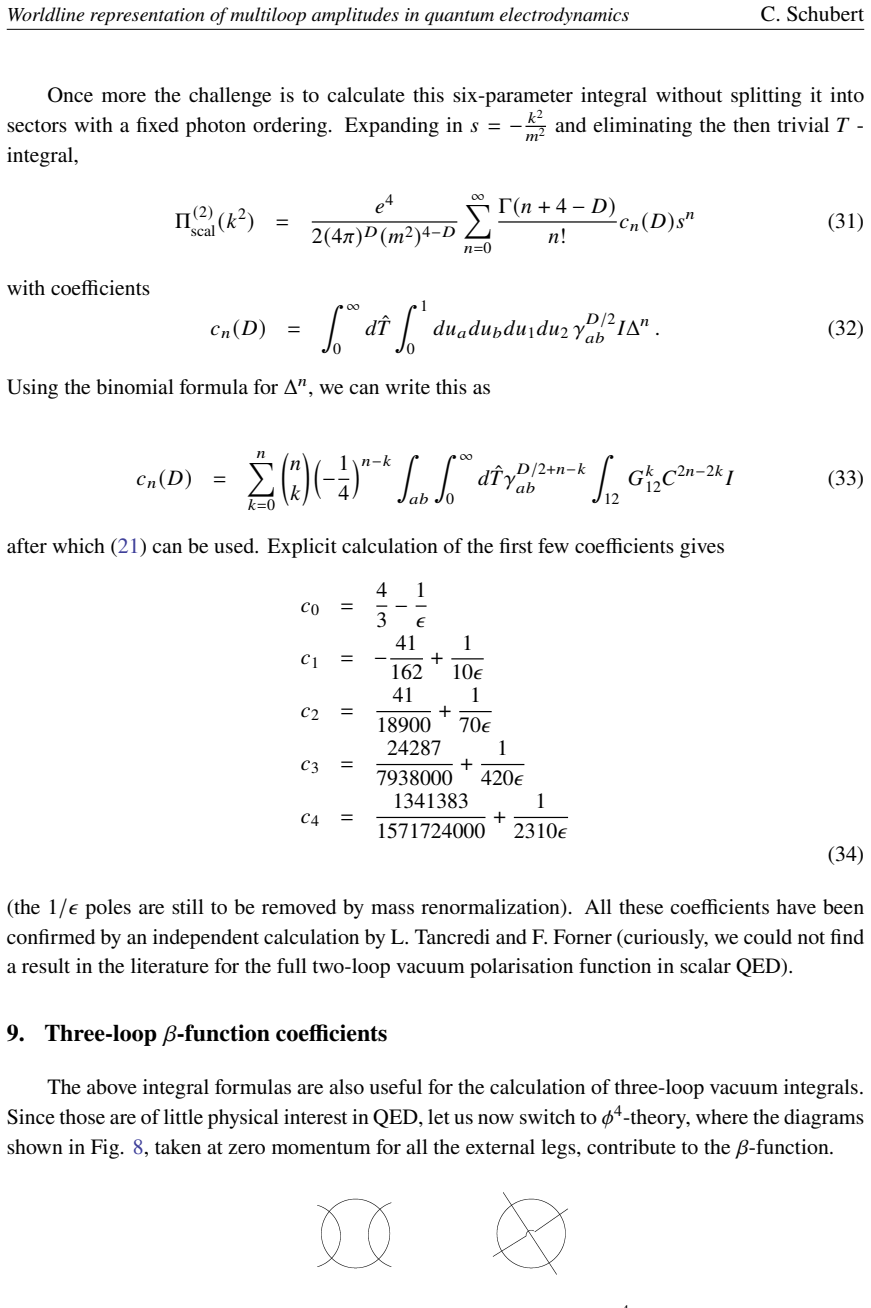
- The same formulas recalculate the three-loop phi^4 vacuum integral, giving I_reg = 12 zeta(3) - 4 zeta(2) - 4, without separating planar and non-planar sectors.
- The method is expected to extend to spinor QED and constant-field backgrounds, opening the way to weak-field expansion coefficients of three-loop Euler-Heisenberg Lagrangians.
- The new dressed-fermion master formulas are being programmed for nonlinear Compton scattering and multiloop g-2 calculations, suggesting the approach reaches beyond vacuum polarization.
Where Pith is reading between the lines
- If the sewing prescription is complete, the same effective-Green's-function construction should yield analogous single-integral representations for three-loop vacuum polarization, though the master-integral table would need to be extended to higher ranks.
- The confirmed coefficients c0–c4 provide a benchmark for future Feynman-diagram codes; the reported absence of a literature result for the full two-loop scalar QED vacuum polarization suggests this calculation fills a gap worth cross-checking.
- A natural testable extension is to compute c5 from the same integral representation and compare with a completely independent method; a mismatch would localize the error either to the sewing prescription or to the master integrals.
- Because the six-parameter integral is finite-dimensional and free of ordering sectors, numerical Monte Carlo evaluation at finite k^2 is a practical way to test completeness of the representation beyond the low-energy expansion.
Editorial analysis
A structured set of objections, weighed in public.
Referee Report
Summary. This is a proceedings contribution reviewing the worldline approach to QED and reporting a set of new technical results: the master integrals (18)--(28) for two-propagator worldline integrals, a compact six-parameter worldline integrand (29)--(30) for the two-loop vacuum polarization in scalar QED, the low-energy coefficients c0...c4 in (34), a recalculation of a three-loop phi^4 beta-function integral in Section 9, and a report on open-fermion-line generalizations. The central quantitative claim is that the master integrals reduce the two-loop scalar QED vacuum polarization to a small set of integrals that can be evaluated 'in one go', yielding the quoted coefficients.
Significance. If correct, the master integrals and the 'one-go' integrand are a genuine technical advance: they combine many photon-order Feynman sectors into a small number of integrals and should be useful for other low-energy QED calculations. The paper also provides an explicit consistency check in Section 9, where the three-loop integral (35) is reproduced from the master formulas by two elementary summations. The strengths of the paper are its explicit, testable formulas and the claimed independent confirmation. However, no code, derivation, or citable independent verification accompanies the principal numerical result, so the significance is currently conditional on the missing details being supplied.
major comments (4)
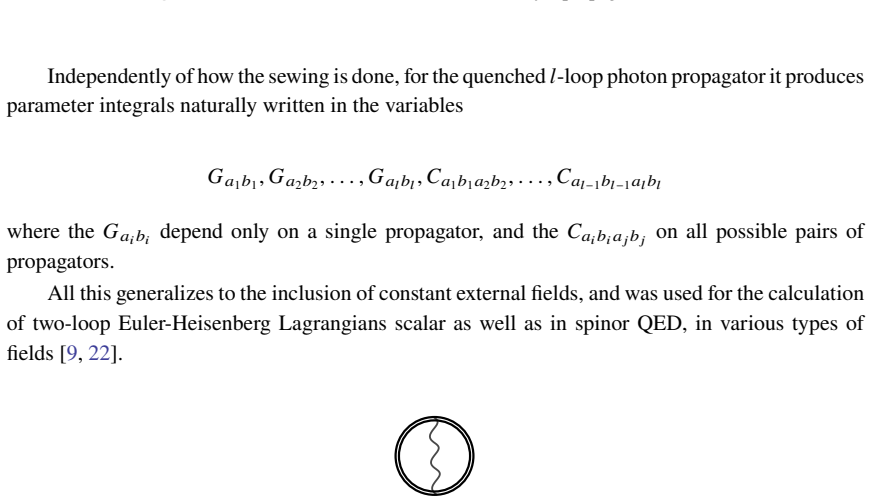
- [§8, Eqs. (29)-(30)] The derivation of the central integrand is absent. After Eq. (15) the text jumps to the six-parameter representation, with no derivation of the polynomial I nor of the claim that the sewing construction of [25] reproduces all two-loop photon-polarization sectors (including seagull vertices) with correct multiplicity. The only derivation-like material is an unassimilated excerpt with equation numbers (9.20)-(9.22) and 'Figure 26', whose connection to (29)-(30) is not explained. This is not merely a presentation issue: if a sector or multiplicity is wrong, the coefficients (34) change. The authors should either provide the derivation or cite a companion paper containing it.
- [§8, Eq. (33)] The reduction to the master formula (21) is not shown. The integrand I in (30) contains ∂1Δ ∂2Δ, ∂aΔ ∂bΔ ∂1∂2Δ, and ∂²[...]∂1Δ; the quoted master formula (21) is for derivative-free integrals ∫12 G12^k C^{2m}. No integration-by-parts or chain-integral identities are presented that would reduce the derivative terms to that form. The chain identities (13)-(14) are for polynomials in G-dot and G_F, not for derivatives of Δ with these argument structures. Without this reduction, the use of (21) in (33) cannot be checked.
- [§8, Eq. (34)] The coefficients c0...c4 are stated without derivation, and the statement 'confirmed by an independent calculation by L. Tancredi and F. Forner' is not backed by a citation, preprint number, or reproducible computer file. Since these numbers are the paper's principal new result, an appeal to a private communication is insufficient; at minimum the authors should give a detailed derivation or a public supplementary calculation. The 1/ε poles are also left unrenormalized, and no comparison to a standard Feynman-diagram evaluation is made, so the paper provides no internal numerical cross-check for (34).
- [§7, Eqs. (18)-(28)] The master formulas (19), (21), and (23) are presented as results with no proofs or derivations. Although this may be acceptable for a review-style proceedings if the formulas had been previously published, here they are new ('we have recently analyzed ...'). A reader cannot verify them, and their correctness is load-bearing because (21) and (23) are the tools used to obtain (34) and (38). At least a sketch or a reference to a companion paper with proofs is required.
minor comments (4)
- [References] Ref. [10] should be Phys. Lett. B822 (2021) 136696; Ref. [25] should be Phys. Lett. B331 (1994) 69. The current forms 'Phys. Lett. B22' and 'Phys. Lett. B33169' are typos.
- [§8 presentation] The block containing equations labelled (9.20)-(9.22) and 'Figure 26' appears to be an excerpt from a different document; it disrupts the paper's own equation numbering and should be removed or rewritten in the paper's notation.
- [§7-8 notation] The definitions (26)-(28) for b_±, c, d are dense; a small worked example for small k,m would aid reproducibility and make the master formula (23) much easier to check.
- [§9, Eq. (38)] The notation I_{n-1}^{n n} is used without explaining how it follows from (19). A line or two defining the index correspondence would help the reader follow the recalculation.
Circularity Check
No significant circularity: the two-loop coefficients are obtained by applying stated master integrals to an explicitly written integrand, with external confirmation cited for the central result.
full rationale
Walking the claimed derivation chain in Section 8: the two-loop integrand (29)-(30) is built from the effective two-loop Green's function (15) and the one-loop worldline master formula. Equation (15) is a prior result for a different quantity and is stated explicitly; it does not already contain the target coefficients c0...c4. The binomial step from (32) to (33) is algebraic, and the quoted text says that the remaining tau1,tau2 integrations are polynomial and are performed with master identities, with total-derivative terms omitted. What is not shown is the detailed reduction of the derivative-containing I in (30) to the derivative-free master integral form (21); that is an omitted derivation / completeness check, not a definitional equivalence or fitted-input prediction. The coefficients (34) are computed from the stated integrals and the authors report confirmation by an independent calculation by Tancredi and Forner, and Section 9 reproduces known planar/nonplanar three-loop beta-function results. No parameter is fitted and then renamed a prediction; no uniqueness theorem is imported from the authors' prior work to forbid alternatives; no known empirical pattern is merely relabeled as a new representation. The paper does rely heavily on the authors' earlier work ([3], [17], [21], [25]), but those cited formulas are either stated in the text or are external results whose assumptions do not include the target coefficients. Thus no circular step is exhibited; the main weaknesses are incompleteness of the derivation and lack of a reproducibility reference for the external check, which are correctness risks rather than circularity.
Axiom & Free-Parameter Ledger
axioms (3)
- domain assumption The worldline master formulas (6) and (8) are equivalent to standard QED Feynman diagrams, with the seagull vertex encoded in the delta-function term of G̈.
- domain assumption The effective two-loop Green's function G^(1)_B (15), obtained by sewing at the path-integral level, correctly generates the full two-loop photon-polarization integrand.
- ad hoc to paper The low-energy expansion in s = -k^2/m^2 and the binomial expansion of Δ^n can be interchanged with parameter integrals before mass renormalization.
read the original abstract
The worldline approach to quantum electrodynamics allows one to construct integral representations combining large numbers of Feynman diagrams. Here I review the state-of-the-art of a long-term effort to make this fact useful for actual multiloop calculations, such as of the scalar and spinor QED vacuum polarization functions and the electron anomalous magnetic moment. After a short historical introduction, and a discussion of the non-standard mathematical challenges involved, I focus on a recent calculation of the two-loop vacuum polarisation in scalar QED and some master integral formulas obtained in this context.
Figures



Reference graph
Works this paper leans on
-
[1]
Feynman, Phys
R.P. Feynman, Phys. Rev.80(1950) 440
1950
-
[2]
Feynman, Phys
R.P. Feynman, Phys. Rev.84(1951) 108
1951
- [3]
-
[4]
E. S. Fradkin,Nucl. Phys.76(1966), 588
1966
-
[5]
Polyakov, Gauge Fields and Strings, Harwood Academic Publishers, 1987
A.M. Polyakov, Gauge Fields and Strings, Harwood Academic Publishers, 1987
1987
-
[6]
Bern and D
Z. Bern and D. A. Kosower, Nucl. Phys.B 379(1992) 451
1992
-
[7]
M. J. Strassler, Nucl. Phys.B 385(1992) 145, hep-ph/9205205
Pith/arXiv arXiv 1992
-
[8]
R. Zh. Shaisultanov, Phys. Lett.B 378(1996) 354, hep-th/9512142
Pith/arXiv arXiv 1996
-
[9]
12 Worldline representation of multiloop amplitudes in quantum electrodynamicsC
M.Reuter,M.G.SchmidtandC.Schubert,Ann.Phys.(N.Y.)259313(1997),hep-th/9610191. 12 Worldline representation of multiloop amplitudes in quantum electrodynamicsC. Schubert
Pith/arXiv arXiv 1997
-
[10]
J.P. Edwards and C. Schubert, Phys. Lett. B22(2021) 136696, arXiv: 2105.08173 [hep-th]
Pith/arXiv arXiv 2021
-
[11]
A. Ilderton and G. Torgrimsson, Phys. Rev. D93(2016) 085006, arXiv:1601.05021 [hep-th]
Pith/arXiv arXiv 2016
-
[12]
C. Schubert and R. Shaisultanov, Phys. Lett.B843 (2023) 137969, arXiv: 2303.08907 [hep- th]
Pith/arXiv arXiv 2023
-
[13]
Bern and D.C
Z. Bern and D.C. Dunbar, Nucl. Phys.B 379(1992) 562
1992
-
[14]
Hostler, J
L.C. Hostler, J. Math. Phys.26(1985) 1348
1985
- [15]
-
[16]
D.J.Broadhurst,R.DelbourgoandD.Kreimer,Phys.Lett.B366(1996)421,hep-ph/9509296
Pith/arXiv arXiv 1996
-
[17]
J.P.Edwards,C.M.Mata,U.MüllerandC.Schubert,SIGMA17(2021)065,arXiv:2106.1207 [hep-th]
arXiv 2021
-
[18]
N.Ahmadiniaz,M.A.Lopez-LopezandC.Schubert,Phys.Lett.B852(2024)138610,arXiv: 2312.07047 [hep-th]
Pith/arXiv arXiv 2024
-
[19]
M. A. Lopez-Lopez, Phys. Lett.B860 (2025) 139157, arXiv: 2408.16474 [hep-th]
Pith/arXiv arXiv 2025
-
[20]
N. Ahmadiniaz, V.M. Banda Guzmán, J.P. Edwards, M.A. Lopez-Lopez, C.M. Mata, L.A. Rodriguez Chacón, C. Schubert and R. Shaisultanov,Proc. of Science(LL2024)011, arXiv:2407.07388 [hep-th]
-
[21]
V. M. Banda Guzmán, JHEP 07 (2025) 159; arXiv:2505.04157 [hep-th]
Pith/arXiv arXiv 2025
-
[22]
G. V. Dunne and C. Schubert, JHEP0208, 053 (2002), hep-th/0205004
Pith/arXiv arXiv 2002
-
[23]
F. Bastianelli, A. Huet, C. Schubert, R. Thakur and A. Weber, JHEP1407(2014) 066, arXiv:1405.7770 [hep-ph]
Pith/arXiv arXiv 2014
-
[24]
N. Ahmadiniaz, C. Lopez-Arcos, M. A. Lopez-Lopez and C. Schubert, Nucl. Phys. B991 (2023) 116217, arXiv:2303.12072 [hep-th]
Pith/arXiv arXiv 2023
-
[25]
M. G. Schmidt and C. Schubert, Phys. Lett. B33169 (1994), hep-th/9403158
Pith/arXiv arXiv 1994
-
[26]
N. Ahmadiniaz, V.M. Banda Guzmán, F. Bastianelli, O. Corradini, J.P. Edwards and C. Schubert, JHEP2008(2020) 049, arXiv:2004.01391 [hep-th]
Pith/arXiv arXiv 2020
-
[27]
N. Ahmadiniaz, V.M. Banda Guzmán, F. Bastianelli, O. Corradini, J.P. Edwards and C. Schubert, JHEP01(2022) 050, arXiv:2107.00199 [hep-th]
Pith/arXiv arXiv 2022
-
[28]
Fradkin and D.M
E.S. Fradkin and D.M. Gitman, Phys. Rev.D 44(1991) 3230. 13
1991
discussion (0)
Sign in with ORCID, Apple, or X to comment. Anyone can read and Pith papers without signing in.