REVIEW 3 major objections 7 minor 1 cited by
Mysticeti's linearization rule gives lower-index validators a permanent ordering head start, and the gas-price re-sort preserves the bias on tied fees.
Reviewed by Pith at T0; open to challenge. T0 means a machine referee read the full paper against a public rubric. the ladder, T0–T4 →
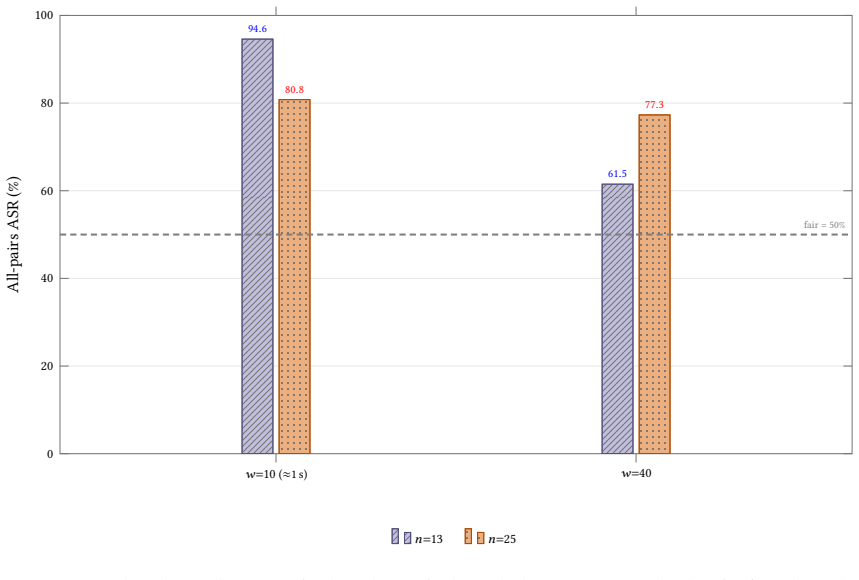
In Sui's Mysticeti, same-round blocks are sorted by validator index, giving lower-indexed validators a measurable ordering head start that survives the gas-price re-sort on tied fees, and 'staying silent' can push it above 94%.
T0 review reviewed 2026-08-02 challenge →
load-bearing objection A real, checkable ordering bias in Sui's consensus path, but the paper never explains the gap between the stated (round, author) tie-break and the measured ~89% same-round win rate, so the central mechanism is not fully pinned down. the 3 major comments →
Fair on the Surface: Transaction-Ordering Bias and MEV in Mysticeti DAG-based BFT Protocol
The pith
A machine-rendered reading of the paper's core claim, the machinery that carries it, and where it could break.
The reading
Core claim
The paper's central claim is that the linearization rule of Mysticeti—sorting committed blocks by (round, author) with a stable sort—makes the validator index the decisive same-round tiebreak. As a result, for any two blocks proposed in the same round, the block from the lower-indexed validator is always placed first, giving that validator a structural front-running advantage with no misbehavior required. The post-consensus gas-price re-sort, being a stable sort, preserves this consensus order whenever fees are equal, and equal fees at the reference gas price are the common case. The paper also identifies strategic silence—a validator choosing to broadcast only on early rounds—as a legitimat
What carries the argument
The mechanism is the linearization function sort_sub_dag_blocks, which flattens a committed sub-DAG by sorting blocks first by round number and then by validator index, using a stable sort; and the post-consensus order_by_gas_price re-sort, also a stable sort, which preserves the consensus order on equal fees. The validator index is the tiebreaker that carries the bias. Strategic silence works by making a validator miss rounds so that its blocks appear only in early rounds, where they outrank later-round blocks.
Load-bearing premise
The head-start claim depends on the source code doing exactly what the paper describes—linearizing by (round, author) with validator index as the only same-round tiebreak, and using a single stable gas-price re-sort after consensus—yet the reported ~89% same-round win rate, rather than 100%, indicates the real sort key may include additional fields, so the described mechanism may not be the exact on-chain behavior.
What would settle it
Collect a sample of commits from Sui mainnet, identify all pairs of blocks from the same round produced by validators of different indices, and check whether the lower-index block always appears first in the committed order. If even one such same-round pair has the higher-index block first, the strict (round, author) tiebreak is not the effective rule, and the claimed head-start mechanism is falsified. Alternatively, inspect sort_sub_dag_blocks in the current Sui source to see whether the sort key includes fields beyond validator index, such as block sequence number or leader schedule.
If this is right
- If the bias is real, any DAG-based BFT protocol that breaks same-round ties by a fixed validator order inherits the same head start, so the finding applies beyond Sui.
- The advertised gas-price defense is a no-op at tied fees; an attacker can front-run without paying a premium, meaning the cost of MEV is paid by users rather than by validators.
- Replacing the validator-index tiebreak with an unpredictable per-commit key removes the same-round head start and the tie loophole, and is safe because the key is fixed at commit time.
- Strategic silence is not closed by the tiebreak and requires a round-level fix; it remains an open ordering vulnerability.
- The paper's measurement methodology shows that all-pairs ASR stays near 50% even when same-round bias is high, so evaluations reporting only aggregate ASR would falsely conclude the protocol is fair.
Where Pith is reading between the lines
- The 89% same-round win rate, rather than 100%, suggests the real sort key may include additional fields (e.g., sequence number or leader schedule), so the head-start mechanism as described may not be the exact on-chain behavior; a deeper source audit would clarify.
- The tie loophole implies that a validator with lower index can profit from arbitrage or sandwiching without paying any fee premium, which could be tested on-chain by measuring whether low-index validators' transactions consistently precede high-index validators' transactions at equal gas prices.
- The fix using a per-commit random key could be extended to the gas-price re-sort tie breaks; the paper implements both, but the strategic-silence gap suggests that round-level fairness mechanisms, such as randomized leader schedules or round-randomized ordering, might be needed to fully close MEV on DAG-based chains.
Editorial analysis
A structured set of objections, weighed in public.
Referee Report
Summary. The paper studies transaction-ordering bias in Mysticeti, the DAG-based BFT consensus protocol used by Sui. It claims that the production linearization rule sorts same-round blocks by validator index, giving low-index validators a permanent head start; that the post-consensus gas-price re-sort is a stable sort and therefore preserves this bias on the equal-fee ties that dominate real traffic; and that a validator can amplify its position by staying silent on non-leader rounds. The authors evaluate these effects on a 13-validator (and, for strategic silence, 25-validator) deployment of the current Sui consensus code, report same-round attack-success rates around 89% for low-index validators, and show that their proposed hash-based tiebreak reduces same-round ASR to about 45% while leaving strategic silence largely intact. They also argue that consensus safety and liveness are unaffected below the Byzantine fault threshold.
Significance. If the mechanism is confirmed, this is a significant result: it challenges the fairness assumptions of a deployed chain with billions of dollars in market capitalization, identifies a concrete and minimal fix, and measures that fix's effect. The paper's strengths include separating same-round from all-pairs ASR, which correctly exposes a bias that aggregate metrics hide; explicitly checking that the observed bias is not a consensus-safety failure; testing a larger committee for strategic silence; and candidly acknowledging that a high ASR ratio need not translate into realized profit and that the proposed fix does not close strategic silence. These checks make the paper more credible than a purely theoretical treatment. However, the production-impact claim currently outruns the evidence, and a key discrepancy between the stated sort rule and the measured same-round ASR is unresolved.
major comments (3)
- [§4.2, §5.1 (Fig. 3)] The paper's central mechanism is that committed sub-DAG blocks are linearized by (round, author) with validator index as the only same-round key. If that rule were exactly implemented, all same-round pairs of committed blocks would place the lower index first, i.e., same-round ASR would be 100%. Yet §5.1 reports ≈89% (mean 87.4% across the 78 pairs), and the paper never explains this gap. Possible causes include an additional sort key (sequence number, commit epoch, digest), sorting by an identifier that is not the numeric index, or a measurement artifact. This is load-bearing: the fix's measured 89%→45% improvement and the claim that the index is the 'sole cause' depend on the exact key set. Please pin the code path at a specific commit and reconcile the predicted 100% with the measured 89%.
- [Abstract; §1; §5] The abstract and introduction assert that the bias 'is already present on Sui's live network' and 'currently active on Sui's production chain.' The experiments, however, deploy the current Sui consensus code on a private cluster; they do not observe mainnet's committed DAG or execution order. The cited $18k/day MEV figure [46] is a third-party estimate and is not evidence for this specific mechanism. Either add direct on-chain measurement (e.g., reconstructing same-round order from live commits) or revise the claim to 'present in the current code and likely affecting mainnet.' As written, the production-impact statement outruns the evidence.
- [§4.2–4.3; §5] Reproducibility of the central code interpretation: the paper refers to sort_sub_dag_blocks in commit.rs and order_by_gas_price in post_consensus_tx_reorder.rs but provides no commit hash, repository version, artifact, or configuration details. Given that the entire result rests on these two functions and that §5.1 already reveals a discrepancy with the stated rule, the code path must be pinned and, ideally, an artifact provided. In addition, specify whether the tested path is the production Sui execution pipeline or a test harness, and whether the gas-price re-sort is applied to the same transaction set in the same order as on mainnet.
minor comments (7)
- [§5.1, Fig. 3] The text quotes 89.5%, 91.7%, and 92.0% while the caption says '≈90%'; make the numbers consistent between text, figure, and Table 1.
- [§5] The formula all-pairs ASR = 1/2 + 1/(2R) is stated without derivation. A short counting argument would make the distinction between same-round and all-pairs metrics easier to verify.
- [§5.3, Table 1] The strategic-silence results are reported as medians over five runs, but no variance or confidence intervals are given. With 60 commits per run, the dispersion could be material, especially for the short 10-commit window.
- [§5.2] Specify the exact Rust method and version (e.g., slice::sort_by_key versus sort_unstable_by_key) and state explicitly that sort_by_key is stable in the version cited, since the tie-loophole argument depends on this property.
- [§6] The statement that Sui's own 'currently gated' reputation-based leader schedule already replaced a fixed tiebreak should be cited or located in the code; otherwise the claim is unverifiable.
- [§5.3] The caveat that a high all-pairs ASR ratio need not translate into realized profit is important and should be foregrounded in the abstract and introduction, where the 94% number is presented without this qualification.
- [General] Occasional typos and spacing issues: 'at atiedfee' in §5.2, 're-sorttechnique' in §5.2, and 're-sorttechnique' in the same paragraph. A light copyedit would help.
Circularity Check
No significant circularity: central claims are empirically grounded in source-code behavior and direct measurements, not fitted to the conclusions.
full rationale
The paper's load-bearing chain is: (1) inspect Sui's consensus code to establish that committed sub-DAGs are linearized by (round, author) and that the gas-price re-sort is a stable sort_by_key; (2) define ASR metrics; (3) measure same-round ASR on a 13-validator deployment; (4) test a minimal fix. Each step is either a stated code assertion, a definition, or a measurement. No parameter is fitted from the data and then renamed a prediction; the 89% figure is an observed outcome, not derived from an assumed model that already contains it. The all-pairs ASR = 1/2 + 1/2R formula is elementary combinatorics and is not used to produce the headline result. The fix's 89% to 45% drop is a measured effect of changing the tiebreaker, not an analytic claim equivalent to the fix's definition. Self-citations ([5], [40], [41]) appear only in background/related work and do not supply the measured quantities or the mechanism. The discrepancy between the strict (round, author) rule predicting 100% and the measured 89% is an open verification question about the code path or measurement, not a circularity; it affects confidence, not score. Therefore no circular step is present.
Axiom & Free-Parameter Ledger
free parameters (3)
- Measurement window w (strategic silence) =
10 commits (~1 s); 40 commits also reported
- Committee size and attacker stake fraction =
n=13, 4 attacker validators (≈31%)
- Same-round ASR metric definition =
same-round pairs only; all-pairs is derived to tend to 50%
axioms (5)
- domain assumption Mysticeti's linearization rule is exactly sort by (round, author) using validator index as the same-round tie-break, and Sui's gas-price re-sort is a stable sort.
- domain assumption A validator may skip proposing blocks (stay silent) without violating protocol rules or triggering slashing/liveness penalties.
- standard math Standard BFT bound: at most f<n/3 Byzantine validators, and protocol remains safe/live below that bound.
- domain assumption Execution order on Sui is exactly the consensus order after gas-price re-sort, with no further reordering before execution.
- domain assumption The ASR metric over committed blocks is a valid proxy for MEV extraction potential.
Cite this review
Pith. "Pith review of Fair on the Surface: Transaction-Ordering Bias and MEV in Mysticeti DAG-based BFT Protocol." pith.science (2026). https://pith.science/paper/7R2RBE4Y
@misc{pith2026260713378,
  author       = {Pith},
  title        = {Pith review of: Fair on the Surface: Transaction-Ordering Bias and MEV in Mysticeti DAG-based BFT Protocol},
  year         = {2026},
  howpublished = {\url{https://pith.science/paper/7R2RBE4Y}},
  note         = {Machine review of arXiv:2607.13378}
}
read the original abstract
Distributed systems deployed in untrustworthy environments agree on a common transaction order through Byzantine fault-tolerant (BFT) consensus protocols, and that order has real financial value in many decentralized applications: whoever influences it can profit at other users' expense, a problem known as maximal extractable value (MEV). Mysticeti is a state-of-the-art DAG-based BFT protocol in which many validators propose blocks in parallel, and the total order is derived from the resulting DAG afterward. Mysticeti is the consensus protocol powering Sui, a production blockchain with a market capitalization of roughly $3 billion, and it is widely believed to order transactions fairly, since many validators propose blocks in parallel and committed transactions are re-sorted by gas price before execution. We show this fairness assumption breaks down in practice, and the effect is already present on Sui's live network. First, when vertices of the committed graph are merged into a single total order, blocks from the same round are sorted by validator index, giving lower-indexed validators a permanent head start. In our evaluation on a 13-validator network with no attacker, the lower-indexed side wins same-round ordering about 89% of the time. Second, the gas-price re-sort intended to remove this bias uses a stable sort, so transactions paying equal fees (common at the reference gas price) retain the original biased order, letting an attacker profit without paying extra. Third, a validator can amplify this advantage by choosing when to stay silent, a fully legitimate action that violates no protocol rule; this raises its ordering win rate above 94%. We measure all three exploitations, verify that Mysticeti otherwise remains resilient below the standard Byzantine fault threshold, and propose a simple fix: replace the validator-index tiebreaker with an unpredictable, per-commit random key.
Figures


Forward citations
Cited by 1 Pith paper
-
Sample More, Reflect Less: Self-Refine and Reflexion Lose to Repeated Sampling at Equal Token Cost, from 1.5B to 7B
Self-inspection methods (Self-Refine, Reflexion, Best-of-N self-verify) lose to equal-token repeated sampling on math from 1.5B to 7B; no tested method reliably wins.
Reference graph
Works this paper leans on
-
[1]
Aptos: The foundation for a new digital economy
-
[2]
Celo: Ethereum layer 2 for payments, stablecoins and defi
-
[3]
Chainlink: The industry-standard oracle platform
-
[4]
Supra: A faster, better web3 experience for everyone
-
[5]
The bedrock of byzantine fault tolerance: A unified platform for{BFT} protocols analysis, implementation, and experimentation
Mohammad Javad Amiri, Chenyuan Wu, Divyakant Agrawal, Amr El Abbadi, Boon Thau Loo, and Mohammad Sadoghi. The bedrock of byzantine fault tolerance: A unified platform for{BFT} protocols analysis, implementation, and experimentation. InSymposium on Networked Systems Design and Implementation (NSDI), pages 371–400. USENIX Association, 2024
2024
-
[6]
A fair consensus protocol for transaction ordering
Avi Asayag, Gad Cohen, Ido Grayevsky, Maya Leshkowitz, Ori Rottenstreich, Ronen Tamari, and David Yakira. A fair consensus protocol for transaction ordering. InInt. Conf. on Network Protocols (ICNP), pages 55–65. IEEE, 2018
2018
-
[7]
Mysticeti: Reaching the latency limits with uncertified dags
Kushal Babel, Andrey Chursin, George Danezis, Anastasios Kichidis, Lefteris Kokoris-Kogias, Arun Koshy, Alberto Sonnino, and Mingwei Tian. Mysticeti: Reaching the latency limits with uncertified dags. InNetwork and Distributed Systems Security Symposium (NDSS), 2025
2025
-
[8]
Sok: Mitigation of front-running in decentralized finance.Cryptology ePrint Archive, 2021
Carsten Baum, James Hsin-yu Chiang, Bernardo David, Tore Kasper Frederiksen, and Lorenzo Gentile. Sok: Mitigation of front-running in decentralized finance.Cryptology ePrint Archive, 2021
2021
-
[9]
Implementing fault-tolerant distributed objects.Trans
Kenneth P Birman, Thomas A Joseph, Thomas Raeuchle, and Amr El Abbadi. Implementing fault-tolerant distributed objects.Trans. on Software Engineering, (6):502–508, 1985
1985
-
[10]
Sui Lutris: A blockchain combining broadcast and consensus
Sam Blackshear, Andrey Chursin, George Danezis, Lefteris Kokoris-Kogias, Alberto Sonnino, et al. Sui Lutris: A blockchain combining broadcast and consensus. InACM SIGSAC Conference on Computer and Communications Security (CCS). ACM, 2024
2024
-
[11]
Tao: Facebook’s distributed data store for the social graph
Nathan Bronson, Zach Amsden, George Cabrera, Prasad Chakka, Peter Dimov, Hui Ding, Jack Ferris, Anthony Giardullo, Sachin Kulkarni, and Harry Li. Tao: Facebook’s distributed data store for the social graph. InAnnual Technical Conf. (ATC), pages 49–60. USENIX Association, 2013
2013
-
[12]
Quick order fairness
Christian Cachin, Jovana Mićić, and Nathalie Steinhauer. Quick order fairness. InInt. Conf. on Financial Cryptography and Data Security (FC), pages 1–18. Springer, 2022
2022
-
[13]
Practical byzantine fault tolerance
Miguel Castro and Barbara Liskov. Practical byzantine fault tolerance. InSymposium on Operating Systems Design and Implementation (OSDI), pages 173–186. USENIX Association, 1999
1999
-
[14]
What is maximal extractable value (mev)? https://chain.link/education-hub/maximal-extractable-value-mev, 2023
Chainlink. What is maximal extractable value (mev)? https://chain.link/education-hub/maximal-extractable-value-mev, 2023
2023
-
[15]
Shardag: Scaling dag-based blockchains via adaptive sharding
Feng Cheng, Jiang Xiao, Cunyang Liu, Shijie Zhang, Yifan Zhou, Bo Li, Baochun Li, and Hai Jin. Shardag: Scaling dag-based blockchains via adaptive sharding. InInt. Conf. on Data Engineering (ICDE), pages 2068–2081. IEEE, 2024
2068
-
[16]
Spanner: Google’s globally distributed database.Transactions on Computer Systems (TOCS), 31(3):8, 2013
James C Corbett, Jeffrey Dean, Michael Epstein, Andrew Fikes, Christopher Frost, Jeffrey John Furman, Sanjay Ghemawat, Andrey Gubarev, Christopher Heiser, and Peter Hochschild. Spanner: Google’s globally distributed database.Transactions on Computer Systems (TOCS), 31(3):8, 2013
2013
-
[17]
Red belly: a secure, fair and scalable open blockchain
Tyler Crain, Christopher Natoli, and Vincent Gramoli. Red belly: a secure, fair and scalable open blockchain. InSymposium on Security and Privacy (SP). IEEE, 2021
2021
-
[18]
Flash boys 2.0: Frontrunning in decentralized exchanges, miner extractable value, and consensus instability
Philip Daian, Steven Goldfeder, Tyler Kell, Yunqi Li, Xueyuan Zhao, Iddo Bentov, Lorenz Breidenbach, and Ari Juels. Flash boys 2.0: Frontrunning in decentralized exchanges, miner extractable value, and consensus instability. InSymposium on security and privacy (SP), pages 910–927. IEEE, 2020
2020
-
[19]
Narwhal and tusk: a dag-based mempool and efficient bft consensus
George Danezis, Lefteris Kokoris-Kogias, Alberto Sonnino, and Alexander Spiegelman. Narwhal and tusk: a dag-based mempool and efficient bft consensus. InEuropean Conf. on Computer Systems (EuroSys), pages 34–50, 2022
2022
-
[20]
Dynamo: Amazon’s highly available key-value store.Operating Systems Review (OSR), 41(6):205–220, 2007
Giuseppe DeCandia, Deniz Hastorun, Madan Jampani, Gunavardhan Kakulapati, Avinash Lakshman, Alex Pilchin, Swaminathan Sivasubramanian, Peter Vosshall, and Werner Vogels. Dynamo: Amazon’s highly available key-value store.Operating Systems Review (OSR), 41(6):205–220, 2007
2007
-
[21]
Sui DEX volume
DefiLlama. Sui DEX volume. https://defillama.com/dexs/chain/sui, 2026. Accessed July 2026
2026
-
[22]
Consensus in the presence of partial synchrony.Journal of the ACM (JACM), 35(2):288–323, 1988
Cynthia Dwork, Nancy Lynch, and Larry Stockmeyer. Consensus in the presence of partial synchrony.Journal of the ACM (JACM), 35(2):288–323, 1988
1988
-
[23]
Sok: Transparent dishonesty: front-running attacks on blockchain
Shayan Eskandari, Seyedehmahsa Moosavi, and Jeremy Clark. Sok: Transparent dishonesty: front-running attacks on blockchain. InInt. Conf. on Financial Cryptography and Data Security (FC), pages 170–189. Springer, 2019
2019
-
[24]
Impossibility of distributed consensus with one faulty process.Journal of the ACM (JACM), 32(2):374–382, 1985
Michael J Fischer, Nancy A Lynch, and Michael S Paterson. Impossibility of distributed consensus with one faulty process.Journal of the ACM (JACM), 32(2):374–382, 1985
1985
-
[25]
Autobahn: Seamless high speed bft
Neil Giridharan, Florian Suri-Payer, Ittai Abraham, Lorenzo Alvisi, and Natacha Crooks. Autobahn: Seamless high speed bft. InSymposium on Operating Systems Principles (SOSP), pages 1–23. ACM SIGOPS, 2024
2024
-
[26]
Sok: Preventing transaction reordering manipulations in decentralized finance
Lioba Heimbach and Roger Wattenhofer. Sok: Preventing transaction reordering manipulations in decentralized finance. InConf. on Advances in Financial Technologies (AFT), pages 1–14. ACM, 2022
2022
-
[27]
H-store: a high-performance, distributed main memory transaction processing system.Proc
Robert Kallman, Hideaki Kimura, Jonathan Natkins, Andrew Pavlo, Alexander Rasin, Stanley Zdonik, Evan PC Jones, Samuel Madden, Michael Stonebraker, and Yang Zhang. H-store: a high-performance, distributed main memory transaction processing system.Proc. of the VLDB Endowment, 1(2):1496–1499, 2008
2008
-
[28]
Fairdag: consensus fairness over multi-proposer causal design
Dakai Kang, Junchao Chen, Tien Tuan Anh Dinh, and Mohammad Sadoghi. Fairdag: consensus fairness over multi-proposer causal design. Proceedings of the VLDB Endowment, 19(2):265–278, 2025
2025
-
[29]
All you need is dag
Idit Keidar, Eleftherios Kokoris-Kogias, Oded Naor, and Alexander Spiegelman. All you need is dag. InSymposium on Principles of Distributed Computing (PODC), pages 165–175. ACM, 2021
2021
-
[30]
Themis: Fast, strong order-fairness in byzantine consensus
Mahimna Kelkar, Soubhik Deb, Sishan Long, Ari Juels, and Sreeram Kannan. Themis: Fast, strong order-fairness in byzantine consensus. InSIGSAC Conf. on Computer and Communications Security (CCS), pages 475–489. ACM, 2023
2023
-
[31]
Order-fairness for byzantine consensus
Mahimna Kelkar, Fan Zhang, Steven Goldfeder, and Ari Juels. Order-fairness for byzantine consensus. InAnnual Int. Cryptology Conf., pages 451–480. Springer, 2020
2020
-
[32]
Ariah Klages-Mundt and Andreea Minca. (in) stability for the blockchain: Deleveraging spirals and stablecoin attacks.arXiv preprint arXiv:1906.02152, 2019
Pith/arXiv arXiv 1906
-
[33]
Omniledger: A secure, scale-out, decentralized ledger via sharding
Eleftherios Kokoris-Kogias, Philipp Jovanovic, Linus Gasser, Nicolas Gailly, Ewa Syta, and Bryan Ford. Omniledger: A secure, scale-out, decentralized ledger via sharding. InSymposium on Security and Privacy (SP), pages 583–598. IEEE, 2018
2018
-
[34]
Wendy, the good little fairness widget: Achieving order fairness for blockchains
Klaus Kursawe. Wendy, the good little fairness widget: Achieving order fairness for blockchains. InConf. on Advances in Financial Technologies (AFT), pages 25–36. ACM, 2020
2020
-
[35]
Wendy grows up: More order fairness
Klaus Kursawe. Wendy grows up: More order fairness. InInt. Conf. on Financial Cryptography and Data Security (FC), pages 191–196. Springer, 2021
2021
-
[36]
Time, clocks, and the ordering of events in a distributed system.Communications of the ACM, 21(7):558–565, 1978
Leslie Lamport. Time, clocks, and the ordering of events in a distributed system.Communications of the ACM, 21(7):558–565, 1978
1978
-
[37]
Fairledger: A fair blockchain protocol for financial institutions
Kfir Lev-Ari, Alexander Spiegelman, Idit Keidar, and Dahlia Malkhi. Fairledger: A fair blockchain protocol for financial institutions. InInt. Conf. on Principles of Distributed Systems (OPODIS). Schloss Dagstuhl-Leibniz-Zentrum fuer Informatik, 2019
2019
-
[38]
Order fairness evaluation of dag-based ledgers
Erwan Mahe and Sara Tucci-Piergiovanni. Order fairness evaluation of dag-based ledgers. InInt. Conf. on Blockchain Computing and Applications (BCCA), pages 106–114. IEEE, 2025
2025
-
[39]
The honey badger of bft protocols
Andrew Miller, Yu Xia, Kyle Croman, Elaine Shi, and Dawn Song. The honey badger of bft protocols. InConf. on Computer and Communications Security (CCS), pages 31–42. ACM, 2016
2016
-
[40]
Dag of dags: Order-fairness made practical
Heena Nagda, Sidharth Sankhe, Sakshi Sinha, Keon Attarha, Mohammad Javad Amiri, and Boon Thau Loo. Dag of dags: Order-fairness made practical. InSIGMOD Int. Conf. on Management of Data. ACM, 2026
2026
-
[41]
Rashnu: Data-dependent order-fairness.Proceedings of the VLDB Endowment, 17(9):2335–2348, 2024
Heena Nagda, Shubhendra Pal Singhal, Mohammad Javad Amiri, and Boon Thau Loo. Rashnu: Data-dependent order-fairness.Proceedings of the VLDB Endowment, 17(9):2335–2348, 2024
2024
-
[42]
Bitcoin: A peer-to-peer electronic cash system
Satoshi Nakamoto. Bitcoin: A peer-to-peer electronic cash system. 2008
2008
-
[43]
Reaching agreement in the presence of faults.Journal of the ACM (JACM), 27(2):228–234, 1980
Marshall Pease, Robert Shostak, and Leslie Lamport. Reaching agreement in the presence of faults.Journal of the ACM (JACM), 27(2):228–234, 1980
1980
-
[44]
Quantifying blockchain extractable value: How dark is the forest? InSymposium on Security and Privacy (SP), pages 198–214
Kaihua Qin, Liyi Zhou, and Arthur Gervais. Quantifying blockchain extractable value: How dark is the forest? InSymposium on Security and Privacy (SP), pages 198–214. IEEE, 2022
2022
-
[45]
Implementing fault-tolerant services using the state machine approach: A tutorial.Computing Surveys (CSUR), 22(4):299–319, 1990
Fred B Schneider. Implementing fault-tolerant services using the state machine approach: A tutorial.Computing Surveys (CSUR), 22(4):299–319, 1990
1990
-
[46]
Shio: MEV protection infrastructure for Sui
Shio. Shio: MEV protection infrastructure for Sui. https://getshio.com, 2024. Accessed July 2026
2024
-
[47]
Bft protocols under fire
Atul Singh, Tathagata Das, Petros Maniatis, Peter Druschel, and Timothy Roscoe. Bft protocols under fire. InSymposium on Networked Systems Design and Implementation (NSDI), volume 8, pages 189–204. USENIX Association, 2008
2008
-
[48]
Bullshark: Dag bft protocols made practical
Alexander Spiegelman, Neil Giridharan, Alberto Sonnino, and Lefteris Kokoris-Kogias. Bullshark: Dag bft protocols made practical. InACM SIGSAC Conf. on Computer and Communications Security (CCS), pages 2705–2718, 2022
2022
-
[49]
Adding fairness to order: Preventing front-running attacks in bft protocols using tees
Chrysoula Stathakopoulou, Signe Rüsch, Marcus Brandenburger, and Marko Vukolić. Adding fairness to order: Preventing front-running attacks in bft protocols using tees. InInt. Symp on Reliable Distributed Systems (SRDS), pages 34–45. IEEE, 2021
2021
-
[50]
Suiscan project directory
Suiscan. Suiscan project directory. [Accessed 20-Feb-2026]
2026
-
[51]
Ethereum: A secure decentralised generalised transaction ledger.Ethereum project yellow paper, 151:1–32, 2014
Gavin Wood. Ethereum: A secure decentralised generalised transaction ledger.Ethereum project yellow paper, 151:1–32, 2014
2014
-
[52]
SoK: Decentralized exchanges (DEX) with automated market maker (AMM) protocols
Jiahua Xu, Krzysztof Paruch, Simon Cousaert, and Yebo Feng. SoK: Decentralized exchanges (DEX) with automated market maker (AMM) protocols. ACM Computing Surveys, 55(11):1–50, 2023
2023
-
[53]
Hotstuff: Bft consensus with linearity and responsiveness
Maofan Yin, Dahlia Malkhi, Michael K Reiter, Guy Golan Gueta, and Ittai Abraham. Hotstuff: Bft consensus with linearity and responsiveness. In Symposium on Principles of Distributed Computing (PODC), pages 347–356. ACM, 2019
2019
-
[54]
No fish is too big for flash boys! frontrunning on dag-based blockchains.Cryptology ePrint Archive, 2024
Jianting Zhang and Aniket Kate. No fish is too big for flash boys! frontrunning on dag-based blockchains.Cryptology ePrint Archive, 2024
2024
-
[55]
Byzantine ordered consensus without byzantine oligarchy
Yunhao Zhang, Srinath Setty, Qi Chen, Lidong Zhou, and Lorenzo Alvisi. Byzantine ordered consensus without byzantine oligarchy. InSymposium on Operating Systems Design and Implementation (OSDI), pages 633–649. USENIX Association, 2020
2020
-
[56]
High-frequency trading on decentralized on-chain exchanges
Liyi Zhou, Kaihua Qin, Christof Ferreira Torres, Duc V Le, and Arthur Gervais. High-frequency trading on decentralized on-chain exchanges. In Symposium on Security and Privacy (SP), pages 428–445. IEEE, 2021
2021
This paper was first reviewed by deepseek-v4-flash on August 2, 2026.
discussion (0)
Sign in with ORCID, Apple, or X to comment. Anyone can read and Pith papers without signing in.