REVIEW 4 major objections 5 minor 33 references
VAMP-MR claims that a SIMD-vectorized collision checker, FK_CC_MULTI, accelerates multi-robot-arm motion planning and postprocessing by 10–150x without changing the planning algorithms.
Reviewed by Pith at T0; open to challenge. T0 means a machine referee read the full paper against a public rubric. the ladder, T0–T4 →
T0 review · deepseek-v4-flash
2026-08-02 05:02 UTC pith:Y7QMGQJL
load-bearing objection Solid engineering contribution with real speedups; the precise magnitude is less certain than the headline claims, but the core method holds up. the 4 major comments →
VAMP-MR: Vector-Accelerated Motion Planning and Execution for Multi-Robot-Arms
The pith
A machine-rendered reading of the paper's core claim, the machinery that carries it, and where it could break.
Core claim
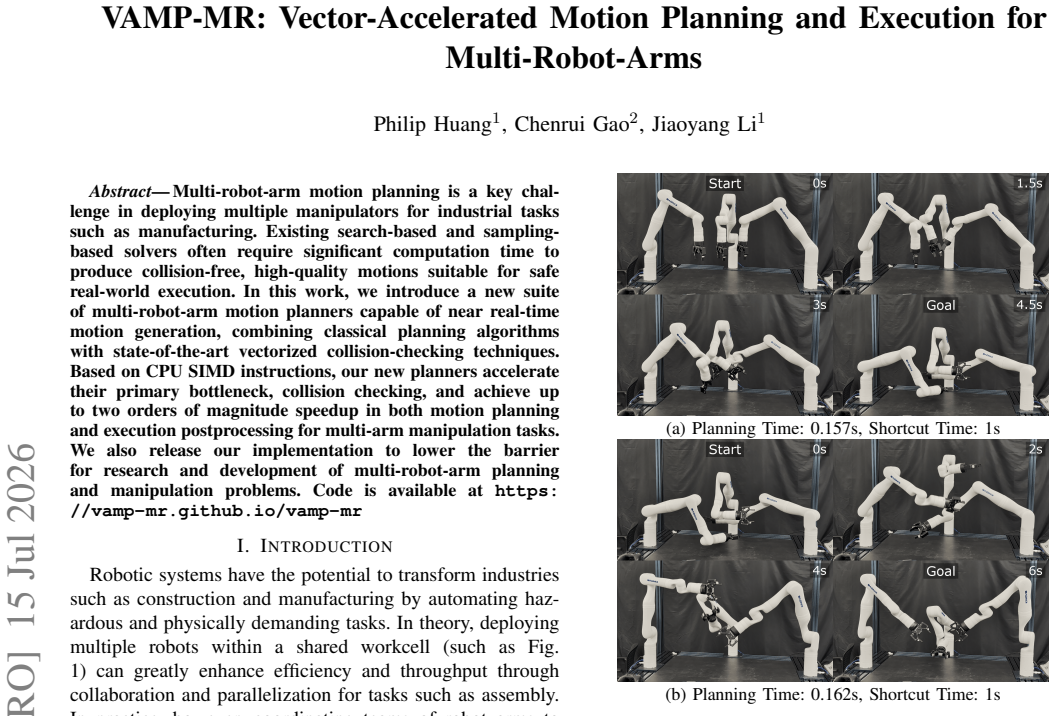
The central claim is that FK_CC_MULTI, a SIMD-vectorized collision checker for multiple robot arms, accelerates collision checking so that standard planners and postprocessors run 10–150x faster with essentially no changes to the planning algorithms. The paper reports 11–27x speedup for single-configuration collision checking and up to 148x speedup for motion validation, and claims up to two orders of magnitude speedup in both motion planning and execution postprocessing. If correct, sub-second planning for four 7-DoF arms becomes routine.
What carries the argument
FK_CC_MULTI: a vectorized routine that batches v composite configurations (one per SIMD lane) and computes forward kinematics and collision checks for all in parallel. It uses spherized robot geometry, interleaves self-collision checks with FK for early termination, transforms environment obstacles into each robot's base frame, and performs pairwise robot-robot checks in world frame. The batch returns Valid only if all configurations are collision-free; motion validation fills the batch with discretized configurations along a motion (v=8 with AVX2).
Load-bearing premise
The speedup ratios are measured against FCL baselines that use the same spherized geometry in isolated checks but the original meshes in the integrated pipeline; if production-optimized FCL with original meshes and multithreading closes much of the gap, the headline 10–150x numbers would not generalize.
What would settle it
Run the same planning and TPG-construction benchmarks with FCL using the original robot meshes, multithreaded TPG construction, and MoveIt-style integration, and compare absolute wall-clock times; if the VAMP-MR advantage drops below, say, 2x, the paper's core claim of order-of-magnitude speedup is not representative of standard practice.
If this is right
- Sub-second planning for four 7-DoF arms becomes routine in the tested environments.
- CBS-MP can expand thousands of constraint-tree nodes within a one-minute limit, enabling more complete search on hard instances.
- TPG construction for long-horizon assembly tasks speeds up 7–21x, even single-threaded versus 16-threaded FCL.
- Trajectory shortcutting reaches full convergence within 1 second, up to 50x faster.
- Collision checking remains the dominant cost (64–90% of planning time), so MAPF search improvements could compound with this acceleration.
Where Pith is reading between the lines
- If the speedups hold outside the benchmark suite, the technique could make real-time replanning and online coordination of multiple arms practical in dynamic environments.
- The batched 'rake' motion validation strategy could be combined with lazy collision checking or with multi-core parallelism for even larger gains.
- The framework's ability to enable/disable collision pairs at runtime may allow planners to reuse roadmaps across changing robot attachments and base transforms.
- The same SIMD batching idea might apply to other problems where the bottleneck is repeated collision queries, e.g., multi-agent pathfinding with large agents or deformable objects.
Editorial analysis
A structured set of objections, weighed in public.
Referee Report
Summary. The paper introduces VAMP-MR, a CPU-SIMD vectorized collision-checking kernel (FK_CC_MULTI) for multiple robot arms. It batches composite configurations into SIMD lanes, fuses forward kinematics and self/environment/robot-robot collision checks, and integrates as a drop-in replacement for FCL into composite RRT-Connect, CBS-MP, DTS shortcutting, and APEX-MR's TPG construction. Reported results include 11-28x speedups for single-configuration checks, up to 148x for motion validation, 10-150x for planners, up to 50x for shortcutting, and 1.25-21x for LEGO assembly pipeline stages, with sub-second planning for four 7-DoF arms.
Significance. The contribution is significant if the reported numbers hold: collision checking is the dominant bottleneck across sampling-based, search-based, and postprocessing stages, and a general-purpose vectorized checker that slots into existing planners without algorithmic changes has broad applicability. The paper is transparent about its lineage from VAMP, releases code, and uses a conservative TPG baseline (16-thread FCL vs single-threaded ours). However, the precise magnitude of the headline speedups is difficult to assess because the FCL baseline is configured differently across experiments, variance is not reported, and roadmap construction is excluded. The core method is plausible and likely genuinely faster; the central claims need additional measurement discipline rather than conceptual revision.
major comments (4)
- [III-B / Table I vs IV-C / Table III note] Table I says FCL is given 'the same approximated spherized geometries' as VAMP-MR, but the Table III note says the FCL baseline uses 'original robot meshes, which we found faster than the spherized geometry.' This is an admission that the Table I FCL configuration may be artificially slow, so the headline 'up to 148x' motion-validation ratio is not measured against the faster baseline. The geometry used for FCL in Fig. 4 and Fig. 5 is not stated. Please report Table I against FCL with original meshes as well, or justify why spherized FCL is the appropriate comparison, and state the FCL geometry for every experiment.
- [Fig. 4 caption / Section IV-A] Fig. 4 reports speedup as the ratio of medians over 'respective solved instances.' With a one-minute timeout, FCL may time out on instances that VAMP-MR solves, so the two medians can describe different instance sets and the ratio is not a per-instance speedup. Table III reports only 4-seed averages without standard deviations, and Fig. 5 curves have no error bars. To support the '10-100x' and 'up to 150x' claims, report paired per-instance speedups (or median of per-instance ratios), the number of solved instances per planner, and confidence intervals or full distributions.
- [IV-A Results] Roadmap construction is 'performed once per environment and excluded from the reported planning time; its speedup is not evaluated.' Roadmap construction validates every sampled configuration and candidate edge and is one of the largest collision-checking costs in CBS-MP (Section II-B). Excluding it from the reported planning time can substantially overstate the end-to-end speedup of the vectorized pipeline. Please report roadmap construction times for FCL and VAMP-MR separately, or include it in the total time and replot Fig. 4 accordingly.
- [IV-C] To use early-terminating batched checks, k consecutive pose nodes are merged into a transit node, coarsening TPG precedence constraints and 'can introduce additional waiting ... and thereby increase the makespan.' The paper asserts this difference is 'negligible' but gives no measurements and does not specify k. Because Table III's makespan improvements (e.g., 10% lower makespan for cliff/vessel/fish) are a stated benefit, the makespan impact of grouping must be quantified, at least by comparing against the original per-node TPG construction on one or more tasks and stating the k used.
minor comments (5)
- [Fig. 6 vs Table III] The Fish task is labeled '47' in the Fig. 6 caption, but Table III reports '# of Bricks' = 29 for Fish. Please reconcile.
- [Abstract / Introduction] The Introduction says 'up to 100x speedups' while the abstract and conclusion say 'up to two orders of magnitude'; specify which metric and environment yields the maximum.
- [Throughout] The symbols VAMP and V AMP are used interchangeably; choose one notation.
- [IV-A] The asymmetric constraint scheme is described as 'inspired by [29]' but no proof of completeness is provided or cited. Please cite the original proof or state that completeness is inherited from [29].
- [Table I] Table I would benefit from reporting the standard deviation across the 10,000 random samples, since FCL timing can vary with early-exit behavior.
Circularity Check
No significant circularity: VAMP-MR's speedups are external measurements against FCL, not derived from its own assumptions.
full rationale
The central claim is an empirical speedup of FK_CC_MULTI against FCL, an external collision-checking library. There is no fitted parameter renamed as a prediction, and no equation is defined in terms of the quantity it is supposed to explain. Algorithm 1 simply implements the definition of a collision-free composite configuration from Sec. II-A; correctness of the implementation is not a derived result. The speedup numbers in Table I are direct runtime measurements on the same sphere models for both methods, and Table III and Fig. 4 replace only the collision checker in otherwise identical pipelines, so the comparison is not forced by construction. The self-citations to [5] (benchmark environments and DTS) and [18] (APEX-MR TPG framework) supply experimental setups and component algorithms; they are not invoked as evidence for the speedup, so they are not load-bearing. The Table III note that the FCL baseline 'uses the original robot meshes for collision checking, which we found faster than the spherized geometry' and the Fig. 4 caption's 'respective solved instances' are real benchmark-consistency caveats: they could affect the magnitude or comparability of the reported ratios, but they are questions of baseline fairness and statistics, not circularity, because the measured speedup still comes from an external comparison rather than from a self-referential definition. Overall, the derivation chain is self-contained with respect to circularity.
Axiom & Free-Parameter Ledger
free parameters (3)
- Motion-validation resolution (L1 distance between checked interpolated configurations) =
0.1 rad
- Sphere geometry approximation (59 spheres per Panda arm) =
59 spheres/arm
- TPG grouping size k (pose nodes merged into a transit node) =
not reported
axioms (5)
- domain assumption Robot geometry can be faithfully approximated by spheres for collision checking
- domain assumption AVX2 SIMD gives 8 single-precision lanes and is preferable to AVX-512 due to clock throttling
- domain assumption Sampling interpolated configurations at 0.1 rad L1 spacing catches all relevant collisions along a motion
- domain assumption The asymmetric CBS constraint scheme from [29] makes CBS-MP complete on roadmaps
- ad hoc to paper Coarsening TPG precedence constraints to transit nodes has negligible makespan impact
read the original abstract
Multi-robot-arm motion planning is a key challenge in deploying multiple manipulators for industrial tasks such as manufacturing. Existing search-based and sampling-based solvers often require significant computation time to produce collision-free, high-quality motions suitable for safe real-world execution. In this work, we introduce a new suite of multi-robot-arm motion planners capable of near real-time motion generation, combining classical planning algorithms with state-of-the-art vectorized collision-checking techniques. Based on CPU SIMD instructions, our new planners accelerate their primary bottleneck, collision checking, and achieve up to two orders of magnitude speedup in both motion planning and execution postprocessing for multi-arm manipulation tasks. We also release our implementation to lower the barrier for research and development of multi-robot-arm planning and manipulation problems. Code is available at https://vamp-mr.github.io/vamp-mr
Figures


Reference graph
Works this paper leans on
-
[1]
Motions in mi- croseconds via vectorized sampling-based planning,
W. Thomason, Z. Kingston, and L. E. Kavraki, “Motions in mi- croseconds via vectorized sampling-based planning,” inProceedings of the IEEE International Conference on Robotics and Automation, pp. 8749–8756, 2024
2024
-
[2]
FCL: A general purpose library for collision and proximity queries,
J. Pan, S. Chitta, and D. Manocha, “FCL: A general purpose library for collision and proximity queries,” inProceedings of the IEEE International Conference on Robotics and Automation, pp. 3859–3866, 2012
2012
-
[3]
PyBullet, a python module for physics simulation for games, robotics and machine learning
E. Coumans and Y . Bai, “PyBullet, a python module for physics simulation for games, robotics and machine learning.”http:// pybullet.org, 2021
2021
-
[4]
RRT-connect: An efficient approach to single-query path planning,
J. J. Kuffner and S. M. LaValle, “RRT-connect: An efficient approach to single-query path planning,” inProceedings of the IEEE Interna- tional Conference on Robotics and Automation, pp. 995–1001, 2000
2000
-
[5]
Benchmarking shortcutting techniques for multi-robot arm motion planning,
P. Huang, Y . Shaoul, and J. Li, “Benchmarking shortcutting techniques for multi-robot arm motion planning,” inProceedings of the IEEE In- ternational Conference on Intelligent Robots and Systems, pp. 13258– 13265, 2025
2025
-
[6]
Mo- tion planning around obstacles with convex optimization,
T. Marcucci, M. Petersen, D. von Wrangel, and R. Tedrake, “Mo- tion planning around obstacles with convex optimization,”Science Robotics, vol. 8, no. 84, p. eadf7843, 2023
2023
-
[7]
Multi-agent pathfinding: Defi- nitions, variants, and benchmarks,
R. Stern, N. Sturtevant, A. Felner, S. Koenig, H. Ma, T. Walker, J. Li, D. Atzmon, L. Cohen, T. Kumar,et al., “Multi-agent pathfinding: Defi- nitions, variants, and benchmarks,” inProceedings of the International Symposium on Combinatorial Search, pp. 151–158, 2019
2019
-
[8]
Conflict-based search for optimal multi-agent pathfinding,
G. Sharon, R. Stern, A. Felner, and N. R. Sturtevant, “Conflict-based search for optimal multi-agent pathfinding,”Artificial Intelligence, vol. 219, pp. 40–66, 2015
2015
-
[9]
Probabilistic roadmaps for path planning in high-dimensional configuration spaces,
L. Kavraki, P. Svestka, J.-C. Latombe, and M. Overmars, “Probabilistic roadmaps for path planning in high-dimensional configuration spaces,” IEEE Transactions on Robotics and Automation, vol. 12, no. 4, pp. 566–580, 1996
1996
-
[10]
Representation- optimal multi-robot motion planning using conflict-based search,
I. Solis, J. Motes, R. Sandstr ¨om, and N. M. Amato, “Representation- optimal multi-robot motion planning using conflict-based search,” IEEE Robotics and Automation Letters, pp. 4608–4615, 2021
2021
-
[11]
Accelerating search- based planning for multi-robot manipulation by leveraging online- generated experiences,
Y . Shaoul, I. Mishani, M. Likhachev, and J. Li, “Accelerating search- based planning for multi-robot manipulation by leveraging online- generated experiences,” inProceedings of the International Conference on Automated Planning and Scheduling, pp. 523–531, 2024
2024
-
[12]
Unconstraining multi-robot manipulation: Enabling arbitrary constraints in ECBS with bounded sub-optimality,
Y . Shaoul, R. Veerapaneni, M. Likhachev, and J. Li, “Unconstraining multi-robot manipulation: Enabling arbitrary constraints in ECBS with bounded sub-optimality,” inProceedings of the International Symposium on Combinatorial Search, pp. 109–117, 2024
2024
-
[13]
Long-horizon multi-robot rearrangement planning for construction assembly,
V . N. Hartmann, A. Orthey, D. Driess, O. S. Oguz, and M. Toussaint, “Long-horizon multi-robot rearrangement planning for construction assembly,”IEEE Transactions on Robotics, pp. 239–252, 2023
2023
-
[14]
Cooperative task and motion planning for multi-arm assembly systems,
J. Chen, J. Li, Y . Huang, C. Garrett, D. Sun, C. Fan, A. Hof- mann, C. Mueller, S. Koenig, and B. C. Williams, “Cooperative task and motion planning for multi-arm assembly systems,” 2022. arXiv:2203.02475
Pith/arXiv arXiv 2022
-
[15]
RoboBallet: Planning for multirobot reaching with graph neural networks and reinforcement learning,
M. Lai, K. Go, Z. Li, T. Kr ¨oger, S. Schaal, K. Allen, and J. Scholz, “RoboBallet: Planning for multirobot reaching with graph neural networks and reinforcement learning,”Science Robotics, vol. 10, no. 106, p. eads1204, 2025
2025
-
[16]
Massively parallelizing the RRT and the RRT*,
J. Bialkowski, S. Karaman, and E. Frazzoli, “Massively parallelizing the RRT and the RRT*,” inProceedings of the IEEE International Conference on Intelligent Robots and Systems, pp. 3513–3518, 2011
2011
-
[17]
Choset, K
H. Choset, K. M. Lynch, S. Hutchinson, G. A. Kantor, and W. Burgard, Principles of Robot Motion: Theory, Algorithms, and Implementations. MIT Press, 2005
2005
-
[18]
APEX-MR: Multi-robot asynchronous planning and execution for cooperative assembly,
P. Huang, R. Liu, C. Liu, and J. Li, “APEX-MR: Multi-robot asynchronous planning and execution for cooperative assembly,” in Proceedings of Robotics: Science and Systems, 2025
2025
-
[19]
Persistent and robust execution of MAPF schedules in warehouses,
W. Honig, S. Kiesel, A. Tinka, J. W. Durham, and N. Ayanian, “Persistent and robust execution of MAPF schedules in warehouses,” IEEE Robotics and Automation Letters, vol. 4, no. 2, pp. 1125–1131, 2019
2019
-
[20]
Robot motion planning on a chip,
S. Murray, W. Floyd-Jones, Y . Qi, D. J. Sorin, and G. Konidaris, “Robot motion planning on a chip,” inProceedings of Robotics: Science and Systems, 2016
2016
-
[21]
Path planning using lazy PRM,
R. Bohlin and L. E. Kavraki, “Path planning using lazy PRM,” in Proceedings of the IEEE International Conference on Robotics and Automation, pp. 521–528, 2000
2000
-
[22]
Learning-based proxy collision detection for robot motion planning applications,
N. Das and M. Yip, “Learning-based proxy collision detection for robot motion planning applications,”IEEE Transactions on Robotics, vol. 36, no. 4, pp. 1096–1114, 2020
2020
-
[23]
Neural joint space implicit signed distance functions for reactive robot manipulator control,
M. Koptev, N. Figueroa, and A. Billard, “Neural joint space implicit signed distance functions for reactive robot manipulator control,”IEEE Robotics and Automation Letters, vol. 8, no. 2, pp. 480–487, 2023
2023
-
[24]
Motion planning networks: Bridging the gap between learning-based and classical motion planners,
A. H. Qureshi, Y . Miao, A. Simeonov, and M. C. Yip, “Motion planning networks: Bridging the gap between learning-based and classical motion planners,”IEEE Transactions on Robotics, vol. 37, no. 1, pp. 48–66, 2021
2021
-
[25]
Scalable multicore motion planning using lock-free concurrency,
J. Ichnowski and R. Alterovitz, “Scalable multicore motion planning using lock-free concurrency,”IEEE Transactions on Robotics, vol. 30, no. 5, pp. 1123–1136, 2014
2014
-
[26]
A fast procedure for computing the distance between complex objects in three-dimensional space,
E. G. Gilbert, D. W. Johnson, and S. S. Keerthi, “A fast procedure for computing the distance between complex objects in three-dimensional space,”IEEE Journal on Robotics and Automation, vol. 4, no. 2, pp. 193–203, 1988
1988
-
[27]
FOAM: A tool for spherical approximation of robot geometry,
S. Coumar, G. Chang, N. Kodkani, and Z. Kingston, “FOAM: A tool for spherical approximation of robot geometry,” 2025. arXiv:2503.13704
Pith/arXiv arXiv 2025
-
[28]
Reducing the barrier to entry of complex robotic software: a MoveIt! case study,
D. Coleman, I. Sucan, S. Chitta, and N. Correll, “Reducing the barrier to entry of complex robotic software: a MoveIt! case study,” 2014
2014
-
[29]
Multi-agent path finding for large agents,
J. Li, P. Surynek, A. Felner, H. Ma, T. S. Kumar, and S. Koenig, “Multi-agent path finding for large agents,” inProceedings of the AAAI Conference on Artificial Intelligence, pp. 7627–7634, 2019
2019
-
[30]
Pairwise symmetry reasoning for multi-agent path finding search,
J. Li, D. Harabor, P. J. Stuckey, H. Ma, G. Gange, and S. Koenig, “Pairwise symmetry reasoning for multi-agent path finding search,” Artificial Intelligence, vol. 301, p. 103574, 2021
2021
-
[31]
EECBS: A bounded-suboptimal search for multi-agent path finding,
J. Li, W. Ruml, and S. Koenig, “EECBS: A bounded-suboptimal search for multi-agent path finding,” inProceedings of the AAAI Conference on Artificial Intelligence, pp. 12353–12362, 2021
2021
-
[32]
MAPF- LNS2: Fast repairing for multi-agent path finding via large neighbor- hood search,
J. Li, Z. Chen, D. Harabor, P. J. Stuckey, and S. Koenig, “MAPF- LNS2: Fast repairing for multi-agent path finding via large neighbor- hood search,” inProceedings of the AAAI Conference on Artificial Intelligence, pp. 10256–10265, 2022
2022
-
[33]
A new approach to time-optimal path parameterization based on reachability analysis,
H. Pham and Q.-C. Pham, “A new approach to time-optimal path parameterization based on reachability analysis,”IEEE Transactions on Robotics, vol. 34, no. 3, pp. 645–659, 2018
2018
discussion (0)
Sign in with ORCID, Apple, or X to comment. Anyone can read and Pith papers without signing in.