REVIEW 3 major objections 4 minor 75 references
Thermal light can be imprinted with Skyrmion topology using a heated metasurface
Reviewed by Pith at T0; open to challenge. T0 means a machine referee read the full paper against a public rubric. the ladder, T0–T4 →
T0 review · deepseek-v4-flash
2026-08-02 04:51 UTC pith:EIJE3IHC
load-bearing objection First credible claim of thermal-light Stokes skyrmions; the renormalization of Stokes vectors needs transparent characterization before the four-decimal invariants can be trusted. the 3 major comments →
Imprinting topology on thermal light
The pith
A machine-rendered reading of the paper's core claim, the machinery that carries it, and where it could break.
Core claim
The central claim is that the Skyrmion number—a topological invariant that counts how many times the polarization direction covers the Poincaré sphere—survives the time-averaged decoherence that defines thermal emission. Because Kirchhoff's law equates absorption and emission for each mode, a metasurface designed to absorb a chosen chiral eigenmode will emit that same eigenmode, and the ensemble-averaged emitted intensity is proportional to its emissivity. By mapping the desired Stokes texture onto the metasurface through local meta-atom orientation, the authors obtain emission whose time-averaged polarization field wraps the Poincaré sphere N times. They demonstrate this for N = −1, −2, −5,
What carries the argument
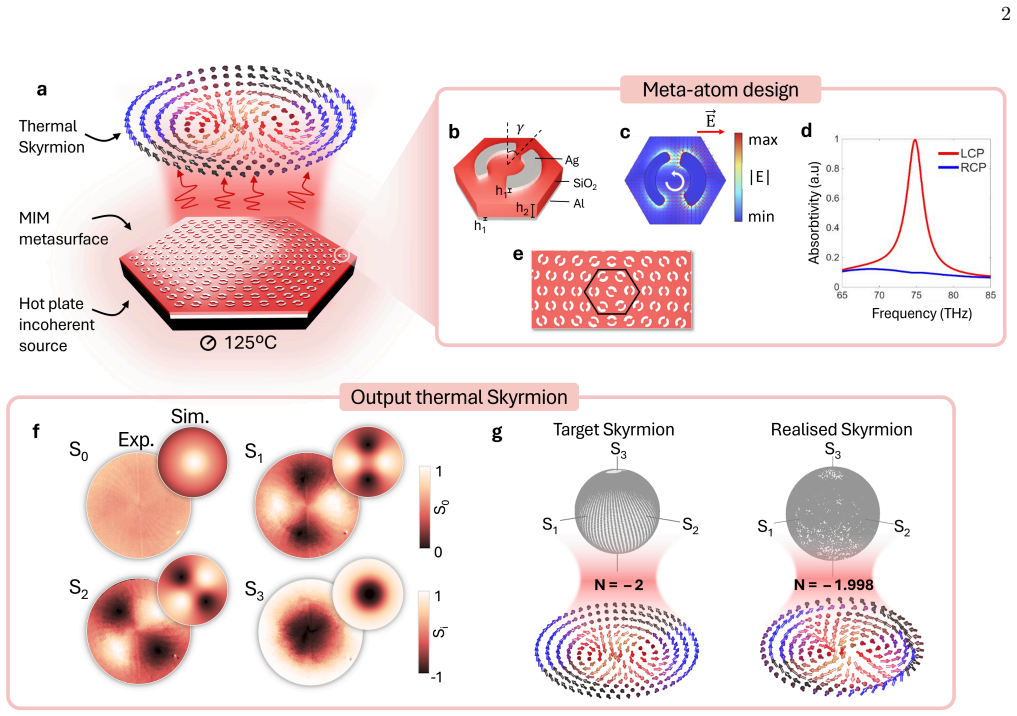
The key machinery is the metal–insulator–metal metasurface with asymmetric double-C silver resonators on a silica spacer over an aluminum mirror, operating at 4 µm (75 THz). Each meta-atom is optimized so that one chiral eigenmode dominates thermal emission (secondary emissivity ε₂ ≈ 0), and Kirchhoff's law links the ensemble-averaged emission intensity to the absorptivity of that eigenmode. A hexagonal lattice keeps the resonance frequency fixed as the meta-atom rotation γ changes, allowing spatial encoding of the full Poincaré sphere. The topological charge is computed via a line-integral formula (Eq. S8) that counts polarization singularities in the locally renormalized Stokes field, rath
Load-bearing premise
The load-bearing premise is that each meta-atom's thermal emission is dominated by a single chiral eigenmode, so the ensemble-averaged field tracks the designed polarization pattern; if partial polarization or inter-meta-atom coherence is significant, the raw field may not carry the claimed topology.
What would settle it
Measure the unnormalized degree of polarization (DoP) of the emitted field and compute the Skyrmion number without local renormalization. If the DoP is well below unity and the unrenormalized Skyrmion number differs markedly from the integer targets, the claimed imprinting of topology onto the thermal field itself would be falsified.
If this is right
- If the claim holds, topological structures can be generated from incoherent thermal sources, eliminating the need for lasers or spatially coherent input light.
- The measured robustness to bubbles and lattice distortions suggests fabrication tolerances may be relaxed, making printable or lower-cost metasurface production viable.
- Simulated coherence engineering with a nonlocal metasurface predicts a 50-fold increase in spatial coherence length, potentially extending the propagation distance over which the topology is retrievable.
- The approach could be ported to other wavelengths and to related topological textures, since the design rule—encode the target Stokes texture in the meta-atom lattice—is wavelength-agnostic.
Where Pith is reading between the lines
- The Skyrmion numbers are computed after locally renormalizing the Stokes parameters; the paper's own propagation data show the raw (unnormalized) degree of polarization is less than one. A skeptical reader might ask whether renormalization manufactures the texture rather than revealing it; this could be tested by computing the invariant without renormalization.
- The single-eigenmode assumption (ε₂ ≈ 0) is an idealization; real meta-atoms have finite polarization extinction. If the emitted field has significant partial polarization, the measured topology may be an artifact of the renormalization step, so a direct measurement of the degree of polarization at the metasurface would clarify.
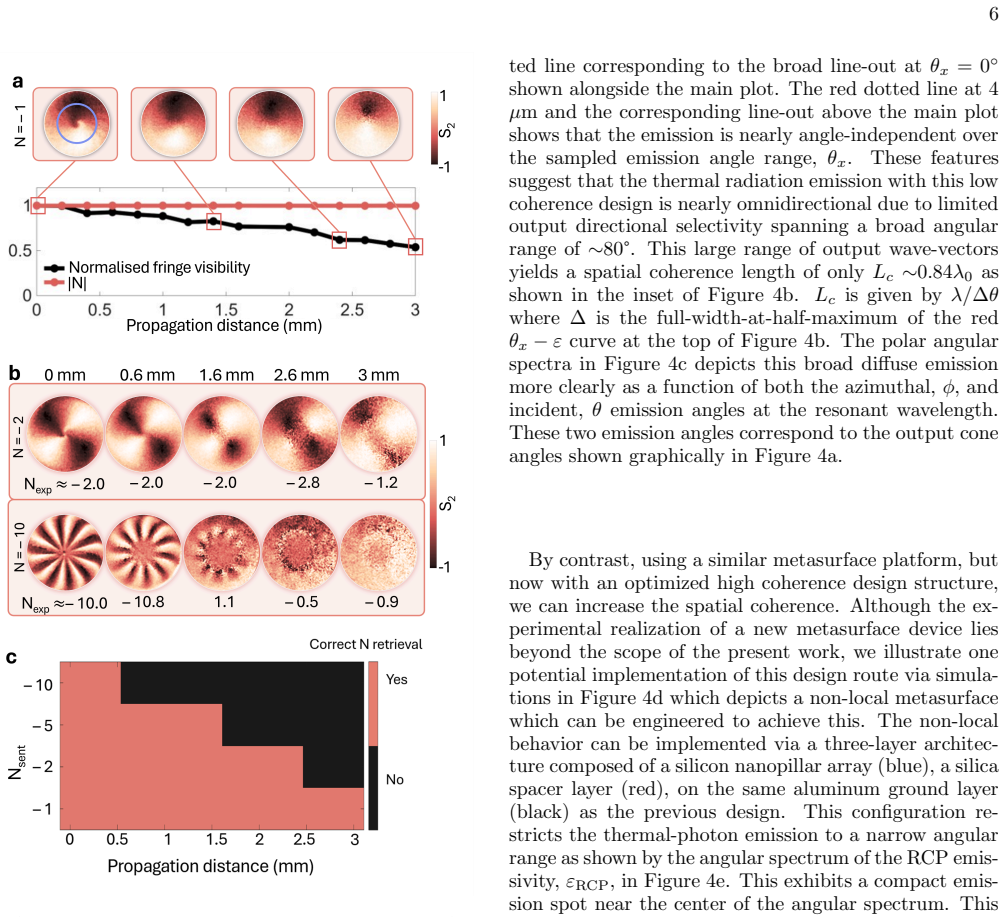
- If thermal Skyrmions are truly topological, the invariant should be more robust than intensity-based measures like fringe visibility as propagation increases—a trend visible in Figure 3—which could be checked quantitatively for even higher-order Skyrmions or other thermal sources.
Editorial analysis
A structured set of objections, weighed in public.
Referee Report
Summary. The paper reports the generation of optical Skyrmions from purely thermal (incoherent) light using a metal-insulator-metal chiral metasurface heated to ~125°C. The metasurface is designed so that, by Kirchhoff's law, the polarization-dependent absorption/emission imprints a spatially varying polarization texture on the ensemble-averaged thermal radiation. The authors measure Stokes parameters in the 4 μm band and extract Skyrmion numbers N = -1, -2, -5, -10, claiming the first topologies from a thermal source. They also demonstrate robustness to fabrication defects, characterize degradation with propagation distance, and propose a non-local metasurface design for longer coherence lengths.
Significance. If the claim holds, this is a notable advance: it extends topological structuring of light to the most common class of incoherent sources, exploiting the topological invariance to time-averaged decoherence. The paper's strengths include a substantial experimental dataset (four target topologies, deliberate defect tests, temperature and exposure dependence), and a public raw-data link. The central risk is post-processing: the Skyrmion number is computed from locally renormalised Stokes vectors, and the SI admits the unnormalised Poincaré coverage has radius <1. Because the manuscript does not provide degree-of-polarization maps or an unnormalised winding analysis, the reported N values could in principle be an artifact of the normalisation and filtering. This is addressable with additional data analysis and is the main reason I cannot accept the paper in its present form.
major comments (3)
- [SI, 'Extracting topological features from Stokes measurements' (Eqs. S7–S8) and SI Fig. S10C] The Skyrmion number is computed from locally renormalised Stokes parameters S_i = s_i / sqrt(s1^2+s2^2+s3^2). The SI (Fig. S10C) explicitly states that the unnormalised Poincaré coverage has radius <1 and shrinks with propagation, i.e., the degree of polarization is less than unity and spatially varying. Normalizing each pixel to the unit sphere is a nonlinear operation that can promote low-intensity noise and partial-polarization fluctuations into a smooth, winding texture. The manuscript does not provide DoP maps, nor does it show that the winding survives when the amplitude information is retained (e.g., by computing the topology of the full Stokes vector with a cutoff, or by showing that the normalized texture is stable against random reassignment of low-DoP pixels). Because the central claim is that the thermal field itself carries the topology, the absence of this control makes the
- [Main text 'Higher-order Skyrmions and their stability' (Fig. 2b–e) and SI Eq. S8] The measured Skyrmion numbers are quoted to four decimal places (-1.000, -1.9995, -4.9991, -9.9792) with no uncertainties. The line-integral formula (Eq. S8) depends on identifying singularity positions and ordering the Stokes parameters; no error analysis is provided. In particular, the result's sensitivity to (i) the 5% intensity threshold, (ii) the Gaussian filter width σ, (iii) camera readout noise, and (iv) the choice of which Stokes component is 'z' is not quantified. Without this, the reader cannot assess whether the agreement with integers is meaningful or the product of a particular post-processing pipeline. I request at least bootstrap or replicate uncertainties, and a systematic sweep of the analysis parameters.
- [SI Eqs. S4–S6 and main text Fig. 1d] The theoretical support assumes that each meta-atom emits predominantly in a single eigenmode v1 (ε2≈0, b→0), and that the ensemble-averaged intensity follows ε1 I_BB. However, the measured circular dichroism is 0.9, not unity, so if the eigenmodes are approximately circular, the subdominant emissivity is ε2≈0.1. The paper does not quantify how this residual emission distorts the unnormalized Stokes texture, nor does it directly compare the raw (un-normalised) Stokes measurements to the eigenmode prediction. Since the metasurface is optimized so that v1 equals the desired local polarization, the agreement between target and normalized measurement is partly by construction; the physical content lies in whether the emitted field's degree and direction of polarization follow v1. Please provide raw Stokes/DoP data for the same field of view and show that the texture is present before normali
minor comments (4)
- [References] The reference list contains duplicate numbering (e.g., [3] appears twice, [1] appears twice, [24] appears twice), which will need correction in production.
- [SI §1 and Fig. S1 caption] The design parameters list r=0.66 μm in the text, while Fig. S1 gives r=0.3 μm for the same unit cell; please resolve the discrepancy.
- [Figure 2 caption] Typo: 'Skrymion numbers' should be 'Skyrmion numbers'.
- [Main text, Propagation section] The phrase 'This is a feature of Nature' appears twice in close proximity; consider rewording to avoid repetition.
Circularity Check
No significant circularity: the central measured claim is independently verified by Stokes polarimetry, and the SI eigenmode design is a constructive prescription rather than a fitted prediction.
full rationale
The paper's derivation chain does not reduce to its own inputs. The target Skyrmion texture (Eq. 1) is an external design input; the metasurface is optimized so that the dominant eigenmode v1 equals that target (SI Eqs. S4-S6), which is a constructive engineering relation, not a prediction fitted to the measured outcome. The measured Skyrmion numbers (N=-1.000, -1.9995, -4.9991, -9.9792) are computed from independently measured Stokes images via Eqs. S7-S8, so the experimental verification is not forced by the design. Self-citations (refs. 46-48 for decoherence resilience; refs. 1, 3 for the line-integral method) are cited as prior empirical and methodological support, not as an unverified uniqueness theorem that forces the conclusion; accordingly they do not constitute circularity. The disclosure that raw Poincare coverage has radius <1 (SI Fig. S10C) and the use of locally renormalized Stokes parameters raise a substantive robustness question about whether normalization could manufacture texture from low-DoP data, but this is a correctness and interpretation concern, not a circular derivation, because the topological invariant is defined on the normalized Stokes vector and the raw data are not used to fit the design. Overall, no step in the claimed derivation is equivalent by construction to a fitted parameter or to a self-citation chain.
Axiom & Free-Parameter Ledger
free parameters (3)
- Meta-atom geometric parameters (w1, w2, r, p, h1, h2, γ) =
w1=0.23, w2=0.33, r=0.66 (SI: 0.3), p=1.09, h1=0.1, h2=0.38 µm; γ varies
- Post-processing parameters: Gaussian filter σ and intensity threshold =
σ=3 (σ_L=45 µm), threshold=5%
- Operating temperature and camera exposure time =
T≈125 °C; exposure 1520 µs
axioms (5)
- domain assumption Kirchhoff's law: absorptivity equals emissivity for reciprocal thermal emitters.
- domain assumption Fluctuation-dissipation theorem connects ensemble-averaged thermal field intensity to emissivity and blackbody spectrum.
- domain assumption Skyrmion topology is invariant under time-averaged decoherence.
- ad hoc to paper Each meta-atom's thermal emission is dominated by a single eigenmode (ε2≈0), and meta-atoms emit independently.
- standard math The line-integral formula (Eq S8) correctly gives the Skyrmion number from discretely sampled polarization singularities.
read the original abstract
Topological structuring of light inevitably leverages on optical coherence to ensure that the imparted spatial phases are preserved, requiring highly coherent sources or coherence engineering embedded in the design. Now we show that thermal light can be spatially engineered to carry optical topologies in the form of Skyrmions. Such topologies are immune to time averaged decoherence, a fact we leverage on in reverse to create metasurface mediated incoherent topologies from a thermal source. The pristine nature of our measured Skyrmions validates the approach, while simulations reveal how coherence management in the metasurface design would further enhance the functionality. Remarkably, the generation stage inherits robustness from the topology, remaining immune to material and fabrication defects. Our work reports the first topologies from purely thermal light, opening a path to exploiting topology in ubiquitous everyday light sources.
Figures


Reference graph
Works this paper leans on
-
[1]
Ozawa and H
T. Ozawa and H. M. Price, Nature Reviews Physics1, 349 (2019)
2019
-
[2]
J.-S. B. Tai and I. I. Smalyukh, Science365, 1449 (2019)
2019
-
[3]
M. Eto, Y. Hamada, and M. Nitta, arXiv preprint arXiv:2407.11731 (2024)
Pith/arXiv arXiv 2024
-
[4]
Faddeev and A
L. Faddeev and A. J. Niemi, Nature387, 58 (1997)
1997
-
[5]
Ge, X.-Y
H. Ge, X.-Y. Xu, L. Liu, R. Xu, Z.-K. Lin, S.-Y. Yu, M. Bao, J.-H. Jiang, M.-H. Lu, and Y.-F. Chen, Physical Review Letters127, 144502 (2021)
2021
-
[6]
H. Xue, Y. Yang, and B. Zhang, Nature Reviews Materi- als7, 974 (2022)
2022
-
[7]
B. Wang, Z. Che, C. Cheng, C. Tong, L. Shi, Y. Shen, K. Y. Bliokh, and J. Zi, Nature (2025), https://doi.org/10.1038/s41586-024-08384-y
-
[8]
Y. Shen, Q. Zhang, P. Shi, L. Du, X. Yuan, and A. V. Zayats, Nature Photonics18, 15 (2024)
2024
-
[9]
Cheng, L
C. Cheng, L. Rao, J. Ye, X. Zhao, Z. Che, W. Liu, J. Wang, and L. Shi, Advances in Optics and Photon- ics18, 1 (2025)
2025
-
[10]
Tsesses, E
S. Tsesses, E. Ostrovsky, K. Cohen, B. Gjonaj, N. Lind- ner, and G. Bartal, Science361, 993 (2018)
2018
-
[11]
Tsesses, P
S. Tsesses, P. Dreher, D. Janoschka, A. Neuhaus, K. Co- hen, T. C. Meiler, T. Bucher, S. Sapir, B. Frank, T. J. Davis,et al., Science387, 644 (2025)
2025
-
[12]
Guti´ errez-Cuevas and E
R. Guti´ errez-Cuevas and E. Pisanty, Journal of Optics 23, 024004 (2021)
2021
-
[13]
L. Du, A. Yang, A. V. Zayats, and X. Yuan, Nature Physics15, 650 (2019)
2019
-
[14]
Sugic, R
D. Sugic, R. Droop, E. Otte, D. Ehrmanntraut, F. Nori, J. Ruostekoski, C. Denz, and M. R. Dennis, Nature com- munications12, 1 (2021)
2021
-
[15]
H. Teng, X. Liu, N. Zhang, H. Fan, G. Chen, Q. Cao, J. Zhong, X. Lei, and Q. Zhan, Light: Science and Ap- plications14(2025), 10.1038/s41377-025-02028-0
-
[16]
Y. Zhou, N. Zhang, A. Zhou, Z. Zhang, J. Liu, C. Liang, S. A. Ponomarenko, Q. Zhan, Y. Cai, and X. Liu, Nature Communications (2026)
2026
-
[17]
Ornelas, I
P. Ornelas, I. Nape, R. de Mello Koch, and A. Forbes, Nature Photonics18, 258 (2024)
2024
-
[18]
J. Liu, J. Ma, J. Yang, S. Liu, B. Chen, X. Li, C. Song, G. Qiu, K. Zou, X. Hu,et al., Nature Physics (2025), 10.1038/s41567-025-02973-y
-
[19]
M. Koni, F. Nothlawala, V. Hakobyan, I. Nape, E. Bras- selet, and A. Forbes, Physical Review Letters135, 223804 (2025)
2025
-
[20]
A. A. Wang, Z. Zhao, Y. Ma, Y. Cai, R. Zhang, X. Shang, Y. Zhang, J. Qin, Z.-K. Pong, T. Marozs´ ak,et al., Light: Science & Applications13, 314 (2024)
2024
-
[21]
Ornelas, I
P. Ornelas, I. Nape, R. de Mello Koch, and A. Forbes, Nature Communications16, 2934 (2025)
2025
-
[22]
de Mello Koch, B.-Q
R. de Mello Koch, B.-Q. Lu, P. Ornelas, I. Nape, and A. Forbes, APL Quantum2(2025)
2025
-
[25]
A. A. Wang, Y. Ma, Y. Zhang, Z. Zhao, Y. Cai, X. Qiu, B. Dong, and C. He, Nature Photonics , 1 (2025)
2025
-
[27]
F. Nothlawala, B. Sephton, P. Ornelas, M. Koni, B. Pic- cirillo, L. Feng, I. Nape, V. D’Ambrosio, and A. Forbes, arXiv preprint arXiv:2603.10491 (2026)
arXiv 2026
-
[28]
H. Gao, C. Wang, Y. Zhou, S. Zhang, Y. Chen, J. Wang, X. Zeng, D. Wei, X. Yang, P. Zhang,et al., (2026)
2026
-
[29]
R. Liu, A. A. Wang, Y. Zhang, Y. Cai, Y. Liu, Z. Li, Y. Ma, Z. Zhao, R. Zhang, Z.-K. Pong,et al., arXiv preprint arXiv:2602.01455 (2026)
arXiv 2026
-
[30]
Mitra, C
C. Mitra, C. S. Madasu, L. Gabardos, C. C. Kwong, Y. Shen, J. Ruostekoski, and D. Wilkowski, APL Pho- tonics10(2025)
2025
-
[31]
M. Lin, Q. Liu, H. Duan, L. Du, and X. Yuan, Applied Physics Reviews11(2024)
2024
-
[32]
Forbes, M
A. Forbes, M. De Oliveira, and M. R. Dennis, Nature photonics15, 253 (2021)
2021
-
[33]
Forbes, F
A. Forbes, F. Nothlawala, and A. Vall´ es, Nature Pho- tonics19, 1291 (2025)
2025
-
[34]
W. Lin, Y. Ota, Y. Arakawa, and S. Iwamoto, Optica 11, 1588 (2024)
2024
-
[35]
and micro-optics [36] demonstrations. Metasurfaces have proven to be a viable route for creating topologi- cal light [36–39], but commonly require coherent sources as the input. Structuring incoherent light is possible but only with sophisticated coherence management in the de- sign [40], e.g., to directly enhance the coherence of the source [41], ultrafa...
Pith/arXiv arXiv 2026
-
[36]
Y. Liu, L. Zhu, X. Xie, H. Zhang, W. Gao, B. Gu, Y. Xu, L. Zhou, Y. Wen, J. Sun,et al., eLight6, 18 (2026)
2026
-
[37]
Z. Shi, P. Wang, Z. Wang, and Y. Liu, Laser & Photonics Reviews , e02805 (2026)
2026
-
[38]
Y. Shen, C. He, Z. Song, B. Chen, H. He, Y. Ma, J. A. Fells, S. J. Elston, S. M. Morris, M. J. Booth,et al., Phys- ical Review Applied21, 024025 (2024)
2024
-
[39]
R. Xie, N. Mata-Cervera, X. Xie, and Y. Shen, Advanced Physics Research5, e00209 (2026)
2026
-
[40]
C. Li, C. Liu, C. Peters, H. Yu, S. A. Maier, A. Forbes, and H. Ren, Nature Communications (2026)
2026
-
[41]
T. He, Y. Meng, L. Wang, H. Zhong, N. Mata-Cervera, D. Li, P. Yan, Q. Liu, Y. Shen, and Q. Xiao, Nature Communications15, 10141 (2024)
2024
-
[42]
A. I. Kuznetsov, M. L. Brongersma, J. Yao, M. K. Chen, U. Levy, D. P. Tsai, N. I. Zheludev, A. Faraon, A. Arbabi, N. Yu,et al., ACS photonics11, 816 (2024). 9
2024
-
[43]
Khaidarov, Z
E. Khaidarov, Z. Liu, R. Paniagua-Dom ´ ınguez, S. T. Ha, V. Valuckas, X. Liang, Y. Akimov, P. Bai, C. E. Png, H. V. Demir,et al., Laser & Photonics Reviews14, 1900235 (2020)
2020
-
[44]
P. P. Iyer, N. Karl, S. Addamane, S. D. Gennaro, M. B. Sinclair, and I. Brener, Nature Photonics17, 588 (2023)
2023
-
[45]
H. Wang, H. Wang, Q. Ruan, J. Y. E. Chan, W. Zhang, H. Liu, S. D. Rezaei, J. Trisno, C.-W. Qiu, M. Gu,et al., Nature Nanotechnology18, 264 (2023)
2023
-
[46]
Forbes and L
A. Forbes and L. Perumal, nature nanotechnology18, 221 (2023)
2023
-
[47]
R. Chen, T. Chen, M. Liu, X. Liu, S. Zhang, F. Raza, H. Dong, Y. Dang, Z. Yu, H. Hu,et al., Nature Commu- nications (2026)
2026
-
[48]
Y. Liu, S. Chen, Z. Guo, K. Zhu, Y. Chen, Y. Cai, Y. Shen, and F. Wang, arXiv preprint arXiv:2604.20207 (2026)
Pith/arXiv arXiv 2026
- [49]
- [50]
-
[51]
X. Zeng, J. Fang, H. Wu, J. Wang, Y. Chen, Y. Zhou, X. Yang, C. Wang, D. Wei, H. Chen,et al., Laser & Pho- tonics Reviews19, e00732 (2025)
2025
-
[52]
J. Wang, X. Zeng, K. Ren, Z. Ye, C. M. Cisowski, Y. Chen, X. Yang, C. Wang, H. Gao, and S. Franke- Arnold, Applied Physics Letters126(2025)
2025
-
[53]
Perez-Garcia, A
B. Perez-Garcia, A. Yepiz, R. I. Hernandez-Aranda, A. Forbes, and G. A. Swartzlander Jr, Optics Letters 41, 3471 (2016)
2016
-
[54]
S. Gao, F. C. Speirits, F. Castellucci, S. Franke-Arnold, S. M. Barnett, and J. B. G¨ otte, Physical Review A102, 053513 (2020)
2020
-
[55]
Y. Chen, F. Deng, B. Wu, R. Wu, H. Liu, and W. Hong, Optics Letters51, 3701 (2026)
2026
-
[56]
X. Wang, T. Sentz, S. Bharadwaj, S. K. Ray, Y. Wang, D. Jiao, L. Qi, and Z. Jacob, Science Advances9, eade4203 (2023)
2023
-
[57]
M. R. Zarei, G. Xu, C. Jiang, and Z. Guo, Laser & Photonics Reviews20, e00772 (2026)
2026
-
[58]
Cort´ es, F
E. Cort´ es, F. J. Wendisch, L. Sortino, A. Mancini, S. Ezendam, S. Saris, L. de S. Menezes, A. Tittl, H. Ren, and S. A. Maier, Chemical reviews122, 15082 (2022)
2022
-
[59]
J. R. Nolen, A. C. Overvig, M. Cotrufo, and A. Al` u, Nature Nanotechnology19, 1627 (2024)
2024
-
[60]
Z. Wang, R. Yu, H. Salihoglu, X. Luo, Z. Li, H. Kim, X. Liu, T. Huang, Y. Zhong, S. Fan,et al., Nature , 1 (2026)
2026
-
[61]
Y. Chen, F. Wang, and Y. Cai, Advances in Physics: X 7, 2009742 (2022)
2022
-
[62]
Mohta, K
P. Mohta, K. Moliya, A. Nag, S. Aarav, and A. K. Jha, Physical Review Applied25, 034001 (2026)
2026
-
[63]
A. Orth, M. Ploschner, E. Wilson, I. Maksymov, and B. Gibson, Science advances5, eaav1555 (2019)
2019
-
[64]
X. Liu, X. Li, S. A. Ponomarenko, F. Wang, X. Peng, Y. Cai, and C. Liang, Laser & Photonics Reviews19, 2401534 (2025)
2025
-
[65]
Zhang, N
R. Zhang, N. Hu, H. Zhou, K. Zou, X. Su, Y. Zhou, H. Song, K. Pang, H. Song, A. Minoofar,et al., Nature Photonics15, 743 (2021)
2021
-
[66]
H. Haas, L. Yin, Y. Wang, and C. Chen, Journal of lightwave technology34, 1533 (2015). 10 SUPPLEMENT AR Y INFORMA TION: SUPPLEMENT AR Y: IMPRINTING TOPOLOGY ONTO A THERMAL SOURCE WITH A CHIRAL MET ASURF ACE To realize Skyrmion features on a thermal source plat- form, here we investigate how the metasurface is capable of imprinting polarisation topology on...
2015
-
[67]
The geometric parameters were optimized for emission at 75 THz (4µm) according tor= 0.66µm,p= 1.09µm, h1 = 0.1µm,h 2 = 0.38µm,w 1 = 0.23µm,w 2 = 0.33 µm
Design/meta-atom geometric parameters Figure S1A,B show the geometry of a single unit cell of the two C-shaped resonators meta-atom design. The geometric parameters were optimized for emission at 75 THz (4µm) according tor= 0.66µm,p= 1.09µm, h1 = 0.1µm,h 2 = 0.38µm,w 1 = 0.23µm,w 2 = 0.33 µm. Due to the break of rotational and mirror symme- tries, the Fab...
-
[68]
Strong chiral absorption is observed at 75 THz (4µm), with a CD as high as 0.9 as per the main text
Simulated metasurface response Simulated absorption spectra under incident light of left- and right-circular polarisation (LCP and RCP) is shown in figure S2A. Strong chiral absorption is observed at 75 THz (4µm), with a CD as high as 0.9 as per the main text. By adjusting the geometric parameterw 1 (while keepingw 1 +w 2 constant) and changing the ro- ta...
-
[69]
First, a 100-nm-thick aluminum layer was deposited onto a 500-µm thick sili- con wafer via electron-beam evaporation (EBV)
Sample fabrication The MIM thermal metasurface was fabricated through a multistep process as follows. First, a 100-nm-thick aluminum layer was deposited onto a 500-µm thick sili- con wafer via electron-beam evaporation (EBV). Next, a 380-nm SiO2 layer was deposited using plasma-enhanced chemical vapor deposition (PECVD). Following this, a bilayer of PMMA ...
-
[70]
Experimental FTIR absorptivity spectra To verify the topological properties of our thermal Skyrmion metasurface, we measured the polarisation- resolved absorption spectra in different micro-regions of the metasurface using a Fourier-Transform Infrared Spec- troscopy (FTIR) system with results shown in Figure S4. It can be observed that in the correspondin...
-
[71]
Angular spectrum characteristics Figure S5A,Dshows LCP/RCP absorption spectra as functions ofk x andk y at the resonant frequency (75 THz). It demonstrates a LCP emission withε≈1 within an angular range of approximately 80 degrees, while the RCP counterpart remains absent, indicating that this mode exhibits omnidirectional chiral emission. Figure S5B,Cand...
-
[72]
Effect of hotplate temperature Figure S8 shows the measuredRandLthermal in- tensity images of theN=−2 metasurface at various temperatures ranging from room temperature (with the hotplate turned off) as in Figure S8A increase until the default operating temperature of 125◦C as in Figure S8D. FIG. S7:Computing the Skyrmion number. A Locally renormalised Sto...
-
[73]
A similar trend is observed as in the tem- perature tuning case, where here shorter integration time yields noisier images
Effect of camera exposure time Figure S9 shows the effect on the output beam as the camera exposure time varies from 101µs (the lower limit of the camera settings) to 1520µs (typical operating ex- posure time). A similar trend is observed as in the tem- perature tuning case, where here shorter integration time yields noisier images. With shorter exposure ...
-
[74]
Decoherence and un-normalised Poincar´ e sphere coverage Figures S10A and B showS 1 andS 3 for theN=−2 metasurface at different propagation distances from the output plane. Qualitatively, the fringe visibility in figures S10A degrades and decreases in contrast as the propaga- tion distance increases, similar to that observed when decreasing the operating ...
-
[75]
These results highlight a quantitative comparison between fringe visibility in the Hpolarisation and the extracted Skyrmion number as in the main text
Skyrmion number in propagation compared with visibility Figure S11 shows the results for the metasurfaces pro- ducingN=−1,−2,−5,−10. These results highlight a quantitative comparison between fringe visibility in the Hpolarisation and the extracted Skyrmion number as in the main text. Figure S11A shows that although the fringe visibility decreases from 0.1...
-
[76]
Peters, N
C. Peters, N. Mata-Cervera, P. Ornelas, R. Warmbier, Y. Shen, and A. Forbes, Advanced Photonics8, 023001 (2026)
2026
-
[77]
A. McWilliam, C. M. Cisowski, Z. Ye, F. C. Speirits, J. B. G¨ otte, S. M. Barnett, and S. Franke-Arnold, Laser and Photonics Reviews17(2023), 10.1002/lpor.202300155
-
[78]
Z. Guo, C. Peters, N. Mata-Cervera, A. N. Vetlugin, R. Guo, P. Zhang, A. Forbes, and Y. Shen, Nature Com- munications (2026)
2026
discussion (0)
Sign in with ORCID, Apple, or X to comment. Anyone can read and Pith papers without signing in.