REVIEW 2 major objections 5 minor 44 references
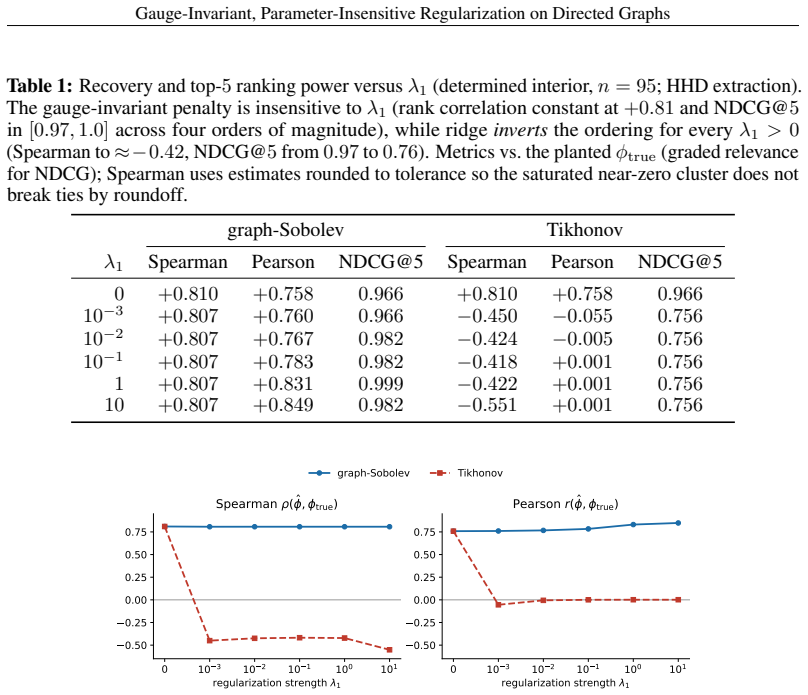
Standard ridge regularization actively inverts recovered potential orderings in flow-inverse problems, while a gauge-invariant graph Dirichlet energy keeps the ordering intact and stable across a wide range of regularization strength.
Reviewed by Pith at T0; open to challenge. T0 means a machine referee read the full paper against a public rubric. the ladder, T0–T4 →
Using the graph Dirichlet energy instead of an L2 penalty makes potential recovery from directed-flow divergence stable across four orders of magnitude in regularization strength, while ridge collapses and can reverse the ordering.
T0 review reviewed 2026-08-02 challenge →
load-bearing objection Real diagnosis and clean chain proofs, but the synthetic instrument's forward-model consistency is unproven and the 'every λ>0' claim overreaches. the 2 major comments →
Gauge-Invariant, Parameter-Insensitive Regularization for Potential Recovery from Flow on Directed Graphs
The pith
A machine-rendered reading of the paper's core claim, the machinery that carries it, and where it could break.
The reading
Core claim
On a directed Poisson inverse problem with Dirichlet boundaries, the standard ridge penalty (R = I) imposes a preferred mean-zero gauge that fights the boundary conditions, compressing interior potentials toward the abandon sink and eventually reversing the planted ordering (rank correlation drops from +0.81 to about −0.42). The graph Dirichlet energy, defined via the conductance-weighted graph Laplacian as φᵀL_Gφ = Σ w_uv(φ_v − φ_u)², is gauge-invariant because L_G 1 = 0; it penalizes differences rather than amplitude. With this penalty, the recovered potential retains rank correlation +0.807 and NDCG@5 between 0.97 and 1.0 across λ ∈ [10⁻³, 10], while ridge collapses to negative correlatio
What carries the argument
The graph Dirichlet energy (the graph H¹ seminorm) — the quadratic form φᵀ L_G φ = Σ_{u,v} w_uv(φ_v − φ_u)², built from the conductance-weighted undirected Laplacian of the support graph. Because L_G 1 = 0, this penalty is flat along the constant (gauge) mode, so it does not bias the solution toward any origin. It replaces the identity ridge penalty and is the mechanism that delivers gauge invariance and parameter-insensitivity.
Load-bearing premise
The observed flow counts can be treated as conductances in a gradient-flow constitutive law, so the empirical divergence is exactly the Poisson right-hand side and a single scalar potential is the correct latent object; if real flows carry large non-gradient or solenoidal components, the recovered potential and the regularizer contrast are artifacts of the model, not the data.
What would settle it
Run the synthetic instrument with an added solenoidal flow component (e.g., adding a divergence-free circulation to the planted gradient flow) at fixed λ. If the graph-Sobolev estimate's rank correlation against the planted potential drops substantially while ridge's negative plateau remains, the central contrast depends on the gradient assumption. More directly, on any real dataset with a known ground-truth potential, check whether ridge's Spearman correlation crosses zero for small λ: if it stays positive, the inversion claim fails.
If this is right
- Practitioners solving discrete Poisson inverse problems on directed graphs should avoid ridge regularization; the graph Dirichlet energy is a parameter-insensitive alternative that preserves whatever ordering the data supports.
- The Poisson residual — the mismatch between forward-predicted and empirical divergence — can reliably localize absorbing boundaries from flow data alone, even in multi-sink graphs where potential ranking fails.
- The same gauge-invariance principle applies to deep directed graph neural networks: neutralizing the constant mode per layer prevents oversmoothing, holding performance flat as depth increases.
- Longer chains help the Dirichlet-energy estimate retain dynamic range, whereas ridge collapses range independently of chain length.
- The recovered gauge-invariant potential is a usable node feature for downstream prediction, adding predictive signal where the ridge-collapsed potential adds none.
Where Pith is reading between the lines
- The gauge diagnosis likely generalizes beyond this specific forward model: any regularizer whose null space does not contain the gauge mode (the constant vector) will bias the solution toward an arbitrary origin, so the contrast may appear in other inverse problems with translation-invariant forward operators.
- Edge-preserving penalties that are also gauge-invariant (e.g., total variation or p-Laplacian) might yield the same parameter-insensitivity while additionally preserving sharp discontinuities; the paper mentions this as future work, and it is a natural testable extension.
- The paper's claim that the topological-sort extraction outperforms the Hodge projection suggests that the acyclic support need not be physically motivated; a cheaper, data-driven ordering may be sufficient, which could simplify deployment on large graphs.
- If the divergence field is dominated by solenoidal (non-gradient) flow, the entire potential-recovery framing may break down; a stress-test on synthetic flows with controlled curl would map the boundary of the method's validity.
Editorial analysis
A structured set of objections, weighed in public.
Referee Report
Summary. The paper studies regularized recovery of a latent potential from observed flow on a directed graph, formulated as a discrete Poisson inverse problem with Dirichlet boundaries. The authors claim that standard ridge (identity-seminorm Tikhonov) regularization does not merely degrade but actively inverts the recovered potential ordering for every positive regularization strength, whereas a gauge-invariant graph Dirichlet energy penalty preserves the ordering and renders the estimate parameter-insensitive across four orders of magnitude in λ. Theoretical results include gauge invariance of the penalty, an SPD reduced system under a path-to-boundary condition, and exact range preservation on chains. The paper validates the claims on a synthetic instrument with planted ground truth and on three clickstream corpora, and extends the gauge principle to a GNN oversmoothing application. The manuscript includes proofs, reproducible code, and an extraction ablation showing the main regularizer contrast is robust to the orientation method.
Significance. If the central claim holds, this is a significant and counterintuitive finding for graph inverse problems: the default regularizer can be not merely suboptimal but harmful, and a classical gauge-invariant penalty eliminates the pathology and the need to tune λ. The paper is well-organized, the theoretical statements are clearly separated from empirical evidence, and the released code supports reproducibility. The honest ablation showing that the Hodge projection is not load-bearing is a strength. However, the universal claim that ridge inverts for every λ>0 is not established and is contradicted by the paper's own real-data rank-agreement numbers, and the synthetic instrument's generative model is described too loosely to rule out misspecification. These issues currently weaken the central empirical contribution.
major comments (2)
- [Section 7, 'Synthetic Validation'] The generative process of the synthetic instrument is underspecified. The text says it 'plants a ground-truth potential, samples flow from it' and defines φ_true as the absorption probability of a funnel, but the estimator uses W_uv = F_uv and the constitutive law Eq. (1). If the flow is produced by simulating a Markov chain, the sampled F does not in general satisfy q_ij = W_ij(φ_j - φ_i) with W = F, so the Poisson solve is misspecified; the Spearman contrast (+0.81→-0.42) could then be an artifact of model mismatch. Please specify the generation mechanism and either verify that the data satisfy Lφ_true = b with W = F, or add an experiment with flow generated explicitly from Eq. (1) plus noise. This is load-bearing because the ridge-inversion claim rests entirely on this instrument.
- [Abstract; §5.7; Proposition 4; Table 5] The claim that ridge 'inverts the ordering for every λ>0' is not supported by the paper's own evidence. Proposition 4 only proves range collapse (Δ ≤ C/λ→0), not rank inversion. The inversion is demonstrated on one synthetic configuration (Table 1), and Table 5 contradicts a universal reading: on RetailRocket and Trivago at λ=1, ridge has positive rank agreement with the unregularized solve (1.000 and 0.833), i.e., it preserves the ordering there. The universal phrasing should be restricted to the synthetic instrument (or a class of graphs with stated conditions), or backed by a theorem. As written, the abstract and conclusion overclaim the generality of the main empirical result.
minor comments (5)
- [Abstract] The abstract states 'we prove the reduced solve is SPD' without the path-to-boundary condition required by Theorem 1. Please qualify the statement.
- [Throughout] The notation for the regularization strength is inconsistent: the abstract and some sections use λ while equations use λ_1. Unify.
- [§3] The sentence 'the empirical flow F_uv, used as the conductance W_uv = F_uv' is a strong modeling assumption. A brief justification or a caveat about when this is appropriate would help.
- [§8.4] The GNN extension is interesting but tangential. The phrase 'recovering PairNorm' overstates the connection; gauge-centering plus rescaling is essentially a PairNorm variant rather than a recovery from one principle.
- [§5.2] The penalty uses the symmetric Laplacian of the undirected support, while the forward operator is the directed Laplacian. The relation between the two null spaces (L1=0 vs. L_G 1=0) and the role of the boundary conditions could be clarified.
Circularity Check
No circularity: the regularizer contrast is an empirical result, not a definitional reduction.
full rationale
We walked the derivation chain: empirical flow F defines W and b (Section 3); the Poisson inverse problem L phi = b is a modeling assumption, not a consequence of the definitions of the regularizers. The gauge-invariance of the Dirichlet energy (Proposition 5, 'Since LG 1 = 0...') is a direct algebraic identity, not a self-fulfilling prediction. Theorem 1 (SPD) and Theorem 2 (range preservation on chains) are proved from the stated objectives and do not assume the target result. The headline claim — ridge inverts the recovered ordering while graph-Sobolev is stable — is an empirical observation on a synthetic instrument (Table 1, Figure 1) and is presented as such; Proposition 4 explicitly does not derive the inversion ('Proposition 4 does not claim the rank correlation tends to -1; empirically it settles to a negative plateau'). No parameter is fitted to the planted truth; lambda is swept and the claim is insensitivity. There are no self-citations and no uniqueness theorem imported from the authors' prior work. The strongest caveat — that setting W_uv = F_uv may not match the generative process of the synthetic funnel — is a model-misspecification/correctness risk, not a circular reduction: the recovered potential is not defined as the planted absorption probability. The paper's own scope statement ('The guarantee is preservation, not signal') is a limitation, not a circular step. Accordingly the circularity score is 0.
Axiom & Free-Parameter Ledger
free parameters (7)
- regularization strength lambda_1 =
swept 1e-3 to 10; not fitted
- dominance threshold rho =
2
- top-k pruning k =
10
- edge retention threshold tau =
per experiment (not tabulated)
- well-visited state threshold =
100 visits
- Spearman rounding tolerance =
numerical tolerance
- penalty trace normalization =
tr[(L_G)_II]
axioms (4)
- domain assumption Flows on the graph follow a gradient constitutive law q_ij = W_ij(phi_j - phi_i) with conductance W_uv = F_uv; the empirical divergence b is the corresponding Poisson right-hand side.
- domain assumption After dominance-orientation, the retained support G_delta is acyclic and its transition operator A is nilpotent.
- ad hoc to paper The gauge is fixed by pinning conversion sinks at 1 and the abandon sink at 0, and the target potential is the harmonic absorption probability.
- domain assumption The empirical divergence b is an unbiased (noisy) estimator of L phi.
Cite this review
Pith. "Pith review of Gauge-Invariant, Parameter-Insensitive Regularization for Potential Recovery from Flow on Directed Graphs." pith.science (2026). https://pith.science/paper/2MS2BZJ5
@misc{pith2026260713609,
  author       = {Pith},
  title        = {Pith review of: Gauge-Invariant, Parameter-Insensitive Regularization for Potential Recovery from Flow on Directed Graphs},
  year         = {2026},
  howpublished = {\url{https://pith.science/paper/2MS2BZJ5}},
  note         = {Machine review of arXiv:2607.13609}
}
abstract
Recovering a latent potential from observed flow on a directed graph (a discrete Poisson problem with Dirichlet boundaries) is ill-posed, and the standard fix backfires: ridge regularization shrinks toward a gauge-meaningless origin, collapsing and reversing the recovered ordering ($+0.81\to-0.42$ rank correlation against a planted ground truth). The gauge-invariant graph Dirichlet energy removes the hazard and delivers parameter-insensitivity: the estimate is stable across four orders of magnitude in $\lambda$, whereas ridge inverts the ordering for every $\lambda>0$. We prove the reduced solve is SPD and preserves dynamic range exactly where ridge collapses it, and localize absorbing boundaries from flow alone via a Poisson residual. The $H^1$ seminorm is classical; what is new is the gauge diagnosis, the parameter-insensitivity it buys, and an ablation showing the result is robust to the extraction method. On three public clickstream corpora the gauge-invariant estimate retains $28$--$41\%$ of the interior dynamic range while ridge collapses to as little as $0.2\%$. The same gauge invariance carries into graph neural networks -- neutralizing the constant mode per layer prevents the oversmoothing that collapses a deep directed GCN -- linking this classical inverse problem to a central question in graph learning.
Figures


Reference graph
Works this paper leans on
-
[1]
1977 , publisher =
Solutions of Ill-Posed Problems , author =. 1977 , publisher =
1977
-
[2]
1998 , publisher =
Rank-Deficient and Discrete Ill-Posed Problems: Numerical Aspects of Linear Inversion , author =. 1998 , publisher =
1998
-
[3]
Physica D: Nonlinear Phenomena , volume =
Nonlinear total variation based noise removal algorithms , author =. Physica D: Nonlinear Phenomena , volume =
-
[4]
1984 , publisher =
Random Walks and Electric Networks , author =. 1984 , publisher =
1984
-
[5]
IEEE Transactions on Pattern Analysis and Machine Intelligence , volume =
Random walks for image segmentation , author =. IEEE Transactions on Pattern Analysis and Machine Intelligence , volume =
-
[6]
Statistical ranking and combinatorial
Jiang, Xiaoye and Lim, Lek-Heng and Yao, Yuan and Ye, Yinyu , journal =. Statistical ranking and combinatorial
-
[7]
Lim, Lek-Heng , journal =
-
[8]
and Benson, Austin R
Schaub, Michael T. and Benson, Austin R. and Horn, Paul and Lippner, Gabor and Jadbabaie, Ali , journal =. Random walks on simplicial complexes and the normalized
-
[9]
IEEE Signal Processing Magazine , volume =
The emerging field of signal processing on graphs , author =. IEEE Signal Processing Magazine , volume =
-
[10]
Belkin, Mikhail and Niyogi, Partha , journal =
-
[11]
Semi-supervised learning using
Zhu, Xiaojin and Ghahramani, Zoubin and Lafferty, John , booktitle =. Semi-supervised learning using
-
[12]
Advances in Neural Information Processing Systems (NeurIPS) , volume =
Learning with local and global consistency , author =. Advances in Neural Information Processing Systems (NeurIPS) , volume =
-
[13]
Journal of Machine Learning Research , volume =
Trend filtering on graphs , author =. Journal of Machine Learning Research , volume =
-
[14]
Bodnar, Cristian and Di Giovanni, Francesco and Chamberlain, Benjamin P. and Li. Neural sheaf diffusion: A topological perspective on heterophily and oversmoothing in. Advances in Neural Information Processing Systems (NeurIPS) , volume =
-
[15]
Zhang, Xitong and He, Yixuan and Brugnone, Nathan and Perlmutter, Michael and Hirn, Matthew , journal =
-
[16]
He, Yixuan and Perlmutter, Michael and Reinert, Gesine and Cucuringu, Mihai , booktitle =
-
[17]
Proceedings of the 25th ACM SIGKDD International Conference on Knowledge Discovery and Data Mining (KDD) , pages =
Graph-based semi-supervised and active learning for edge flows , author =. Proceedings of the 25th ACM SIGKDD International Conference on Knowledge Discovery and Data Mining (KDD) , pages =
-
[18]
IEEE Global Conference on Signal and Information Processing (GlobalSIP) , pages =
Flow smoothing and denoising: Graph signal processing in the edge-space , author =. IEEE Global Conference on Signal and Information Processing (GlobalSIP) , pages =
-
[19]
Learning on Graphs Conference (LoG) , series =
Edge directionality improves learning on heterophilic graphs , author =. Learning on Graphs Conference (LoG) , series =
-
[20]
IEEE Signal Processing Magazine , volume =
Signal processing on directed graphs: The role of edge directionality when processing and learning from network data , author =. IEEE Signal Processing Magazine , volume =
-
[21]
Zhao, Lingxiao and Akoglu, Leman , booktitle =
-
[22]
Advances in Neural Information Processing Systems (NeurIPS) , year =
Dirichlet Energy Constrained Learning for Deep Graph Neural Networks , author =. Advances in Neural Information Processing Systems (NeurIPS) , year =
-
[23]
L aplacian eigenmaps for dimensionality reduction and data representation
Mikhail Belkin and Partha Niyogi. L aplacian eigenmaps for dimensionality reduction and data representation. Neural Computation, 15 0 (6): 0 1373--1396, 2003
2003
-
[24]
Chamberlain, Pietro Li \`o , and Michael M
Cristian Bodnar, Francesco Di Giovanni, Benjamin P. Chamberlain, Pietro Li \`o , and Michael M. Bronstein. Neural sheaf diffusion: A topological perspective on heterophily and oversmoothing in GNN s. In Advances in Neural Information Processing Systems (NeurIPS), volume 35, pages 18527--18541, 2022
2022
-
[25]
Doyle and J
Peter G. Doyle and J. Laurie Snell. Random Walks and Electric Networks. Carus Mathematical Monographs. Mathematical Association of America, 1984
1984
-
[26]
Random walks for image segmentation
Leo Grady. Random walks for image segmentation. IEEE Transactions on Pattern Analysis and Machine Intelligence, 28 0 (11): 0 1768--1783, 2006
2006
-
[27]
Rank-Deficient and Discrete Ill-Posed Problems: Numerical Aspects of Linear Inversion
Per Christian Hansen. Rank-Deficient and Discrete Ill-Posed Problems: Numerical Aspects of Linear Inversion. SIAM, Philadelphia, 1998
1998
-
[28]
MSGNN : A spectral graph neural network based on a novel magnetic signed L aplacian
Yixuan He, Michael Perlmutter, Gesine Reinert, and Mihai Cucuringu. MSGNN : A spectral graph neural network based on a novel magnetic signed L aplacian. In Learning on Graphs Conference (LoG), volume 198 of PMLR, 2022
2022
-
[29]
Schaub, Santiago Segarra, and Austin R
Junteng Jia, Michael T. Schaub, Santiago Segarra, and Austin R. Benson. Graph-based semi-supervised and active learning for edge flows. In Proceedings of the 25th ACM SIGKDD International Conference on Knowledge Discovery and Data Mining (KDD), pages 761--771, 2019
2019
-
[30]
Statistical ranking and combinatorial H odge theory
Xiaoye Jiang, Lek-Heng Lim, Yuan Yao, and Yinyu Ye. Statistical ranking and combinatorial H odge theory. Mathematical Programming, 127 0 (1): 0 203--244, 2011
2011
-
[31]
H odge L aplacians on graphs
Lek-Heng Lim. H odge L aplacians on graphs. SIAM Review, 62 0 (3): 0 685--715, 2020
2020
-
[32]
Marques, Santiago Segarra, and Gonzalo Mateos
Antonio G. Marques, Santiago Segarra, and Gonzalo Mateos. Signal processing on directed graphs: The role of edge directionality when processing and learning from network data. IEEE Signal Processing Magazine, 37 0 (6): 0 99--116, 2020
2020
-
[33]
Bronstein
Emanuele Rossi, Bertrand Charpentier, Francesco Di Giovanni, Fabrizio Frasca, Stephan G \"u nnemann, and Michael M. Bronstein. Edge directionality improves learning on heterophilic graphs. In Learning on Graphs Conference (LoG), volume 231 of PMLR, 2023
2023
-
[34]
Rudin, Stanley Osher, and Emad Fatemi
Leonid I. Rudin, Stanley Osher, and Emad Fatemi. Nonlinear total variation based noise removal algorithms. Physica D: Nonlinear Phenomena, 60 0 (1--4): 0 259--268, 1992
1992
-
[35]
Schaub and Santiago Segarra
Michael T. Schaub and Santiago Segarra. Flow smoothing and denoising: Graph signal processing in the edge-space. In IEEE Global Conference on Signal and Information Processing (GlobalSIP), pages 735--739, 2018
2018
-
[36]
Schaub, Austin R
Michael T. Schaub, Austin R. Benson, Paul Horn, Gabor Lippner, and Ali Jadbabaie. Random walks on simplicial complexes and the normalized H odge 1- L aplacian. SIAM Review, 62 0 (2): 0 353--391, 2020
2020
-
[37]
Shuman, Sunil K
David I. Shuman, Sunil K. Narang, Pascal Frossard, Antonio Ortega, and Pierre Vandergheynst. The emerging field of signal processing on graphs. IEEE Signal Processing Magazine, 30 0 (3): 0 83--98, 2013
2013
-
[38]
Tikhonov and Vasiliy Y
Andrey N. Tikhonov and Vasiliy Y. Arsenin. Solutions of Ill-Posed Problems. Winston & Sons, Washington, D.C., 1977
1977
-
[39]
Smola, and Ryan J
Yu-Xiang Wang, James Sharpnack, Alexander J. Smola, and Ryan J. Tibshirani. Trend filtering on graphs. Journal of Machine Learning Research, 17 0 (105): 0 1--41, 2016
2016
-
[40]
M ag N et: A neural network for directed graphs
Xitong Zhang, Yixuan He, Nathan Brugnone, Michael Perlmutter, and Matthew Hirn. M ag N et: A neural network for directed graphs. Advances in Neural Information Processing Systems (NeurIPS), 34: 0 27003--27015, 2021
2021
-
[41]
PairNorm : Tackling oversmoothing in GNN s
Lingxiao Zhao and Leman Akoglu. PairNorm : Tackling oversmoothing in GNN s. In International Conference on Learning Representations (ICLR), 2020
2020
-
[42]
Lal, Jason Weston, and Bernhard Sch \"o lkopf
Dengyong Zhou, Olivier Bousquet, Thomas N. Lal, Jason Weston, and Bernhard Sch \"o lkopf. Learning with local and global consistency. In Advances in Neural Information Processing Systems (NeurIPS), volume 16, pages 321--328, 2004
2004
-
[43]
Dirichlet energy constrained learning for deep graph neural networks
Kaixiong Zhou, Xiao Huang, Daochen Zha, Rui Chen, Li Li, Soo-Hyun Choi, and Xia Hu. Dirichlet energy constrained learning for deep graph neural networks. In Advances in Neural Information Processing Systems (NeurIPS), 2021
2021
-
[44]
Semi-supervised learning using G aussian fields and harmonic functions
Xiaojin Zhu, Zoubin Ghahramani, and John Lafferty. Semi-supervised learning using G aussian fields and harmonic functions. In Proceedings of the 20th International Conference on Machine Learning (ICML), pages 912--919, 2003
2003
This paper was first reviewed by deepseek-v4-flash on August 2, 2026.
discussion (0)
Sign in with ORCID, Apple, or X to comment. Anyone can read and Pith papers without signing in.