REVIEW 3 major objections 4 minor 64 references
This paper claims that in tau decays to two vector mesons, the longitudinal polarization fraction f_L deviates substantially from the universal Lorentz-symmetry endpoint value of 1/3, and computes these deviations for five decay channels.
Reviewed by Pith at T0; open to challenge. T0 means a machine referee read the full paper against a public rubric. the ladder, T0–T4 →
T0 review · deepseek-v4-flash
2026-08-02 03:50 UTC pith:Z3GB6ACC
load-bearing objection New f_L predictions for five tau-to-VV modes, presented honestly, but the headline rho-omega deviation from 1/3 rests on the least-certain input — the a1-rho-omega vertex — so treat the numbers as model-limited and require the supplemental material before publication. the 3 major comments →
Polarized observables in τ to VV ν_(τ) decays
The pith
A machine-rendered reading of the paper's core claim, the machinery that carries it, and where it could break.
Core claim
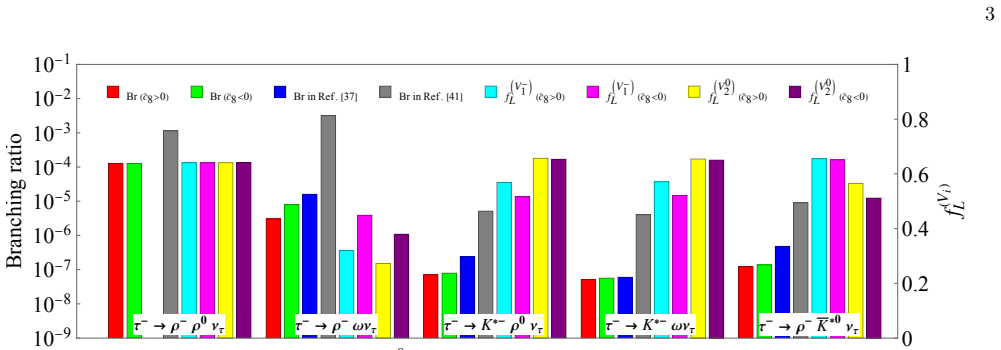
Working in the generalized hidden local symmetry framework, the authors compute the full hadronic helicity amplitudes for tau^- -> V1^- V2 nu_tau, keeping four contributions: an axial-vector meson intermediate state, a pseudoscalar pole, a nonresonant coupling, and a vector meson intermediate state. They show that the endpoint relation f_L = 1/3 holds exactly only at Q^2 = (m_V1 + m_V2)^2, where the vector mesons are produced at rest; once the phase-space integral over Q^2 up to m_tau^2 is done, the values shift. Their Fig. 3 gives branching fractions and f_L for (rho^-,rho^0), (rho^-,omega), (K*^-,rho^0), (K*^-,omega), and (rho^-,K*^0), with f_L in the ranges 0.51-0.66 for channels with the
What carries the argument
Hadronic helicity amplitudes for the five channels, built from four diagram types: axial-vector meson exchange, pseudoscalar pole, nonresonant contact term, and vector-meson pole, evaluated in the generalized hidden local symmetry (GHLS) Lagrangian, a chiral effective theory in which rho and omega as well as a1 and K1 are treated as dynamical gauge fields. The decisive object is the anomalous a1-rho-omega vertex, whose momentum dependence is fixed in GHLS to be proportional to (p1-p2); together with the sign-undetermined coupling c8_tilde, extracted from a recent D_s -> rho-omega measurement, it controls the largest model uncertainty in the f_L predictions.
Load-bearing premise
The calculation leans on a specific, momentum-dependent form of the axial-vector meson's coupling to rho and omega; if the alternative simplified form used in some tau simulations is the correct one, the predicted branching fractions and polarizations change by orders of magnitude.
What would settle it
Measure Br(tau^- -> rho^- omega nu_tau) and f_L for that channel at an e+e- flavor factory. The GHLS treatment used here predicts Br around 10^-5 with f_L in the 0.27-0.45 window; the alternative vertex structure predicts Br around 10^-2 with f_L near 0.34. A measurement near 10^-2 would falsify the paper's central prediction.
If this is right
- f_L is not pinned to 1/3 in tau-to-VV decays; the phase-space integral generates corrections of order tens of percent, so the endpoint approximation cannot be used as a precise prediction at the tau mass scale.
- Channels with a vector-meson pole diagram are predicted to have f_L between 0.51 and 0.66, clearly above the endpoint value, while the rho-omega-nu channel sits between 0.27 and 0.45 depending on the sign of c8_tilde.
- A single measurement of Br(tau^- -> rho^- omega nu_tau) distinguishes the GHLS a1-rho-omega vertex from the alternative structure: approximately 10^-5 versus 10^-2.
- Future flavor-factory measurements of f_L for tau-to-VV decays would constrain the a1-rho-omega coupling and provide an independent check on the D-to-VV polarization puzzle, where measured f_L values also deviate strongly from 1/3.
Where Pith is reading between the lines
- If the GHLS vertex treatment is correct, existing tau-to-five-pion simulation codes that use the (p1-p2)^0 a1-rho-omega vertex may overestimate tau^- -> rho^- omega nu_tau backgrounds by two to three orders of magnitude, which could affect how tau hadronic channels are modeled at flavor factories.
- Because the sign of c8_tilde is not fixed by D_s -> rho omega, the rho-omega channel offers a practical way to measure that sign: positive c8 pushes f_L to the upper part of the range and negative to the lower part; a differential measurement in Q^2 would sharpen this further.
- The same helicity formalism could be applied to tau decays into an axial-vector meson plus a vector meson, which would test whether the deviation pattern seen here is generic or specific to the VVA vertex.
- The paper's method suggests a quantitative criterion for when the endpoint limit is reliable: the deviation is controlled by u_tau(Q^2_max) = (m_V1 + m_V2)^2 / m_tau^2, which ranges from 0.76 to 0.89 for the five channels. Measuring f_L as a function of Q^2 would directly map how corrections build up away from the endpoint.
Editorial analysis
A structured set of objections, weighed in public.
Referee Report
Summary. The manuscript computes branching fractions and longitudinal polarization fractions f_L for five tau -> V1 V2 nu_tau channels (rho-rho, rho-omega, K*-rho, K*-omega, rho-K*0) in the generalized hidden local symmetry (GHLS) framework. Using helicity amplitudes, the authors find f_L values that deviate from the Lorentz-symmetry endpoint value 1/3, and they argue that these deviations are nonnegligible at the tau-mass scale, in contrast to the commonly used endpoint approximation. Branching fractions are compared with effective chiral model and angular-momentum-algebra predictions. The paper also emphasizes that tau -> V V nu_tau has seven nonvanishing helicity configurations, unlike D -> V V which has three.
Significance. If the predictions are reliable, the paper provides a new, potentially testable observable at Belle II and connects the tau-scale hadronization with the D -> V V polarization puzzle. The careful helicity formalism and the explicit demonstration that f_L = 1/3 at the kinematical endpoint but not elsewhere are useful conceptual contributions. A strength is that the free couplings are calibrated to external inputs (HLS parameters and a BESIII branching ratio) rather than fitted to f_L data, so the claim of model calibration rather than circular reasoning is justified. However, the present numerical impact is limited by the reliance on unpublished Supplemental Material, by a model-dependent axial-vector vertex choice, and by the absence of uncertainty propagation.
major comments (3)
- [Angular distributions and text near Eq. (10)] The core derivations are not self-contained: Eqs. (4)â(6), (C1)â(C5), and the calibration |tilde c8| = 2.7e-2 from BESIII are all placed in Supplemental Material Ref. [48], which is not included. These expressions and the extraction of the a1-rho-omega coupling are load-bearing for every numerical result in Figs. 3 and 4. Without the supplement, the central f_L and branching-fraction predictions cannot be reproduced or checked. The paper should either include these derivations in an appendix or provide the supplement with the submission.
- [Eq. (9) and Eqs. (D11)â(D17)] The axial-vector intermediate-state contribution, Fig. 2(a), is not robustly fixed. The GHLS vertex T^(a)_GHLS is proportional to (p1-p2)^1, while the TAUOLA-based vertex T^(a)_TAUOLA is proportional to (p1-p2)^0. The authors reject the latter because it is absent from a parity/C/hermiticity-invariant GHLS Lagrangian, but this statement is asserted rather than demonstrated, and Ref. [52] is a published TAUOLA analysis. Moreover, Footnote [63] notes that Ref. [52] itself contains both structures and adopts the (p1-p2)^0 form only for simplicity. The numerical consequences are large: the TAUOLA form gives Br[tau->rho omega nu] = O(1)% and f_L ~ 0.34, near the endpoint value. Since the rho-omega channel is discussed as a key illustration, the vertex ambiguity must be resolved or quantified.
- [Fig. 3 and Fig. 4] No uncertainties are propagated. The HLS parameters g=6.00, c3=0.61, a=2.07 are quoted without errors or fit ranges; the K1 mixing angle theta_K1 is set to 34 degrees with only a claim of weak sensitivity; and only the sign of tilde c8 is varied. The central claim that f_L deviates nonnegligibly from 1/3 needs a significance statement. For example, the range 0.51 <= f_L <= 0.66 for channels with Fig. 2(d) is a prediction, but the reader cannot tell whether this range is robust under the quoted parameter uncertainties. Please provide an error propagation or a scan over the allowed parameter space.
minor comments (4)
- [General] There is a typo: 'pamameters' should be 'parameters'.
- [Ref. [48]] The Supplemental Material is referenced as '[URL will be inserted by publisher]'. This must be replaced with a working link or an appendix in the final version.
- [Footnote [63]] The statement that Ref. [52] also contains (p1-p2)^1 structures is important and could be moved to the main text, since it directly bears on the vertex-ambiguity discussion around Eq. (9).
- [End Matter / Table II] The counting of helicity configurations is useful, but the text could state more explicitly that the seven configurations in tau decays are a consequence of the three-body phase space and the V-A current structure, not of the specific hadronic model.
Circularity Check
No significant circularity: parameter calibration to external BESIII data and explicit model ambiguity are not circular reductions.
full rationale
The derivation is not circular. The hadronic helicity amplitudes in Eqs. (D1)-(D8, D11-D15) are constructed from the (G)HLS Lagrangian [29,32,51] with parameters (g,c3,a)=(6.00,0.61,2.07) taken from earlier HLS phenomenology [32] and |c8|=2.7e-2 fixed from the external BESIII measurement Br(D_s+→rho+omega)=0.99e-2 [59], with the extraction deferred to the authors' Supplemental Material [48]. This is model calibration to a different process, not a fit to the tau→VV f_L observables being predicted. The central quantity f_L is computed from K integrals (Eqs. (C1)-(C6)) over the hadronic invariant mass Q^2; the endpoint value 1/3 in Eq. (13) is a kinematical identity at Q^2=Q^2_min and is not used as an input for Fig. 3. The axial-vector vertex choice T_GHLS vs T_TAUOLA is a model ambiguity explicitly quantified (Eq. (9), Eq. (D17)); the authors choose GHLS on Lagrangian grounds [51] and report the TAUOLA alternative, which shifts f_L(rho-omega) to 0.34 near the endpoint. This exposes model dependence, not circular reasoning. The only transparency caveat is that the |c8| derivation is not included in the main text ([48]); that is an omitted-proof / external-benchmark issue, not a definitional reduction, so it does not raise the circularity score.
Axiom & Free-Parameter Ledger
free parameters (5)
- g (HLS gauge coupling) =
6.00
- c3 (HLS parameter) =
0.61
- a (HLS parameter) =
2.07
- tilde c8 (GHLS anomalous VVA coupling) =
|tilde c8|=2.7e-2; sign undetermined
- theta_K1 (K1 mixing angle) =
34 degrees
axioms (6)
- domain assumption SM charged current is purely left-handed V-A: J_q^mu = \bar q gamma^mu(1-gamma5)u
- standard math Endpoint relation f_L=1/3 at Q^2=Q^2_min (Eq. 13) holds exactly
- domain assumption GHLS provides the correct a1rho omega vertex; TAUOLA's T^(a) proportional to (p1-p2)^0 is absent in a parity/charge-conjugation/hermitian GHLS Lagrangian
- domain assumption G-parity conservation selects the nonzero diagrams for rho-rho0 and rho-omega
- domain assumption Large-N_c limit justifies extracting |tilde c8| from a single measured BESIII branching ratio Br(D_s+ -> rho+ omega)
- domain assumption Zero-width vector mesons and no rho-omega interference in the phase-space integrals
read the original abstract
We study polarization observables in $\tau^- \to V_1^- V_2^0 \nu_\tau$ decays for $(V_1^-, V_2^0)=(\rho^-, \rho^0), (\rho^-, \omega), (K^{*-}, \rho^0), (K^{*-}, \omega), (\rho^-, \bar{K}^{*0})$ using the helicity formalism within the generalized hidden local symmetry framework. The predicted branching fractions are comparable with those from the effective chiral model, but smaller than those from the angular momentum algebra model. Our results for the longitudinal polarization fractions $f_L$ indicate that nonnegligible corrections to the endpoint limit ($f_L = 1/3$), a consequence of Lorentz symmetry, are present at the scale of tau mass. Future measurements of $f_L$ at Belle II for $\tau^- \to V_1^- V_2^0 \nu_\tau$ decays will provide crucial information on polarization patterns observed in nonleptonic charm decays.
Figures



Reference graph
Works this paper leans on
-
[1]
Coffmanet al.(MARK-III Collaboration), Resonant substructure in ¯Kπππdecays ofDmesons, Phys
D. Coffmanet al.(MARK-III Collaboration), Resonant substructure in ¯Kπππdecays ofDmesons, Phys. Rev. D45, 2196 (1992)
1992
-
[2]
J. M. Linket al.(FOCUS Collaboration), Study of the D0 →π −π+π−π+ decay, Phys. Rev. D75, 052003 (2007)
2007
-
[3]
Ablikimet al.(BESIII Collaboration), First Measure- ment of Polarizations in the DecayD 0 →ωϕ, Phys
M. Ablikimet al.(BESIII Collaboration), First Measure- ment of Polarizations in the DecayD 0 →ωϕ, Phys. Rev. Lett.128, 011803 (2022)
2022
-
[4]
M. Ablikimet al.(BESIII Collaboration), Amplitude analysis and branching fraction measurement of the de- cayD 0 →K +K −π0π0, arXiv:2603.25649
-
[5]
A. Ali, J. G. K¨ orner, G. Kramer and J. Willrodt, Non- leptonic Weak Decays of Bottom Mesons, Z. Phys. C1, 269 (1979)
1979
-
[6]
Aubertet al.(BABARCollaboration), Measurement of theB 0 →ϕK 0 decay amplitudes, Phys
B. Aubertet al.(BABARCollaboration), Measurement of theB 0 →ϕK 0 decay amplitudes, Phys. Rev. Lett.93, 231804 (2004)
2004
-
[7]
K. F. Chenet al.(Belle Collaboration), Measurement of polarization and triple-product correlations inB→ϕK ∗ decays, Phys. Rev. Lett.94, 221804 (2005)
2005
-
[8]
Aubertet al.(BABARCollaboration), Vector-tensor and vector-vector decay amplitude analysis ofB 0 → φK ∗0, Phys
B. Aubertet al.(BABARCollaboration), Vector-tensor and vector-vector decay amplitude analysis ofB 0 → φK ∗0, Phys. Rev. Lett.98, 051801 (2007)
2007
-
[9]
Aubertet al.(BABARCollaboration), Amplitude Analysis of theB ± →φK ∗(892)± Decay, Phys
B. Aubertet al.(BABARCollaboration), Amplitude Analysis of theB ± →φK ∗(892)± Decay, Phys. Rev. Lett.99, 201802 (2007)
2007
-
[10]
Aubertet al.(BABARCollaboration), Time- Dependent and Time-Integrated Angular Analysis of B→φK 0 Sπ0 andφK ±π∓, Phys
B. Aubertet al.(BABARCollaboration), Time- Dependent and Time-Integrated Angular Analysis of B→φK 0 Sπ0 andφK ±π∓, Phys. Rev. D78, 092008 (2008)
2008
-
[11]
Aaijet al.(LHCb Collaboration), First observation of the decayB 0 s →ϕ ¯K ∗0, J
R. Aaijet al.(LHCb Collaboration), First observation of the decayB 0 s →ϕ ¯K ∗0, J. High Energy Phys. 11 (2013) 092
2013
-
[12]
Primet al.(Belle Collaboration), Angular analysis of B0 →ϕK ∗ decays and search forCPviolation at Belle, Phys
M. Primet al.(Belle Collaboration), Angular analysis of B0 →ϕK ∗ decays and search forCPviolation at Belle, Phys. Rev. D88, 072004 (2013)
2013
-
[13]
Aaijet al.(LHCb Collaboration), Measurement of polarization amplitudes and CP asymmetries inB 0 → ϕK ∗(892)0, J
R. Aaijet al.(LHCb Collaboration), Measurement of polarization amplitudes and CP asymmetries inB 0 → ϕK ∗(892)0, J. High Energy Phys. 05 (2014) 069
2014
-
[14]
Navaset al.(Particle Data Group), Review of particle physics, Phys
S. Navaset al.(Particle Data Group), Review of particle physics, Phys. Rev. D110, 030001 (2024)
2024
-
[15]
H. Y. Cheng and C. W. Chiang, Updated analysis of D→P P, V P, andV Vdecays: Implications forK 0 S −K 0 L asymmetries andD 0 − ¯D0 mixing, Phys. Rev. D109, 073008 (2024)
2024
-
[16]
Hiller and R
G. Hiller and R. Zwicky, (A)symmetries of weak decays at and near the kinematic endpoint, J. High Energy Phys. 03 (2014) 042
2014
-
[17]
Hiller and R
G. Hiller and R. Zwicky, Endpoint relations for baryons, J. High Energy Phys. 11 (2021) 073
2021
-
[18]
Zwicky, Endpoint symmetries of helicity amplitudes, Nucl
R. Zwicky, Endpoint symmetries of helicity amplitudes, Nucl. Phys. B975, 115673 (2022)
2022
-
[19]
Y. Cao, Y. Cheng and Q. Zhao, Resolving the polariza- tion puzzles inD 0 →V V, Phys. Rev. D109, 073002 (2024)
2024
-
[20]
J. Ou-Yang, H. Zheng, R. H. Li and S. H. Zhou, Precise theoretical prediction on branching fractions and polar- izations ofD→V Vdecays, arXiv:2604.01008
-
[21]
Jacob and G
M. Jacob and G. C. Wick, On the General Theory of Collisions for Particles with Spin, Ann. Phys. (Berlin)7, 404 (1959)
1959
-
[22]
J. D. Richman, An Experimenter’s Guide to the Helicity Formalism, California Institute of Technology, Pasadena, California, Report No. CALT-68-1148
-
[23]
Dunietz, H
I. Dunietz, H. R. Quinn, A. Snyder, W. Toki and H. J. Lipkin, How to extract CP violating asymmetries from angular correlations, Phys. Rev. D43, 2193 (1991)
1991
-
[24]
Kramer and W
G. Kramer and W. F. Palmer, Branching ratios and CP asymmetries in the decayB→V V, Phys. Rev. D45, 193 (1992)
1992
-
[25]
A. S. Dighe, I. Dunietz, H. J. Lipkin and J. L. Rosner, Angular Distributions and Lifetime Differences inB s → J/ψϕDecays, Phys. Lett. B369, 144 (1996)
1996
-
[26]
J. G. K¨ orner and G. A. Schuler, Exclusive Semileptonic Heavy Meson Decays Including Lepton Mass Effects, Z. Phys. C46, 93 (1990)
1990
-
[27]
Fajfer, J
S. Fajfer, J. F. Kamenik and I. Nisandzic, On theB→ D∗τ¯ντ Sensitivity to New Physics, Phys. Rev. D85, 094025 (2012)
2012
-
[28]
Kadeer, J
A. Kadeer, J. G. K¨ orner and U. Moosbrugger, Helicity analysis of semileptonic hyperon decays including lepton mass effects, Eur. Phys. J. C59, 27 (2009)
2009
-
[29]
Bando, T
M. Bando, T. Fujiwara and K. Yamawaki, Generalized Hidden Local Symmetry and the A1 Meson, Prog. Theor. Phys.79, 1140 (1988)
1988
-
[30]
Bando, T
M. Bando, T. Kugo, S. Uehara, K. Yamawaki and T. Yanagida, Is rho Meson a Dynamical Gauge Boson of Hidden Local Symmetry?, Phys. Rev. Lett.54, 1215 (1985)
1985
-
[31]
Bando, T
M. Bando, T. Kugo and K. Yamawaki, Nonlinear Real- ization and Hidden Local Symmetries, Phys. Rept.164, 217 (1988)
1988
-
[32]
Harada and K
M. Harada and K. Yamawaki, Hidden local symmetry at loop: A New perspective of composite gauge boson and chiral phase transition, Phys. Rept.381, 1 (2003)
2003
-
[33]
Ecker, J
G. Ecker, J. Gasser, A. Pich and E. de Rafael, The Role of Resonances in Chiral Perturbation Theory, Nucl. Phys. B321, 311 (1989)
1989
-
[34]
Ecker, J
G. Ecker, J. Gasser, H. Leutwyler, A. Pich and E. de Rafael, Chiral Lagrangians for Massive Spin 1 Fields, Phys. Lett. B223, 425 (1989)
1989
-
[35]
B. A. Li,U(2) L ×U(2) R chiral theory of mesons, Phys. Rev. D52, 5165 (1995)
1995
-
[36]
B. A. Li,U(3) L ×U(3) R chiral theory of mesons, Phys. Rev. D52, 5184 (1995)
1995
-
[37]
B. A. Li, Tau mesonic decays and strong anomaly of PCAC, Phys. Rev. D55, 1425 (1997)
1997
-
[38]
B. A. Li, Theory of tau mesonic decays, Phys. Rev. D 55, 1436 (1997)
1997
-
[39]
Kimura, K
D. Kimura, K. Y. Lee and T. Morozumi, The Form fac- tors ofτ→Kπ(η)νand the predictions for CP violation 6 beyond the standard model, Prog. Theor. Exp. Phys. 2013, 053B03 (2013);2013, 099201(E) (2013);2014, 089202(E) (2014)
2013
-
[40]
Kimura, T
D. Kimura, T. Morozumi and H. Umeeda, Analysis of Dalitz decays with intrinsic parity violating interactions in resonance chiral perturbation theory, Prog. Theor. Exp. Phys.2018, 123B02 (2018)
2018
-
[41]
L. R. Dai, R. Pavao, S. Sakai and E. Oset,τ − → ντ M1M2, withM 1, M2 pseudoscalar or vector mesons, Eur. Phys. J. A55, 20 (2019)
2019
-
[42]
L. R. Dai, L. Roca and E. Oset,τdecay into a pseu- doscalar and an axial-vector meson, Phys. Rev. D99, 096003 (2019)
2019
-
[43]
L. R. Dai, L. Roca and E. Oset, Tau decay intoν τ and a1(1260),b 1(1235), and twoK 1(1270), Eur. Phys. J. C 80, 673 (2020)
2020
-
[44]
J. H. K¨ uhn and E. Mirkes, Structure functions in tau decays, Z. Phys. C56, 661 (1992);67, 364(E) (1995)
1992
-
[45]
Decker and E
R. Decker and E. Mirkes, Angular distributions in the τ→ν τ ωπdecay mode, Z. Phys. C57, 495 (1993)
1993
-
[46]
Decker, E
R. Decker, E. Mirkes, R. Sauer and Z. W¸ as, Tau de- cays into three pseudoscalar mesons, Z. Phys. C58, 445 (1993)
1993
-
[47]
J. H. K¨ uhn and E. Mirkes, CP violation in semileptonic tau decays with unpolarized beams, Phys. Lett. B398, 407 (1997)
1997
-
[48]
(4)- (6), Eqs
See Supplemental Material at [URL will be inserted by publisher] for detailed procedure for obtaining Eqs. (4)- (6), Eqs. (C1)-(C5), and the value ofa 1ρωcoupling con- stant in GHLS
-
[49]
Cabibbo, Unitary Symmetry and Leptonic Decays, Phys
N. Cabibbo, Unitary Symmetry and Leptonic Decays, Phys. Rev. Lett.10, 531 (1963)
1963
-
[50]
Kobayashi and T
M. Kobayashi and T. Maskawa, CP Violation in the Renormalizable Theory of Weak Interaction, Prog. Theor. Phys.49, 652 (1973)
1973
-
[51]
Kaiser and U
N. Kaiser and U. G. Meissner, Generalized hidden sym- metry for low-energy hadron physics, Nucl. Phys. A519, 671 (1990)
1990
-
[52]
J. H. K¨ uhn and Z. W¸ as, tau decays to five mesons in TAUOLA, Acta Phys. Pol. B39, 147 (2008)
2008
-
[53]
J. A. Harvey, C. T. Hill and R. J. Hill, Standard Model Gauging of the Wess-Zumino-Witten Term: Anomalies, Global Currents and pseudo-Chern-Simons Interactions, Phys. Rev. D77, 085017 (2008)
2008
-
[54]
H. Y. Cheng, Revisiting Axial-Vector Meson Mixing, Phys. Lett. B707, 116 (2012)
2012
-
[55]
Hayasaka, Z
K. Hayasaka, Z. Huang and E. Kou, The hadronicτde- cayτ − →K − 1 ντ →(K −ω)ντ →(K −π+π−π0)ντ and the axial vector mixing angle, Eur. Phys. J. C81, 502 (2021)
2021
-
[56]
Bramon, A
A. Bramon, A. Grau and G. Pancheri, Radiative vec- tor meson decays in SU(3) broken effective chiral La- grangians, Phys. Lett. B344, 240 (1995)
1995
-
[57]
Hashimoto, Hidden local symmetry for anomalous processes with isospin- and SU(3)-breaking effects, Phys
M. Hashimoto, Hidden local symmetry for anomalous processes with isospin- and SU(3)-breaking effects, Phys. Rev. D54, 5611 (1996)
1996
-
[58]
Harada, S
M. Harada, S. Matsuzaki and K. Yamawaki, Anomalous ω-Z-γVertex from Hidden Local Symmetry, Phys. Rev. D84, 036010 (2011)
2011
-
[59]
Ablikimet al.(BESIII Collaboration), Observation of theW-annihilation processD + s →ωρ + and measurement ofD + s →ϕρ + inD + s →π +π+π−π0π0 decays, Phys
M. Ablikimet al.(BESIII Collaboration), Observation of theW-annihilation processD + s →ωρ + and measurement ofD + s →ϕρ + inD + s →π +π+π−π0π0 decays, Phys. Rev. Lett.134, 201902 (2025)
2025
-
[60]
Aokiet al.(Flavour Lattice Averaging Group (FLAG)), Phys
Y. Aokiet al.(Flavour Lattice Averaging Group (FLAG)), Phys. Rev. D113, 014508 (2026)
2026
-
[61]
Buchalla, A
G. Buchalla, A. J. Buras and M. E. Lautenbacher, Weak Decays beyond Leading Logarithms, Rev. Mod. Phys.68, 1125 (1996)
1996
-
[62]
Sinceρ − andωare respectively even and odd inG-parity, they multiplicatively give aG-parity odd final state
-
[63]
[52],a 1ρωinteraction structures that include the p1 −p 2 factor are also introduced
In Ref. [52],a 1ρωinteraction structures that include the p1 −p 2 factor are also introduced. However, the one pro- portional to (p 1 −p 2)0 is adopted in that reference for simplicity. End Matter Process dependence of polarized configurations—For channels including vector meson(s) in the final state, pos- sible configurations of polarizations are differe...
-
[64]
As for the Lorentz-scalar objects in Eq
(GHLS [51]) Lagrangian. As for the Lorentz-scalar objects in Eq. (8), expressions are given by (ϵ µνρσ repre- sents totally antisymmetric tensor) T (a) =T (c) − ϵ·Q m2 A ˜T (b),(D11) ˜T (b) =−iϵ µναβ Qµ(p1 −p 2)νϵ∗ 1αϵ∗ 2β,(D12) T (b) = ϵ·Q Q2 −m 2 P ˜T (b),(D13) T (c) =−iϵ µναβ ϵµ(p1 −p 2)νϵ∗ 1αϵ∗ 2β,(D14) T (d) =ϵ µ 2(p2 ·ϵ ∗ 1)ϵ∗µ 2 −2(p 1 ·ϵ ∗ 2)ϵ∗µ 1...
discussion (0)
Sign in with ORCID, Apple, or X to comment. Anyone can read and Pith papers without signing in.