REVIEW 3 major objections 4 minor 80 references
Sliding one layer of twisted multilayer MoTe2 can switch a fractional Chern insulator into a charge density wave, and the authors trace this to the band's quantum geometry rather than its width.
Reviewed by Pith at T0; open to challenge. T0 means a machine referee read the full paper against a public rubric. the ladder, T0–T4 →
T0 review · deepseek-v4-flash
2026-08-02 03:38 UTC pith:AS43POF5
load-bearing objection A solid ED study arguing sliding tunes FCI stability via quantum geometry; the flat-band test is the key control, but the decisive non-FCI point sits where the single-band projection is least reliable. the 3 major comments →
Fractional Chern insulators in alternating twisted multilayer MoTe₂
The pith
A machine-rendered reading of the paper's core claim, the machinery that carries it, and where it could break.
Core claim
In alternating twisted trilayer and tetralayer MoTe2, sliding the top layer and applying a displacement field tunes the band structure of the topmost hole band. Exact diagonalization at 1/3 filling reveals that for some parameter sets (e.g., trilayer with θ=3.0°, D=10 meV, δ=0) the system exhibits three quasi-degenerate ground states with spectral flow, signatures of an FCI, while for others (e.g., δ=0.5a1) the same topological band instead favors a CDW. The paper attributes this contrast to differences in the quantum geometric tensor, specifically the trace condition T = (1/2π)∫dk [Tr g(k) − |Ωxy(k)|], which increases with sliding and correlates with FCI destruction. A flat-band test that r
What carries the argument
The key object is the trace condition T, a single scalar that quantifies the deviation of the band's quantum geometry from an ideal Landau level. It is defined in terms of the Fubini-Study metric g(k) and Berry curvature Ω(k). The authors use exact diagonalization of the projected many-body Hamiltonian onto the topmost hole band, and they isolate geometry's role by a flat-band Hamiltonian that drops kinetic energy while keeping the same single-particle eigenstates. This lets them compare FCI vs CDW behavior while bandwidth is zero, attributing any remaining difference to T.
Load-bearing premise
The paper assumes that the topmost band alone captures the many-body physics, namely that projecting interactions onto that band (neglecting mixing with other bands) correctly distinguishes FCI from CDW, even in the parameter regime where the authors admit this approximation is 'less valid.'
What would settle it
Perform exact diagonalization including two or more bands (beyond the single-band projection) for the AT3L case at θ=3.0°, D=10 meV, δ=0.5a1. If including interband mixing restores the three-fold quasi-degeneracy and spectral flow characteristic of an FCI (or changes the CDW to another state), then the trace-condition attribution would be invalidated. Conversely, if the CDW persists, it strengthens the paper's claim.
If this is right
- If quantum geometry indeed controls FCI stability, then the trace condition can serve as a predictive diagnostic for which moiré bands will support FCIs.
- Sliding becomes a practical experimental knob: by translating one layer with an AFM tip or other means, one could continuously tune between FCI and CDW phases in the same device.
- The work extends the bilayer MoTe2 FCI framework to multilayers, where relative layer sliding offers a broader parameter space for engineering correlated states.
- Combining sliding with displacement fields can drive topological transitions (Chern number changes) that may be used to switch between different correlated phases.
- The method suggests that similar geometric tuning could apply to other twisted multilayer semiconductors, not just MoTe2.
Where Pith is reading between the lines
- The paper's central contrast (FCI at δ=0 vs CDW at δ=0.5a1) is anchored at a parameter point where the authors themselves caution that the single-band approximation is less valid; if interband mixing were included, the CDW identification might change, potentially weakening the geometric attribution.
- The trace condition is only one of several proposed geometry indicators; the paper does not directly test alternative measures (e.g., the Berry curvature fluctuation) in the same systems, so it remains open whether the trace condition is uniquely predictive or merely a proxy.
- A direct experimental test could be performed by measuring the quantum metric via optical or transport probes (e.g., nonlinear Hall effect) in a sliding-tunable device and correlating with FCI signatures, but the paper does not propose such an experiment explicitly.
- The flat-band test still leaves the interaction potential and finite-size effects unchanged; a more robust test would vary system sizes or use different interaction ranges to confirm the geometry-only conclusion.
Editorial analysis
A structured set of objections, weighed in public.
Referee Report
Summary. The paper studies alternating twisted trilayer and tetralayer MoTe2, where sliding the top layer and applying a displacement field tune the band structure. Using a continuum model (Eq. (3)) and exact diagonalization of the projected interaction Hamiltonian (Eq. (15)), the authors identify fractional Chern insulator (FCI) phases at 1/3 filling for certain parameters (e.g., AT3L with θ=3.0°, D=10 meV, δ=0) and charge density wave (CDW) phases for others (e.g., AT3L with δ=0.5a1 and AT4L with D=2 meV), even when the topmost hole band has Chern number 1. The contrast is attributed primarily to quantum geometry as quantified by the trace condition T (Eq. (20)). A flat-band test, which removes the kinetic term while keeping eigenstates unchanged, reproduces the FCI/CDW distinction and is presented as strong support for the trace-condition criterion. The paper proposes sliding as an experimental knob for tuning quantum geometry and probing correlated states.
Significance. If the central claim holds, the paper provides a concrete and experimentally realistic method to control FCI stability through quantum geometry, distinct from the more commonly studied bandwidth effects. The main strengths are: (i) the trace condition is computed from the single-particle band structure with no fitted parameters; (ii) the flat-band test is a clean control that isolates bandwidth from geometry; (iii) the FCI identification uses standard, well-accepted criteria (quasi-degeneracy, spectral flow, entanglement gap). These features make the paper a potentially useful contribution to the ongoing effort to understand and predict FCI robustness in moiré materials.
major comments (3)
- [Sec. III, Figs. 3(b,d), 9(b), Eq. (15)] The decisive non-FCI case (AT3L, θ=3.0°, D=10 meV, δ=0.5a1) is precisely the case where the authors state that the single-band approximation is 'less valid' and that results 'should be interpreted with care.' All many-body spectra, including the flat-band test in Fig. 9(b), are obtained after projecting onto the topmost hole band via Eq. (15). Removing the kinetic energy does not change the Hilbert space and therefore does not address possible interband mixing. If band mixing reorganizes the 15-state cluster at δ=0.5a1, the attribution of the FCI-to-CDW transition to the trace condition would be undermined. A multiband ED calculation (e.g., including the second band) or a quantitative estimate of interband matrix elements is needed to validate this central comparison.
- [Sec. III, Fig. 3(d)] The CDW identification is based on 'considerable splitting' of the 15 low-lying states and a static structure factor with 'two shallow peaks' whose largest-to-second-largest ratio 'is not very large.' Because the paper's central contrast is FCI versus CDW, the phase label at this load-bearing parameter point must be more robust. Please provide additional evidence—e.g., real-space density correlations, finite-size scaling of the ground-state manifold, or comparison with a well-established topologically trivial CDW—to confirm that this state is indeed a CDW and not another competing phase.
- [Sec. III, Fig. 4(a), Appendix A, Figs. 9-10] The bandwidth W and the trace condition T vary together with δ (Fig. 4(a)), and the flat-band test removes the bandwidth but does not isolate T from other aspects of quantum geometry such as Berry curvature inhomogeneity or metric anisotropy. The paper's abstract and title attribute the phase difference specifically to the trace condition, but the presented evidence more directly supports the broader statement that quantum geometry matters. A test that fixes W while varying T, or that compares bands with similar Berry curvature distributions but different T, would make the trace-condition attribution considerably stronger.
minor comments (4)
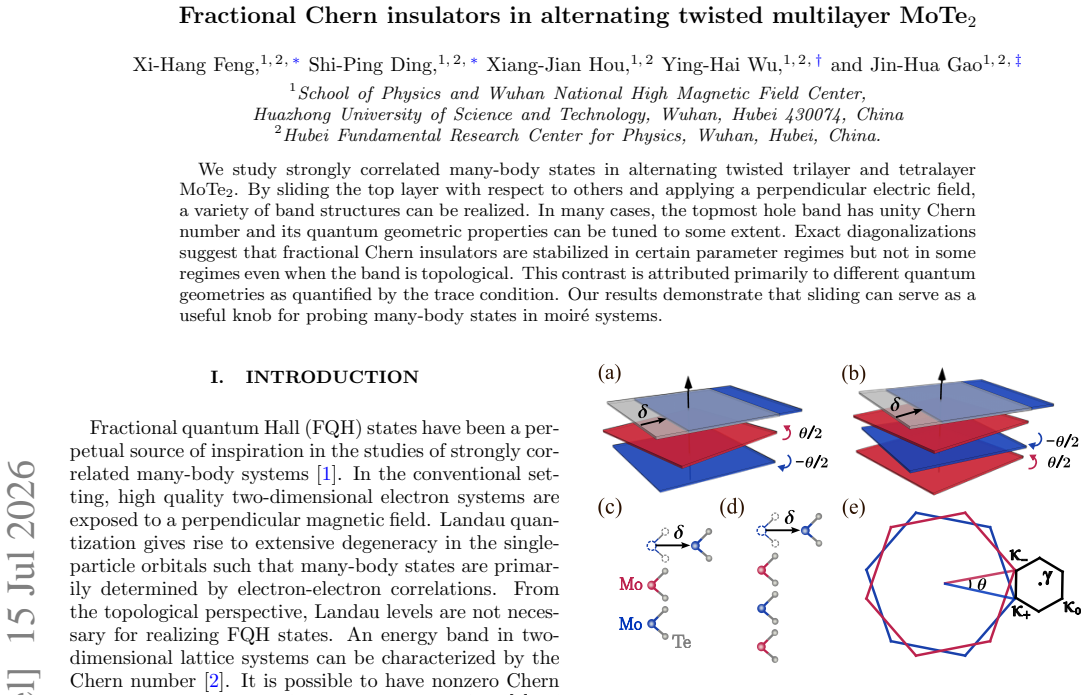
- [Fig. 1 caption] 'tetrlayer' should be 'tetralayer'.
- [Sec. III] 'zero silding' should be 'zero sliding'.
- [Eqs. (9) and (20)] The symbol T is used both for interlayer tunneling in Eq. (9) and for the trace-condition integral in Eq. (20); consider renaming one to avoid confusion.
- [References] Ref. [71] lacks volume/page details ('Phys. Rev. B (2026)'); please complete or cite the published version if available.
Circularity Check
No circularity found: trace-condition comparison is an external correlation, flat-band test is a control, and self-citations are not load-bearing.
full rationale
The derivation is self-contained. The continuum model (Eq. 3) and its parameters are fixed externally (e.g., m*=0.62m_e, V=8 meV, w=-8.5 meV, from Refs. [37,39,50,66]); the trace condition T in Eq. (20) is computed from the single-particle eigenstates (Eqs. 12 and 19), while the FCI/CDW phase is read off from exact-diagonalization spectra, spectral flow, and static structure factor in Sec. III. No parameter is fitted to the many-body outcome, so the comparison is an external correlation rather than a construction. The flat-band test drops the kinetic term in Eq. (15) but keeps the eigenstates and hence the quantum geometry; this is a control that removes bandwidth, not a renamed input. The paper honestly flags limitations: for δ=0.5a1 it states 'single band approximation is less valid in this case... results should be interpreted with care,' and the confound 'the band width and T increase concomitantly, so their effects cannot be separated'; these are correctness risks, not circular steps. Self-citations [33,36] provide motivation and a symmetry-decomposition expectation, but the band structures and ED results are computed in this paper, so the self-citations do not carry the central trace-condition claim.
Axiom & Free-Parameter Ledger
axioms (6)
- domain assumption Continuum model of alternating twisted multilayer MoTe2 (Eqs. 3–11): massive-Dirac moiré bands with parameters m*=0.62me, V=8 meV, ψ=−89.6°, w=−8.5 meV.
- domain assumption Spin-valley polarization: electrons treated as spin-valley polarized in a single valley, suppressing those indices.
- domain assumption Single-band projection of the interaction onto the topmost hole band (Eq. 15), neglecting interband mixing.
- domain assumption Trace condition T (Eq. 20) as the operative FCI stability indicator.
- domain assumption Coulomb interaction with V(q)=2πe²/(ε|q|) and an unspecified dielectric constant ε.
- domain assumption Moiré reciprocal lattice truncation |ni|≤6 for the plane-wave basis (Eq. 12).
read the original abstract
We study strongly correlated many-body states in alternating twisted trilayer and tetralayer MoTe$_{2}$. By sliding the top layer with respect to others and applying a perpendicular electric field, a variety of band structures can be realized. In many cases, the topmost hole band has unity Chern number and its quantum geometric properties can be tuned to some extent. Exact diagonalizations suggest that fractional Chern insulators are stabilized in certain parameter regimes but not in some regimes even when the band is topological. This contrast is attributed primarily to different quantum geometries as quantified by the trace condition. Our results demonstrate that sliding can serve as a useful knob for probing many-body states in moir\'e systems.
Figures


Reference graph
Works this paper leans on
-
[1]
B. I. Halperin and J. K. Jain, eds.,Fractional Quantum Hall Effects: New Developments(World Scientific Publishing, 2020)
2020
-
[2]
D. J. Thouless, M. Kohmoto, M. P. Nightingale, and M. den Nijs, Quantized Hall conductance in a two-dimensional periodic potential, Phys. Rev. Lett.49, 405 (1982)
1982
-
[3]
We set the parameters asm ∗ = 0.62m e,V= 8 meV, and ψ=−89.6 ◦ [37, 39, 50, 66]
is one first-shell reciprocal lattice vec- tors of single layer, andg j (Gj) is the vector obtained by (j−1)π/3 counterclockwise rotation ofg 1 (G1). We set the parameters asm ∗ = 0.62m e,V= 8 meV, and ψ=−89.6 ◦ [37, 39, 50, 66]. To describe the other components in Eq. (5), it is useful to define the kinetic-potential term Hi =− ℏ2 2m∗ (k−κ i)2 + ∆i (di−1...
-
[4]
parity anomaly
F. D. M. Haldane, Model for a quantum Hall effect without Landau levels: Condensed-matter realization of the “parity anomaly”, Phys. Rev. Lett.61, 2015 (1988)
2015
-
[5]
Tang, J.-W
E. Tang, J.-W. Mei, and X.-G. Wen, High-temperature fractional quantum Hall states, Phys. Rev. Lett.106, 236802 (2011)
2011
-
[6]
K. Sun, Z. Gu, H. Katsura, and S. Das Sarma, Nearly flatbands with nontrivial topology, Phys. Rev. Lett.106, 236803 (2011)
2011
-
[7]
Neupert, L
T. Neupert, L. Santos, C. Chamon, and C. Mudry, Fractional quantum Hall states at zero magnetic field, Phys. Rev. Lett. 106, 236804 (2011)
2011
-
[8]
D. N. Sheng, Z.-C. Gu, K. Sun, and L. Sheng, Fractional quantum Hall effect in the absence of Landau levels, Nat. Commun.2, 389 (2011)
2011
-
[9]
Regnault and B
N. Regnault and B. A. Bernevig, Fractional Chern insulator, Phys. Rev. X1, 021014 (2011)
2011
-
[10]
Liu and E
Z. Liu and E. J. Bergholtz, Recent developments in fractional Chern insulators, inEncyclopedia of Condensed Matter Physics, edited by T. Chakraborty (Academic Press, Oxford, 2024) 2nd ed., pp. 515–538
2024
-
[11]
B. A. Bernevig, L. Fu, L. Ju, A. H. MacDonald, K. F. Mak, and J. Shan, Fractional quantization in insulators from Hall to Chern, Nat. Phys.21, 1702 (2025)
2025
-
[12]
J. Cai, E. Anderson, C. Wang, X. Zhang, X. Liu, W. Holtzmann, Y. Zhang, F. Fan, T. Taniguchi, K. Watanabe, Y. Ran, T. Cao, L. Fu, D. Xiao, W. Yao, and X. Xu, Signatures of fractional quantum anomalous Hall states in twisted MoTe 2, Nature (London)622, 63 (2023)
2023
-
[13]
Y. Zeng, Z. Xia, K. Kang, J. Zhu, P. Kn¨ uppel, C. Vaswani, K. Watanabe, T. Taniguchi, K. F. Mak, and J. Shan, Thermodynamic evidence of fractional Chern insulator in moir´ e MoTe2, Nature (London)622, 69 (2023)
2023
-
[14]
H. Park, J. Cai, E. Anderson, Y. Zhang, J. Zhu, X. Liu, C. Wang, W. Holtzmann, C. Hu, Z. Liu, T. Taniguchi, K. Watanabe, J.-H. Chu, T. Cao, L. Fu, W. Yao, C.-Z. Chang, D. Cobden, D. Xiao, and X. Xu, Observation of fractionally quantized anomalous Hall effect, Nature (London)622, 74 (2023). 8
2023
-
[15]
F. Xu, Z. Sun, T. Jia, C. Liu, C. Xu, C. Li, Y. Gu, K. Watanabe, T. Taniguchi, B. Tong, J. Jia, Z. Shi, S. Jiang, Y. Zhang, X. Liu, and T. Li, Observation of integer and fractional quantum anomalous Hall effects in twisted bilayer MoTe 2, Phys. Rev. X13, 031037 (2023)
2023
-
[16]
H. Park, W. Li, C. Hu, C. Beach, M. Gon¸ calves, J. F. Mendez-Valderrama, J. Herzog-Arbeitman, T. Taniguchi, K. Watan- abe, D. Cobden, L. Fu, B. A. Bernevig, N. Regnault, J.-H. Chu, D. Xiao, and X. Xu, Observation of dissipationless fractional Chern insulator, Nat. Phys.22, 389 (2026)
2026
-
[17]
Z. Lu, T. Han, Y. Yao, A. P. Reddy, J. Yang, J. Seo, K. Watanabe, T. Taniguchi, L. Fu, and L. Ju, Fractional quantum anomalous Hall effect in multilayer graphene, Nature (London)626, 759–764 (2024)
2024
-
[18]
J. Xie, Z. Huo, X. Lu, Z. Feng, Z. Zhang, W. Wang, Q. Yang, K. Watanabe, T. Taniguchi, K. Liu, Z. Song, X. C. Xie, J. Liu, and X. Lu, Tunable fractional Chern insulators in rhombohedral graphene superlattices, Nat. Mater.24, 1042–1048 (2025)
2025
-
[19]
S. H. Aronson, T. Han, Z. Lu, Y. Yao, J. P. Butler, K. Watanabe, T. Taniguchi, L. Ju, and R. C. Ashoori, Displacement field-controlled fractional Chern insulators and charge density waves in a graphene/hBN moir´ e superlattice, Phys. Rev. X 15, 031026 (2025)
2025
-
[20]
J. P. Butler, T. Han, A. DiFabbio, Z. Hadjri, E. Aitken, K. Watanabe, T. Taniguchi, L. Ju, and R. C. Ashoori, 1/3 fractional and gapless integer quantum anomalous Hall states in rhombohedral graphene, arXiv:2606.06450
-
[21]
J. Dong, L. Liu, J. Zhu, Z. Pan, Y. Hong, F. Wang, Z. Ren, Z. Jia, K. Watanabe, T. Taniguchi, L. Du, D. Shi, W. Yang, and G. Zhang, Observation of integer and fractional Chern insulators in high Chern number flatbands, arXiv:2507.09908
-
[22]
Z. Li, W. Wang, F. Wang, Z. Zhang, Q. Yang, K. Watanabe, T. Taniguchi, X. C. Xie, J. Wang, K. Liu, Z. Song, and X. Lu, Fractional high-Chern insulator in twisted rhombohedral graphene, arXiv:2512.21612
-
[23]
S. A. Parameswaran, R. Roy, and S. L. Sondhi, Fractional Chern insulators and theW ∞ algebra, Phys. Rev. B85, 241308(R) (2012)
2012
-
[24]
Roy, Band geometry of fractional topological insulators, Phys
R. Roy, Band geometry of fractional topological insulators, Phys. Rev. B90, 165139 (2014)
2014
-
[25]
Dobardˇ zi´ c, M
E. Dobardˇ zi´ c, M. V. Milovanovi´ c, and N. Regnault, Geometrical description of fractional Chern insulators based on static structure factor calculations, Phys. Rev. B88, 115117 (2013)
2013
-
[26]
T. S. Jackson, G. M¨ oller, and R. Roy, Geometric stability of topological lattice phases, Nat. Commun.6, 8629 (2015)
2015
-
[27]
Bauer, T
D. Bauer, T. S. Jackson, and R. Roy, Quantum geometry and stability of the fractional quantum Hall effect in the Hofstadter model, Phys. Rev. B93, 235133 (2016)
2016
-
[28]
Shavit and Y
G. Shavit and Y. Oreg, Quantum geometry and stabilization of fractional Chern insulators far from the ideal limit, Phys. Rev. Lett.133, 156504 (2024)
2024
-
[29]
J. Cano and J. Wang, Ideal quantum geometry for fractional Chern insulators, arXiv:2606.05496
-
[30]
T¨ orm¨ a, Essay: Where can quantum geometry lead us?, Phys
P. T¨ orm¨ a, Essay: Where can quantum geometry lead us?, Phys. Rev. Lett.131, 240001 (2023)
2023
-
[31]
Liu, X.-B
T. Liu, X.-B. Qiang, H.-Z. Lu, and X. C. Xie, Quantum geometry in condensed matter, Natl. Sci. Rev.12, nwae334 (2025)
2025
-
[32]
J. Yu, B. A. Bernevig, R. Queiroz, E. Rossi, P. T¨ orm¨ a, and B.-J. Yang, Quantum geometry in quantum materials, npj Quantum Mater.10, 101 (2025)
2025
-
[33]
AlBuhairan and M
H. AlBuhairan and M. Vogl, Band structure and band topology in twisted homotrilayer transition metal dichalcogenides, Phys. Rev. B108, 155106 (2023)
2023
-
[34]
Liang, S.-P
M. Liang, S.-P. Ding, M. Wu, C. Zhao, and J.-H. Gao, Moir´ e flat bands in alternating twisted MoTe 2 multilayers, Phys. Rev. B111, 085412 (2025)
2025
-
[35]
A. Fedorko, C.-X. Liu, and Z. Bi, Engineering moir´ e kagome superlattices in twisted transition metal dichalcogenides, arXiv:2503.13422
-
[36]
Nakatsuji, T
N. Nakatsuji, T. Kawakami, H. Tateishi, K. Kato, and M. Koshino, Moir´ e band engineering in twisted trilayer WSe 2, Commun. Mater.6, 274 (2025)
2025
-
[37]
S.-P. Ding, M. Liang, T.-L. Wu, M.-H. Wu, J.-T. L¨ u, J.-H. Gao, and X. C. Xie, Sliding-tuned quantum geometry in moir´ e systems: Nonlinear Hall effect and quantum metric control, Phys. Rev. B113, L121411 (2026)
2026
-
[38]
F. Wu, T. Lovorn, E. Tutuc, I. Martin, and A. H. MacDonald, Topological insulators in twisted transition metal dichalco- genide homobilayers, Phys. Rev. Lett.122, 086402 (2019)
2019
-
[39]
H. Li, U. Kumar, K. Sun, and S.-Z. Lin, Spontaneous fractional Chern insulators in transition metal dichalcogenide moir´ e superlattices, Phys. Rev. Res.3, L032070 (2021)
2021
-
[40]
A. P. Reddy, F. Alsallom, Y. Zhang, T. Devakul, and L. Fu, Fractional quantum anomalous Hall states in twisted bilayer MoTe2 and WSe2, Phys. Rev. B108, 085117 (2023)
2023
-
[41]
A. P. Reddy and L. Fu, Toward a global phase diagram of the fractional quantum anomalous Hall effect, Phys. Rev. B 108, 245159 (2023)
2023
-
[42]
Cr´ epel and L
V. Cr´ epel and L. Fu, Anomalous Hall metal and fractional Chern insulator in twisted transition metal dichalcogenides, Phys. Rev. B107, L201109 (2023)
2023
-
[43]
J. Dong, J. Wang, P. J. Ledwith, A. Vishwanath, and D. E. Parker, Composite Fermi liquid at zero magnetic field in twisted MoTe2, Phys. Rev. Lett.131, 136502 (2023)
2023
-
[44]
Goldman, A
H. Goldman, A. P. Reddy, N. Paul, and L. Fu, Zero-field composite Fermi liquid in twisted semiconductor bilayers, Phys. Rev. Lett.131, 136501 (2023)
2023
-
[45]
W.-X. Qiu, B. Li, X.-J. Luo, and F. Wu, Interaction-driven topological phase diagram of twisted bilayer MoTe 2, Phys. Rev. X13, 041026 (2023)
2023
-
[46]
Wang, X.-W
C. Wang, X.-W. Zhang, X. Liu, Y. He, X. Xu, Y. Ran, T. Cao, and D. Xiao, Fractional Chern insulator in twisted bilayer MoTe2, Phys. Rev. Lett.132, 036501 (2024). 9
2024
-
[47]
Morales-Dur´ an, N
N. Morales-Dur´ an, N. Wei, J. Shi, and A. H. MacDonald, Magic angles and fractional Chern insulators in twisted homo- bilayer transition metal dichalcogenides, Phys. Rev. Lett.132, 096602 (2024)
2024
-
[48]
Lu and L
T. Lu and L. H. Santos, Fractional Chern insulators in twisted bilayer MoTe 2: A composite Fermion perspective, Phys. Rev. Lett.133, 186602 (2024)
2024
-
[49]
C. Xu, J. Li, Y. Xu, Z. Bi, and Y. Zhang, Maximally localized wannier functions, interaction models, and fractional quantum anomalous Hall effect in twisted bilayer MoTe 2, Proc. Natl. Acad. Sci. U.S.A.121, e2316749121 (2024)
2024
-
[50]
Abouelkomsan, A
A. Abouelkomsan, A. P. Reddy, L. Fu, and E. J. Bergholtz, Band mixing in the quantum anomalous Hall regime of twisted semiconductor bilayers, Phys. Rev. B109, L121107 (2024)
2024
-
[51]
Y. Jia, J. Yu, J. Liu, J. Herzog-Arbeitman, Z. Qi, H. Pi, N. Regnault, H. Weng, B. A. Bernevig, and Q. Wu, Moir´ e fractional Chern insulators. i. first-principles calculations and continuum models of twisted bilayer MoTe 2, Phys. Rev. B 109, 205121 (2024)
2024
-
[52]
J. Yu, J. Herzog-Arbeitman, M. Wang, O. Vafek, B. A. Bernevig, and N. Regnault, Fractional Chern insulators versus nonmagnetic states in twisted bilayer MoTe 2, Phys. Rev. B109, 045147 (2024)
2024
-
[53]
Sharma, Y
P. Sharma, Y. Peng, and D. N. Sheng, Topological quantum phase transitions driven by a displacement field in twisted MoTe2 bilayers, Phys. Rev. B110, 125142 (2024)
2024
-
[54]
C.-E. Ahn, W. Lee, K. Yananose, Y. Kim, and G. Y. Cho, Non-Abelian fractional quantum anomalous Hall states and first Landau level physics of the second moir´ e band of twisted bilayer MoTe2, Phys. Rev. B110, L161109 (2024)
2024
-
[55]
H. Li, Y. Su, Y. B. Kim, H.-Y. Kee, K. Sun, and S.-Z. Lin, Contrasting twisted bilayer graphene and transition metal dichalcogenides for fractional Chern insulators: An emergent gauge picture, Phys. Rev. B109, 245131 (2024)
2024
-
[56]
A. P. Reddy, N. Paul, A. Abouelkomsan, and L. Fu, Non-Abelian fractionalization in topological minibands, Phys. Rev. Lett.133, 166503 (2024)
2024
-
[57]
C. Xu, N. Mao, T. Zeng, and Y. Zhang, Multiple Chern bands in twisted mote 2 and possible Non-Abelian states, Phys. Rev. Lett.134, 066601 (2025)
2025
-
[58]
Fujimoto, D
M. Fujimoto, D. E. Parker, J. Dong, E. Khalaf, A. Vishwanath, and P. Ledwith, Higher vortexability: Zero-field realization of higher Landau levels, Phys. Rev. Lett.134, 106502 (2025)
2025
-
[59]
Wang, X.-W
C. Wang, X.-W. Zhang, X. Liu, J. Wang, T. Cao, and D. Xiao, Higher Landau-Level analogs and signatures of Non-Abelian states in twisted bilayer MoTe 2, Phys. Rev. Lett.134, 076503 (2025)
2025
-
[60]
Chen, W.-W
F. Chen, W.-W. Luo, W. Zhu, and D. N. Sheng, Robust non-Abelian even-denominator fractional Chern insulator in twisted bilayer MoTe2, Nat. Commun.16, 2115 (2025)
2025
-
[61]
Y. He, S. H. Simon, and S. A. Parameswaran, Fractional Chern insulators and competing states in a twisted MoTe 2 lattice model, arXiv:2505.06354
-
[62]
J. Chen, Q. Li, X. Wang, and W. Li, Fractional Chern insulator and quantum anomalous Hall crystal in twisted MoTe 2, Sci. Bull.71, 1034 (2026)
2026
-
[63]
B. Li, Y. Ouyang, and F. Wu, Abelian and non-Abelian fractionalized states in twisted mote 2: A generalized Landau-level theory, Phys. Rev. B113, 195129 (2026)
2026
-
[64]
Xiao, G.-B
D. Xiao, G.-B. Liu, W. Feng, X. Xu, and W. Yao, Coupled spin and valley physics in monolayers of MoS 2 and other group-vi dichalcogenides, Phys. Rev. Lett.108, 196802 (2012)
2012
-
[65]
Bistritzer and A
R. Bistritzer and A. H. MacDonald, Moir´ e bands in twisted double-layer graphene, Proc. Natl. Acad. Sci. U.S.A.108, 12233 (2011)
2011
-
[66]
J. M. B. Lopes dos Santos, N. M. R. Peres, and A. H. Castro Neto, Continuum model of the twisted graphene bilayer, Phys. Rev. B86, 155449 (2012)
2012
-
[67]
N. Mao, C. Xu, J. Li, T. Bao, P. Liu, Y. Xu, C. Felser, L. Fu, and Y. Zhang, Transfer learning relaxation, electronic structure and continuum model for twisted bilayer MoTe 2, Commun. Phys.7, 262 (2024)
2024
-
[68]
B. A. Bernevig and N. Regnault, Emergent many-body translational symmetries of Abelian and non-Abelian fractionally filled topological insulators, Phys. Rev. B85, 075128 (2012)
2012
-
[69]
Chen and V
M. Chen and V. W. Scarola, Reordering fractional Chern insulators into stripes of fractional charges with long-range interactions, Phys. Rev. B92, 035138 (2015)
2015
-
[70]
B. Peng and J.-X. Hu, Anisotropic moir´ e fractional Chern insulators and their phase transitions, arXiv:2606.02094
-
[71]
Zaklama, D
T. Zaklama, D. Luo, and L. Fu, Structure factor and topological bound of twisted bilayer semiconductors at fractional fillings, Phys. Rev. B112, L041115 (2025)
2025
-
[72]
Parker, P
D. Parker, P. Ledwith, E. Khalaf, T. Soejima, J. Hauschild, Y. Xie, A. Pierce, M. P. Zaletel, A. Yacoby, and A. Vishwanath, Field-tuned and zero-field fractional chern insulators in magic-angle twisted graphene, Phys. Rev. B (2026)
2026
-
[73]
Sterdyniak, N
A. Sterdyniak, N. Regnault, and B. A. Bernevig, Extracting excitations from model state entanglement, Phys. Rev. Lett. 106, 100405 (2011)
2011
-
[74]
J. K. Jain, Composite-fermion approach for the fractional quantum hall effect, Phys. Rev. Lett.63, 199 (1989)
1989
-
[75]
B. I. Halperin, P. A. Lee, and N. Read, Theory of the half-filled landau level, Phys. Rev. B47, 7312 (1993)
1993
-
[76]
Z. Liu, B. Li, Y. Shi, and F. Wu, Characterization of fractional chern insulator quasiparticles in twisted homobilayer mote2, Phys. Rev. B112, 245104 (2025)
2025
-
[77]
B. M. Kousa, N. Morales-Dur´ an, T. M. R. Wolf, E. Khalaf, and A. H. MacDonald, Theory of magnetoroton bands in moir´ e materials, Phys. Rev. Lett.135, 246604 (2025)
2025
-
[78]
N. Paul, A. Abouelkomsan, A. Reddy, and L. Fu, Shining light on collective modes in moir´ e fractional chern insulators, arXiv:2502.17569
- [79]
-
[80]
C. Wang Beach, C. Baier, K. Yang, H. Zheng, Y. Fan, W. Li, S. Yuan, Y. Zhao, Y. Sun, C. Hu, T. Taniguchi, K. Watanabe, J.-h. Chu, L. Fu, T. Cao, S. Okamoto, D. Xiao, and X. Xu, Electrically programmable correlated topology and magnetism in a moir´ e trilayer, arXiv:2606.21004
discussion (0)
Sign in with ORCID, Apple, or X to comment. Anyone can read and Pith papers without signing in.