REVIEW 4 major objections 4 minor 68 references
Cyclone claims that a single latent diffusion model, trained entirely on unpaired driving images, can both synthesize and remove fog, rain, and snow, and that cleaning degraded images this way improves downstream driving perception.
Reviewed by Pith at T0; open to challenge. T0 means a machine referee read the full paper against a public rubric. the ladder, T0–T4 →
T0 review · deepseek-v4-flash
2026-08-02 03:19 UTC pith:DQP7H7SQ
load-bearing objection Solid empirical package for unpaired multi-weather editing, but the anti-collapse mechanism is self-referential and needs a frozen-teacher control before the central claim is airtight. the 4 major comments →
Cyclone: Diffusion Model for Cycle-Consistent Weather Editing from Unpaired Driving Data
The pith
A machine-rendered reading of the paper's core claim, the machinery that carries it, and where it could break.
Core claim
The central claim, stated on the paper's own terms, is that a single 0.9B-parameter latent diffusion model can translate a driving image between weather conditions—clear, foggy, rainy, snowy, and with day/night variants—using only unpaired images and weather labels. The model takes the noisy latent, the clean source image, and a target-weather text prompt, and denoises to the edited image. Training minimizes four objectives: reconstruction (recovering the source from the source condition), cycle consistency (recovering the source after editing to a target weather and back), distillation (matching the output of an EMA copy of the student), and a CLIP-based directional alignment (the image-emb
What carries the argument
The central mechanism is the shared conditional denoiser with a latent-space cycle-consistency pair. The cycle loss, L_cycle = E_t ||D_theta(y_t, c_x, bar_y) - x_0||^2, is what transfers scene structure without paired data: the model must undo its own edit when conditioned back on the source prompt. The reconstruction loss anchors the model to the source domain, and the invariance bound B_t = sqrt(L_recon) + sqrt(L'_recon) shows that cycling through multiple target domains bounds the difference between edits made from different target conditions. The anti-collapse side is carried by a distillation loss against an EMA-updated teacher and by a CLIP directional loss that compares image-embeddin
Load-bearing premise
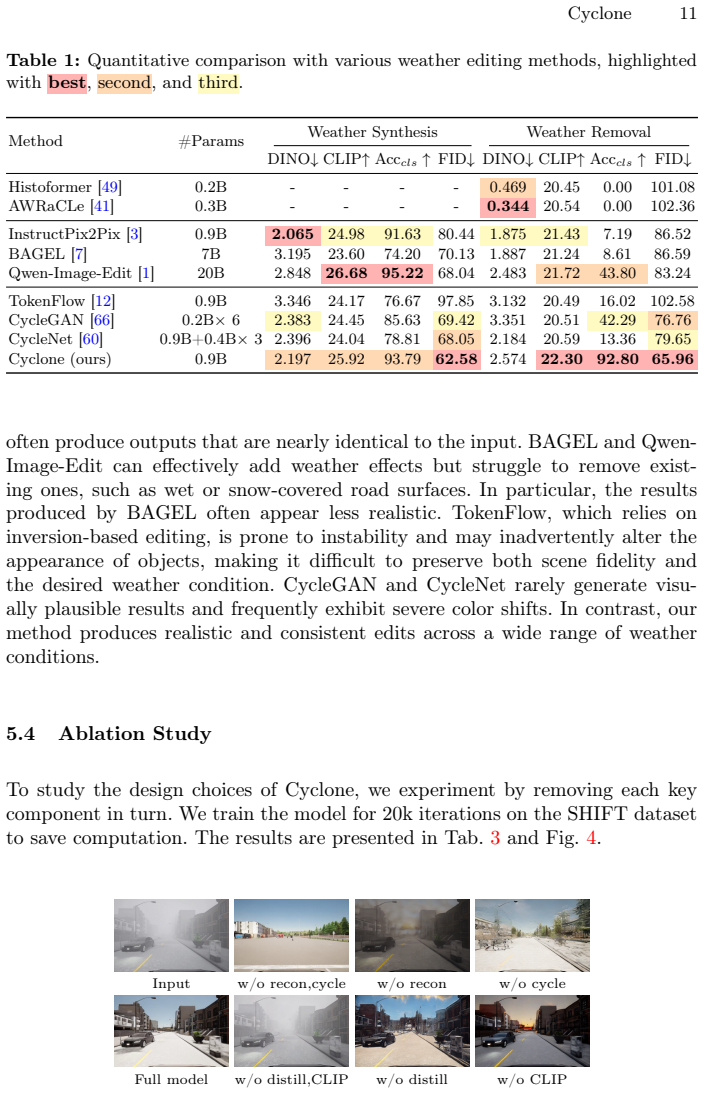
The load-bearing premise is that the combination of EMA self-distillation and CLIP directional guidance keeps training away from the identity mapping, which would trivially satisfy both the reconstruction and cycle losses; the paper's own ablation shows this collapse is nearby (Table 3, w/o L_distill and L_CLIP gives DINO 0.577 and weather-classification accuracy 2.52%), and Appendix A.2 shows the teacher inherits the student's fine-tuned weights rather than being a fixed pre
What would settle it
Train Cyclone with the CLIP loss removed while keeping the distillation loss and the cycle losses; if weather-classification accuracy falls toward the near-zero level of the w/o-distill-and-CLIP ablation, then EMA distillation alone is insufficient and the anti-collapse mechanism is not load-bearing. Alternatively, measure the pixel-level distance between output and input for the w/o L_distill, L_CLIP ablation; a near-zero distance confirms identity collapse, and swapping the EMA teacher for a frozen pretrained teacher would show whether the 'teacher' is truly providing external knowledge.
If this is right
- Weather editing for autonomous driving can be trained from unlabeled, unpaired video, since only scene images and weather labels are required.
- A single model can serve both as a data-augmentation engine (synthesizing adverse weather for training) and as a pre-processor (removing adverse weather before perception).
- The invariance bound suggests that adding more weather domains during training should strengthen structural preservation without requiring new generators or discriminators.
- Cyclone's image edits can be distilled into a video diffusion model, giving temporally consistent weather editing for driving logs.
- Removing adverse weather with Cyclone improves zero-shot depth estimation, semantic segmentation, and object detection on the reported driving benchmarks.
Where Pith is reading between the lines
- In my reading, the 'distillation' term is best understood as self-consistency rather than knowledge transfer from a frozen expert: the teacher is an EMA copy of the student initialized from the same fine-tuned weights. A direct comparison against a genuinely frozen teacher would isolate whether the anti-collapse property comes from external knowledge or from temporal averaging.
- The invariance bound predicts a testable scaling effect: training with more weather domains (for instance, adding night variants) should tighten structure preservation as measured by DINO, since the bound shrinks as reconstruction errors are minimized across more domains.
- The CLIP directional loss assumes weather transitions are linearly separable in embedding space; the reported failure at extreme low-light night rain may be exactly where that assumption breaks, so replacing or augmenting that loss with a text-conditioned classifier could extend the method's range.
- The same unpaired cycle-plus-distillation recipe could transfer to other scene-level editing problems where paired data is infeasible, such as season change, road-surface condition, or lighting shifts.
Editorial analysis
A structured set of objections, weighed in public.
Referee Report
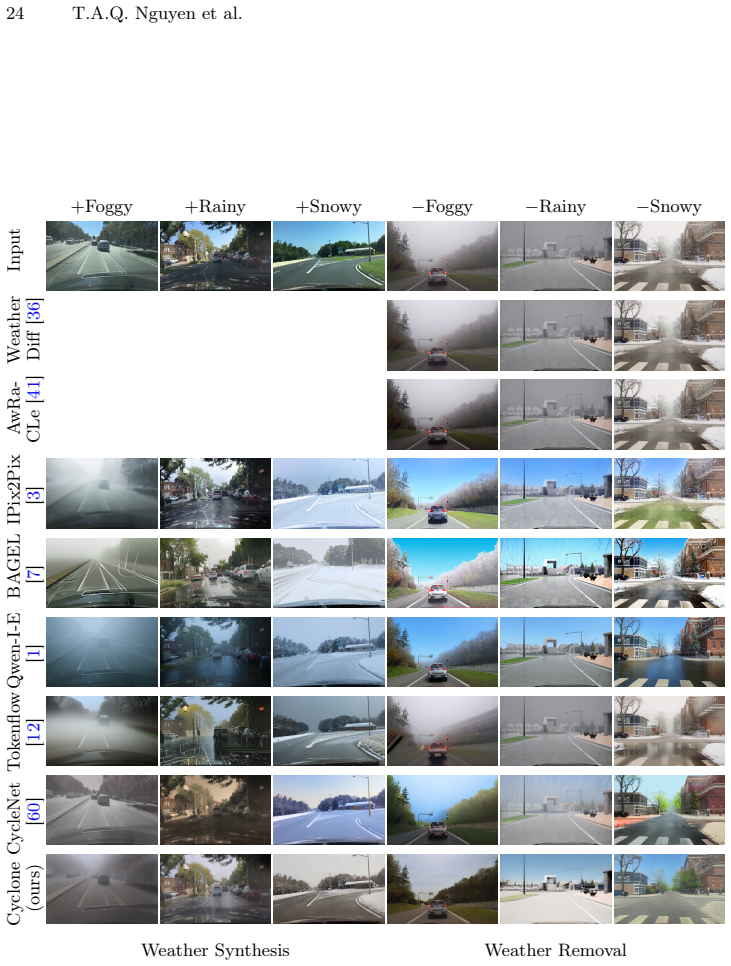
Summary. The paper proposes Cyclone, a latent diffusion model for weather synthesis and removal in driving scenes, trained without paired data. The method uses a single U-Net, text conditioning, cycle-consistency losses (L_recon, L_cycle), a distillation loss L_distill that compares student outputs with an EMA teacher, and a CLIP directional loss. Experiments compare against restoration and editing baselines on ACDC/SHIFT and report DINO/CLIP/FID plus downstream depth, segmentation, and detection results. A video-diffusion distillation extension is also described and evaluated with VBench/FVD.
Significance. If the central claim is stable, this is a useful step toward practical unpaired weather editing: a single 0.9B model that both adds and removes several weather conditions, with plausible gains over same-data baselines (CycleGAN, CycleNet, TokenFlow), consistent downstream perception improvements on two datasets, and a video-consistency extension. The empirical package is broad and the ablations are informative. However, the anti-collapse mechanism is not currently established: the 'teacher' in L_distill is the student's own EMA, and the only external pull, L_CLIP, is undefined at the identity mapping. The ablation in Table 3 (w/o L_distill, L_CLIP) shows that the trivial solution is nearby. The central unpaired-editing claim therefore rests on an unverified stability property.
major comments (4)
- [§4.3, Fig. 2, Appendix A.2] The anti-collapse argument for L_distill is circular as stated. Equation (6) treats D_phi as a teacher, but D_phi is the student's EMA initialized from the same pre-adapted LDM (Fig. 2, A.2). If the student drifts to identity, L_recon and L_cycle are minimized, L_CLIP is degenerate at \bar y = x0, and the EMA teacher also becomes identity, so L_distill vanishes. Table 3 shows that without these losses the model collapses to near-identity (DINO 0.577, Acc_cls 2.52%). The paper provides no convergence or long-run stability analysis for 100k iterations. Please add a frozen-teacher control (e.g., keep D_phi fixed after pre-adaptation) or otherwise demonstrate that the EMA loop cannot converge to identity; this is load-bearing for the central claim of non-trivial unpaired editing.
- [§4.4, Eq. (7)] L_CLIP is ill-defined at the identity solution: when \bar y = x0, \Delta I = 0 and the cosine term in Eq. (7) has a zero denominator. Since identity minimizes L_recon and L_cycle, the optimizer can approach a singular point and receive no corrective gradient. The paper should specify a fallback for this case (e.g., clamping, an explicit identity penalty, or a separate loss term) and confirm that the loss remains well-defined throughout training.
- [Table 2, §5.5] The video-distillation claim is partially contradicted by Table 2: Overall Consistency decreases from 20.42 to 19.52 for weather synthesis and from 15.91 to 14.90 for removal, giving negative gains (-0.90 and -1.01). The text says the video model improves temporal consistency without compromising visual fidelity, but the only consistency metric reported worsens. Please address this directly or qualify the claim.
- [§4.2, Eq. (2)] Equation (2) defines L_recon = E_t ||D_theta(x_t, c_x, \bar y) - x_0||^2. If \bar y is the forward output, this is not a reconstruction of x_0 from its own noisy latent; the backward pass is already captured by L_cycle in Eq. (3). The text and Fig. 2 suggest the intended form is D_theta(x_t, c_x, x_0). Please correct the equation or explain why \bar y appears in both losses.
minor comments (4)
- [§4.3, Eq. (6)] The loss is called 'distillation' and motivated via SDS (Eq. 5), but Eq. (6) is an L2 distance in image space between the student output and the EMA teacher output, not an SDS gradient. The terminology should be aligned with the actual objective.
- [Tables 1, 3, 4] All quantitative claims rely on point estimates; no confidence intervals or significance tests are reported. Given the small differences on some metrics (e.g., CLIP in Table 3), the robustness of the conclusions is hard to judge.
- [§5.1, Implementation Details] The time gate t > 0.5 for L_cycle is a hyperparameter with no sensitivity analysis. Since it directly controls when cycle consistency applies, please report at least one alternative setting.
- [Appendix A.2] The pre-adaptation fine-tuning stage is described only qualitatively. Please provide the number of iterations, learning rate, text prompts, and data mix used for this stage, as it is the initialization for both student and teacher.
Circularity Check
The L_distill 'teacher' is the student's own EMA rather than a fixed pretrained model, so the claimed external distillation is self-referential; CLIP-based evaluation also overlaps with L_CLIP.
specific steps
-
self definitional
[Sec. 4.3 (Eq. 6), Fig. 2, Appendix A.2]
"A teacher network φ is introduced to provide a stable reference. It is initialized with the same weights as the student and is subsequently updated via an exponential moving average (EMA) of the student’s parameters each training step, with a momentum of 0.9999."
Eq. 6 defines Ldistill as E[w(t)(Dθ(xt,cy,x0)−Dφ(y′t,cy,x0))]. The text calls this 'knowledge distillation from pretrained text-to-image models', but Dφ is not a fixed pretrained model: it is the student's own EMA, initialized from the same fine-tuned weights and updated from the student's parameters. The teacher is therefore defined in terms of the student. If the student drifts toward identity (which minimizes Lrecon and Lcycle), the EMA teacher follows, so Ldistill also tends to zero and supplies no independent external pull. The load-bearing anti-collapse claim of Sec. 4.3 thus reduces to self-comparison.
-
fitted input called prediction
[Sec. 4.4 Eq. (7) vs Sec. 5.1 Metrics]
"LCLIP = 1− ⟨∆I, ∆T⟩/(∥∆I∥∥∆T∥) ... we compute CLIP Score [14], which quantifies the similarity between the edited images and their associated text prompts. In addition, we employ CLIP [40] as a weather classifier/text-retriever and report the resulting classification accuracy (%)"
The training objective Eq. 7 directly maximizes cosine similarity in CLIP embedding space between the edited image and the target weather text, using the same CLIP encoders that are later used to compute the reported CLIP Score and Acc_cls metrics. The semantic-alignment gains on these two metrics are therefore partly forced by the training loss itself, rather than independent confirmation. DINO, FID, and downstream perception results remain external, so this is a partial overlap, not total circularity.
full rationale
The paper's main empirical claims are tested against external benchmarks: DINO-Struct, FID, and downstream depth/segmentation/detection, none of which are optimized by the training losses. So the work is not globally circular. However, the method's two 'external knowledge' components are partially self-referential. First, the distillation teacher in Eq. 6 is the student's own EMA copy (initialized from the same fine-tuned weights), so the 'pretrained text-to-image knowledge' enters only at initialization and then tracks the student; the ablation 'w/o Ldistill, LCLIP' (DINO 0.577, Acc_cls 2.52%) shows the identity solution is nearby, and nothing in the EMA construction guarantees it is avoided. Second, the CLIP-based evaluation metrics are the same modality optimized by LCLIP, so those particular numbers are partly a re-statement of the objective. These are genuine self-references in load-bearing parts, but the independent metrics and downstream tasks keep the central contribution from reducing entirely to its inputs.
Axiom & Free-Parameter Ledger
free parameters (6)
- Loss weights λ_cycle, λ_distill, λ_CLIP =
0.5 / 0.5 / 0.1
- Cycle-loss time gate =
t > 0.5
- EMA momentum =
0.9999
- Inference settings =
CFG=1, 20 DDIM steps
- Pre-adaptation LDM fine-tuning stage =
unspecified
- Training schedule =
100k iters, lr 1e-5, batch 8
axioms (6)
- domain assumption Pretrained SD v2.1 and CLIP priors transfer to driving-scene weather after a weather-prompt fine-tune; the fine-tuned model is a valid seed for student and teacher.
- domain assumption One-step denoising predictions D_θ(x_t, c, x_0) trained with L_recon/L_cycle/L_distill are a valid surrogate for the 20-step DDIM sampling used at inference.
- domain assumption The CLIP directional loss (Eq. 7), moving the image embedding along ∆T, produces perceivably correct weather edits.
- domain assumption Weather class labels (clear/foggy/rainy/snowy, day/night) are sufficient weak supervision; text prompts from these labels define the target domain.
- standard math Standard denoising-diffusion and latent-VAE machinery: v-prediction, zero terminal SNR with trailing sampling (Eq. 1, Section 5.1).
- standard math The invariance bound (Eq. 4 / Appendix A) applies triangle and Jensen inequalities correctly.
read the original abstract
Reliable perception under diverse weather conditions remains a major challenge for autonomous driving systems. A common strategy to improve robustness is either to synthesize adverse weather conditions for training perception models or to apply weather-removal techniques to recover clean inputs. However, existing approaches typically rely on synthetic data augmentation or physics-based, task-specific models that require paired training data and often struggle to generate realistic weather effects or generalize robustly to out-of-domain scenarios. Toward this problem, we present Cyclone, a unified framework for weather editing based on latent diffusion, equipped with cycle-consistent constraints and knowledge from image-text models. Cyclone enables the generation of multiple weather conditions across diverse scenes while eliminating the need for paired data. Experimental results show that our approach produces more realistic, structure-preserving outputs than existing baselines and leads to consistent improvements across several downstream driving perception tasks. Furthermore, we demonstrate that Cyclone can be distilled to a video diffusion model for temporally consistent weather editing.
Figures






Reference graph
Works this paper leans on
-
[1]
Bai, S., Chen, K., Liu, X., Wang, J., Ge, W., Song, S., Dang, K., Wang, P., Wang, S., Tang, J., et al.: Qwen2. 5-vl technical report. arXiv:2502.13923 (2025)
Pith/arXiv arXiv 2025
-
[2]
Blattmann, A., Dockhorn, T., Kulal, S., Mendelevitch, D., Kilian, M., Lorenz, D., Levi, Y., English, Z., Voleti, V., Letts, A., et al.: Stable video diffusion: Scaling latent video diffusion models to large datasets. arXiv:2311.15127 (2023)
Pith/arXiv arXiv 2023
-
[3]
In: IEEE Conf
Brooks, T., Holynski, A., Efros, A.A.: InstructPix2Pix: Learning to follow image editing instructions. In: IEEE Conf. on Computer Vision and Pattern Recognition (CVPR) (2023)
2023
-
[4]
In: IEEE Conf
Caesar, H., Bankiti, V., Lang, A.H., Vora, S., Liong, V.E., Xu, Q., Krishnan, A., Pan, Y., Baldan, G., Beijbom, O.: nuScenes: A multimodal dataset for autonomous driving. In: IEEE Conf. on Computer Vision and Pattern Recognition (CVPR) (2020)
2020
-
[5]
In: Proc
Chen, W.T., Fang, H.Y., Ding, J.J., Tsai, C.C., Kuo, S.Y.: JSTASR: Joint size and transparency-aware snow removal algorithm based on modified partial convolution and veiling effect removal. In: Proc. of the European Conf. on Computer Vision (ECCV) (2020)
2020
-
[6]
In: IEEE Conf
Cheng, B., Misra, I., Schwing, A.G., Kirillov, A., Girdhar, R.: Masked-attention mask transformer for universal image segmentation. In: IEEE Conf. on Computer Vision and Pattern Recognition (CVPR) (2022)
2022
-
[7]
Deng, C., Zhu, D., Li, K., Gou, C., Li, F., Wang, Z., Zhong, S., Yu, W., Nie, X., Song, Z., et al.: Emerging properties in unified multimodal pretraining. arXiv:2505.14683 (2025)
Pith/arXiv arXiv 2025
-
[8]
In: Ad- vances in Neural Information Processing Systems (NeurIPS) (2021)
Dhariwal, P., Nichol, A.: Diffusion models beat gans on image synthesis. In: Ad- vances in Neural Information Processing Systems (NeurIPS) (2021)
2021
-
[9]
ACM Trans
Gal, R., Patashnik, O., Maron, H., Bermano, A.H., Chechik, G., Cohen-Or, D.: Stylegan-nada: Clip-guided domain adaptation of image generators. ACM Trans. on Graphics (TOG) (2022)
2022
-
[10]
In: Proc
Gao, R., Chen, K., Xie, E., Hong, L., Li, Z., Yeung, D.Y., Xu, Q.: MagicDrive: Street view generation with diverse 3d geometry control. In: Proc. of the Interna- tional Conf. on Learning Representations (ICLR) (2024)
2024
-
[11]
In: Advances in Neural Information Processing Systems (NeurIPS) (2024)
Gao, S., Yang, J., Chen, L., Chitta, K., Qiu, Y., Geiger, A., Zhang, J., Li, H.: Vista: A generalizable driving world model with high fidelity and versatile controllability. In: Advances in Neural Information Processing Systems (NeurIPS) (2024)
2024
-
[12]
In: Proc
Geyer, M., Bar-Tal, O., Bagon, S., Dekel, T.: TokenFlow: Consistent diffusion fea- tures for consistent video editing. In: Proc. of the International Conf. on Learning Representations (ICLR) (2023)
2023
-
[13]
Hertz, A., Mokady, R., Tenenbaum, J., Aberman, K., Pritch, Y., Cohen-Or, D.: Prompt-to-prompt image editing with cross attention control. arXiv:2208.01626 (2022)
Pith/arXiv arXiv 2022
-
[14]
In: Proc
Hessel,J.,Holtzman,A.,Forbes,M.,LeBras,R.,Choi,Y.:CLIPScore:Areference- free evaluation metric for image captioning. In: Proc. of the Conference on Empir- ical Methods in Natural Language Processing (EMNLP) (2021) 16 T.A.Q. Nguyen et al
2021
-
[15]
In: Advances in Neural Information Processing Systems (NeurIPS) (2017)
Heusel,M.,Ramsauer,H.,Unterthiner,T.,Nessler,B.,Hochreiter,S.:Ganstrained by a two time-scale update rule converge to a local nash equilibrium. In: Advances in Neural Information Processing Systems (NeurIPS) (2017)
2017
-
[16]
In: Advances in Neural Information Processing Systems (NeurIPS) (2020)
Ho, J., Jain, A., Abbeel, P.: Denoising diffusion probabilistic models. In: Advances in Neural Information Processing Systems (NeurIPS) (2020)
2020
-
[17]
In: IEEE Conf
Huang, Z., He, Y., Yu, J., Zhang, F., Si, C., Jiang, Y., Zhang, Y., Wu, T., Jin, Q., Chanpaisit, N., et al.: Vbench: Comprehensive benchmark suite for video genera- tive models. In: IEEE Conf. on Computer Vision and Pattern Recognition (CVPR) (2024)
2024
-
[18]
In: IEEE Conf
Isola, P., Zhu, J.Y., Zhou, T., Efros, A.A.: Image-to-image translation with con- ditional adversarial networks. In: IEEE Conf. on Computer Vision and Pattern Recognition (CVPR) (2017)
2017
-
[19]
In: IEEE Conf
Ke, B., Obukhov, A., Huang, S., Metzger, N., Daudt, R.C., Schindler, K.: Repur- posing diffusion-based image generators for monocular depth estimation. In: IEEE Conf. on Computer Vision and Pattern Recognition (CVPR) (2024)
2024
-
[20]
Kingma, D.P., Welling, M.: Auto-encoding variational bayes. arXiv:1312.6114 (2013)
Pith/arXiv arXiv 2013
-
[21]
In: Proc
Kumari, N., Wang, S.Y., Zhao, N., Nitzan, Y., Li, Y., Singh, K.K., Zhang, R., Shechtman, E., Zhu, J.Y., Huang, X.: Learning an image editing model without image editing pairs. In: Proc. of the International Conf. on Learning Representa- tions (ICLR) (2026)
2026
-
[22]
1 kontext: Flow match- ing for in-context image generation and editing in latent space
Labs, B.F., Batifol, S., Blattmann, A., Boesel, F., Consul, S., Diagne, C., Dock- horn, T., English, J., English, Z., Esser, P., et al.: Flux. 1 kontext: Flow match- ing for in-context image generation and editing in latent space. arXiv preprint arXiv:2506.15742 (2025)
Pith/arXiv arXiv 2025
-
[23]
In: Proc
Lan, Y., Cui, Z., Liu, C., Peng, J., Wang, N., Luo, X., Liu, D.: Exploiting diffusion prior for real-world image dehazing with unpaired training. In: Proc. of the Conf. on Artificial Intelligence (AAAI) (2025)
2025
-
[24]
In: Proc
Li, A.C., Prabhudesai, M., Duggal, S., Brown, E., Pathak, D.: Your diffusion model is secretly a zero-shot classifier. In: Proc. of the IEEE International Conf. on Com- puter Vision (ICCV) (2023)
2023
-
[25]
In: IEEE Conf
Li, R., Cheong, L.F., Tan, R.T.: Heavy rain image restoration: Integrating physics model and conditional adversarial learning. In: IEEE Conf. on Computer Vision and Pattern Recognition (CVPR) (2019)
2019
-
[26]
In: Proc
Lin, C.H., Wang, Z., Liang, R., Zhang, Y., Fidler, S., Wang, S., Gojcic, Z.: Con- trollable weather synthesis and removal with video diffusion models. In: Proc. of the IEEE International Conf. on Computer Vision (ICCV) (2025)
2025
-
[27]
In: Proc
Lin, S., Liu, B., Li, J., Yang, X.: Common diffusion noise schedules and sample steps are flawed. In: Proc. of the IEEE Winter Conference on Applications of Computer Vision (WACV) (2024)
2024
-
[28]
In: Advances in Neural Information Processing Systems (NeurIPS) (2017)
Liu, M.Y., Breuel, T., Kautz, J.: Unsupervised image-to-image translation net- works. In: Advances in Neural Information Processing Systems (NeurIPS) (2017)
2017
-
[29]
In: Proc
Liu, S., Zeng, Z., Ren, T., Li, F., Zhang, H., Yang, J., Jiang, Q., Li, C., Yang, J., Su, H., et al.: Grounding dino: Marrying dino with grounded pre-training for open-set object detection. In: Proc. of the European Conf. on Computer Vision (ECCV) (2024)
2024
-
[30]
IEEE Trans
Liu, Y.F., Jaw, D.W., Huang, S.C., Hwang, J.N.: Desnownet: Context-aware deep network for snow removal. IEEE Trans. on Image Processing (TIP) (2018)
2018
-
[31]
In: Proc
Loshchilov, I., Hutter, F.: Decoupled weight decay regularization. In: Proc. of the International Conf. on Learning Representations (ICLR) (2017) Cyclone 17
2017
-
[32]
In: Proc
Meng, C., He, Y., Song, Y., Song, J., Wu, J., Zhu, J.Y., Ermon, S.: SDEdit: Guided image synthesis and editing with stochastic differential equations. In: Proc. of the International Conf. on Learning Representations (ICLR) (2022)
2022
-
[33]
Mukhopadhyay, S., Gwilliam, M., Agarwal, V., Padmanabhan, N., Swaminathan, A., Hegde, S., Zhou, T., Shrivastava, A.: Diffusion models beat gans on image classification. arXiv:2307.08702 (2023)
Pith/arXiv arXiv 2023
-
[34]
In: Proc
Nayar, S.K., Narasimhan, S.G.: Vision in bad weather. In: Proc. of the IEEE International Conf. on Computer Vision (ICCV) (1999)
1999
-
[35]
Oquab, M., Darcet, T., Moutakanni, T., Vo, H., Szafraniec, M., Khalidov, V., Fernandez, P., Haziza, D., Massa, F., El-Nouby, A., et al.: DINOv2: Learning robust visual features without supervision. arXiv:2304.07193 (2023)
Pith/arXiv arXiv 2023
-
[36]
IEEE Trans
Özdenizci, O., Legenstein, R.: Restoring vision in adverse weather conditions with patch-based denoising diffusion models. IEEE Trans. on Pattern Analysis and Ma- chine Intelligence (PAMI) (2023)
2023
-
[37]
Parmar, G., Park, T., Narasimhan, S., Zhu, J.Y.: One-step image translation with text-to-image models. arXiv:2403.12036 (2024)
Pith/arXiv arXiv 2024
-
[38]
Poole, B., Jain, A., Barron, J.T., Mildenhall, B.: DreamFusion: Text-to-3D using 2D diffusion. arXiv:2209.14988 (2022)
Pith/arXiv arXiv 2022
-
[39]
In: IEEE Conf
Qian, R., Tan, R.T., Yang, W., Su, J., Liu, J.: Attentive generative adversarial network for raindrop removal from a single image. In: IEEE Conf. on Computer Vision and Pattern Recognition (CVPR) (2018)
2018
-
[40]
In: Proc
Radford, A., Kim, J.W., Hallacy, C., Ramesh, A., Goh, G., Agarwal, S., Sastry, G., Askell, A., Mishkin, P., Clark, J., et al.: Learning transferable visual models from natural language supervision. In: Proc. of the International Conf. on Machine Learning (ICML) (2021)
2021
-
[41]
In: Proc
Rajagopalan, S., Patel, V.M.: Awracle: All-weather image restoration using visual in-context learning. In: Proc. of the AAAI Conference on Artificial Intelligence (2025)
2025
-
[42]
Ren, X., Lu, Y., Cao, T., Gao, R., Huang, S., Sabour, A., Shen, T., Pfaff, T., Wu, J.Z., Chen, R., et al.: Cosmos-drive-dreams: Scalable synthetic driving data generation with world foundation models. arXiv:2506.09042 (2025)
Pith/arXiv arXiv 2025
-
[43]
In: IEEE Conf
Rombach, R., Blattmann, A., Lorenz, D., Esser, P., Ommer, B.: High-resolution image synthesis with latent diffusion models. In: IEEE Conf. on Computer Vision and Pattern Recognition (CVPR) (2022)
2022
-
[44]
In: International Conf
Ronneberger, O., Fischer, P., Brox, T.: U-Net: Convolutional networks for biomed- ical image segmentation. In: International Conf. on Medical Image Computing and Computer-Assisted Intervention (MICCAI) (2015)
2015
-
[45]
In: IEEE Conf
Sakaridis, C., Dai, D., Van Gool, L.: Acdc: The adverse conditions dataset with correspondences for semantic driving scene understanding. In: IEEE Conf. on Com- puter Vision and Pattern Recognition (CVPR) (2021)
2021
-
[46]
In: ACM Trans
Sauer, A., Boesel, F., Dockhorn, T., Blattmann, A., Esser, P., Rombach, R.: Fast high-resolution image synthesis with latent adversarial diffusion distillation. In: ACM Trans. on Graphics (SIGGRAPH Asia) (2024)
2024
-
[47]
In: Proc
Song, J., Meng, C., Ermon, S.: Denoising diffusion implicit models. In: Proc. of the International Conf. on Learning Representations (ICLR) (2020)
2020
-
[48]
In: IEEE Conf
Sun, P., Kretzschmar, H., Dotiwalla, X., Chouard, A., Patnaik, V., Tsui, P., Guo, J., Zhou, Y., Chai, Y., Caine, B., et al.: Scalability in perception for autonomous driving: Waymo open dataset. In: IEEE Conf. on Computer Vision and Pattern Recognition (CVPR) (2020) 18 T.A.Q. Nguyen et al
2020
-
[49]
Sun, S., Ren, W., Gao, X., Wang, R., Cao, X.: Restoring images in adverse weather conditionsviahistogramtransformer.In:Proc.oftheEuropeanConf.onComputer Vision (ECCV) (2024)
2024
-
[50]
In: IEEE Conf
Sun, T., Segu, M., Postels, J., Wang, Y., Van Gool, L., Schiele, B., Tombari, F., Yu, F.: Shift: a synthetic driving dataset for continuous multi-task domain adaptation. In: IEEE Conf. on Computer Vision and Pattern Recognition (CVPR) (2022)
2022
-
[51]
In: Advances in Neural Information Processing Systems (NeurIPS) (2017)
Tarvainen, A., Valpola, H.: Mean teachers are better role models: Weight-averaged consistency targets improve semi-supervised deep learning results. In: Advances in Neural Information Processing Systems (NeurIPS) (2017)
2017
-
[52]
In: Proc
Torbunov, D., Huang, Y., Yu, H., Huang, J., Yoo, S., Lin, M., Viren, B., Ren, Y.: UCVGAN: Unet vision transformer cycle-consistent gan for unpaired image- to-image translation. In: Proc. of the IEEE Winter Conference on Applications of Computer Vision (WACV) (2023)
2023
-
[53]
In: International Conf
Unterthiner, T., van Steenkiste, S., Kurach, K., Marinier, R., Michalski, M., Gelly, S.: FVD: A new metric for video generation. In: International Conf. on Learning Representations (ICLR) Workshop (2019)
2019
-
[54]
In: IEEE Conf
Valanarasu, J.M.J., Yasarla, R., Patel, V.M.: TransWeather: Transformer-based restoration of images degraded by adverse weather conditions. In: IEEE Conf. on Computer Vision and Pattern Recognition (CVPR) (2022)
2022
-
[55]
In: Proc
Wang, X., Zhu, Z., Huang, G., Chen, X., Zhu, J., Lu, J.: Drivedreamer: Towards real-world-drive world models for autonomous driving. In: Proc. of the European Conf. on Computer Vision (ECCV) (2024)
2024
-
[56]
In: IEEE Conf
Wang, Y., He, J., Fan, L., Li, H., Chen, Y., Zhang, Z.: Driving into the future: Mul- tiview visual forecasting and planning with world model for autonomous driving. In: IEEE Conf. on Computer Vision and Pattern Recognition (CVPR) (2024)
2024
-
[57]
In: IEEE Conf
Wu, R.Q., Duan, Z.P., Guo, C.L., Chai, Z., Li, C.: RIDCP: Revitalizing real image dehazing via high-quality codebook priors. In: IEEE Conf. on Computer Vision and Pattern Recognition (CVPR) (2023)
2023
-
[58]
In: IEEE International Intelligent Transportation Systems Conference (ITSC) (2021)
Xiao, P., Shao, Z., Hao, S., Zhang, Z., Chai, X., Jiao, J., Li, Z., Wu, J., Sun, K., Jiang, K., et al.: Pandaset: Advanced sensor suite dataset for autonomous driv- ing. In: IEEE International Intelligent Transportation Systems Conference (ITSC) (2021)
2021
-
[59]
In: IEEE Conf
Xiao, S., Wang, Y., Zhou, J., Yuan, H., Xing, X., Yan, R., Li, C., Wang, S., Huang, T., Liu, Z.: OmniGen: Unified image generation. In: IEEE Conf. on Computer Vision and Pattern Recognition (CVPR) (2025)
2025
-
[60]
In: Advances in Neural Information Processing Systems (NeurIPS) (2023)
Xu, S., Ma, Z., Huang, Y., Lee, H., Chai, J.: CycleNet: Rethinking cycle con- sistency in text-guided diffusion for image manipulation. In: Advances in Neural Information Processing Systems (NeurIPS) (2023)
2023
-
[61]
In: IEEE Conf
Yang, J., Gao, S., Qiu, Y., Chen, L., Li, T., Dai, B., Chitta, K., Wu, P., Zeng, J., Luo, P., et al.: Generalized predictive model for autonomous driving. In: IEEE Conf. on Computer Vision and Pattern Recognition (CVPR) (2024)
2024
-
[62]
In: IEEE Conf
Yang, W., Tan, R.T., Feng, J., Liu, J., Guo, Z., Yan, S.: Deep joint rain detection and removal from a single image. In: IEEE Conf. on Computer Vision and Pattern Recognition (CVPR) (2017)
2017
-
[63]
In: Proc
Ye, T., Chen, S., Bai, J., Shi, J., Xue, C., Jiang, J., Yin, J., Chen, E., Liu, Y.: Adverse weather removal with codebook priors. In: Proc. of the IEEE International Conf. on Computer Vision (ICCV) (2023)
2023
-
[64]
In: Proc
Yi, Z., Zhang, H., Tan, P., Gong, M.: DualGAN: Unsupervised dual learning for image-to-image translation. In: Proc. of the IEEE International Conf. on Computer Vision (ICCV) (2017) Cyclone 19
2017
-
[65]
In: IEEE Conf
Yu, F., Chen, H., Wang, X., Xian, W., Chen, Y., Liu, F., Madhavan, V., Darrell, T.: Bdd100k: A diverse driving dataset for heterogeneous multitask learning. In: IEEE Conf. on Computer Vision and Pattern Recognition (CVPR) (2020)
2020
-
[66]
In: Proc
Zhu, J.Y., Park, T., Isola, P., Efros, A.A.: Unpaired image-to-image translation using cycle-consistent adversarial networks. In: Proc. of the IEEE International Conf. on Computer Vision (ICCV) (2017)
2017
-
[67]
a photo of a suburban street under [...]weather
Zhu, Y., Zhu, Z., Hašan, M., Yang, J., Xie, J., Wang, B.: WeatherDif- fusion: Weather-guided diffusion model for forward and inverse rendering. arXiv:2508.06982 (2025) 20 T.A.Q. Nguyen et al. A Implementation Details Derivation of Invariance Bound.We provide the complete derivation of the timestep-dependent bound presented in Eq. 4 of the main paper. This...
Pith/arXiv arXiv 2025
-
[4090]
22 T.A.Q
During inference, we set CFG to 1 and perform denoising with 20 steps DDIM [47]. 22 T.A.Q. Nguyen et al. A.3 Convergence Analysis We compare the convergence properties of CycleNet and Cyclone by training both models on the same data. Similar to ControlNet, CycleNet also exhibits a sudden convergence, typically occurring between 5k and 10k training iterati...
discussion (0)
Sign in with ORCID, Apple, or X to comment. Anyone can read and Pith papers without signing in.