REVIEW 3 major objections 5 minor 41 references
A decoder-only Transformer with continuous inputs and a categorical output can beat probabilistic and tree baselines at predicting the next foreign-exchange return distribution on held-out 2025 data.
Reviewed by Pith at T0; open to challenge. T0 means a machine referee read the full paper against a public rubric. the ladder, T0–T4 →
2026-08-02 03:16 UTC pith:QMGMMKNO
load-bearing objection Careful, honest small-scale study of a hybrid continuous-input/categorical-output financial decoder; the main gain over LightGBM is real but depends on a deliberately weak single-bar baseline. the 3 major comments →
VAIOM: Continuous-Input, Discrete-Output Decoder-Only Financial Sequence Modeling
The pith
A machine-rendered reading of the paper's core claim, the machinery that carries it, and where it could break.
Core claim
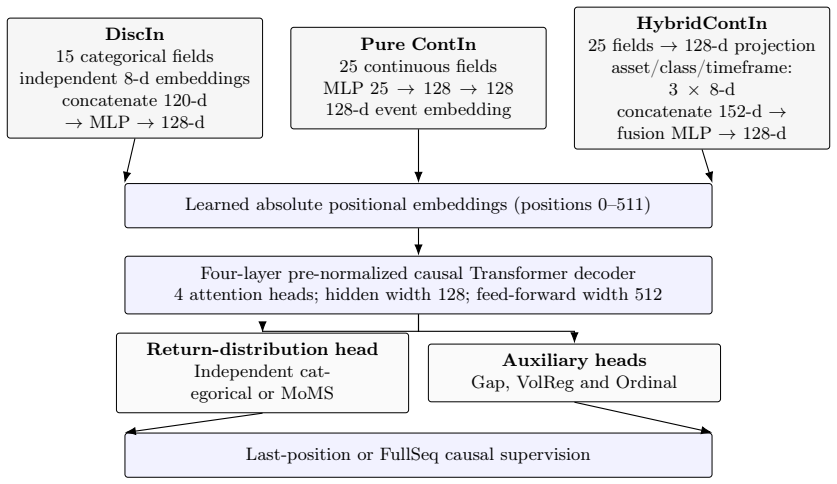
VAIOM's central claim is that separating input representation from output likelihood resolves the financial modeling dilemma: continuous inputs preserve local numerical geometry, while a categorical output over 16 volatility-normalized return buckets enables cross-entropy training and bits-per-event evaluation. The selected 0.9M HybridContIn model—25 continuous event fields plus learned asset, class, and timeframe embeddings, a four-component mixture return head, and Gap, volatility-regime, and ordinal auxiliary supervision under full-sequence causal training—achieves 3.1764 bits/event in 2025H1 and 3.1359 bits/event in 2025H2, beating all three baselines in both halves. Validation ablations
What carries the argument
The load-bearing design is the input/output split. A 25-dimensional continuous event vector—return, opening gap, relative log volatility, EWMA scale, periodic calendar channels, and mask flags—is projected into the Transformer's hidden space and processed by a four-layer causal decoder; the target is a categorical distribution over 16 return buckets, with bucket edges fixed from train-quantiles and tail cutoffs. The Mixture-of-Market-States head expresses the return distribution as a mixture of four latent categorical components, and auxiliary Gap, volatility-regime, and ordinal objectives shape the representation. Full-sequence supervision trains every valid causal position, and evaluation
Load-bearing premise
The headline result depends on the premise that a single-bar, non-autoregressive gradient-boosted tree is the right reference: VAIOM conditions on 512 bars of causal context while the tree sees only the current bar, so if a context-augmented tree baseline erased or reversed the gain, the main empirical claim would be weakened.
What would settle it
Retrain the tree baseline with the same 512-bar causal context (lag features or aggregated history) and compare per-event NLL on the two 2025 test halves; if its likelihood reaches or beats VAIOM's 3.1764/3.1359 bits/event, the claimed advantage over tree baselines collapses.
If this is right
- If the results hold, decoder-only next-token training can be applied to financial events without tokenizing all inputs, preserving weak numerical signals that discretization would destroy.
- The bits-per-event gains concentrate in the tail buckets, so the model is assigning materially better probability to extreme returns, not just matching unconditional class frequencies or first-order transitions.
- Full-sequence supervision should be the default training regime for similar return-distribution models, with checkpoint selection recalibrated to its earlier optimum.
- Mixture-parameterized categorical output heads are a viable alternative to plain softmax heads for return-bucket likelihood.
- For a corpus of roughly 1.27M unique train windows, the smallest evaluated 0.9M architecture gives the best validation likelihood; larger rungs do not convert added parameters into better compression.
Where Pith is reading between the lines
- If a context-augmented tree baseline—lag features or 512-bar aggregation—closes the 0.018–0.043 bit/event gap, the practical advantage would be attributable to sequence representation rather than the continuous-input formulation; running that baseline would settle it.
- The absolute gains are small in likelihood terms; the paper does not claim, and its evidence does not show, that they translate into trading profit after costs.
- Should the continuous-input advantage survive field-matched tokenization with identical metadata, it would strengthen the general lesson that discretizing inputs destroys locally relevant numerical geometry—a transferable result for other noisy, heterogeneous event streams.
- The capacity analysis suggests a rough data-to-parameter heuristic (about 1.54 unique windows per non-positional parameter) that could be tested across larger corpora and asset classes, though the paper explicitly cautions against treating it as universal.
Editorial analysis
A structured set of objections, weighed in public.
Referee Report
Summary. The paper introduces VAIOM, a small decoder-only Transformer that accepts continuous multivariate financial-event vectors as input and predicts a categorical distribution over volatility-normalized next-return buckets. The method is evaluated on one-hour FX and spot-metal bars using a chronological Train/buffer/Validation/Test split, with preprocessing and baselines fit only on Train and the selected model evaluated on two 2025 Test halves without refitting. The selected 0.9M HybridContIn model with a four-component Mixture-of-Market-States return head and Gap/VolReg/Ordinal auxiliary losses is reported to beat Frequency, Markov, and a single-bar LightGBM baseline in both Test halves, with paired gains of 0.0292 and 0.0426 bits/event and stable multi-seed results. Validation ablations address input representation, supervision scope, auxiliary objectives, and output head, and a supporting capacity analysis concludes that the 0.9M rung is best supported by the corpus.
Significance. If the main comparison survives a stronger baseline, the paper is a solid, carefully executed empirical contribution. Its strengths are the unusually disciplined evaluation protocol: no Test refitting, three independent training seeds reported without cherry-picking, asset-month block-bootstrap intervals, explicit causal information-flow rules, and detailed tables of exact configurations and diagnostics. The proposed continuous-input/categorical-output formulation is a sensible middle ground between fully tokenized market models and continuous-output forecasting models, and the validation ablations are informative for practitioners. The absolute likelihood gains are small, but consistent and concentrated in tail buckets. The main limitation is that the only nonlinear Test baseline is deliberately restricted to a single bar while VAIOM sees 512 bars, so the headline claim currently conflates sequence context with architecture; this is acknowledged by the authors but not tested.
major comments (3)
- [§3.11, Table 1; §4.1] The headline Test comparison is not a tree-baseline test of the architecture. VAIOM conditions on 512 bars while LightGBM receives only the current 28-field bar (Table 1), so the reported 0.0292/0.0426 bits/event gains measure context plus learned representation. The manuscript acknowledges this caveat in §4.1 and lists lag-stacking as future work, but the central claim 'improves beyond tree-based baselines' is, as stated, contingent on a weakened comparator. This is load-bearing because LightGBM is the only nonlinear baseline in the Test panel. Please add a context-augmented GBDT — at minimum a few lagged bars (e.g., lags 1,2,4,8,24) and simple rolling aggregates — trained and selected under the same Train/Validation discipline. If such a model erases or reverses the gain, the conclusion must be revised to 'sequence context helps' rather than 'VAIOM improves beyond tree-based baselines.
- [§3.14 and §4.5] The corpus-support criterion is defined operationally as: a larger rung is 'supported' only if it improves Validation NLL (§3.14). The finding that 5M and 15M are 'underfed' is therefore partly a restatement of the validation outcome, not an independent diagnostic. The RU ratios (1.5366, 0.2621, 0.0872) are descriptive, and no prespecified threshold or calibration is given. The paper is careful to call the result local, but the phrase 'supporting capacity study' and the abstract's framing imply more. I suggest reframing this as a controlled rung comparison, or providing a falsifiable support rule (e.g., a larger rung is supported only if it crosses a pre-registered improvement threshold after a fixed training budget) before using the 'underfed' language.
- [§4.2, Table 5] The DiscIn-versus-ContIn representation comparison is not field-matched: DiscIn includes asset, asset-class, and timeframe identifiers, while pure ContIn omits them, as the text acknowledges. The conclusion 'continuous input improves' is therefore an end-to-end schema-level result, not an isolated estimate of the effect of continuity. Since the selected HybridContIn model later reintroduces metadata, the correct decomposition would be (i) DiscIn against DiscIn plus continuous fields, or (ii) the already-reported ContIn versus ContIn-plus-metadata (Table 6). Please state more prominently in §4.2 that RQ2 is answered at the schema level and that continuity-specific evidence is indirect.
minor comments (5)
- [§3.2 and throughout] Several split names are typeset with a space after the first letter ('T rain', 'V alidation', 'T est'), likely a rendering artifact. Please fix for final submission.
- [Abstract and Table 3] The phrase 'identity-augmented single-bar LightGBM' is used before it is defined. Consider saying 'a LightGBM classifier using the current bar plus asset/class/timeframe categorical identifiers' in the abstract and defining 'identity-augmented' in Table 1.
- [§3.14] The RU ratio uses 'unique valid Train windows' but Section 3.2 says training samples are drawn from valid causal context windows, and overlapping windows are possible. Clarify whether 'unique windows' means unique starting positions, and how duplicates from sampling are handled.
- [§4.3] The FullSeq target-exposure calculation assumes Q≈511 valid positions per 512-length window. This is reasonable given rare masks, but it is an approximation. Reporting the exact mean valid-position count per window from the actual training data would make the 56× comparison more precise.
- [Appendix E.1/F] The paper states that no per-asset NLL table or calibration analysis is available 'in the retained experiment record.' For a journal submission, it would be preferable either to include these standard diagnostics or to give a data/code availability statement explaining how the retained records can be accessed for reproducibility.
Circularity Check
Capacity 'support' finding is definitionally tied to its own criterion, but central claims are self-contained; the LightGBM baseline caveat is a fairness limitation, not circularity.
specific steps
-
self definitional
[Section 3.14 (Corpus-support analysis) and Section 4.5, Table 10]
"Corpus support for additional capacity is assessed incrementally. Under the same corpus, context, objective, auxiliary setup, optimizer budget and Validation protocol, a larger complete rung is supported only when it improves Validation return likelihood relative to the immediately smaller complete rung. When a larger rung receives fewer unique windows per non-positional parameter and fails to produce an incremental likelihood gain, it is described as underfed under this protocol."
The support criterion defines 'supported' purely as 'improves Validation return likelihood.' Section 4.5 then reports that the 5M and 15M rungs have worse Validation NLL than 0.9M (+0.0038 and +0.0065 bits/event) and labels them 'underfed,' while 0.9M is said to have 'the strongest Validation likelihood.' Thus the capacity conclusion—only the smallest rung is supported—is a restatement of the empirical input to the criterion, not a derived prediction about corpus capacity. The R_U = U/N ratio is computed but does not enter the criterion; calling R_U = 1.5366 the 'minimum supported complete-rung ratio' merely names the winner's ratio. The conclusion is explicitly local and operational, and it does not affect the central Test/Validation likelihood claims.
full rationale
VAIOM's central empirical claims are not circular. Preprocessing and model parameters are fit only on Train; Validation selects the checkpoint; the two 2025 Test halves are held out and never used for selection; three seeds are reported without best-seed selection; and paired block-bootstrap intervals are computed on held-out event losses. The RQ1 results against Frequency and Markov are direct held-out likelihood comparisons. The LightGBM comparison is weakened by the context mismatch—VAIOM sees 512 bars while LightGBM sees only the current bar—and the paper explicitly acknowledges this in Section 3.11 (Table 1) and Section 4.1. That is a baseline-strength and fairness limitation, not a reduction of the prediction to its inputs, so it belongs to correctness risk rather than circularity. There is no load-bearing self-citation chain, no imported uniqueness theorem, and no same-author ansatz smuggled in via citation. The only definitional circularity is the Section 3.14/4.5 'corpus support' classification: support is defined as Validation likelihood improvement, so describing larger rungs as 'underfed' is a restatement of their observed NLL deficit. This is a supporting, secondary result and does not infect the main held-out claims, hence the low score.
Axiom & Free-Parameter Ledger
free parameters (8)
- Seven interior return-bucket quantile edges =
-1.0085, -0.6241, -0.2697, 0.0118, 0.2833, 0.6362, 1.0206
- Fixed return/Gap tail cutoffs =
(-8,-5,-3,-2,+2,+3,+5,+8)
- Gap bucket interior quantile edges =
-0.6776, -0.3059, 0, 0.3195, 0.7012
- Auxiliary loss weights lambda_gap, lambda_volreg, lambda_ord =
0.1 each
- MoMS mixture component count Kstates =
4
- Number of return buckets K =
16
- FullSeq checkpoint step count =
5,500
- LightGBM hyperparameters =
leaves=31, lr=0.03, L1=0.1, L2=5.0, min_child_samples=500, subsample=0.8, colsample=0.8
axioms (8)
- standard math Softmax categorical likelihood and cross-entropy are a valid probabilistic scoring rule for return buckets
- domain assumption Short-span EWMA of squared clean returns is a suitable volatility scale for normalizing returns
- domain assumption Train-fitted bucket edges and categorical maps remain valid on 2024H2 Validation and 2025 Test
- ad hoc to paper Data-quality masks and validity rules identify non-informative financial events
- domain assumption A causal context of 512 one-hour bars contains the relevant predictive information for next-return distribution
- standard math Asset-month block bootstrap adequately captures temporal dependence for test uncertainty
- ad hoc to paper Capacity support criterion: a larger rung is 'supported' only if it improves Validation likelihood, otherwise 'underfed'
- domain assumption MoMS latent components need not correspond to real market regimes
invented entities (1)
-
Uninterpreted latent market-state components (MoMS heads)
no independent evidence
Cite this review
Pith. "Pith review of VAIOM: Continuous-Input, Discrete-Output Decoder-Only Financial Sequence Modeling." pith.science (2026). https://pith.science/paper/QMGMMKNO
@misc{pith2026260713929,
  author       = {Pith},
  title        = {Pith review of: VAIOM: Continuous-Input, Discrete-Output Decoder-Only Financial Sequence Modeling},
  year         = {2026},
  howpublished = {\url{https://pith.science/paper/QMGMMKNO}},
  note         = {Machine review of arXiv:2607.13929}
}
read the original abstract
Financial observations are continuous, heterogeneous, and noisy, whereas decoder-only next-token models are usually built around discrete symbolic inputs. We introduce Vector-Input Autoregressive Inference for Ordinal-Return Modeling (VAIOM), a decoder-only Transformer for probabilistic next-return modeling on one-hour foreign-exchange bars. VAIOM separates input representation from output likelihood: continuous multivariate financial-event vectors preserve numerical structure at the input, while a categorical distribution over the next volatility-normalized return bucket supports cross-entropy training and likelihood evaluation. The selected 0.9M Hybrid Continuous Input model combines continuous event features with categorical asset metadata, a Mixture-of-Market-States return head, Gap, volatility-regime, and Ordinal auxiliary objectives, and full-sequence supervision. Models and preprocessing are fit using pre-2024 Train data; models are selected on 2024H2 Validation and evaluated without refitting on two 2025 Test periods. Across three independent training seeds, every model outperforms fixed single-bar LightGBM baseline in both Test halves. For the canonical checkpoint, paired gains over LightGBM are 0.029 and 0.043 bits per event. Validation experiments show that continuous input improves over discrete-token input under the same categorical return objective, full-sequence supervision improves over last-position training, and auxiliary representation shaping together with a mixture-structured return head improves return likelihood in controlled comparisons. A supporting capacity study finds that the smallest evaluated complete architecture rung achieves the strongest Validation likelihood on the present corpus.
Figures

Reference graph
Works this paper leans on
-
[1]
Advances in Neural Information Processing Systems , volume =
Attention Is All You Need , author =. Advances in Neural Information Processing Systems , volume =. 2017 , url =
2017
-
[2]
Proceedings of the AAAI Conference on Artificial Intelligence , volume =
Informer: Beyond Efficient Transformer for Long Sequence Time-Series Forecasting , author =. Proceedings of the AAAI Conference on Artificial Intelligence , volume =. 2021 , doi =
2021
-
[3]
Advances in Neural Information Processing Systems , volume =
Autoformer: Decomposition Transformers with Auto-Correlation for Long-Term Series Forecasting , author =. Advances in Neural Information Processing Systems , volume =. 2021 , url =
2021
-
[4]
2022 , url =
Zhou, Tian and Ma, Ziqing and Wen, Qingsong and Wang, Xue and Sun, Liang and Jin, Rong , booktitle =. 2022 , url =
2022
-
[5]
Proceedings of the AAAI Conference on Artificial Intelligence , volume =
Are Transformers Effective for Time Series Forecasting? , author =. Proceedings of the AAAI Conference on Artificial Intelligence , volume =. 2023 , doi =
2023
-
[6]
International Conference on Learning Representations , year =
A Time Series Is Worth 64 Words: Long-Term Forecasting with Transformers , author =. International Conference on Learning Representations , year =
-
[7]
2024 , url =
Liu, Yong and Hu, Tengge and Zhang, Haoran and Wu, Haixu and Wang, Shiyu and Ma, Lintao and Long, Mingsheng , booktitle =. 2024 , url =
2024
-
[8]
2023 , url =
Wu, Haixu and Hu, Tengge and Liu, Yong and Zhou, Hang and Wang, Jianmin and Long, Mingsheng , booktitle =. 2023 , url =
2023
-
[9]
and Zhou, Jun , booktitle =
Wang, Shiyu and Wu, Haixu and Shi, Xiaoming and Hu, Tengge and Luo, Huakun and Ma, Lintao and Zhang, James Y. and Zhou, Jun , booktitle =. 2024 , url =
2024
-
[10]
and Wang, Hao and Mahoney, Michael W
Ansari, Abdul Fatir and Stella, Lorenzo and Turkmen, Caner and Zhang, Xiyuan and Mercado, Pedro and Shen, Huibin and Shchur, Oleksandr and Rangapuram, Syama Sundar and Arango, Sebastian Pineda and Kapoor, Shubham and Zschiegner, Jasper and Maddix, Danielle C. and Wang, Hao and Mahoney, Michael W. and Torkkola, Kari and Wilson, Andrew Gordon and Bohlke-Sch...
2024
-
[11]
Proceedings of the 41st International Conference on Machine Learning , series =
A Decoder-Only Foundation Model for Time-Series Forecasting , author =. Proceedings of the 41st International Conference on Machine Learning , series =. 2024 , url =
2024
-
[12]
Proceedings of the 41st International Conference on Machine Learning , series =
Unified Training of Universal Time Series Forecasting Transformers , author =. Proceedings of the 41st International Conference on Machine Learning , series =. 2024 , url =
2024
-
[13]
2024 , url =
Goswami, Mononito and Szafer, Konrad and Choudhry, Arjun and Cai, Yifu and Li, Shuo and Dubrawski, Artur , booktitle =. 2024 , url =
2024
-
[14]
arXiv preprint arXiv:2310.08278 , year =
Rasul, Kashif and Ashok, Arjun and Williams, Andrew Robert and Ghonia, Hena and Bhagwatkar, Rishika and Khorasani, Arian and Bayazi, Mohammad Javad Darvishi and Adamopoulos, George and Riachi, Roland and Hassen, Nadhir and Bilo. arXiv preprint arXiv:2310.08278 , year =. 2310.08278 , archivePrefix =
-
[15]
2024 , eprint =
Shi, Xiaoming and Wang, Shiyu and Nie, Yuqi and Li, Dianqi and Ye, Zhou and Wen, Qingsong and Jin, Ming , journal =. 2024 , eprint =
2024
-
[16]
One Fits All: Power General Time Series Analysis by Pretrained
Zhou, Tian and Niu, Peisong and Wang, Xue and Sun, Liang and Jin, Rong , booktitle =. One Fits All: Power General Time Series Analysis by Pretrained. 2023 , url =
2023
-
[17]
and Shi, Xiaoming and Chen, Pin-Yu and Liang, Yuxuan and Li, Yuan-Fang and Pan, Shirui and Wen, Qingsong , booktitle =
Jin, Ming and Wang, Shiyu and Ma, Lintao and Chu, Zhixuan and Zhang, James Y. and Shi, Xiaoming and Chen, Pin-Yu and Liang, Yuxuan and Li, Yuan-Fang and Pan, Shirui and Wen, Qingsong , booktitle =. 2024 , url =
2024
-
[18]
2024 , eprint =
Mai, Dat , journal =. 2024 , eprint =
2024
-
[19]
2025 , doi =
Zhu, Zhuohang and Chen, Haodong and Qu, Qiang and Chung, Vera , booktitle =. 2025 , doi =
2025
-
[20]
2025 , eprint =
Shi, Yu and Fu, Zongliang and Chen, Shuo and Zhao, Bohan and Xu, Wei and Zhang, Changshui and Li, Jian , journal =. 2025 , eprint =
2025
-
[21]
2024 , eprint =
Li, Junjie and Liu, Yang and Liu, Weiqing and Fang, Shikai and Wang, Lewen and Xu, Chang and Bian, Jiang , journal =. 2024 , eprint =
2024
-
[22]
, journal =
Wheeler, Aaron and Varner, Jeffrey D. , journal =. 2024 , eprint =
2024
-
[23]
Re(Visiting) Time Series Foundation Models in Finance , author =. 2025 , month = nov, day =. doi:10.2139/ssrn.5770562 , url =
-
[24]
Proceedings of the 2025 2nd International Conference on Digital Economy and Computer Science , pages =
Time-Series Foundation Models in Finance: Pretraining Corpora, Architectures, Financial Benchmarks, and Risk-Aware Evaluation , author =. Proceedings of the 2025 2nd International Conference on Digital Economy and Computer Science , pages =. 2025 , doi =
2025
-
[25]
The Review of Financial Studies , volume =
Empirical Asset Pricing via Machine Learning , author =. The Review of Financial Studies , volume =. 2020 , doi =
2020
-
[26]
European Journal of Operational Research , volume =
Deep Learning with Long Short-Term Memory Networks for Financial Market Predictions , author =. European Journal of Operational Research , volume =. 2018 , doi =
2018
-
[27]
Finance Research Letters , volume =
Machine Learning for Stock Return Prediction: Transformers or Simple Neural Networks , author =. Finance Research Letters , volume =. 2025 , doi =
2025
-
[28]
2017 , url =
Ke, Guolin and Meng, Qi and Finley, Thomas and Wang, Taifeng and Chen, Wei and Ma, Weidong and Ye, Qiwei and Liu, Tie-Yan , booktitle =. 2017 , url =
2017
-
[29]
arXiv preprint arXiv:1706.05098 , year =
An Overview of Multi-Task Learning in Deep Neural Networks , author =. arXiv preprint arXiv:1706.05098 , year =. 1706.05098 , archivePrefix =
-
[30]
arXiv preprint arXiv:2009.09796 , year =
Multi-Task Learning with Deep Neural Networks: A Survey , author =. arXiv preprint arXiv:2009.09796 , year =. 2009.09796 , archivePrefix =
Pith/arXiv arXiv 2009
-
[31]
Proceedings of the Eighteenth International Conference on Artificial Intelligence and Statistics , series =
Deeply-Supervised Nets , author =. Proceedings of the Eighteenth International Conference on Artificial Intelligence and Statistics , series =. 2015 , url =
2015
-
[32]
Pattern Recognition Letters , volume =
Rank Consistent Ordinal Regression for Neural Networks with Application to Age Estimation , author =. Pattern Recognition Letters , volume =. 2020 , doi =
2020
-
[33]
1994 , url =
Mixture Density Networks , author =. 1994 , url =
1994
-
[34]
2019 , doi =
Devlin, Jacob and Chang, Ming-Wei and Lee, Kenton and Toutanova, Kristina , booktitle =. 2019 , doi =
2019
-
[35]
International Conference on Learning Representations , year =
An Image is Worth 16x16 Words: Transformers for Image Recognition at Scale , author =. International Conference on Learning Representations , year =
-
[36]
Advances in Neural Information Processing Systems , volume =
Limits to Depth Efficiencies of Self-Attention , author =. Advances in Neural Information Processing Systems , volume =. 2020 , url =
2020
-
[37]
European Conference on Computer Vision , pages =
Three Things Everyone Should Know About Vision Transformers , author =. European Conference on Computer Vision , pages =. 2022 , doi =
2022
-
[38]
Alabdulmohsin, Ibrahim and Zhai, Xiaohua and Kolesnikov, Alexander and Beyer, Lucas , booktitle =. Getting. 2023 , url =
2023
-
[39]
Conference on Language Modeling , year =
Establishing Task Scaling Laws via Compute-Efficient Model Ladders , author =. Conference on Language Modeling , year =
-
[40]
Advances in Neural Information Processing Systems , volume =
Gemstones: A Model Suite for Multi-Faceted Scaling Laws , author =. Advances in Neural Information Processing Systems , volume =. 2025 , url =
2025
-
[41]
, booktitle =
Tan, Mingxing and Le, Quoc V. , booktitle =. 2019 , url =
2019
This paper was first reviewed by deepseek-v4-flash on August 2, 2026.
discussion (0)
Sign in with ORCID, Apple, or X to comment. Anyone can read and Pith papers without signing in.