REVIEW 5 minor 71 references
The two-dimensional Wigner crystal is real, and one Einstein-phonon picture explains its energy, melting near r_s≈34, ferromagnetic spin order, and Berry-curvature variants.
Reviewed by Pith at T0; open to challenge. T0 means a machine referee read the full paper against a public rubric. the ladder, T0–T4 →
T0 review · deepseek-v4-flash
2026-08-02 03:16 UTC pith:GYR7TPRV
load-bearing objection A clear, honest set of lecture notes that makes no new claims but gives a reliable pedagogical map of the 2D Wigner crystal field; worth refereeing as a review, not as a research paper.
Lecture Notes: The two-dimensional electron Wigner crystal -- What's old and what's new?
The pith
A machine-rendered reading of the paper's core claim, the machinery that carries it, and where it could break.
Core claim
The central claim of these lectures is that the Wigner crystal of two-dimensional electrons, proposed in 1934 and only directly imaged in zero magnetic field within the last few years, is a real phase with a coherent, mostly old-fashioned theory. The notes argue that the 'Einstein phonon' description — each electron as an independent harmonic oscillator in the quadratic potential created by its neighbors — is quantitatively trustworthy: it gives the zero-point correction to the crystal energy within about 8% of the full phonon calculation, predicts a wave-packet size ∼ a_B r_s^{3/4}, and, combined with a Lindemann criterion η_c = 0.23, places the zero-temperature melting transition at r_s ≈
What carries the argument
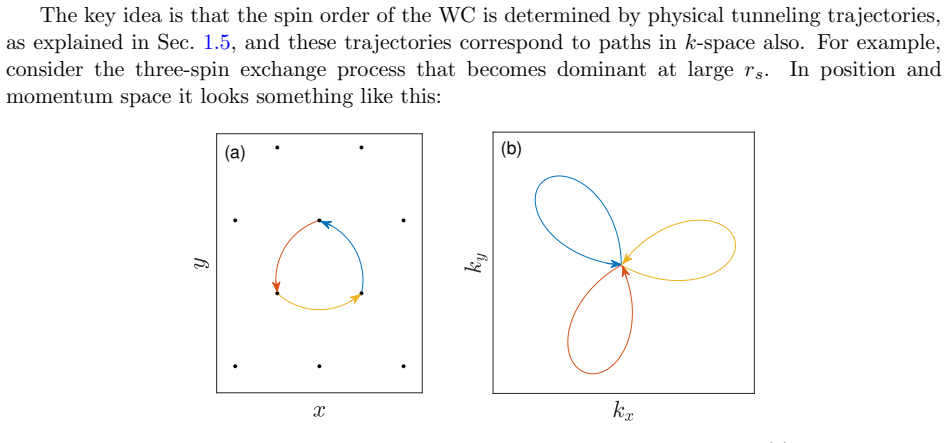
The workhorse is the Einstein-phonon approximation: replace the Wigner crystal by independent 2D harmonic oscillators, each electron confined by V(r) ≈ (1/2)mω²r² with ω set by the Coulomb energy scale, so the ground state is a Gaussian packet of width ∼a_B r_s^{3/4} and zero-point energy ℏω. This yields the energy series and the Lindemann-based melting estimate. For spin, the machinery is multiparticle ring exchange with imaginary action S_n: exchange amplitudes J_a ∼ exp(iS_a/ℏ), and the counterintuitive ordering S_3 < S_2 selects ferromagnetism. With Berry curvature, the same tunneling trajectories enclose a Berry flux Φ that turns the three-spin exchange into a chiral term Jχ Σ S_i·(S_j×
Load-bearing premise
The quantitative phase-boundary estimate (r_s≈34) rests on assuming that the empirical Lindemann threshold η_c=0.23, calibrated from classical thermal melting, applies unchanged to quantum zero-temperature melting driven by zero-point fluctuations.
What would settle it
A clean two-dimensional electron system tuned through the zero-field freezing transition: if the melting density corresponds to an interaction parameter r_s clearly outside the 30–40 window, the paper's Lindemann-based phase-boundary estimate loses its quantitative support.
If this is right
- If the Lindemann estimate is right, zero-field Wigner crystallization in any clean 2D system should occur near r_s≈34; experiments can look for the predicted wave-packet size scaling ∼ r_s^{3/4} through tunneling or compressibility.
- Deep in the Wigner crystal the spin sector is governed by ring exchange, making the ground state ferromagnetic; only near the melting transition do competing terms open a narrow antiferromagnetic window.
- The self-doping instability means that for r_s≲70 a pinned Wigner lattice can still conduct through mobile vacancies and interstitials, explaining 'metallic electron crystal' behavior, including the sign-changing Hall effect seen in rhombohedral graphene.
- Berry curvature can make the crystal's insulating bulk coexist with a dissipationless, quantized Hall edge, so a WC material can masquerade as a quantum Hall state in transport while looking like a triangular lattice in STM.
- Berry curvature converts the three-spin ring exchange into a chiral scalar-chirality interaction, which can produce non-coplanar spin textures or spin-liquid behavior if the Heisenberg term is antiferromagnetic.
Where Pith is reading between the lines
- Inference: The Lindemann-transfer assumption could be tested directly in classical 2D colloidal or dusty-plasma crystals with tunable screening, where the melting threshold η_c is measured, and then compared with quantum Monte Carlo estimates; if η_c differs in the deep-quantum regime, the r_s≈34 number would need revision.
- Inference: The microemulsion proof for 1<α<2 suggests that other long-range-interacting 2D systems with softer interactions (e.g., dipolar gases with α=3) might not require microemulsions; observing the absence of intermediate phases in such systems would sharpen the role of Coulomb frustration.
- Inference: The chiral three-spin term implies that Berry-curvature-rich Wigner crystals could exhibit an orbital/spin chiral ground state even at zero magnetic field; a concrete experimental search would be to look for a spontaneous Hall or Kerr signal developing below the crystallization temperature in a clean TMD or rhombohedral graphene device.
- Inference: The anomalous Hall crystal scenario suggests that some existing 'quantum anomalous Hall' observations in moiré materials may actually be Wigner crystals with a topological edge rather than filled Chern bands; simultaneous real-space imaging and transport would distinguish them.
Editorial analysis
A structured set of objections, weighed in public.
Referee Report
Summary. These lecture notes (arXiv:2607.13933) survey the zero-field two-dimensional electron Wigner crystal (WC), combining "old" jellium-model physics with "new" Berry-curvature effects. Section 1 develops the classical/quantum energy of the WC, the semiclassical Einstein-phonon estimate and Lindemann melting criterion (r_s,c ≈ 34, with QMC window 30–40), the liquid-solid transition and Coulomb-frustrated microemulsions, experimental signatures (STM, umklapp scattering, pinning, negative compressibility), spin ordering via multi-electron ring exchange, and the self-doping/metallic electron crystal proposal. Section 2 reviews Berry-curvature modifications: anomalous Hall crystals, ℓ = 1 / halo Wigner crystals, and chiral three-spin exchange terms. The notes are explicitly pedagogical and advance no new predictive claim; their aim is to provide an accurate, useful map of current WC physics.
Significance. If accurate, the notes fill a useful niche: a readable, up-to-date entry point to the WC literature that connects classic Wigner/Lindemann/ring-exchange results with recent STM imaging and rhombohedral-graphene experiments. The manuscript's main strength is its intellectual honesty. Section 1.2 labels the Einstein-phonon/Lindemann route "cheating" and anchors the phase boundary with QMC r_s = 30–40; Section 1.3.1 explicitly flags the α = 1 microemulsion case as inconclusive and defers to Ref. [25]; Section 2.5 lists omitted topics without overclaiming. These self-imposed caveats make the pedagogical claims trustworthy. I find no load-bearing technical error, and the central claim — that the notes provide an accurate map of current zero-field WC physics — is defensible on the evidence presented.
minor comments (5)
- [Sec. 1.3.1 / Eq. (12)] The title "proof that something like microemulsions must exist" is stronger than the displayed derivation, which is self-admittedly inconclusive at α = 1, the actual Coulomb case. The text handles this by deferring to Ref. [25], so the lecture notes' conclusion is supported by the literature; please make the scope of the "proof" explicit at the start of the subsection (or soften the title) so casual readers do not take the sketch as the full Coulomb proof.
- [Sec. 1.2 / Eq. (6)] The step from Eq. (6) to r_s = 34 uses r_s = 1/(√π n a_B²) and η_c = 0.23 plus numerical prefactors, but the text omits the √π factor. Since this is a semi-empirical estimate, please show the one-line algebra (√⟨r²⟩ ≈ a_B r_s^{3/4} = η_c n^{-1/2} = η_c √π a_B r_s) so the quoted number is reproducible.
- [Sec. 1.3 / Fig. 6] In the re-entrance paragraph, "as depicted in Fig. dipoles(b)" is a broken reference; it should be Fig. 6(b). The phrase suggests a missing label substitution from an earlier draft and should be corrected.
- [Sec. 2.4 / Eq. (21)] Typo: "three neighboring spins i, j, know looks like" should read "i, j, k now looks like". In the same paragraph, ensure the relation P_ijk = P_ij P_jk is consistent with the inverse notation in Eq. (13) or briefly explain the convention.
- [Sec. 1.3.1] The note states that the subsection is a near-verbatim repetition of an argument that the author "wrote more or less this same text" in Ref. [19]. For a journal version, please verify that this reuse complies with the journal's prior-publication policy and that permission/citation is sufficient; a footnote acknowledging the source already helps.
Circularity Check
No load-bearing circularity: the notes are an independent review, and the few self-cited results are used as external literature rather than as inputs that define the derivations.
full rationale
The paper is a self-described lecture-note review ('a smattering of old and new ideas'), not a derivation of new quantitative results. The nearest candidates for circularity are explicitly flagged limitations. In Sec. 1.2, the Lindemann-criterion estimate of r_s=34 is presented as the 'cheating way', with η_c=0.23 taken from an external empirical range and the result immediately cross-checked against independent QMC values r_s=30-40; it is a pedagogical consistency check, not a fitted input renamed as a prediction. In Sec. 1.3.1, the microemulsion proof is explicitly attributed to Spivak/Kivelson, and the notes concede that the α→1 Coulomb case 'is inconclusive' and defer completion to Ref. [25]; the self-repetition note ('I also wrote more or less this same text in Ref. [19]') concerns presentation, not the derivation. The self-citations (e.g., Refs. [11,19,22,23,41,55]) are used as pointers to prior work with stated physical mechanisms; none is used as an input whose output is then claimed as a new prediction. The gapless-material claim in Sec. 2.1 rests on Ref. [41] by the same author, but it is background motivation, is mechanism-based and externally falsifiable, and does not reduce the paper's central survey to a self-citation chain. The Berry-curvature sections review recent overlapping and independent theory and experiment without making new predictions. Therefore the derivation chain is self-contained with respect to its pedagogical claims, and no circular step is present.
Axiom & Free-Parameter Ledger
free parameters (1)
- Lindemann threshold η_c =
0.23 (empirical range 0.21–0.25)
axioms (6)
- domain assumption Uniform neutralizing positive jellium background; electrons are confined to a strict 2D plane.
- domain assumption The Wigner crystal ground state has a triangular lattice.
- domain assumption The unscreened Coulomb interaction V(r) = e²/r is the relevant interaction in the zero-gate limit.
- domain assumption Lindemann criterion applies to quantum melting of the WC with η_c ≈ 0.23.
- domain assumption Quantum Monte Carlo results for the 2D WC-FL transition (r_s = 30–40) are correct.
- domain assumption For the microemulsion proof, the interaction has the form k/r^α with 1 < α < 2; the α = 1 case is deferred to Ref. [25].
invented entities (3)
-
Anomalous Hall crystal
independent evidence
-
ℓ = 1 / halo Wigner crystal
no independent evidence
-
Chiral three-spin term from Berry phases
no independent evidence
read the original abstract
These are lecture notes created for a short lecture series at the 2026 CTEQ Summer School at Penn State. They are written in a conversational and informal style. The goal of these notes is to introduce and review a smattering of old and new ideas about the Wigner crystal (the solid phase of the two-dimensional electron system) in the context of recent experiments. Particular emphasis is given to the semiclassical description of the Wigner crystal, its quantum melting transition, its spin order, and the ways in which the Wigner crystal can be modified by Berry curvature.
Figures





Reference graph
Works this paper leans on
-
[1]
On the interaction of electrons in metals,
E. Wigner, “On the interaction of electrons in metals,”Phys. Rev.46(Dec, 1934) 1002–1011. https://link.aps.org/doi/10.1103/PhysRev.46.1002
-
[2]
Imaging quantum melting in a disordered 2d wigner solid,
Z. Xiang, H. Li, J. Xiao, M. H. Naik, Z. Ge, Z. He, S. Chen, J. Nie, S. Li, Y. Jiang, R. Sailus, R. Banerjee, T. Taniguchi, K. Watanabe, S. Tongay, S. G. Louie, M. F. Crommie, and F. Wang, “Imaging quantum melting in a disordered 2d wigner solid,”Science388no. 6748, (2025) 736–740. https://www.science.org/doi/abs/10.1126/science.ado7136
-
[3]
C. C. Grimes and G. Adams, “Evidence for a liquid-to-crystal phase transition in a classical, two-dimensional sheet of electrons,”Phys. Rev. Lett.42(Mar, 1979) 795–798. https://link.aps.org/doi/10.1103/PhysRevLett.42.795
-
[4]
Liquid-solid transition and the fractional quantum-hall effect,
P. K. Lam and S. M. Girvin, “Liquid-solid transition and the fractional quantum-hall effect,”Phys. Rev. B30(Jul, 1984) 473(R)–475(R).https://link.aps.org/doi/10.1103/PhysRevB.30.473
-
[5]
Direct observation of a magnetic-field-induced Wigner crystal,
Y.-C. Tsui, M. He, Y. Hu, E. Lake, T. Wang, K. Watanabe, T. Taniguchi, M. P. Zaletel, and A. Yazdani, “Direct observation of a magnetic-field-induced Wigner crystal,”Nature628no. 8007, (Apr., 2024) 287–292.https://www.nature.com/articles/s41586-024-07212-7
2024
-
[6]
Defects in the two-dimensional electron solid and implications for melting,
D. S. Fisher, B. I. Halperin, and R. Morf, “Defects in the two-dimensional electron solid and implications for melting,”Phys. Rev. B20(Dec, 1979) 4692–4712. https://link.aps.org/doi/10.1103/PhysRevB.20.4692
-
[7]
Some static and dynamical properties of a two-dimensional wigner crystal,
L. Bonsall and A. A. Maradudin, “Some static and dynamical properties of a two-dimensional wigner crystal,”Phys. Rev. B15(Feb, 1977) 1959–1973. https://link.aps.org/doi/10.1103/PhysRevB.15.1959
-
[8]
Die plancksche theorie der strahlung und die theorie der spezifischen w¨ arme,
A. Einstein, “Die plancksche theorie der strahlung und die theorie der spezifischen w¨ arme,”Annalen der Physik327no. 1, (1907) 180–190
1907
-
[9]
Phase diagram of the low-density two-dimensional homogeneous electron gas,
N. D. Drummond and R. J. Needs, “Phase diagram of the low-density two-dimensional homogeneous electron gas,”Phys. Rev. Lett.102(Mar, 2009) 126402. https://link.aps.org/doi/10.1103/PhysRevLett.102.126402
-
[10]
Quantum monte carlo study of the phase diagram of the two-dimensional uniform electron liquid,
S. Azadi, N. D. Drummond, and S. M. Vinko, “Quantum monte carlo study of the phase diagram of the two-dimensional uniform electron liquid,”Phys. Rev. B110(Dec, 2024) 245145. https://link.aps.org/doi/10.1103/PhysRevB.110.245145
-
[11]
M. Babadi, B. Skinner, M. M. Fogler, and E. Demler, “Universal behavior of repulsive two-dimensional fermions in the vicinity of the quantum freezing point,”EPL (Europhysics Letters) 103no. 1, (Jul, 2013) 16002.https://doi.org/10.1209/0295-5075/103/16002
-
[12]
Unrestricted hartree-fock theory of wigner crystals,
J. R. Trail, M. D. Towler, and R. J. Needs, “Unrestricted hartree-fock theory of wigner crystals,” Phys. Rev. B68(Jul, 2003) 045107.https://link.aps.org/doi/10.1103/PhysRevB.68.045107
-
[13]
Hartree-fock phase diagram of the two-dimensional electron gas,
B. Bernu, F. Delyon, M. Holzmann, and L. Baguet, “Hartree-fock phase diagram of the two-dimensional electron gas,”Phys. Rev. B84(Sep, 2011) 115115. https://link.aps.org/doi/10.1103/PhysRevB.84.115115
-
[14]
Quantization of the hall conductance from density quantization alone,
S. Kivelson and S. A. Trugman, “Quantization of the hall conductance from density quantization alone,”Phys. Rev. B33(Mar, 1986) 3629–3635. https://link.aps.org/doi/10.1103/PhysRevB.33.3629
-
[15]
Phase separation in the two-dimensional electron liquid in mosfet’s,
B. Spivak, “Phase separation in the two-dimensional electron liquid in mosfet’s,”Phys. Rev. B67 (Mar, 2003) 125205.https://link.aps.org/doi/10.1103/PhysRevB.67.125205
-
[16]
Phases intermediate between a two-dimensional electron liquid and wigner crystal,
B. Spivak and S. A. Kivelson, “Phases intermediate between a two-dimensional electron liquid and wigner crystal,”Phys. Rev. B70(Oct, 2004) 155114. https://link.aps.org/doi/10.1103/PhysRevB.70.155114. 23
-
[17]
Ground state of a two-dimensional electron liquid in a weak magnetic field,
M. M. Fogler, A. A. Koulakov, and B. I. Shklovskii, “Ground state of a two-dimensional electron liquid in a weak magnetic field,”Phys. Rev. B54(Jul, 1996) 1853–1871. https://link.aps.org/doi/10.1103/PhysRevB.54.1853
-
[18]
An electronic microemulsion phase emerging from a quantum crystal-to-liquid transition,
J. Sung, J. Wang, I. Esterlis, P. A. Volkov, G. Scuri, Y. Zhou, E. Brutschea, T. Taniguchi, K. Watanabe, Y. Yang,et al., “An electronic microemulsion phase emerging from a quantum crystal-to-liquid transition,”Nature Physics21no. 3, (2025) 437–443
2025
-
[19]
S. Joy and B. Skinner, “Upper bound on the window of density occupied by microemulsion phases in two-dimensional electron systems,”Phys. Rev. B108(Dec, 2023) L241110. https://link.aps.org/doi/10.1103/PhysRevB.108.L241110
-
[20]
Disorder-induced liquid-solid phase coexistence in two-dimensional electron systems,
S. Joy and B. Skinner, “Disorder-induced liquid-solid phase coexistence in two-dimensional electron systems,”Phys. Rev. B113(May, 2026) L201117.https://link.aps.org/doi/10.1103/71l6-w8hl
-
[21]
Is disorder a friend or a foe to melting of wigner-mott insulators?,
M. Hammam, C. Lewandowski, V. Dobrosavljevic, and S. Joy, “Is disorder a friend or a foe to melting of wigner-mott insulators?,” 2025.https://arxiv.org/abs/2512.07932
arXiv 2025
-
[22]
Anomalously large capacitance of a plane capacitor with a two-dimensional electron gas,
B. Skinner and B. I. Shklovskii, “Anomalously large capacitance of a plane capacitor with a two-dimensional electron gas,”Phys. Rev. B82(Oct, 2010) 155111. https://link.aps.org/doi/10.1103/PhysRevB.82.155111
-
[23]
B. Skinner and M. M. Fogler, “Simple variational method for calculating energy and quantum capacitance of an electron gas with screened interactions,”Phys. Rev. B82(Nov, 2010) 201306(R). https://link.aps.org/doi/10.1103/PhysRevB.82.201306
-
[24]
Critical gate distance for wigner crystallization in the two-dimensional electron gas,
A. Valenti, V. Calvera, Y. Yang, M. A. Morales, S. A. Kivelson, I. Esterlis, and S. Zhang, “Critical gate distance for wigner crystallization in the two-dimensional electron gas,”Physical Review Letters 135no. 16, (Oct., 2025) .http://dx.doi.org/10.1103/2qgp-v27h
-
[25]
Universal aspects of coulomb-frustrated phase separation,
R. Jamei, S. Kivelson, and B. Spivak, “Universal aspects of coulomb-frustrated phase separation,” Phys. Rev. Lett.94(Feb, 2005) 056805. https://link.aps.org/doi/10.1103/PhysRevLett.94.056805
-
[26]
Signatures of wigner crystal of electrons in a monolayer semiconductor,
T. Smole´ nski, P. E. Dolgirev, C. Kuhlenkamp, A. Popert, Y. Shimazaki, P. Back, X. Lu, M. Kroner, K. Watanabe, T. Taniguchi,et al., “Signatures of wigner crystal of electrons in a monolayer semiconductor,”Nature595no. 7865, (July, 2021) 53–57. https://doi.org/10.1038/s41586-021-03590-4
-
[27]
J. Falson, I. Sodemann, B. Skinner, D. Tabrea, Y. Kozuka, A. Tsukazaki, M. Kawasaki, K. von Klitzing, and J. H. Smet, “Competing correlated states around the zero-field Wigner crystallization transition of electrons in two dimensions,”Nature Materials21no. 3, (Mar., 2022) 311–316. https://doi.org/10.1038/s41563-021-01166-1
-
[28]
Evidence of metallic wigner crystal in rhombohedral graphene,
T. Han, J. P. Butler, S. Ye, Z. Hua, S. Dutta, Z. Hadjri, Z. Wu, J. Yang, J. Seo, P. Pattanakanvijit, E. Aitken, K. Watanabe, T. Taniguchi, P. Xiong, E. Zeldov, Z. Lu, R. Ashoori, and L. Ju, “Evidence of metallic wigner crystal in rhombohedral graphene,” 2026.https://arxiv.org/abs/2604.00113
arXiv 2026
-
[29]
Coulomb gap and variable range hopping in a pinned Wigner crystal,
B. I. Shklovskii, “Coulomb gap and variable range hopping in a pinned Wigner crystal,”physica status solidi (c)1no. 1, (2004) 46–50. https://onlinelibrary.wiley.com/doi/abs/10.1002/pssc.200303642
-
[30]
Negative compressibility of interacting two-dimensional electron and quasiparticle gases,
J. P. Eisenstein, L. N. Pfeiffer, and K. W. West, “Negative compressibility of interacting two-dimensional electron and quasiparticle gases,”Phys. Rev. Lett.68(Feb, 1992) 674–677. https://link.aps.org/doi/10.1103/PhysRevLett.68.674
-
[31]
J. P. Eisenstein, L. N. Pfeiffer, and K. W. West, “Compressibility of the two-dimensional electron gas: Measurements of the zero-field exchange energy and fractional quantum hall gap,”Phys. Rev. B50 (Jul, 1994) 1760–1778.https://link.aps.org/doi/10.1103/PhysRevB.50.1760
-
[32]
Density of localized states in the surface impurity band of a metal-insulator-semiconductor structure,
M. S. Bello, E. I. Levin, B. I. Shklovskii, and A. L. Efros, “Density of localized states in the surface impurity band of a metal-insulator-semiconductor structure,”Sov. Phys. JETP53(1981) 822. 24
1981
-
[33]
Where does magnetism come from?,
Brian Skinner, “Where does magnetism come from?,” Apr., 2015. https://gravityandlevity.wordpress.com/2015/04/19/where-does-magnetism-come-from/
2015
-
[34]
S. M. Girvin and K. Yang,Modern condensed matter physics. Cambridge University Press, 2019
2019
-
[35]
Interstitial-Induced Ferromagnetism in a Two-Dimensional Wigner Crystal,
K.-S. Kim, C. Murthy, A. Pandey, and S. A. Kivelson, “Interstitial-Induced Ferromagnetism in a Two-Dimensional Wigner Crystal,”Physical Review Letters129no. 22, (Nov., 2022) 227202. https://link.aps.org/doi/10.1103/PhysRevLett.129.227202
-
[36]
Dynamical defects in a two-dimensional wigner crystal: Self-doping and kinetic magnetism,
K.-S. Kim, I. Esterlis, C. Murthy, and S. A. Kivelson, “Dynamical defects in a two-dimensional wigner crystal: Self-doping and kinetic magnetism,”Physical Review B109no. 23, (2024) 235130
2024
-
[37]
Transport evidence for wigner crystals in monolayer mote2,
M. Zhang, Z. Wang, Y. Jiang, Y. Liu, K. Watanabe, T. Taniguchi, S. Liu, S. Lei, Y. Li, and Y. Xu, “Transport evidence for wigner crystals in monolayer mote2,” 2025. https://arxiv.org/abs/2506.20392
Pith/arXiv arXiv 2025
-
[38]
Crystals caught doping: Metallic wigner crystals in rhombohedral graphene,
J. Dong, T. Soejima, D. E. Parker, and A. Vishwanath, “Crystals caught doping: Metallic wigner crystals in rhombohedral graphene,” 2026.https://arxiv.org/abs/2604.00114
arXiv 2026
-
[39]
A review of the quantum hall effects in mgzno/zno heterostructures,
J. Falson and M. Kawasaki, “A review of the quantum hall effects in mgzno/zno heterostructures,” Reports on Progress in Physics81no. 5, (2018) 056501
2018
-
[40]
Bilayer Wigner crystals in a transition metal dichalcogenide heterostructure,
Y. Zhou, J. Sung, E. Brutschea, I. Esterlis, Y. Wang, G. Scuri, R. J. Gelly, H. Heo, T. Taniguchi, K. Watanabe, G. Zar´ and, M. D. Lukin, P. Kim, E. Demler, and H. Park, “Bilayer Wigner crystals in a transition metal dichalcogenide heterostructure,”Nature595no. 7865, (July, 2021) 48–52. https://doi.org/10.1038/s41586-021-03560-w
-
[41]
Wigner crystallization in bernal bilayer graphene,
S. Joy and B. Skinner, “Wigner crystallization in bernal bilayer graphene,” 2023
2023
-
[42]
Fractional quantum anomalous hall effect in multilayer graphene,
Z. Lu, T. Han, Y. Yao, A. P. Reddy, J. Yang, J. Seo, K. Watanabe, T. Taniguchi, L. Fu, and L. Ju, “Fractional quantum anomalous hall effect in multilayer graphene,”Nature626no. 8000, (2024) 759–764
2024
-
[43]
Signatures of chiral superconductivity in rhombohedral graphene,
T. Han, Z. Lu, Z. Hadjri, L. Shi, Z. Wu, W. Xu, Y. Yao, A. A. Cotten, O. Sharifi Sedeh, H. Weldeyesus, J. Yang, J. Seo, S. Ye, M. Zhou, H. Liu, G. Shi, Z. Hua, K. Watanabe, T. Taniguchi, P. Xiong, D. M. Zumb¨ uhl, L. Fu, and L. Ju, “Signatures of chiral superconductivity in rhombohedral graphene,”Nature643no. 8072, (July, 2025) 654–661. https://www.nature...
2025
-
[44]
Parent berry curvature and the ideal anomalous hall crystal,
T. Tan and T. Devakul, “Parent berry curvature and the ideal anomalous hall crystal,”Phys. Rev. X 14(Nov, 2024) 041040.https://link.aps.org/doi/10.1103/PhysRevX.14.041040
-
[45]
Orbital multiferroicity in pentalayer rhombohedral graphene,
T. Han, Z. Lu, G. Scuri, J. Sung, J. Wang, T. Han, K. Watanabe, T. Taniguchi, L. Fu, H. Park, and L. Ju, “Orbital multiferroicity in pentalayer rhombohedral graphene,”Nature623no. 7985, (Nov.,
-
[46]
Quantum geometry and the hidden scales in materials,
N. Verma, P. J. W. Moll, T. Holder, and R. Queiroz, “Quantum geometry and the hidden scales in materials,”Nature Reviews Physics8no. 4, (Mar., 2026) 226–239. http://dx.doi.org/10.1038/s42254-026-00923-y
-
[47]
Dawn of the topological age?,
A. P. Ramirez and B. Skinner, “Dawn of the topological age?,”Physics Today73no. 9, (2020) 30–36
2020
-
[48]
Z. Teˇ sanovi´ c, F. m. c. Axel, and B. I. Halperin, ““hall crystal” versus wigner crystal,”Phys. Rev. B 39(Apr, 1989) 8525–8551.https://link.aps.org/doi/10.1103/PhysRevB.39.8525
-
[49]
Moir´ e-driven topological electronic crystals in twisted graphene,
R. Su, D. Waters, B. Zhou, K. Watanabe, T. Taniguchi, Y.-H. Zhang, M. Yankowitz, and J. Folk, “Moir´ e-driven topological electronic crystals in twisted graphene,”Nature637no. 8048, (Jan., 2025) 1084–1089.https://www.nature.com/articles/s41586-024-08239-6
2025
-
[50]
Signatures of fractional quantum anomalous Hall states in twisted MoTe2,
J. Cai, E. Anderson, C. Wang, X. Zhang, X. Liu, W. Holtzmann, Y. Zhang, F. Fan, T. Taniguchi, K. Watanabe, Y. Ran, T. Cao, L. Fu, D. Xiao, W. Yao, and X. Xu, “Signatures of fractional quantum anomalous Hall states in twisted MoTe2,”Nature622no. 7981, (Oct., 2023) 63–68. https://www.nature.com/articles/s41586-023-06289-w. 25
2023
-
[51]
Observation of fractionally quantized anomalous Hall effect,
H. Park, J. Cai, E. Anderson, Y. Zhang, J. Zhu, X. Liu, C. Wang, W. Holtzmann, C. Hu, Z. Liu, T. Taniguchi, K. Watanabe, J.-H. Chu, T. Cao, L. Fu, W. Yao, C.-Z. Chang, D. Cobden, D. Xiao, and X. Xu, “Observation of fractionally quantized anomalous Hall effect,”Nature622no. 7981, (Oct.,
-
[52]
J. Dong, T. Wang, T. Wang, T. Soejima, M. P. Zaletel, A. Vishwanath, and D. E. Parker, “Anomalous Hall Crystals in Rhombohedral Multilayer Graphene. I. Interaction-Driven Chern Bands and Fractional Quantum Hall States at Zero Magnetic Field,”Physical Review Letters133no. 20, (Nov., 2024) 206503.https://link.aps.org/doi/10.1103/PhysRevLett.133.206503
-
[53]
74–79.https://www.nature.com/articles/s41586-023-06536-0
-
[54]
Stability of anomalous hall crystals in multilayer rhombohedral graphene,
Z. Dong, A. S. Patri, and T. Senthil, “Stability of anomalous hall crystals in multilayer rhombohedral graphene,”Phys. Rev. B110(Nov, 2024) 205130. https://link.aps.org/doi/10.1103/PhysRevB.110.205130
-
[55]
T. Soejima, J. Dong, T. Wang, T. Wang, M. P. Zaletel, A. Vishwanath, and D. E. Parker, “Anomalous Hall crystals in rhombohedral multilayer graphene. II. General mechanism and a minimal model,”Physical Review B110no. 20, (Nov., 2024) 205124. https://link.aps.org/doi/10.1103/PhysRevB.110.205124
-
[56]
λ-jellium model for the anomalous hall crystal,
T. Soejima, J. Dong, A. Vishwanath, and D. E. Parker, “λ-jellium model for the anomalous hall crystal,”Phys. Rev. Lett.135(Oct, 2025) 186505.https://link.aps.org/doi/10.1103/x53d-12s6
-
[57]
Chiral wigner crystal phases induced by berry curvature,
S. Joy, L. Levitov, and B. Skinner, “Chiral wigner crystal phases induced by berry curvature,”Phys. Rev. Lett.135(Dec, 2025) 256502.https://link.aps.org/doi/10.1103/h5hy-jh6m
-
[58]
Chiral stoner magnetism in dirac bands,
Z. Dong and L. Levitov, “Chiral stoner magnetism in dirac bands,”Phys. Rev. B110(Sep, 2024) 104420.https://link.aps.org/doi/10.1103/PhysRevB.110.104420
-
[59]
K.-S. Kim, “Exchange interactions of a Wigner crystal in a magnetic field and Berry curvature: Multiparticle tunneling through complex trajectories,”Physical Review B113no. 14, (Apr., 2026) 144434.https://link.aps.org/doi/10.1103/lj9b-3myv
-
[60]
Global phase diagram and quantum spin liquids in a spin-1/2 triangular antiferromagnet,
S.-S. Gong, W. Zhu, J.-X. Zhu, D. N. Sheng, and K. Yang, “Global phase diagram and quantum spin liquids in a spin-1/2 triangular antiferromagnet,”Physical Review B96no. 7, (Aug., 2017) 075116. https://link.aps.org/doi/10.1103/PhysRevB.96.075116
-
[61]
Spin chirality and fermion stirring in topological bands,
A. Panigrahi, V. Poliakov, Z. Dong, and L. Levitov, “Spin chirality and fermion stirring in topological bands,” 2024
2024
-
[62]
Imaging two-dimensional generalized Wigner crystals,
H. Li, S. Li, E. C. Regan, D. Wang, W. Zhao, S. Kahn, K. Yumigeta, M. Blei, T. Taniguchi, K. Watanabe, S. Tongay, A. Zettl, M. F. Crommie, and F. Wang, “Imaging two-dimensional generalized Wigner crystals,”Nature597no. 7878, (Sept., 2021) 650–654. https://www.nature.com/articles/s41586-021-03874-9
2021
-
[63]
Correlated insulating states at fractional fillings of moir´ e superlattices,
Y. Xu, S. Liu, D. A. Rhodes, K. Watanabe, T. Taniguchi, J. Hone, V. Elser, K. F. Mak, and J. Shan, “Correlated insulating states at fractional fillings of moir´ e superlattices,”Nature587no. 7833, (Nov.,
-
[64]
Stability, dynamical properties, and melting of a classical bilayer Wigner crystal,
G. Goldoni and F. M. Peeters, “Stability, dynamical properties, and melting of a classical bilayer Wigner crystal,”Physical Review B53no. 8, (Feb., 1996) 4591–4603. https://link.aps.org/doi/10.1103/PhysRevB.53.4591
-
[65]
A bilayer of Wigner crystal in the harmonic approximation,
K. Esfarjani and Y. Kawazoe, “A bilayer of Wigner crystal in the harmonic approximation,”Journal of Physics: Condensed Matter7no. 36, (Sept., 1995) 7217. https://doi.org/10.1088/0953-8984/7/36/011
-
[66]
Quasi-two-dimensional Wigner crystals with a compound lattice,
Y. M. Vil’k and Y. P. Monarkha, “Quasi-two-dimensional Wigner crystals with a compound lattice,” Soviet Journal Low Temperature Physics10no. 8, (Aug., 1984) 465–466. https://doi.org/10.1063/10.0031167
-
[67]
Magnetism from multiparticle ring exchange in moir´ e wigner crystals,
I. Esterlis and A. Levchenko, “Magnetism from multiparticle ring exchange in moir´ e wigner crystals,” Phys. Rev. B111(May, 2025) L201115. https://link.aps.org/doi/10.1103/PhysRevB.111.L201115
-
[68]
Quantum melting a Wigner crystal into Hall liquids,
A. P. Reddy and L. Fu, “Quantum melting a Wigner crystal into Hall liquids,”Physical Review B113 no. 16, (Apr., 2026) L161403.https://link.aps.org/doi/10.1103/xt9w-8dg7. 27
-
[69]
Electronic crystals in layered materials,
Y. Zhou, I. Esterlis, and T. Smole´ nski, “Electronic crystals in layered materials,”npj 2D Materials and Applications(June, 2026) .https://www.nature.com/articles/s41699-026-00713-1. 26
2026
-
[2020]
214–218.https://www.nature.com/articles/s41586-020-2868-6
-
[2023]
41–47.https://www.nature.com/articles/s41586-023-06572-w
discussion (0)
Sign in with ORCID, Apple, or X to comment. Anyone can read and Pith papers without signing in.