REVIEW 3 major objections 5 minor 88 references
Adding metadata as auxiliary training targets improves species identification and transfer across acoustic, species, and geographic domain shifts.
Reviewed by Pith at T0; open to challenge. T0 means a machine referee read the full paper against a public rubric. the ladder, T0–T4 →
T0 review · deepseek-v4-flash
2026-08-02 02:50 UTC pith:37K7GQKS
load-bearing objection A solid, honest empirical study whose central claim—location, season, and background-species auxiliary losses improve bioacoustic transfer—is plausible and mostly supported, but the noise in its model-selection procedure makes the reported gains less certain than the text suggests. the 3 major comments →
MetaPerch: Learning from metadata for bioacoustics foundation models
The pith
A machine-rendered reading of the paper's core claim, the machinery that carries it, and where it could break.
Core claim
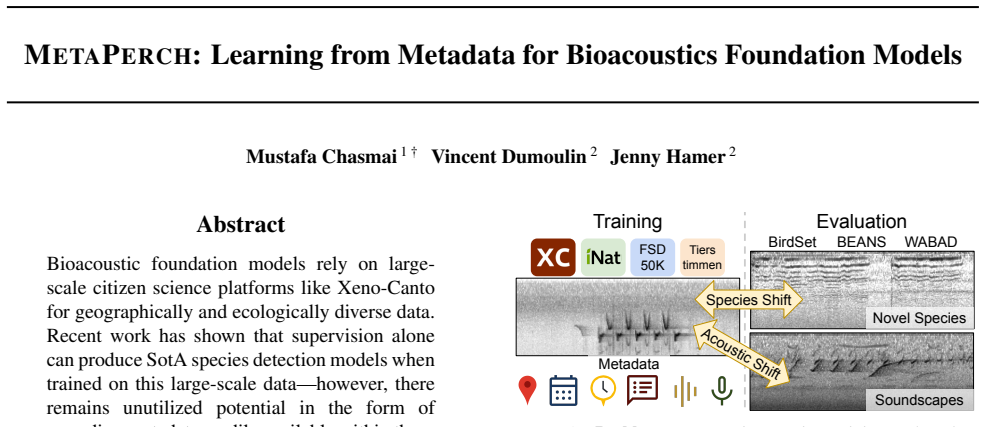
The central claim is that forcing the shared audio embedding to predict metadata, as auxiliary tasks alongside species identification, produces features that transfer better under domain shift. MetaPerch jointly trains species classification with prediction of location (S2 cell at level 7), season, and background species, treating each as a classification task with a constant loss weight and with mixup targets built from whichever metadata is present. Missing metadata is handled by placeholder values and zeroed loss contributions; an optional gradient-reversal layer makes the embedding adversarial to a metadata source. On the paper's own terms, the discovery is that this simple multi-task re
What carries the argument
The central object is a multi-task training objective on a shared EfficientNet-B3 embedding: the standard species classification loss plus a weighted sum of metadata classification losses, each with its own small MLP head. Location is binned into S2 cells (roughly 50,000 square kilometers at the chosen level) and treated as a classification target; season is derived from date and hemisphere; background species is a multi-label target present on a fraction of recordings. The mechanism does its work by shaping the embedding to encode where and when a recording was made and what else is audible, so that at test time—where metadata is not supplied—the embedding already carries geographic and hab
Load-bearing premise
The load-bearing premise is that the validation recipe—geometric averaging of observed-species classification, one-shot retrieval, and novel-species linear probing—predicts performance on the 17 evaluation benchmarks, so that the choices of location/season/background metadata, loss weights, and hyperparameters are supported; the paper itself reports a disconnect where the median hyperparameter trial beats the best-validation trial on WABAD.
What would settle it
Train MetaPerch and the species-only baseline with identical compute but select hyperparameters using a held-out portion of WABAD (or another globally distributed soundscape benchmark) instead of the paper's three validation task families. If the WABAD gains of +0.018 prototype / +0.070 linear ROC-AUC shrink or vanish, the reported benefit is largely a model-selection artifact rather than a property of metadata supervision. A second check: remove the location head and confirm whether the WABAD biome-clustering visualization collapses; if it does not, location supervision is not the driver of t
If this is right
- Metadata supervision only needs to be available during training; deployed models can run without location or time inputs.
- Location and season help most for regions underrepresented in training data, such as South America and Hawai‘i in BirdSet.
- The same recipe with the same architecture outperforms the species-only baseline on soundscape tasks and on novel-species transfer, by 0.015–0.070 ROC-AUC depending on benchmark.
- Background species supervision appears to teach the embedding to attend to co-occurring species, which is exactly the signal needed in dense soundscape recordings.
- Simple constant loss weights are sufficient; more complex multi-task balancing strategies do not add value.
Where Pith is reading between the lines
- If the mechanism is really about encoding habitat and geographic priors, the same auxiliary heads could be grafted onto other audio foundation models or taxa; a direct test would be to train location and season heads on a general audio encoder and measure transfer on non-avian tasks.
- The paper's own validation-disconnect result suggests the reported gains may understate or overstate deployment benefit depending on how models are selected; a fair comparison would select hyperparameters with WABAD-style globally distributed soundscapes in the validation mix.
- Because even 1% metadata availability still improved over baseline, metadata supervision could be a practical pretraining signal for passive acoustic monitoring deployments where species labels are sparse but GPS and timestamps are routinely logged.
- Adversarial training helped for day-part and text-embedding metadata, hinting that a per-metadata adversarial-versus-standard switch could be automated rather than chosen by hand.
Editorial analysis
A structured set of objections, weighed in public.
Referee Report
Summary. The paper introduces MetaPerch, a bioacoustic foundation model trained on Xeno-Canto, iNaturalist, Tierstimmenarchiv, and FSD50K. In addition to the species-identification objective, MetaPerch adds auxiliary prediction heads for recording metadata — most importantly location (S2-cell classification), season, and background species — with per-task loss weights tuned by Vizier. The model is compared to BioBaseline, a same-architecture model without metadata losses, and to recent baselines on BirdSet (7 datasets), BEANS (10 bioacoustic tasks), WABAD, and controlled BIRB few-shot settings. The paper reports average improvements of +0.015 BirdSet ROC-AUC, +0.016 accuracy/+0.006 cmAP on BEANS, and +0.018/+0.070 ROC-AUC on WABAD, along with extensive ablations of metadata sources, missing-metadata handling, mixup variants, adversarial training, and location formulations.
Significance. Metadata as auxiliary supervision is an attractive, low-cost direction: metadata is already present in citizen-science repositories and can be used at training time without test-time conditioning. If the reported gains are robust, MetaPerch would offer a simple recipe for improving transfer under acoustic, species, and geographic shift. The paper's controlled same-architecture baseline, the breadth of the evaluation (17 datasets), the systematic ablation of nine metadata sources, and the 5-seed repeated runs are genuine strengths, as is the public model release. The central caveat is model selection: the paper reports a disconnect between its validation score and WABAD performance, and the hyperparameter space for MetaPerch is much larger than for BioBaseline, so the size of the improvement may be inflated by selection. This is addressable with additional analysis, but it currently tempers confidence.
major comments (3)
- [§3.4, §4.4 (Table 5a)] The model-selection procedure in §3.4 chooses the metadata source set, per-metadata loss weights, head architectures, and adversarial/standard flags by a geometric average over three validation task families. Section 4.4 then reports that the median Vizier trial by validation score yields 0.952 WABAD ROC-AUC, while the best-validation trial yields only 0.946. Thus the validation ranking is not predictive of WABAD, one of the headline benchmarks. Because MetaPerch has many more tunable choices than BioBaseline, selecting the single best-validation configuration creates a best-of-N selection bias; the 5-seed standard deviations in §A.7 quantify seed noise for the selected configuration, not selection variance. The reported gains are therefore not yet established as unbiased estimates of the metadata benefit. Please report the full distribution of validation/test scores (or a selection-adju
- [Table A6] The appendix reports Top-1 accuracy for BirdSet. MetaPerch is worse than BioBaseline on four of seven datasets (UHH 0.550 vs 0.651; HSN 0.580 vs 0.625; NBP 0.679 vs 0.717; SNE 0.778 vs 0.792) and better only on PER and SSW. The main text's characterization of 'consistent improvements' rests entirely on ROC-AUC. Since the paper's central claim is that metadata improves species identification, this metric sensitivity needs to be discussed directly: either justify ROC-AUC/cmAP as the primary competencies (and state this in the main text), or explain why Top-1 accuracy regresses. As written, a reader could reasonably conclude that the metadata model trades classification confidence for ranking quality.
- [§4.4, Figure 7a] The BIRB few-shot analysis shows that MetaPerch's advantage over BioBaseline reverses at higher shot counts on the Xeno-Canto held-out set. The paper acknowledges this and appeals to PAM soundscapes being more representative. This is a legitimate qualification, but the reversal is also present in a species-shift-only setting, which is central to the 'novel species' narrative. Please either provide an explanation for the reversal or soften the general claim in the abstract/conclusion that metadata improves transfer to novel species. At minimum, the limitation should be reflected in the summary rather than only in a figure caption.
minor comments (5)
- [§3.3] Typo: 'biacoustics' should be 'bioacoustics'.
- [Table A3] The hidden-dimension search space lists 265 where 256 is clearly intended (it appears as '265{64, 128, 265, 512}' and the optimal value is also 265). Please correct the typo.
- [Table A6] '0.58±.014' should be '0.580±.014' for consistency with the other entries.
- [Figure 7a] The legend contains duplicated/confusing entries ('MetaBio', 'BioBaseline' twice). Please clean up the figure legend.
- [Abstract/Conclusion] The abstract and conclusion claim that metadata improves species identification quite broadly. The reported WABAD desert biome drop (Table A8, Deserts/Xeric Shrublands: 0.936 to 0.912) and the BIRB reversal at higher shots are counterexamples that appear only in the body; a sentence of qualification would better reflect the evidence.
Circularity Check
No derivation-level circularity: metadata improvements are empirical, held-out benchmark results; self-citations and validation selection do not reduce to the paper's own inputs.
full rationale
MetaPerch's central claim is empirical: adding location, season, and background-species auxiliary losses improves species identification relative to a same-architecture BioBaseline on BirdSet, BEANS, and WABAD. This is not derived from the training objective by construction; it is measured on held-out evaluation benchmarks. The paper's self-citations (Perch 2.0, BIRB, Chasmai et al. 2026) supply architecture, baselines, and experiment templates, not the metadata-improvement result, and the comparisons also include external methods (Perch 2.0, BirdNet, etc.). The validation/model-selection procedure in Section 3.4 uses a geometric average over validation tasks that do not overlap the test benchmarks; the paper explicitly discloses a 'disconnect between the validation and WABAD performance' (Section 4.4, Table 5a), where the median Vizier trial outperforms the best-validation trial on WABAD. This is a disclosed selection-validity limitation, not a circular reduction: the final WABAD or BirdSet numbers are not forced by the validation scores, and the paper does not hide the discrepancy. Ablations in Section 4.4 use WABAD to compare design choices (e.g., location formulation in Figure 7d), which is a test-set selection risk, but it does not make the reported gains equivalent to the selected hyperparameters by construction. Overall, no step in the claimed derivation chain reduces to its own inputs, so no circularity is identified.
Axiom & Free-Parameter Ledger
free parameters (10)
- Metadata loss weights (lambda_location, lambda_season, lambda_background) =
1.006, 0.955, 1.042 (Table A3)
- Metadata source set =
{location, season, background species} of 9 candidates
- S2 cell level for location =
Level 7 (~50,000 km^2)
- Metadata head architectures =
location: swish/265/1; season: relu/512/2; background: relu/512/1 (Table A3)
- Adversarial-vs-standard training flags =
False (standard) for all selected metadata
- Learning rate =
2.98e-4
- Dropout =
0.389
- Mixup parameters =
Dirichlet concentration 5.73, max signals 5, beta-binomial (15.09, 12.84)
- Season and day-part category definitions =
4 classes each; broad boundaries
- Background-species missing-metadata/mixup rule =
'mix if any present'
axioms (6)
- domain assumption All labels of a recording are assigned to every sampled 5s window (weak labels).
- domain assumption Cross-dataset taxonomy mapping (Xeno-Canto/Tierstimmenarchiv to iNaturalist classes) is correct.
- domain assumption Citizen-science metadata (location, date, background species) are accurate and ecologically meaningful, not just platform artifacts.
- domain assumption Evaluation benchmarks are disjoint from training data; only CBI is explicitly excluded for overlap.
- ad hoc to paper Mixup with multihot metadata targets ('mix any present metadata') is valid supervision.
- standard math Standard spectrogram construction and S2 geometry are correct.
read the original abstract
Bioacoustic foundation models rely on large-scale citizen science platforms like Xeno-Canto for geographically and ecologically diverse data. Recent work has shown that supervision alone can produce SotA species detection models when trained on this large-scale data -- however, there remains unutilized potential in the form of recording metadata readily available within these community-driven data hubs. In this work, we explore the use of metadata -- such as location and time -- as auxiliary supervision signals, allowing the model to leverage species-metadata correlations in its learned representation. Auxiliary metadata losses provide additional information beyond vocalizations alone that can encourage a richer, more robust representation that generalizes better to species distribution and acoustic domain shifts -- important challenges for deployment in real-world passive acoustic monitoring (PAM) settings. We introduce MetaPerch, a new foundation model that achieves strong species identification performance across multiple challenging domains and present an extensive empirical study of the effects of 9 diverse metadata sources on 17 bioacoustic datasets.
Figures


Reference graph
Works this paper leans on
-
[1]
European conference on computer vision , pages=
Planet-photo geolocation with convolutional neural networks , author=. European conference on computer vision , pages=. 2016 , organization=
2016
-
[2]
2021 , publisher=
Kahl, Stefan and Wood, Connor M and Eibl, Maximilian and Klinck, Holger , journal=. 2021 , publisher=
2021
-
[3]
Scientific Reports , volume=
Global birdsong embeddings enable superior transfer learning for bioacoustic classification , author=. Scientific Reports , volume=. 2023 , publisher=
2023
-
[4]
arXiv preprint arXiv:2312.07439 , year=
Hamer, Jenny and Triantafillou, Eleni and Van Merri. arXiv preprint arXiv:2312.07439 , year=
-
[5]
arXiv preprint arXiv:2508.11845 , year=
What matters for bioacoustic encoding , author=. arXiv preprint arXiv:2508.11845 , year=
-
[6]
arXiv preprint arXiv:2508.01277 , year=
Foundation models for bioacoustics---a comparative review , author=. arXiv preprint arXiv:2508.01277 , year=
-
[7]
arXiv preprint arXiv:2508.04665 , year=
Perch 2.0: the bittern lesson for bioacoustics , author=. arXiv preprint arXiv:2508.04665 , year=
-
[8]
EfficientNet : Rethinking model scaling for convolutional Neural Networks
Tan, Mingxing and Le, Quoc. EfficientNet : Rethinking model scaling for convolutional Neural Networks. International Conference on Machine Learning
-
[9]
A closer look at loss weighting in multi-task learning , author=
-
[10]
Advances in neural information processing systems , volume=
Gradient surgery for multi-task learning , author=. Advances in neural information processing systems , volume=
-
[11]
Forty-third International Conference on Machine Learning , year=
Bioacoustic Geolocation: Species Sounds as Geographic Signals , author=. Forty-third International Conference on Machine Learning , year=
-
[12]
International Conference on Learning Representations , year=
mixup: Beyond Empirical Risk Minimization , author=. International Conference on Learning Representations , year=
-
[13]
2019 16th International Conference on Machine Vision Applications (MVA) , pages=
Domain adaptation using a gradient reversal layer with instance weighting , author=. 2019 16th International Conference on Machine Vision Applications (MVA) , pages=. 2019 , organization=
2019
-
[14]
Journal of machine learning research , volume=
Domain-adversarial training of neural networks , author=. Journal of machine learning research , volume=
-
[15]
iNaturalist Research-grade Observations
iNaturalist contributors. iNaturalist Research-grade Observations
-
[16]
Xeno-Canto
Vellinga, Willem-Pier and Planqu\' e , Bob. Xeno-Canto
-
[17]
The archive of animal sounds at the Humboldt-university of Berlin
Frommolt, Karl-Heinz. The archive of animal sounds at the Humboldt-university of Berlin. Bioacoustics
-
[18]
FSD50K : An open dataset of human-labeled sound events
Fonseca, Eduardo and Favory, Xavier and Pons, Jordi and Font, Frederic and Serra, Xavier. FSD50K : An open dataset of human-labeled sound events. IEEE/ACM Transactions on Audio, Speech, and Language Processing
-
[19]
Advances in Neural Information Processing Systems , volume=
The iNaturalist sounds dataset , author=. Advances in Neural Information Processing Systems , volume=
-
[20]
Symes and Viviana Ruiz-Gutiérrez and Ingrid Molina-Mora and Fernando Cediel and Luis Sandoval and Holger Klinck , title =
Álvaro Vega-Hidalgo and Stefan Kahl and Laurel B. Symes and Viviana Ruiz-Gutiérrez and Ingrid Molina-Mora and Fernando Cediel and Luis Sandoval and Holger Klinck , title =. Zenodo , version = 1, doi =
-
[21]
Zenodo , version = 1, doi =
Mary Clapp and Stefan Kahl and Erik Meyer and Megan McKenna and Holger Klinck and Gail Patricelli , title =. Zenodo , version = 1, doi =
-
[22]
Alexander Hopping and Stefan Kahl and Holger Klinck , title =
W. Alexander Hopping and Stefan Kahl and Holger Klinck , title =. Zenodo , version = 1, doi =
-
[23]
Wood and Philip Chaon and M
Stefan Kahl and Connor M. Wood and Philip Chaon and M. Zachariah Peery and Holger Klinck , title =. Zenodo , version = 1, doi =
-
[24]
Zenodo , version = 1, doi =
Amanda Navine and Stefan Kahl and Ann Tanimoto-Johnson and Holger Klinck and Patrick Hart , title =. Zenodo , version = 1, doi =
-
[25]
Zenodo , version = 1, doi =
Stefan Kahl and Russell Charif and Holger Klinck , title =. Zenodo , version = 1, doi =
-
[26]
PeerJ Computer Science , volume=
NIPS4Bplus: a richly annotated birdsong audio dataset , author=. PeerJ Computer Science , volume=. 2019 , publisher=
2019
-
[27]
Marín-Gómez and Irene Mendoza and Miguel A
Pérez-Granados, Cristian and Jon Morant and Kevin Darras and Oscar H. Marín-Gómez and Irene Mendoza and Miguel A. Muñoz-Mohedano and Eduardo Santamaría-García and Giulia Bastianelli and Alba Márquez-Rodríguez and Michał Budka and Gerard Bota and José M. De la Peña-Rubio and Eladio L. García de la Morena and Manu Santa-Cruz and Pablo de la Nava and Mario F...
-
[28]
Weldy and Tom Denton and Abram B
Matthew J. Weldy and Tom Denton and Abram B. Fleishman and Jaclyn Tolchin and Matthew Mckown and Robert S. Spaan and Zachary J. Ruff and Julianna M. A. Jenkins and Matthew G. Betts and Damon B. Lesmeister , title =. Zenodo , version =. doi:10.5281/zenodo.10895837 , url =
-
[29]
Scientific Data , volume=
A Public Dataset of Annotated Orcinus orca Acoustic Signals for Detection and Ecotype Classification , author=. Scientific Data , volume=. 2025 , publisher=
2025
-
[30]
Pacific Islands Passive Acoustic Network ( PIPAN ) 10kHz Data
NOAA Pacific Islands Fisheries Science Center. Pacific Islands Passive Acoustic Network ( PIPAN ) 10kHz Data
-
[31]
Philosophical Transactions B , volume=
Using tropical reef, bird and unrelated sounds for superior transfer learning in marine bioacoustics , author=. Philosophical Transactions B , volume=. 2025 , publisher=
2025
-
[32]
Proceedings of Meetings on Acoustics , volume=
The Watkins marine mammal sound database: an online, freely accessible resource , author=. Proceedings of Meetings on Acoustics , volume=. 2016 , organization=
2016
-
[33]
Scientific data , volume=
An annotated dataset of Egyptian fruit bat vocalizations across varying contexts and during vocal ontogeny , author=. Scientific data , volume=. 2017 , publisher=
2017
-
[34]
2020 , howpublished =
Addison Howard and Holger Klinck and Sohier Dane and Stefan Kahl and tom denton and Tom Denton , title =. 2020 , howpublished =
2020
-
[35]
Animal behaviour , volume=
Barking in domestic dogs: context specificity and individual identification , author=. Animal behaviour , volume=. 2004 , publisher=
2004
-
[36]
Thirty-fifth Conference on Neural Information Processing Systems Datasets and Benchmarks Track (Round 2) , year=
HumBugDB: A Large-scale Acoustic Mosquito Dataset , author=. Thirty-fifth Conference on Neural Information Processing Systems Datasets and Benchmarks Track (Round 2) , year=
-
[37]
, author=
Few-Shot Bioacoustic Event Detection: A New Task at the DCASE 2021 Challenge. , author=. DCASE , pages=
2021
-
[38]
, author=
An annotated set of audio recordings of Eastern North American birds containing frequency, time, and species information. , author=. Ecology , volume=
-
[39]
Hawaiian Islands cetacean and ecosystem assessment survey (HICEAS) towed array data. edited and annotated for the 9th international workshop on detection, classification, localization, and density estimation of marine mammals using passive acoustics (DCLDE 2022) , author=. 2022 , publisher=
2022
-
[40]
Ecological Informatics , volume=
A pipeline for identification of bird and frog species in tropical soundscape recordings using a convolutional neural network , author=. Ecological Informatics , volume=. 2020 , publisher=
2020
-
[41]
Remote Sensing in Ecology and Conservation , year=
Automated detection of Hainan gibbon calls for passive acoustic monitoring , author=. Remote Sensing in Ecology and Conservation , year=
-
[42]
Advances in Neural Information Processing Systems , volume=
Geoclip: Clip-inspired alignment between locations and images for effective worldwide geo-localization , author=. Advances in Neural Information Processing Systems , volume=
-
[43]
Proceedings of the AAAI Conference on Artificial Intelligence , volume=
Satclip: Global, general-purpose location embeddings with satellite imagery , author=. Proceedings of the AAAI Conference on Artificial Intelligence , volume=
-
[44]
The Thirteenth International Conference on Learning Representations , year=
BirdSet: A Large-Scale Dataset for Audio Classification in Avian Bioacoustics , author=. The Thirteenth International Conference on Learning Representations , year=
-
[45]
ICASSP 2023-2023 IEEE International Conference on Acoustics, Speech and Signal Processing (ICASSP) , pages=
Beans: The benchmark of animal sounds , author=. ICASSP 2023-2023 IEEE International Conference on Acoustics, Speech and Signal Processing (ICASSP) , pages=. 2023 , organization=
2023
-
[46]
arXiv preprint arXiv:2411.07186 , year=
Naturelm-audio: an audio-language foundation model for bioacoustics , author=. arXiv preprint arXiv:2411.07186 , year=
-
[47]
The Thirty-ninth Annual Conference on Neural Information Processing Systems , year=
Towards a translative model of Sperm Whale vocalization , author=. The Thirty-ninth Annual Conference on Neural Information Processing Systems , year=
-
[48]
arXiv preprint arXiv:2504.12880 , year=
Can Masked Autoencoders Also Listen to Birds? , author=. arXiv preprint arXiv:2504.12880 , year=
-
[49]
arXiv preprint arXiv:2605.14031 , year=
Masked Autoencoders with Limited Data: Does It Work? A Fine-Grained Bioacoustics Case Study , author=. arXiv preprint arXiv:2605.14031 , year=
-
[50]
The Thirty-Ninth Annual Conference on Neural Information Processing Systems workshop: AI for non-human animal communication , year=
TinyBird: Fine-Grained Syllable Discovery in Birdsong Using Asymmetric Patches , author=. The Thirty-Ninth Annual Conference on Neural Information Processing Systems workshop: AI for non-human animal communication , year=
-
[51]
ICASSP 2023-2023 IEEE International Conference on Acoustics, Speech and Signal Processing (ICASSP) , pages=
Aves: Animal vocalization encoder based on self-supervision , author=. ICASSP 2023-2023 IEEE International Conference on Acoustics, Speech and Signal Processing (ICASSP) , pages=. 2023 , organization=
2023
-
[52]
arXiv preprint arXiv:2406.01253 , year=
animal2vec and MeerKAT: A self-supervised transformer for rare-event raw audio input and a large-scale reference dataset for bioacoustics , author=. arXiv preprint arXiv:2406.01253 , year=
-
[53]
George Vengrovski and Timothy J Gardner , booktitle=. Song. 2025 , url=
2025
-
[54]
International conference on machine learning , pages=
Spatial implicit neural representations for global-scale species mapping , author=. International conference on machine learning , pages=. 2023 , organization=
2023
-
[55]
ICASSP 2024-2024 IEEE International Conference on Acoustics, Speech and Signal Processing (ICASSP) , pages=
Exploring meta information for audio-based zero-shot bird classification , author=. ICASSP 2024-2024 IEEE International Conference on Acoustics, Speech and Signal Processing (ICASSP) , pages=. 2024 , organization=
2024
-
[56]
Ecology letters , volume=
AVONET: morphological, ecological and geographical data for all birds , author=. Ecology letters , volume=. 2022 , publisher=
2022
-
[57]
Global ecology and biogeography , volume=
Life-history characteristics of European birds , author=. Global ecology and biogeography , volume=. 2018 , publisher=
2018
-
[58]
ICASSP 2024-2024 IEEE International Conference on Acoustics, Speech and Signal Processing (ICASSP) , pages=
Transferable models for bioacoustics with human language supervision , author=. ICASSP 2024-2024 IEEE International Conference on Acoustics, Speech and Signal Processing (ICASSP) , pages=. 2024 , organization=
2024
-
[59]
Proceedings of the IEEE/CVF International Conference on Computer Vision , pages=
Presence-only geographical priors for fine-grained image classification , author=. Proceedings of the IEEE/CVF International Conference on Computer Vision , pages=
-
[60]
Ecological Informatics , volume=
Improving deep learning acoustic classifiers with contextual information for wildlife monitoring , author=. Ecological Informatics , volume=. 2023 , publisher=
2023
-
[61]
Expert Systems with Applications , volume=
DeepShip: An underwater acoustic benchmark dataset and a separable convolution based autoencoder for classification , author=. Expert Systems with Applications , volume=. 2021 , publisher=
2021
-
[62]
The Thirty-Ninth Annual Conference on Neural Information Processing Systems workshop: AI for non-human animal communication , year=
Perch 2.0 transfers 'whale' to underwater tasks , author=. The Thirty-Ninth Annual Conference on Neural Information Processing Systems workshop: AI for non-human animal communication , year=
-
[63]
arXiv preprint arXiv:2108.09203 , year=
Parsing birdsong with deep audio embeddings , author=. arXiv preprint arXiv:2108.09203 , year=
-
[64]
Interspeech 2024 , pages=
Investigating self-supervised speech models' ability to classify animal vocalizations: The case of gibbon's vocal signatures , author=. Interspeech 2024 , pages=. 2024 , organization=
2024
-
[65]
BioRxiv , pages=
TweetyNet: a neural network that enables high-throughput, automated annotation of birdsong , author=. BioRxiv , pages=. 2020 , publisher=
2020
-
[66]
ICASSP 2025-2025 IEEE International Conference on Acoustics, Speech and Signal Processing (ICASSP) , pages=
Acoustic identification of individual animals with hierarchical contrastive learning , author=. ICASSP 2025-2025 IEEE International Conference on Acoustics, Speech and Signal Processing (ICASSP) , pages=. 2025 , organization=
2025
-
[67]
ICASSP 2025-2025 IEEE International Conference on Acoustics, Speech and Signal Processing (ICASSP) , pages=
Comparing Self-Supervised Learning Models Pre-Trained on Human Speech and Animal Vocalizations for Bioacoustics Processing , author=. ICASSP 2025-2025 IEEE International Conference on Acoustics, Speech and Signal Processing (ICASSP) , pages=. 2025 , organization=
2025
-
[68]
Methods in Ecology and Evolution , volume=
Same data, different results? Machine learning approaches in bioacoustics , author=. Methods in Ecology and Evolution , volume=. 2025 , publisher=
2025
-
[69]
arXiv preprint arXiv:2409.08589 , year=
Domain-invariant representation learning of bird sounds , author=. arXiv preprint arXiv:2409.08589 , year=
-
[70]
Ecological Informatics , volume=
Unsupervised classification to improve the quality of a bird song recording dataset , author=. Ecological Informatics , volume=. 2023 , publisher=
2023
-
[71]
Proceedings of the 2024 International Conference on Information Technology for Social Good , pages=
Active and Transfer Learning for Efficient Identification of Species in Multi-Label Bioacoustic Datasets , author=. Proceedings of the 2024 International Conference on Information Technology for Social Good , pages=
2024
-
[72]
Proceedings of the IEEE/CVF winter conference on applications of computer vision , pages=
Multi-loss weighting with coefficient of variations , author=. Proceedings of the IEEE/CVF winter conference on applications of computer vision , pages=
-
[73]
Proceedings of the IEEE conference on computer vision and pattern recognition , pages=
Multi-task learning using uncertainty to weigh losses for scene geometry and semantics , author=. Proceedings of the IEEE conference on computer vision and pattern recognition , pages=
-
[74]
Proceedings of the International Conference on Learning Representations (ICLR) , year=
Gradient Vaccine: Investigating and Improving Multi-task Optimization in Massively Multilingual Models , author=. Proceedings of the International Conference on Learning Representations (ICLR) , year=
-
[75]
Advances in neural information processing systems , volume=
Multi-task learning as multi-objective optimization , author=. Advances in neural information processing systems , volume=
-
[76]
arXiv preprint arXiv:2409.07825 , year=
Deep multimodal learning with missing modality: A survey , author=. arXiv preprint arXiv:2409.07825 , year=
-
[77]
ICASSP 2022-2022 IEEE International Conference on Acoustics, Speech and Signal Processing (ICASSP) , pages=
Improving bird classification with unsupervised sound separation , author=. ICASSP 2022-2022 IEEE International Conference on Acoustics, Speech and Signal Processing (ICASSP) , pages=. 2022 , organization=
2022
-
[78]
Advances in neural information processing systems , volume=
This looks like that: deep learning for interpretable image recognition , author=. Advances in neural information processing systems , volume=
-
[79]
Ecological Informatics , volume=
AudioProtoPNet: An interpretable deep learning model for bird sound classification , author=. Ecological Informatics , volume=. 2025 , publisher=
2025
-
[80]
2025 , author =
S2 Geometry Library , howpublished =. 2025 , author =
2025
discussion (0)
Sign in with ORCID, Apple, or X to comment. Anyone can read and Pith papers without signing in.