REVIEW 4 major objections 6 minor 22 references
The paper claims that ITGPT, a transformer-based architecture with hierarchical attention and a diagnostic regularizer, outperforms prior LSTM-based models on DDR/ITG chart generation, improving step placement F1 from 0.70 to 0.78 and cutti
Reviewed by Pith at T0; open to challenge. T0 means a machine referee read the full paper against a public rubric. the ladder, T0–T4 →
T0 review · deepseek-v4-flash
2026-08-02 06:19 UTC pith:YID6UPD2
load-bearing objection The architecture is genuinely new and the results are consistently better, but the DDC/DDCL comparison is under-specified — a referee needs a statement on whether the baselines were retrained on the expanded data. the 4 major comments →
ITGPT: A Transformer Based Architecture for the Generation of Dance Dance Revolution and In the Groove Charts
The pith
A machine-rendered reading of the paper's core claim, the machinery that carries it, and where it could break.
Core claim
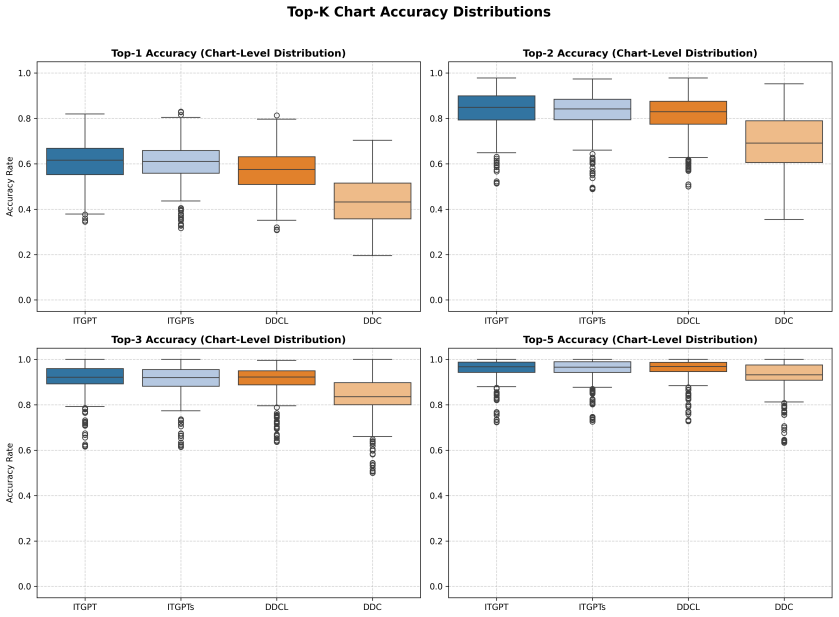
The central claim is that replacing the recurrent cores of earlier chart generators with a transformer that attends over an entire song's beats, while retaining beat-delineated audio features, improves both halves of the pipeline. In the step-placement task (deciding when a step occurs), ITGPT reaches an F1 of 0.780 at a flat 0.5 threshold, up from 0.703 for DDCL, and the authors say ITGPT is superior to DDCL in almost every metric at every difficulty. In the step-selection task (deciding which arrows to press), accuracy rises from 0.553 to 0.591. The model also generates a full chart in about 4.4 seconds on a consumer GPU, roughly seven times faster than DDCL.
What carries the argument
Two halves. For step placement, a hierarchical transformer encoder processes beat-level convolutional audio features, then self-attention over bars, phrases, and the full song (max 2000 beats), with a diagnostic network that tries to recover BPM and difficulty from predicted placements and regularizes the model. For step selection, an autoregressive transformer conditions on up to 500 prior steps, uses residual vector quantization for audio, FiLM conditioning for step-timing and audio context, and is trained to predict four future steps at once. A scaling repetition penalty and nucleus sampling shape generation.
Load-bearing premise
The assumption that BPM values detected by ArrowVortex during generation exactly match the BPM values stored in the training charts; if this mismatch is significant, the model is conditioned on unseen values and the performance comparison may not hold.
What would settle it
Run ArrowVortex's BPM detector on every song in the expanded dataset and compare to the BPM labels in the chart files. If more than a few percent disagree, re-run ITGPT's evaluation using the chart-file BPM as conditioning; if its F1 then drops below DDCL's, the claimed advantage depends on the alignment assumption.
If this is right
- ITGPT cuts average chart generation to about 4.4 seconds on a single consumer GPU, making on-demand chart generation practical.
- The largest accuracy gains are at Beginner and Easy difficulties, so automated tools could cover chart tiers that human authors undersupply.
- Because the step-selection model pre-encodes audio once per song and then iterates over steps, generation latency scales with chart length, not audio re-encoding.
- With the diagnostic regularizer, ITGPT works well at a fixed 0.5 threshold, removing the threshold-tuning step that earlier models needed.
- The expanded dataset (253 songs, 952 charts) introduced here becomes a new benchmark resource for future rhythm-game chart-generation research.
Where Pith is reading between the lines
- The diagnostic-network idea is a general way to enforce that generative outputs respect explicit continuous conditioning variables; it could be ported to text-to-music or text-to-motion tasks where tempo, key, or energy must be preserved.
- If the BPM-alignment assumption is correct, the same architecture should transfer to other four-panel rhythm games (e.g., osu!mania, beatmania) by changing the step vocabulary and audio framing.
- The paper notes ITGPT underperforms DDCL on held notes (0.378 vs 0.412); adding a mechanism that explicitly tracks sustained audio tones, such as longer audio context or a dedicated hold head, could close that gap.
- A human playability study—blind-rated charts generated by ITGPT vs DDCL—would be a stronger test of the claimed improvement than the automatic metrics reported.
Editorial analysis
A structured set of objections, weighed in public.
Referee Report
Summary. The paper proposes ITGPT, a transformer-based two-stage system for automatic DDR/ITG chart generation. The step-placement stage uses a hierarchical encoder with global self-attention, a diagnostic regularizer that enforces BPM/difficulty consistency, and a one-shot prediction head. The step-selection stage is an autoregressive transformer over 256 step classes, conditioned on pre-encoded audio and previous steps. The system is evaluated on an expanded Fraxtil dataset (253 songs, 952 charts) with an 8/1/1 split, comparing against DDC, DDCL, and the GOCT pretrained model. The authors report consistent improvements in step-placement F1, precision/recall, and step-selection accuracy, as well as large gains in generation speed.
Significance. If the reported improvements hold up under a properly controlled comparison, ITGPT is a meaningful advance for the niche but active area of automated rhythm-game chart generation. The hierarchical transformer is a sensible architectural contribution, and the diagnostic regularizer is a novel idea in this domain. The paper also expands the public Fraxtil dataset and provides code, which supports reproducibility. The generation-time speedup (0.06 s/chart for placement, 4.39 s/chart for selection) is a practical advantage. However, these strengths are contingent on the central comparative claim being established without confounds, which currently requires additional experimental clarity and, ideally, repeated-seed statistics.
major comments (4)
- [§6 Experiments; Tables 2 and 4] The paper never states whether the DDC and DDCL baselines were retrained on the expanded Fraxtil dataset's 8/1/1 split or whether published checkpoints from the smaller original dataset were reused. The text in §2 ('we will explicitly compare our results to the original DDC architecture, as well as DDCL') and §6.1 ('we compare our models to DDC and DDCL as predecessor works') suggests the latter, and GOCT is explicitly described as a pretrained checkpoint. Since ITGPT is trained on roughly 3× the data, the reported gains (e.g., F1 0.7033→0.7801 in Table 2; accuracy 0.5533→0.5908 in Table 4) could be largely due to data scale rather than the transformer architecture. The central claim in §6.1.1 that 'ITGPT is superior to DDCL in almost every metric, for every difficulty' is not decision-ready without a controlled comparison on the same training data. Please state the baseline training pro
- [§6.1.1, Tables 2 and A1] The Max-prefixed metrics (Max F1, Max Precision, Max Recall) are obtained by selecting thresholds on the test set. This is a form of test-set model selection, which inflates scores and makes comparisons against GOCT—which cannot be threshold-tuned—unfair. While the flat-threshold F1 already shows improvement, the paper relies on the Max metrics for the 'almost every metric' claim. Additionally, only a single 8/1/1 split is used, and no error bars, confidence intervals, or multiple-seed results are reported. Given that the improvements over DDCL are around 0.05–0.08 in F1, the statistical significance of these differences is unclear. Please report threshold selection on a validation split (or justify the test-set selection) and provide variance estimates or significance tests.
- [§4 (BPM detection paragraph)] The assumption that the ArrowVortex BPM-detection algorithm reproduces the BPM values stored in the training charts is not verified on the expanded Fraxtil dataset. The text claims 'there is little to no risk of BPM misalignment between the training and generation processes,' but this is an assertion, not an empirical check. If the chart metadata were assigned manually or with a different tool, the BPM conditioning at test time would be out-of-distribution, potentially harming step-placement performance and the comparison against baselines. Please measure the agreement between the detected BPM and the BPM stored in each chart file, and report the match rate (or describe any preprocessing used to reconcile differences).
- [§6.1, §6.2; GOCT comparisons] GOCT is described as a pretrained model from an osu!-trained checkpoint, evaluated on DDR/ITG. The paper acknowledges this in §2, but then interprets GOCT's closeness to ITGPT as evidence. This is not an apples-to-apples comparison: GOCT was not trained on the target game, whereas ITGPT and the DDC/DDCL baselines were. I recommend treating the GOCT results as an auxiliary reference only, and removing any claim that implies competitive equivalence or superiority based on these numbers. The central comparison should rest on DDC/DDCL under matched conditions.
minor comments (6)
- [Abstract] Typo: 'timestaking' should be 'time-consuming'.
- [§2 Related Work] Typo: 'transfomer' should be 'transformer'.
- [§5.1 Generation] Formatting: 'threshold of.9' should read 'threshold of .9'.
- [§6.2 Step selection evaluation] The claim 'GOCT is timing only for DDR/ITG' is confusing; earlier the paper compares GOCT for step placement. Please clarify whether GOCT can generate step selections for DDR/ITG or not, and why it is omitted from Table 4.
- [§9 Code Availability] The GitHub link is indicated but not included in the text. Please add the actual URL.
- [Table 4 caption] The loss column for ITGPT is not comparable to DDC/DDCL because the multi-step objective is different. The text notes this, but it would help to add a footnote to the table caption as well.
Circularity Check
No significant circularity; ITGPT is evaluated against independent baselines on a held-out split, with only minor non-load-bearing self-citation.
full rationale
The central empirical claim — ITGPT outperforms DDCL and DDC — rests on metrics reported in Tables 2 and 4 over an 8/1/1 test split of the expanded Fraxtil dataset, not on an equation that reduces the prediction to a fitted parameter. DDC and DDCL are treated as benchmarked predecessor systems, and GOCT is tested with the external checkpoints supplied by its authors. The author's own DDCL [13] is cited as the predecessor baseline and as the source of certain design choices (delta-beat sampling, audio-conditioned step selection), but those citations do not by themselves supply the reported F1 or accuracy numbers; the comparisons are computed and reported in this paper. The diagnostic network in Eq. (1) only contributes a training-time regularizer and its estimated BPM/difficulty outputs are not used as the measured predictions; BPM and difficulty are conditioning inputs at both training and generation, so there is no self-definitional loop. The Section 4 claim that ArrowVortex BPM detection matches the chart authors' process is an unverified data-provenance assumption, but it does not make any output equivalent to its input by construction. Methodological concerns such as whether DDC/DDCL were retrained on the larger dataset are experimental confounds, not circularity. One minor self-citation exists, but it is not load-bearing; hence a score of 1 rather than 0.
Axiom & Free-Parameter Ledger
free parameters (7)
- Auxiliary normalization bounds =
Diff [0,50], BPM [30,500]
- BPM bucketing width =
10 BPM bands
- Nucleus sampling threshold =
0.9
- Repetition penalty scaling =
p = 1.07^(l-3)
- BCE position weights =
2.0 / 1.5 / 0.5
- Diagnostic loss weight =
lambda_diag = 0.005
- Multi-step head weighting exponent =
lambda_i = 1 + i/4
axioms (5)
- domain assumption Mirroring steps (left/right or up/down) preserves step technicality and chart validity.
- domain assumption ArrowVortex BPM detection reproduces the BPM labels in the training charts.
- domain assumption All difficulty variants of a song are placed in the same split to prevent train/test leakage.
- standard math STFT/mel-spectrogram representation preserves chart-relevant audio information.
- standard math Standard modules (self-attention, FiLM conditioning, RVQ, Conv1D, GELU) behave as described in the cited literature.
read the original abstract
Dance Dance Revolution and In the Groove are rhythm games consisting of songs and accompanying choreography, referred to as charts. Players press arrows on a device referred to as a dance pad in time with steps determined by the song's chart. The process of manual chart generation is timestaking and difficult, motivating interest in automation. We propose ITGPT, a new transformer based architecture for the generation of DDR/ITG charts, and demonstrate significant improvements to generation accuracy and computational cost in comparison to predecessor work.
Figures



Reference graph
Works this paper leans on
-
[1]
2025.url:https://itgwiki.dominick
ITGwiki authors.Technical Notation. 2025.url:https://itgwiki.dominick. cc/en/playstyles/tech/notation
2025
-
[2]
dance / simfile - creation-resources/
International Timing Collective.url: https : / / itc . dance / simfile - creation-resources/
-
[3]
Dance Dance Convolu- tion
Chris Donahue, Zachary C Lipton, and Julian McAuley. “Dance Dance Convolu- tion”. In:Proceedings of the 34th Inter- national Conference on Machine Learning. 2017
2017
-
[4]
High Fidelity Neural Audio Compression
Alexandre D´ efossez et al. “High Fidelity Neural Audio Compression”. In:arXiv preprint arXiv:2210.13438(2022)
Pith/arXiv arXiv 2022
-
[5]
TaikoNation: Patterning-focused Chart Generation for Rhythm Action Games
Emily Halina and Matthew Guzdial. “TaikoNation: Patterning-focused Chart Generation for Rhythm Action Games”. In:Proceedings of the 16th International Conference on the Foundations of Dig- ital Games. FDG ’21. Montreal, QC, Canada: Association for Computing Ma- chinery, 2021.isbn: 9781450384223.doi: 10.1145/3472538.3472589.url:https: //doi.org/10.1145/347...
arXiv 2021
-
[6]
Building musically-relevant au- dio features through mul- tiple timescale representations
Philippe Hamel, Yoshua Bengio, and Dou- glas. Eck. “Building musically-relevant au- dio features through mul- tiple timescale representations.” In:ISMIR(2012)
2012
-
[7]
Time-based Chart Par- titioning: Improving Local Coherency in Rhythm Game Chart Generation
Jonah Hanzen, Emily Halina, and Math- thew Guzdial. “Time-based Chart Par- titioning: Improving Local Coherency in Rhythm Game Chart Generation”. In: Proceedings of the AAAI Conference on Artificial Intelligence and Interactive Dig- ital Entertainment. 2025
2025
-
[8]
Rithesh Kumar et al.High-Fidelity Au- dio Compression with Improved R VQGAN
-
[9]
AutoOsu: Audio- Aware Action Generation for Rhythm Games
S. Lee and D. Jeong. “AutoOsu: Audio- Aware Action Generation for Rhythm Games”. In:Ismir 2023 Hybrid Confer- ence. 2023
2023
-
[10]
Procedural Content Generation of Rhythm Games Using Deep Learning Methods
Yubin Liang, Wanxiang Li, and Kokolo Ikeda. “Procedural Content Generation of Rhythm Games Using Deep Learning Methods”. In:Entertainment Computing and Serious Games. Ed. by Erik van der Spek et al. Cham: Springer International 15 Publishing, 2019, pp. 134–145.isbn: 978- 3-030-34644-7
2019
-
[11]
GenerationMania: Learning to Semantically Choreograph
Zhiyu Lin, Kyle Xiao, and Mark O. Riedl. “GenerationMania: Learning to Semantically Choreograph”. In:CoRR abs/1806.11170 (2018). arXiv:1806 . 11170.url:http : / / arxiv . org / abs / 1806.11170
Pith/arXiv arXiv 2018
-
[12]
De- coupled Weight Decay Regularization
Ilya Loshchilov and Frank Hutter. “De- coupled Weight Decay Regularization”. In:International Conference on Learning Representations. 2017.url:https : / / api . semanticscholar . org / CorpusID : 53592270
2017
-
[13]
Miguel O’Malley.Dance Dance ConvL- STM. 2025. arXiv:2507.01644 [cs.LG]. url:https : / / arxiv . org / abs / 2507 . 01644
Pith/arXiv arXiv 2025
-
[14]
Dancing Monkeys ( Au- tomated creation of step files for Dance Dance Revolution
Karl O’Keeffe. “Dancing Monkeys ( Au- tomated creation of step files for Dance Dance Revolution”. In: 2003.url:https: //api.semanticscholar.org/CorpusID: 32105004
2003
-
[15]
Weizhen Qi et al.ProphetNet: Predicting Future N-gram for Sequence-to-Sequence Pre-training. 2020. arXiv:2001 . 04063 [cs.CL].url:https://arxiv.org/abs/ 2001.04063
Pith/arXiv arXiv 2020
-
[16]
Gen´ eLive! Gen- erating Rhythm Actions in Love Live!
Atsushi Takada et al. “Gen´ eLive! Gen- erating Rhythm Actions in Love Live!” In:AAAI Conference on Artificial In- telligence. 2022.url:https : / / api . semanticscholar . org / CorpusID : 247155107
2022
-
[17]
Dance Dance Gradation: A Generation of Fine-Tuned Dance Charts
Yudai Tsujino and Ryosuke Yamanishi. “Dance Dance Gradation: A Generation of Fine-Tuned Dance Charts”. In:In- ternational Conference on Evolutionary Computation. 2018.url:https : / / api . semanticscholar . org / CorpusID : 52163674
2018
-
[18]
2017.url:https: //arrowvortex.ddrnl.com/
Bram van de Wetering. 2017.url:https: //arrowvortex.ddrnl.com/
2017
-
[19]
Bram van de Wetering.Non-causal Beat Tracking for Rhythm Games. 2016
2016
-
[20]
Jayeon Yi, Sungho Lee, and Kyogu Lee.Beat-Aligned Spectrogram-to-Sequence Generation of Rhythm-Game Charts. 2023. arXiv:2311.13687 [cs.LG].url:https: //arxiv.org/abs/2311.13687
Pith/arXiv arXiv 2023
-
[21]
Neil Zeghidour et al.SoundStream: An End-to-End Neural Audio Codec. 2021. arXiv:2107.03312 [cs.SD].url:https: //arxiv.org/abs/2107.03312. Appendix 16 Table A1: All Metrics by Fine (Integer) Difficulty and Model Metric Diff. DDC DDCL GOCT ITGPT ITGPT (NH) ITGPT (ND) F1 Score 1 0.237887 0.345704 - 0.555398 0.472772 0.586783 3 0.449043 0.702762 - 0.750893 0....
Pith/arXiv arXiv 2021
-
[2023]
06546 [cs.SD].url: https://arxiv.org/abs/2306.06546
arXiv:2306 . 06546 [cs.SD].url: https://arxiv.org/abs/2306.06546
discussion (0)
Sign in with ORCID, Apple, or X to comment. Anyone can read and Pith papers without signing in.