REVIEW 3 major objections 4 minor 55 references
Terrestrial neutrino data exclude the no-fine-tuning Majorana N-naturalness benchmark with N=10^4 sectors.
Reviewed by Pith at T0; open to challenge. T0 means a machine referee read the full paper against a public rubric. the ladder, T0–T4 →
T0 review · deepseek-v4-flash
2026-08-02 02:44 UTC pith:B44YYKCM
load-bearing objection First experimental search for the N-naturalness neutrino tower, with a plausible Majorana exclusion of the r=1 benchmark — but the reach hinges on a hand-set coupling ratio whose robustness is asserted rather than shown. the 3 major comments →
Searching for the N-naturalness tower of neutrinos
The pith
A machine-rendered reading of the paper's core claim, the machinery that carries it, and where it could break.
Core claim
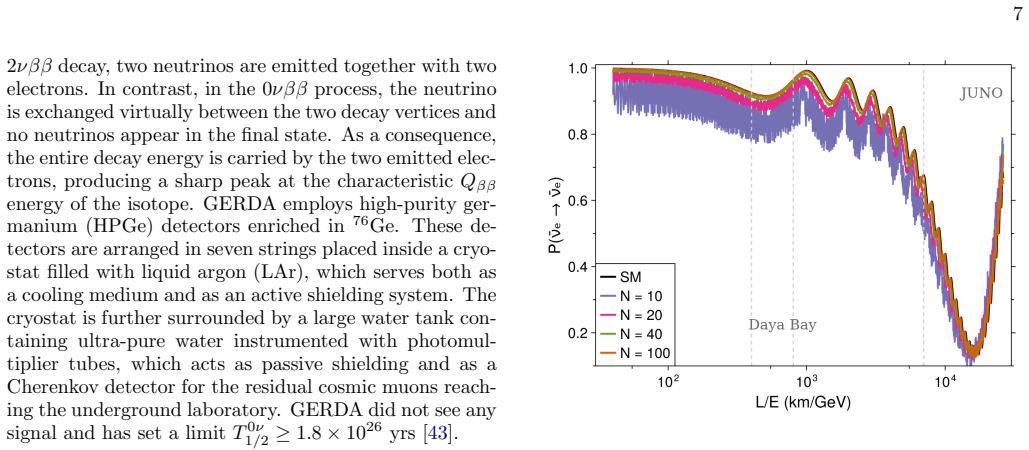
The paper's central claim is that the N-naturalness tower of neutrinos, in its Majorana realization, produces observable enhancements in the effective Majorana mass m_ββ and distortions in reactor neutrino oscillations. Using a global fit, the authors find that with current GERDA data combined with Daya Bay, all non-fine-tuned scenarios with r=1 up to N=10^4 are excluded at 90% confidence level, in both normal and inverted mass ordering. This rules out the benchmark scenario in which N=10^4 sectors with a cutoff around 10 TeV solve the hierarchy problem without additional fine-tuning while preserving gauge coupling unification. For projected JUNO+TAO data, the exclusion extends to N<500 for
What carries the argument
The key object is the N-sector neutrino mass matrix, parametrised so that the intra-to-inter-sector coupling ratio is fixed at η=1+1/N (i.e., (a²−b²)=b²/N), leaving only N and r as free parameters. The authors numerically diagonalise the full 3N/2 × 3N/2 matrix to compute three-flavour oscillation probabilities and the generalised effective Majorana mass m_ββ, which includes contributions from the heavy tower states via the formalism of eq. (37) with benchmark nuclear matrix elements. The m_ββ prediction is the main driver of the bound: for large N and r near 1, the heavy states push m_ββ above the GERDA limit.
Load-bearing premise
The entire reach of the search rests on the choice η=1+1/N—that the inter-sector Yukawa coupling differs from the intra-sector one by exactly one part in N; if the inter-sector coupling is smaller by hand, the oscillation distortions and the m_ββ enhancement that produce the exclusions would largely disappear.
What would settle it
Recompute the predicted Majorana m_ββ for N=10^4, r=1 using the full allowed range of heavy-neutrino nuclear matrix elements (e.g., M_0ν_N=401 and M_0ν_ν=2.89 instead of the adopted benchmarks 194 and 5.28). If the resulting 0νββ half-life for 76Ge exceeds the GERDA limit of 1.8×10^26 yr, the ruling out of the N=10^4 benchmark would no longer follow.
If this is right
- If correct, the simplest Majorana N-naturalness benchmark—N=10^4, r=1, Λ_H~10 TeV—is experimentally excluded, so a no-fine-tuning solution to the hierarchy problem of this type must move to N>10^4 or to the Dirac realization.
- The surviving Majorana parameter space requires either N>10^4 or r≤0.1 for 500≤N≤10^4, meaning the theory must reintroduce some degree of fine-tuning to remain viable in this region.
- The Dirac realization remains viable for N up to about 50 (and for all N at larger r), so the neutrino tower solution is not dead overall, only the Majorana version at moderate N.
- Projected JUNO+TAO data will exclude N<500 for any r in the Majorana case, and LEGEND-1000 will further tighten m_ββ bounds, potentially extending the excluded region beyond N=10^4.
- The analysis demonstrates a new, purely terrestrial probe of N-naturalness, complementary to cosmological constraints.
Where Pith is reading between the lines
- The exclusion strength relies on η=1+1/N; if a UV theory naturally suppressed the inter-sector coupling b, the predicted oscillations and m_ββ would shrink and the bounds would weaken. A derivation of b's size from a UV completion would clarify whether the N=10^4 benchmark is truly excluded.
- The m_ββ bound passes through the heavy-neutrino regime where nuclear matrix elements are uncertain; the paper asserts insensitivity without showing it, so recomputing contours with M_0ν_N over its full [104, 401] range would provide a direct check.
- The same global-fit machinery could be applied to other tower models (e.g., extra-dimensional KK neutrinos) to compare their exclusion reach on a common footing.
- Including KATRIN's β-decay spectrum, as the authors suggest, could strengthen the Dirac bound and might also probe the tower through spectral kinks.
Editorial analysis
A structured set of objections, weighed in public.
Referee Report
Summary. The manuscript presents a global fit of public terrestrial neutrino data to constrain the N-naturalness model in its neutrino sector, with parameters N (number of sectors) and r (fine-tuning measure). The model generates a tower of neutrino mass eigenstates from the N/2 SM-like sectors mixing with the SM neutrino. The authors numerically diagonalize the mass matrix (Section III), use Daya Bay data and JUNO+TAO projections for oscillation constraints, and compare the predicted 0νββ effective mass with GERDA/LEGEND half-life limits (Section V.B). The headline result is that for Majorana neutrinos, N ≤ 10^4 with r ≥ 0.1 is excluded by current data, ruling out the no-fine-tuning GUT-scale benchmark scenario, and that projected JUNO+TAO data will exclude all N < 500 and 500 ≤ N ≤ 10^4 for r ≥ 0.1. The main results are the exclusion contours shown in Figs. 7–9 for Majorana and Dirac cases in both mass orderings.
Significance. If the result is robust, this is an important first experimental probe of N-naturalness from the neutrino sector, with the striking conclusion that the N=10^4, r=1 Majorana benchmark is excluded. The analysis has definite strengths: it uses numerical diagonalization where the perturbative treatment of [28] is invalid, it relies on public data and the reproducible Newtrinos.jl framework, and it profiles 22 systematic parameters in the JUNO+TAO projection. However, the central claim is contingent on (i) the hand-set inter-sector coupling ratio η=1+1/N and (ii) the treatment of heavy-neutrino contributions to 0νββ using benchmark nuclear matrix elements and an ad hoc interpolation. The paper asserts robustness to these choices but does not demonstrate it quantitatively. The significance is therefore high if the sensitivity to these assumptions is shown to be small, but that demonstration is currently missing.
major comments (3)
- [Section III, Eq. (24)] The choice η=1+1/N (i.e., \tilde a^2 − \tilde b^2 = \tilde b^2/N) is an input assumption, not a prediction of the N-naturalness framework. The paper's exclusion reach scales directly with this ratio: the heavy-sector masses and their mixing, which drive mββ above the GERDA limit via Eq. (35), are controlled by η, and the text itself warns that 'if we turn down the inter-sector coupling by hand, many effects would vanish.' The statement that 'small deviations of O(1) from this regime do not affect our conclusions' is not sufficient, because the naturalness prior is precisely what is being tested. The authors should quantify how far η can deviate before the N=10^4, r=1 exclusion disappears, e.g., by showing contours for several η values or a robustness scan. Without this, the headline bound remains conditional on an unverified maximal-mixing prior.
- [Section V.B, Eqs. (37)–(38)] The 0νββ constraint is implemented as a point-like comparison of the predicted mββ to a single half-life limit with a nominal 10% uncertainty, rather than a spectral fit. More importantly, the heavy-state contribution uses the [52] formalism with benchmark nuclear matrix elements Mν=5.28, MN=194 and the piecewise interpolation function F(m). The paper asserts that 'studies are made on the final contours... and the results vary only slightly,' but no scan or quantitative bound is shown. Since the heavy-state term is what pushes mββ above the GERDA limit for N≈10^4, the contours in Figs. 7–8 must be demonstrated to be stable within the published ranges Mν∈[2.89,6.04] and MN∈[104,401] and across reasonable choices of F(m). Without this demonstration, the central exclusion is not established.
- [Section III, Eqs. (25)–(30)] The overall scales s1–s3 are fixed using the analytic perturbative expressions for the sector-0 masses, Eqs. (25)–(30), even though the paper explicitly abandons the perturbative diagonalization because it breaks down in the tested parameter region. There is no check that the numerically diagonalized eigenvalues obtained with these s_i actually reproduce the input neutrino masses and measured squared-mass splittings across the scanned (N,r) plane. If the numerical eigenvalues deviate from the analytic expressions, then the oscillation probabilities and mββ predictions are systematically miscalibrated. The authors should validate the calibration (e.g., by showing the numerical sector-0 masses versus the inputs) or fix the scales directly from the numerical eigenvalues. In addition, Eq. (29) contains a factor 2 in the denominator that is inconsistent with Eq. (26); this needs clarification
minor comments (4)
- [Section V.A] Wilks' theorem is misspelled as 'Wilk's theorem' in the sentence introducing the profile likelihood test statistic.
- [Section VI] The description of the combined analysis, 'combining the likelihood functions of the individual experiments,' does not specify whether or how correlations between experiments (e.g., reactor flux uncertainties common to Daya Bay and JUNO) are handled. A brief statement of the combination prescription and its independence assumptions would improve reproducibility.
- [Section II, Eqs. (9)–(10)] The matrices in Eqs. (9)–(10) appear to be (N/2+1)-dimensional with indices running over the SM-like sectors, while the text refers to N total sectors. The notation should be clarified explicitly to avoid confusion between total N and the dimension of the sector-space mass matrix.
- [Section VII] The concluding sentence 'non-fine-tuned model realisations (r=1 up to r=0.1)' is ambiguous; since the exclusion is for r≥0.1, it would be clearer to say 'r values from 0.1 to 1' or 'r≥0.1'.
Circularity Check
No significant circularity; the N≤10^4 Majorana exclusion is an external-data test of a stated model realization.
full rationale
The derivation is not circular. The scale parameters s1–s3 are calibrated to the observed neutrino masses (Eqs. 25–30), but this is a standard overall normalization, not a fit to the predicted observables. The predictions compared with data are the oscillation survival probabilities and the effective Majorana mass mββ, computed from the numerically diagonalized mass matrices as functions of N and r (Eqs. 31, 33, 35). The mββ enhancement that drives the GERDA exclusion comes from the heavy tower eigenstates, whose masses and mixings are determined by N and r through the matrix structure, not merely from the fitted light masses. The choice η = 1 + 1/N is an explicitly stated model assumption in Section III, with the caveat that turning down the inter-sector coupling would erase the effects; this makes the headline result conditional on a stated realization but does not reduce the prediction to its input. The paper's robustness assertions about η and the [52] nuclear matrix element benchmarks are abbreviated, but that is a support/evidence weakness, not circularity. Self-citations, including [28] for the mass-matrix structure and η prescription, supply the model setup; the central exclusion claim is nevertheless tested against independent public data (Daya Bay and GERDA), so it has genuine external content.
Axiom & Free-Parameter Ledger
free parameters (5)
- per-flavor overall scales s1, s2, s3 =
s1 = m1/((η−1)r); s2 = m2/(2(η−1)r); s3 = m3/((η−1)r), eqs. (28)-(30)
- η ≡ ã²/b̃² (intra- vs inter-sector coupling ratio) =
1 + 1/N (chosen by hand)
- m0 (lightest neutrino mass) =
0.01 eV for headline; scan set {0, 10^-4, 10^-2, 10^-1} eV
- F(m) heavy-state interpolation values =
0.7 (10^4–10^6 eV), 1.0 (≥10^6 eV)
- Nuclear matrix element benchmarks M_ν^0ν, M_N^0ν, ⟨p²⟩ =
5.28, 194, per eq. (38)
axioms (6)
- domain assumption N-naturalness: Higgs mass parameters uniformly distributed as mu_i^2 = -(Lambda_H^2/N)(2i + r)
- domain assumption Neutrino mass matrices M_D, M_M and Yukawa structure lambda_ij = a*diag + b*off-diag, with b <= 1/sqrt(N)
- domain assumption Reheaton cosmology: only the lightest sector is populated; m_S ~ 100 GeV; Majorana reheaton S induces the Weinberg operator (eq. 8)
- ad hoc to paper Heavy-state 0νββ formalism with interpolation F(m) and benchmark NMEs (eqs. 37-38)
- standard math Wilks' theorem: -2 Delta ln L ~ chi^2(2 dof) for the two-dimensional scans
- domain assumption Species bound M_f = M_P/sqrt(N); gauge-unification identity N ~ 10^4 corresponds to Lambda_H ~ 10 TeV (eq. 4)
invented entities (3)
-
Tower of extra neutrino mass eigenstates (one per sector)
independent evidence
-
N dark sectors (copies of the Standard Model)
no independent evidence
-
Fermionic reheaton S (Majorana case only)
no independent evidence
read the original abstract
We present the first experimental search for the $N$-naturalness tower of neutrinos using a global analysis of publicly available neutrino data. As a potential solution to the hierarchy problem, the $N$-naturalness model employs a varying Higgs mass parameter among $N$ dark sectors and encodes the required fine-tuning of the placement of the sectors in a parameter $r$. We report exclusion limits on the parameter space ($r$, $N$), for normal and inverted ordering and in case the neutrino is Majorana or Dirac. In the case of a Majorana neutrino, we can rule out $N\leq 10^4$ sectors with $r\geq 0.1$. This is particularly exciting as it shows that a gauge and gravitational unification around $M_{GUT}$, which is a benchmark scenario of the $N$-naturalness framework with $N=10^4$ without fine-tuning, is ruled out by neutrino experiments.
Figures


Reference graph
Works this paper leans on
-
[1]
Baryon and Lepton Nonconserving Processes,
S. Weinberg, “Baryon and Lepton Nonconserving Processes,”Phys. Rev. Lett.43(1979) 1566–1570
1979
-
[2]
µ→eγat a Rate of One Out of 10 9 Muon Decays?,
P. Minkowski, “µ→eγat a Rate of One Out of 10 9 Muon Decays?,”Phys. Lett. B67(1977) 421–428
1977
-
[3]
Complex Spinors and Unified Theories,
M. Gell-Mann, P. Ramond, and R. Slansky, “Complex Spinors and Unified Theories,”Conf. Proc. C790927 (1979) 315–321,arXiv:1306.4669 [hep-th]
Pith/arXiv arXiv 1979
-
[4]
Horizontal Symmetry and Masses of Neutrinos,
T. Yanagida, “Horizontal Symmetry and Masses of Neutrinos,”Prog. Theor. Phys.64(1980) 1103
1980
-
[5]
Neutrino Mass and Spontaneous Parity Nonconservation,
R. N. Mohapatra and G. Senjanovic, “Neutrino Mass and Spontaneous Parity Nonconservation,”Phys. Rev. Lett.44(1980) 912
1980
-
[6]
Seesaw mechanism and its implications,
R. N. Mohapatra, “Seesaw mechanism and its implications,” inSEESA W25: International Conference on the Seesaw Mechanism and the Neutrino Mass, pp. 29–44. 12, 2004.arXiv:hep-ph/0412379
Pith/arXiv arXiv 2004
-
[7]
The Hierarchy problem and new dimensions at a millimeter,
N. Arkani-Hamed, S. Dimopoulos, and G. R. Dvali, “The Hierarchy problem and new dimensions at a millimeter,”Phys. Lett. B429(1998) 263–272, arXiv:hep-ph/9803315
Pith/arXiv arXiv 1998
-
[8]
Neutrino masses from large extra dimensions,
N. Arkani-Hamed, S. Dimopoulos, G. R. Dvali, and J. March-Russell, “Neutrino masses from large extra dimensions,”Phys. Rev. D65(2001) 024032, arXiv:hep-ph/9811448
Pith/arXiv arXiv 2001
-
[9]
Probing large extra dimensions with neutrinos,
G. R. Dvali and A. Y. Smirnov, “Probing large extra dimensions with neutrinos,”Nucl. Phys. B563(1999) 63–81,arXiv:hep-ph/9904211
Pith/arXiv arXiv 1999
-
[10]
Phenomenology of 10 32 Dark Sectors,
G. Dvali and M. Redi, “Phenomenology of 10 32 Dark Sectors,”Phys. Rev. D80(2009) 055001, arXiv:0905.1709 [hep-ph]
Pith/arXiv arXiv 2009
-
[11]
Neutrino physics in TeV scale gravity theories,
M. Ettengruber, “Neutrino physics in TeV scale gravity theories,”Phys. Rev. D106no. 5, (2022) 055028, arXiv:2206.00034 [hep-ph]
Pith/arXiv arXiv 2022
-
[12]
and how neutrino mass can be explained within it. The original problem addressed by this theory is the hi- erarchy problem, which is generated by the sensitivity of the Higgs mass to the cutoff of the SM and the required fine-tuning to realise the light Higgs boson observed at LHC. The starting point ofN-naturalness is the realisation that the fine-tuning...
-
[13]
N. Arkani-Hamed, S. Dimopoulos, and G. R. Dvali, “Phenomenology, astrophysics and cosmology of theories with submillimeter dimensions and TeV scale quantum gravity,”Phys. Rev. D59(1999) 086004, arXiv:hep-ph/9807344
Pith/arXiv arXiv 1999
-
[14]
Dark Matter via Many Copies of the Standard Model,
G. Dvali, I. Sawicki, and A. Vikman, “Dark Matter via Many Copies of the Standard Model,”JCAP08(2009) 009,arXiv:0903.0660 [hep-th]
Pith/arXiv arXiv 2009
-
[15]
Solving the Hierarchy Problem at Reheating with a Large Number of Degrees of Freedom,
N. Arkani-Hamed, T. Cohen, R. T. D’Agnolo, A. Hook, H. D. Kim, and D. Pinner, “Solving the Hierarchy Problem at Reheating with a Large Number of Degrees of Freedom,”Phys. Rev. Lett.117no. 25, (2016) 251801,arXiv:1607.06821 [hep-ph]
Pith/arXiv arXiv 2016
-
[16]
Dark dimension, the swampland, and the dark matter fraction composed of primordial black holes,
L. A. Anchordoqui, I. Antoniadis, and D. Lust, “Dark dimension, the swampland, and the dark matter fraction composed of primordial black holes,”Phys. Rev. D106 no. 8, (2022) 086001,arXiv:2206.07071 [hep-th]
Pith/arXiv arXiv 2022
-
[17]
Dark dimension gravitons as dark matter,
E. Gonzalo, M. Montero, G. Obied, and C. Vafa, “Dark dimension gravitons as dark matter,”JHEP11(2023) 109,arXiv:2209.09249 [hep-ph]
Pith/arXiv arXiv 2023
-
[18]
Primordial black hole dark matter in the context of extra dimensions,
A. Friedlander, K. J. Mack, S. Schon, N. Song, and A. C. Vincent, “Primordial black hole dark matter in the context of extra dimensions,”Phys. Rev. D105 no. 10, (2022) 103508,arXiv:2201.11761 [hep-ph]
Pith/arXiv arXiv 2022
-
[19]
M. Ettengruber and F. Kuhnel, “Micro Black Hole Dark Matter,”arXiv:2506.14871 [hep-th]
-
[20]
The dark dimension and the Swampland,
M. Montero, C. Vafa, and I. Valenzuela, “The dark dimension and the Swampland,”JHEP02(2023) 022, arXiv:2205.12293 [hep-th]
Pith/arXiv arXiv 2023
-
[21]
The dark universe: Primordial black hole⇋dark graviton gas connection,
L. A. Anchordoqui, I. Antoniadis, and D. Lust, “The dark universe: Primordial black hole⇋dark graviton gas connection,”Phys. Lett. B840(2023) 137844, arXiv:2210.02475 [hep-th]
Pith/arXiv arXiv 2023
-
[22]
Kinematical Test of Large Extra Dimension in Beta Decay Experiments,
V. S. Basto-Gonzalez, A. Esmaili, and O. L. G. Peres, “Kinematical Test of Large Extra Dimension in Beta Decay Experiments,”Phys. Lett. B718(2013) 1020–1023,arXiv:1205.6212 [hep-ph]
Pith/arXiv arXiv 2013
-
[23]
Constraining new physics scenarios in neutrino oscillations from Daya Bay data,
I. Girardi and D. Meloni, “Constraining new physics scenarios in neutrino oscillations from Daya Bay data,” 13 Phys. Rev. D90no. 7, (2014) 073011,arXiv:1403.5507 [hep-ph]
Pith/arXiv arXiv 2014
-
[24]
Testing for Large Extra Dimensions with Neutrino Oscillations,
P. A. N. Machado, H. Nunokawa, and R. Zukanovich Funchal, “Testing for Large Extra Dimensions with Neutrino Oscillations,”Phys. Rev. D 84(2011) 013003,arXiv:1101.0003 [hep-ph]
Pith/arXiv arXiv 2011
-
[25]
Updated Constraints on Large Extra Dimensions from Reactor Antineutrino Experiments,
T. G. Ela¸ cmaz, I. Martinez-Soler, and Y. F. Perez-Gonzalez, “Updated Constraints on Large Extra Dimensions from Reactor Antineutrino Experiments,” arXiv:2510.12900 [hep-ph]
-
[26]
Dark Dimension Right-handed Neutrinos Confronted with Long-Baseline Oscillation Experiments,
A.-Y. Bai, A. Chatrabhuti, Y.-Y. Huang, H. Isono, and J. Tang, “Dark Dimension Right-handed Neutrinos Confronted with Long-Baseline Oscillation Experiments,”arXiv:2601.00790 [hep-ph]
-
[27]
Neutrino data analysis of extra-dimensional theories with massive bulk fields,
P. Eller, M. Ettengruber, and A. Zander, “Neutrino data analysis of extra-dimensional theories with massive bulk fields,”Phys. Rev. D112no. 5, (2025) 055009, arXiv:2508.04274 [hep-ph]
Pith/arXiv arXiv 2025
-
[28]
Neutrino masses and phenomenology in N-naturalness,
M. Ettengruber, “Neutrino masses and phenomenology in N-naturalness,”Phys. Rev. D112no. 5, (2025) 055015,arXiv:2502.09538 [hep-ph]
Pith/arXiv arXiv 2025
-
[29]
Consistent origin of neutrino mass and freeze-in dark matter in large N theories,
Z.-L. Han, B. Zhu, L. Bian, and R. Ding, “Consistent origin of neutrino mass and freeze-in dark matter in large N theories,”arXiv:1812.00637 [hep-ph]
-
[30]
Testing the number of neutrino species with a global fit of neutrino data,
M. Ettengruber, A. Zander, and P. Eller, “Testing the number of neutrino species with a global fit of neutrino data,”Phys. Rev. D109no. 9, (2024) 095016, arXiv:2402.00490 [hep-ph]
Pith/arXiv arXiv 2024
-
[31]
B. Batell, A. Ghalsasi, W. Huang, and M. Low, “i-ncidental N-naturalness,”JHEP05(2026) 127, arXiv:2512.14841 [hep-ph]
arXiv 2026
-
[32]
Black Holes and Large N Species Solution to the Hierarchy Problem,
G. Dvali, “Black Holes and Large N Species Solution to the Hierarchy Problem,”Fortsch. Phys.58(2010) 528–536,arXiv:0706.2050 [hep-th]
Pith/arXiv arXiv 2010
-
[33]
A cosmological case study of a tower of warm dark matter states:Nnaturalness,
S. Bansal, S. Ghosh, M. Low, and Y. Tsai, “A cosmological case study of a tower of warm dark matter states:Nnaturalness,”arXiv:2410.19224 [astro-ph.CO]
-
[34]
Newtrinos.jl: Julia package for global analysis of neutrino data
P. Eller, “Newtrinos.jl: Julia package for global analysis of neutrino data.” https://github.com/philippeller/Newtrinos.jl, 2025
2025
-
[35]
Constraints on non-unitary neutrino mixing in light of atmospheric and reactor neutrino data,
T. Kozynets, P. Eller, A. Zander, M. Ettengruber, and D. J. Koskinen, “Constraints on non-unitary neutrino mixing in light of atmospheric and reactor neutrino data,”JHEP05(2025) 130,arXiv:2407.20388 [hep-ph]
Pith/arXiv arXiv 2025
-
[36]
Black Hole Bound on the Number of Species and Quantum Gravity at LHC,
G. Dvali and M. Redi, “Black Hole Bound on the Number of Species and Quantum Gravity at LHC,” Phys. Rev. D77(2008) 045027,arXiv:0710.4344 [hep-th]
Pith/arXiv arXiv 2008
-
[37]
The detector system of the daya bay reactor neutrino experiment,
D. Collaboration, “The detector system of the daya bay reactor neutrino experiment,”Nuclear Instruments and Methods in Physics Research Section A: Accelerators, Spectrometers, Detectors and Associated Equipment811 (03, 2016) 133–161,arXiv:1508.03943 [physics]
Pith/arXiv arXiv 2016
-
[38]
A side-by-side comparison of daya bay antineutrino detectors,
D. B. Collaboration, “A side-by-side comparison of daya bay antineutrino detectors,”Nuclear Instruments and Methods in Physics Research Section A: Accelerators, Spectrometers, Detectors and Associated Equipment685 (09, 2012) 78–97,arXiv:1202.6181 [physics]
Pith/arXiv arXiv 2012
-
[39]
Atmospheric Neutrino Oscillations: the Full Picture,
P. Eller, “Atmospheric Neutrino Oscillations: the Full Picture,”arXiv:2606.09714 [hep-ex]
-
[40]
Potential to identify neutrino mass ordering with reactor antineutrinos at JUNO*,
JUNO Collaboration, “Potential to identify neutrino mass ordering with reactor antineutrinos at JUNO*,” Chinese Physics C49no. 3, (03, 2025) 033104
2025
-
[41]
Sub-percent precision measurement of neutrino oscillation parameters with JUNO*,
JUNO Collaboration, “Sub-percent precision measurement of neutrino oscillation parameters with JUNO*,”Chinese Physics C46no. 12, (12, 2022) 123001
2022
-
[42]
Precision measurement of reactor antineutrino oscillation at kilometer-scale baselines by daya bay,
Daya Bay Collaboration, “Precision measurement of reactor antineutrino oscillation at kilometer-scale baselines by daya bay,”Physical Review Letters130 no. 16, (04, 2023) 161802
2023
-
[43]
Final results of GERDA on the search for neutrinoless double-beta decay,
GERDA Collaboration, “Final results of GERDA on the search for neutrinoless double-beta decay,”Physical Review Letters125no. 25, (12, 2020) 252502
2020
-
[44]
First results from LEGEND-200 on the search for neutrinoless double beta decay,
G. Saleh, “First results from LEGEND-200 on the search for neutrinoless double beta decay,”Nuovo Cim. C49no. 1-2, (2026) 5,arXiv:2509.21166 [nucl-ex]
arXiv 2026
-
[45]
Measurement of reactor neutrino oscillation with the first juno data,
T. J. Collaboration, “Measurement of reactor neutrino oscillation with the first juno data,”Nature654(June,
-
[46]
Neutrino masses and mixing: Entering the era of subpercent precision,
F. Capozzi, W. Giar` e, E. Lisi, A. Marrone, A. Melchiorri, and A. Palazzo, “Neutrino masses and mixing: Entering the era of subpercent precision,” Phys. Rev. D111no. 9, (2025) 093006, arXiv:2503.07752 [hep-ph]. [47]Particle Data GroupCollaboration, S. Navaset al., “Review of particle physics,”Phys. Rev. D110no. 3, (2024) 030001
Pith/arXiv arXiv 2025
-
[48]
First results on the search for lepton number violating neutrinoless double-βdecay with the LEGEND-200 experiment,
LEGEND Collaboration, “First results on the search for lepton number violating neutrinoless double-βdecay with the LEGEND-200 experiment,”Physical Review Letters136no. 2, (01, 2026) 022701
2026
-
[49]
Nufit-6.0: updated global analysis of three-flavor neutrino oscillations,
I. Esteban, M. Gonzalez-Garcia, M. Maltoni, I. Martinez-Soler, J. P. Pinheiro, and T. Schwetz, “Nufit-6.0: updated global analysis of three-flavor neutrino oscillations,”Journal of High Energy Physics 2024no. 12, (2024) 216
2024
-
[50]
Discovering neutrinoless double-beta decay in the era of precision neutrino cosmology,
M. Ettengruber, M. Agostini, A. Caldwell, P. Eller, and O. Schulz, “Discovering neutrinoless double-beta decay in the era of precision neutrino cosmology,”Phys. Rev. D106no. 7, (2022) 073004,arXiv:2208.09954 [hep-ph]
Pith/arXiv arXiv 2022
-
[51]
Impact of nuclear matrix element calculations for current and future neutrinoless double beta decay searches,
F. Pompa, T. Schwetz, and J.-Y. Zhu, “Impact of nuclear matrix element calculations for current and future neutrinoless double beta decay searches,”Journal of High Energy Physics2023no. 6, (06, 2023) 104
2023
-
[52]
Status and future of nuclear matrix elements for neutrinoless double-beta decay: a review,
J. Engel and J. Men´ endez, “Status and future of nuclear matrix elements for neutrinoless double-beta decay: a review,”Reports on Progress in Physics80 no. 4, (2017) 046301. arXiv:1610.06548 [nucl-th]
Pith/arXiv arXiv 2017
-
[55]
Probing the nature of heavy neutral leptons in direct searches and neutrinoless double beta decay,
P. D. Bolton, F. F. Deppisch, M. Rai, and Z. Zhang, “Probing the nature of heavy neutral leptons in direct searches and neutrinoless double beta decay,”Nuclear Physics B1010(2025) 116785
2025
-
[100]
In the region 500≤N≤10 4, the theory remains viable only if a fine- tuning of at leastr≤0.1 is introduced
Considering the JUNO+TAO projected sensitivity and the corresponding global constraints, all values of N <500 are excluded for any choice ofr. In the region 500≤N≤10 4, the theory remains viable only if a fine- tuning of at leastr≤0.1 is introduced. FIG. 7. Excluded regions at 90% C.L. in the (r, N) plane from all the experiments considered for the Majora...
-
[1000]
Other experiments, such as MINOS and KamLand have been taken into consideration, but since they are not sensitive enough to the theory parameters, at least at the analysis level performed, they are not reported here. A. Oscillation experiments We make use of two reactor neutrino experiments: Daya Bay and JUNO+TAO. The Daya Bay Reactor Neutrino Experiment ...
2025
-
[2026]
Published: 10 June 2026
343–348. Published: 10 June 2026
2026
discussion (0)
Sign in with ORCID, Apple, or X to comment. Anyone can read and Pith papers without signing in.