REVIEW 3 major objections 5 minor 168 references
The paper argues that the TeV glow in the Swift J1834–0846/W41 region is best explained by two engines: a hadronic supernova remnant and a leptonic magnetar wind nebula whose energy budget forces a birth spin period under 0.2 seconds.
Reviewed by Pith at T0; open to challenge. T0 means a machine referee read the full paper against a public rubric. the ladder, T0–T4 →
T0 review · deepseek-v4-flash
2026-08-02 02:19 UTC pith:6R7SOXU7
load-bearing objection A careful SED fitting paper whose central magnetar claim rests on a morphological hint that the data never test, and the abstract oversells the P0 constraint. the 3 major comments →
Multiwavelength study of non-thermal emission in the Swift J1834.9-0846/W41 region
The pith
A machine-rendered reading of the paper's core claim, the machinery that carries it, and where it could break.
Core claim
The central claim is that the broadband radio-to-TeV spectrum of the region can be explained by a lepto-hadronic supernova remnant, with protons accelerated at the shock and producing gamma rays through neutral-pion decay, plus, in the preferred two-component morphology, a leptonic magnetar wind nebula centered on Swift J1834–0846. The nebula's inferred electron energy of roughly 5×10^47 erg cannot be supplied by the magnetar's present spin-down over its characteristic age unless the initial spin-down timescale was very short, 8–25 years, implying an initial spin period P0 ≲ 0.2 s; if the true age is instead about 60 kyr, the bound relaxes to P0 ≲ 0.3 s. The paper also argues that purely lep
What carries the argument
The load-bearing machinery is simultaneous Markov-chain Monte Carlo fitting of an exponentially cutoff broken power law for electrons and an exponentially cutoff power law for protons against radio, X-ray, GeV, and TeV data, under two alternative spatial assumptions. In the two-component scenario, the central point-like TeV source is assigned to the magnetar wind nebula, and the requirement that its electron energy budget be supplied by spin-down energy converts the fitted spectrum into a constraint on the magnetar's initial spin period.
Load-bearing premise
The central point-like TeV component is real, separate, and physically tied to the magnetar wind nebula; the data so far show only hints of that two-component structure, and every magnetar-specific conclusion collapses if the decomposition is wrong.
What would settle it
A 30-hour observation with the next-generation Cherenkov array that resolves HESS J1834–087 as a single smooth extended source with no central point-source excess would falsify the two-component scenario and with it the P0 ≲ 0.2 s claim; alternatively, a measured proper motion for Swift J1834–0846 much larger than about 100 km/s would contradict a shared 60–200 kyr age with W41.
If this is right
- If the lepto-hadronic picture holds, W41 is an efficient cosmic-ray accelerator with roughly 10^50 erg in relativistic protons, matching the canonical 10% of supernova kinetic energy.
- A purely leptonic interpretation of the remnant is disfavored because it would imply a magnetic field near 2 microgauss and a spectral break inconsistent with standard synchrotron cooling.
- In the two-component scenario, the extended TeV emission is hadronic while the central excess is leptonic, making Swift J1834–0846 the first magnetar wind nebula with a TeV counterpart.
- The inferred fast birth spin, P0 ≲ 0.2 s, supports magnetar formation models that predict initial rotation periods of milliseconds to tens of milliseconds.
- A 30-hour exposure with the next-generation Cherenkov array should detect the region at high significance, resolve the point-like versus extended morphology, and constrain the proton cutoff beyond 10 TeV.
Where Pith is reading between the lines
- The P0 ≲ 0.2 s result should be read as conditional on the two-component morphology, which the paper itself describes as only hinted; if future observations resolve a single smooth source, the magnetar-nebula and fast-spin conclusions lose their foundation.
- A natural extension is to apply the same SED-fitting machinery to other magnetar wind nebula candidates; if TeV-bright magnetar nebulae generally require short birth spins, that would turn a single-object inference into a population statement about magnetar formation.
- A decisive side test is measuring the proper motion of Swift J1834–0846: if it is truly coeval with a 60–200 kyr remnant, its transverse velocity must be nearly zero, whereas a large proper motion would break the association and with it the age and spin arguments.
- If fast birth spins are confirmed, magnetar birth becomes a potential source of gravitational-wave bursts, a consequence the paper does not model.
Editorial analysis
A structured set of objections, weighed in public.
Referee Report
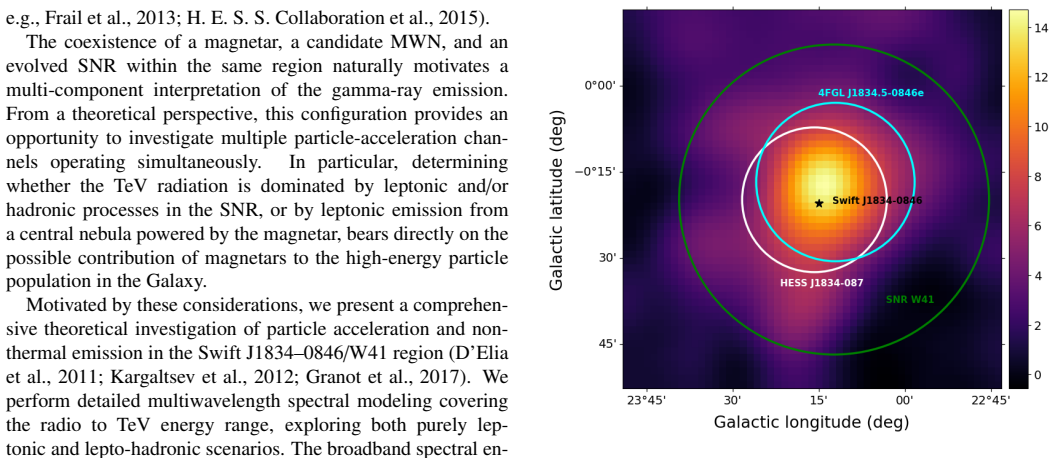
Summary. The paper models the broadband (radio-to-TeV) spectral energy distribution of the Swift J1834–0846/W41 region with MCMC sampling in the Naima framework, testing purely leptonic and lepto-hadronic particle distributions under two assumed TeV morphologies: a single extended source and a two-component configuration with an extended SNR component plus a central point-like MWN component. In the single-source scenario the authors find leptonic models disfavored by the very low magnetic fields they require, and lepto-hadronic models preferred on energetic grounds, although the BIC differences among Kep variants are explicitly inconclusive (ΔBIC≈0.44, P≈0.55). In the two-component scenario, they argue that the extended TeV emission is hadronic while the central excess is leptonic, with an inferred electron energy of ~5×10^47 erg implying an initial spin period of P0≲0.2 s for the magnetar. The paper closes with CTAO simulations showing that 30 h exposures could distinguish the two morphological configurations and extend the spectrum beyond ~10 TeV. The manuscript is careful in places—it states that the two-component structure is only hinted and that the current data do not uniquely favor one scenario—but the abstract and several conclusions present the two-component/MWN interpretation more firmly than the supporting analysis warrants.
Significance. If the two-component interpretation were established, this would be the first TeV-bright magnetar wind nebula and would connect the fitted MWN electron population to a fast birth spin for Swift J1834–0846; the CTAO simulations also provide a concrete, falsifiable observational test. The paper's strengths are its use of public analysis tools (Naima, Gammapy, public H.E.S.S./Fermi data), its explicit reporting of BIC values and parameter uncertainties, and the fact that the CTAO predictions are quantitative and testable. However, the central claim is conditional on a morphological decomposition that is assumed rather than statistically established, and the P0 inference is a derived quantity that depends sensitively on assumed spin-down timescales and ages. The paper would be valuable if these load-bearing caveats are addressed either by an explicit test of the point-like component or by a substantial reframing of the conclusions.
major comments (3)
- [§1 and §3 (Table 1)] The two-component morphology is assumed, not tested. The paper itself describes the central point-like component as only a 'hint' (§1, citing H.E.S.S. Collaboration et al. 2015), and the BIC comparisons in Table 1 are only between Kep variants within each morphological scenario. There is no likelihood or TS test comparing the single-source model to the two-component model, and no test of whether the point-like component is statistically required by the H.E.S.S. data. Since all MWN-specific conclusions (We≈5×10^47 erg, P0≲0.2 s) are derived from this assumed decomposition, the central claim is conditional on an unvalidated morphological assumption. I request either an explicit statistical test of the point-like component using the available data, or a clear statement in the abstract and conclusions that the two-component results are conditional and not preferred by current data.
- [§4.2] The claimed short initial spin period is not an independent prediction. The value P0≲0.2 s is obtained by equating the fitted electron energy We≈5×10^47 erg with the total rotational energy released under an assumed initial spin-down timescale of τ0≈8–25 yr. The same section shows that adopting τ0≈10^3 yr and an assumed age of 60 kyr yields P0≲0.3 s. The age assumption is also uncertain because the magnetar's characteristic age is 4.9 kyr while the remnant age is taken as ~60 kyr. Thus the P0 constraint is degenerate with model assumptions and cannot be presented as a robust implication of the data; a sensitivity analysis or a clearly labeled 'illustrative' statement is needed.
- [§4.2 and Table 1] For the point-like MWN component, only a leptonic model is fitted; no hadronic or lepto-hadronic alternative is considered for this component. The statement that the central excess is 'well described by a leptonic magnetar wind nebula' is therefore not the result of model comparison—it is the only model attempted. The BIC for this model is reported but not contrasted with any alternative. To support the conclusion, the authors should fit an alternative model for the point-like component (e.g., a hadronic compact source) or explicitly state that the leptonic MWN interpretation is assumed, not demonstrated.
minor comments (5)
- [§4.1] In the discussion of the leptonic spectral break, the text reads '∆Γ e ,1'; this appears to be a typo and should likely read 'ΔΓ e ≠ 1' or similar.
- [Table 1] The point-like MWN entry lists Ee,cut = 679.5 +336.6/−519.1 TeV, which is an unusually high value. Please check this number and, if correct, discuss its physical meaning in the context of B≈6 µG and IC-dominated emission.
- [Figure 2 caption] The phrase 'as a single source TeV' is awkward; rephrase, e.g., 'in the single-source TeV scenario.'
- [§2] The X-ray photon index is denoted Γγ, which conflicts with the gamma-ray notation used elsewhere. Use Γ_X or Γ_ph for the X-ray index.
- [§3] The paper does not state the MCMC convergence diagnostics or the number of walkers/steps. Adding a brief description of the sampling setup would improve reproducibility.
Circularity Check
No significant circularity: the modeling is a self-contained SED fit and the CTAO simulations are forward-modeled from explicitly stated inputs.
full rationale
The paper's derivation chain is not circular. The broadband SED is fit with external radiative formalisms (Naima, Rybicki & Lightman, Kelner et al.) to radio-to-TeV data, and the resulting particle spectra, magnetic fields, and energy budgets are fit outputs, not inputs. The two-component TeV morphology is explicitly taken from H.E.S.S. 2015 as a 'hint' and a scenario, not derived from the authors' own model; the paper repeatedly states that current data do not uniquely favor one scenario and that CTAO will be decisive. The P0≲0.2 s inference is conditional on stated assumptions about the initial spin-down timescale (τ0~8-25 yr) and characteristic age; the paper also shows that assuming τ0~10^3 yr with a 60 kyr age gives P0≲0.3 s. This is parameter-dependent model inference, not a fitted quantity renamed as a prediction. The CTAO simulations are forward models that adopt H.E.S.S. spatial templates as input, so the claim that CTAO can discriminate between the assumed configurations is a simulation capability statement, not a validation of the two-component model. The only self-citation (Padilha & Anjos 2025) appears in a general list of SNR acceleration references and is not load-bearing. No quoted equation or fitted parameter reduces by construction to an input, and no uniqueness theorem or ansatz is smuggled through self-citation. Correctness risks—such as the unvalidated two-component morphological assumption and the age discrepancy—are acknowledged in the text and belong to model robustness, not circularity.
Axiom & Free-Parameter Ledger
free parameters (9)
- Electron normalization Φ0,e =
implicit; W_e = 0.005–1.5×10^50 erg across models
- Electron spectral indices Γe1, Γe2 =
e.g., MWN: 1.77, 3.59; SNR K_ep=1e-2: 2.19, 2.28
- Electron break and cutoff energies (Eb, Ee,cut) =
Eb=0.05–7.08 TeV; Ee,cut=1.42–679.5 TeV
- Proton normalization Φ0,p (via K_ep) =
K_ep = 1e-1, 1e-2, 1e-3 grid; W_p = 0.13–3.15×10^50 erg
- Proton spectral index Γp and cutoff Ep,cut =
Γp≈2.16–2.36; Ep,cut≈13–315 TeV
- Magnetic field B =
2–70 μG depending on scenario
- Ambient gas density n =
6 cm^-3
- FIR/NIR target photon energy densities =
u_FIR=0.5 eV cm^-3 (25 K); u_NIR=1.0 eV cm^-3 (3000 K)
- Initial spin-down timescale τ0 =
10^3 yr (standard) or 8–25 yr (short), plus age 4.9 or 60 kyr
axioms (8)
- standard math Standard radiative formulas for synchrotron, inverse Compton, and pp→π0→γγ emission are correct.
- domain assumption Emission from each region is one-zone, homogeneous, steady-state, with a constant magnetic field and a single broken power-law electron spectrum (ECBPL) and power-law proton spectrum (ECPL).
- ad hoc to paper The two-component morphological decomposition of HESS J1834-087 (central point-like source + extended emission) is real, and the point-like source is associated with the magnetar/MWN.
- domain assumption The adopted distance 4.2 kpc, ambient gas density 6 cm^-3, and FIR/NIR photon fields (25 K/0.5 eV cm^-3, 3000 K/1.0 eV cm^-3) are correct and fixed.
- domain assumption Particle acceleration occurs via diffusive shock acceleration in SNR W41 and at the magnetar wind termination shock, producing the assumed injection spectra.
- domain assumption The magnetar's spin-down (possibly supplemented by bursts) is the energy source for the MWN electron population; the dipole spin-down formula and assumed τ0 apply.
- domain assumption In the SNR scenario the MWN X-ray flux can be used as an upper limit on SNR synchrotron; in the MWN scenario the SNR radio fluxes are upper limits for MWN synchrotron.
- domain assumption The magnetar's characteristic age (4.9 kyr) may underestimate its true age (~60 kyr) due to non-constant torque history, as assumed in the second energy-budget calculation.
read the original abstract
We investigate the origin of non-thermal emission from the Swift J1834-0846/W41 region by modeling its broadband spectral energy distribution from radio to TeV energies within leptonic and lepto-hadronic frameworks using Markov Chain Monte Carlo sampling. Motivated by morphological studies of HESS J1834-087 suggesting a two-component TeV structure, we explore a single extended source scenario and a configuration comprising a central point-like component embedded within extended emission. Purely leptonic models are disfavored in both scenarios by unrealistically low magnetic field strengths, whereas lepto-hadronic solutions yield field intensities and non-thermal energy budgets consistent with an evolved supernova remnant undergoing efficient cosmic-ray acceleration. In the two-component scenario, hadronic interactions dominate the extended TeV emission from W41, while the central excess is well described by a leptonic magnetar wind nebula powered by Swift J1834-0846, implying a short initial spin period of $P_0 \lesssim 0.2$ s. Simulated observations with the Cherenkov Telescope Array Observatory show that 30 h exposures will discriminate between the two morphological configurations and extend spectral measurements beyond $\sim$10 TeV.
Figures


Reference graph
Works this paper leans on
-
[1]
VERITAS: the Very Energetic Radiation Imaging Telescope Array System , journal =
T.C Weekes and H Badran and S.D Biller and I Bond and S Bradbury and J Buckley and D Carter-Lewis and M Catanese and S Criswell and W Cui and P Dowkontt and C Duke and D.J Fegan and J Finley and L Fortson and J Gaidos and G.H Gillanders and J Grindlay and T.A Hall and K Harris and A.M Hillas and P Kaaret and M Kertzman and D Kieda and F Krennrich and M.J ...
2002
-
[2]
The MAGIC gamma-ray observatory , journal =
Daniel Ferenc , abstract =. The MAGIC gamma-ray observatory , journal =. 2005 , note =. doi:https://doi.org/10.1016/j.nima.2005.08.085 , url =
-
[3]
Advances in Space Research , year = 2014, month =
HAWC: A next-generation all-sky gamma-ray telescope. Advances in Space Research , year = 2014, month =. doi:10.1016/j.asr.2013.03.016 , adsurl =
-
[4]
Abdollahi and F
S. Abdollahi and F. Acero and L. Baldini and J. Ballet and D. Bastieri and R. Bellazzini and B. Berenji and A. Berretta and E. Bissaldi and R. D. Blandford and E. Bloom and R. Bonino and A. Brill and R. J. Britto and P. Bruel and T. H. Burnett and S. Buson and R. A. Cameron and R. Caputo and P. A. Caraveo and D. Castro and S. Chaty and C. C. Cheung and G....
-
[5]
Acero and M
F. Acero and M. Ackermann and M. Ajello and A. Albert and W. B. Atwood and M. Axelsson and L. Baldini and J. Ballet and G. Barbiellini and D. Bastieri and A. Belfiore and R. Bellazzini and E. Bissaldi and R. D. Blandford and E. D. Bloom and J. R. Bogart and R. Bonino and E. Bottacini and J. Bregeon and R. J. Britto and P. Bruel and R. Buehler and T. H. Bu...
-
[6]
Ackermann and M
M. Ackermann and M. Ajello and W. B. Atwood and L. Baldini and J. Ballet and G. Barbiellini and D. Bastieri and J. Becerra Gonzalez and R. Bellazzini and E. Bissaldi and R. D. Blandford and E. D. Bloom and R. Bonino and E. Bottacini and T. J. Brandt and J. Bregeon and P. Bruel and R. Buehler and S. Buson and G. A. Caliandro and R. A. Cameron and R. Caputo...
-
[7]
Ajello and W
M. Ajello and W. B. Atwood and L. Baldini and J. Ballet and G. Barbiellini and D. Bastieri and R. Bellazzini and E. Bissaldi and R. D. Blandford and E. D. Bloom and R. Bonino and J. Bregeon and R. J. Britto and P. Bruel and R. Buehler and S. Buson and R. A. Cameron and R. Caputo and M. Caragiulo and P. A. Caraveo and E. Cavazzuti and C. Cecchi and E. Char...
-
[8]
37th International Cosmic Ray Conference , year = 2022, month = mar, eid =
Detection methods for the Cherenkov Telescope Array at very-short exposure times. 37th International Cosmic Ray Conference , year = 2022, month = mar, eid =. doi:10.22323/1.395.0694 , archivePrefix =. 2108.04504 , primaryClass =
Pith/arXiv arXiv 2022
-
[9]
2024 , eprint=
A gamma ray study of Galactic PeVatron candidates LHAASO J1825-1236 and J1839-0545 , author=. 2024 , eprint=
2024
-
[10]
Phase Separation in Ultramassive White Dwarfs. , keywords =. doi:10.3847/1538-4357/ac1513 , archivePrefix =. 2107.07094 , primaryClass =
-
[12]
Survey of the Inner Galaxy in Very High Energy Gamma Rays
The H.E.S.S. Survey of the Inner Galaxy in Very High Energy Gamma Rays. , keywords =. doi:10.1086/498013 , archivePrefix =. astro-ph/0510397 , primaryClass =
-
[13]
3FHL: The Third Catalog of Hard Fermi-LAT Sources. , keywords =. doi:10.3847/1538-4365/aa8221 , archivePrefix =. 1702.00664 , primaryClass =
-
[14]
2FHL: The Second Catalog of Hard Fermi-LAT Sources. , keywords =. doi:10.3847/0067-0049/222/1/5 , archivePrefix =. 1508.04449 , primaryClass =
-
[15]
Incremental Fermi Large Area Telescope Fourth Source Catalog. , keywords =. doi:10.3847/1538-4365/ac6751 , archivePrefix =. 2201.11184 , primaryClass =
-
[16]
Fermi Large Area Telescope Fourth Source Catalog Data Release 4 (4FGL-DR4). arXiv e-prints , keywords =. doi:10.48550/arXiv.2307.12546 , archivePrefix =. 2307.12546 , primaryClass =
-
[17]
Fermi Large Area Telescope Third Source Catalog. , keywords =. doi:10.1088/0067-0049/218/2/23 , archivePrefix =. 1501.02003 , primaryClass =
-
[18]
Extended VHE -ray emission towards SGR1806-20, LBV 1806-20, and stellar cluster Cl* 1806-20. , keywords =. doi:10.1051/0004-6361/201628695 , archivePrefix =. 1606.05404 , primaryClass =
-
[19]
The H.E.S.S. Galactic plane survey. , keywords =. doi:10.1051/0004-6361/201732098 , archivePrefix =. 1804.02432 , primaryClass =
-
[20]
IEEE Transactions on Automatic Control , keywords =
A New Look at the Statistical Model Identification. IEEE Transactions on Automatic Control , keywords =
-
[21]
Gammapy: A Python package for gamma-ray astronomy. , keywords =. doi:10.1051/0004-6361/202346488 , archivePrefix =. 2308.13584 , primaryClass =
-
[22]
doi:10.5281/zenodo.17814297 , url =
Acero, Fabio and Aguasca-Cabot, Arnau and Barrios-Jiménez, Luis and Arnesen, Tora Therese Høiland and Batt, Anushka and Bernete, Juan and Biederbeck, Noah and Buchner, Johannes and Bylund, Tomas and Djuvsland, Julia and Donath, Axel and Emery, Gabriel and Egg, Katharina and Feijen, Kirsty and Fröse, Stefan and Galelli, Claudio and Gréaux, Lucas and Khélif...
-
[23]
Background modelling in very-high-energy -ray astronomy. , keywords =. doi:10.1051/0004-6361:20066674 , archivePrefix =. astro-ph/0610959 , primaryClass =
-
[24]
Analysis methods for results in gamma-ray astronomy. , keywords =. doi:10.1086/161295 , adsurl =
-
[25]
doi:10.5281/zenodo.5499840 , url =
CTAO Instrument Response Functions - prod5 version v0.1 , month = sep, year = 2021, publisher =. doi:10.5281/zenodo.5499840 , url =
-
[26]
Nuovo Cimento C Geophysics Space Physics C , year = 2017, month = may, volume =
GRBs as multimessenger sources. Nuovo Cimento C Geophysics Space Physics C , year = 2017, month = may, volume =. doi:10.1393/ncc/i2017-17126-2 , adsurl =
-
[27]
Frontiers in Astronomy and Space Sciences , keywords =
Multimessenger Search for the Sources of Cosmic Rays using Cosmic Neutrinos. Frontiers in Astronomy and Space Sciences , keywords =. doi:10.3389/fspas.2019.00032 , adsurl =
arXiv 2019
-
[28]
Cosmic rays from pulsars and magnetars. , keywords =. doi:10.1111/j.1745-3933.2010.00874.x , archivePrefix =. 1005.1003 , primaryClass =
arXiv 2010
-
[29]
The First LHAASO Catalog of Gamma-Ray Sources. , keywords =. doi:10.3847/1538-4365/acfd29 , archivePrefix =. 2305.17030 , primaryClass =
-
[30]
A Catalog of the Highest-energy Cosmic Rays Recorded during Phase I of Operation of the Pierre Auger Observatory. , keywords =. doi:10.3847/1538-4365/aca537 , adsurl =
-
[31]
Constraining models for the origin of ultra-high-energy cosmic rays with a novel combined analysis of arrival directions, spectrum, and composition data measured at the Pierre Auger Observatory. , keywords =. doi:10.1088/1475-7516/2024/01/022 , archivePrefix =. 2305.16693 , primaryClass =
Pith/arXiv arXiv 2024
-
[32]
Massive stars as major factories of Galactic cosmic rays. Nature Astronomy , keywords =. doi:10.1038/s41550-019-0724-0 , archivePrefix =. 1804.02331 , primaryClass =
-
[33]
Massive star cluster origin for the galactic cosmic ray population at very-high energies. , keywords =. doi:10.1093/mnras/stac3469 , archivePrefix =. 2211.11625 , primaryClass =
-
[34]
The origin of galactic cosmic rays. , keywords =. doi:10.1007/s00159-013-0070-7 , archivePrefix =. 1311.7346 , primaryClass =
-
[35]
Magnetars as powering sources of gamma-ray burst associated supernovae, and unsupervized clustering of cosmic explosions. , keywords =. doi:10.1093/mnras/stae901 , archivePrefix =. 2403.18076 , primaryClass =
-
[36]
European Physical Journal Web of Conferences , year = 2023, series =
UHECR results of combined analyses of TA and Auger experiments. European Physical Journal Web of Conferences , year = 2023, series =. doi:10.1051/epjconf/202328004001 , adsurl =
arXiv 2023
-
[37]
Annual Review of Nuclear and Particle Science , keywords =
Ultra-High-Energy Gamma-Ray Astronomy. Annual Review of Nuclear and Particle Science , keywords =. doi:10.1146/annurev-nucl-112822-025357 , archivePrefix =. 2310.01744 , primaryClass =
-
[38]
Formation of Very Strongly Magnetized Neutron Stars: Implications for Gamma-Ray Bursts. , keywords =. doi:10.1086/186413 , adsurl =
-
[39]
Radiative mechanism for outbursts
The soft gamma repeaters as very strongly magnetized neutron stars - I. Radiative mechanism for outbursts. , keywords =. doi:10.1093/mnras/275.2.255 , adsurl =
-
[40]
Binary Coalescences as Sources of Ultrahigh-Energy Cosmic Rays. , keywords =. doi:10.1103/PhysRevLett.132.091401 , archivePrefix =. 2307.06200 , primaryClass =
-
[41]
Science with the Cherenkov Telescope Array. doi:10.1142/10986 , adsurl =
-
[42]
W. B. Atwood and A. A. Abdo and M. Ackermann and W. Althouse and B. Anderson and M. Axelsson and L. Baldini and J. Ballet and D. L. Band and G. Barbiellini and J. Bartelt and D. Bastieri and B. M. Baughman and K. Bechtol and D. Bédérède and F. Bellardi and R. Bellazzini and B. Berenji and G. F. Bignami and D. Bisello and E. Bissaldi and R. D. Blandford an...
2009
-
[43]
The Astrophysical Journal , keywords =
X-Ray Observations of the New Unusual Magnetar Swift J1834.9-0846. The Astrophysical Journal , keywords =. doi:10.1088/0004-637X/748/1/26 , archivePrefix =. 1201.1894 , primaryClass =
-
[44]
Monthly Notices of the Royal Astronomical Society , keywords =
Learning about the magnetar Swift J1834.9-0846 from its wind nebula. Monthly Notices of the Royal Astronomical Society , keywords =. doi:10.1093/mnras/stw2554 , archivePrefix =. 1608.06994 , primaryClass =
-
[45]
The Astronomical Journal , keywords =
The Distances of SNR W41 and Overlapping H II Regions. The Astronomical Journal , keywords =. doi:10.1088/0004-6256/135/1/167 , archivePrefix =. 0708.3377 , primaryClass =
-
[46]
The Astrophysical Journal , keywords =
On the Origin of TeV Gamma-Ray Emission from HESS J1834-087. The Astrophysical Journal , keywords =. doi:10.1088/0004-637X/691/2/1707 , archivePrefix =. 0810.1605 , primaryClass =
-
[47]
The Astrophysical Journal Letters , keywords =
VLA and XMM-Newton Observations of the SNR W41/TeV Gamma-Ray Source HESS J1834-087. The Astrophysical Journal Letters , keywords =. doi:10.1086/512544 , archivePrefix =. astro-ph/0612296 , primaryClass =
-
[48]
The Astrophysical Journal , keywords =
The Prelude to and Aftermath of the Giant Flare of 2004 December 27: Persistent and Pulsed X-Ray Properties of SGR 1806-20 from 1993 to 2005. The Astrophysical Journal , keywords =. doi:10.1086/507459 , archivePrefix =. astro-ph/0602402 , primaryClass =
Pith/arXiv arXiv 2004
-
[49]
Monthly Notices of the Royal Astronomical Society , keywords =
A downward revision to the distance of the 1806-20 cluster and associated magnetar from Gemini Near-Infrared Spectroscopy. Monthly Notices of the Royal Astronomical Society , keywords =. doi:10.1111/j.1745-3933.2008.00453.x , archivePrefix =. 0802.0815 , primaryClass =
arXiv 2008
-
[50]
Rita C. dos Anjos and Jaziel G. Coelho and Jonas P. Pereira and Fernando Catalani , title =. Journal of Cosmology and Astroparticle Physics , abstract =. 2021 , month =. doi:10.1088/1475-7516/2021/10/023 , url =
-
[51]
Jaziel G. Coelho and Luana N. Padilha and Rita C. dos Anjos and Cynthia V. Ventura and Geanderson A. Carvalho , title =. 2022 , month =. doi:10.1088/1475-7516/2022/10/041 , url =
-
[52]
Suzaku Observations of SGR1900+14 and SGR1806-20. , keywords =. doi:10.1093/pasj/61.sp1.S387 , archivePrefix =. 0808.3846 , primaryClass =
-
[53]
The McGill Magnetar Catalog. , keywords =. doi:10.1088/0067-0049/212/1/6 , archivePrefix =. 1309.4167 , primaryClass =
-
[54]
Reports on Progress in Physics , keywords =
Physics of strongly magnetized neutron stars. Reports on Progress in Physics , keywords =. doi:10.1088/0034-4885/69/9/R03 , archivePrefix =. astro-ph/0606674 , primaryClass =
-
[55]
Advances in Space Research , year = 2011, month = apr, volume =
The multi-wavelength properties of Anomalous X-ray Pulsars and Soft Gamma-ray Repeaters. Advances in Space Research , year = 2011, month = apr, volume =. doi:10.1016/j.asr.2010.08.031 , adsurl =
-
[56]
Proper Motions and Origins of SGR 1806-20 and SGR 1900+14. , keywords =. doi:10.1088/0004-637X/761/1/76 , archivePrefix =. 1210.8151 , primaryClass =
Pith/arXiv arXiv 1900
-
[57]
An exceptionally bright flare from SGR 1806-20 and the origins of short-duration -ray bursts. , keywords =. doi:10.1038/nature03519 , archivePrefix =. astro-ph/0502329 , primaryClass =
-
[58]
The Nature of a Cosmic-Ray Accelerator, CTB37B, Observed with Suzaku and Chandra. , keywords =. doi:10.1093/pasj/61.sp1.S197 , archivePrefix =. 0808.2339 , primaryClass =
-
[59]
GRB Coordinates Network , year = 2011, month = jan, volume =
GRB 110807A: Swift detection of a burst or a posible new Sgr. GRB Coordinates Network , year = 2011, month = jan, volume =
2011
-
[60]
A New Population of Very High Energy Gamma-Ray Sources in the Milky Way. Science , keywords =. doi:10.1126/science.1108643 , archivePrefix =. astro-ph/0504380 , primaryClass =
-
[61]
Inverse Compton Emission from Galactic Supernova Remnants: Effect of the Interstellar Radiation Field. , keywords =. doi:10.1086/507770 , archivePrefix =. astro-ph/0607344 , primaryClass =
-
[62]
naima: a Python package for inference of relativistic particle energy distributions from observed nonthermal spectra , year = 2015, journal =. 1509.03319 , adsurl =
Pith/arXiv arXiv 2015
-
[63]
Galaxies , year = 2023, month = mar, volume =
Challenges of This Century in High-Density Compact Objects, High-Energy Astrophysics, and Multi-Messenger Observations: Quo Vadis?. Galaxies , year = 2023, month = mar, volume =. doi:10.3390/galaxies11020048 , adsurl =
-
[64]
Fermi Large Area Telescope observations of the supernova remnant HESS J1731-347. , keywords =. doi:10.1051/0004-6361/201322737 , archivePrefix =. 1405.4888 , primaryClass =
-
[65]
Evolution of High-energy Particle Distribution in Mature Shell-type Supernova Remnants. , keywords =. doi:10.3847/1538-4357/834/2/153 , archivePrefix =. 1611.07564 , primaryClass =
-
[66]
Modeling the Multi-Wavelength Emission of the Shell-type Supernova Remnant RX J1713.7-3946. , keywords =. doi:10.1088/0004-637X/735/2/120 , archivePrefix =. 1011.0145 , primaryClass =
-
[67]
Gamma-Ray Observations of the Supernova Remnant RX J0852.0-4622 with the Fermi Large Area Telescope. , keywords =. doi:10.1088/2041-8205/740/2/L51 , archivePrefix =. 1109.4658 , primaryClass =
Pith/arXiv arXiv 2041
-
[68]
The acceleration of cosmic rays in shock fronts - I. , keywords =. doi:10.1093/mnras/182.2.147 , adsurl =
-
[69]
Cosmic Rays from the Knee to the Second Knee:. 10 ^ 14 to 10 ^ 18 eV. Modern Physics Letters A , keywords =. doi:10.1142/S0217732307024139 , archivePrefix =. astro-ph/0611387 , primaryClass =
-
[70]
An unusual supernova in the error box of the -ray burst of 25 April 1998. , keywords =. doi:10.1038/27150 , archivePrefix =. astro-ph/9806175 , primaryClass =
Pith/arXiv arXiv 1998
-
[71]
Energy Spectrum and Chemical Composition of Ultrahigh Energy Cosmic Rays from Semi-relativistic Hypernovae. , keywords =. doi:10.1088/0004-637X/746/1/40 , archivePrefix =. 1111.6256 , primaryClass =
-
[72]
IAU General Assembly , year = 2015, volume =
Mopra CO-line observation towards SNR CTB37B. IAU General Assembly , year = 2015, volume =
2015
-
[73]
Cosmic Rays and Particle Physics
-
[74]
Gamma rays from cosmic rays in supernova remnants. , keywords =. doi:10.1051/0004-6361/201220394 , archivePrefix =. 1210.8071 , primaryClass =
-
[75]
Planets, Stars and Stellar Systems
Gamma-Ray Emission of Supernova Remnants and the Origin of Galactic Cosmic Rays , author=. Planets, Stars and Stellar Systems. Volume 5: Galactic Structure and Stellar Populations , volume=
-
[76]
Energy Partition between Energetic Electrons and Turbulent Magnetic Field in Supernova Remnant RX J1713.7-3946. , keywords =. doi:10.1088/0004-637X/773/2/138 , archivePrefix =. 1306.4399 , primaryClass =
-
[77]
On the Foundation of Equipartition in Supernova Remnants. , keywords =. doi:10.3847/1538-4357/aaac2d , archivePrefix =. 1801.10422 , primaryClass =
-
[78]
The Wind Nebula around Magnetar Swift J1834.9-0846. , keywords =. doi:10.3847/0004-637X/824/2/138 , archivePrefix =. 1604.06472 , primaryClass =
-
[79]
Rotationally Powered Magnetar Nebula around Swift J1834.9-0846. , keywords =. doi:10.3847/1538-4357/835/1/54 , archivePrefix =. 1612.02835 , primaryClass =
-
[80]
MAGPIS: A Multi-Array Galactic Plane Imaging Survey. , keywords =. doi:10.1086/503253 , adsurl =
-
[81]
The Bolocam Galactic Plane Survey: Survey Description and Data Reduction. , keywords =. doi:10.1088/0067-0049/192/1/4 , archivePrefix =. 1011.0691 , primaryClass =
discussion (0)
Sign in with ORCID, Apple, or X to comment. Anyone can read and Pith papers without signing in.