REVIEW 2 major objections 6 minor 16 references
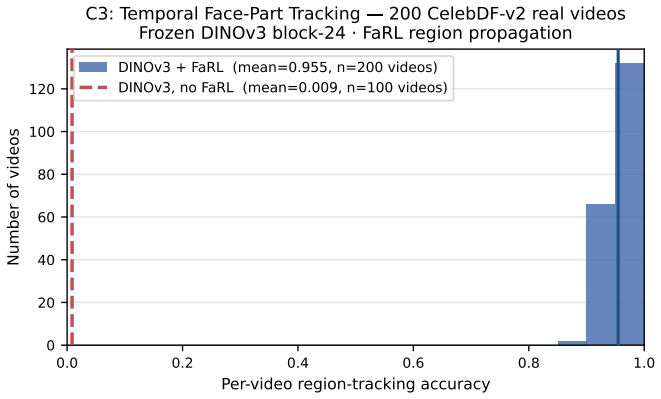
Frozen DINOv3 features support a region-level facial coordinate system: unconstrained nearest-neighbor matching recovers the correct facial region 83% of the time across identities, and 95.5% through time, with no face-specific training.
Reviewed by Pith at T0; open to challenge. T0 means a machine referee read the full paper against a public rubric. the ladder, T0–T4 →
T0 review · deepseek-v4-flash
2026-08-02 02:06 UTC pith:P4VRKEQI
load-bearing objection A plausible phenomenon, but the headline accuracy is confounded by face alignment; needs a grid-position baseline and number cleanup. the 2 major comments →
Emergent Region-Level Facial Correspondence in Frozen Vision Foundation Models
The pith
A machine-rendered reading of the paper's core claim, the machinery that carries it, and where it could break.
Core claim
The paper claims that frozen DINOv3 features define a region-level facial coordinate system: a feature space in which a patch of brow, eye, mouth, nose, skin, or hair remains closest to patches of the same anatomical region in another face, even when identity, expression, and lighting change. This is established by showing that nearest-neighbor matching in the frozen feature space recovers the same FaRL region across identities (83.0% vs 23.0% random), that the structure persists over time (95.5% tracking accuracy), and that the signal is strongest at block 18, an intermediate layer whose per-dimension amplitude profiles remain locally discriminative before final LayerNorm mixes token direct
What carries the argument
The central object is the DINOv3 ViT-L/16 patch-token feature space, specifically the intermediate block-18 token embeddings (with per-channel batch normalization) versus the final block-24 LayerNorm-normalized tokens. The paper's mechanism is the 'Gram-anchored shared coordinate system': the Gram-matrix anchoring regularizer constrains the covariance structure of patch tokens across training views, so that each feature dimension develops a stable functional role across all spatial positions and identities. FaRL (a frozen face-parsing model) serves only as a labeling interface—it assigns semantic region names to patches; all correspondence is computed by nearest-neighbor search or label prop
Load-bearing premise
The load-bearing premise is that nearest-neighbor matches in DINOv3 feature space reflect anatomical region identity rather than mere spatial proximity within the aligned face crop, since the reported accuracy is compared against an area-weighted random baseline and never against a grid-position baseline.
What would settle it
Take two faces from the evaluation set and match every foreground patch of face A to the patch at the same grid position in face B (no features). If this positional-only baseline yields semantic accuracy close to the reported 83.0%, the claim that DINOv3 features encode anatomical identity is falsified; if it lands near the 23% random level, the feature-based result stands.
If this is right
- If frozen DINOv3 features carry anatomical region identity, dense face analysis (region segmentation, part tracking, re-targeting, avatar animation) can be bootstrapped from one labeled frame plus a frozen feature extractor, with no face-specific fine-tuning.
- Intermediate layers rather than the final layer should be the default for dense face tasks; block 18's 4.93× discrimination ratio (7.19× excluding symmetric pairs) versus 1.48× at block 24 makes layer choice a first-order factor.
- CLIP's image-level contrastive supervision captures coarse facial layout but not fine anatomical identity; tasks requiring region-level identity across individuals should prefer dense self-supervised features over image-text features.
- The no-FaRL collapse to 0.9% shows semantic initialization is strictly load-bearing: a practical system needs a small amount of semantic naming, after which frozen features alone sustain 95.5% temporal tracking.
- Because k-means on frozen features independently recovers FaRL-like regions (NMI 0.45), the same feature space could support fully unsupervised face-part discovery, not just supervised label propagation.
Where Pith is reading between the lines
- The paper never reports a positional baseline; matching patches by grid coordinates alone (no features) could plausibly capture much of the 83% because the aligned face crop fixes region layout. Testing such a baseline would directly separate anatomical identity from spatial prior.
- All metrics are cosine-based and thus invariant to global rotations of feature axes, so the per-dimension 'shared coordinate system' mechanism is only indirectly tested; a dimension-level analysis (e.g., canonicalizing the basis and measuring selectivity of individual features) would make the mechanism falsifiable.
- The temporal protocol uses a rolling context of 7 frames and a circular neighborhood mask; a single-anchor, no-context variant drops to 50.9%, so the 95.5% result is partly protocol-dependent. A stress test varying context length and radius would clarify how much of the temporal stability comes from the features versus the propagation machinery.
- CelebDF-v2 and LaPa cover a limited demographic range; if the coordinate system is truly generic, it should survive evaluation on diverse ethnicity, age, and extreme-pose face sets—a natural next test.
Editorial analysis
A structured set of objections, weighed in public.
Referee Report
Summary. The paper tests whether frozen DINOv3 ViT-L/16 patch features encode region-level facial correspondence usable across identities and time, using FaRL only as a labeling interface for eight facial regions. On 200 CelebDF-v2 real videos, it reports 83.0% cross-identity unconstrained nearest-neighbor semantic accuracy versus a 23.0% area-weighted random baseline, 95.5% temporal label-propagation accuracy without learned temporal modules, and a block-depth dissociation (block 18 gives 4.93× same-region vs. cross-region cosine ratio vs. 1.48× at block 24). A no-FaRL control collapses to 0.9%, and comparisons with CLIP and with SegFormer labels, plus an unsupervised k-means validation, are presented as supporting evidence.
Significance. If the central claim holds, the paper is a useful contribution: it would demonstrate that a frozen self-supervised vision transformer preserves anatomical face-part identity well enough for dense cross-identity and temporal correspondence without face-specific training, and that intermediate layers are more discriminative than the final layer. The authors include several thoughtful controls: an area-weighted random baseline, bootstrapped confidence intervals, an independent labeler (SegFormer), an unsupervised clustering check, a no-FaRL ablation, and a cross-backbone comparison. These indicate good experimental hygiene. However, the headline quantitative claim is currently undermined by a missing position-controlled baseline, so the significance is conditional on whether the correspondence is truly semantic rather than an artifact of aligned face crops and ViT positional embeddings.
major comments (2)
- [§2.4, §2.6, §3.2 (Table 2)] The unconstrained cross-identity matching protocol uses RetinaFace crops with 22% padding, resized to 448×448 (§2.4). For the predominantly frontal CelebDF-v2 faces, this produces near-constant grid positions for eyes, brows, nose, mouth, skin, and hair across identities. DINOv3 patch tokens contain positional embeddings, so nearest-neighbor cosine search can succeed by matching grid coordinates rather than semantic region identity. The only baseline reported is an area-weighted random baseline (0.230), which has no position prior. The paper never reports a same-grid-position baseline (e.g., transferring the label of the patch at the same (x,y) coordinate in the other face) or a position-only descriptor baseline. The SegFormer (§5.2) and k-means (§5.3) controls operate on the same aligned grids, so they inherit the same confound. Without a position baseline, the 83.0% accuracy does not e
- [§2.1, §2.6, §7] The paper repeatedly invokes a 'shared coordinate system' in which each feature dimension has a stable functional role, and frames the contribution as identifying such a coordinate system (§2.1, §7). However, the evaluation metrics are cosine-based and hence invariant to global rotations of the feature space, as the paper itself acknowledges in §2.6. Cosine similarity is consistent with many mechanisms that do not involve a fixed per-dimension coordinate system. To support the mechanistic language, the authors should either provide a direct test of per-dimension role stability across identities (e.g., dimension-wise canonical correlation or consistent ranking of dimensions) or revise the language to describe the results as correspondence without committing to a per-dimension coordinate system. This is a central interpretive issue, though not a numerical error.
minor comments (6)
- [Abstract and Table 3] The headline 83.0% semantic accuracy is area-weighted and dominated by skin and hair, which together account for 91% of foreground patches. The face-only unconstrained accuracy (0.686 for block 18, Table 3) is substantially lower and should be reported in the abstract or prominently in the text to avoid overstatement.
- [Figure 1 vs Table 1] Figure 1 displays 'diag/off-diag = 4.66×' while the caption and Table 1 state 4.93×. Please clarify whether these come from different samplings and unify the notation.
- [§5.3] The text says the block-18 advantage is an 'amplitude discriminability property' and that k-means on L2-normalised features probes structure 'where amplitude is removed.' But §2.5 and §2.6 also L2-normalize patch features for the region-confusion protocol. This apparent inconsistency should be resolved: either both analyses remove amplitude, or the explanation should be rephrased.
- [§2.1] The claim that DINOv3's Gram anchoring produces 'stronger dimensional correspondence than DINOv2' is stated without a direct comparison or citation to a specific study quantifying this. A brief comparison or a caveat would be appropriate.
- [§4.1] The temporal tracking result (0.955) depends on the official propagate() hyperparameters (r=12, K=5, τ=0.2, Q=7). Reporting sensitivity to these parameters would strengthen the claim that the representation, not the protocol, is responsible.
- [Table 2] The FaRL-constrained spatial precision for eyes is far below the 0.50 random baseline (0.078–0.100). This is surprising and deserves discussion, as it suggests that constrained matching does not localize small regions meaningfully.
Circularity Check
No significant circularity: the DINOv3/FaRL evaluation loop is self-acknowledged but mitigated by independent labeler and unsupervised checks; no self-citation chain or definitional reduction.
full rationale
The central derivation is not circular. The paper's claimed result—that frozen DINOv3 patch features support region-level cross-identity and temporal facial correspondence—is measured by nearest-neighbor matching and label propagation in DINOv3 feature space, with FaRL used solely to attach semantic names. FaRL is a pretrained face parser, not a component of DINOv3 and not fitted to the evaluation set; hence the FaRL labels used as ground truth in §2.6/§2.7 are not derived from the features being tested. The paper explicitly flags the labeling-interface/ground-truth overlap in §7 ('FaRL is both labeling interface and ground truth'), but this is a validation-cleanliness concern rather than a definitional reduction, and it is addressed by the independent SegFormer check (§5.2, 89.1% inter-labeler agreement) and unsupervised k-means validation (§5.3, NMI≈0.45), which do not use FaRL as ground truth. No parameter is fitted to the test data: block selection, propagation hyperparameters, and normalization follow the frozen DINOv3 protocol. The main threat to the headline claim is a missing position-controlled baseline—RetinaFace-aligned crops may make grid position a confound—but that is a correctness/experimental-design risk, not circularity: the paper's equations do not define the predicted accuracy in terms of the fitted inputs, and no self-citation chain is load-bearing.
Axiom & Free-Parameter Ledger
free parameters (2)
- propagate() hyperparameters (r, K, τ, Q) =
r=12, K=5, τ=0.2, Q=7
- per-region patch sampling K =
K=20
axioms (6)
- domain assumption DINOv3's Gram-anchored training establishes a per-dimension 'shared coordinate system' in patch-token features.
- domain assumption FaRL (lapa/448) region labels are a correct and adequate ground truth for facial regions in the evaluation.
- domain assumption The TAP-Vid propagate() protocol and hyperparameters constitute a valid measure of temporal label propagation.
- domain assumption RetinaFace detection plus square crops leaves faces aligned enough that patch-grid locations are roughly comparable across identities.
- standard math The area-weighted random baseline (sum of squared region proportions) is the correct null model for unconstrained semantic matching.
- ad hoc to paper Block-24 LayerNorm affine transform causes the final-layer directional collapse.
Cite this review
Pith. "Pith review of Emergent Region-Level Facial Correspondence in Frozen Vision Foundation Models." pith.science (2026). https://pith.science/paper/P4VRKEQI
@misc{pith2026260714423,
  author       = {Pith},
  title        = {Pith review of: Emergent Region-Level Facial Correspondence in Frozen Vision Foundation Models},
  year         = {2026},
  howpublished = {\url{https://pith.science/paper/P4VRKEQI}},
  note         = {Machine review of arXiv:2607.14423}
}
read the original abstract
Frozen self-supervised vision models can align parts of generic objects, but it remains unclear whether this correspondence extends to human faces, where global layout is shared while identity-specific appearance varies sharply. We test whether frozen DINOv3 features define a region-level facial coordinate system: a feature space in which eyes, brows, nose, mouth, skin, and hair remain distinguishable across people and across time without face-specific training. Using DINOv3 ViT-L/16 patch embeddings and FaRL only as a face-part labeling interface, we evaluate cross-identity nearest-neighbor matching and temporal label propagation on 200 CelebDF-v2 real videos. DINOv3 achieves 83.0% region-level semantic accuracy under unconstrained cross-identity matching, compared with a 23.0% area-weighted random baseline, and 95.5% temporal tracking accuracy without a learned temporal module. A no-FaRL control collapses to 0.9%, showing that FaRL supplies semantic initialization while DINOv3 supplies dense spatial correspondence. The strongest correspondence appears at an intermediate layer: block 18 gives a 4.93x same-region versus cross-region discrimination ratio, compared with 1.48x at the final block. Against CLIP ViT-L/14, DINOv3 shows only a small aggregate advantage but a +16.8 pp gain on anatomical regions, indicating that image-level contrastive supervision captures coarse facial layout but not fine-grained anatomical identity. These results establish frozen DINOv3 as a strong zero-shot representation for region-level facial correspondence and identify intermediate self-supervised features as the most useful layer for dense face analysis.
Figures




Reference graph
Works this paper leans on
-
[1]
Amir, S., Gandelsman, Y ., Bagon, S., & Dekel, T. (2022). Deep ViT features as dense visual descriptors. ECCV Workshops
2022
-
[2]
Deng, J., Guo, J., Ververas, E., Kotsia, I., & Zafeiriou, S. (2020). RetinaFace: Single-stage dense face localisation in the wild.CVPR, 5203–5212
2020
-
[3]
Doersch, C., et al. (2022). TAP-Vid: A benchmark for tracking any point in a video.NeurIPS
2022
-
[4]
Jabri, A., Owens, A., & Efros, A.A. (2020). Space-time correspondence as a contrastive random walk. NeurIPS
2020
-
[5]
Kim, I.H., Cho, S., Huang, J., Yi, J., Lee, J.-Y ., & Kim, S. (2025). Exploring temporally-aware features for point tracking.CVPR
2025
-
[6]
Li, Y ., Yang, X., Sun, P., Qi, H., & Lyu, S. (2020). Celeb-DF: A large-scale challenging dataset for DeepFake forensics.CVPR, 3207–3216
2020
-
[7]
Liu, Y ., et al. (2020). A new dataset and boundary-attention semantic segmentation for face parsing.AAAI
2020
-
[8]
Oquab, M., et al. (2023). DINOv2: Learning robust visual features without supervision.TMLR
2023
-
[9]
Siméoni, O., et al. (2025). DINOv3.arXiv preprint arXiv:2508.10104
Pith/arXiv arXiv 2025
-
[10]
Tang, S., et al. (2023). Emergent correspondence from image diffusion.NeurIPS
2023
-
[11]
Wang, X., Jabri, A., & Efros, A.A. (2019). Learning correspondence from the cycle-consistency of time. CVPR
2019
-
[12]
Xie, E., Wang, W., Yu, Z., Anandkumar, A., Alvarez, J.M., & Luo, P. (2021). SegFormer: Simple and efficient design for semantic segmentation with transformers.NeurIPS
2021
-
[13]
Zhang, C., et al. (2023). A tale of two features: Stable diffusion complements DINO for zero-shot semantic correspondence.NeurIPS
2023
-
[14]
Zhang, K., Li, X., Lu, J., & Han, K. (2025). Semantic correspondence: Unified benchmarking and a strong baseline.arXiv preprint arXiv:2505.18060
Pith/arXiv arXiv 2025
-
[15]
Zheng, Y ., et al. (2022). General facial representation learning in a visual-linguistic manner.CVPR
2022
-
[16]
Radford, A., Kim, J.W., Hallacy, C., Ramesh, A., Goh, G., Agarwal, S., Sastry, G., Askell, A., Mishkin, P., Clark, J., Krueger, G., & Sutskever, I. (2021). Learning transferable visual models from natural language supervision.ICML. 10 A Qualitative Examples This appendix illustrates the protocols of §2 on individual samples from the evaluation set (two id...
2021
discussion (0)
Sign in with ORCID, Apple, or X to comment. Anyone can read and Pith papers without signing in.