REVIEW 3 major objections 5 minor 1 cited by
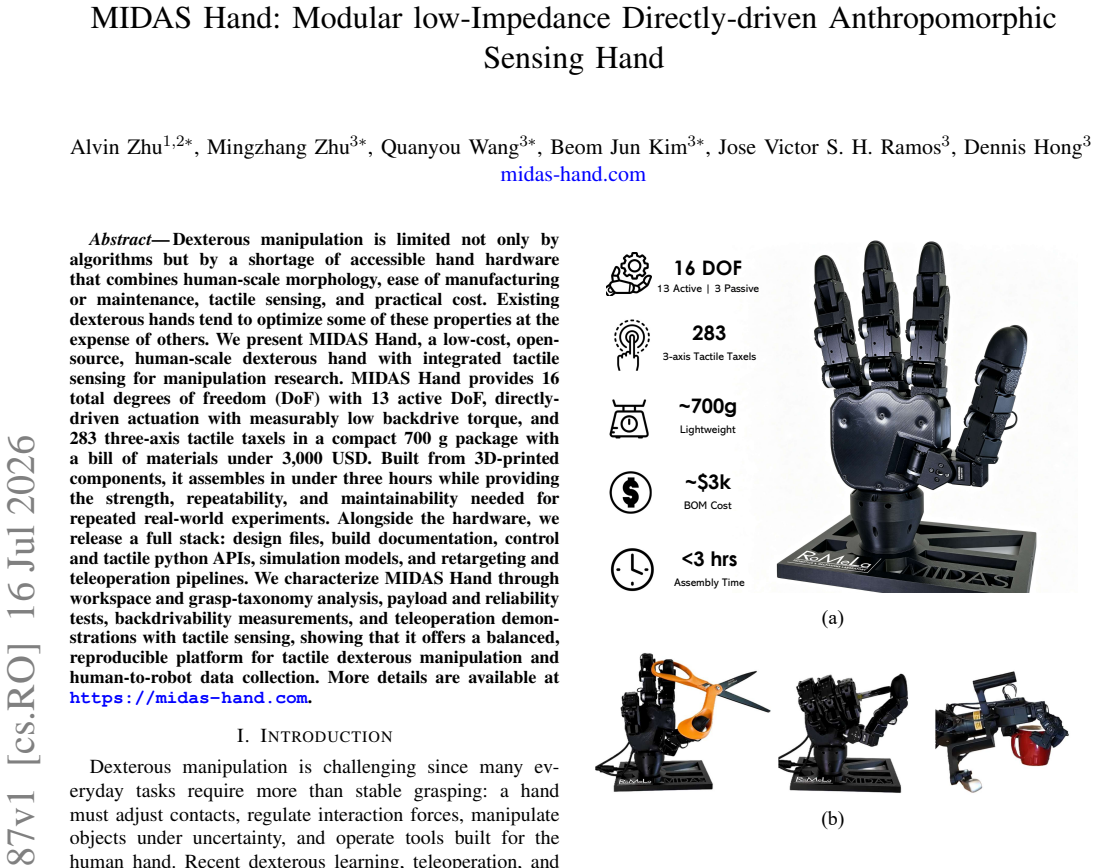
The paper argues that one hand can simultaneously achieve human-scale dexterity, dense tactile sensing, and low-cost reproducible construction, and provides a 13-active-DoF, 283-taxel, sub-$3k design as evidence.
Reviewed by Pith at T0; open to challenge. T0 means a machine referee read the full paper against a public rubric. the ladder, T0–T4 →
T0 review · deepseek-v4-flash
2026-08-02 01:56 UTC pith:WOLV4BCZ
load-bearing objection A genuinely useful open-source tactile hand platform; the backdrivability numbers need one more measurement pass before they're quoted. the 3 major comments →
MIDAS Hand: Modular low-Impedance Direct-drive Anthropomorphic Sensing Hand
The pith
A machine-rendered reading of the paper's core claim, the machinery that carries it, and where it could break.
Core claim
The central claim is that directly-driven actuation with rigid linkages and identical actuators can yield uniformly low backdrive torque (~0.02 N·m) while still providing the strength and repeatability needed for real manipulation experiments. The paper further claims that this low-impedance actuation, combined with modular 3D-printed fingers, commercial tactile arrays, and a full open-source software stack, delivers a balanced, reproducible platform for tactile dexterous manipulation and human-to-robot data collection. Evidence includes a 2-hour, 5,143-cycle grasp test with bounded endpoint error, a 0.016 mm closing repeatability, a 9.5 kg whole-hand payload, and coverage of 32 of 33 GRASP
What carries the argument
The load-bearing mechanism is the crossed four-bar linkage that couples each finger's DIP joint to its PIP joint, turning four independently actuated finger joints into three active ones, and the direct-drive transmission built from identical Dynamixel XM335-T323-T motors and rigid linkages. This architecture is what keeps the hand compact, uniform in joint torque, backdrivable, and low in part count.
Load-bearing premise
The claim that the hand is uniformly low-impedance rests on a backdrivability measurement where each joint is tested alone with the other joints locked and actuators torque-disabled, so if friction changes under real multi-joint loads or with wear and temperature, the ≈0.02 N·m value and the 3.5–30× advantage over Sharpa Wave may not hold.
What would settle it
Measure single-joint backdrive torque while the adjacent joints are free to move and under a realistic grasp load, then repeat after 5,000 additional grasp cycles; if the torque rises above ~0.1 N·m or becomes non-uniform across joints, the paper's central low-impedance claim is refuted.
If this is right
- Research labs can assemble a dexterous, tactile-sensing hand for under $3,000 and roughly three hours of printing assembly, lowering the entry barrier for contact-rich manipulation studies.
- The uniform ~0.02 N·m backdrive torque means the hand yields under unexpected loads, which the authors argue reduces impact damage during repeated real-world experiments.
- The release of control and tactile APIs, simulation models, and teleoperation pipelines alongside hardware could make this hand a common testbed for comparing manipulation-learning algorithms.
- If the hand is as reproducible as claimed, a fleet of identical hands across labs becomes feasible, which would make benchmark comparisons and shared demonstration datasets meaningful.
- The passive DIP-PIP coupling preserves 80.1% of the human index-finger sagittal workspace and 32/33 grasp types, indicating that underactuation does not cost much dexterity in practice.
Where Pith is reading between the lines
- If the in-house backdrive protocol reflects real operating conditions, the uniform low-impedance value could simplify impedance or force control, since a single torque model per joint might suffice.
- The hand's combination of tactile taxels on all fingertips plus low backdrive torque suggests it could serve as a physical simulator for human hand biomechanics studies, though the paper does not claim this.
- Connecting the 32/33 GRASP coverage to the human radial-to-ulnar opposition trend implies that a four-finger hand may be enough for most everyday manipulation; a five-finger version, if the mechanism scales, might only need the little finger's ulnar support.
- A clean falsifiable extension would be to run the teleoperation pipeline with the haptic glove mapping tactile forces back to the operator and measure whether grasp success rates improve — a test the authors list as future work.
Editorial analysis
A structured set of objections, weighed in public.
Referee Report
Summary. The paper presents MIDAS Hand, a 16-DoF (13 active) four-finger, directly-driven, 3D-printed anthropomorphic hand with 283 three-axis tactile taxels, ~700 g mass, and a claimed BOM under $3,000. The authors contribute an open-source hardware/software stack (CAD files, control and tactile APIs, simulation models, retargeting and teleoperation pipelines) and characterize the hand through backdrivability, workspace, grasp taxonomy, payload, reliability, repeatability, and teleoperation experiments. The main quantitative claims are a uniform low backdrive torque of ≈0.02 N·m (3.5–30× lower than a directly-driven commercial hand), 32/33 GRASP taxonomy coverage, human-like thumb opposition, >9.5 kg whole-hand payload, 0.016 mm repeatability, and stable operation over 5,143 cycles in a 2-hour test.
Significance. If substantiated, MIDAS Hand would be a valuable research platform: it combines human-scale morphology, dense multi-axis tactile sensing, direct-drive backdrivable actuation, low cost, and modular maintainability in one open-source package. The release of design files, APIs, simulation models, and teleoperation tools is a genuine contribution, and the in-house comparison of backdrivability against Sharpa Wave and Wuji Hand is a useful data point for actuation choice. The 32/33 taxonomy result and the reliability/repeatability data, if properly documented, support the paper's claim that the platform is suitable for extended real-world manipulation experiments and data collection.
major comments (3)
- [Sec. IV-A, Table III] The headline backdrivability claim rests on a single-joint static breakaway measurement with no error bars, no trial counts, no specification of joint angle, and no moment-arm accuracy. All MIDAS joints are reported as exactly 0.02 N·m, which could reflect measurement resolution or inference from the use of identical actuators rather than measured per-joint uniformity. The 3.5–30× advantage over Sharpa Wave therefore lacks statistical support. Please report repeated trials (mean ± std, n), the force-application point and moment-arm uncertainty, and ideally measurements at multiple joint angles and with coupled joints to assess whether the value transfers to practical manipulation.
- [Table III] The table's column structure is ambiguous. Entries such as "0.35×0.02" are difficult to parse, and the × symbol conflates the 'non-backdrivable' marker with column separators. Separate columns for Sharpa Wave, Wuji Hand, and MIDAS Hand, with units and uncertainty, would make the central comparison interpretable.
- [Sec. IV-E] The claim of successful reproduction of 32 of 33 GRASP taxonomy types is supported only by a figure; no object list, success criterion, or objective/quantitative measure is given. Since dexterity is one of the paper's selling points, the authors should specify how a grasp was judged successful and whether the evaluation was repeated by multiple raters. If this test is intended as illustrative, the wording should be softened accordingly.
minor comments (5)
- [Sec. III-D] The tactile sensor specifications (25 N normal range, ±10 N tangential, 83.3 Hz, 0.1 N minimum force, 1 mm resolution) are vendor-reported. The authors should clearly label these as manufacturer data and, if tactile performance is a central contribution, provide independent calibration or at least a caveat that they were not verified in-house.
- [Sec. IV-D] The repeatability result of 0.051 mm is reported without defining the metric (e.g., 3σ, range, standard deviation of centroid?). The text says 'average measurement of 0.207 mm and a standard deviation of 0.016 mm' but the relationship between these numbers and the quoted repeatability should be clarified.
- [Sec. II] Typo: 'furthur' should be 'further'. Also, the phrase 'aligns closely with which of human biological counterpart' in Sec. III-B appears to be missing a word (likely 'that' or 'the').
- [Table II] The DIP joint is listed with limits [−107, 0] but is passive and coupled to the PIP via a four-bar linkage. Clarify whether these limits are mechanical stops or derived from the PIP coupling, and note whether the coupled relationship was factored into the workspace analysis.
- [Sec. IV-D] The endpoint position error during the 2-hour test is described only qualitatively as 'bounded' with no summary statistics (mean, max, drift slope). Reporting these would strengthen the reliability claim.
Circularity Check
No significant circularity: MIDAS Hand's measured hardware characterizations are self-contained and benchmarked against external data.
full rationale
The paper's central claims are hardware characterizations based on direct measurement, not derived quantities that reduce to fitted inputs. The backdrivability result (Sec. IV-A, Table III) is obtained by a force-gauge protocol: force at motion onset is converted to joint torque via a measured moment arm with actuators torque-disabled. This is an empirical measurement, not a construction that assumes the reported 0.02 N·m value. The comparison to Sharpa Wave and Wuji Hand uses the same in-house protocol on those hands; regardless of its methodological limitations (single-joint, static, no error bars), it is not circular. The workspace claim (80.1% coverage) is computed against external human anthropometric data [30] with an explicit 'equal overall hand length' scaling assumption and a stated definition of coverage; the human-like thumb opposition trend is compared to external results from Kuo et al. [5]; the grasp taxonomy evaluation uses the external GRASP taxonomy [32]. These are external benchmarks, not self-referential inputs. The only overlapping-author self-citation is [2] (A. Zhu et al., Dexexo), cited in the introduction as an example of data-hungry learning methods; it is not load-bearing for any design, measurement, or conclusion. The paper also explicitly limits its claims in Sec. V, noting that tactile sensing is not yet in closed-loop control and that results indicate hardware readiness rather than manipulation performance. No fitted parameter is renamed as a prediction, no uniqueness theorem is imported from the authors' prior work, and no ansatz is smuggled in via self-citation. The skeptic's critique of the backdrive protocol concerns measurement robustness and transferability, which is a correctness-risk issue, not circularity. Overall, the derivation chain is self-contained, and there is no significant circularity.
Axiom & Free-Parameter Ledger
axioms (5)
- domain assumption Human-scale morphology, thumb opposition, and tactile feedback are necessary or strongly beneficial for dexterous manipulation and human-to-robot transfer (Sec. I).
- domain assumption Paxini tactile modules meet their manufacturer-reported specs (0.1 N minimum force, 1 mm resolution, 83.3 Hz rate, 25 N normal and ±10 N tangential ranges) when integrated in the hand (Sec. III-D).
- domain assumption The anthropometric source [30] and the equal-hand-length scaling used to compute the 80.1% fingertip workspace coverage are representative of the human hand (Sec. III-B).
- domain assumption The GRASP taxonomy's 33 grasp types are a valid proxy for dexterity, and the only failure is attributable to the missing little finger (Sec. IV-E).
- standard math The crossed four-bar linkage produces a deterministic DIP-PIP coupling with the reported passive DIP range (Table II).
read the original abstract
Dexterous manipulation is limited not only by algorithms but by a shortage of accessible hand hardware that combines human-scale morphology, ease of manufacturing or maintenance, tactile sensing, and practical cost. Existing dexterous hands tend to optimize some of these properties at the expense of others. We present MIDAS Hand, a low-cost, open-source, human-scale dexterous hand with integrated tactile sensing for manipulation research. MIDAS Hand provides 16 total degrees of freedom (DoF) with 13 active DoF, directly driven actuation with measurably low backdrive torque, and 283 three-axis tactile taxels in a compact 700 g package with a bill of materials under 3,000 USD. Built from 3D-printed components, it assembles in under three hours while providing the strength, repeatability, and maintainability needed for repeated real-world experiments. Alongside the hardware, we release a full stack: design files, build documentation, control and tactile Python APIs, simulation models, and retargeting and teleoperation pipelines. We characterize MIDAS Hand through workspace and grasp-taxonomy analysis, payload and reliability tests, backdrivability measurements, and teleoperation demonstrations with tactile sensing, showing that it offers a balanced, reproducible platform for tactile dexterous manipulation and human-to-robot data collection. Project page: https://midas-hand.com
Figures


Forward citations
Cited by 1 Pith paper
-
DexDirect: Direct Kinesthetic Arm Guidance for Efficient Dexterous Demonstration Collection
A hybrid kinesthetic-arm-plus-webcam-hand teleoperation interface achieved 17x/3x higher demonstration throughput than vision baselines and trained a 90%-success pick-and-place policy in a ten-person study.
Reference graph
Works this paper leans on
-
[1]
Dexumi: Using human hand as the universal manipu- lation interface for dexterous manipulation,
M. Xu et al., “Dexumi: Using human hand as the universal manipu- lation interface for dexterous manipulation,” inConference on Robot Learning, PMLR, 2025, pp. 437–459
2025
-
[2]
Zhu et al.,Dexexo: A wearability-first dexterous exoskeleton for operator-agnostic demonstration and learning, 2026
A. Zhu et al.,Dexexo: A wearability-first dexterous exoskeleton for operator-agnostic demonstration and learning, 2026. arXiv:2603. 17323 [cs.RO]
2026
-
[3]
Zheng et al.,Egoscale: Scaling dexterous manipulation with diverse egocentric human data, 2026
R. Zheng et al.,Egoscale: Scaling dexterous manipulation with diverse egocentric human data, 2026. arXiv:2602 . 16710 [cs.RO]
2026
-
[4]
T. Tang et al.,Towards human-like manipulation through rl- augmented teleoperation and mixture-of-dexterous-experts vla, 2026. arXiv:2603.08122 [cs.RO]
arXiv 2026
-
[5]
Functional workspace for precision manipulation between thumb and fingers in normal hands,
L.-C. Kuo, H.-Y . Chiu, C.-W. Chang, H.-Y . Hsu, and Y .-N. Sun, “Functional workspace for precision manipulation between thumb and fingers in normal hands,”Journal of Electromyography and Kinesiology, vol. 19, no. 5, pp. 829–839, 2009
2009
-
[6]
The precision of the human hand: Variability in pinch strength and manual dexterity,
A. Bardo et al., “The precision of the human hand: Variability in pinch strength and manual dexterity,”Symmetry, vol. 14, no. 1, 2022
2022
-
[7]
H. Kang, J. Lee, J. Ahn, and D. I. Park,Kinematic optimization of phalanx length ratios in robotic hands using potential dexterity,
-
[8]
M. Peticco and P. Agrawal,Karma: A kinematic metric for fine manipulation ability in robotic hands, 2026. arXiv:2605.15548 [cs.RO]
Pith/arXiv arXiv 2026
-
[9]
Niu et al.,T-rex: Tactile-reactive dexterous manipulation, 2026
D. Niu et al.,T-rex: Tactile-reactive dexterous manipulation, 2026. arXiv:2606.17055 [cs.RO]
Pith/arXiv arXiv 2026
-
[10]
L. Heng, H. Geng, K. Zhang, P. Abbeel, and J. Malik,Vitacformer: Learning cross-modal representation for visuo-tactile dexterous ma- nipulation, 2025. arXiv:2506.15953 [cs.RO]
Pith/arXiv arXiv 2025
-
[11]
Omnivtla: Vision-tactile-language-action model with semantic-aligned tactile sensing,
Z. Cheng et al., “Omnivtla: Vision-tactile-language-action model with semantic-aligned tactile sensing,”arXiv preprint arXiv:2508.08706, 2025
arXiv 2025
-
[13]
Y . R. Song et al.,Opentouch: Bringing full-hand touch to real-world interaction, 2025. arXiv:2512.16842 [cs.CV]. [14]Allegro hand v5 plus, 2024. [15]Wuji hand, 2025. [16]Sharpa wave, 2025
arXiv 2025
-
[14]
arXiv:2603.23481 [cs.RO]
-
[17]
Index Finger Extension
-
[18]
Leap hand: Low-cost, efficient, and anthropomorphic hand for robot learning,
K. Shaw, A. Agarwal, and D. Pathak, “Leap hand: Low-cost, efficient, and anthropomorphic hand for robot learning,”Robotics: Science and Systems (RSS), 2023
2023
-
[19]
Ruka: Rethinking the design of humanoid hands with learning,
A. Zorin et al., “Ruka: Rethinking the design of humanoid hands with learning,” inRobotics: Science and Systems, 2025
2025
-
[20]
X. L. Liu et al.,Ruka-v2: Tendon driven open-source dexterous hand with wrist and abduction for robot learning, 2026. arXiv:2603. 26660 [cs.RO]
2026
-
[21]
C. C. Christoph et al., “Orca: An open-source, reliable, cost- effective, anthropomorphic robotic hand for uninterrupted dexter- ous task learning,” inProceedings of the IEEE/RSJ International Conference on Intelligent Robots and Systems (IROS), 2025. eprint: 2504.04259(cs.RO)
arXiv 2025
-
[22]
L. Lin, S. Patel, J. Moon, S. Lazebnik, and U. Jain,Craft: A tendon- driven hand with hybrid hard-soft compliance, 2026. arXiv:2603. 12120 [cs.RO]. [22]Paxini, 2026
2026
-
[23]
Dexpilot: Vision-based teleoperation of dexterous robotic hand-arm system,
A. Handa et al., “Dexpilot: Vision-based teleoperation of dexterous robotic hand-arm system,” inIEEE International Conference on Robotics and Automation (ICRA), 2020
2020
-
[24]
Anyteleop: A general vision-based dexterous robot arm-hand teleoperation system,
Y . Qin et al., “Anyteleop: A general vision-based dexterous robot arm-hand teleoperation system,” inRobotics: Science and Systems, 2023
2023
-
[25]
A. S. Lakshmipathy, J. K. Hodgins, and N. S. Pollard,Kinematic motion retargeting for contact-rich anthropomorphic manipulations,
-
[26]
DOGlove: Dexterous Manipulation with a Low-Cost Open-Source Haptic Force Feedback Glove,
H. Zhang, S. Hu, Z. Yuan, and H. Xu, “DOGlove: Dexterous Manipulation with a Low-Cost Open-Source Haptic Force Feedback Glove,” inProceedings of Robotics: Science and Systems, LosAn- geles, CA, USA, Jun. 2025
2025
-
[27]
Q. Zhao, W. Li, C. Wang, and K. Zhang,Dexemg: Towards dexterous teleoperation system via emg2pose generalization, 2026. arXiv: 2603.05861 [cs.RO]
arXiv 2026
-
[28]
Wen et al.,Dexterous teleoperation of 20-dof bytedexter hand via human motion retargeting, 2025
R. Wen et al.,Dexterous teleoperation of 20-dof bytedexter hand via human motion retargeting, 2025. arXiv:2507.03227 [cs.RO]
Pith/arXiv arXiv 2025
- [29]
-
[30]
An anthropometric study for the anthropomorphic design of tomato-harvesting robots,
Z. Li, F. Miao, Z. Yang, and H. Wang, “An anthropometric study for the anthropomorphic design of tomato-harvesting robots,”Com- puters and Electronics in Agriculture, vol. 163, p. 104 881, 2019
2019
-
[31]
The normal active range of motion of the index, middle, ring, and little fingers in a sample of indian population,
A. Karanjkar et al., “The normal active range of motion of the index, middle, ring, and little fingers in a sample of indian population,” Indian Journal of Plastic Surgery, vol. 57, no. 4, pp. 248–255, 2024
2024
-
[32]
The grasp taxonomy of human grasp types,
T. Feix, J. Romero, H.-B. Schmiedmayer, A. M. Dollar, and D. Kragic, “The grasp taxonomy of human grasp types,”IEEE Trans- actions on Human-Machine Systems, vol. 46, no. 1, pp. 66–77, 2016
2016
-
[33]
11: GRASP taxonomy evaluation
Inferior Pincer Fig. 11: GRASP taxonomy evaluation. MIDAS Hand successfully reproduces 32 of the 33 grasp types defined in the GRASP taxonomy. The only unsuccessful grasp requires the little finger, which is absent in the current four-finger design
-
[2024]
arXiv:2402.04820 [cs.GR]
-
[2026]
arXiv:2604.20686 [cs.RO]
discussion (0)
Sign in with ORCID, Apple, or X to comment. Anyone can read and Pith papers without signing in.