REVIEW 3 major objections 2 minor 73 references
In any text-conditioned visual generator, the value space of attention is where concepts can be erased: projecting text values away from a target direction removes them, with no retraining or weight edits.
Reviewed by Pith at T0; open to challenge. T0 means a machine referee read the full paper against a public rubric. the ladder, T0–T4 →
T0 review · deepseek-v4-flash
2026-08-02 01:49 UTC pith:LKJ2XB5D
load-bearing objection Uni-AdaVD is a serious, broad extension of AdaVD to multiple generative architectures, but the 'universal no-tuning' claim does not yet hold: erasure strength is concept-dependent and the threshold/scale selection protocol is under-specified. the 3 major comments →
Uni-AdaVD: Universal Concept Erasure for Visual Generation via Orthogonal Value Decomposition
The pith
A machine-rendered reading of the paper's core claim, the machinery that carries it, and where it could break.
Core claim
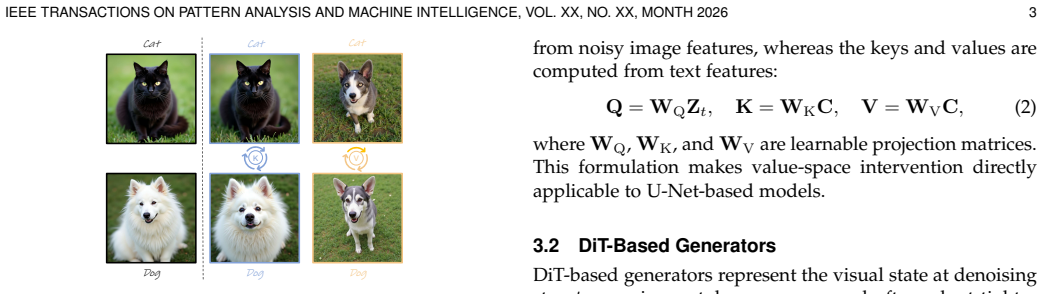
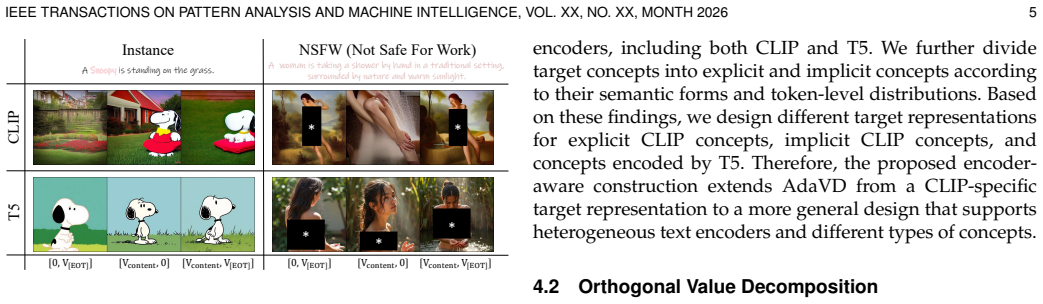
Central claim: the value space of attention is the right place to erase concepts in any text-conditioned visual generator — swapping values flips a 'cat' to a 'dog,' swapping keys changes little. The paper maps target semantics per encoder: CLIP's causal attention puts explicit concepts at the last subject token and implicit ones near the end-of-text token, while T5's bidirectional attention spreads them across all valid tokens. A target direction is built per encoder and each text value's component along it is subtracted, scaled by a per-layer sigmoid so weakly aligned tokens are barely touched. This training-free recipe erases instances, styles, NSFW, and multi-concept targets across U-Net
What carries the argument
The load-bearing mechanism is Orthogonal Value Decomposition (OVD): each text-derived value vector v_i is replaced by its projection orthogonal to the target direction v̂_i, so the aligned component is removed and the residual survives; for multiple concepts, targets are orthonormalized and the whole span is removed. Layer-wise Adaptive Erasing Shift (LAES) scales the removed component by a sigmoid of cosine similarity against a per-layer threshold, so weakly aligned tokens are barely disturbed. Encoder-aware Target Representation Construction (ETRC) fixes where v̂_i comes from: the last subject token for CLIP explicit concepts, the subject-to-end-of-text mean for CLIP implicit concepts, the
Load-bearing premise
The per-layer erasure thresholds are set from the measured gap between target and non-target prompt similarity on the benchmark data, and the universality claim rests on those gaps transferring to unseen prompts, concepts, and architectures without re-tuning.
What would settle it
A direct test of the universality claim: take a generator outside the paper's set (a masked-token image model, or one with a different text encoder), erase a concept using thresholds estimated exactly as described — the per-layer target-versus-non-target similarity gap — then probe a held-out set of prompts and concepts. If erasure stays on target without re-estimating those thresholds, the claim holds; if thresholds must be re-fit per architecture or concept, universality fails. A smaller probe: compare layer-wise thresholds against the fixed ϵ=0.5 on a second concept — the paper shows layer-
If this is right
- The same deployed model can change which concepts are banned on the fly, because erasure is a per-token projection at generation time and never modifies weights.
- One safety module covers heterogeneous model families — U-Net, DiT, autoregressive, and video — so no architecture-specific erasure method is needed.
- Explicit instances, artistic styles, identities, and implicit safety concepts all reduce to the same projection once the target value sequence is built for the right encoder, including single-, dual-, and triple-concept targets.
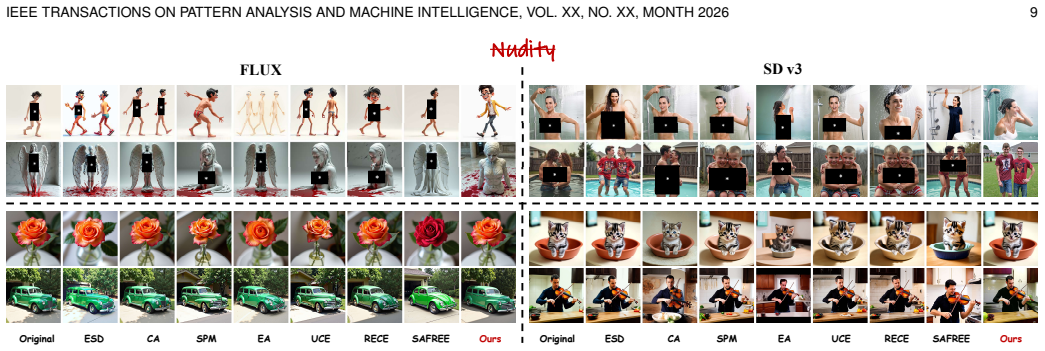
- Erasure strength scales with token-level alignment to the target, so weakly related tokens are barely affected; on non-target prompts, FID, SSIM, and LPIPS stay at or near the unmodified model's level.
- Resistance to adversarial prompt attacks improves without adversarial training: the paper reports lower attack-success rates than other inference-time methods on black-box and white-box attack benchmarks.
Where Pith is reading between the lines
- The value-space view suggests the projection should compose with other prompt-side steering — guidance, editing, personalization — since only the injected text stream is altered; the paper does not test such compositions, but they follow directly from the mechanism.
- The per-layer thresholds are the unstated tuning burden: the paper describes them as tracking the target-versus-non-target similarity gap per layer but gives no exact algorithm, so the true test of universality is whether unseen concepts and prompts erase cleanly with zero threshold re-estimation.
- The paper's own failure cases — residual sketch textures with a conservative scaling factor, residual nudity with mild settings — suggest the shift factor may ultimately need to depend on concept strength, not just layer and token alignment.
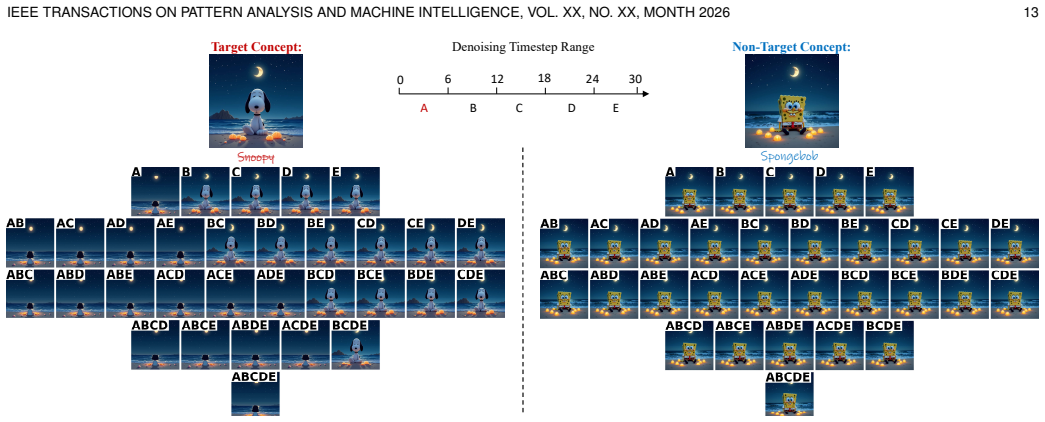
- Because effective erasure happens in the first six of thirty denoising steps, the framework's early-steps-only default points to a cheap deployment rule for video models, where per-frame inference cost dominates.
Editorial analysis
A structured set of objections, weighed in public.
Referee Report
Summary. The paper proposes Uni-AdaVD, an inference-time concept erasure framework that intervenes in the value space of multimodal attention. It constructs encoder-aware target representations (ETRC), removes target-aligned value components via orthogonal value decomposition (OVD), and modulates erasure strength with a layer-wise adaptive erasing shift (LAES, Eq. 9). The authors claim the same recipe transfers across U-Net, DiT, autoregressive image generators, and text-to-video models, with no training or weight modification, and report experiments on nudity, instance, artistic style, and safety-concept erasure.
Significance. If the universality claim were established with a fully specified, reproducible protocol, this would be a useful contribution: value-space projection is simple, architecture-agnostic, and avoids retraining. The paper also provides a broad set of experiments and, for the first time, applies value-space erasure to autoregressive and video generators. The core OVD computation in Eqs. (6)-(11) is mathematically sound, and the ablation in Table 8 sensibly identifies text-side value intervention as the best trade-off in FLUX. However, the central claim of a single adaptive and universal mechanism is currently weakened by the per-model/per-concept hyperparameter choices in Table S1 and by the absence of a selection protocol for the threshold epsilon_l and scale s.
major comments (3)
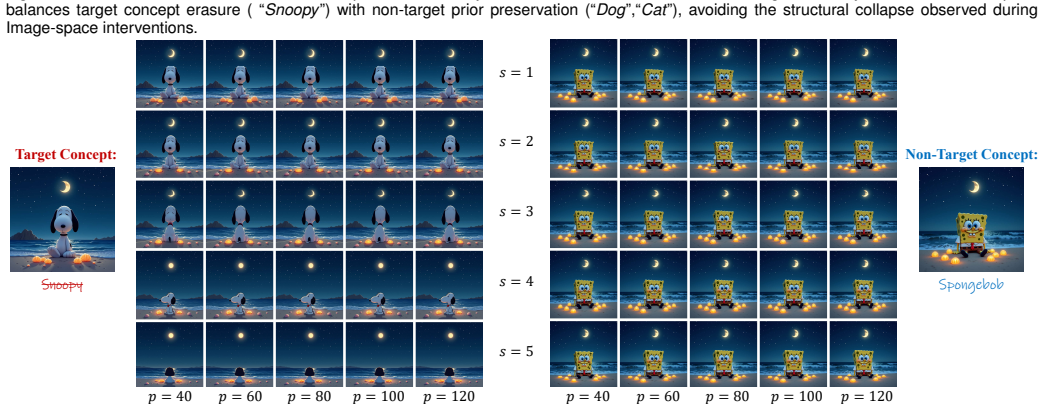
- [Section 5.1.3 and Tables 1, 3, 5, 6] The 'adaptive' and 'universal' claims are not yet supported by a reproducible parameter-selection rule. LAES depends on s, p, and epsilon_l; Table S1 gives different s values for explicit vs. implicit concepts and across architectures, and epsilon_l is listed as '–' for FLUX, SD v3, and CogVideoX. Section 4.3 says epsilon_l is 'determined based on the difference between the target similarity and the non-target similarity at that layer,' but no algorithm, sample size, or formula is provided, and Fig. S1 only draws a dashed line. More directly, Supplementary Sec. E reports that the default s=5 leaves residual 'Pencil Sketch' style and s=1 leaves residual nudity, with the remedy being manual increases to s=8 and s=1.5. Thus the reported results appear to depend on concept-specific tuning. To support the universality claim, the authors should either provide an automatic, pre-registered proto
- [Section 4.3, Fig. S1, and Tables 5/S2] Explicit-concept erasure is measured primarily by CLIP Score, computed with a CLIP text encoder from the same family whose embeddings define the target representation in Eqs. (6)-(9). This creates a circularity risk: a lower CLIP Score between the prompt and the generated image may reflect suppression of the text-embedding direction rather than removal of the actual visual concept. For example, Table 5 reports low CS for 'Snoopy' after erasure, but no independent classifier or human evaluation confirms the visual concept is gone. I recommend adding a separate evaluation that is not based on the same representation family — e.g., a fine-grained image classifier, a retrieval model with a different encoder, or human judgments — at least for a subset of explicit concepts and styles.
- [Section 5.6 and Fig. 10/11] The layer-wise thresholds epsilon_l appear to be estimated from the same concepts that are later used for evaluation. Fig. S1 shows target/non-target cosine-similarity distributions for 'Snoopy' vs. 'Mickey' in FLUX, and Table 5 measures erasure of 'Snoopy' while preserving 'Mickey' (and vice versa). If the threshold is chosen from the similarity gap between those exact concepts, then the reported performance is partly a fitting result, not a predictive result. Please specify the calibration set separately from the test set, report the exact rule used to map distribution statistics to epsilon_l, and show thresholds on held-out concepts (e.g., 'SpongeBob', 'Dog') without recalibration.
minor comments (2)
- [Section 5.6 and Fig. 10/11] epsilon_l is shown as '–' for DiT-based and video models although Eq. (9) uses epsilon_l. Please clarify whether LAES is applied there with a layer-specific threshold and, if so, report the thresholds or explain why they are omitted.
- [Section 5.6 and Fig. 10/11] The ablation of s and p in Fig. 10 is only qualitative. Given that s is a load-bearing hyperparameter, please report quantitative erasure/prior-preservation metrics for the grid of (s, p) values, and specify the exact denoising window used for each model. The main text says 'timesteps 1-6' for FLUX, while the supplement says 'first 40 denoising steps' for video; clarify the protocol per model.
Circularity Check
No significant circularity; the OVD derivation is self-contained, with minor caveats about threshold fitting and self-citation to AdaVD.
full rationale
Uni-AdaVD's central operation—orthogonal value decomposition (Eqs. 6–7)—is a direct linear-algebra projection defined within the paper; it does not presuppose the empirical results it is used to explain. The choice of value space as the intervention interface is motivated by the paper's own attention-swapping experiment (Fig. 1) and the general attention formulation in Sec. 3, not by a self-citation. The ETRC anchor construction follows from the paper's own token-masking observations (Fig. 4). The LAES shift (Eqs. 8–11) is a sigmoid gate; although the layer-wise thresholds epsilon_l are estimated from target/non-target similarity distributions (Sec. 4.3, Fig. S1) rather than a fully specified algorithmic rule, this is a calibration/reproducibility issue rather than a case where an output is equal to an input by construction. The main erasure claims are also checked with external classifiers (NudeNet, Q16, SafeSora) and show cross-architecture transfer, so the central claim has independent content. Self-citations to AdaVD are not load-bearing: OVD is a standard mathematical operation and the paper provides its own supporting evidence. Score 2 reflects the minor self-citation and the underspecified threshold fitting, but no significant circularity.
Axiom & Free-Parameter Ledger
free parameters (4)
- LAES scaling factor s =
explicit/implicit: SD v1-4 2/1, FLUX 5/2, SD v3 2/1, Switti-AR 1/1, CogVideoX 4/1; failure cases use 8 and 1.5
- LAES steepness p =
100 for all settings
- Layer-wise similarity threshold epsilon_l =
0.93/0.43 (CLIP explicit/implicit), 0.9/0.4 (AR); layer-specific for DiT (Fig. S1)
- Denoising intervention window =
first 6 of 30 steps for diffusion; first 40 steps for video
axioms (4)
- domain assumption The value space of multimodal attention is a sufficient and universal semantic intervention space for concept erasure across U-Net, DiT, AR, and video generators.
- domain assumption Projecting out the component of a value vector along a target direction removes target semantics while preserving orthogonal content (Eqs. 6-7).
- ad hoc to paper CLIP explicit concepts concentrate at the last subject token, CLIP implicit concepts accumulate near [EOT], and T5 distributes semantics uniformly over valid tokens (Figs. 3-4).
- domain assumption Intervening only on the text value branch in joint-attention models preserves visual priors better than key or image-side interventions.
read the original abstract
Visual generative models inevitably absorb undesirable concepts from uncurated pretraining data, making concept erasure essential for safe deployment. Existing erasure methods, however, are often architecture-specific and struggle to remove target concepts while preserving non-target content and generative priors. We present Uni-AdaVD, a universal inference-time concept erasure framework for visual generation. Uni-AdaVD treats the value space of multimodal attention as a unified intervention space and introduces encoder-aware target representation construction to localize target semantics across heterogeneous text encoders. It further combines orthogonal value decomposition with an adaptive erasing shift to suppress target semantic directions without updating the original model weights. Extensive experiments on U-Net-, DiT-, and autoregressive image generators, as well as text-to-video models, demonstrate strong performance on single- and multi-concept erasure while preserving non-target priors. These results suggest that Uni-AdaVD provides an efficient and adaptable safety mechanism for modern visual generative models. Our code is available at https://github.com/QifanZhou/Uni-AdaVD.
Figures






Reference graph
Works this paper leans on
-
[1]
Denoising diffusion probabilistic models,
J. Ho, A. Jain, and P . Abbeel, “Denoising diffusion probabilistic models,”Advances in neural information processing systems, vol. 33, pp. 6840–6851, 2020
2020
-
[2]
Score-based generative modeling through stochastic differential equations,
Y. Song, J. Sohl-Dickstein, D. P . Kingma, A. Kumar, S. Ermon, and B. Poole, “Score-based generative modeling through stochastic differential equations,”arXiv preprint arXiv:2011.13456, 2020
Pith/arXiv arXiv 2011
-
[3]
Denoising diffusion implicit models,
J. Song, C. Meng, and S. Ermon, “Denoising diffusion implicit models,”arXiv preprint arXiv:2010.02502, 2020
Pith/arXiv arXiv 2010
-
[4]
Classifier-free diffusion guidance,
J. Ho and T. Salimans, “Classifier-free diffusion guidance,”arXiv preprint arXiv:2207.12598, 2022
Pith/arXiv arXiv 2022
-
[5]
Flow matching for generative modeling,
Y. Lipman, R. T. Chen, H. Ben-Hamu, M. Nickel, and M. Le, “Flow matching for generative modeling,”arXiv preprint arXiv:2210.02747, 2022
Pith/arXiv arXiv 2022
-
[6]
Multimodal learning with transformers: A survey,
P . Xu, X. Zhu, and D. A. Clifton, “Multimodal learning with transformers: A survey,”IEEE Transactions on Pattern Analysis and Machine Intelligence, vol. 45, no. 10, pp. 12 113–12 132, 2023
2023
-
[7]
Conditional image generation with pixelcnn decoders,
A. Van den Oord, N. Kalchbrenner, L. Espeholt, O. Vinyals, A. Graveset al., “Conditional image generation with pixelcnn decoders,”Advances in neural information processing systems, vol. 29, 2016
2016
-
[8]
Taming transformers for high-resolution image synthesis,
P . Esser, R. Rombach, and B. Ommer, “Taming transformers for high-resolution image synthesis,” inProceedings of the IEEE/CVF conference on computer vision and pattern recognition, 2021, pp. 12 873–12 883
2021
-
[9]
Maskgit: Masked generative image transformer,
H. Chang, H. Zhang, L. Jiang, C. Liu, and W. T. Freeman, “Maskgit: Masked generative image transformer,” inProceedings of the IEEE/CVF conference on computer vision and pattern recognition, 2022, pp. 11 315–11 325
2022
-
[10]
Visual autore- gressive modeling: Scalable image generation via next-scale pre- diction,
K. Tian, Y. Jiang, Z. Yuan, B. Peng, and L. Wang, “Visual autore- gressive modeling: Scalable image generation via next-scale pre- diction,”Advances in neural information processing systems, vol. 37, pp. 84 839–84 865, 2024
2024
-
[11]
Autoregressive model beats diffusion: Llama for scalable image generation,
P . Sun, Y. Jiang, S. Chen, S. Zhang, B. Peng, P . Luo, and Z. Yuan, “Autoregressive model beats diffusion: Llama for scalable image generation,”arXiv preprint arXiv:2406.06525, 2024
Pith/arXiv arXiv 2024
-
[12]
Generative adversarial networks in computer vision: A survey and taxonomy,
Z. Wang, Q. She, and T. E. Ward, “Generative adversarial networks in computer vision: A survey and taxonomy,”ACM Computing Surveys (CSUR), vol. 54, no. 2, pp. 1–38, 2021
2021
-
[13]
Diffusion models beat gans on image synthesis,
P . Dhariwal and A. Nichol, “Diffusion models beat gans on image synthesis,”Advances in neural information processing systems, vol. 34, pp. 8780–8794, 2021
2021
-
[14]
High-resolution image synthesis with latent diffusion models,
R. Rombach, A. Blattmann, D. Lorenz, P . Esser, and B. Ommer, “High-resolution image synthesis with latent diffusion models,” in Proceedings of the IEEE/CVF conference on computer vision and pattern recognition, 2022, pp. 10 684–10 695
2022
-
[15]
Scalable diffusion models with trans- formers,
W. Peebles and S. Xie, “Scalable diffusion models with trans- formers,” inProceedings of the IEEE/CVF international conference on computer vision, 2023, pp. 4195–4205
2023
-
[16]
Sdxl: Improving latent diffu- sion models for high-resolution image synthesis,
D. Podell, Z. English, K. Lacey, A. Blattmann, T. Dockhorn, J. Müller, J. Penna, and R. Rombach, “Sdxl: Improving latent diffu- sion models for high-resolution image synthesis,” inInternational Conference on Learning Representations, vol. 2024, 2024, pp. 1862– 1874
2024
-
[17]
Scaling rectified flow transformers for high-resolution image synthesis,
P . Esser, S. Kulal, A. Blattmann, R. Entezari, J. Müller, H. Saini, Y. Levi, D. Lorenz, A. Sauer, F. Boeselet al., “Scaling rectified flow transformers for high-resolution image synthesis,” inForty-first international conference on machine learning, 2024. IEEE TRANSACTIONS ON PATTERN ANAL YSIS AND MACHINE INTELLIGENCE, VOL. XX, NO. XX, MONTH 2026 14
2024
-
[18]
Diffusion model-based image editing: A survey,
Y. Huang, J. Huang, Y. Liu, M. Yan, J. Lv, J. Liu, W. Xiong, H. Zhang, L. Cao, and S. Chen, “Diffusion model-based image editing: A survey,”IEEE Transactions on Pattern Analysis and Ma- chine Intelligence, 2025
2025
-
[19]
Freeedit: Mask-free reference-based image editing with multi-modal instruction,
R. He, K. Ma, L. Huang, S. Huang, J. Gao, X. Wei, J. Dai, J. Han, and S. Liu, “Freeedit: Mask-free reference-based image editing with multi-modal instruction,”IEEE Transactions on Pattern Analysis and Machine Intelligence, 2025
2025
-
[20]
Video diffusion models,
J. Ho, T. Salimans, A. Gritsenko, W. Chan, M. Norouzi, and D. J. Fleet, “Video diffusion models,”Advances in neural information processing systems, vol. 35, pp. 8633–8646, 2022
2022
-
[21]
Stable video diffusion: Scaling latent video diffusion models to large datasets,
A. Blattmann, T. Dockhorn, S. Kulal, D. Mendelevitch, M. Kilian, D. Lorenz, Y. Levi, Z. English, V . Voleti, A. Lettset al., “Stable video diffusion: Scaling latent video diffusion models to large datasets,” arXiv preprint arXiv:2311.15127, 2023
Pith/arXiv arXiv 2023
-
[22]
Video gen- eration models as world simulators,
T. Brooks, B. Peebles, C. Holmes, W. DePue, Y. Guo, L. Jing, D. Schnurr, J. Taylor, T. Luhman, E. Luhmanet al., “Video gen- eration models as world simulators,”OpenAI Blog, vol. 1, no. 8, p. 1, 2024
2024
-
[23]
Diffusion models in vision: A survey,
F.-A. Croitoru, V . Hondru, R. T. Ionescu, and M. Shah, “Diffusion models in vision: A survey,”IEEE transactions on pattern analysis and machine intelligence, vol. 45, no. 9, pp. 10 850–10 869, 2023
2023
-
[24]
Depth-aware gener- ative adversarial network for talking head video generation,
F.-T. Hong, L. Zhang, L. Shen, and D. Xu, “Depth-aware gener- ative adversarial network for talking head video generation,” in Proceedings of the IEEE/CVF conference on computer vision and pattern recognition, 2022, pp. 3397–3406
2022
-
[25]
Cogvideox: Text-to-video diffusion models with an expert transformer,
Z. Yang, J. Teng, W. Zheng, M. Ding, S. Huang, J. Xu, Y. Yang, W. Hong, X. Zhang, G. Fenget al., “Cogvideox: Text-to-video diffusion models with an expert transformer,” inInternational Conference on Learning Representations, vol. 2025, 2025, pp. 83 048– 83 077
2025
-
[26]
Erasing concepts from diffusion models,
R. Gandikota, J. Materzynska, J. Fiotto-Kaufman, and D. Bau, “Erasing concepts from diffusion models,” inProceedings of the IEEE/CVF international conference on computer vision, 2023, pp. 2426–2436
2023
-
[27]
Ablating concepts in text-to-image diffusion models,
N. Kumari, B. Zhang, S.-Y. Wang, E. Shechtman, R. Zhang, and J.-Y. Zhu, “Ablating concepts in text-to-image diffusion models,” inProceedings of the IEEE/CVF international conference on computer vision, 2023, pp. 22 691–22 702
2023
-
[28]
Mace: Mass con- cept erasure in diffusion models,
S. Lu, Z. Wang, L. Li, Y. Liu, and A. W.-K. Kong, “Mace: Mass con- cept erasure in diffusion models,” inProceedings of the IEEE/CVF Conference on Computer Vision and Pattern Recognition, 2024, pp. 6430–6440
2024
-
[29]
One-dimensional adapter to rule them all: Concepts diffusion models and erasing applications,
M. Lyu, Y. Yang, H. Hong, H. Chen, X. Jin, Y. He, H. Xue, J. Han, and G. Ding, “One-dimensional adapter to rule them all: Concepts diffusion models and erasing applications,” inProceedings of the IEEE/CVF Conference on Computer Vision and Pattern Recognition, 2024, pp. 7559–7568
2024
-
[30]
Editing implicit assump- tions in text-to-image diffusion models,
H. Orgad, B. Kawar, and Y. Belinkov, “Editing implicit assump- tions in text-to-image diffusion models,” inProceedings of the IEEE/CVF International Conference on Computer Vision, 2023, pp. 7053–7061
2023
-
[31]
Unified concept editing in diffusion models,
R. Gandikota, H. Orgad, Y. Belinkov, J. Materzy ´ nska, and D. Bau, “Unified concept editing in diffusion models,” inProceedings of the IEEE/CVF winter conference on applications of computer vision, 2024, pp. 5111–5120
2024
-
[32]
Reliable and efficient concept erasure of text-to-image diffusion models,
C. Gong, K. Chen, Z. Wei, J. Chen, and Y.-G. Jiang, “Reliable and efficient concept erasure of text-to-image diffusion models,” in European Conference on Computer Vision. Springer, 2024, pp. 73–88
2024
-
[33]
Fantastic targets for concept erasure in diffusion models and where to find them,
A. Bui, T.-T. Vu, L. Vuong, T. Le, P . Montague, T. Abraham, J. Kim, and D. Phung, “Fantastic targets for concept erasure in diffusion models and where to find them,” inInternational Conference on Learning Representations, vol. 2025, 2025, pp. 64 032–64 074
2025
-
[34]
Safe latent diffusion: Mitigating inappropriate degeneration in diffu- sion models,
P . Schramowski, M. Brack, B. Deiseroth, and K. Kersting, “Safe latent diffusion: Mitigating inappropriate degeneration in diffu- sion models,” inProceedings of the IEEE/CVF conference on computer vision and pattern recognition, 2023, pp. 22 522–22 531
2023
-
[35]
Safree: Training- free and adaptive guard for safe text-to-image and video gener- ation,
J. Yoon, S. Yu, V . R. Patil, H. Yao, and M. Bansal, “Safree: Training- free and adaptive guard for safe text-to-image and video gener- ation,” inInternational Conference on Learning Representations, vol. 2025, 2025, pp. 56 439–56 465
2025
-
[36]
Groce: Graph- guided online concept erasure for text-to-image diffusion models,
N. Han, Z. Ge, F. Han, Y. Sun, C. Li, and J. Chen, “Groce: Graph- guided online concept erasure for text-to-image diffusion models,” arXiv preprint arXiv:2511.12968, 2025
Pith/arXiv arXiv 2025
-
[37]
Speed: Scalable, precise, and efficient concept erasure for diffusion models,
O. Li, Y. Wang, X. Hu, H. Jiang, T. Liang, Y. Hao, G. Ma, and F. Feng, “Speed: Scalable, precise, and efficient concept erasure for diffusion models,”arXiv preprint arXiv:2503.07392, 2025
arXiv 2025
-
[38]
Trce: Towards reliable malicious concept erasure in text-to-image diffusion models,
R. Chen, H. Guo, L. Wang, C. Zhang, W. Nie, and A.-A. Liu, “Trce: Towards reliable malicious concept erasure in text-to-image diffusion models,” inProceedings of the IEEE/CVF International Conference on Computer Vision, 2025, pp. 18 927–18 936
2025
-
[39]
Cure: Concept unlearning via orthogonal representation editing in diffusion models,
S. D. Biswas, A. Roy, and K. Roy, “Cure: Concept unlearning via orthogonal representation editing in diffusion models,”Advances in Neural Information Processing Systems, vol. 38, pp. 82 539–82 563, 2026
2026
-
[40]
Eraseanything: Enabling concept erasure in recti- fied flow transformers,
D. Gao, S. Lu, W. Zhou, J. Chu, J. Zhang, M. Jia, B. Zhang, Z. Fan, and W. Zhang, “Eraseanything: Enabling concept erasure in recti- fied flow transformers,” inForty-second International Conference on Machine Learning, 2025
2025
-
[41]
Differential vector erasure: Unified training-free concept erasure for flow matching models,
Z. Zhang, X. Zhong, Y. Sun, S. Sun, B. Chen, S.-T. Xia, and X. Wang, “Differential vector erasure: Unified training-free concept erasure for flow matching models,”arXiv preprint arXiv:2602.01089, 2026
arXiv 2026
-
[42]
Precise, fast, and low-cost concept erasure in value space: Orthogonal complement matters,
Y. Wang, O. Li, T. Mu, Y. Hao, K. Liu, X. Wang, and X. He, “Precise, fast, and low-cost concept erasure in value space: Orthogonal complement matters,” in2025 IEEE/CVF Conference on Computer Vision and Pattern Recognition (CVPR). IEEE, 2025, pp. 28 759– 28 768
2025
-
[43]
Salun: Em- powering machine unlearning via gradient-based weight saliency in both image classification and generation,
C. Fan, J. Liu, Y. Zhang, E. Wong, D. Wei, and S. Liu, “Salun: Em- powering machine unlearning via gradient-based weight saliency in both image classification and generation,” inInternational Con- ference on Learning Representations, vol. 2024, 2024, pp. 53 643– 53 673
2024
-
[44]
Defensive unlearning with adversarial training for robust concept erasure in diffusion models,
Y. Zhang, X. Chen, J. Jia, Y. Zhang, C. Fan, J. Liu, M. Hong, K. Ding, and S. Liu, “Defensive unlearning with adversarial training for robust concept erasure in diffusion models,”Advances in neural information processing systems, vol. 37, pp. 36 748–36 776, 2024
2024
-
[45]
Stereo: A two-stage framework for adversarially robust concept erasing from text-to-image diffusion models,
K. Srivatsan, F. Shamshad, M. Naseer, V . M. Patel, and K. Nan- dakumar, “Stereo: A two-stage framework for adversarially robust concept erasing from text-to-image diffusion models,” inProceed- ings of the IEEE/CVF Conference on Computer Vision and Pattern Recognition, 2025, pp. 23 765–23 774
2025
-
[46]
Co-occurring associated REtained concepts in diffusion unlearning,
M. Kim, G. Lee, Y. Kim, H. Kim, J. Park, and W. Lee, “Co-occurring associated REtained concepts in diffusion unlearning,” inThe Fourteenth International Conference on Learning Representations, 2026
2026
-
[47]
Prototype-guided con- cept erasure in diffusion models,
Y. Cai, J. Lu, H. Shi, Y. Zhou, and H. Lu, “Prototype-guided con- cept erasure in diffusion models,” inProceedings of the IEEE/CVF Conference on Computer Vision and Pattern Recognition, 2026, pp. 16 509–16 519
2026
-
[48]
black-forest-labs/flux,
Black Forest Labs, “black-forest-labs/flux,” https://github.com/ black-forest-labs/flux, 2024
2024
-
[49]
Z-erase: Enabling concept erasure in single- stream diffusion transformers,
N. Jiang, Z. Fan, B. Wang, D. Gao, J. Cheng, J. Guo, Y. Qin, Y. Jin, H. Zheng, F. Wuet al., “Z-erase: Enabling concept erasure in single- stream diffusion transformers,”arXiv preprint arXiv:2603.25074, 2026
Pith/arXiv arXiv 2026
-
[50]
Exploring the limits of transfer learning with a unified text-to-text transformer,
C. Raffel, N. Shazeer, A. Roberts, K. Lee, S. Narang, M. Matena, Y. Zhou, W. Li, and P . J. Liu, “Exploring the limits of transfer learning with a unified text-to-text transformer,”Journal of machine learning research, vol. 21, no. 140, pp. 1–67, 2020
2020
-
[51]
Learning transferable visual models from natural language supervision,
A. Radford, J. W. Kim, C. Hallacy, A. Ramesh, G. Goh, S. Agar- wal, G. Sastry, A. Askell, P . Mishkin, J. Clarket al., “Learning transferable visual models from natural language supervision,” inInternational conference on machine learning. PmLR, 2021, pp. 8748–8763
2021
-
[52]
Switti: Designing scale-wise transformers for text- to-image synthesis,
A. Voronov, D. Kuznedelev, M. Khoroshikh, V . Khrulkov, and D. Baranchuk, “Switti: Designing scale-wise transformers for text- to-image synthesis,”arXiv preprint arXiv:2412.01819, 2024
Pith/arXiv arXiv 2024
-
[53]
Infinity: Scaling bitwise autoregressive modeling for high-resolution image synthesis,
J. Han, J. Liu, Y. Jiang, B. Yan, Y. Zhang, Z. Yuan, B. Peng, and X. Liu, “Infinity: Scaling bitwise autoregressive modeling for high-resolution image synthesis,” inProceedings of the IEEE/CVF Conference on Computer Vision and Pattern Recognition (CVPR), 2025, pp. 15 733–15 744
2025
-
[54]
Ear: Erasing concepts from unified autoregressive models,
H. Fan, S. Zhang, Baohunesitu, Z. Guo, and H. Zhang, “Ear: Erasing concepts from unified autoregressive models,” 2025
2025
-
[55]
Vce: Safe autoregressive image generation via visual contrast exploitation,
F. Han, C. Gong, Z. Wei, J. Chen, and Y.-G. Jiang, “Vce: Safe autoregressive image generation via visual contrast exploitation,” arXiv preprint arXiv:2509.16986, 2025
arXiv 2025
-
[56]
Key-locked rank one editing for text-to-image personalization,
Y. Tewel, R. Gal, G. Chechik, and Y. Atzmon, “Key-locked rank one editing for text-to-image personalization,” inACM SIGGRAPH 2023 conference proceedings, 2023, pp. 1–11
2023
-
[57]
Zeroscope v2 576w,
cerspense, “Zeroscope v2 576w,” https://huggingface.co/ cerspense/zeroscope_v2_576w, 2023
2023
-
[58]
Aiml-tuda/i2p,
AIML-TUDA, “Aiml-tuda/i2p,” https://huggingface.co/ datasets/AIML-TUDA/i2p, 2023. IEEE TRANSACTIONS ON PATTERN ANAL YSIS AND MACHINE INTELLIGENCE, VOL. XX, NO. XX, MONTH 2026 15
2023
-
[59]
Safesora: Towards safety alignment of text2video generation via a human preference dataset,
J. Dai, T. Chen, X. Wang, Z. Yang, T. Chen, J. Ji, and Y. Yang, “Safesora: Towards safety alignment of text2video generation via a human preference dataset,”Advances in Neural Information Processing Systems, vol. 37, pp. 17 161–17 214, 2024
2024
-
[60]
Microsoft coco: Common objects in context,
T.-Y. Lin, M. Maire, S. Belongie, J. Hays, P . Perona, D. Ramanan, P . Dollár, and C. L. Zitnick, “Microsoft coco: Common objects in context,” inEuropean conference on computer vision. Springer, 2014, pp. 740–755
2014
-
[61]
Ring-a-bell! how reliable are concept removal methods for diffusion models?
Y.-L. Tsai, C.-Y. Hsu, C. Xie, C.-H. Lin, J. Y. Chen, B. Li, P .-Y. Chen, C.-M. Yu, and C.-Y. Huang, “Ring-a-bell! how reliable are concept removal methods for diffusion models?” inInternational Conference on Learning Representations, vol. 2024, 2024, pp. 41 543–41 554
2024
-
[62]
Mma- diffusion: Multimodal attack on diffusion models,
Y. Yang, R. Gao, X. Wang, T.-Y. Ho, N. Xu, and Q. Xu, “Mma- diffusion: Multimodal attack on diffusion models,” inProceedings of the IEEE/CVF Conference on Computer Vision and Pattern Recogni- tion, 2024, pp. 7737–7746
2024
-
[63]
Prompting4debugging: Red-teaming text-to-image diffu- sion models by finding problematic prompts,
Z.-Y. Chin, C.-M. Jiang, C.-C. Huang, P .-Y. Chen, and W.-C. Chiu, “Prompting4debugging: Red-teaming text-to-image diffu- sion models by finding problematic prompts,”arXiv preprint arXiv:2309.06135, 2023
arXiv 2023
-
[64]
To generate or not? safety-driven unlearned diffusion models are still easy to generate unsafe images... for now,
Y. Zhang, J. Jia, X. Chen, A. Chen, Y. Zhang, J. Liu, K. Ding, and S. Liu, “To generate or not? safety-driven unlearned diffusion models are still easy to generate unsafe images... for now,” in European Conference on Computer Vision. Springer, 2024, pp. 385– 403
2024
-
[65]
Clip- score: A reference-free evaluation metric for image captioning,
J. Hessel, A. Holtzman, M. Forbes, R. Le Bras, and Y. Choi, “Clip- score: A reference-free evaluation metric for image captioning,” inProceedings of the 2021 conference on empirical methods in natural language processing, 2021, pp. 7514–7528
2021
-
[66]
Nudenet: Lightweight nudity de- tection,
P . Bedapudi and contributors, “Nudenet: Lightweight nudity de- tection,” https://github.com/notAI-tech/NudeNet, 2024
2024
-
[67]
Can machines help us answering question 16 in datasheets, and in turn reflecting on inappropriate content?
P . Schramowski, C. Tauchmann, and K. Kersting, “Can machines help us answering question 16 in datasheets, and in turn reflecting on inappropriate content?” inProceedings of the 2022 ACM confer- ence on fairness, accountability, and transparency, 2022, pp. 1350–1361
2022
-
[68]
Gans trained by a two time-scale update rule converge to a local nash equilibrium,
M. Heusel, H. Ramsauer, T. Unterthiner, B. Nessler, and S. Hochre- iter, “Gans trained by a two time-scale update rule converge to a local nash equilibrium,”Advances in neural information processing systems, vol. 30, 2017
2017
-
[69]
Image quality assessment: from error visibility to structural similarity,
Z. Wang, A. C. Bovik, H. R. Sheikh, and E. P . Simoncelli, “Image quality assessment: from error visibility to structural similarity,” IEEE transactions on image processing, vol. 13, no. 4, pp. 600–612, 2004
2004
-
[70]
The unreasonable effectiveness of deep features as a perceptual metric,
R. Zhang, P . Isola, A. A. Efros, E. Shechtman, and O. Wang, “The unreasonable effectiveness of deep features as a perceptual metric,” inProceedings of the IEEE conference on computer vision and pattern recognition, 2018, pp. 586–595
2018
-
[71]
Videoeraser: Concept erasure in text-to-video diffusion models,
N. Xu, J. Zhang, C. Li, Z. Chen, C. Zhou, Q. Li, T. Du, and S. Ji, “Videoeraser: Concept erasure in text-to-video diffusion models,” inProceedings of the 2025 Conference on Empirical Methods in Natural Language Processing, 2025, pp. 5965–5994
2025
-
[72]
Neighbor- aware localized concept erasure in text-to-image diffusion mod- els,
Z. Shi, A. D. Farashah, R. de Vries, and G. Farnadi, “Neighbor- aware localized concept erasure in text-to-image diffusion mod- els,”arXiv preprint arXiv:2603.25994, 2026
arXiv 2026
-
[73]
Pixart-σ: Weak-to-strong training of diffusion transformer for 4k text-to-image generation,
J. Chen, C. Ge, E. Xie, Y. Wu, L. Yao, X. Ren, Z. Wang, P . Luo, H. Lu, and Z. Li, “Pixart-σ: Weak-to-strong training of diffusion transformer for 4k text-to-image generation,” inEuropean Confer- ence on Computer Vision. Springer, 2024, pp. 74–91. IEEE TRANSACTIONS ON PATTERN ANAL YSIS AND MACHINE INTELLIGENCE, VOL. XX, NO. XX, MONTH 2026 16 Supplementary...
arXiv 2024
discussion (0)
Sign in with ORCID, Apple, or X to comment. Anyone can read and Pith papers without signing in.