REVIEW 3 major objections 5 minor 52 references
For the Muon optimizer, the shape you fold each parameter block into before orthogonalizing it is part of the geometry: shorter shapes lose singular channels, while a square reshape matches the native layout in pretraining.
Reviewed by Pith at T0; open to challenge. T0 means a machine referee read the full paper against a public rubric. the ladder, T0–T4 →
T0 review · deepseek-v4-flash
2026-08-02 01:49 UTC pith:TTWLJTCI
load-bearing objection The representation axis is a real theoretical contribution, but the main empirical claim is undercut by an effective-learning-rate confound the paper never addresses. the 3 major comments →
Muse: Representation Geometry of Muon Beyond Normalized Momentum
The pith
A machine-rendered reading of the paper's core claim, the machinery that carries it, and where it could break.
Core claim
The central claim is that the matrixization supplied to Muon's polar map is an integral component of its geometry. For any Frobenius-isometric reshaping T, the pulled-back polar direction D_T(G) = T^{-1}(Orth(T(G))) satisfies the steepest-descent identity ⟨G, D_T(G)⟩ = ‖T(G)‖_* over the spectral ball, so different reshapes of the same block yield different update directions. The short side p_T bounds the rank of the polar update, the nuclear support, the pullback's Frobenius norm, and the constants in a stochastic nonconvex stationarity guarantee of order Õ(K^{-1/4}). Under a local curvature-collapse model in which the ReLU teacher–student Hessian becomes a scalar Frobenius quadratic and the
What carries the argument
The central object is the family of Frobenius-isometric flat representations T_p: R^d → R^{p × d/p}, ranging from the native shape through a nearest-square reshape, skinny-θ reshapes, down to the 1×d vector endpoint. The polar map Orth(A)=UV^T (the orthogonal factor from the SVD) is applied to T_p(M_t), and the direction is pulled back by T_p^{-1}. The designed identity is ⟨G, D_T(G)⟩ = ‖T(G)‖_*, which makes each reshape a distinct steepest-descent geometry under the spectral/nuclear norm, with the short side p_T acting as the channel budget. In the dissipation analysis, the scalar shape factor β(γ) γ^{1/4} — the MP-mean of the singular values times the fourth root of the aspect ratio — orde
Load-bearing premise
The quantitative dissipation ordering assumes that the singular values of the represented perturbation follow a Marchenko–Pastur distribution with the corresponding aspect ratio; if real optimizer-state spectra deviate from that isotropic model, the predicted shape-factor curve and learning-rate scalings can fail even though the rank-bound ordering is forced.
What would settle it
Train a Transformer twice at fixed budget, once with a square reshape and once with a vector reshape, and measure whether the vector's best validation loss can beat or match the square's; the theory says the square's Θ(d^{1/4}) nuclear-support advantage should make that impossible at any learning rate. More directly, compute the empirical singular-value profile of saved momentum blocks and re-derive the dissipation ordering with β(γ) replaced by the measured nuclear-to-Frobenius ratio; if the observed ranking of representations reverses, the MP-based mechanism is wrong.
If this is right
- Nearest-square reshaping matches native Muon in LLaMA2 pretraining (600M: 2.671 vs 2.668 validation loss), so the native row–column layout is not required for Muon's gains.
- Reducing the temporary short side degrades performance monotonically toward normalized SGD with momentum (600M: Skinny-25 2.710, Vector 3.080), consistent with loss of singular-channel support.
- All fixed representations share the same Õ(K^{-1/4}) stochastic stationarity rate, with worst-case constants controlled only by the short side p_T; same-short-side representations have identical bounds.
- Under the curvature-collapse/MP model, the square shape's leading normalized dissipation exceeds the vector's by Θ(d^{1/4}), which predicts a large-learning-rate separation between matrix and vector endpoints.
- The representation family also modulates Newton–Schulz cost: square reshapes cost more than native (relative NS cost 1.5–1.75×), while skinnier and vector reshapes cost far less, making representation a compute–accuracy trade-off axis.
Where Pith is reading between the lines
- If the short side alone controls worst-case constants, reshaping different modules to different short sides (e.g., skinny for attention, square for MLP) may recover most of Muon's gain at lower orthogonalization cost — a per-module schema the paper does not sweep.
- The MP-based ordering is an isotropic-model prediction; on real momentum states, one could replace the theoretical β(γ) with the measured nuclear-to-Frobenius ratio per module and test whether the resulting ranking predicts the observed pretraining loss ordering more sharply than the shape ladder does.
- Since the vector endpoint provably collapses the polar update to one singular channel, Muon's empirical separation from normalized SGD may be largely explained as nuclear-support preservation; this suggests hybrid interpolations (e.g., keeping only the top-k channels of the polar factor) as a cheap approximation with a controlled loss of geometry.
- The theory fixes the learning-rate rule η_T ∼ τ_d σ_0 √q_T / β(γ_T); a direct transfer test would be to train the same model with two representations whose β(γ)γ^{1/4} values predict a specific LR ratio and check that the matched-loss operating points satisfy it.
Editorial analysis
A structured set of objections, weighed in public.
Referee Report
Summary. The paper studies how the choice of matrix representation (native, nearest-square, skinny, vector) supplied to the polar/orthogonalization step of Muon-style optimizers affects the resulting update geometry. It proves that any Frobenius-isometric representation induces a polar steepest-descent direction in the represented spectral norm (Theorem 3.1), that the represented short side p_T controls the rank, norm, and stationarity constants in a stochastic nonconvex bound (Theorem 3.2), and that, under a curvature-collapse teacher–student model and a Marchenko–Pastur spectral assumption, the early normalized dissipation scales with β(γ_T)γ_T^{1/4} (Theorem 3.5, Corollary 3.6). Empirically, LLaMA2-130M and LLaMA2-600M pretraining sweeps show Native and Square achieving the best validation loss, with progressively skinnier representations degrading toward normalized SGD with momentum.
Significance. If the central claim holds, the paper establishes a genuinely new design axis for polar-type optimizers: the matrixization passed to the polar map is not a harmless relabeling but determines rank support, update norm, and learning-rate calibration. The theoretical core is largely sound: the spectral-duality argument for Theorem 3.1 is clean, the short-side dependence in Theorem 3.2 is correctly derived through the rank bound on the polar direction, and the MP calculation leading to β(1)=8/(3π) and the Θ(d^{1/4}) square-to-vector separation is internally consistent. The paper also provides falsifiable predictions — the shape-factor curve and the representation-dependent LR scaling — and includes detailed appendices with proofs, which is a strength. However, the empirical confirmation of the central ladder is currently vulnerable to a learning-rate multiplier confound, and the quantitative spectral prediction is validated only indirectly on momentum blocks rather than the perturbation-from-initialization object analyzed by the theory. These issues are fixable, but they are load-bearing for the paper's empirical conclusions.
major comments (3)
- [Appendix G / Section 4.1, Tables 2–3] If the multiplier is computed from the represented shape, the reported LR grids cover only a tiny fraction of the range predicted by Corollary 3.6; the resulting loss ladder does not distinguish the geometric mechanism from a step-size mismatch. Please clarify and, if necessary, rerun or add a matched-effective-LR analysis.
- [Section 3.3, Assumption 3.3; Figure 1(b); Appendix H] This concern does not invalidate Theorem 3.5 as a theoretical statement; it affects how much empirical weight the quantitative MP prediction should carry.
- [Section 4.1 / Figure 4] This is secondary if the LR confound is resolved, but it is needed to support the strength of the empirical ordering.
minor comments (5)
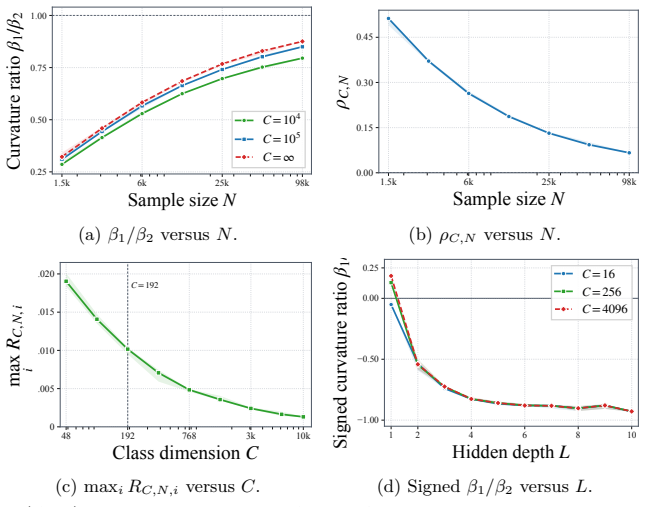
- [Figure 1(b)] The legend uses small background points for actual γ_T and connected markers for weighted averages, but the weighting is not defined in the caption. Please state how the averages are weighted (e.g., by parameter count or nuclear mass).
- [Section 3.3, Eq. after Theorem 3.5] The notation 'g(γ)=β(γ)γ^{1/4}' is used in Figure 1(b) but introduced in the text only as 'β(γ_T)γ_T^{1/4}'. Define g(γ) explicitly at first use to make the figure self-contained.
- [Appendix G, 'standard Muon multiplier'] Even if the multiplier is native-based in the experiments, the paper should state this explicitly in the protocol, since a reader cannot infer it from Algorithm 1, which uses a single scalar η_t.
- [Section 2.2] The definition of 'skinny-θ' via argmin_{a|d, a≤s} |a−θs| can select different actual fractions for different divisors; reporting the nearest divisor would help reproducibility. Table 1 gives representative shapes, but the exact chosen short sides are not listed for every block.
- [Abstract / Introduction] The phrase 'beyond normalized momentum' is evocative, but it may mislead: the vector endpoint is exactly nSGDM, so Muon is shown to contain nSGDM as a special case, not to go 'beyond' it in all aspects. Consider rephrasing to 'from normalized momentum to multi-channel polar geometry'.
Circularity Check
No significant circularity: the representation geometry is proven self-contained, and the empirical loss ladder is measured after independent per-representation learning-rate tuning.
full rationale
The paper's central derivation is not circular. Theorems 3.1 and 3.2 are proven in the appendix directly from Frobenius isometry, polar-factor identities, and standard smoothness/oracle assumptions; the representation enters only through the defined pulled-back direction D_T and the short side p_T, and no fitted parameter is later relabeled as a prediction. The dissipation ordering in Theorem 3.5 is a conditional statement: under the curvature-collapse theorem and the explicitly stated isotropic Marchenko–Pastur baseline (Assumption 3.3), the represented nuclear-to-squared-Frobenius ratio evaluates to β(γ)γ^{1/4}/(σ0 d^{1/4}). The MP profile is an assumption, not a fit to LLaMA losses, and Section 6 explicitly says it is only an isotropic baseline and that the result depends on the represented spectral quantity itself. Figure 1(b) compares the theory's g(γ) with a separately defined empirical shape factor measured from saved momentum blocks; this is an external moment check that could fail, not a tautology. The pretraining ladder is obtained by sweeping and selecting a learning rate for each representation (Tables 2–3), so the loss ordering is observed, not computed from the theory. Self-citations appear only in contextual statements about shared backends and related convergence analyses; they are not invoked as a load-bearing uniqueness theorem or as the sole justification of the central claim. The possible ambiguity about whether the standard Muon multiplier 0.2/√max(m,n) uses the native or represented shape is a correctness/confound risk, but the paper does not specify the represented-shape reading, and without a quoted reduction it cannot be scored as circularity.
Axiom & Free-Parameter Ledger
free parameters (2)
- per-method learning rate =
130M: N 0.01, Sq 0.0075, V 0.015; 600M: N 0.0015, Sq 0.0015, Sk-75/50/25 0.001 (grid edge), V 0.003
- σ_0 (initial perturbation scale) =
measured from saved teacher–student initialization; cancels in leading ratios
axioms (5)
- ad hoc to paper Assumption 3.3: normalized singular values of the represented perturbation satisfy the Marchenko–Pastur profile with mean β(γ_T) and unit second moment
- ad hoc to paper Assumptions 3.1–3.2: nonzero hidden rows over a fixed radius plus strong incoherence/moment conditions on teacher-output columns
- standard math Assumptions 2.1–2.3: L-smoothness, unbiased stochastic gradients, bounded variance
- standard math Spectral–nuclear norm duality and polar-factor identities
- standard math Marchenko–Pastur law, including β(1) = 8/(3π) quarter-circle mean
read the original abstract
Muon-style optimizers apply a polar map to matrix momentum, but their updates also depend on the representation of each parameter block before orthogonalization. We study this representation choice as a form of optimizer geometry and introduce {\method}, a family of Muon-style optimizers that shares the same momentum rule and Newton--Schulz backend across native, nearest-square, skinny, and vector representations. Each Frobenius-isometric representation induces a distinct polar steepest-descent geometry, in which the shorter matrix dimension determines the number of supported singular channels, the pullback scaling, and the constants in stochastic nonconvex convergence bounds. In a teacher--student model, curvature collapse and an isotropic Marchenko--Pastur spectral profile connect early-stage dissipation to the represented nuclear-to-squared-Frobenius norm ratio. Pretraining experiments on LLaMA2-130M and LLaMA2-600M, together with fixed-momentum diagnostics, show that balanced non-native representations can match the performance of the native representation, whereas reducing the shorter dimension weakens the scaling and singular-channel support, leading to behavior that increasingly resembles normalized momentum.
Figures




Reference graph
Works this paper leans on
-
[1]
Dion: Distributed orthonormalized updates.arXiv preprint arXiv:2504.05295,
Kwangjun Ahn, Byron Xu, Natalie Abreu, Ying Fan, Gagik Magakyan, Pratyusha Sharma, Zheng Zhan, and John Langford. Dion: Distributed orthonormalized updates.arXiv preprint arXiv:2504.05295,
-
[3]
Asgo: Adaptive structured gradient optimization.arXiv preprint arXiv:2503.20762,
Kang An, Yuxing Liu, Rui Pan, Yi Ren, Shiqian Ma, Donald Goldfarb, and Tong Zhang. Asgo: Adaptive structured gradient optimization.arXiv preprint arXiv:2503.20762,
-
[6]
Towards understanding of orthogonalization in muon
Valentyn Boreiko, Zhiqi Bu, and Sheng Zha. Towards understanding of orthogonalization in muon. In High-dimensional Learning Dynamics 2025,
2025
-
[8]
Da Chang, Qiankun Shi, Lvgang Zhang, Yu Li, and Ruijie Zhang. A note on stability for orthogonalized matrix momentum with client sampling.arXiv preprint arXiv:2606.01720, 2026a. Da Chang, Qiankun Shi, Lvgang Zhang, Yu Li, Ruijie Zhang, Yao Lu, Yongxiang Liu, and Ganzhao Yuan. Muoneq: Balancing before orthogonalization with lightweight equilibration.arXiv ...
-
[9]
Momentum improves normalized sgd.arXiv preprint arXiv:2002.03305,
Ashok Cutkosky and Harsh Mehta. Momentum improves normalized sgd.arXiv preprint arXiv:2002.03305,
Pith/arXiv arXiv 2002
-
[11]
Shenyang Deng, Zhuoli Ouyang, Tianyu Pang, Zihang Liu, Ruochen Jin, Shuhua Yu, and Yaoqing Yang. Rmnp: Row-momentum normalized preconditioning for scalable matrix-based optimization.arXiv preprint arXiv:2603.20527,
-
[12]
Towards quantifying the hes- sian structure of neural networks.ArXiv, abs/2505.02809,
Zhaorui Dong, Yushun Zhang, Zhi-Quan Luo, Jianfeng Yao, and Ruoyu Sun. Towards quantifying the hes- sian structure of neural networks.ArXiv, abs/2505.02809,
-
[14]
A stable whitening optimizer for efficient neural network training.arXiv preprint arXiv:2506.07254,
Kevin Frans, Sergey Levine, and Pieter Abbeel. A stable whitening optimizer for efficient neural network training.arXiv preprint arXiv:2506.07254,
-
[15]
Ekaterina Grishina, Matvey Smirnov, and Maxim Rakhuba. Accelerating newton-schulz iteration for orthogonalization via chebyshev-type polynomials.arXiv preprint arXiv:2506.10935,
-
[16]
Error feedback for muon and friends.arXiv preprint arXiv:2510.00643,
Kaja Gruntkowska, Alexander Gaponov, Zhirayr Tovmasyan, and Peter Richtárik. Error feedback for muon and friends.arXiv preprint arXiv:2510.00643,
-
[17]
Effective quantization of muon optimizer states.arXiv preprint arXiv:2509.23106,
Aman Gupta, Rafael Celente, Abhishek Shivanna, DT Braithwaite, Gregory Dexter, Shao Tang, Hiroto Udagawa, Daniel Silva, Rohan Ramanath, and S Sathiya Keerthi. Effective quantization of muon optimizer states.arXiv preprint arXiv:2509.23106,
-
[18]
Di He, Songjun Tu, Ajay Jaiswal, Li Shen, Ganzhao Yuan, Shiwei Liu, and Lu Yin
URLhttps://openreview.net/forum?id= lJSfxtLpLm. Di He, Songjun Tu, Ajay Jaiswal, Li Shen, Ganzhao Yuan, Shiwei Liu, and Lu Yin. Alphadecay: Module- wise weight decay for heavy-tailed balancing in llms.Advances in Neural Information Processing Systems, 38:29745–29768, 2026a. Di He, Songjun Tu, Keyu Wang, Lu Yin, and Shiwei Liu. One lr doesn’t fit all: Heav...
-
[20]
Muon: An optimizer for hidden layers in neural networks, 2024.URL https://kellerjordan
Keller Jordan, Yuchen Jin, Vlado Boza, You Jiacheng, Franz Cecista, Laker Newhouse, and Jeremy Bernstein. Muon: An optimizer for hidden layers in neural networks, 2024.URL https://kellerjordan. github. io/posts/muon, 6,
2024
-
[22]
Kingma and Jimmy Ba
Diederik P. Kingma and Jimmy Ba. Adam: A method for stochastic optimization. In Yoshua Bengio and Yann LeCun, editors,3rd International Conference on Learning Representations, ICLR 2015,
2015
-
[24]
cc/paper_files/paper/2023/hash/a3cc50126338b175e56bb3cad134db0b-Abstract-Conference
URLhttp://papers.nips. cc/paper_files/paper/2023/hash/a3cc50126338b175e56bb3cad134db0b-Abstract-Conference. html. Jiaxiang Li and Mingyi Hong. A note on the convergence of muon.arXiv preprint arXiv:2502.02900,
Pith/arXiv arXiv 2023
-
[25]
Muon is scalable for llm training.arXiv preprint arXiv:2502.16982,
Jingyuan Liu, Jianlin Su, Xingcheng Yao, Zhejun Jiang, Guokun Lai, Yulun Du, Yidao Qin, Weixin Xu, Enzhe Lu, Junjie Yan, et al. Muon is scalable for llm training.arXiv preprint arXiv:2502.16982,
-
[27]
Shuntaro Nagashima and Hideaki Iiduka. Improved convergence rates of muon optimizer for nonconvex optimization.arXiv preprint arXiv:2601.19400,
-
[28]
Spectral flattening is all muon needs: How orthogonalization controls learning rate and convergence
Tien-Phat Nguyen, Truong Nguyen, Minh-Phuc Truong, Tuc Nguyen, James Bailey, and Trung Le. Spectral flattening is all muon needs: How orthogonalization controls learning rate and convergence. arXiv preprint arXiv:2605.13079,
-
[29]
Training deep learning models with norm-constrained lmos.arXiv preprint arXiv:2502.07529,
Thomas Pethick, Wanyun Xie, Kimon Antonakopoulos, Zhenyu Zhu, Antonio Silveti-Falls, and Volkan Cevher. Training deep learning models with norm-constrained lmos.arXiv preprint arXiv:2502.07529,
-
[31]
Lions and muons: Optimization via stochastic frank-wolfe
Maria-Eleni Sfyraki and Jun-Kun Wang. Lions and muons: Optimization via stochastic frank-wolfe. arXiv preprint arXiv:2506.04192,
-
[32]
Practical efficiency of muon for pretraining.arXiv preprint arXiv:2505.02222,
Ishaan Shah, Anthony M Polloreno, Karl Stratos, Philip Monk, Adarsh Chaluvaraju, Andrew Hojel, Andrew Ma, Anil Thomas, Ashish Tanwer, Darsh J Shah, et al. Practical efficiency of muon for pretraining.arXiv preprint arXiv:2505.02222,
-
[33]
Adafactor: Adaptive learning rates with sublinear memory cost.ArXiv, abs/1804.04235,
Noam Shazeer and Mitchell Stern. Adafactor: Adaptive learning rates with sublinear memory cost.ArXiv, abs/1804.04235,
-
[35]
Hao-Jun Michael Shi, Tsung-Hsien Lee, Shintaro Iwasaki, Jose Gallego-Posada, Zhijing Li, Kaushik Rangadurai, Dheevatsa Mudigere, and Michael Rabbat. A distributed data-parallel pytorch imple- mentation of the distributed shampoo optimizer for training neural networks at-scale.arXiv preprint arXiv:2309.06497,
-
[36]
Beyond the ideal: Analyzing the inexact muon update.arXiv preprint arXiv:2510.19933,
Egor Shulgin, Sultan AlRashed, Francesco Orabona, and Peter Richtárik. Beyond the ideal: Analyzing the inexact muon update.arXiv preprint arXiv:2510.19933,
-
[37]
12 Zakhar Shumaylov, Nathaël Da Costa, Peter Zaika, Bálint Mucsányi, Alex Massucco, Yoav Gelberg, Carola-Bibiane Schönlieb, Yarin Gal, and Philipp Hennig. Muon is not that special: Random or inverted spectra work just as well.arXiv preprint arXiv:2605.11181,
-
[38]
Adamuon: Adaptive muon optimizer.arXiv preprint arXiv:2507.11005,
Chongjie Si, Debing Zhang, and Wei Shen. Adamuon: Adaptive muon optimizer.arXiv preprint arXiv:2507.11005,
-
[39]
Hugo Touvron, Louis Martin, Kevin R
URLhttps://api.semanticscholar.org/CorpusID:276094438. Hugo Touvron, Louis Martin, Kevin R. Stone, Peter Albert, Amjad Almahairi, Yasmine Babaei, Niko- lay Bashlykov, Soumya Batra, Prajjwal Bhargava, Shruti Bhosale, Daniel M. Bikel, Lukas Blecher, Cristian Cantón Ferrer, Moya Chen, Guillem Cucurull, David Esiobu, Jude Fernandes, Jeremy Fu, Wenyin Fu, Bria...
-
[40]
Soap: Improving and stabilizing shampoo using adam.arXiv preprint arXiv:2409.11321,
Nikhil Vyas, Depen Morwani, Rosie Zhao, Mujin Kwun, Itai Shapira, David Brandfonbrener, Lucas Janson, and Sham Kakade. Soap: Improving and stabilizing shampoo using adam.arXiv preprint arXiv:2409.11321,
-
[41]
Ziqing Wen, Jiahuan Wang, Ping Luo, Dongsheng Li, and Tao Sun
URLhttp://papers.nips.cc/paper_files/paper/2023/hash/ 7ac19fdcdf4f311f3e3ef2e7ef4784d7-Abstract-Conference.html. Ziqing Wen, Jiahuan Wang, Ping Luo, Dongsheng Li, and Tao Sun. Foam: Blocked state folding for memory-efficient llm training.arXiv preprint arXiv:2512.07112,
Pith/arXiv arXiv 2023
-
[42]
Ruihan Xu, Jiajin Li, and Yiping Lu. On the width scaling of neural optimizers under matrix operator norms i: Row/column normalization and hyperparameter transfer.arXiv preprint arXiv:2603.09952,
-
[43]
Huizhuo Yuan, Yifeng Liu, Shuang Wu, Xun Zhou, and Quanquan Gu. Mars: Unleashing the power of variance reduction for training large models.arXiv preprint arXiv:2411.10438,
-
[44]
Adagrad meets muon: Adaptive stepsizes for orthogonal updates.arXiv preprint arXiv:2509.02981,
Minxin Zhang, Yuxuan Liu, and Hayden Schaeffer. Adagrad meets muon: Adaptive stepsizes for orthogonal updates.arXiv preprint arXiv:2509.02981,
-
[45]
Minxin Zhang, Yuxuan Liu, and Hayden Scheaffer. Adam improves muon: Adaptive moment estimation with orthogonalized momentum.arXiv preprint arXiv:2602.17080,
-
[46]
Why transformers need adam: A hessian perspective.ArXiv, abs/2402.16788,
13 Yushun Zhang, Congliang Chen, Tian Ding, Ziniu Li, Ruoyu Sun, and Zhimin Luo. Why transformers need adam: A hessian perspective.ArXiv, abs/2402.16788,
-
[47]
Dongruo Zhou, Pan Xu, and Quanquan Gu
doi: 10.1007/s11432-022-3892-8. Dongruo Zhou, Pan Xu, and Quanquan Gu. Stochastic nested variance reduction for nonconvex optimiza- tion.Journal of machine learning research, 21(103):1–63,
-
[48]
14 Appendix A Related Work ▶ Adaptive and structured preconditioning.Coordinate-wise adaptive methods estimate diagonal or factored geometry from gradient history, whereas natural-gradient methods, K-FAC, Shampoo, SOAP, and related tensor preconditioners organize geometry at the layer, matrix, or tensor level (Duchi et al., 2011; Kingma and Ba, 2015; Losh...
2011
-
[49]
The model has123 .59M trainable parameters
with12layers, hidden width768,12attention heads of dimension64, MLP hidden width 2048, RMSNorm with ϵ = 10 −6, tied token embeddings, no bias parameters, and no dropout. The model has123 .59M trainable parameters. Training uses the FineWeb10B stream (Penedo et al., 2024), which contains10 ,255,324,043training tokens and100 ,000,000validation tokens, and a...
2048
-
[50]
with vocabulary size50,304. We use sequence length4096, global batch size128,4960training steps,496warmup steps, cosine learning-rate decay, weight decay0 .1, gradient clipping at norm1 .0, and bfloat16 training. These runs use four NVIDIA RTX PRO 6000 Blackwell GPUs (96GB). Muon/Muse updates the matrix modules summarized in Table 1 with momentum0.95, no ...
2024
-
[51]
with hidden width1024, MLP hidden width4096, RMSNorm, tied token embeddings, no bias parameters, and no dropout. The run uses the C4 stream with T5-base tokenization (Raffel et al., 2020), sequence length4096, global batch size320, and9600training steps, corresponding to 12,582,912,000training tokens. The warmup–stable–decay schedule uses800warmup steps a...
2020
-
[52]
In these settings, the selected markers for narrower or vectorized representations occur at larger learning rates than the native and square markers
These panels use the same protocol as the main-text sweep and cover the remaining settingsm∈ {32, 48, 64}, with n = 2m and C = 8m. In these settings, the selected markers for narrower or vectorized representations occur at larger learning rates than the native and square markers. 0 2000 4000 6000 8000 10000 Stochastic steps 10−5 10−4 10−3 10−2 10−1 100 No...
2000
-
[2001]
Convergence bound and critical batch size of muon optimizer.arXiv preprint arXiv:2507.01598,
Naoki Sato, Hiroki Naganuma, and Hideaki Iiduka. Convergence bound and critical batch size of muon optimizer.arXiv preprint arXiv:2507.01598,
-
[2009]
Thibaut Boissin, Thomas Massena, Franck Mamalet, and Mathieu Serrurier. Turbo-muon: Accelerating orthogonality-based optimization with pre-conditioning.arXiv preprint arXiv:2512.04632,
-
[2010]
Old optimizer, new norm: An anthology.arXiv preprint arXiv:2409.20325,
Jeremy Bernstein and Laker Newhouse. Old optimizer, new norm: An anthology.arXiv preprint arXiv:2409.20325,
-
[2015]
Tim Tsz-Kit Lau, Qi Long, and Weijie Su
URLhttp://arxiv.org/abs/1412.6980. Tim Tsz-Kit Lau, Qi Long, and Weijie Su. Polargrad: A class of matrix-gradient optimizers from a unifying preconditioning perspective.arXiv preprint arXiv:2505.21799,
-
[2018]
Wei Shen, Ruichuan Huang, Minhui Huang, Cong Shen, and Jiawei Zhang
URLhttps://api.semanticscholar.org/CorpusID:4786918. Wei Shen, Ruichuan Huang, Minhui Huang, Cong Shen, and Jiawei Zhang. On the convergence analysis of muon.arXiv preprint arXiv:2505.23737,
-
[2019]
Chao Ma, Wenbo Gong, Meyer Scetbon, and Edward Meeds
URLhttps://openreview.net/ forum?id=Bkg6RiCqY7. Chao Ma, Wenbo Gong, Meyer Scetbon, and Edward Meeds. Swan: Sgd with normalization and whitening enables stateless llm training.ArXiv, abs/2412.13148,
-
[2020]
Momentum-based variance reduction in non-convex sgd.ArXiv, abs/1905.10018,
Ashok Cutkosky and Francesco Orabona. Momentum-based variance reduction in non-convex sgd.ArXiv, abs/1905.10018,
Pith/arXiv arXiv 1905
-
[2021]
Florian Hübler, Thomas Pethick, and Suvrit Sra
URL https://api.semanticscholar.org/CorpusID:235436027. Florian Hübler, Thomas Pethick, and Suvrit Sra. Free heavy-tailed lunch for muon: A theoretical justification of empirical success.arXiv preprint arXiv:2606.14560,
-
[2023]
10 Cong Fang, Chris Junchi Li, Zhouchen Lin, and T. Zhang. Spider: Near-optimal non-convex optimization via stochastic path integrated differential estimator.ArXiv, abs/1807.01695,
-
[2024]
Muonbp: Faster muon via block-periodic orthogonalization.arXiv preprint arXiv:2510.16981,
Ahmed Khaled, Kaan Ozkara, Tao Yu, Mingyi Hong, and Youngsuk Park. Muonbp: Faster muon via block-periodic orthogonalization.arXiv preprint arXiv:2510.16981,
-
[2025]
Noah Amsel, David Persson, Christopher Musco, and Robert M Gower. The polar express: Optimal matrix sign methods and their application to the muon algorithm.arXiv preprint arXiv:2505.16932,
-
[2026]
On the convergence of muon and beyond.arXiv preprint arXiv:2509.15816,
Da Chang, Yongxiang Liu, and Ganzhao Yuan. On the convergence of muon and beyond.arXiv preprint arXiv:2509.15816,
discussion (0)
Sign in with ORCID, Apple, or X to comment. Anyone can read and Pith papers without signing in.