REVIEW 4 major objections 5 minor 13 references
This paper claims that mask-free, multi-garment virtual try-on can match or beat mask-based state-of-the-art methods while preserving fine textures, using a frozen diffusion backbone plus lightweight expert adapters and a synthetic training
Reviewed by Pith at T0; open to challenge. T0 means a machine referee read the full paper against a public rubric. the ladder, T0–T4 →
T0 review · deepseek-v4-flash
2026-08-02 00:59 UTC pith:HF24YLJ6
load-bearing objection A coherent mask-free VTON system that combines known components into a plausible pipeline, but the headline numbers rest on an unvalidated synthetic training base and no release. the 4 major comments →
TAMF-VTON: Texture-Aware Mask-Free Virtual Try-On via High-Fidelity Image Synthesis
The pith
A machine-rendered reading of the paper's core claim, the machinery that carries it, and where it could break.
Core claim
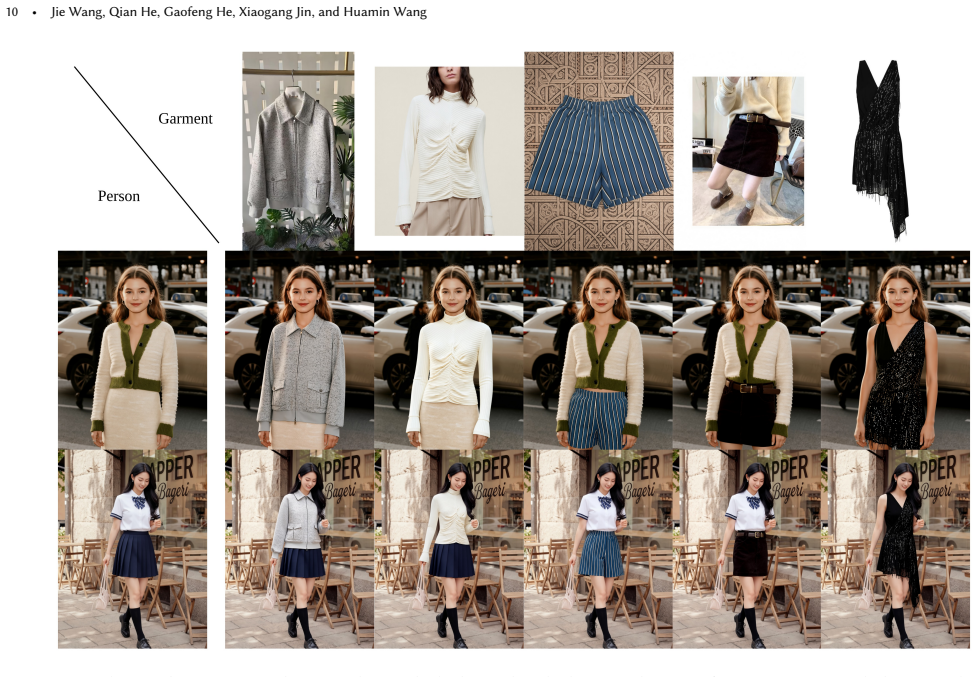
The central discovery is that the three obstacles to practical mask-free try-on—mask dependence, texture loss, and limited multi-garment support—can be removed jointly within one diffusion-based editing framework. TAMF-VTON feeds the person image, one or more garment images, and a text instruction into a multimodal diffusion transformer as concatenated tokens. A token-wise mixture-of-experts adapter, with a few low-rank branches and top-2 routing, injects try-on-specific behavior while leaving the base model frozen. A frequency-domain loss, applied to the Fourier spectrum of the reconstructed image and weighted to emphasize low-noise steps, pushes the model to keep high-frequency garment det
What carries the argument
The central mechanism is the adaptive inpainting data pipeline that synthesizes aligned training pairs from ordinary try-on datasets. Since no dataset provides 'before-wear' images, the paper creates them: a detector locates the reference garment and its aspect ratio, pose keypoints map the body layout, and a linear regressor predicts the garment's hemline in the target image. That predicted region, combined with the original garment's mask and with hands and feet protected, becomes the inpainting region for a retrained inpainting model, yielding a reference-agnostic base image. The model then learns to map base image plus reference garment image(s) plus text instruction back to the original
Load-bearing premise
The load-bearing premise is that the lightweight linear regressor, fed by garment detection and pose keypoints, predicts where the reference garment will fall in the target image accurately enough that the inpainted 'before-wear' bases are semantically aligned with the final try-on; if that prediction is wrong for complex poses, occlusions, or cross-category swaps, the model trains on misaligned or artifact-laden images and the mask-free gains vanish.
What would settle it
Human-audit a random sample of synthesized training pairs (base image, reference garment, target image) for cases where the reference garment is much longer or shorter than the one worn. If the predicted hemline is systematically off—e.g., a long coat's hemline lands above the waist or a crop top's hemline extends past the hips—then the model is being trained on misaligned supervision, and the mask-free performance claim would be expected to fail exactly on cross-length transfers.
If this is right
- Inference no longer requires a segmentation or inpainting mask: the same model accepts flat-lay product photos, one item or several, and a short text instruction, and outputs the synthesized person image.
- Multi-garment outfits can be composed in a single pass rather than by sequentially editing one garment at a time, avoiding accumulated artifacts.
- Fine garment details—logos, weaves, patterns—are better preserved, attributed to the frequency-domain supervision, especially for dense textures.
- The frozen-backbone MoE design keeps the base model's general editing skills intact while adding try-on expertise cheaply.
- With 4-bit quantization the model runs in under 15 seconds per image on a consumer GPU, making e-commerce deployment practical.
Where Pith is reading between the lines
- If the training-pair synthesis is as faithful as claimed, the same inverse-try-on trick could be applied to other garment-centric editing tasks such as try-off, textile retexturing, or style transfer, since it converts unpaired data into supervised pairs without manual annotation.
- The frequency-domain loss, applied globally rather than on masked regions, suggests a general recipe for diffusion-based editing: enforce spectral consistency on the whole reconstructed image with a timestep-dependent weight, which may transfer to non-fashion editing tasks where texture fidelity matters.
- A testable extension: because the MoE router learns token-dependent expert activation implicitly, one could probe whether the experts specialize by spatial region or by garment category; if they do, the router could be exposed for user control, e.g., forcing a 'texture expert' for patterned garments.
- The reported improvement in unpaired FID and KID implies better distributional realism; if true, mask-free training on synthetic pairs may narrow the gap between studio benchmarks and in-the-wild e-commerce photos, though human preference studies would be the natural next check.
Editorial analysis
A structured set of objections, weighed in public.
Referee Report
Summary. The paper proposes TAMF-VTON, a mask-free virtual try-on framework built on the Qwen-Edit diffusion transformer. It introduces three components: (1) a lightweight Mixture-of-Experts (MoE) LoRA adaptation with top-2 token routing, claimed to preserve the base model's general editing ability; (2) a frequency-domain supervision loss that penalizes high-frequency spectral differences between the decoded prediction and ground truth; and (3) an adaptive inpainting pipeline that synthesizes mask-free training tuples by replacing the target person's garment with a randomly sampled garment using a retrained FitDiT prior. The authors report state-of-the-art SSIM, LPIPS, FID, and KID on VITON-HD and DressCode, support for single- and multi-garment transfer, and inference under 15 seconds on an RTX 4090 with INT4 quantization.
Significance. If the results are valid, TAMF-VTON would be a practically valuable contribution: it removes the need for inference-time segmentation masks, supports multi-garment composition, and achieves efficient deployment on consumer hardware. The architectural ideas are coherent and the derivations in Eqs. (6)–(9) are internally consistent. The qualitative examples are appealing. However, the central quantitative claim rests on a synthetic training-data pipeline whose faithfulness to real 'before-wear' images is not validated. Because the model is trained and evaluated on the same benchmark datasets without documented split provenance, the reported improvements over baselines may be inflated. The paper also provides no code, no error bars, and limited reproducibility details, which weakens confidence in the headline SOTA numbers.
major comments (4)
- [§4.3, §4.3.1] The entire mask-free training set is built from synthetic I_base images generated by the retrained FitDiT prior using the adaptive inpainting masks. The paper treats these synthetic bases as faithful proxies for true before-wear images, but provides no quantitative validation of this assumption. Supplementary Fig. 1 only shows qualitative comparisons; there is no metric for mask quality, no distributional comparison (e.g., FID/LPIPS) between synthetic I_base and real before-wear images, and no failure analysis for cross-category, long-coat, or occluded cases. If the hemline regressor or the inpainting prior produces misaligned or artifact-laden bases, the model is trained on corrupted supervision, and the Table 1 improvements could reflect inverting the synthetic pipeline rather than performing mask-free try-on on real photographs. Please provide a validation of the synthetic bases or an
- [§5.1, Table 1] The paper trains on a 20K synthetic dataset 'constructed from VITON-HD and DressCode' and then evaluates on the test sets of those same benchmarks. It is not stated whether the synthetic training samples are derived from the train split or the test split, nor whether any person identities or garment instances overlap between training and evaluation. This is a load-bearing data-hygiene issue: if the training tuples are synthesized from the test set's own persons or garments, the paired SSIM/LPIPS numbers may be favorably biased by identity leakage. The split provenance must be documented, including the number of unique identities/garments in training versus test.
- [Table 1, §5.3] Quantitative results are reported without error bars, number of seeds, or statistical significance tests. Many of the claimed improvements are small (e.g., VITON-HD SSIM 0.913 vs. 0.898 for FitDiT; KID 0.265 vs. 0.342). Without confidence intervals or significance testing, it is unclear whether these differences are meaningful, especially given the unvalidated synthetic training data. Additionally, some baseline rows have missing FID/KID values; the comparisons are therefore incomplete. Please report mean ± std over multiple runs (or the evaluation protocol) and complete the baseline results.
- [§5.1, 'Nunchaku acceleration engine'] The inference-speed claim of under 15 seconds on an RTX 4090 with INT4 quantization is not accompanied by measurement details: no warmup, no batch size, no explicit image resolution, no version of the acceleration engine, and no distinction between first-call and steady-state latency. Since practical deployment is a stated motivation, this should be specified. This is a secondary but non-negligible issue for the paper's practical claims.
minor comments (5)
- [§5.2.1] Typo: 'We presents both single-garment and multi-garment try-on comparisons' should be 'We present'.
- [§4.2.1] The sentence 'Since the ground-truth velocity is v_t = epsilon - z_0' is a fragment; rephrase for clarity.
- [Figure 2] The overview figure is dense. Consider labeling the MoE router and the flow of the frequency loss more explicitly so that the three contributions are immediately visible.
- [References] The text refers to the 'Nunchaku acceleration engine [25]', but reference [25] is 'SVDQuant'. Please clarify the relation or correct the citation.
- [Reproducibility] Only a commercial project page is provided, not a code repository. If code is not released, state this explicitly and describe how the benchmarks were evaluated in sufficient detail for reproduction.
Circularity Check
No significant circularity: all training losses and benchmark metrics are anchored to real ground-truth images; synthetic training bases are an empirical proxy, not a definitional identity.
full rationale
TAMF-VTON's derivation chain is supervised against external ground truth at every key stage. The flow-matching loss (Eq. 4) is defined w.r.t. the true velocity v_t = eps - z0; the spectral loss (Eq. 9) compares the decoded estimate x0_hat = D(z_t - t*v_hat) against the real target image x0; and the benchmark metrics in Table 1 are computed on VITON-HD and DressCode test images with real ground-truth try-on outputs. The adaptive-inpainting data curation (Sec. 4.3) uses a mask-based VTON prior (retrained FitDiT) to synthesize I_base training inputs, but the training target I_target is the original real photograph, so the model is not asked to reproduce its own synthetic artifact as if it were a prediction. The linear regressor for hemline placement is a data-construction heuristic, not a fitted parameter whose output is later reported as a benchmark prediction. No load-bearing step is justified solely by a self-citation: the reference list contains no author-overlapping 'uniqueness' or ansatz-citation chain, and the ablations (MoE vs LoRA, with/without L_f) change only the trained model while holding the external test protocol fixed. The unvalidated synthetic-to-real fidelity of FitDiT-generated I_base is an empirical validity/correctness risk, not circularity; if I_base is misaligned or artifact-laden, the training signal is degraded, but the derivation does not reduce Eq. X to Eq. Y by construction. Similarly, the limitation that AIS-vs-NAIS is only qualitatively validated (Supplementary Fig. 1) is a missing-support concern, not a circular step. Hence no significant circularity; score 0.
Axiom & Free-Parameter Ledger
free parameters (5)
- spectral loss weight λ =
not reported
- high-frequency cutoff r =
(h+w)/32
- timestep weighting exponent =
(1-t)^2
- MoE topology (rank, experts, top-k) =
rank 64, 4 experts, top-2
- hemline regressor weights =
not reported
axioms (5)
- standard math Flow matching training objective with standard velocity definition v_t = ε − z0
- domain assumption Qwen-Edit MMDiT plus VAE provide a capable base for multimodal image editing
- ad hoc to paper Synthetic base images from the retrained FitDiT inpainting prior are valid 'before-wear' inputs
- domain assumption Spectral supervision on the VAE-decoded x0 is meaningful despite latent-space information loss
- ad hoc to paper The hemline regressor generalizes across categories and poses
read the original abstract
Recent diffusion-based virtual try-on (VTON) methods remain limited by their reliance on segmentation masks, insufficient preservation of fine-grained textures, and limited support for arbitrary multi-garment compositions. Consequently, existing approaches still face significant challenges in real-world e-commerce deployment. We present TAMF-VTON, a texture-aware, mask-free framework that enables high-fidelity image synthesis under practical unconstrained conditions. Our method requires no human parsing or inpainting masks at inference time and supports diverse garment styles, categories, and quantities, enabling the simultaneous transfer of multiple items while preserving body structure and intricate texture details. This is achieved through a unified generative pipeline with three key components: (1) a lightweight Mixture-of-Experts (MoE) adaptation scheme that enables efficient fine-tuning without compromising the base model's general editing capabilities; (2) a frequency-domain supervision mechanism that explicitly optimizes high-frequency spectral consistency to preserve high-fidelity textures; and (3) a robust data curation pipeline employing an adaptive inpainting strategy to simulate the inverse VTON process for high-quality training pair generation. Extensive experiments demonstrate that our approach outperforms state-of-the-art methods in both quantitative metrics and perceptual quality. Optimized for efficiency, the model achieves inference in under 15 seconds per image on an NVIDIA RTX 4090 with INT4 quantization. By combining mask-free operation, flexible multi-garment composition, faithful texture preservation, and efficient inference on consumer hardware, TAMF-VTON demonstrates a commercially viable solution for scalable deployment in real-world digital fashion scenarios. The project is available at https://www.style3d.ai/ai-photoshoot/virtual-clothing-try-on.
Figures




Reference graph
Works this paper leans on
-
[1]
Seunghwan Choi, Sunghyun Park, Minsoo Lee, and Jaegul Choo. 2021. VITON- HD: High-Resolution Virtual Try-On via Misalignment-Aware Normalization. In Proceedings of the IEEE/CVF Conference on Computer Vision and Pattern Recognition (CVPR). 14131–14140
2021
-
[2]
Yisol Choi, Sangkyung Kwak, Kyungmin Lee, Hyungwon Choi, and Jinwoo Shin
-
[3]
Zheng Chong, Xiao Dong, Haoxiang Li, Shiyue Zhang, Wenqing Zhang, Xu- jie Zhang, Hanqing Zhao, Dongmei Jiang, and Xiaodan Liang. 2025. Catvton: Concatenation is all you need for virtual try-on with diffusion models.The International Conference on Learning Representations(2025)
2025
-
[4]
Chenghu Du, Shengwu Xiong, and Yi Rong. 2025. All Parts Matter: A Unified Mask-Free Virtual Try-On Framework. InProceedings of the IEEE/CVF Interna- tional Conference on Computer Vision (ICCV). 19525–19534
2025
-
[5]
Boyuan Jiang, Xiaobin Hu, Donghao Luo, Qingdong He, Chengming Xu, Jinlong Peng, Jiangning Zhang, Chengjie Wang, Yunsheng Wu, and Yanwei Fu. 2024. Fitdit: Advancing the authentic garment details for high-fidelity virtual try-on. arXiv preprint arXiv:2411.10499(2024)
Pith/arXiv arXiv 2024
-
[6]
Black Forest Labs. 2025. FLUX.2: Frontier Visual Intelligence. https://bfl.ai/blog/ flux-2
2025
-
[7]
Davide Morelli, Matteo Fincato, Marcella Cornia, Federico Landi, Fabio Cesari, and Rita Cucchiara. 2022. Dress Code: High-Resolution Multi-Category Virtual Try-On. InProceedings of the IEEE/CVF Conference on Computer Vision and Pattern Recognition (CVPR) Workshops. 2231–2235
2022
-
[8]
Gemini Team, Rohan Anil, and Sebastian Borgeaud. 2025. Gemini: A Family of Highly Capable Multimodal Models. arXiv:2312.11805 [cs.CL] https://arxiv.org/ abs/2312.11805
Pith/arXiv arXiv 2025
-
[9]
Zhenchen Wan, Yanwu Xu, Dongting Hu, Weilun Cheng, Tianxi Chen, Zhao- qing Wang, Feng Liu, Tongliang Liu, and Mingming Gong. 2025. MFT-VITON: High-Fidelity Virtual Try-On with Minimal Input via a Mask-Free Transformer- Diffusion Model. In2025 IEEE/CVF International Conference on Computer Vision Workshops (ICCVW). 2006–2015. doi:10.1109/ICCVW69036.2025.00210
arXiv 2025
-
[10]
Chenfei Wu, Jiahao Li, Jingren Zhou, Junyang Lin, Kaiyuan Gao, Kun Yan, Sheng- ming Yin, Shuai Bai, Xiao Xu, Yilei Chen, et al . 2025. Qwen-image technical report.arXiv preprint arXiv:2508.02324(2025)
Pith/arXiv arXiv 2025
-
[11]
Yuhao Xu, Tao Gu, Weifeng Chen, and Arlene Chen. 2025. Ootdiffusion: Outfitting fusion based latent diffusion for controllable virtual try-on. InProceedings of the AAAI Conference on Artificial Intelligence, Vol. 39. 8996–9004
2025
-
[12]
Xuanpu Zhang, Dan Song, Pengxin Zhan, Tianyu Chang, Jianhao Zeng, Qing- guo Chen, Weihua Luo, and An-An Liu. 2025. BooW-VTON: Boosting In-the- Wild Virtual Try-On via Mask-Free Pseudo Data Training. InProceedings of the IEEE/CVF conference on computer vision and pattern recognition. 26399–26408. doi:10.1109/CVPR52734.2025.02458
arXiv 2025
-
[2024]
In European Conference on Computer Vision
Improving diffusion models for authentic virtual try-on in the wild. In European Conference on Computer Vision. Springer, 206–235
discussion (0)
Sign in with ORCID, Apple, or X to comment. Anyone can read and Pith papers without signing in.