REVIEW 4 major objections 4 minor 37 references
A closed-form per-token control rule, driven by the directional mismatch between source and target velocity fields, localizes training-free 3D edits while preserving untouched geometry.
Reviewed by Pith at T0; open to challenge. T0 means a machine referee read the full paper against a public rubric. the ladder, T0–T4 →
T0 review · deepseek-v4-flash
2026-08-02 00:39 UTC pith:EBXTB4BZ
load-bearing objection TanGO is a clean, cheap per-token steering method for 3D editing, but its localization claim rests on an assumption the paper's own evidence does not actually test. the 4 major comments →
TanGO: Training-Free 3D Editing via Tangent-Space Guidance and Optimization
The pith
A machine-rendered reading of the paper's core claim, the machinery that carries it, and where it could break.
Core claim
On the paper's own terms, the discovery is that editing a 3D asset in a VecSet-based flow generator can be cast as an instantaneous optimal-control problem in the tangent space of the generative dynamics. At each ODE step, the method computes source and target velocity fields for every latent token, normalizes them, and defines a demand d_i(t)=1−cosθ_i(t), the directional discrepancy between the two. The closed-form optimal control is u_i(t)=λ_eff(t) g_i(t) Δv_i(t) with g_i(t) proportional to d_i(t), so tokens whose source and target directions disagree strongly are steered hard, while tokens that already agree are left alone. Mean-gain normalization keeps the overall guidance energy stable
What carries the argument
The load-bearing object is the per-token steering gain g_i(t)=d_i(t)/ρ, with demand d_i(t)=1−cosθ_i(t), where θ_i(t) is the angle between the normalized source and target velocity vectors at token i. The demand is motivated as a scaled von Mises-Fisher negative log-likelihood: when the target direction is far from the source direction, demand is high. The update u_i(t)=λ_eff(t) g_i(t) Δv_i(t) comes from a one-step optimal control problem that maximizes progress toward Δv_i while penalizing control energy and restricting updates to the span of Δv_i. The second mechanism is mean-gain normalization, λ_eff(t)=λ·η/(ḡ(t)+ε), which prevents the average steering strength from drifting over time; wit
Load-bearing premise
The method assumes that a token's directional velocity mismatch between source and target is a reliable indicator of whether that token's local geometric region should be edited: high mismatch means edit, low mismatch means preserve.
What would settle it
A causal perturbation experiment would settle it: for a set of edits, set the demand of individual tokens to zero one at a time and record which mesh regions stop changing. If high-demand tokens include regions that should be preserved, or if low-demand tokens include regions that must change, the directional mismatch is not the right localization signal. An oracle-mask comparison—using ground-truth edit masks instead of d_i(t)—would quantify how much of the gain comes from the demand design versus the per-token control structure itself.
If this is right
- Text-driven edits can be applied to existing VecSet-based 3D generators without retraining or external masks: the per-token gain automatically suppresses changes in preserved regions.
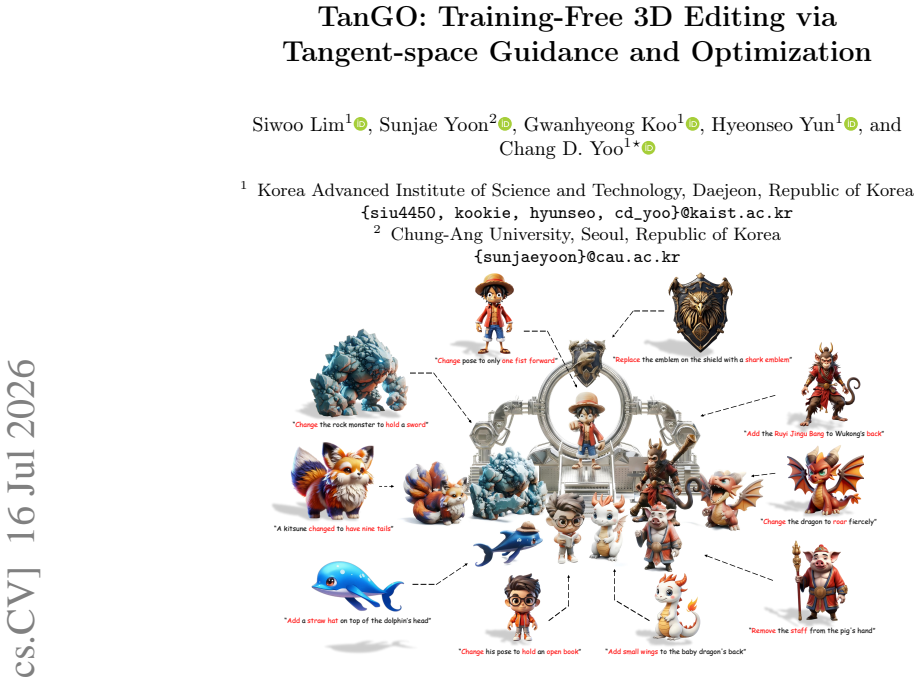
- Rigid edits (add, replace, remove) and non-rigid edits (pose, style) share the same control rule, and the paper reports strong results on both.
- Because the control is computed from the two velocity evaluations already required, the added computational cost is small compared with prior flow-based editing methods.
- The same mechanism transfers across multiple VecSet-based generators with different token budgets, suggesting it is not tied to one backbone.
- Gain normalization is necessary: without it, steering strength drifts over timesteps and leads to under-editing or over-editing.
- On a mask-aware 3D benchmark, the per-token approach preserves unedited geometry better than baselines, as measured by Chamfer distance and normal consistency inside preserved regions.
Where Pith is reading between the lines
- This suggests the same demand signal could serve as a general mask-free localization prior for other tokenized generative models—for example, locating which tokens in a latent video or audio diffusion model must change for an instruction.
- Because d_i(t) is derived purely from velocity directions, one could use it as an interpretability tool: plotting per-token demand over steps may reveal which parts of the object the model believes are being edited.
- A direct comparison against oracle-mask per-token control would separate the contribution of the demand design from the per-token steering structure; the paper does not run that ablation.
- The observed token locality is measured with an attention-based proxy, not by causal perturbation; if that proxy is imperfect, refining d_i(t) with a learned or mask-based prior could close the gap—a natural extension the paper leaves implicit.
Editorial analysis
A structured set of objections, weighed in public.
Referee Report
Summary. The paper proposes TanGO, a training-free method for localized text-driven editing of VecSet-based 3D flow-matching models (e.g., Hunyuan3D 2.1, TripoSG). The method formulates per-token editing as an instantaneous one-step optimal control problem, derives a closed-form control input u_i(t) = λ_eff(t) g_i(t) Δv_i(t), and sets the per-token demand d_i(t) = 1 − cos θ_i(t) from the direction mismatch between source and target velocity fields. A mean-gain normalization is introduced to stabilize global edit strength. The authors introduce a new benchmark, TanGOEdit, and report state-of-the-art results against MVEdit, EditP23, FlowEdit, and AnchorFlow on CLIP-I, CLIP-T, and DINO-I, with additional mask-aware 3D metrics in the supplementary material.
Significance. If the central localization claim is valid, TanGO is a practically useful contribution: it is training-free, mask-free, computationally light (28.73 s per edit), transfers across two VecSet-based backbones, and the closed-form derivation in Section 4 and Appendix B is correct as stated. The release of code and the inclusion of a new benchmark are also assets. However, the paper's headline claim — that per-token directional discrepancy identifies tokens whose geometric region should be edited — rests on an attention-based proxy that the authors themselves state does not directly measure geometric deformation under token perturbation. In addition, the state-of-the-art comparison is evaluated on a self-curated benchmark on which the default hyperparameters were tuned, and no significance testing is reported. These issues are load-bearing for the claimed contribution and need to be addressed before publication.
major comments (4)
- [Section 4.2, Eq. (10); Appendix A.1] The core mechanism of the paper is that d_i(t) = 1 − cos θ_i(t) localizes edits: high-demand tokens should lie in the edit region and low-demand tokens in preserved regions. The only locality evidence is the attention-based proxy in Appendix A.1, which explicitly 'does not directly measure geometric deformation under explicit token perturbation' (Remark, Appendix A.1). The mask-aware evaluation in Supp. E.1 reports final geometry metrics on 150 annotated samples but never measures whether the per-token gain map (e.g., accumulated ||u_i(t)|| or d_i(t)) coincides with the annotated edit mask. Without this measurement, the ablation gains in Supp. Table 3 cannot be attributed to the proposed localization mechanism. Please report a direct token-level agreement measure (e.g., mask IoU, precision/recall) on the annotated samples, or a causal token-perturbation experiment that shows high-demand
- [Section 5.3, Table 1; Section 5.4, Fig. 8] The headline SOTA claim is evaluated on TanGOEdit, a self-curated benchmark of 100 samples (Supp. C). The default λ and η are selected by sweeping the same TanGOEdit benchmark (Fig. 8(b)). No error bars, confidence intervals, or significance tests are provided for Table 1 or Supp. Table 2. This creates a tuning-on-test-set risk for the central quantitative claim. Please report variability across samples (e.g., bootstrap confidence intervals or per-category breakdowns), use an external benchmark for the main comparison where possible, and show that the chosen hyperparameters are not overfit to the evaluation set.
- [Section 4.3, Eqs. (11)–(12)] After mean-gain normalization, λ and η are not separately identifiable. With ε → 0, Eq. (12) gives u_i(t) = λη (d_i(t)/mean_d(t)) Δv_i(t), so only the product λη matters. This makes the two-dimensional (λ, η) sweep in Fig. 8(b) effectively one-dimensional, and it calls into question the interpretation of η as a 'target energy level' that is independent of λ. The same cancellation applies to the vMF concentration κ: since d_i appears only through ratios after normalization, the vMF derivation in Eqs. (8)–(10) does not determine the demand shape beyond a monotone function of 1 − cos θ. Please clarify which parameters are identifiable and what the vMF derivation adds beyond choosing a monotone discrepancy.
- [Section 5.1, Implementation Details; Eq. (7)] The source and target classifier-free guidance scales differ substantially (s_src = 3.5, s_tar = 7.5). Since v_tar is produced with much stronger guidance, the cosine mismatch in Eq. (7) may reflect a global shift in the text-conditioned velocity field rather than a spatially localized edit demand. This potential confound is not analyzed. Please report an experiment with matched guidance scales, or show that the d_i(t) map remains localized over a range of s_tar values, to support the spatial localization interpretation.
minor comments (4)
- [Eq. (6) vs. Eq. (11)] The symbol ε is used both as a normalization stabilizer in Eq. (6) and as a division-protection term in Eq. (11). Use different symbols (e.g., ε_norm and ε_gain) to avoid confusion.
- [Appendix B.5] The appendix correctly notes that the regularized normalization in Eq. (6) is not exactly unit-norm. This is an important implementation detail, but the main text should at least mention that the vMF derivation applies to the idealized unit vectors, while the practical demand is a regularized approximation.
- [Fig. 2] Panel labels (c) and (d) appear to refer to CLIP-I and CLIP-T, but the caption and text could be clearer about which panel corresponds to which metric. Please check the labels.
- [Appendix F] The limitation on thin structures and the VAE bottleneck is presented only in the supplementary material. Since these are directly relevant to the method's applicability, a brief statement in the main text (Section 5 or the conclusion) would help readers calibrate expectations.
Circularity Check
No circular derivation: the control law is a stated closed-form function of source/target velocities, and the vMF step is an explicit identity, not a hidden reuse of the result.
full rationale
TanGO's derivation chain is self-contained. The control law follows from the explicit concave objective (Eq. 4): maximizing d_i<u_i,Δv_i> − (ρ/2)||u_i||^2 over u_i∈span(Δv_i) gives the closed-form u_i=(d_i/ρ)Δv_i (Eq. 5), where d_i is an input weighting, not a fitted output. The paper then chooses d_i=1−cosθ_i by defining the vMF negative log-likelihood (Eqs. 8–10); this is a mathematical identity (−log vMF = const + κ(1−cosθ)) and is explicitly labeled as a definition ('We therefore define the demand...'), so it does not secretly embed the evaluation target. The claimed localization rests on an empirical assumption supported by an attention proxy; Supp. A.1 candidly remarks the metric 'does not directly measure geometric deformation under explicit token perturbation,' which is a validity limitation rather than a circular step. No load-bearing self-citation is used: the authors' prior works [18,34] appear only as related-work context, not as justification for the control law or the vMF choice. The only benchmark concern is that λ and η are selected by sweeping the same TanGOEdit benchmark used for final comparison (Fig. 8b); this is a test-set tuning weakness that can bias the reported SOTA numbers, but it is not a reduction of the derivation to its inputs, and TanGO's update rule remains an explicit function of the stated inputs. Under the specified criteria, no circular step can be exhibited.
Axiom & Free-Parameter Ledger
free parameters (3)
- global guidance scale λ =
5.0
- target mean-gain energy η =
0.2
- classifier-free guidance scales s_src, s_tar =
3.5, 7.5
axioms (5)
- domain assumption VecSet tokens exhibit strong spatial locality, so each token can be edited independently enough for per-token control.
- domain assumption The velocity difference Δv = v_tar − v_src is the correct tangent direction for semantic editing.
- domain assumption Directional disagreement 1−cosθ between normalized source and target velocities identifies which tokens should be edited.
- ad hoc to paper A vMF likelihood is an appropriate model for target velocity directions around source directions, and κ/ρ can be absorbed into λ.
- domain assumption The pretrained 3D VAE reconstructs edited latents with enough fidelity for the edited mesh to be usable.
read the original abstract
While recent flow-matching 3D generative models (e.g., VecSet) adopt structured representations, their tokens share global context, causing conventional training-free editing to suffer from semantic artifacts such as collapsed preserved regions or incomplete transformations. To address this, we propose TanGO, a training-free framework that enables adaptive per-token steering in the tangent space of generative dynamics. To realize this selective control, we formulate a one-step optimal control rule and determine the strength of each token's control signal using a von Mises-Fisher inspired directional discrepancy derived from the source and target velocity fields. Experiments show that TanGO substantially reduces structural artifacts and achieves state-of-the-art performance, outperforming existing 3D editing baselines. The code is publicly available at https://github.com/siw00-lim/TanGO.
Figures


Reference graph
Works this paper leans on
-
[1]
Bai, S., Chen, K., Liu, X., Wang, J., Ge, W., Song, S., Dang, K., Wang, P., Wang, S., Tang, J., Zhong, H., Zhu, Y., Yang, M., Li, Z., Wan, J., Wang, P., Ding, W., Fu, Z., Xu, Y., Ye, J., Zhang, X., Xie, T., Cheng, Z., Zhang, H., Yang, Z., Xu, H., Lin, J.: Qwen2.5-vl technical report (2025),https://arxiv.org/abs/2502.13923
Pith/arXiv arXiv 2025
-
[2]
arXiv preprint arXiv:2506.20652 (2025)
Bar-On, R., Cohen-Bar, D., Cohen-Or, D.: Editp23: 3d editing via propagation of image prompts to multi-view. arXiv preprint arXiv:2506.20652 (2025)
Pith/arXiv arXiv 2025
-
[3]
In: Proceedings of the Computer Vision and Pattern Recognition Conference
Barda, A., Gadelha, M., Kim, V.G., Aigerman, N., Bermano, A.H., Groueix, T.: Instant3dit: Multiview inpainting for fast editing of 3d objects. In: Proceedings of the Computer Vision and Pattern Recognition Conference. pp. 16273–16282 (2025)
2025
-
[4]
In: Proceedings of the IEEE/CVF conference on computer vision and pattern recognition
Brooks, T., Holynski, A., Efros, A.A.: Instructpix2pix: Learning to follow image editing instructions. In: Proceedings of the IEEE/CVF conference on computer vision and pattern recognition. pp. 18392–18402 (2023)
2023
-
[5]
In: Pro- ceedings of the IEEE/CVF international conference on computer vision
Cao, M., Wang, X., Qi, Z., Shan, Y., Qie, X., Zheng, Y.: Masactrl: Tuning-free mutual self-attention control for consistent image synthesis and editing. In: Pro- ceedings of the IEEE/CVF international conference on computer vision. pp. 22560– 22570 (2023)
2023
-
[6]
In: Proceedings of the IEEE/CVF international conference on computer vision
Caron, M., Touvron, H., Misra, I., Jégou, H., Mairal, J., Bojanowski, P., Joulin, A.: Emerging properties in self-supervised vision transformers. In: Proceedings of the IEEE/CVF international conference on computer vision. pp. 9650–9660 (2021)
2021
-
[7]
arXiv preprint arXiv:2403.12032 (2024)
Chen, H., Shi, R., Liu, Y., Shen, B., Gu, J., Wetzstein, G., Su, H., Guibas, L.: Generic 3d diffusion adapter using controlled multi-view editing. arXiv preprint arXiv:2403.12032 (2024)
Pith/arXiv arXiv 2024
-
[8]
In: Proceedings of the IEEE/CVF international conference on computer vision
Chen, R., Chen, Y., Jiao, N., Jia, K.: Fantasia3d: Disentangling geometry and appearance for high-quality text-to-3d content creation. In: Proceedings of the IEEE/CVF international conference on computer vision. pp. 22246–22256 (2023)
2023
-
[9]
In: Proceedings of the IEEE/CVF Conference on Computer Vision and Pattern Recognition
Chen, R., Zhang, J., Liang, Y., Luo, G., Li, W., Liu, J., Li, X., Long, X., Feng, J., Tan, P.: Dora: Sampling and benchmarking for 3d shape variational auto-encoders. In: Proceedings of the IEEE/CVF Conference on Computer Vision and Pattern Recognition. pp. 16251–16261 (2025)
2025
-
[10]
In: Proceedings of the IEEE/CVF conference on computer vision and pattern recognition
Chen, Y., Chen, Z., Zhang, C., Wang, F., Yang, X., Wang, Y., Cai, Z., Yang, L., Liu, H., Lin, G.: Gaussianeditor: Swift and controllable 3d editing with gaussian splatting. In: Proceedings of the IEEE/CVF conference on computer vision and pattern recognition. pp. 21476–21485 (2024)
2024
-
[11]
Advances in Neural Information Processing Systems36, 35799–35813 (2023)
Deitke, M., Liu, R., Wallingford, M., Ngo, H., Michel, O., Kusupati, A., Fan, A., Laforte, C., Voleti, V., Gadre, S.Y., et al.: Objaverse-xl: A universe of 10m+ 3d objects. Advances in Neural Information Processing Systems36, 35799–35813 (2023)
2023
-
[12]
In: 2022 International Conference on Robotics and Automation (ICRA)
Downs, L., Francis, A., Koenig, N., Kinman, B., Hickman, R., Reymann, K., McHugh, T.B., Vanhoucke, V.: Google scanned objects: A high-quality dataset of 3d scanned household items. In: 2022 International Conference on Robotics and Automation (ICRA). pp. 2553–2560. Ieee (2022)
2022
-
[13]
In: ACM SIGGRAPH 2023 conference proceedings
Gao, W., Aigerman, N., Groueix, T., Kim, V., Hanocka, R.: Textdeformer: Ge- ometry manipulation using text guidance. In: ACM SIGGRAPH 2023 conference proceedings. pp. 1–11 (2023)
2023
-
[14]
In: Proceedings of the IEEE/CVF interna- tional conference on computer vision
Haque,A., Tancik,M.,Efros, A.A., Holynski, A., Kanazawa,A.: Instruct-nerf2nerf: Editing 3d scenes with instructions. In: Proceedings of the IEEE/CVF interna- tional conference on computer vision. pp. 19740–19750 (2023) TanGO 17
2023
-
[15]
In: The Twelfth International Conference on Learning Representations (2023)
Hong, Y., Zhang, K., Gu, J., Bi, S., Zhou, Y., Liu, D., Liu, F., Sunkavalli, K., Bui, T., Tan, H.: Lrm: Large reconstruction model for single image to 3d. In: The Twelfth International Conference on Learning Representations (2023)
2023
-
[16]
In: Proceedings of the IEEE/CVF International Conference on Computer Vision
Huang, Z., Guo, Y.C., Wang, H., Yi, R., Ma, L., Cao, Y.P., Sheng, L.: Mv- adapter: Multi-view consistent image generation made easy. In: Proceedings of the IEEE/CVF International Conference on Computer Vision. pp. 16377–16387 (2025)
2025
-
[17]
arXiv preprint arXiv:2506.15442 (2025)
Hunyuan3D, T., Yang, S., Yang, M., Feng, Y., Huang, X., Zhang, S., He, Z., Luo, D., Liu, H., Zhao, Y., et al.: Hunyuan3d 2.1: From images to high-fidelity 3d assets with production-ready pbr material. arXiv preprint arXiv:2506.15442 (2025)
Pith/arXiv arXiv 2025
-
[18]
In: European Conference on Computer Vision
Koo, G., Yoon, S., Hong, J.W., Yoo, C.D.: Flexiedit: Frequency-aware latent re- finement for enhanced non-rigid editing. In: European Conference on Computer Vision. pp. 363–379. Springer (2024)
2024
-
[19]
In: Proceedings of the IEEE/CVF International Conference on Computer Vision
Kulikov, V., Kleiner, M., Huberman-Spiegelglas, I., Michaeli, T.: Flowedit: Inversion-free text-based editing using pre-trained flow models. In: Proceedings of the IEEE/CVF International Conference on Computer Vision. pp. 19721–19730 (2025)
2025
-
[20]
arXiv preprint arXiv:2512.03052 (2025)
Lai, Z., Zhao, Y., Zhao, Z., Liu, H., Lin, Q., Huang, J., Guo, C., Yue, X.: Lattice: Democratize high-fidelity 3d generation at scale. arXiv preprint arXiv:2512.03052 (2025)
arXiv 2025
-
[21]
arXiv preprint arXiv:2508.19247 (2025)
Li, L., Huang, Z., Feng, H., Zhuang, G., Chen, R., Guo, C., Sheng, L.: Voxhammer: Training-free precise and coherent 3d editing in native 3d space. arXiv preprint arXiv:2508.19247 (2025)
Pith/arXiv arXiv 2025
-
[22]
IEEE Transactions on Pattern Analysis and Machine Intel- ligence (2025)
Li, Y., Zou, Z.X., Liu, Z., Wang, D., Liang, Y., Yu, Z., Liu, X., Guo, Y.C., Liang, D., Ouyang, W., et al.: Triposg: High-fidelity 3d shape synthesis using large-scale rectified flow models. IEEE Transactions on Pattern Analysis and Machine Intel- ligence (2025)
2025
-
[23]
In: Proceedings of the IEEE/CVF conference on computer vision and pattern recognition
Liang, Y., Yang, X., Lin, J., Li, H., Xu, X., Chen, Y.: Luciddreamer: Towards high- fidelity text-to-3d generation via interval score matching. In: Proceedings of the IEEE/CVF conference on computer vision and pattern recognition. pp. 6517–6526 (2024)
2024
-
[24]
In: Proceedings of the IEEE/CVF Conference on Computer Vision and Pattern Recognition
Lin, C.H., Gao, J., Tang, L., Takikawa, T., Zeng, X., Huang, X., Kreis, K., Fidler, S., Liu, M.Y., Lin, T.Y.: Magic3d: High-resolution text-to-3d content creation. In: Proceedings of the IEEE/CVF Conference on Computer Vision and Pattern Recognition. pp. 300–309 (2023)
2023
-
[25]
Macmillan, N.A., Creelman, C.D.: Detection Theory: A User’s Guide. Psychology Press, 2 edn. (2004).https://doi.org/10.4324/9781410611147
-
[26]
In: Proceedings of the IEEE/CVF Conference on Computer Vision and Pattern Recognition
Michel, O., Bar-On, R., Liu, R., Ben-Efraim, S., Hanocka, R.: Text2mesh: Text- driven neural stylization for meshes. In: Proceedings of the IEEE/CVF Conference on Computer Vision and Pattern Recognition. pp. 13492–13502 (2022)
2022
-
[27]
arXiv preprint arXiv:2209.14988 (2022)
Poole, B., Jain, A., Barron, J.T., Mildenhall, B.: Dreamfusion: Text-to-3d using 2d diffusion. arXiv preprint arXiv:2209.14988 (2022)
Pith/arXiv arXiv 2022
-
[28]
In: International conference on machine learning
Radford, A., Kim, J.W., Hallacy, C., Ramesh, A., Goh, G., Agarwal, S., Sastry, G., Askell, A., Mishkin, P., Clark, J., et al.: Learning transferable visual models from natural language supervision. In: International conference on machine learning. pp. 8748–8763. PMLR (2021)
2021
-
[29]
In: Proceedings of the IEEE/CVF winter conference on applications of computer vision
Suvorov, R., Logacheva, E., Mashikhin, A., Remizova, A., Ashukha, A., Silvestrov, A., Kong, N., Goka, H., Park, K., Lempitsky, V.: Resolution-robust large mask inpainting with fourier convolutions. In: Proceedings of the IEEE/CVF winter conference on applications of computer vision. pp. 2149–2159 (2022) 18 S. Lim et al
2022
-
[30]
Advances in neural information processing systems36, 8406–8441 (2023)
Wang, Z., Lu, C., Wang, Y., Bao, F., Li, C., Su, H., Zhu, J.: Prolificdreamer: High-fidelity and diverse text-to-3d generation with variational score distillation. Advances in neural information processing systems36, 8406–8441 (2023)
2023
-
[31]
Advances in Neural Information Processing Systems37, 121859–121881 (2024)
Wu, S., Lin, Y., Zhang, F., Zeng, Y., Xu, J., Torr, P., Cao, X., Yao, Y.: Direct3d: Scalable image-to-3d generation via 3d latent diffusion transformer. Advances in Neural Information Processing Systems37, 121859–121881 (2024)
2024
-
[32]
In: Proceedings of the IEEE/CVF conference on computer vision and pattern recognition
Xiang, J., Lv, Z., Xu, S., Deng, Y., Wang, R., Zhang, B., Chen, D., Tong, X., Yang, J.: Structured 3d latents for scalable and versatile 3d generation. In: Proceedings of the IEEE/CVF conference on computer vision and pattern recognition. pp. 21469–21480 (2025)
2025
-
[33]
arXiv preprint arXiv:2510.15019 (2025)
Ye, J., Xie, S., Zhao, R., Wang, Z., Yan, H., Zu, W., Ma, L., Zhu, J.: Nano3d: A training-free approach for efficient 3d editing without masks. arXiv preprint arXiv:2510.15019 (2025)
arXiv 2025
-
[34]
In: European Conference on Computer Vision
Yoon, S., Koo, G., Hong, J.W., Yoo, C.D.: Dni: Dilutional noise initialization for diffusion video editing. In: European Conference on Computer Vision. pp. 180–195. Springer (2024)
2024
-
[35]
ACM Transactions On Graphics (TOG)42(4), 1–16 (2023)
Zhang, B., Tang, J., Niessner, M., Wonka, P.: 3dshape2vecset: A 3d shape repre- sentation for neural fields and generative diffusion models. ACM Transactions On Graphics (TOG)42(4), 1–16 (2023)
2023
-
[36]
ACM Transactions on Graphics (TOG)43(4), 1–20 (2024)
Zhang, L., Wang, Z., Zhang, Q., Qiu, Q., Pang, A., Jiang, H., Yang, W., Xu, L., Yu, J.: Clay: A controllable large-scale generative model for creating high-quality 3d assets. ACM Transactions on Graphics (TOG)43(4), 1–20 (2024)
2024
-
[37]
In: Proceedings of the IEEE/CVF Conference on Computer Vision and Pattern Recognition
Zhou, Z., Ma, F., Gui, C., Xia, X., Fan, H., Yang, Y., Chua, T.S.: Anchorflow: Training-free 3d editing via latent anchor-aligned flows. In: Proceedings of the IEEE/CVF Conference on Computer Vision and Pattern Recognition. pp. 14387– 14397 (2026) Supplementary Material for TanGO: Training-Free 3D Editing via Tangent-space Guidance and Optimization Siwoo ...
2026
discussion (0)
Sign in with ORCID, Apple, or X to comment. Anyone can read and Pith papers without signing in.