REVIEW 3 major objections 4 minor 46 references
Copula regression models should be validated by the regression function they induce, and this paper supplies a consistent, asymptotically normal estimator of the weighted L2 distance between the true regression and the fitted copula-regress
Reviewed by Pith at T0; open to challenge. T0 means a machine referee read the full paper against a public rubric. the ladder, T0–T4 →
A kernel-based test of the weighted L2 distance between the true regression function and the copula-regression approximation is consistent and asymptotically normal, with pivotal self-normalized confidence intervals for relevant deviations.
T0 review reviewed 2026-08-02 challenge →
load-bearing objection Solid asymptotic machinery for a well-defined distance, but the advertised interpretation of M² as the distance to the best regression approximation is not what the math delivers. the 3 major comments →
Testing for correct model specification in copula regression models
The pith
A machine-rendered reading of the paper's core claim, the machinery that carries it, and where it could break.
The reading
Core claim
The paper's central claim is that misspecification of a copula regression model should be measured at the level of the regression function m(x)=E(Y|X=x), not at the level of the copula density itself. It defines M² = ∫(m(x)−m(x,ϑ*))² c_X(F(x),ϑ*)² p(x)² dx, where ϑ* is the pseudo-maximum-likelihood parameter minimizing the Kullback-Leibler divergence of the copula density, and m(x,ϑ*) is the copula-induced regression function. The estimator Wn in (3.1) is proved consistent for M²; under H0: M²=0 it satisfies nh^{d/2}Wn → N(0,σ₀²), and under fixed alternatives √n(Wn−μ_n) → N(0,4(σ₁²+σ₂²)) with μ_n ≈ M². From these results the paper derives a classical asymptotic level-α test for H0, a consist
What carries the argument
The load-bearing object is the U-statistic Wn = 1/(n(n−1)) Σ_{i≠j} h^{-d} K((Xi−Xj)/h) e_i e_j ĉ_X(Û_i) ĉ_X(Û_j), where e_i are residuals from the copula regression fit, K is a kernel, h a bandwidth, and ĉ_X is the estimated inner copula density of the predictors. The extra factors ĉ_X are the key trick: they cancel the denominators of the copula regression estimator, so Wn directly estimates the integrated squared difference between the true regression and the copula-induced regression, weighted by c_X(F(x),ϑ*)²p(x)². The proof machinery uses degenerate U-statistic asymptotics for the null limit, Hájek projections and U-statistic CLTs for the fixed-alternative limit, and a sequential U-proc
Load-bearing premise
The load-bearing premise is that the pseudo-ML/Kullback-Leibler minimizer ϑ* also yields the best L2 regression approximation m(·,ϑ*); the paper states this but does not prove it, and in general the two objectives need not coincide.
What would settle it
Take a simple univariate misspecification, e.g., X uniform on (0,1), Y = (X−1/2)² + ε, and fit the FGM copula family. Estimate ϑ* by pseudo-ML, compute M² from (5.2), then numerically minimize (5.2) over ϑ to find the true L2-best regression parameter. If the two values of M² differ, and Wn tracks the pseudo-ML-based distance, then the paper's 'best approximation' is not the best L2 approximation, and the test targets a different quantity than advertised.
If this is right
- Rejecting H0: M²=0 is evidence that the chosen copula family does not reproduce the regression function, even if the copula density itself is not the formal target of the test.
- The self-normalized confidence interval for M² lets practitioners say how large the regression-level misspecification is, not just that it is nonzero.
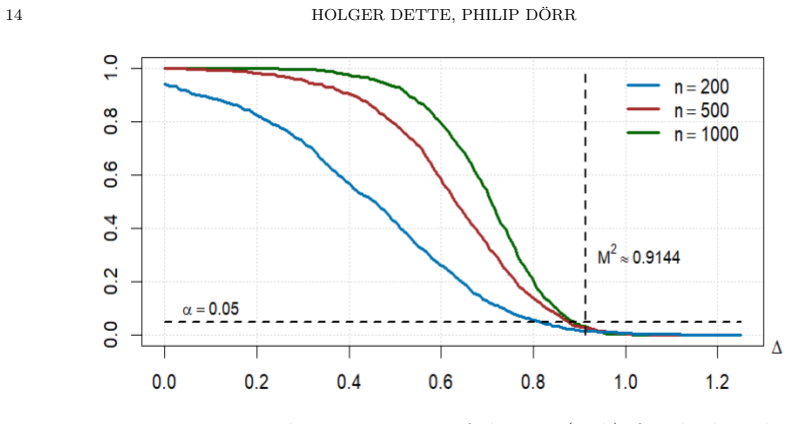
- The relevant-hypothesis tests allow a pre-specified tolerance Δ, so a copula family can be accepted when its induced regression is close enough to the true regression.
- Because the test is consistent under fixed alternatives, any fixed misspecification is detected with probability tending to one as n grows.
- The same Wn construction extends the classical goodness-of-fit question to a wider class of semiparametric regression models where the plug-in parameter is estimated by pseudo-likelihood.
Where Pith is reading between the lines
- Editorial inference: the target M² is defined with ϑ* from pseudo-ML/KL minimization of the copula density, and the paper calls m(·,ϑ*) the best approximation; nothing in the theorems shows that this ϑ* minimizes the L2 regression distance, so M² may be larger than the true best L2 distance to the copula-regression family.
- A testable consequence: define an alternative estimator of ϑ* by directly minimizing the empirical L2 distance to m(·,ϑ); comparing the two targets would reveal when the KL objective distorts the regression-level assessment.
- The self-normalized pivot has a distribution depending only on Brownian motion, so the same construction could be ported to other semiparametric models with intractable alternative variances, provided a sequential U-statistic CLT holds.
- Bandwidth choice remains a practical pressure point; the paper's simulations already show more sensitivity in dimension three, suggesting a bandwidth-free or adaptive variant as a natural extension.
Editorial analysis
A structured set of objections, weighed in public.
Referee Report
Summary. The paper proposes a goodness-of-fit procedure for semiparametric copula regression models. It defines a weighted L2 measure M^2 (Eqs. (1.5), (3.2)) as the distance between the true regression function m and the copula regression function m(·,ϑ*) induced by the pseudo-maximum-likelihood limit ϑ* defined in Eq. (2.6). A kernel-based U-statistic W_n (Eq. (3.1)) is proposed. The paper proves consistency of W_n (Theorem 3.1), asymptotic normality under the null (Theorem 3.2) and under fixed alternatives (Theorem 3.3), and a self-normalized sequential CLT (Theorem 4.1) leading to confidence intervals and tests for relevant hypotheses of the form H0:M^2≤Δ. Simulation evidence is provided for level and power. The proofs are detailed and use standard U-statistic and empirical-process techniques; I found no algebraic error in the main limit theorems. However, the central advertised interpretation of M^2 as the distance to the "best" regression approximation is not justified by the definition of ϑ*, which is the Kullback-Leibler/pseudo-ML projection of the copula, not the minimizer of the L2 regression distance.
Significance. If the advertised interpretation were supported, the paper would offer a useful tool: it would provide a direct regression-level specification test and, through self-normalization, avoid variance estimation in a difficult U-statistic setting. The proof strategy is coherent, especially the decomposition into estimation error and misspecification, the degenerate/non-degenerate U-statistic regimes, and the U-process weak convergence used for the sequential statistic. The self-normalized confidence intervals and relevant-hypothesis tests are a genuine contribution. The weakness is conceptual: the quantity being estimated is the distance to the pseudo-ML/KL-induced regression function, not to the best L2 approximation in the regression family. Because this mismatch affects the interpretation of the null hypothesis and the scope of the tests, it is load-bearing for the paper's central claim. The mathematical results are internally consistent for the quantity actually defined in (3.2).
major comments (3)
- [Abstract, §1 Eq. (1.5), §2 Eq. (2.6), §3.3] The paper repeatedly calls m(·,ϑ*) the 'best approximation' of m by the copula regression model, but ϑ* in (2.6) is the Kullback-Leibler projection of the copula density, not the minimizer of ∫(m(x)-m(x,ϑ))²π(dx). No result in the paper shows these projections coincide; in general they do not. Consequently H0:M^2=0 is not equivalent to m belonging to the parametric regression family {m(·,ϑ):ϑ∈Θ}, and the test can reject a correctly specified regression function when the KL-optimal parameter induces a different regression curve. The theorems are internally consistent for M^2 as defined in (3.2), but the advertised interpretation in the abstract and introduction is unsupported. Please add a theorem giving conditions under which the two projections coincide, redefine M^2 via the regression-projection parameter and develop the corresponding estimator, or revise the 'best approximation' wordi
- [§3.2, Theorem 3.2, Eq. (3.5)] Theorem 3.2 is stated under H0:M^2=0 (the proof says 'If the classical null hypothesis (1.6) is true'), but the proof and the variance formula (3.3) rely on the stronger assumption that the copula family is correctly specified, i.e. (2.2). If M^2=0 arises from a misspecified copula that still induces the true regression, the limiting variance in (3.3) would involve c_X(·,ϑ*) rather than the true inner copula density c_X, and the estimator (3.4) is not justified for that case. The level guarantee for the test (3.5) for the stated null (1.6) is therefore not established outside correct copula specification. Please either prove Theorem 3.2 under M^2=0 alone, or state the null as correct copula specification throughout.
- [§3.3, Theorem 3.3; §4, Theorem 4.1] The fixed-alternative results are introduced under the assumption c∉C, but the CLT is for M^2>0. If the copula is misspecified yet m=m(·,ϑ*), then Δ=0, σ1²=σ2²=0, the √n limit is degenerate, and the self-normalized ratio in (4.3) does not follow. Theorem 3.3 and Theorem 4.1 should explicitly assume M^2>0 (or Δ not identically zero); otherwise the scope of the confidence intervals and relevant tests in Section 4 is broader than the theorems support.
minor comments (4)
- [§3.2, after Eq. (3.5)] 'hypothesis in (1.3)' should read '(1.6)': the test is for H0:M^2=0, not for the copula hypothesis (1.3).
- [§4, Eq. (4.2) and Theorem 4.1] The symbol W_n is reused for the original statistic (3.1) and for the integrated denominator in (4.2). This makes Theorem 4.1 and Corollaries 4.2–4.4 hard to read; please use different symbols, e.g. W_n^{(1)} and W_n^{(2)} or script letters.
- [Table 2 caption] The caption says 'under the alternative H0:M^2>0'; this should be H1:M^2>0.
- [Remark 4.3] The condition h^r=o(n^{-1/2}) with h=Θ(n^{-1/(4+d)}) gives r>2+d/2, not r>3+d/2 as stated. The differentiability requirement 'up to order 2+⌈d/2⌉' also appears not to match the stated kernel order; please align the arithmetic and the smoothness assumption.
Circularity Check
No circularity: the estimator is proved by direct U-statistic arguments to converge to the quantity M² as defined; the 'best approximation' wording is a semantic gap, not a circular step.
full rationale
The paper defines M² in (1.5)/(3.2) as the L2-type integral with ϑ* from (2.6), and Wn in (3.1) as a U-statistic in residuals ei = Yi − ˆm(Xi). The main theorems are proved directly. Theorem 3.1 decomposes Wn into Wn1 + 2Wn2 + Wn3; Wn1 is a U-statistic whose kernel expectation equals the integral defining M² by a substitution argument, while Wn2 and Wn3 are shown to be OP(1/n) via Lemma A.1. Theorem 3.2 obtains the null limit from degeneracy of the kernel when ∆≡0, and Theorem 3.3 uses a Hájek projection plus a U-statistic CLT. None of these steps assumes the conclusion. The cited prior work (Noh et al. 2013 expansion (2.7); Dette and Spreckelsen 2004 Theorem 2; Zheng 1996 lemmas) supplies external, parameter-free asymptotic tools whose assumptions do not include M² or the test's limiting result. The only self-citations — Dette et al. (2014) for motivation and Dette and Spreckelsen (2004) for a standard CLT — are not load-bearing in the sense of assuming the target theorem. No fitted parameter is renamed as a prediction: ϑ* is the probability limit of the pseudo-ML estimator, and Wn is a consistent estimator of the integral that defines M²; this is estimation of a target, not circular reasoning. A separate caveat, which is a correctness/interpretation issue rather than circularity, is that Eq. (1.5) calls m(·,ϑ*) the 'best approximation' by the regression model, but ϑ* is defined in (2.6) as the Kullback-Leibler minimizer of the copula density, not as the minimizer of ∫(m−m(·,ϑ))²π(dx). Thus H0: M²=0 is not necessarily equivalent to m belonging to the regression family {m(·,ϑ)}, so the test's advertised null should be read as 'the KL-optimal parameter reproduces m'. This does not make the derivation circular.
Axiom & Free-Parameter Ledger
free parameters (2)
- bandwidth h =
h=0.5 n^{-1/5} or 1 n^{-1/7}; cross-validation grid in §5.1
- self-normalization truncation δ =
1/2
axioms (6)
- standard math Copula representation m(x)=E[Y c(F0(Y),F(x),ϑ0)]/cX(F(x),ϑ0) is valid.
- domain assumption Regression model Y=m(X)+ε with ε independent of X and regularity conditions R1–R5.
- domain assumption ϑ* lies in the interior of compact Θ.
- domain assumption Pseudo-ML estimator satisfies the expansion (2.7) with i.i.d. influence terms η_k.
- standard math Standard empirical-process Donsker and U-statistic CLT conditions hold.
- domain assumption For Remark 4.3, kernel order r>3+d/2 and smoothness of Δ, c_X*, and p make √n(μ_n−M²)→0.
Cite this review
Pith. "Pith review of Testing for correct model specification in copula regression models." pith.science (2026). https://pith.science/paper/22Y4GUDY
@misc{pith2026260714930,
  author       = {Pith},
  title        = {Pith review of: Testing for correct model specification in copula regression models},
  year         = {2026},
  howpublished = {\url{https://pith.science/paper/22Y4GUDY}},
  note         = {Machine review of arXiv:2607.14930}
}
abstract
We propose a goodness-of-fit test for semiparametric copula regression models. Such models express the regression function in terms of marginal distribution functions and copula densities and therefore provide a flexible way to avoid fully nonparametric estimation in high-dimensional regression problems. Their performance, however, depends crucially on the specification of the parametric copula family. Instead of testing the copula model itself, we assess misspecification directly at the level of the induced regression function. To this end, we introduce a weighted $L^2$-distance between the true regression function and its best approximation within the postulated copula regression model. A kernel-based estimator of this distance is proposed and shown to be consistent and asymptotically normal under both the null hypothesis of correct specification and fixed alternatives. We derive a classical specification test and, using a self-normalized sequential statistic, construct pivotal confidence intervals and tests for relevant deviations from the model. Finite-sample simulations demonstrate accurate level approximation and good power properties of the proposed procedures.
Figures


Reference graph
Works this paper leans on
-
[1]
1999 , publisher=
Convergence of probability measures , author=. 1999 , publisher=
1999
-
[2]
The Annals of Statistics , volume=
A consistent test for the functional form of a regression based on a difference of variance estimators , author=. The Annals of Statistics , volume=. 1999 , publisher=
1999
-
[3]
Journal of Time Series Analysis , volume=
Some comments on specification tests in nonparametric absolutely regular processes , author=. Journal of Time Series Analysis , volume=. 2004 , publisher=
2004
-
[4]
Journal of the American Statistical Association , volume=
Some comments on copula-based regression , author=. Journal of the American Statistical Association , volume=. 2014 , publisher=
2014
-
[5]
Journal of multivariate analysis , volume=
Central limit theorem for integrated square error of multivariate nonparametric density estimators , author=. Journal of multivariate analysis , volume=. 1984 , publisher=
1984
-
[6]
URL http://ie
Package ‘copula’ , author=. URL http://ie. archive. ubuntu. com/disk1/disk1/cran. r-project. org/web/packages/copula/copula. pdf , year=
-
[7]
arXiv preprint arXiv:2604.14649 , year=
Model Checking for Regressions Based on Weighted Residual Processes with Diverging Number of Predictors , author=. arXiv preprint arXiv:2604.14649 , year=
-
[8]
Insurance: Mathematics and Economics , year=
Claims prediction with dependence using copula models , author=. Insurance: Mathematics and Economics , year=
-
[9]
Econometrica: Journal of the Econometric Society , pages=
Semiparametric estimation of index coefficients , author=. Econometrica: Journal of the Econometric Society , pages=. 1989 , publisher=
1989
-
[10]
Journal of the American Statistical Association , volume=
Self-normalization for time series: a review of recent developments , author=. Journal of the American Statistical Association , volume=. 2015 , publisher=
2015
-
[11]
Journal of the Royal Statistical Society Series B: Statistical Methodology , volume=
A self-normalized approach to confidence interval construction in time series , author=. Journal of the Royal Statistical Society Series B: Statistical Methodology , volume=. 2010 , publisher=
2010
-
[12]
Fonctions de repartition an dimensions et leurs marges , author=. Publ. inst. statist. univ. Paris , volume=
-
[13]
Canadian Journal of Statistics , volume=
Semiparametric estimation in copula models , author=. Canadian Journal of Statistics , volume=. 2005 , publisher=
2005
-
[14]
2000 , publisher=
Asymptotic statistics , author=. 2000 , publisher=
2000
-
[15]
Journal of Econometrics , volume=
A consistent test of functional form via nonparametric estimation techniques , author=. Journal of Econometrics , volume=. 1996 , publisher=
1996
-
[16]
Journal of the American Statistical Association , year =
Noh, Hohsuk and El Ghouch, Anouar and Bouezmarni, Taoufik , title =. Journal of the American Statistical Association , year =
-
[17]
Journal of Business & Economic Statistics , year =
Noh, Hohsuk and El Ghouch, Anouar and Van Keilegom, Ingrid , title =. Journal of Business & Economic Statistics , year =
-
[18]
Computational Statistics & Data Analysis , year =
Kraus, Daniel and Czado, Claudia , title =. Computational Statistics & Data Analysis , year =
-
[19]
Insurance: Mathematics and Economics , year =
Aas, Kjersti and Czado, Claudia and Frigessi, Arnoldo and Bakken, Henrik , title =. Insurance: Mathematics and Economics , year =
-
[20]
Czado, Claudia , title =
-
[21]
Journal of Multivariate Analysis , year =
Nagler, Thomas and Czado, Claudia , title =. Journal of Multivariate Analysis , year =
-
[22]
Journal of the Royal Statistical Society Series C: Applied Statistics , volume =
Jobst, David and Möller, Annette and Groß, Jürgen , title =. Journal of the Royal Statistical Society Series C: Applied Statistics , volume =. 2025 , month =. doi:10.1093/jrsssc/qlaf011 , url =
-
[23]
Distributional Regression for Data Analysis , type =
Klein, Nadja , doi =. Distributional Regression for Data Analysis , type =. Annual Review of Statistics and Its Application , keywords =. 2024 , bdsk-url-1 =
2024
-
[24]
Insurance: Mathematics and Economics , year =
Genest, Christian and R\'emillard, Bruno and Beaudoin, Denis , title =. Insurance: Mathematics and Economics , year =
-
[25]
Test , year =
Genest, Christian and R\'emillard, Bruno , title =. Test , year =
-
[26]
Computational Statistics & Data Analysis , year =
Kojadinovic, Ivan and Yan, Jun , title =. Computational Statistics & Data Analysis , year =
-
[27]
Insurance: Mathematics and Economics , year =
Kraemer, Nicole and Brechmann, Eike and Czado, Claudia , title =. Insurance: Mathematics and Economics , year =
-
[28]
Miller Jr., R. G. and Sen, Pranab Kumar , journal=. Weak Convergence of. 1972 , publisher=
1972
-
[29]
Annals of Statistics , year =
Omelka, Martin and Gijbels, Irene and Veraverbeke, Noel , title =. Annals of Statistics , year =
-
[30]
Kien C. Tran and Mike G. Tsionas , doi =. Efficient semiparametric copula estimation of regression models with endogeneity , url =. 2022 , bdsk-url-1 =. https://doi.org/10.1080/07474938.2021.1957284 , journal =
arXiv 2022
-
[31]
A semiparametric copula-based estimation of the regression function for right-censored data , url =
Taoufik Bouezmarni and Yassir Rabhi and Charles Fontaine , doi =. A semiparametric copula-based estimation of the regression function for right-censored data , url =. 2020 , bdsk-url-1 =. https://doi.org/10.1080/02331888.2019.1682582 , journal =
arXiv 2020
-
[32]
Journal of the Royal Statistical Society Series A: Statistics in Society , pages =
Bouezmarni, Taoufik and Doukali, Mohamed and Taamouti, Abderrahim , title =. Journal of the Royal Statistical Society Series A: Statistics in Society , pages =. 2025 , month =. doi:10.1093/jrsssa/qnaf039 , url =
-
[33]
Canadian Journal of Statistics , volume =
Akpo, Talagbe Gabin and Rivest, Louis-Paul , title =. Canadian Journal of Statistics , volume =. doi:https://doi.org/10.1002/cjs.11830 , url =. https://onlinelibrary.wiley.com/doi/pdf/10.1002/cjs.11830 , abstract =
-
[34]
Journal of Econometrics , volume=
Weighted residual empirical processes, martingale transformations, and model specification tests for regressions with diverging number of parameters , author=. Journal of Econometrics , volume=. 2025 , publisher=
2025
-
[35]
Copula-based regression models with data missing at random , url =
Shigeyuki Hamori and Kaiji Motegi and Zheng Zhang , doi =. Copula-based regression models with data missing at random , url =. Journal of Multivariate Analysis , keywords =. 2020 , bdsk-url-1 =
2020
-
[36]
Statistics and Computing , year =
Klein, Nadja and Faschingbauer, Felix and Kneib, Thomas , title =. Statistics and Computing , year =
-
[37]
An Overview of the Goodness-of-Fit Test Problem for Copulas , year =
Fermanian, Jean-David , booktitle =. An Overview of the Goodness-of-Fit Test Problem for Copulas , year =
-
[38]
Copula goodness-of-fit testing: an overview and power comparison , url =
Daniel Berg , doi =. Copula goodness-of-fit testing: an overview and power comparison , url =. 2009 , bdsk-url-1 =. https://doi.org/10.1080/13518470802697428 , journal =
-
[39]
The Price of Tolerance in Distribution Testing , url =
Canonne, Clement L and Jain, Ayush and Kamath, Gautam and Li, Jerry , booktitle =. The Price of Tolerance in Distribution Testing , url =. 2022 , bdsk-url-1 =
2022
-
[40]
2026 , eprint=
Testing Imprecise Hypotheses , author=. 2026 , eprint=
2026
-
[41]
Testing for relevant dependence change in financial data: a CUSUM copula approach , url =
Kutzker, Tim and Stark, Florian and Wied, Dominik , date =. Testing for relevant dependence change in financial data: a CUSUM copula approach , url =. Empirical Economics , number =. 2021 , bdsk-url-1 =. doi:10.1007/s00181-019-01811-4 , id =
-
[42]
The Annals of Statistics , keywords =
Patrick Bastian and Holger Dette and Johannes Heiny , doi =. The Annals of Statistics , keywords =. 2024 , bdsk-url-1 =
2024
-
[43]
Bootstrap tests for almost goodness-of-fit , url =
Ba. Bootstrap tests for almost goodness-of-fit , url =. Statistics and Computing , number =. 2025 , bdsk-url-1 =. doi:10.1007/s11222-025-10762-z , id =
-
[44]
Hall, Peter and Marron, J. S. , title =. Statistics & Probability Letters , volume =. 1987 , mrnumber =
1987
-
[45]
and Ritov, Ya'acov , title =
Bickel, Peter J. and Ritov, Ya'acov , title =. Sankhyā: The Indian Journal of Statistics, Series A , volume =. 1988 , mrnumber =
1988
-
[46]
, title =
Lobato, Ignacio N. , title =. Journal of the American Statistical Association , year =
This paper was first reviewed by deepseek-v4-flash on August 2, 2026.
discussion (0)
Sign in with ORCID, Apple, or X to comment. Anyone can read and Pith papers without signing in.