REVIEW 2 major objections 5 minor 32 references
A multilayer perceptron, trained on STIRAP transfer efficiencies measured under eight driving and detuning configurations, can reconstruct the gauge-invariant plaquette phase of a three-level Δ system across the full 2π interval.
Reviewed by Pith at T0; open to challenge. T0 means a machine referee read the full paper against a public rubric. the ladder, T0–T4 →
T0 review · deepseek-v4-flash
2026-08-02 00:19 UTC pith:6HSTI6JV
load-bearing objection A clean simulation-level proof of principle for estimating the plaquette phase from STIRAP efficiencies; the 'sensing' language runs ahead of the evidence, and the sign-degeneracy objection doesn't survive contact with the paper. the 2 major comments →
Machine-Learning-Empowered Quantum Sensing of the Plaquette Phase in a Three-Level Delta System
The pith
A machine-rendered reading of the paper's core claim, the machinery that carries it, and where it could break.
Core claim
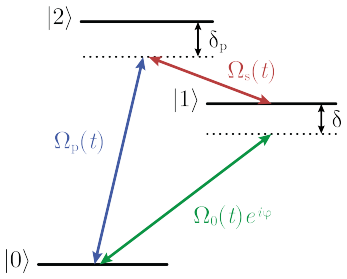
The paper demonstrates that the plaquette phase φ, a gauge-invariant quantity that cannot be directly measured, is encoded in the transfer efficiency of STIRAP. When the detuning is set to the value that would ensure perfect trapping at φ=0, any nonzero φ causes leakage from the dark manifold proportional to sin φ, so the final population of the target state becomes a phase-dependent observable. The authors construct an eight-dimensional fingerprint of efficiencies from three driving conditions and three detuning schemes, and show that a multilayer perceptron trained on noiseless simulated data predicts φ across the full interval with small error. The MLP outputs (cos φ, sin φ), avoiding the
What carries the argument
The gauge-invariant plaquette phase φ = φ0 + φs − φp, which remains after all local gauge transformations are exhausted; the generalized dark-state (trapped-state) condition that defines the detuning baseline; the dark state |D⟩ = cosθ|0⟩ − sinθ|1⟩; and the fact that for φ ≠ 0 the dressed states acquire a component along |D⟩ proportional to sin φ, which produces phase-dependent leakage. The sensing protocol uses eight STIRAP efficiencies (three driving configurations × detuning settings) as features, and a two-output MLP trained with mean-squared error on the circular encoding.
Load-bearing premise
The eight measured transfer efficiencies form a well-conditioned, effectively invertible fingerprint of the plaquette phase, so a network trained on ideal noiseless simulations will infer the phase from real measurements made with noise and experimental imperfections.
What would settle it
Sweep the plaquette phase on a controllable platform (or simulate the full Lindblad master equation with realistic noise) and record the eight efficiencies; if two distinct phases in [−π,π] yield fingerprint vectors that are statistically indistinguishable at the experimental noise level, or if the network's prediction error grows sharply once noise is added to the ideal efficiencies, then the central sensing claim fails. A numerical check: compute the Jacobian of the eight-efficiency map with respect to φ; if its singular values collapse toward zero anywhere, the map is locally non-invertible
If this is right
- A single final-population measurement per configuration replaces full state tomography, making the phase estimate cheap and experimentally accessible.
- The phase-dependent degradation of STIRAP, normally a drawback, becomes the physical resource that carries the sensing signal.
- Because the method relies only on the closed-loop geometry, it transfers to any engineered platform—superconducting circuits, NV centers, quantum dots—with the same fingerprint structure.
- The circular (cos φ, sin φ) output means the estimator works uniformly across the 2π boundary, so no phase discontinuity artifacts appear.
Where Pith is reading between the lines
- The paper only tests noiseless synthetic data; the immediate next experiment is to add measurement noise and parameter fluctuations. If the eight-efficiency mapping is not robust, the authors will need to augment the training set or the feature vector.
- The choice of eight features is heuristic (three driving conditions, three detunings, two matched configurations). A cheaper protocol with fewer features may be possible; the paper lists reducing the number of input features as future work.
- In a lattice of many triangular plaquettes, the same method could serve as a local magnetometer for synthetic gauge fields: measuring each plaquette's phase map would reconstruct the effective magnetic-field texture.
- The network's generalization is only demonstrated within the same parameter range used for training (fixed pulse width, delay, and amplitude ratio). Whether the estimator is robust to changes in pulse shape or timing is an untested extension.
Editorial analysis
A structured set of objections, weighed in public.
Referee Report
Summary. The paper proposes a machine-learning approach to estimate the plaquette phase φ in a closed-loop three-level Δ system from STIRAP population transfer efficiencies. The Hamiltonian (2) contains a residual complex coupling e^{±iφ}; Sec. 2.3 shows that a non-zero φ breaks coherent population trapping, producing a phase-dependent transfer efficiency. Sec. 3 describes an eight-efficiency feature vector built from three driving conditions and several detuning protocols, and an MLP with circular output (cos φ, sin φ). Sec. 4 reports low test error on a synthetic dataset of 2000 phases. The authors conclude that the phase can be accurately reconstructed from experimentally accessible observables.
Significance. The analytical treatment of the dark-state breakdown is standard and the data-generation pipeline is transparent, including a held-out test set and early stopping; these are strengths. However, the central sensing claim is invalidated by an exact symmetry: all eight input efficiencies are invariant under φ→-φ while the target is not. Thus the reported MLP performance cannot be reproduced as stated, and the proposed method does not sense the signed plaquette phase. The practical significance of the work therefore hinges on a symmetry obstruction that is not addressed; the paper would need a fundamentally different observable or a reduced target (e.g., |φ|) to be salvageable.
major comments (2)
- [Secs. 3.3 and 4, Eq. (2)] For the Hamiltonian in Eq. (2), H(−φ)=H(φ)^*. Since the pulses in Eq. (10) are real, the detunings are real, and the STIRAP initial state is |0⟩, the propagator satisfies U(−φ)=U(φ)^*. Every feature is a final population η=|<1|ψ(t_f)>|² (Eq. 12), so η_k(−φ)=η_k(φ) for each of the eight configurations. The input vector therefore satisfies x(−φ)=x(φ) while the target (cos φ, sin φ) in Eq. (13) is not invariant under φ→−φ. A deterministic MLP cannot separate φ and −φ from identical inputs. The low test error in Fig. 4 is inconsistent with the stated data-generation protocol unless the symmetry is broken by an unstated step. This is a load-bearing flaw, not a noise issue: it persists in the ideal noiseless limit.
- [Abstract; Sec. 5] The abstract claims estimation from 'experimentally accessible observables' and the conclusions frame the result as a quantum-sensing protocol. However, the entire study uses noiseless synthetic data with no detector noise, no parameter fluctuations, no error bars, and no comparison with a direct estimator or baseline. The only generalization demonstrated is interpolation within the same model distribution. This overstates the experimental scope and should be corrected even if the symmetry issue were resolved.
minor comments (5)
- [Sec. 5, first paragraph] 'three-level ∆ system with.' contains a dangling 'with'.
- [Abstract] 'STImulated' should be 'Stimulated'.
- [Eq. (8)] The notation eδ_p is undefined; it presumably denotes the shifted detuning defined in Eq. (7).
- [Sec. 3.3, Table 2] The definitions of δ_pump and δ_Stokes are described only in prose; the table would be clearer if the matched detuning formulas were written explicitly.
- [Sec. 4 and Fig. 4] The conversion from the two output components to a predicted angle is not specified; the convention used to report 'predicted phase' should be stated.
Circularity Check
No circular derivation; physics is from external Ref. [15], ML test is held-out interpolation, self-citations are motivational only.
full rationale
The derivation chain is self-contained. The trapping condition, dark state, and dressed-state leakage (Eqs. (4)-(8)) are taken from Ref. [15], an external reference, and the MLP is trained on numerically integrated Schrödinger dynamics of Eq. (2) with held-out test phases; the target y=(cos φ, sin φ) is not used as an input and no fitted parameter is renamed as a prediction. The only self-citations [23,24] appear as motivation ('we take inspiration') and for a normalization convention; they carry no load in the sensing argument. The paper itself flags the inverse problem as 'generally non-invertible' (Sec. 1) and defers noise robustness to future work (Sec. 5); these are limitations of the protocol, not circularity. Any φ→−φ identifiability issue would be a physical correctness concern rather than a definitional/fitted-input circularity and is not counted here.
Axiom & Free-Parameter Ledger
free parameters (4)
- Pulse width T =
ΩT = 15
- Pulse delay τ =
0.7 T
- Detuning δ_p =
0
- Pulse amplitude ratios =
Ω_p/Ω_s ∈ {1, 2, 1/2}
axioms (5)
- domain assumption Rotating-wave three-level Δ Hamiltonian with complex couplings, Eqs. (1)-(2)
- domain assumption The trapped-state/dressed-state analysis from Ref. [15] (Sec. 2.3) remains valid under the operational detuning of Eq. (9)
- ad hoc to paper The mapping from phase φ to the 8-dimensional efficiency vector is well-posed (unique and stable enough to invert)
- standard math An MLP can approximate this mapping and generalize to unseen phases
- domain assumption Measured transfer efficiencies are noiseless and exact
read the original abstract
We propose a machine-learning-empowered approach to the quantum sensing of the plaquette phase, a gauge-invariant quantity arising in three-level $\Delta$ systems. This phase profoundly affects the system dynamics, breaking coherent population trapping and inducing a non-trivial phase dependence of the dynamics. We demonstrate that a multi-layer perceptron (MLP), trained in a supervised-learning framework, can accurately estimate the plaquette phase from STImulated Raman Adiabatic Passage (STIRAP) population transfer efficiencies measured under different driving conditions, which provide experimentally accessible observables. Our results highlight how the combination of coherent control and machine learning (ML) enables effective phase identification in closed-loop quantum systems, opening new perspectives for quantum technologies, specifically quantum sensing applications including synthetic gauge fields.
Figures


Reference graph
Works this paper leans on
-
[1]
The Quantum Technologies Roadmap: A European Community View
A. Ac ´ ın et al. “The Quantum Technologies Roadmap: A European Community View”. In:New Journal of Physics20 (2018), p. 080201. issn: 1367-2630.doi:10.1088/1367-2630/aad1ea
-
[2]
Quantum Technology: The Sec- ond Quantum Revolution
J. P. Dowling and G. J. Milburn. “Quantum Technology: The Sec- ond Quantum Revolution”. In:Philosophical Transactions of the Royal Society of London. Series A: Mathematical, Physical and Engineering Sciences361 (2003). Ed. by A. G. J. MacFarlane, pp. 1655–1674.issn: 1364-503X, 1471-2962.doi:10.1098/rsta.2003.1227
arXiv 2003
-
[3]
C. L. Degen, F. Reinhard, and P. Cappellaro. “Quantum Sensing”. In:Reviews of Modern Physics89 (2017), p. 035002.issn: 0034-6861, 1539-0756.doi:10.1103/RevModPhys.89.035002
-
[4]
Coherent Manipulations of Atoms Using Laser Light
B. Shore. “Coherent Manipulations of Atoms Using Laser Light”. In: Acta Physica Slovaca. Reviews and Tutorials58.3 (2008).issn: 1336- 040X, 0323-0465.doi:10.2478/v10155-010-0090-z
-
[5]
Nonabsorbing Atomic Coherences by Coherent Two-Photon Transitions in a Three-Level Optical Pumping
E. Arimondo and G. Orriols. “Nonabsorbing Atomic Coherences by Coherent Two-Photon Transitions in a Three-Level Optical Pumping”. In:Lettere al Nuovo Cimento (1971-1985)17.10 (1976), pp. 333–338. issn: 1827-613X.doi:10.1007/BF02746514
-
[6]
Coherent Trapping of Atomic Populations
H. R. Gray, R. M. Whitley, and C. R. Stroud. “Coherent Trapping of Atomic Populations”. In:Optics Letters3.6 (1978), pp. 218–220.issn: 1539-4794.doi:10.1364/OL.3.000218. 13
-
[7]
V coherent population trapping in laser spectroscopy
E. Arimondo. “V coherent population trapping in laser spectroscopy”. In:Progress in optics35 (1996), pp. 257–354.doi:10.1016/S0079- 6638(08)70531-6
doi:10.1016/s0079- 1996
-
[8]
Coherent Population Transfer among Quantum States of Atoms and Molecules
K. Bergmann, H. Theuer, and B. W. Shore. “Coherent Population Transfer among Quantum States of Atoms and Molecules”. In:Re- views of Modern Physics70.3 (1998), pp. 1003–1025.doi:10.1103/ RevModPhys.70.1003
1998
-
[9]
Stimulated Raman Adiabatic Passage in Physics, Chemistry, and Beyond
N. V. Vitanov et al. “Stimulated Raman Adiabatic Passage in Physics, Chemistry, and Beyond”. In:Reviews of Modern Physics89.1 (2017), p. 015006.doi:10.1103/RevModPhys.89.015006
-
[10]
Stimulated Raman Adiabatic Passage in a Three- Level Superconducting Circuit
K. S. Kumar et al. “Stimulated Raman Adiabatic Passage in a Three- Level Superconducting Circuit”. In:Nature Communications7.1 (2016), p. 10628.issn: 2041-1723.doi:10.1038/ncomms10628
-
[11]
J. Siewert, T. Brandes, and G. Falci. “Advanced Control with a Cooper- pair Box: Stimulated Raman Adiabatic Passage and Fock-state Gen- eration in a Nanomechanical Resonator”. In:Physical Review B79.2 (2009), p. 024504.doi:10.1103/PhysRevB.79.024504
-
[12]
Design of a Lambda System for Population Transfer in Superconducting Nanocircuits
G. Falci et al. “Design of a Lambda System for Population Transfer in Superconducting Nanocircuits”. In:Physical Review B87.21 (2013), p. 214515.doi:10.1103/PhysRevB.87.214515
-
[13]
Advances in Quantum Control of Three-Level Super- conducting Circuit Architectures
G. Falci et al. “Advances in Quantum Control of Three-Level Super- conducting Circuit Architectures”. In:Fortschritte der Physik65.6-8 (2017), p. 1600077.issn: 1521-3978.doi:10.1002/prop.201600077
-
[14]
Population Transfer in a Lambda System In- duced by Detunings
P. G. Di Stefano et al. “Population Transfer in a Lambda System In- duced by Detunings”. In:Physical Review B91.22 (2015), p. 224506. doi:10.1103/PhysRevB.91.224506
-
[15]
Coherent Trapping in Small Quantum Networks
T. J. Pope et al. “Coherent Trapping in Small Quantum Networks”. In:Journal of Statistical Mechanics: Theory and Experiment2019.12 (2019), p. 124024.issn: 1742-5468.doi:10.1088/1742-5468/ab54b7
-
[16]
Atomic Physics and Quantum Optics Using Superconducting Circuits
J. Q. You and F. Nori. “Atomic Physics and Quantum Optics Using Superconducting Circuits”. In:Nature474 (2011), pp. 589–597.issn: 0028-0836, 1476-4687.doi:10.1038/nature10122
-
[17]
Y. Liu et al. “Optical Selection Rules and Phase-Dependent Adiabatic State Control in a Superconducting Quantum Circuit”. In:Physical Review Letters95 (2005), p. 087001.doi:10.1103/PhysRevLett.95. 087001
-
[18]
Observation of chiral solitary waves in a nonlinear Aharonov-Bohm ring
I. Velkovsky et al. “Observation of chiral solitary waves in a nonlinear Aharonov-Bohm ring”. In:arXiv preprint arXiv:2406.01732(2024). 14
Pith/arXiv arXiv 2024
-
[19]
Machine Learning and Quantum Devices
F. Marquardt. “Machine Learning and Quantum Devices”. In:SciPost Physics Lecture Notes(2021), p. 29.issn: 2590-1990.doi:10.21468/ SciPostPhysLectNotes.29
2021
-
[20]
Artificial intelligence and machine learning for quan- tum technologies
M. Krenn et al. “Artificial intelligence and machine learning for quan- tum technologies”. In:Phys. Rev. A107 (1 2023), p. 010101.doi: 10.1103/PhysRevA.107.010101
-
[21]
J. Brown et al. “Reinforcement learning-enhanced protocols for co- herent population-transfer in three-level quantum systems”. In:New Journal of Physics23.9 (2021), p. 093035.doi:10.1088/1367-2630/ ac2393
-
[22]
A Tutorial on Optimal Control and Reinforcement Learning Methods for Quantum Technologies
L. Giannelli et al. “A Tutorial on Optimal Control and Reinforcement Learning Methods for Quantum Technologies”. In:Physics Letters A 434 (2022), p. 128054.issn: 03759601.doi:10 . 1016 / j . physleta . 2022.128054
arXiv 2022
-
[23]
Noise Classification in Three-Level Quantum Net- works by Machine Learning
S. Mukherjee et al. “Noise Classification in Three-Level Quantum Net- works by Machine Learning”. In:Machine Learning: Science and Tech- nology5.4 (2024), p. 045049.issn: 2632-2153.doi:10 . 1088 / 2632 - 2153/ad9193
2024
-
[24]
Fasone et al.Detection of Noise Correlations in Two Qubit Systems by Machine Learning
D. Fasone et al.Detection of Noise Correlations in Two Qubit Systems by Machine Learning. 2025.doi:10.48550/arXiv.2509.03389. arXiv: 2509.03389 [quant-ph]
-
[25]
Artificial Gauge Fields with Ultracold Atoms
V. Galitski, G. Juzeli¯ unas, and I. B. Spielman. “Artificial Gauge Fields with Ultracold Atoms”. In:Physics Today72.1 (2019), pp. 38–44.issn: 0031-9228, 1945-0699.doi:10.1063/PT.3.4111
-
[26]
Atomic Interferometers: Phase-dependence in Mul- tilevel Atomic Transitions
S. J. Buckle et al. “Atomic Interferometers: Phase-dependence in Mul- tilevel Atomic Transitions”. In:Optica Acta: International Journal of Optics33.9 (1986), pp. 1129–1140.issn: 0030-3909.doi:10 . 1080 / 713822082
1986
-
[27]
Laser-Induced Adiabatic Atomic Reorientation with Control of Diabatic Losses
R. G Unanyan et al. “Laser-Induced Adiabatic Atomic Reorientation with Control of Diabatic Losses”. In:Optics Communications139 (1997), pp. 48–54.issn: 00304018.doi:10.1016/S0030-4018(97)00099-0
-
[28]
Burkov.The Hundred-Page Machine Learning Book
A. Burkov.The Hundred-Page Machine Learning Book. Vol. 1. 2019
2019
-
[29]
D. P. Kingma and J. Ba.Adam: A Method for Stochastic Optimization. 2014.doi:10.48550/arXiv.1412.6980. arXiv:1412.6980 [cs.LG]
-
[30]
Abadi et al.TensorFlow: Large-Scale Machine Learning on Het- erogeneous Systems
M. Abadi et al.TensorFlow: Large-Scale Machine Learning on Het- erogeneous Systems. Software available from tensorflow.org. 2015.url: https://www.tensorflow.org/
2015
-
[31]
Chiral Ground-State Currents of Interacting Pho- tons in a Synthetic Magnetic Field
P. Roushan et al. “Chiral Ground-State Currents of Interacting Pho- tons in a Synthetic Magnetic Field”. In:Nature Physics13 (Feb. 2017), pp. 146–151.issn: 1745-2473, 1745-2481.doi:10.1038/nphys3930. 15
-
[32]
Phase-Controlled Coherent Dynamics of a Single Spin under Closed-Contour Interaction
A. Barfuss et al. “Phase-Controlled Coherent Dynamics of a Single Spin under Closed-Contour Interaction”. In:Nature Physics14 (Nov. 2018), pp. 1087–1091.issn: 1745-2481.doi:10.1038/s41567-018-0231-8. 16
discussion (0)
Sign in with ORCID, Apple, or X to comment. Anyone can read and Pith papers without signing in.