REVIEW 3 major objections 6 minor 94 references
QuReC claims that replacing a single image-level degradation prompt with per-query prototype matching, plus calibrating local-global attention, makes one restoration model the best across three all-in-one benchmark suites—including all 11 c
Reviewed by Pith at T0; open to challenge. T0 means a machine referee read the full paper against a public rubric. the ladder, T0–T4 →
T0 review · deepseek-v4-flash
2026-08-02 00:08 UTC pith:XPMVJN4M
load-bearing objection A well-ablated, genuinely new query-specific prompt mechanism for all-in-one restoration; the SOTA margins are plausible but rest on single unseeded runs and undocumented baseline provenance. the 3 major comments →
QuReC: All-in-One Image Restoration with Query-Specific Guidance and Local-Global Response Calibration
The pith
A machine-rendered reading of the paper's core claim, the machinery that carries it, and where it could break.
Core claim
The central claim is that replacing one image-level degradation prompt with per-query degradation semantics, and then re-weighting local and global attention outputs with learnable priors, lets a single restoration network outperform dedicated and all-in-one baselines on denoising, deraining, dehazing, deblurring, low-light enhancement, and composite mixes of them. DQRM matches each spatial query against a bank of degradation prototypes (built from text embeddings of degradation names) to reconstruct a query-specific prompt, aided by a weakly supervised loss that balances prototype usage and pulls the average matching distribution toward the degradations actually present in the image. LGRCM
What carries the argument
The load-bearing mechanism is the combination of (1) a Degradation-Guided Query Reconstruction Module (DQRM), in which each spatial query soft-matches against a frozen text-embedding prototype bank and adds the matched prototype signal plus a shared anchor to its base query; and (2) a Local-Global Response Calibration Module (LGRCM), which computes local-window and global attention in a shared softmax space and gates the outputs with prior responses retrieved from the base query. The two are inserted as Query Reconstruction and Response Calibration Blocks (QRCBs) at three decoder stages, so guidance is refined progressively from coarse to fine. A weakly supervised matching loss (load balanci
Load-bearing premise
The central claim assumes that the baseline numbers in Tables 1–3 were produced under the same all-in-one training/evaluation protocol as QuReC; the paper does not state whether baselines were retrained in-house or how many seeds were used, and some winning margins are smaller than typical run-to-run variation.
What would settle it
Run the compared baselines and QuReC under one identical training schedule, dataset splits, patch sizes, and evaluation script with multiple seeds; if margins on SOTS, BSD68-denosing, and other settings shrink to near zero or flip, the state-of-the-art claim would not survive. A targeted behavioral falsifier: synthesize images that are half haze and half rain (or haze plus local rain patches) and check whether the model applies qualitatively different restoration in the two regions—if the output looks like a single global prompt was used, the query-specific guidance claim is undercut.
If this is right
- A single model can now handle spatially heterogeneous and mixed degradations without needing a separate branch per degradation type.
- Because queries are reconstructed per location, the same prototype bank can in principle scale to more degradation categories by adding prototypes, assuming the matching loss is updated accordingly.
- Joint normalization of local and global attention forces the two branches to compete in one probability space, which the ablations show improves coordination over independent branches.
- The weak semantic supervision makes routing interpretable: t-SNE shows separation of degradation clusters, enabling region-level diagnostics of what the model thinks is wrong.
- The gains on the composite CDD11 set (e.g., about 3.7 dB over the prior best model on the haze setting) suggest composite degradations benefit most from per-query guidance.
Where Pith is reading between the lines
- The prototype bank is fixed to the degradations seen in training; extending toward open-set or never-seen degradations via dynamic prototype creation is a natural next step that the paper's own OOD experiment shows is currently limited.
- The reported margins on some tasks (e.g., 0.08 dB on SOTS in the five-task table) are smaller than typical run-to-run noise; a controlled re-benchmark with identical training protocol and multiple seeds would make the superiority claim robust.
- Because the matching loss uses only image-level degradation labels, the model learns spatial attribution without dense annotation; one could test whether the learned attribution matches human-annotated degradation maps, which the qualitative visualizations suggest but do not quantify.
- The extra overhead of DQRM over LGRCM is small (0.89M params, 3.27G FLOPs, about 0.001s), so the per-query mechanism may transfer to real-time or mobile restoration pipelines if the base attention cost is acceptable.
Editorial analysis
A structured set of objections, weighed in public.
Referee Report
Summary. The paper proposes QuReC, a unified all-in-one image restoration framework. Two modules are introduced: (i) DQRM, which builds a degradation prototype bank from CLIP text embeddings and reconstructs query-specific degradation-aware queries by softly matching each spatial token against the prototypes, regularized by a load-balancing loss and an image-level weak matching loss; and (ii) LGRCM, which performs joint local-global attention with learnable prior-gated calibration. The model is evaluated on three benchmark suites: three-task all-in-one (denoising, deraining, dehazing), five-task all-in-one (additionally deblurring and low-light enhancement), and the CDD11 composite-degradation benchmark. The paper reports state-of-the-art average PSNR/SSIM on all three suites and claims the best PSNR/SSIM in nearly all individual settings. Ablations show that both modules and the matching objective contribute to the reported gains.
Significance. If the reported results are reproducible, the architecture is a meaningful contribution: it moves beyond image-level prompts to spatially adaptive degradation guidance and introduces a local-global attention calibration mechanism that is broadly applicable to all-in-one restoration. The paper has several strengths: a clean module design, consistent ablation results, supplementary sensitivity analyses, and a promise of code release. However, the central claim of state-of-the-art performance rests on experimental comparisons whose rigor is not yet established: no seed or error-bar information is provided, baseline protocols are not documented, and several reported margins are extremely small. These issues are fixable but currently prevent the paper's headline claim from being fully verified.
major comments (3)
- [Section 4.2, Tables 1-3] The central SOTA claim is based on single-run numbers without error bars, number of seeds, or significance tests. Key margins are very small: Table 2 shows a 0.08 dB gain on SOTS (31.72 vs. 31.64) and Table 1 shows a 0.09 dB gain on BSD68 sigma=50 (28.34 vs. 28.25). In the all-in-one restoration literature, such differences are commonly within run-to-run variation under a fixed schedule. Please report mean and standard deviation over at least three seeds for QuReC and, ideally, for the main baselines; otherwise the claim of 'best in all five evaluation settings' is not established.
- [Section 4.1 / Table 4 protocol] The manuscript does not state whether baseline numbers in Tables 1-3 were produced by retraining under the same merged-data, 150-epoch protocol or taken from original papers. The baseline Restormer value in Table 4 matches Table 1, but this does not document the protocol for the other methods. Differences in training schedule, crop size, loss, or data mixing can easily account for margins of 0.1-0.3 dB. Please clarify for each baseline whether it was retrained in-house, and if numbers are cited, provide the source and state the exact training setting used for the comparison.
- [Supplementary Table 16] The Urban100 columns appear misaligned: the IRCNN row lists PSNR 27.59 for sigma=15, 31.20 for sigma=25, and 27.70 for sigma=50, which is an implausible ordering for a denoising method. This suggests a formatting or transcription error in the table. Since the supplementary tables are used to support the model's task-specific competitiveness, please correct the alignment and verify every number against the original sources.
minor comments (6)
- [Section 3.2, Eq. (5)] Equation (5) is typeset ambiguously: the expression 'K \sum (u)^2 - 1' appears to be a garbled form of the squared coefficient of variation used in Algorithm 1 (line 11). Please rewrite the equation in standard notation so that the load-balancing objective is unambiguous.
- [Section 3.2 / Supplementary Algorithm 1] The weak matching loss in Eq. (7) uses image-level degradation labels y_b, which in the all-in-one setting are exactly the degradation labels present in each training image. Calling this 'weakly supervised' is misleading; it is image-level supervision, not token-level. Suggest renaming it 'image-level matching supervision' to avoid confusion.
- [Section 2 (Related Work)] Typo: 'arichitectural' should be 'architectural'.
- [Figure 2] The figure contains garbled labels in the QRCB diagram, e.g., 'Spilit' and malformed resolution markers. Please regenerate the figure with clean text.
- [Table 1] The Restormer row reports SSIM 0.865 for both BSD68 sigma=15 and sigma=25, which is inconsistent with published Restormer results (sigma=15 should be substantially higher). If this is not a typo, please explain the discrepancy; if it is, correct it.
- [Section 3.2] The CLIP text encoder is said to be frozen, but the specific CLIP variant (e.g., ViT-B/32) is not stated. Please provide the exact model and text prompt templates used for the prototype bank.
Circularity Check
No significant circularity: QuReC is an empirical architecture paper whose reported gains come from supervised training against clean targets; the few self-citations are not load-bearing.
full rationale
QuReC does not derive a prediction from a fitted input. Its modules are defined by explicit equations: DQRM reconstructs queries as q̂_n = q_n + p_g + p_n (Eq. 2) via a soft mixture of CLIP prototypes (Eq. 1), and LGRCM computes calibrated attention outputs (Eqs. 9–13). The final training objective L = L_res + L_pm (Eq. 16) is dominated by L_res = L1 + 0.1 L_fft against clean images, so the reported PSNR/SSIM values are not forced by construction. The auxiliary prototype-matching loss L_match (Eq. 7) uses image-level degradation labels y_b (Eq. 6); this is ordinary weak supervision of an internal routing/assignment mechanism, not the restoration target being encoded into the input. The ablation tables (Tables 4–6, and supplementary Tables 7–10) show incremental gains from each component under a fixed evaluation protocol, which is consistent with a genuine architectural contribution rather than a renamed known result. References [70] and [84] share an author with this paper, but they appear only as related-work examples of prompt-based and dehazing methods and carry no argumentative weight; no uniqueness theorem or ansatz is imported from them, and no design choice is justified solely by those citations. The main weaknesses of the paper—small margins (e.g., 0.08 dB on SOTS in Table 2), unreported seeds, and unspecified baseline training protocols—are experimental-validity concerns about benchmark comparability, not circularity: they do not show that any stated quantity is equal to its input by definition. Under the given rubric, which requires exhibiting a specific reduction (Eq. X = Eq. Y by construction, or a fitted parameter renamed as a prediction), no circular step is present.
Axiom & Free-Parameter Ledger
free parameters (6)
- lambda_bal =
0.01
- lambda_match =
0.05
- alpha_s =
0.7
- alpha_h =
0.3
- local window size k =
3
- L_fft weight =
0.1
axioms (4)
- domain assumption CLIP text embeddings of degradation names provide semantically meaningful anchors for pixel-level restoration guidance.
- domain assumption Image-level degradation labels are available for every training image and the prototype categories match the evaluation distributions.
- domain assumption Baseline numbers from Table 1-3 are comparable to QuReC under the same training/evaluation protocol.
- domain assumption PSNR and SSIM on the chosen benchmarks are accepted measures of restoration quality.
invented entities (2)
-
Degradation prototype bank T
no independent evidence
-
Learnable local/global prior banks B_l and B_g
no independent evidence
read the original abstract
All-in-one image restoration aims to recover clean images degraded by multiple corruption types using a single unified model. Existing methods typically rely on image-level prompts or shared guidance to handle diverse degradations. However, such a paradigm becomes inadequate when degradations are spatially heterogeneous or even coexist in mixed forms within a single image. Yet spatially adaptive guidance alone is not sufficient, since accurate restoration also requires each spatial query to reliably aggregate complementary information from local neighborhoods and global contexts. To this end, we propose QuReC, a unified framework for all-in-one image restoration. QuReC consists of a Degradation-Guided Query Reconstruction Module (DQRM) and a Local-Global Response Calibration Module (LGRCM). Specifically, DQRM matches each spatial query against a degradation prototype space to reconstruct a query-specific degradation-aware representation, thereby providing fine-grained spatially adaptive restoration guidance. To further stabilize this query-wise matching process, we introduce a weakly supervised prototype matching learning strategy to improve optimization stability and degradation semantic consistency. Meanwhile, LGRCM performs local-global dual-branch aggregation and calibrates the aggregated responses with learnable priors, improving the reliability of feature aggregation and the coordination between local detail modeling and global context modeling. Extensive experiments demonstrate that QuReC achieves superior performance on multiple all-in-one image restoration benchmarks. The code is released at https://github.com/zhoushen1/QuReC.
Figures


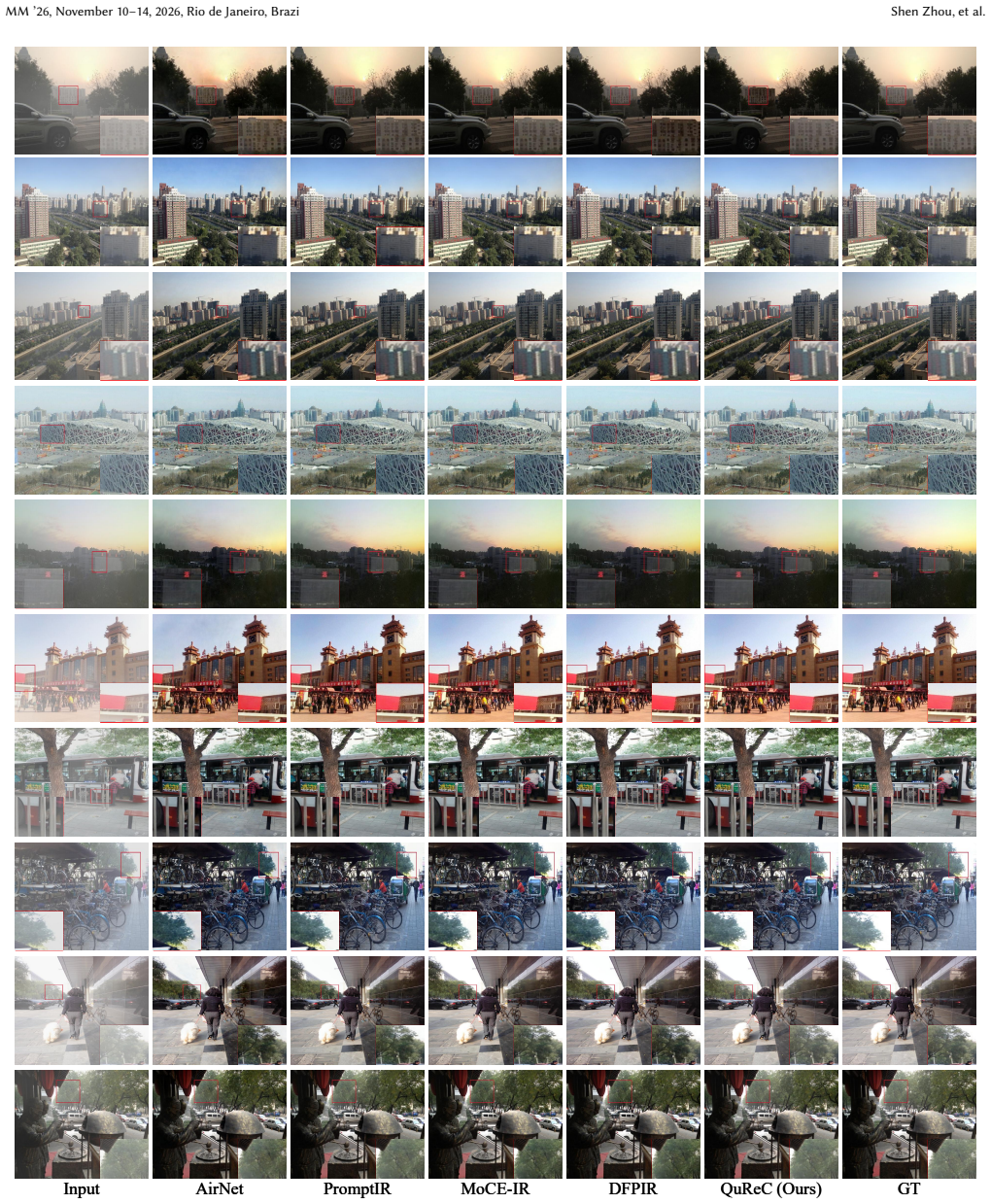

Reference graph
Works this paper leans on
-
[1]
Pablo Arbeláez, Michael Maire, Charless Fowlkes, and Jitendra Malik. 2011. Con- tour Detection and Hierarchical Image Segmentation. IEEE Transactions on Pattern Analysis and Machine Intelligence 33, 5 (2011), 898–916
2011
-
[2]
Bolun Cai, Xiangmin Xu, Kui Jia, Chunmei Qing, and Dacheng Tao. 2016. De- hazeNet: An End-to-End System for Single Image Haze Removal. IEEE Transac- tions on Image Processing 25, 11 (2016), 5187–5198
2016
-
[3]
Yuanhao Cai, Hao Bian, Jing Lin, Haoqian Wang, Radu Timofte, and Yulun Zhang
-
[4]
Anthony Chan
Cheuk-Yiu Chan, Wan-Chi Siu, Yuk-Hee Chan, and H. Anthony Chan. 2024. AnlightenDiff: Anchoring Diffusion Probabilistic Model on Low Light Image Enhancement. IEEE Transactions on Image Processing 33 (2024), 6324–6339
2024
-
[5]
Chenghao Chen and Hao Li. 2021. Robust representation learning with feedback for single image deraining. In Proceedings of the IEEE/CVF conference on computer vision and pattern recognition . 7742–7751
2021
-
[6]
Jun Chen, Liling Yang, Wei Yu, Wenping Gong, Zhanchuan Cai, and Jiayi Ma
-
[7]
Liangyu Chen, Xiaojie Chu, Xiangyu Zhang, and Jian Sun. 2022. Simple baselines for image restoration. InEuropean conference on computer vision. Springer, 17–33
2022
-
[8]
Wei-Ting Chen, Hao-Yu Fang, Cheng-Lin Hsieh, Cheng-Che Tsai, I Chen, Jian- Jiun Ding, Sy-Yen Kuo, et al. 2021. All snow removed: Single image desnowing algorithm using hierarchical dual-tree complex wavelet representation and con- tradict channel loss. In Proceedings of the IEEE/CVF international conference on computer vision. 4196–4205
2021
-
[9]
Wei-Ting Chen, Zhi-Kai Huang, Cheng-Che Tsai, Hao-Hsiang Yang, Jian-Jiun Ding, and Sy-Yen Kuo. 2022. Learning multiple adverse weather removal via two-stage knowledge learning and multi-contrastive regularization: Toward a unified model. In Proceedings of the IEEE/CVF conference on computer vision and pattern recognition. 17653–17662
2022
-
[10]
Sung-Jin Cho, Seo-Won Ji, Jun-Pyo Hong, Seung-Won Jung, and Sung-Jea Ko. 2021. Rethinking coarse-to-fine approach in single image deblurring. In Proceedings of the IEEE/CVF international conference on computer vision . 4641–4650
2021
-
[11]
Marcos V Conde, Gregor Geigle, and Radu Timofte. 2024. Instructir: High-quality image restoration following human instructions. In European Conference on Computer Vision. 1–21
2024
-
[12]
Yuning Cui, Yi Tao, Wenqi Ren, and Alois Knoll. 2023. Dual-domain attention for image deblurring. In Proceedings of the AAAI conference on artificial intelligence . 479–487
2023
-
[13]
Yuning Cui, Syed Waqas Zamir, Salman Khan, Alois Knoll, Mubarak Shah, and Fahad Shahbaz Khan. 2025. Adair: Adaptive all-in-one image restoration via frequency mining and modulation. In 13th international conference on learning representations, ICLR 2025. 57335–57356
2025
-
[14]
Shifei Ding, Qidong Wang, Lili Guo, Xuan Li, Ling Ding, and Xindong Wu
-
[15]
Hang Dong, Jinshan Pan, Lei Xiang, Zhe Hu, Xinyi Zhang, Fei Wang, and Ming- Hsuan Yang. 2020. Multi-scale boosted dehazing network with dense feature fusion. In Proceedings of the IEEE/CVF conference on computer vision and pattern recognition. 2157–2167
2020
-
[16]
Yu Dong, Yihao Liu, He Zhang, Shifeng Chen, and Yu Qiao. 2020. FD-GAN: Generative adversarial networks with fusion-discriminator for single image dehazing. In Proceedings of the AAAI conference on artificial intelligence . 10729– 10736
2020
-
[17]
Hongyun Gao, Xin Tao, Xiaoyong Shen, and Jiaya Jia. 2019. Dynamic scene deblurring with parameter selective sharing and nested skip connections. In Proceedings of the IEEE/CVF conference on computer vision and pattern recognition . 3848–3856
2019
-
[18]
Chunle Guo, Chongyi Li, Jichang Guo, Chen Change Loy, Junhui Hou, Sam Kwong, and Runmin Cong. 2020. Zero-reference deep curve estimation for low- light image enhancement. In Proceedings of the IEEE/CVF conference on computer vision and pattern recognition . 1780–1789
2020
-
[19]
Yu Guo, Yuan Gao, Yuxu Lu, Huilin Zhu, Ryan Wen Liu, and Shengfeng He. 2024. Onerestore: A universal restoration framework for composite degradation. In European conference on computer vision . 255–272
2024
-
[20]
Chunming He, Chengyu Fang, Yulun Zhang, Longxiang Tang, Jinfa Huang, Kai Li, zhenhua guo, Xiu Li, and Sina Farsiu. 2025. Reti-Diff: Illumination Degradation Image Restoration with Retinex-based Latent Diffusion Model. In International Conference on Learning Representations . 43332–43352
2025
-
[21]
Shengkai Hu, Jiaqi Ma, Jun Wan, Wenwen Min, Yongcheng Jing, Lefei Zhang, and Dacheng Tao. 2025. ClusIR: Towards Cluster-Guided All-in-One Image Restoration. arXiv preprint arXiv:2512.10948 (2025)
Pith/arXiv arXiv 2025
-
[22]
Tao Huang, Songjiang Li, Xu Jia, Huchuan Lu, and Jianzhuang Liu. 2021. Neigh- bor2neighbor: Self-supervised denoising from single noisy images. InProceedings of the IEEE/CVF conference on computer vision and pattern recognition . 14781– 14790
2021
-
[23]
Kui Jiang, Zhongyuan Wang, Peng Yi, Chen Chen, Baojin Huang, Yimin Luo, Jiayi Ma, and Junjun Jiang. 2020. Multi-scale progressive fusion network for single image deraining. In Proceedings of the IEEE/CVF conference on computer vision and pattern recognition . 8346–8355
2020
-
[24]
Diederik P Kingma and Jimmy Ba. 2014. Adam: A method for stochastic opti- mization. arXiv preprint arXiv:1412.6980 (2014)
Pith/arXiv arXiv 2014
-
[25]
Orest Kupyn, Tetiana Martyniuk, Junru Wu, and Zhangyang Wang. 2019. Deblurgan-v2: Deblurring (orders-of-magnitude) faster and better. In Proceedings of the IEEE/CVF international conference on computer vision . 8878–8887
2019
-
[26]
Boyun Li, Xiao Liu, Peng Hu, Zhongqin Wu, Jiancheng Lv, and Xi Peng. 2022. All- in-one image restoration for unknown corruption. In Proceedings of the IEEE/CVF conference on computer vision and pattern recognition . 17452–17462
2022
-
[27]
Boyi Li, Wenqi Ren, Dengpan Fu, Dacheng Tao, Dan Feng, Wenjun Zeng, and Zhangyang Wang. 2019. Benchmarking Single-Image Dehazing and Beyond. IEEE Transactions on Image Processing 28, 1 (2019), 492–505
2019
-
[28]
Ruoteng Li, Robby T Tan, and Loong-Fah Cheong. 2020. All in one bad weather removal using architectural search. In Proceedings of the IEEE/CVF conference on computer vision and pattern recognition . 3175–3185
2020
-
[29]
Zilong Li, Yiming Lei, Chenglong Ma, Junping Zhang, and Hongming Shan. 2023. Prompt-In-Prompt Learning for Universal Image Restoration. arXiv preprint arXiv:2312.05038 (2023)
Pith/arXiv arXiv 2023
-
[30]
Jingyun Liang, Jiezhang Cao, Guolei Sun, Kai Zhang, Luc Van Gool, and Radu Timofte. 2021. Swinir: Image restoration using swin transformer. In Proceedings of the IEEE/CVF international conference on computer vision . 1833–1844
2021
-
[31]
Xin Lin, Chao Ren, Xiao Liu, Jie Huang, and Yinjie Lei. 2023. Unsupervised image denoising in real-world scenarios via self-collaboration parallel generative adversarial branches. In Proceedings of the IEEE/CVF International Conference on Computer Vision. 12642–12652
2023
-
[32]
Yun Liu, Tao Li, Chunping Tan, Wenqi Ren, Cosmin Ancuti, and Weisi Lin. 2026. IHDCP: Single Image Dehazing Using Inverted Haze Density Correction Prior. IEEE Transactions on Image Processing 35 (2026), 1448–1461
2026
-
[33]
Zhaoxin Liu, Jinjian Wu, Guangming Shi, Wen Yang, Weisheng Dong, and Qing- hang Zhao. 2024. Motion-Oriented Hybrid Spiking Neural Networks for Event- Based Motion Deblurring. IEEE Transactions on Circuits and Systems for Video Technology 34, 5 (2024), 3742–3754
2024
-
[34]
Gustafsson, Zheng Zhao, Jens Sjölund, and Thomas Schön
Ziwei Luo, Fredrik K. Gustafsson, Zheng Zhao, Jens Sjölund, and Thomas Schön
-
[35]
Jiaqi Ma, Shengkai Hu, Xu Zhang, Jun Wan, Jiaxing Huang, Lefei Zhang, and Salman Khan. 2025. EvoIR: Towards All-in-One Image Restoration via Evolution- ary Frequency Modulation. arXiv preprint arXiv:2512.05104 (2025)
arXiv 2025
-
[36]
Kede Ma, Zhengfang Duanmu, Qingbo Wu, Zhou Wang, Hongwei Yong, Hongliang Li, and Lei Zhang. 2017. Waterloo Exploration Database: New Chal- lenges for Image Quality Assessment Models. IEEE Transactions on Image Pro- cessing 26, 2 (2017), 1004–1016
2017
-
[37]
Xintian Mao, Yiming Liu, Fengze Liu, Qingli Li, Wei Shen, and Yan Wang. 2023. Intriguing findings of frequency selection for image deblurring. In Proceedings of the AAAI conference on artificial intelligence . 1905–1913
2023
-
[38]
In International Conference on Learning Representations
Controlling Vision-Language Models for Multi-Task Image Restoration. In International Conference on Learning Representations . 16226–16246
-
[39]
Seungjun Nah, Tae Hyun Kim, and Kyoung Mu Lee. 2017. Deep multi-scale convolutional neural network for dynamic scene deblurring. In Proceedings of the IEEE conference on computer vision and pattern recognition . 3883–3891. MM ’26, November 10–14, 2026, Rio de Janeiro, Brazi Shen Zhou, et al
2017
-
[40]
Dongwon Park, Dong Un Kang, Jisoo Kim, and Se Young Chun. 2020. Multi- temporal recurrent neural networks for progressive non-uniform single image deblurring with incremental temporal training. In European conference on com- puter vision. 327–343
2020
-
[41]
Vaishnav Potlapalli, Syed Waqas Zamir, Salman H Khan, and Fahad Shahbaz Khan
-
[42]
Martin, C
D. Martin, C. Fowlkes, D. Tal, and J. Malik. 2001. A database of human segmented natural images and its application to evaluating segmentation algorithms and measuring ecological statistics. In Proceedings Eighth IEEE International Confer- ence on Computer Vision. ICCV 2001 , Vol. 2. 416–423 vol.2
2001
-
[43]
Yanyun Qu, Yizi Chen, Jingying Huang, and Yuan Xie. 2019. Enhanced pix2pix dehazing network. In Proceedings of the IEEE/CVF conference on computer vision and pattern recognition. 8160–8168
2019
-
[44]
Chao Ren, Xiaohai He, Chuncheng Wang, and Zhibo Zhao. 2021. Adaptive consistency prior based deep network for image denoising. In Proceedings of the IEEE/CVF conference on computer vision and pattern recognition . 8596–8606
2021
-
[45]
Dongwei Ren, Wangmeng Zuo, Qinghua Hu, Pengfei Zhu, and Deyu Meng
-
[46]
Advances in neural information processing systems 36 (2023), 71275–71293
Promptir: Prompting for all-in-one image restoration. Advances in neural information processing systems 36 (2023), 71275–71293
2023
-
[47]
Xu Qin, Zhilin Wang, Yuanchao Bai, Xiaodong Xie, and Huizhu Jia. 2020. FFA-Net: Feature fusion attention network for single image dehazing. In Proceedings of the AAAI conference on artificial intelligence . 11908–11915
2020
-
[48]
Xiongfei Su, Siyuan Li, Yuning Cui, Miao Cao, Yulun Zhang, Zheng Chen, Zongliang Wu, Zedong Wang, Yuanlong Zhang, and Xin Yuan. 2025. Prior-guided hierarchical harmonization network for efficient image dehazing. In Proceedings of the AAAI conference on artificial intelligence . 7042–7050
2025
-
[49]
Chunwei Tian, Yong Xu, and Wangmeng Zuo. 2020. Image denoising using deep CNN with batch renormalization. Neural Networks 121 (2020), 461–473
2020
-
[50]
Xiangpeng Tian, Xiangyu Liao, Xiao Liu, Meng Li, and Chao Ren. 2025. Degradation-aware feature perturbation for all-in-one image restoration. In Pro- ceedings of the IEEE/CVF Conference on Computer Vision and Pattern Recognition . 28165–28175
2025
-
[51]
Yuchuan Tian, Jianhong Han, Hanting Chen, Yuanyuan Xi, Ning Ding, Jie Hu, Chao Xu, and Yunhe Wang. 2024. Instruct-ipt: All-in-one image processing transformer via weight modulation. arXiv preprint arXiv:2407.00676 (2024)
Pith/arXiv arXiv 2024
-
[52]
Wenqi Ren, Si Liu, Hua Zhang, Jinshan Pan, Xiaochun Cao, and Ming-Hsuan Yang. 2016. Single image dehazing via multi-scale convolutional neural networks. In European conference on computer vision . 154–169
2016
-
[53]
Lingyan Ruan, Bin Chen, Jizhou Li, and Miuling Lam. 2022. Learning to deblur using light field generated and real defocus images. InProceedings of the IEEE/CVF conference on computer vision and pattern recognition . 16304–16313
2022
-
[54]
Cong Wang, Jinshan Pan, Wanyu Lin, Jiangxin Dong, Wei Wang, and Xiao-Ming Wu. 2024. Selfpromer: Self-prompt dehazing transformers with depth-consistency. In Proceedings of the AAAI conference on artificial intelligence , Vol. 38. 5327–5335
2024
-
[55]
Yongzhen Wang, Yongjun Li, Zhuoran Zheng, Xiao-Ping Zhang, and Mingqiang Wei. 2025. M2Restore: Mixture-of-Experts-Based Mamba-CNN Fusion Framework for All-in-One Image Restoration.IEEE Transactions on Image Processing 34 (2025), 8086–8100
2025
-
[56]
Zhendong Wang, Xiaodong Cun, Jianmin Bao, Wengang Zhou, Jianzhuang Liu, and Houqiang Li. 2022. Uformer: A general u-shaped transformer for image restoration. In Proceedings of the IEEE/CVF conference on computer vision and pattern recognition. 17683–17693
2022
-
[57]
Chen Wei, Wenjing Wang, Wenhan Yang, and Jiaying Liu. 2018. Deep retinex decomposition for low-light enhancement.arXiv preprint arXiv:1808.04560 (2018)
Pith/arXiv arXiv 2018
-
[58]
Jeya Maria Jose Valanarasu, Rajeev Yasarla, and Vishal M Patel. 2022. Tran- sweather: Transformer-based restoration of images degraded by adverse weather conditions. In Proceedings of the IEEE/CVF conference on computer vision and pattern recognition. 2353–2363
2022
-
[59]
Ashish Vaswani, Noam Shazeer, Niki Parmar, Jakob Uszkoreit, Llion Jones, Aidan N Gomez, Łukasz Kaiser, and Illia Polosukhin. 2017. Attention is all you need. Advances in neural information processing systems 30 (2017)
2017
-
[60]
Gang Wu, Junjun Jiang, Yijun Wang, Kui Jiang, and Xianming Liu. 2025. Debiased all-in-one image restoration with task uncertainty regularization. In Proceedings of the AAAI Conference on Artificial Intelligence , Vol. 39. 8386–8394
2025
-
[61]
Haiyan Wu, Yanyun Qu, Shaohui Lin, Jian Zhou, Ruizhi Qiao, Zhizhong Zhang, Yuan Xie, and Lizhuang Ma. 2021. Contrastive learning for compact single image dehazing. In Proceedings of the IEEE/CVF conference on computer vision and pattern recognition. 10551–10560
2021
-
[62]
Jiawei Wu, Zhifei Yang, Zhe Wang, and Zhi Jin. 2025. Gradient as conditions: Rethinking HOG for all-in-one image restoration. arXiv preprint arXiv:2504.09377 (2025)
arXiv 2025
-
[63]
Han Xu, Xunpeng Yi, Chen Lu, Guangcan Liu, and Jiayi Ma. 2025. URFusion: Un- supervised Unified Degradation-Robust Image Fusion Network.IEEE Transactions on Image Processing 34 (2025), 5803–5818
2025
-
[64]
Wei Wei, Deyu Meng, Qian Zhao, Zongben Xu, and Ying Wu. 2019. Semi- supervised transfer learning for image rain removal. In Proceedings of the IEEE/CVF conference on computer vision and pattern recognition . 3877–3886
2019
-
[65]
Gang Wu, Junjun Jiang, Kui Jiang, Xianming Liu, and Liqiang Nie. 2026. Beyond Degradation Redundancy: Contrastive Prompt Learning for All-in-One Image Restoration. IEEE Transactions on Pattern Analysis and Machine Intelligence 48, 4 (2026), 4005–4022
2026
-
[66]
Wenhan Yang, Robby T Tan, Shiqi Wang, Yuming Fang, and Jiaying Liu. 2020. Single image deraining: From model-based to data-driven and beyond. IEEE Transactions on pattern analysis and machine intelligence 43, 11 (2020), 4059– 4077
2020
-
[67]
Mingde Yao, Ruikang Xu, Yuanshen Guan, Jie Huang, and Zhiwei Xiong. 2024. Neural Degradation Representation Learning for All-in-One Image Restoration. IEEE Transactions on Image Processing 33 (2024), 5408–5423
2024
-
[68]
Siyuan Yao, Rui Zhu, Ziqi Wang, Wenqi Ren, Yanyang Yan, and Xiaochun Cao
-
[69]
Rajeev Yasarla and Vishal M Patel. 2019. Uncertainty guided multi-scale residual learning-using a cycle spinning cnn for single image de-raining. InProceedings of the IEEE/CVF conference on computer vision and pattern recognition . 8405–8414
2019
-
[70]
Qingsen Yan, Yixu Feng, Cheng Zhang, Guansong Pang, Kangbiao Shi, Peng Wu, Wei Dong, Jinqiu Sun, and Yanning Zhang. 2025. Hvi: A new color space for low-light image enhancement. In Proceedings of the computer vision and pattern recognition conference. 5678–5687
2025
-
[71]
Tan, Jiashi Feng, Zongming Guo, Shuicheng Yan, and Jiaying Liu
Wenhan Yang, Robby T. Tan, Jiashi Feng, Zongming Guo, Shuicheng Yan, and Jiaying Liu. 2020. Joint Rain Detection and Removal from a Single Image with Contextualized Deep Networks. IEEE Transactions on Pattern Analysis and Ma- chine Intelligence 42, 6 (2020), 1377–1393
2020
-
[72]
Syed Waqas Zamir, Aditya Arora, Salman Khan, Munawar Hayat, Fahad Shah- baz Khan, and Ming-Hsuan Yang. 2022. Restormer: Efficient transformer for high-resolution image restoration. In Proceedings of the IEEE/CVF conference on computer vision and pattern recognition . 5728–5739
2022
-
[73]
Syed Waqas Zamir, Aditya Arora, Salman Khan, Munawar Hayat, Fahad Shahbaz Khan, Ming-Hsuan Yang, and Ling Shao. 2021. Multi-stage progressive image restoration. In Proceedings of the IEEE/CVF conference on computer vision and pattern recognition. 14821–14831
2021
-
[74]
Haijin Zeng, Xiangming Wang, Yongyong Chen, Jingyong Su, and Jie Liu. 2025. Vision-language gradient descent-driven all-in-one deep unfolding networks. In Proceedings of the Computer Vision and Pattern Recognition Conference. 7524–7533
2025
-
[75]
In Proceedings of the IEEE/CVF International Conference on Computer Vision (ICCV)
UMDATrack: Unified Multi-Domain Adaptive Tracking Under Adverse Weather Conditions. In Proceedings of the IEEE/CVF International Conference on Computer Vision (ICCV). 6466–6475
-
[76]
Jinghao Zhang, Jie Huang, Mingde Yao, Zizheng Yang, Hu Yu, Man Zhou, and Feng Zhao. 2023. Ingredient-oriented multi-degradation learning for image restoration. In Proceedings of the IEEE/CVF conference on computer vision and pattern recognition. 5825–5835
2023
-
[77]
Xiaoyan Yu, Shen Zhou, Huafeng Li, and Liehuang Zhu. 2025. Multi-Expert Adaptive Selection: Task-Balancing for All-in-One Image Restoration. IEEE Transactions on Circuits and Systems for Video Technology 35, 5 (2025), 4619–4634
2025
-
[78]
Eduard Zamfir, Zongwei Wu, Nancy Mehta, Yuedong Tan, Danda Pani Paudel, Yulun Zhang, and Radu Timofte. 2025. Complexity experts are task-discriminative learners for any image restoration. In Proceedings of the Computer Vision and Pattern Recognition Conference. 12753–12763
2025
-
[79]
Kai Zhang, Wangmeng Zuo, and Lei Zhang. 2018. FFDNet: Toward a Fast and Flexible Solution for CNN-Based Image Denoising. IEEE Transactions on Image Processing 27, 9 (2018), 4608–4622
2018
-
[80]
Xiaoqin Zhang, Runhua Jiang, Tao Wang, and Wenhan Luo. 2021. Single Im- age Dehazing via Dual-Path Recurrent Network. IEEE Transactions on Image Processing 30 (2021), 5211–5222
2021
discussion (0)
Sign in with ORCID, Apple, or X to comment. Anyone can read and Pith papers without signing in.