REVIEW 4 major objections 2 minor 9 references
A two-level routing scheme lets a 16 GB GPU fine-tune an 8B model with 16K-token contexts, matching dense-training quality at 2K.
Reviewed by Pith at T0; open to challenge. T0 means a machine referee read the full paper against a public rubric. the ladder, T0–T4 →
Hierarchical token routing with truncated backprop and RAM/NVMe KV storage extends QLoRA fine-tuning context from 2K to 16K on a 16 GB GPU, with matched quality at the 2K boundary.
T0 review reviewed 2026-08-02 challenge →
load-bearing objection Solid engineering result on long-context fine-tuning with limited VRAM; memory scaling is credible, quality parity is proven only at 2K/4K, and the disclosed causal side channel is real but likely minor in the reported runs. the 4 major comments →
Long-Context Fine-Tuning with Limited VRAM
The pith
A machine-rendered reading of the paper's core claim, the machinery that carries it, and where it could break.
The reading
Core claim
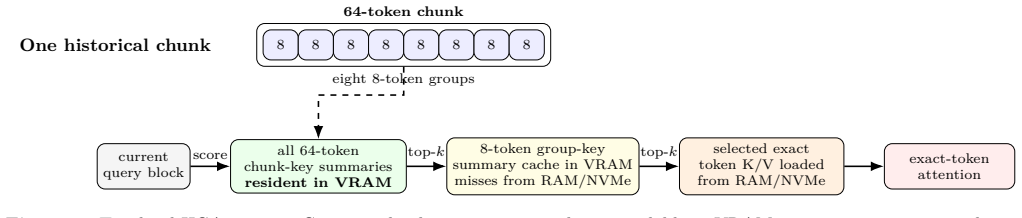
HGA replaces dense attention during fine-tuning with a two-level content-based router: 64-token chunk summaries select relevant historical regions, 8-token group summaries refine the selection, and only the exact token K/V of the selected groups enters the differentiable working set. Combined with segment-wise backpropagation (TBPTT) and tiered KV storage, the GPU working set depends on the active segment and routing budget, not on total context length. The reported numbers show Qwen3-8B with 4-bit QLoRA: dense training fits 2,048 tokens and OOMs at 4,096, while HGA completes 16,384 tokens at 15.28 GB peak VRAM and evaluates up to 131,072 tokens on the same card. Under the cleanest compariso
What carries the argument
Hierarchical Global Attention (HGA): a two-level router built from the model's existing projected keys, with 64-token chunk summaries always resident in VRAM and 8-token group summaries cached, selecting a bounded set of exact token K/V pairs from external memory. Segment-wise backpropagation detaches older history at segment boundaries, and tiered KV storage (VRAM, host RAM, optional NVMe) makes the historical record scale with system memory rather than VRAM.
Load-bearing premise
The load-bearing assumption is that the causal side channel from shared routing decisions stays weak enough within the tested ~100M-token horizon that HGA training and dense training learn the same long-context behavior; if leakage appears earlier, the 2K quality parity would not generalize to the longer contexts the method enables.
What would settle it
Train an HGA adapter on PG19 for 200–300 million tokens and compare its next-token loss under strictly causal evaluation against a dense-trained adapter; if the HGA-trained model shows a significant loss advantage on predictions that could only benefit from later-token information, the causal leakage is present. A simpler probe: mask a later token and check whether earlier-token predictions change, which would indicate non-causal information flow.
If this is right
- A 16 GB GPU can fine-tune with 8K–16K token contexts instead of being limited to 2K, opening long-context adaptation to commodity hardware.
- The resulting adapter can be served with standard dense attention, so the quality parity measured under dense readout carries directly into existing generation frameworks.
- HGA's per-token historical attention work stays roughly constant as context grows, while dense work grows linearly, so the throughput advantage observed at 2K should widen at longer contexts.
- With RAM or NVMe backing the historical KV store, the practical context limit shifts from VRAM capacity to host memory and storage bandwidth.
- The current implementation is validated only for fine-tuning runs under roughly 100 million training tokens; pretraining would require a strictly causal routing variant.
Where Pith is reading between the lines
- The causal leakage described in Section 6.1 could be tested directly: train beyond 100M tokens and probe whether earlier token positions improve next-token prediction when later tokens are masked, which would confirm the side channel.
- The NVMe-backed tier is implemented but not benchmarked; a natural extension is measuring throughput when history spills to disk, which would determine the practical ceiling for very long contexts.
- The same decoupling of GPU working set from sequence history might apply to other memory-hungry training states, such as activations and optimizer moments, potentially extending the method to larger models or longer segments.
- If a strictly causal routing variant succeeds, HGA could move from fine-tuning to pretraining, a substantially stronger claim than the one demonstrated here.
Editorial analysis
A structured set of objections, weighed in public.
Referee Report
Summary. The paper proposes combining Hierarchical Global Attention (HGA) with truncated backpropagation through time and tiered KV storage so that long-context fine-tuning fits in limited VRAM by keeping only the active segment differentiable and routing to a bounded set of exact historical tokens. On Qwen3-8B with 4-bit QLoRA and PG19, it reports extending trainable context from 2K to 16K (and 32K with streaming) on a 16 GB GPU, while HGA-trained and dense-trained adapters achieve nearly equal loss under dense readout at 2K/4K. It also reports comparable or slightly better HGA throughput at 2K and RULER-style retrieval parity. The paper explicitly acknowledges a long-horizon causal side channel in the routing and states that the current implementation is suitable for fine-tuning but not pretraining.
Significance. If the memory-scaling and quality-parity results are validated, the method has immediate practical value for long-context adaptation on consumer GPUs: it demonstrates a 8x increase in trainable context on a 16 GB card with only a 0.0022 nat difference from dense training at the overlap boundary. The use of exact historical tokens, the matched dense readout for quality comparisons, and the public code repository are concrete strengths. However, the evidence is currently single-configuration and the causal-leakage concern is acknowledged but not directly measured, so the central quality claim needs additional support.
major comments (4)
- [Sec. 2.2, Eq. (1)] Equation (1) states M_GPU ~ M_model + M_adapters/optimizer + O(S) + O(B_route) with "chunk summaries in VRAM" as a parenthetical, but the text and Figures 1-2 make clear that all chunk summaries are resident in VRAM. The GPU working set therefore contains an O(L/c) term (c = chunk size) that is omitted from the equation. The abstract and conclusion acknowledge that VRAM grows gently with resident summaries, so Eq. (1) should be corrected to include this term and its measured coefficient; otherwise the central claim of separating the GPU working set from the full training history is overstated.
- [Sec. 6.1 and Tables 3/6] The paper acknowledges a causal side channel in routing: the selected chunk set for a token depends on scores from multiple query positions, so earlier tokens can obtain indirect future information. The claim that this is negligible for the reported runs is not supported by any direct measurement, and the batch size is not reported, so the reader cannot verify that the 100-step runs are below the stated ~100M-token threshold. A strictly causal routing variant or a leakage diagnostic (for example, comparing loss on early versus later positions, or training with future information scrambled) is needed to show that the 2K/4K dense-readout parity is due to HGA's sparsity rather than future information. This is load-bearing for the main quality claim.
- [Abstract/Conclusion and Tables 4-5] The abstract states that under evaluation the adapter runs through 131,072 tokens, and the conclusion repeats that HGA evaluation is validated through 131,072 tokens. However, the highest context reported in Tables 4 and 5 is 32,768 tokens, with dense readout only through 4,096. No table or figure supports the 131,072-token claim. Add the missing evaluation (VRAM, loss/perplexity, routing density, and any relevant timing) or qualify the claim to match the reported data.
- [Sec. 4.3 and Table 6] The quality parity between HGA-trained and dense-trained adapters is based on a single seed, 100 optimizer steps, and no confidence intervals or multiple-run variance. The observed differences are 0.0022 nat at 2K and roughly 0.04 PPL at 4K; without variance estimates, "practically indistinguishable" is not statistically established. Moreover, no dense-trained baseline is available at 8K-16K, so the claim that HGA preserves dense-readout quality is only demonstrated through 4K. Please add multiple seeds or bootstrap intervals, and clearly scope the quality claim to the overlap range where a dense baseline exists.
minor comments (2)
- [Table: Experimental configuration] The batch size is not listed anywhere in the experimental configuration or in Table 3. Reporting it is necessary both for reproducibility and for relating the 100-step runs to the ~100M-token leakage threshold in Sec. 6.1.
- [Sec. 4.2, Table 2] The description that dense timing is "obtained by disabling the router" should clarify whether the dense baseline uses the same segment-wise TBPTT schedule or a single full-sequence forward. This matters because HGA's TBPTT overhead is part of its measured time, while the dense baseline in Table 1 is a full-sequence forward.
Circularity Check
No circular derivation: the central quality claims are benchmarked against an external dense-training baseline.
full rationale
The paper's load-bearing claims are not constructed from their own outputs. The HGA-trained and dense-trained adapters are trained with identical data order, seed, and hyperparameters and then evaluated under the same dense-attention readout on held-out PG19 blocks (Tables 3 and 6) and on RULER-style retrieval (Table 8); none of these comparisons fits an HGA parameter to the target quantity. Equation (1) is a memory-scaling model rather than a derivation that assumes the claimed 16K result, and the throughput crossover at 2K is measured (Table 2); the wider-context speed advantage is explicitly labeled an expectation based on the fixed routing budget, not a fitted prediction. The only self-citation, to the prior HGA paper [1], supplies the routing mechanism, but the present paper re-implements and benchmarks it independently against dense training, so the self-citation is not load-bearing. Section 6.1's causal side channel is a genuine correctness risk that could undermine the parity interpretation, but it is not circularity: it does not make any reported quantity equal to an input by construction. Hence no circular step is identified.
Axiom & Free-Parameter Ledger
free parameters (4)
- TBPTT segment length S =
2048 tokens
- chunk size =
64 tokens
- group size =
8 tokens
- routing budget (top-k chunks) =
8 (default)
axioms (4)
- domain assumption Pretrained Q/K/V/O projections are directly usable for routing summaries and exact-token attention without new learned weights.
- domain assumption TBPTT gradient truncation at segment boundaries is sufficient for fine-tuning long contexts.
- domain assumption Causal side channel from shared routing decisions is negligible within the tested training horizon.
- domain assumption PG19 is a valid benchmark for long-context fine-tuning quality.
Cite this review
Pith. "Pith review of Long-Context Fine-Tuning with Limited VRAM." pith.science (2026). https://pith.science/paper/ET7PT6SR
@misc{pith2026260715105,
  author       = {Pith},
  title        = {Pith review of: Long-Context Fine-Tuning with Limited VRAM},
  year         = {2026},
  howpublished = {\url{https://pith.science/paper/ET7PT6SR}},
  note         = {Machine review of arXiv:2607.15105}
}
read the original abstract
Parameter-efficient fine-tuning reduces model and optimizer memory, but dense attention still makes long training sequences expensive. We combine Hierarchical Global Attention (HGA) with segment-wise backpropagation and tiered KV storage. Only the active segment remains differentiable in VRAM; older KV is detached into RAM or NVMe, and HGA loads a bounded set of exact historical tokens for each query block. On Qwen3-8B with 4-bit QLoRA and PG19, dense training on a 16 GB Quadro RTX 5000 fits 2,048 tokens but fails at 4,096, whereas HGA reaches 16,384 tokens with 15.28 GB peak VRAM. Under evaluation the same adapter runs through 131,072 tokens on this card; VRAM is not constant but grows gently with the resident chunk summaries, so RAM and NVMe capacity set the practical limit beyond these lengths. At the shared 2K training length, HGA-trained and dense-trained adapters obtain 2.7405 and 2.7383 nat under the same dense-attention readout, while the stock model obtains 2.9541. At this boundary HGA training is already marginally faster (217.75 vs. 207.02 tokens/s), and the HGA-to-dense throughput ratio improves from 1K to 2K; because HGA keeps the attended historical set per token approximately constant while dense work per token grows, we expect this lead to widen as context grows. Dense attention is used for the main quality and retrieval comparisons so that they measure the learned weights and remain compatible with standard generation frameworks. HGA can also be used for retrieval and generation; an optimized production-grade serving implementation is under development.
Figures

Reference graph
Works this paper leans on
-
[1]
F. Woernle, V. Fedosov, and A. Grinenko. Hierarchical Global Attention: Drop-In Exact-Token Routing for Pretrained Long-Context Transformers.arXiv:2606.30709, 2026
Pith/arXiv arXiv 2026
- [2]
-
[3]
Dettmers, A
T. Dettmers, A. Pagnoni, A. Holtzman, and L. Zettlemoyer. QLoRA: Efficient Finetuning of Quantized LLMs. NeurIPS, 2023
2023
-
[4]
Hu et al
E. Hu et al. LoRA: Low-Rank Adaptation of Large Language Models.ICLR, 2022
2022
-
[5]
J. Rae, A. Potapenko, S. Jayakumar, T. Hillier, and T. Lillicrap. Compressive Transformers for Long-Range Sequence Modelling.ICLR, 2020
2020
-
[6]
C.-Y. Hsieh et al. RULER: What’s the Real Context Window Size of Your Long-Context Language Models? arXiv:2404.06654, 2024
Pith/arXiv arXiv 2024
-
[7]
T. Dao, D. Fu, S. Ermon, A. Rudra, and C. Ré. FlashAttention: Fast and Memory-Efficient Exact Attention with IO-Awareness.NeurIPS, 2022
2022
-
[8]
Y. Chen et al. LongLoRA: Efficient Fine-Tuning of Long-Context Large Language Models.arXiv:2309.12307, 2023
Pith/arXiv arXiv 2023
-
[9]
Williams and D
R. Williams and D. Zipser. An Efficient Gradient-Based Algorithm for On-Line Training of Recurrent Network Trajectories.Neural Computation, 2(4):490–501, 1990. 6
1990
This paper was first reviewed by deepseek-v4-flash on August 2, 2026.
discussion (0)
Sign in with ORCID, Apple, or X to comment. Anyone can read and Pith papers without signing in.