REVIEW 3 major objections 3 minor 68 references
Successive adiabatic evolution lets a two-level quantum probe perform lock-in detection with a clean triangular-wave modulation, eliminating the odd-harmonic spectral leakage that limits pulse-based quantum lock-in amplifiers.
Reviewed by Pith at T0; open to challenge. T0 means a machine referee read the full paper against a public rubric. the ladder, T0–T4 →
T0 review · deepseek-v4-flash
2026-08-02 00:05 UTC pith:MZRY6GIB
load-bearing objection A genuinely new adiabatic lock-in protocol with a clean algebraic core, but the central phase formulas are approximations with no error bound, and the 'triangular-wave' framing oversells the actual sinusoidal modulation. the 3 major comments →
Quantum Lock-In Detection via Successive Adiabatic Evolution
The pith
A machine-rendered reading of the paper's core claim, the machinery that carries it, and where it could break.
Core claim
Successive adiabatic evolutions turn a two-level probe into a quantum lock-in amplifier whose modulation is a triangular wave. With Rabi frequency and detuning set to A sin(ωt) and A cos(ωt), the rotating-frame signal Hamiltonian becomes diagonal to first Magnus order, so the probe accumulates phase α=∫M(t)cos(ωt)dt in a two-step sequence and β=∫M(t)sin(ωt)dt in a three-step sequence; measuring the final state yields amplitude and initial phase directly. The triangular modulation produces a single-peaked filter function, removing the odd-harmonic spectral leakage of pulse-based protocols, and the adiabatic XY8 sequence is robust to control errors and dephasing in an NV-center implementation.
What carries the argument
The central object is the time-dependent control Hamiltonian whose eigenstates rotate with mixing angle θ(t)=ωt, realized by Rabi frequency A sin(ωt) and detuning A cos(ωt). Under the adiabatic theorem the probe follows the eigenstate, and in the rotating frame the first-order Magnus approximation keeps only the diagonal entries M(t)cos(ωt) and M(t)sin(ωt). These entries integrate to the lock-in phases α and β, so the control sequence itself performs the signal-reference multiplication that classical lock-in amplifiers do with nonlinear mixers.
Load-bearing premise
The phase formulas assume that the rapidly oscillating off-diagonal terms of the rotating-frame Hamiltonian are completely averaged away, and the paper gives no quantitative bound on the residual that remains for finite A/ω; if that residual is not negligible, the measured α and β drift from the exact lock-in integrals.
What would settle it
Run the proposed NV sequence with a pure test tone at 3ω_c: if the triangular-wave modulation is exact, the measured phase should remain at the noise floor; a systematic phase growing with the tone's amplitude would expose leakage from non-adiabatic corrections. Equivalently, numerically integrate the full Schrödinger equation without the Magnus truncation and compare the accumulated phase to α(T,0); any deviation above the shot-noise floor falsifies the claim that the integrals are exact.
If this is right
- A single two-level sensor can measure both amplitude and initial phase of a weak ac signal directly from the final state, without complicated post-processing.
- Triangular modulation restricts the sensor response to the vicinity of the reference frequency, so broadband noise is suppressed more effectively than in π-pulse lock-in protocols.
- The protocol inherits the robustness of adiabatic driving, so composite adiabatic XY8 sequences can extend coherence and sensing time.
- The frequency-estimation variant determines an unknown carrier frequency by comparing phase measurements with adjustable time intervals, at a step-count cost set by the desired relative error.
- The scheme is platform-independent: any controllable two-level system with a σz-type signal coupling can implement it.
Where Pith is reading between the lines
- A quantitative bound on the neglected rotating-frame off-diagonal terms (which scale with M/A) would let experimenters set the minimum A/ω for a given target accuracy; the paper leaves this as an open estimate.
- The same triangular-modulation idea could be applied to continuous dynamical decoupling, where the filter shape is determined by the drive envelope rather than by pulse timing.
- The paper's mention of two-NV simultaneous I/Q readout suggests a differential protocol in which common-mode noise cancels, potentially improving sensitivity beyond single-probe performance.
- The filter-function framework implies an immediate test: apply a pure tone at 3ω and check that the accumulated phase stays at the noise floor; any residual response exposes non-adiabatic corrections.
Editorial analysis
A structured set of objections, weighed in public.
Referee Report
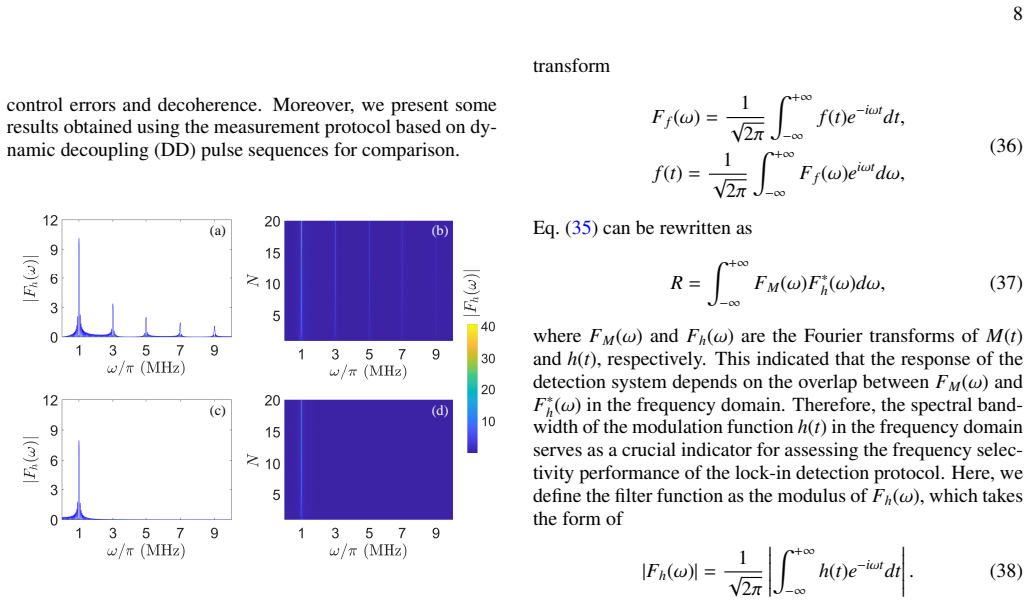
Summary. The manuscript proposes a quantum lock-in detection protocol based on successive adiabatic sweeps of a driven two-level probe. The signal M(t)σ_z is transformed to the adiabatic eigenframe, and the authors show (Eqs. (12)–(16), (18)–(26)) that after two or three successive sweeps the accumulated phase is proportional to ∫M cos(ωt)dt or ∫M sin(ωt)dt, allowing simultaneous amplitude and phase extraction. They further propose an NV-center implementation using XY8-type composite sequences, compare filter functions with pulse-based dynamical decoupling, and present numerical simulations of white and harmonic noise, control errors, and dephasing. The central claim is that the continuous ('triangular') modulation eliminates the odd-harmonic spectral leakage of π-pulse protocols.
Significance. If made rigorous, the protocol would be a useful alternative to pulse-based quantum lock-in: continuous modulation would suppress harmonic response and allow full amplitude/phase extraction with a single probe. The paper has real strengths: the block-propagator algebra is internally consistent, the simulations integrate the full Schrödinger equation rather than the approximate formulas, and the NV implementation is concrete. The main obstacle is the absence of a quantitative error analysis for the rotating-wave approximation used to obtain the lock-in integrals; this affects the filter-function and SNR claims.
major comments (3)
- [§II.B–II.C, Eqs. (12), (16), (24)] The derivation replaces H_rot in Eq. (11) by its diagonal part, claiming the off-diagonal terms are averaged out when A≫ω_max. This is uncontrolled. For M(t)=S0 cos(ωt+φ), the first-order off-diagonal Magnus integral over a segment of length L is ~S0/(A±2ω) unless (A±2ω)L is a multiple of 2π. In the quadrature sequence, L=π/(2ω); at A=20ω, (A±2ω)L=10π±π, so the residual is nonzero. The measured phase then has a waveform-dependent correction, so Eqs. (16) and (24)–(26) are not exact equalities. Please provide a quantitative bound on the first/second-order residual or impose parameter constraints eliminating it, and demonstrate it is below the target precision.
- [§IV.A, Eqs. (35)–(38), Fig. 2] The filter function is computed from h(t)=cos(ωt) over the measurement window. This is the exact response kernel only if the diagonal approximation of comment 1 is exact. With the unquantified residual, the true response kernel has extra spectral weight; the single-peaked filter function and the claimed suppression of odd-harmonic spectral leakage are not established. Derive the filter function from the full propagator, or state explicitly that it is the ideal large-A filter and bound the correction.
- [§II.D, Eqs. (27)–(32)] The unknown-carrier-frequency protocol is not well posed. α in Eq. (27) depends on the unknown initial phase φ. Equal α values in a pair of sequences separated by T′ do not imply ω_c T′=2πn, and if φ is random, the distribution of α(φ) is a scaled arcsine law for every T′, so comparing individual measurements cannot identify T′_n. Specify the comparison statistic (controlled phase variation or reference-frequency scan) and analyze the effect of noise on the step-count bounds.
minor comments (3)
- [§IV.A] The modulation function h(t)=cos(ωt) is a sinusoidal envelope, not a triangular wave; clarify the terminology or define what is meant by 'triangular-wave modulation.'
- [§III] The readout formulas after Eq. (33) omit the known φ2−φ1 offsets appearing in Eq. (16); state explicitly that the XY8 phase pattern is chosen so that these offsets cancel over one cycle.
- [§II.B, Eq. (12)] The step of deleting the off-diagonal elements is an additional rotating-wave approximation beyond the first-order Magnus term; the terminology should be adjusted to avoid conflating the two.
Circularity Check
No significant circularity: the lock-in phase formulas follow from explicit Hamiltonians via a first-order Magnus trace; simulations are self-consistent checks, not fitted predictions.
full rationale
I traced the derivation chain from the control+signal Hamiltonian (Eq. 4) through the rotating-frame Hamiltonian (Eq. 11) to the claimed in-phase and quadrature phase accumulations (Eqs. 12-26). The diagonal entries of the rotating-frame propagator are obtained by first-order Magnus expansion plus a stated rapid-oscillation approximation; they are not defined in terms of the measured phases α and β, and no experimentally measured quantity is used to set the form of those integrals. The simulations in Sec. IV solve the full time-dependent Schrödinger equation for the same Hamiltonian and compare the extracted amplitude/phase to the known input values; this is a consistency check of the approximation, not circular fitting. The paper does contain some self-citations (e.g., Refs. [40,42] by coauthor S. Chen, and Ref. [21] by coauthor G. Adesso), but these are background references for existing quantum lock-in protocols and unrelated material; they are not used to justify the central derivation or to exclude alternative approaches. No uniqueness theorem, fitted parameter, or ansatz is imported from the authors' prior work. The main weakness identified by the skeptic — the uncontrolled magnitude of the neglected off-diagonal Magnus terms, which can produce waveform-dependent systematic errors of order S0/A — is a correctness/rigor concern, not a circularity: the dropped terms are not constructed from the predicted α and β, and the paper does not retroactively impose the lock-in result on the input. Therefore I find no circular step and assign score 0.
Axiom & Free-Parameter Ledger
free parameters (3)
- control amplitude A =
2π×10 MHz (simulation choice)
- number of sequence repetitions N =
5 (simulations)
- dephasing width σ =
2π MHz (simulation choice)
axioms (5)
- domain assumption Rotating-wave approximation and truncation to the two-level subspace of the NV ground state
- domain assumption Adiabatic theorem with slowly varying H_ctrl: transitionless evolution when A ≫ ω
- domain assumption First-order Magnus expansion with off-diagonal H_rot terms averaged to zero
- domain assumption Target signal is weak compared with control (M(t) ≪ A) and noise far from ω is completely averaged
- domain assumption Gaussian quasistatic dephasing model with σ = 2π MHz and averaging over 2500 realizations
read the original abstract
In recent years, quantum lock-in detection has emerged as a promising technique to accurately detect weak signals submerged in background noise. However, the signal-to-noise ratio of existing protocols is severely limited by spectral leakage resulting from control operations implemented in pulse form. Here, we propose a general protocol for realizing quantum lock-in detection by employing successive quantum adiabatic evolution. In our protocol, the signal modulation is achieved by adiabatically controlling the time evolution of the quantum probe, which enables the implementation of triangular modulation functions. The realization of triangular-wave modulation fundamentally solves the problem of spectral leakage and facilitates the extraction of the complete characteristics of the target signals. We present a practical implementation scheme of adiabatic quantum lock-in detection based on nitrogen-vacancy centers in diamond, and demonstrate that the proposed protocol possesses strong resilience against experimental imperfections. Our results establish adiabatic quantum lock-in detection as a robust and experimentally accessible approach to detection of weak alternating signals in noisy environments, thus promoting the advance of real-world quantum sensing technologies.
Figures



Reference graph
Works this paper leans on
-
[1]
Yaghjian, An overview of near-field antenna measurements, IEEE Trans
A. Yaghjian, An overview of near-field antenna measurements, IEEE Trans. Antennas Propag.34, 30 (1986)
1986
-
[2]
Vengalattore, J
M. Vengalattore, J. M. Higbie, S. R. Leslie, J. Guzman, L. E. Sadler, and D. M. Stamper-Kurn, High-resolution magnetome- try with a spinor Bose-Einstein condensate, Phys. Rev. Lett.98, 200801 (2007)
2007
-
[3]
B. M. Escher, R. L. de Matos Filho, and L. Davidovich, General framework for estimating the ultimate precision limit in noisy quantum-enhanced metrology, Nat. Phys.7, 406 (2011)
2011
-
[4]
Rovny, S
J. Rovny, S. Gopalakrishnan, A. C. Bleszynski Jayich, P. Maletinsky, E. Demler, and N. P. de Leon, Nanoscale diamond quantum sensors for many-body physics, Nat. Rev. Phys.6, 753 (2024)
2024
-
[5]
S. D. Bass and M. Doser, Quantum sensing for particle physics, Nat. Rev. Phys.6, 329 (2024)
2024
-
[6]
M. C. Marshall, M. J. Turner, M. J. H. Ku, D. F. Phillips and R. L. Walsworth, Directional detection of dark matter with dia- mond, Quantum Sci. Technol.6, 024011 (2021)
2021
-
[7]
C. R. Cosens, A balance-detector for alternating-current bridges, Proc. Phys. Soc.46, 818 (1934)
1934
-
[8]
W. C. Michels, A double tube vacuum tube voltmeter, Rev. Sci. Instrum.9, 10 (1938). 13
1938
-
[9]
W. C. Michels and N. L. Curtis, A pentode lock-in amplifier of high frequency selectivity, Rev. Sci. Instrum.12, 444 (1941)
1941
-
[10]
M. L. R. Barrios, F. E. H. Montero, J. C. G. Mancilla, and E. P. Mar´ın, Application of lock-in amplifier on gear diagnosis, Measurement107, 120 (2017)
2017
-
[11]
Gervasoni, M
G. Gervasoni, M. Carminati, and G. Ferrari, Switched ratiomet- ric lock-in amplifier enabling sub-ppm measurements in a wide frequency range, Rev. Sci. Instrum.88, 104704 (2017)
2017
-
[12]
G. A. Stimpson, M. S. Skilbeck, R. L. Patel, B. L. Green, and G. W. Morley, An open-source high-frequency lock-in amplifier, Rev. Sci. Instrum.90, 094701 (2019)
2019
-
[13]
Kishore and S
K. Kishore and S. A. Akbar, Evolution of lock-in amplifier as portable sensor interface platform: A review, IEEE Sens. J.20, 10345 (2020)
2020
-
[14]
Zhang, W
Q. Zhang, W. Jeong, and D. J. Kang, Lock-in amplifiers as a platform for weak signal measurements: Development and ap- plications, Curr. Appl. Phys.66, 95 (2024)
2024
-
[15]
J. Du, F. Shi, X. Kong, F. Jelezko, and J. Wrachtrup, Single- molecule scale magnetic resonance spectroscopy using quan- tum diamond sensors, Rev. Mod. Phys.96, 025001 (2024)
2024
-
[16]
N. R. Neuling, R. D. Allert, and D. B. Bucher, Prospects of single-cell nuclear magnetic resonance spectroscopy with quan- tum sensors, Curr. Opin. Biotechnol.83, 102975 (2023)
2023
-
[17]
Granata and A
C. Granata and A. Vettoliere, Nano superconducting quantum interference device: A powerful tool for nanoscale investiga- tions, Phys. Rep.614, 1 (2016)
2016
-
[18]
Casola, T
F. Casola, T. van der Sar, and A. Yacoby, Probing condensed matter physics with magnetometry based on nitrogen-vacancy centres in diamond, Nat. Rev. Mater.3, 17088 (2018)
2018
-
[19]
C. L. Degen, F. Reinhard, and P. Cappellaro, Quantum sensing, Rev. Mod. Phys.89, 035002 (2017)
2017
-
[20]
Montenegro, C
V . Montenegro, C. Mukhopadhyay, R. Yousefjani, S. Sarkar, U. Mishra, M. G. A. Paris, and A. Bayat, Review: Quantum metrology and sensing with many-body systems, Phys. Rep. 1134, 1 (2025)
2025
-
[21]
A. I. Lvovsky, M. R. Grace, S. Guha, M. Tsang, and G. Adesso, Passive optical superresolution at the quantum limit, arXiv preprint arXiv:2605.10767 (2026)
Pith/arXiv arXiv 2026
-
[22]
J. M. Boss, K. S. Cujia, J. Zopes, and C. L. Degen, Quantum sensing with arbitrary frequency resolution, Science356, 837 (2017)
2017
-
[23]
Schmitt, T
S. Schmitt, T. Gefen, F. M. Sturner, T. Unden, G. Wolff, C. Muller, J. Scheuer, B. Naydenov, M. Markham, S. Pezzagna, J. Meijer, I. Schwarz, M. Plenio, A. Retzker, L. P. McGuinness, and F. Jelezko, Submillihertz magnetic spectroscopy performed with a nanoscale quantum sensor, Science356, 832 (2017)
2017
-
[24]
D. R. Glenn, D. B. Bucher, J. Lee, M. D. Lukin, H. Park, and R. L. Walsworth, High-resolution magnetic resonance spec- troscopy using a solid-state spin sensor, Nature555, 351 (2018)
2018
-
[25]
G. T. Genov, Y . Ben-Shalom, F. Jelezko, A. Retzker, and N. Bar-Gill, Efficient and robust signal sensing by sequences of adiabatic chirped pulses, Phys. Rev. Res.2, 033216 (2020)
2020
-
[26]
M. Jing, Y . Hu, J. Ma, H. Zhang, L. Zhang, L. Xiao, and S. Jia, Atomic superheterodyne receiver based on microwave-dressed Rydberg spectroscopy, Nat. Phys.16, 911 (2020)
2020
-
[27]
K. A. Gilmore, M. Affolter, R. J. Lewis-Swan, D. Barberena, E. Jordan, A. M. Rey, and J. J. Bollinger, Quantum-enhanced sens- ing of displacements and electric fields with two-dimensional trapped-ion crystals, Science373, 673 (2021)
2021
-
[28]
Wang, Y .-X
G. Wang, Y .-X. Liu, J. M. Schloss, S. T. Alsid, D. A. Braje, and P. Cappellaro, Sensing of arbitrary-frequency fields using a quantum mixer, Phys. Rev. X12, 021061 (2022)
2022
-
[29]
W. Ji, Z. Liu, Y . Guo, Z. Hu, J. Zhou, S. Dai, Y . Chen, P. Yu, M. Wang, K. Xia, F. Shi, Y . Wang, and J. Du, Correlated sensing with a solid-state quantum multisensor system for atomic-scale structural analysis, Nat. Photon.18, 230 (2024)
2024
-
[30]
Zhang, Y
H. Zhang, Y . Ma, K. Liao, W. Yang, Z. Liu, D. Ding, H. Yan, W. Li, and L. Zhang, Rydberg atom electric field sensing for metrology, communication and hybrid quantum systems, Sci. Bull.69, 1515 (2024)
2024
-
[31]
K. Zeng, X. Yu, M. B. Plenio, and Z.-Y . Wang, Wide-band un- ambiguous quantum sensing via geodesic evolution, Phys. Rev. Lett.132, 250801 (2024)
2024
-
[32]
Tang, X.-W
Y .-S. Tang, X.-W. Xu, J.-Q. Liao, H. Jing, and L.-M. Kuang, Highly sensitive temperature sensing via quadratic optome- chanical coupling, Phys. Rev. A111, 063513 (2025)
2025
-
[33]
Abbas, A
R. Abbas, A. R. Mirza, and A. Z. Chaudhry, Sensing high- frequency ac fields via a two-qubit sensor, Phys. Rev. A112, 052612 (2025)
2025
-
[34]
Louzon, G
D. Louzon, G. T. Genov, N. Staudenmaier, F. Frank, J. Lang, M. L. Markham, A. Retzker, and F. Jelezko, Robust noise sup- pression and quantum sensing by continuous phased dynamical decoupling, Phys. Rev. Lett.134, 120802 (2025)
2025
-
[35]
Mihailescu, S
G. Mihailescu, S. Campbell, and K. Gietka, Uncertain quan- tum critical metrology: From single-to multiparameter sensing, Phys. Rev. A111, 052621 (2025)
2025
-
[36]
Kotler, N
S. Kotler, N. Akerman, Y . Glickman, A. Keselman, and R. Ozeri, Single-ion quantum lock-in amplifier, Nature (London) 473, 61 (2011)
2011
-
[37]
Shaniv and R
R. Shaniv and R. Ozeri, Quantum lock-in force sensing us- ing optical clock doppler velocimetry, Nat. Commun.8, 14157 (2017)
2017
-
[38]
Zhuang, J
M. Zhuang, J. H. Huang, and C. Lee, Many-body quantum lock-in amplifier, PRX Quantum2, 040317 (2021)
2021
-
[39]
Shibata, N
K. Shibata, N. Sekiguchi, and T. Hirano, Quantum lock-in de- tection of a vector light shift, Phys. Rev. A103, 043335 (2021)
2021
-
[40]
S. Chen, M. Zhuang, R. Fang, Y . Chen, C. Han, B. Lu, J. Huang, and C. Lee, Quantum double lock-in amplifier, Commun. Phys. 7, 189 (2024)
2024
-
[41]
Y . Zhao, X. N. Feng, and L. F. Wei, Quantum lock-in amplifica- tion with spin-oscillator hybrid interferometers for weak-signal detection, Phys. Rev. A112, 022417 (2025)
2025
-
[42]
Zhuang, S
M. Zhuang, S. Chen, J. Huang, and C. Lee, Quantum lock-in measurement of weak alternating signals, Quantum Front.3, 4 (2024)
2024
-
[43]
Loretz, J
M. Loretz, J. M. Boss, T. Rosskopf, H. J. Mamin, D. Rugar, and C. L. Degen, Spurious harmonic response of multipulse quan- tum sensing sequences, Phys. Rev. X5, 021009 (2015)
2015
-
[44]
V . M. Frey, S. Mavadia, L. M. Norris, W. de Ferranti, D. Lu- carelli, L. Viola, and M. J. Biercuk, Application of optimal band-limited control protocols to quantum noise sensing, Nat. Commun.8, 2189 (2017)
2017
-
[45]
Born and V
M. Born and V . Fock, Beweis des Adiabatensatzes, Z. Phys.51, 165 (1928)
1928
-
[46]
Messiah, Quantum Mechanics (North-Holland Pub
A. Messiah, Quantum Mechanics (North-Holland Pub. Co., Amsterdam, 1962)
1962
-
[47]
M. V . Berry, Quantal phase factors accompanying adiabatic changes, Proc. R. Soc. A392, 45 (1984)
1984
-
[48]
M. H. Levitt, Composite pulses, Prog. NMR Spectrosc.18, 61 (1986)
1986
-
[49]
Tycko and A
R. Tycko and A. Pines, Iterative schemes for broad-band and narrow-band population inversion in NMR, Chem. Phys. Lett. 111, 462 (1984)
1984
-
[50]
B. T. Torosov and N. V . Vitanov, Smooth composite pulses for high-fidelity quantum information processing, Phys. Rev. A83, 053420 (2011)
2011
-
[51]
G. T. Genov, Y . Ben-Shalom, F. Jelezko, A. Retzker, and N. 14 Bar-Gill, Efficient and robust signal sensing by sequences of adiabatic chirped pulses, Phys. Rev. Res.2, 033216 (2020)
2020
-
[52]
Stefanatos and E
D. Stefanatos and E. Paspalakis, Resonant shortcuts for adia- batic rapid passage with onlyz-field control, Phys. Rev. A100, 012111 (2019)
2019
-
[53]
M. W. Doherty, N. B. Manson, P. Delaney, F. Jelezko, J. Wrachtrup, and L. C. Hollenberg, The nitrogen-vacancy colour centre in diamond, Phys. Rep.528, 1 (2013)
2013
-
[54]
Jacques, P
V . Jacques, P. Neumann, J. Beck, M. Markham, D. Twitchen, J. Meijer, F. Kaiser, G. Balasubramanian, F. Jelezko, and J. Wrachtrup, Dynamic polarization of single nuclear spins by op- tical pumping of nitrogen-vacancy color centers in diamond at room temperature, Phys. Rev. Lett.102, 057403 (2009)
2009
-
[55]
Robledo, H
L. Robledo, H. Bernien, T. van der Sar, and R. Hanson, Spin dynamics in the optical cycle of single nitrogen-vacancy centres in diamond, New J. Phys.13, 025013 (2011)
2011
-
[56]
Aslam, M
N. Aslam, M. Pfender, P. Neumann, R. Reuter, A. Zappe, F. F. de Oliveira, A. Denisenko, H. Sumiya, S. Onoda, J. Isoya, and J. Wrachtrup, Nanoscale nuclear magnetic resonance with chemical resolution, Science357, 67 (2017)
2017
-
[57]
Munuera-Javaloy, A
C. Munuera-Javaloy, A. Tobalina, and J. Casanova, High- resolution NMR spectroscopy at large fields with nitrogen va- cancy centers, Phys. Rev. Lett.130, 133603 (2023)
2023
-
[58]
H. B. Callen and T. A. Welton, Irreversibility and generalized noise, Phys. Rev.83, 34 (1951)
1951
-
[59]
Zhang, L
S.-C. Zhang, L. Zhao, R.-J. Qiu, J.-Q. Geng, T. Tian, B.-W. Zhao, Y . Liu, L.-K. Shan, X.-D. Chen, G.-C. Guo, and F.-W. Sun, High-voltage current sensing with nitrogen-vacancy cen- ters in diamond, APL Photonics10, 036117 (2025)
2025
-
[60]
P. M. Poggi, G. De Chiara, S. Campbell, and A. Kiely, Uni- versally robust quantum control, Phys. Rev. Lett.132, 193801 (2024)
2024
-
[61]
X. Rong, J. Geng, Z. Wang, Q. Zhang, C. Ju, F. Shi, C. K. Duan, and J. F. Du, Implementation of dynamically corrected gates on a single electron spin in diamond, Phys. Rev. Lett.112, 050503 (2014)
2014
-
[62]
Z. Wang, F. Kong, P. Zhao, Z. Huang, P. Yu, Y . Wang, F. Shi, and J. Du, Picotesla magnetometry of microwave fields with diamond sensors, Sci. Adv.8, eabq8158 (2022)
2022
-
[63]
Meinel, V
J. Meinel, V . V orobyov, B. Yavkin, D. Dasari, H. Sumiya, S. Onoda, J. Isoya, and J. Wrachtrup, Heterodyne sensing of microwaves with a quantum sensor, Nat. Commun.12, 2737 (2021)
2021
-
[64]
Bylander, S
J. Bylander, S. Gustavsson, F. Yan, F. Yoshihara, K. Harrabi, G. Fitch, D. G. Cory, Y . Nakamura, J.-S. Tsai, and W. D. Oliver, Noise spectroscopy through dynamical decoupling with a su- perconducting flux qubit, Nat. Phys.7, 565 (2011)
2011
-
[65]
Wudarski, Y
F. Wudarski, Y . Zhang, and M. I. Dykman, Nonergodic mea- surements of qubit frequency noise, Phys. Rev. Lett.131, 230201 (2023)
2023
-
[66]
Ezzell, B
N. Ezzell, B. Pokharel, L. Tewala, G. Quiroz, and D. A. Lidar, Dynamical decoupling for superconducting qubits: A perfor- mance survey, Phys. Rev. Appl.20, 064027 (2023)
2023
-
[67]
Aharon, M
N. Aharon, M. Drewsen, and A. Retzker, Enhanced quantum sensing with multi-level structures of trapped ions, Quantum Sci. Technol.2, 034006 (2017)
2017
-
[68]
Zhao, L.-M
X. Zhao, L.-M. Kuang, and J.-Q. Liao, General dark-state the- ory for arbitrary multilevel quantum systems, Phys. Rev. A113, 013723 (2026)
2026
discussion (0)
Sign in with ORCID, Apple, or X to comment. Anyone can read and Pith papers without signing in.