REVIEW 4 major objections 4 minor 145 references
The paper claims landmark bias in geo-localization is measurable (Bias Intensity, Bias Harmfulness) and reducible: HoloGeo reaches 27.27% city-level accuracy on a new misleading-landmark benchmark while preserving standard performance.
Reviewed by Pith at T0; open to challenge. T0 means a machine referee read the full paper against a public rubric. the ladder, T0–T4 →
T0 review · deepseek-v4-flash
2026-08-01 23:42 UTC pith:ATHHNWOH
load-bearing objection The BI/BH diagnostics and LandmarkBias-3K are genuinely new, but the BF-30K annotation prompt leaks the ground-truth location, undercutting the paper's evidence-driven claim. the 4 major comments →
HoloGeo: Mitigating Landmark Bias in Geo-localization via Evidence-Driven Reasoning
The pith
A machine-rendered reading of the paper's core claim, the machinery that carries it, and where it could break.
Core claim
The central claim is that landmark bias is quantifiable: Bias Intensity measures the log-confidence boost a landmark gives its favored label, and Bias Harmfulness measures how much that boost costs the ground-truth label, computed from full, landmark-removed, and landmark-only views. These metrics select LandmarkBias-3K and guide BF-30K, a training set of structured multi-evidence reasoning chains. HoloGeo fine-tunes a 7B vision-language backbone with supervised learning plus policy-gradient reinforcement learning, rewarding hierarchical geo-accuracy, visual-box coverage, and judge-scored reasoning validity. The paper reports 27.27% city-level accuracy on LandmarkBias-3K and strong results o
What carries the argument
The load-bearing machinery is the two-metric diagnostic BI/BH, computed from three views: the raw image, the landmark-removed image, and the landmark-only crop. BI is the log-probability difference for the landmark-induced label between raw and landmark-removed inputs; BH is the change, caused by the landmark, in the log-odds of the true label versus the landmark-induced label. These metrics choose which images enter LandmarkBias-3K and which BF-30K samples are labeled landmark-biased. HoloGeo's training machinery then combines supervised fine-tuning with group-relative policy optimization, using a total reward of format compliance, hierarchical geo-accuracy (country first, city second), bou
Load-bearing premise
The evidence-driven foundation of HoloGeo rests on the claim that the BF-30K reasoning chains were produced from visual evidence alone, without seeing the confirmed location; the annotation prompt shown in Figure 9 appears to include that confirmed location, so if that prompt was used, the chains are post-hoc rationalizations and the central debiasing premise loses its support.
What would settle it
Inspect the actual BF-30K annotation prompts and logs. If the confirmed country/city appears anywhere in the model input before reasoning—as the template in Figure 9 suggests—the chains are post-hoc. A decisive experiment: re-annotate a random subset without any location label, retrain HoloGeo on that subset only, and measure LandmarkBias-3K city accuracy; if it falls back toward the SFT-only level, the evidence-driven premise is refuted.
If this is right
- LandmarkBias-3K provides a diagnostic where most current geo-localization systems score below 20% city-level accuracy, exposing failures that accuracy-only benchmarks miss.
- HoloGeo's 27.27% city-level accuracy on LandmarkBias-3K, alongside 47.3% city-level on IM2GPS and leading results on YFCC4k, indicates that reducing landmark bias does not have to sacrifice standard performance.
- The BI/BH metric pair separates harmful anchoring from beneficial landmark use, meaning future benchmarks can be built to penalize only the harmful cases.
- Ablations show each of the three rewards contributes; removing any one lowers performance, so the multi-reward design, not any single term, carries the improvement.
- Cross-model tercile agreement for BI/BH suggests the metrics capture stable patterns rather than quirks of one vision-language model.
Where Pith is reading between the lines
- Editorial inference: The apparent leak of the confirmed location into the BF-30K annotation prompt does not by itself disprove the debiasing effect; the box-coverage and reasoning-validity rewards could be doing the work independent of chain purity. A clean test is to train on re-annotated chains without any location label and compare.
- Editorial inference: The BI/BH construction is task-agnostic—replace 'landmark' with any dominant spurious cue and the three-view probability comparison can audit shortcut reliance in other VLM tasks, such as medical imaging or wildlife monitoring.
- Editorial inference: The benchmark's per-category results suggest that cues like language signs and architecture are both common and misleading at city level, while climate cues are milder; balancing training data toward informative-but-not-anchor-like cue types could push accuracy further.
- Editorial inference: The paper's own limitation section concedes that the training distribution leaves remote and underrepresented regions poorly served; this is a separate failure mode from landmark bias, so HoloGeo's robustness claim should be read as applying to well-represented regions unless the data distribution is expanded.
Editorial analysis
A structured set of objections, weighed in public.
Referee Report
Summary. The paper proposes HoloGeo, a framework for mitigating landmark bias in VLM-based image geo-localization. It introduces two metrics, Bias Intensity (BI) and Bias Harmfulness (BH), and constructs a benchmark, LandmarkBias-3K, from MP-16 and GLDv2. To reduce bias, it builds a training dataset BF-30K with structured multi-evidence reasoning chains and uses a two-stage SFT+GRPO training pipeline with rewards for geo-accuracy, visual evidence grounding, and reasoning validity. The main empirical claim is that HoloGeo achieves 27.27% city-level accuracy on LandmarkBias-3K versus 16.83% for the Qwen2.5-VL-7B backbone and 23.57% for the strongest prior method, while maintaining competitive results on IM2GPS, IM2GPS3K, and YFCC4K.
Significance. If the results are correct, the paper would make a useful contribution: BI/BH provide a principled way to measure landmark over-reliance, LandmarkBias-3K targets a real failure mode, and the multi-reward GRPO framework is a plausible training strategy. The extensive qualitative analyses and the cross-model validation of BI/BH are additional strengths. However, the significance is conditional on resolving serious concerns about the construction of BF-30K and the definition of the BI/BH label space, both of which are load-bearing for the central claims.
major comments (4)
- [Appendix C, Fig. 9] The paper states in Appendix C that annotation models are 'without access to ground-truth location labels,' yet the BF-30K annotation prompt template in Figure 9 begins with 'The confirmed geographical location corresponding to the original image is: "country": {country}, "city": {city}' before asking the model to reason independently. This is a direct internal contradiction. Because these reasoning chains are the supervision signal for both SFT (§4.2) and the R_CLR reward (§4.3, Eq. 7), the claimed 'bias-free evidence-driven reasoning' is not established; the chains may be post-hoc rationalizations of the supplied label. The authors must resolve this contradiction and demonstrate that the training signal is not contaminated by the ground-truth label.
- [§3.1, Eqs. (1)–(4)] BI and BH are defined via probabilities P(y|x), P(y|x_r), and P(y|r), but the label space Y is never specified. It is unclear whether y ranges over all geographic entities, a fixed set of country/city names, or a closed vocabulary. Since the model is a generative VLM, the paper must define how P(y|x) is computed (e.g., token probabilities, constrained decoding, or ranking over a fixed list). Without this, the BI/BH values, the threshold selection in Appendix B (Eq. 10), and the resulting LandmarkBias-3K benchmark are not reproducible or verifiable.
- [§3.2 and §4.1] LandmarkBias-3K is constructed from MP-16 and GLDv2 (§3.2), and BF-30K is also filtered from MP-16 and GLDv2 (§4.1). The paper never states that the training set and the benchmark are disjoint. If there is overlap, the reported LandmarkBias-3K accuracy in Table 2 could be inflated by training-data memorization, which would undermine the central claim of systematic bias mitigation. The authors must confirm disjointness or quantify the overlap.
- [§4.3, Eq. (7)] The comprehensive logical reasoning reward R_CLR is computed by Qwen3.5-35B-A3B, a model from the same family as the policy backbone Qwen2.5-VL-7B. If the reward model shares the same landmark-bias tendencies as the policy, the RL loop may amplify rather than correct bias. The paper provides no analysis of the judge's reliability, agreement with human judgments, or sensitivity to the judge's own biases. At minimum, an ablation using a cross-family judge is needed to support the claim that R_CLR is 'comprehensive' and not circular.
minor comments (4)
- [Table 1] The GAEA row is formatted incorrectly: '43.0 57.477.236.9 56.073.2' should be separated as '43.0 57.4 77.2 | 36.9 56.0 73.2'. This makes the table hard to read.
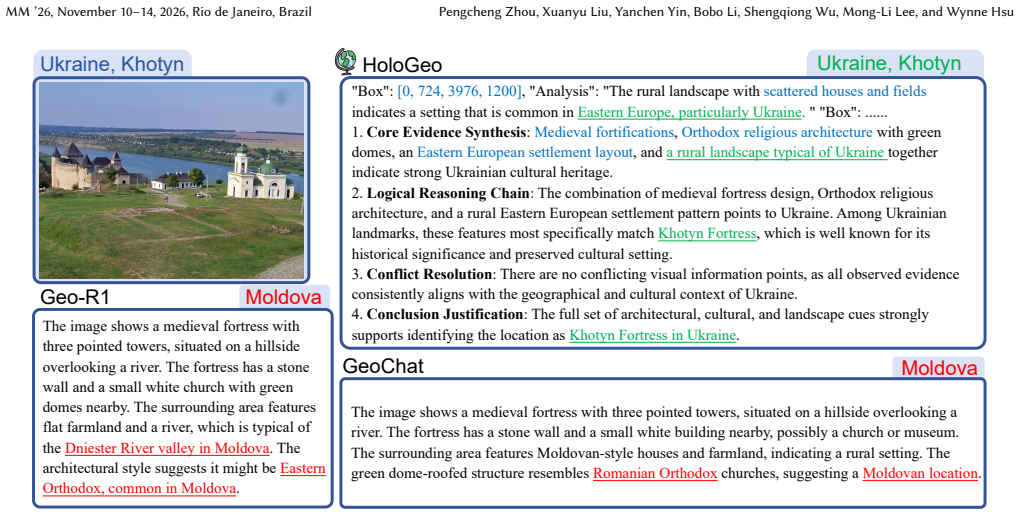
- [Figure 1] The figure contains small text snippets (e.g., 'The Nessie statue suggests...') that are nearly illegible in the PDF. Please enlarge the font or remove the clutter.
- [Appendix F.3, Fig. 20] Several failure-case reasoning chains explicitly reference an 'original conclusion' (e.g., 'supports the original conclusion of Accra, Ghana'), which suggests the annotation prompts may have conditioned on prior answers. This is consistent with the label-leakage concern and should be clarified or corrected.
- [§3.1, Eq. (4)] The definition of BH combines positive and negative log-differences. A short worked example with concrete probability values would help readers interpret the sign and magnitude of BH.
Circularity Check
BF-30K annotation prompts supply ground-truth locations, contradicting the paper's 'no label access' claim; the evidence-driven training signal is post-hoc rationalization, and the bias benchmark is selected using the same Qwen BI/BH scoring used to filter the training data.
specific steps
-
self definitional
[Appendix C (Detailed BF-30K Annotation) and Figure 9 prompt template]
"To ensure faithful reasoning, the prompt (Figure 9) explicitly restricts the model to rely solely on visual evidence, without access to ground-truth location labels. ... [Figure 9 prompt:] The confirmed geographical location corresponding to the original image is: 'country': {country}, 'city': {city}. Your final task is to INDEPENDENTLY determine the country and city where the original image is located based solely on visual evidence."
The annotation prompt gives the ground-truth country/city before requesting independent reasoning. The resulting <Analyze>/<Think> chains are therefore answer-conditioned rationalizations, not bias-free visual-evidence reasoning. Since BF-30K is the sole source of SFT supervision (Section 4.2) and the RCLR reward supervises reasoning consistency (Section 4.3), HoloGeo's claimed 'evidence-driven joint reasoning' reduces to imitating a model that already knew the answer. The paper's own Section C claim that labels were withheld is directly contradicted by Figure 9.
-
self definitional
[Sections 3.1-3.2 (LandmarkBias-3K construction) and Section 4.1 (BF-30K filtering)]
"To ensure a stable probability estimation, Qwen2.5-VL-72B [2] is adopted for all probability estimates of I1, I2, and I3. ... For landmark-containing images, we further compute BI and BH scores to identify instances exhibiting strong landmark bias characteristics."
The same Qwen2.5-VL-72B model and the same BI/BH scoring are used both to select LandmarkBias-3K (the bias benchmark) and to filter landmark-biased images into BF-30K (the training set). The evaluation therefore measures HoloGeo (a Qwen2.5-VL-7B model) on a benchmark that was chosen to be biased under the same scoring function that also curated its training data. Improvement on LandmarkBias-3K is partly a measure of fit to the Qwen-family bias signature, not an independent test of general landmark-bias mitigation.
full rationale
The strongest circularity is internal: Section C asserts the BF-30K annotation models reason 'without access to ground-truth location labels,' but Figure 9, the actual annotation prompt, begins with the confirmed country and city. This makes the 'bias-free, evidence-driven' reasoning chains post-hoc rationalizations, and because those chains supervise both SFT and RCLR, the central mechanism of HoloGeo is not established by the paper's own evidence. A second loop exists in the benchmark construction: both LandmarkBias-3K and the landmark-biased portion of BF-30K are selected using BI/BH computed with Qwen2.5-VL-72B, so the reported gain on LandmarkBias-3K is partially self-referential. The paper's standard-benchmark results (IM2GPS, IM2GPS3K, YFCC4K) are external and provide independent evidence that the training procedure is not wholly vacuous; hence the score is 6 rather than higher. No additional self-citation chain or uniqueness theorem is load-bearing.
Axiom & Free-Parameter Ledger
free parameters (6)
- alpha (city-level weight in Rgeo) =
0.8
- lambda1 (Rgeo reward weight) =
1.2
- lambda2 (Rbox reward weight) =
0.3
- lambda3 (RCLR reward weight) =
0.5
- tau_IoU (Rbox matching threshold) =
0.6
- BI/BH inclusion thresholds =
BI > 0, BH > 0
axioms (4)
- domain assumption VLM output token probabilities can be interpreted as a calibrated distribution P(y|x) over all candidate location labels
- domain assumption GroundingDINO reliably detects the single prominent landmark region for every image
- domain assumption MP-16/GLDv2 labels are correct and sufficient for city-level geo-localization
- ad hoc to paper BF-30K reasoning annotations were generated without seeing ground-truth labels
read the original abstract
Recent advances in Vision-Language Models (VLMs) have significantly improved image geo-localization, yet existing models remain susceptible to landmark bias, causing them to overlook geographical cues or form spurious correlations, ultimately resulting in inaccurate localization. To systematically investigate this issue, we first design two quantitative metrics, Bias Intensity (BI) and Bias Harmfulness (BH), to characterize the impact of landmarks exerted on model reasoning, and establish a comprehensive benchmark, LandmarkBias-3K. To mitigate landmark bias, we further propose an evidence-driven reasoning framework, HoloGeo, to improve the reliability of geo-localization. HoloGeo is supported by a high-quality dataset, BF-30k, annotated with structured multi-evidence bias-free reasoning chains. By incorporating multi-dimensional rewards, HoloGeo explicitly encourages balanced attention over diverse visual cues and achieves evidence-driven joint reasoning. Extensive experiments demonstrate that HoloGeo not only maintains excellent performance on IM2GPS3K and YFCC4k but also significantly outperforms existing open-source VLMs on LandmarkBias-3K, validating its effectiveness for robust geospatial reasoning.
Figures




Reference graph
Works this paper leans on
-
[1]
Josh Achiam, Steven Adler, Sandhini Agarwal, Lama Ahmad, Ilge Akkaya, Floren- cia Leoni Aleman, Diogo Almeida, Janko Altenschmidt, Sam Altman, Shyamal Anadkat, et al. 2023. GPT-4 technical report.arXiv preprint arXiv:2303.08774 (2023)
Pith/arXiv arXiv 2023
-
[2]
Shuai Bai, Keqin Chen, Xuejing Liu, Jialin Wang, Wenbin Ge, Sibo Song, Kai Dang, Peng Wang, Shijie Wang, Jun Tang, Humen Zhong, Yuanzhi Zhu, Mingkun Yang, Zhaohai Li, Jianqiang Wan, Pengfei Wang, Wei Ding, Zheren Fu, Yiheng Xu, Jiabo Ye, Xi Zhang, Tianbao Xie, Zesen Cheng, Hang Zhang, Zhibo Yang, Haiyang Xu, and Junyang Lin. 2025. Qwen2.5-VL Technical Rep...
Pith/arXiv arXiv 2025
-
[3]
Maurits Bleeker, Mariya Hendriksen, Andrew Yates, and Maarten de Rijke. 2024. Demonstrating and Reducing Shortcuts in Vision-Language Representation Learning.Transactions on Machine Learning Research(2024)
2024
-
[4]
Ron Campos, Ashmal Vayani, Parth Parag Kulkarni, Rohit Gupta, Aizan Zafar, Aritra Dutta, and Mubarak Shah. 2026. Gaea: A geolocation aware conversational assistant. InProceedings of the IEEE/CVF Winter Conference on Applications of Computer Vision. 5236–5246
2026
-
[5]
Athanasios Chalvatzaras, Ioannis Pratikakis, and Angelos A Amanatiadis. 2022. A survey on map-based localization techniques for autonomous vehicles.IEEE Transactions on intelligent vehicles8, 2 (2022), 1574–1596
2022
-
[6]
Cong Chen, Mingyu Liu, Chenchen Jing, Yizhou Zhou, Fengyun Rao, Hao Chen, Bo Zhang, and Chunhua Shen. 2025. PerturboLLaVA: Reducing Multimodal Hallucinations with Perturbative Visual Training. InThe Thirteenth Interna- tional Conference on Learning Representations. https://openreview.net/forum?id= j4LITBSUjs
2025
-
[7]
Zhe Chen, Jiannan Wu, Wenhai Wang, Weijie Su, Guo Chen, Sen Xing, Muyan Zhong, Qinglong Zhang, Xizhou Zhu, Lewei Lu, et al . 2024. Internvl: Scaling up vision foundation models and aligning for generic visual-linguistic tasks. In Proceedings of the IEEE/CVF Conference on Computer Vision and Pattern Recognition. 24185–24198
2024
-
[8]
Fenghua Cheng, Jinxiang Wang, Sen Wang, Zi Huang, and Xue Li. 2025. GeoGuess: Multimodal Reasoning based on Hierarchy of Visual Information in Street View. arXiv preprint arXiv:2506.16633(2025)
arXiv 2025
-
[9]
Wenqing Cheng, Ruxue Wen, Haojun Huang, Wang Miao, and Chen Wang
-
[10]
Zihui Cheng, Qiguang Chen, Xiao Xu, Jiaqi Wang, Weiyun Wang, Hao Fei, Yidong Wang, Alex Jinpeng Wang, Zhi Chen, Wanxiang Che, et al. 2025. Visual thoughts: A unified perspective of understanding multimodal chain-of-thought.arXiv preprint arXiv:2505.15510(2025)
arXiv 2025
-
[11]
Ziheng Chi, Yifan Hou, Chenxi Pang, Shaobo Cui, Mubashara Akhtar, and Mrin- maya Sachan. 2025. Chimera: Diagnosing Shortcut Learning in Visual-Language Understanding.arXiv preprint arXiv:2509.22437(2025)
arXiv 2025
-
[12]
Tianzhe Chu, Yuexiang Zhai, Jihan Yang, Shengbang Tong, Saining Xie, Dale Schuurmans, Quoc V Le, Sergey Levine, and Yi Ma. 2025. SFT Memorizes, RL Generalizes: A Comparative Study of Foundation Model Post-training. InInter- national Conference on Machine Learning. PMLR, 10818–10838
2025
-
[13]
Brandon Clark, Alec Kerrigan, Parth Parag Kulkarni, Vicente Vivanco Cepeda, and Mubarak Shah. 2023. Where we are and what we’re looking at: Query based worldwide image geo-localization using hierarchies and scenes. InProceedings of the IEEE/CVF Conference on Computer Vision and Pattern Recognition. 23182– 23190
2023
-
[14]
Zhiyang Dou, Zipeng Wang, Xumeng Han, Guorong Li, Zhipei Huang, and Zhenjun Han. 2024. Gaga: Towards interactive global geolocation assistant. arXiv preprint arXiv:2412.08907(2024)
Pith/arXiv arXiv 2024
-
[15]
Nicolas Dufour, Vicky Kalogeiton, David Picard, and Loic Landrieu. 2025. Around the world in 80 timesteps: A generative approach to global visual geolocation. In Proceedings of the Computer Vision and Pattern Recognition Conference. 23016– 23026
2025
-
[16]
Aritra Dutta, Srijan Das, Jacob Nielsen, Rajatsubhra Chakraborty, and Mubarak Shah. 2024. Multiview aerial visual recognition (mavrec): Can multi-view improve aerial visual perception?. InProceedings of the IEEE/CVF Conference on Computer Vision and Pattern Recognition. 22678–22690
2024
-
[17]
Yu Feng, Puzhen Zhang, Guohui Xiao, Linfang Ding, and Liqiu Meng. 2025. Towards a barrier-free GeoQA portal: Natural language interaction with geospa- tial data using multi-agent LLMs and semantic search.Int. J. Appl. Earth Obs. Geoinformation144 (2025), 104825
2025
-
[18]
Daya Guo, Dejian Yang, Haowei Zhang, Junxiao Song, Ruoyu Zhang, Runxin Xu, Qihao Zhu, Shirong Ma, Peiyi Wang, Xiao Bi, et al . 2025. Deepseek-r1: Incentivizing reasoning capability in llms via reinforcement learning.arXiv preprint arXiv:2501.12948(2025)
Pith/arXiv arXiv 2025
-
[19]
Lukas Haas, Silas Alberti, and Michal Skreta. 2023. Learning generalized zero-shot learners for open-domain image geolocalization.arXiv preprint arXiv:2302.00275 (2023)
Pith/arXiv arXiv 2023
-
[20]
Lukas Haas, Michal Skreta, Silas Alberti, and Chelsea Finn. 2024. Pigeon: Predict- ing image geolocations. InProceedings of the IEEE/CVF Conference on Computer Vision and Pattern Recognition. 12893–12902
2024
-
[21]
Xiao Han, Chen Zhu, Hengshu Zhu, and Xiangyu Zhao. 2025. Swarm intelligence in geo-localization: A multi-agent large vision-language model collaborative framework. InProceedings of the 31st ACM SIGKDD Conference on Knowledge Discovery and Data Mining V. 2. 814–825
2025
-
[22]
James Hays and Alexei A Efros. 2008. Im2gps: estimating geographic informa- tion from a single image. In2008 ieee conference on computer vision and pattern recognition. 1–8
2008
-
[23]
Edward J Hu, yelong shen, Phillip Wallis, Zeyuan Allen-Zhu, Yuanzhi Li, Shean Wang, Lu Wang, and Weizhu Chen. 2022. LoRA: Low-Rank Adaptation of Large Language Models. InInternational Conference on Learning Representations. https: //openreview.net/forum?id=nZeVKeeFYf9
2022
-
[24]
Jie Huang, Xinyun Chen, Swaroop Mishra, Huaixiu Steven Zheng, Adams Wei Yu, Xinying Song, and Denny Zhou. 2024. Large Language Models Cannot Self-Correct Reasoning Yet. InThe Twelfth International Conference on Learning Representations
2024
-
[25]
Pengyue Jia, Yiding Liu, Xiaopeng Li, Yuhao Wang, Yantong Du, Xiao Han, Xuetao Wei, Shuaiqiang Wang, Dawei Yin, and Xiangyu Zhao. 2024. G3: an effective and adaptive framework for worldwide geolocalization using large multi-modality models.Advances in Neural Information Processing Systems37 (2024), 53198–53221
2024
-
[26]
Pengyue Jia, Seongheon Park, Song Gao, Xiangyu Zhao, and Yixuan Li. 2025. GeoRanker: Distance-Aware Ranking for Worldwide Image Geolocalization.arXiv preprint arXiv:2505.13731(2025)
Pith/arXiv arXiv 2025
-
[27]
Modi Jin, Yiming Zhang, Boyuan Sun, Dingwen Zhang, Ming-Ming Cheng, and Qibin Hou. 2026. Geoagent: Learning to geolocate everywhere with reinforced geographic characteristics. InProceedings of the IEEE/CVF Conference on Computer Vision and Pattern Recognition. 41352–41364
2026
-
[28]
Kartik Kuckreja, Muhammad Sohail Danish, Muzammal Naseer, Abhijit Das, Salman Khan, and Fahad Shahbaz Khan. 2024. Geochat: Grounded large vision- language model for remote sensing. InProceedings of the IEEE/CVF conference on computer vision and pattern recognition. 27831–27840
2024
-
[29]
Martha Larson, Mohammad Soleymani, Guillaume Gravier, Bogdan Ionescu, and Gareth JF Jones. 2017. The benchmarking initiative for multimedia evaluation: MediaEval 2016.IEEE MultiMedia24, 1 (2017), 93–96
2017
-
[30]
Bin Li, Dehong Gao, Yeyuan Wang, Linbo Jin, Shanqing Yu, Xiaoyan Cai, and Libin Yang. 2025. Instruction-Aligned Visual Attention for Mitigating Hallucina- tions in Large Vision-Language Models. In2025 IEEE International Conference on Multimedia and Expo (ICME). IEEE, 1–6
2025
-
[31]
Ling Li, Yu Ye, Bingchuan Jiang, and Wei Zeng. 2024. GeoReasoner: Geo- localization with Reasoning in Street Views using a Large Vision-Language Model. InInternational Conference on Machine Learning. PMLR, 29222–29233
2024
-
[32]
Lingyao Li, Runlong Yu, Qikai Hu, Bowei Li, Min Deng, Yang Zhou, and Xiaowei Jia. 2025. From pixels to places: A systematic benchmark for evaluating image geolocalization ability in large language models.arXiv preprint arXiv:2508.01608 (2025). 9 MM ’26, November 10–14, 2026, Rio de Janeiro, Brazil Pengcheng Zhou, Xuanyu Liu, Yanchen Yin, Bobo Li, Shengqio...
Pith/arXiv arXiv 2025
-
[33]
Ling Li, Yao Zhou, Yuxuan Liang, Fugee Tsung, and Jiaheng Wei. 2025. Recogni- tion through Reasoning: Reinforcing Image Geo-localization with Large Vision- Language Models. InAdvances in Neural Information Processing Systems
2025
-
[34]
Wen Li, Limin Wang, Wei Li, Eirikur Agustsson, and Luc Van Gool. 2017. Webvi- sion database: Visual learning and understanding from web data.arXiv preprint arXiv:1708.02862(2017)
Pith/arXiv arXiv 2017
-
[35]
Yuxuan Liang, Songyu Ke, Junbo Zhang, Xiuwen Yi, and Yu Zheng. 2018. Geoman: Multi-level attention networks for geo-sensory time series prediction.. InIjcai, Vol. 2018. 3428–3434
2018
-
[36]
Haotian Liu, Chunyuan Li, Yuheng Li, Bo Li, Yuanhan Zhang, Sheng Shen, and Yong Jae Lee. 2024. LLaVA-NeXT: Improved reasoning, OCR, and world knowl- edge
2024
-
[37]
Jiazhen Liu, Yuhan Fu, Ruobing Xie, Runquan Xie, Xingwu Sun, Fengzong Lian, Zhanhui Kang, and Xirong Li. 2025. PhD: A ChatGPT-Prompted Visual Hallucina- tion Evaluation Dataset. InIEEE/CVF Conference on Computer Vision and Pattern Recognition, CVPR 2025, Nashville, TN, USA, June 11-15, 2025. 19857–19866
2025
-
[38]
Shilong Liu, Zhaoyang Zeng, Tianhe Ren, Feng Li, Hao Zhang, Jie Yang, Qing Jiang, Chunyuan Li, Jianwei Yang, Hang Su, et al. 2024. Grounding dino: Marry- ing dino with grounded pre-training for open-set object detection. InEuropean conference on computer vision
2024
-
[39]
Yi Liu, Junchen Ding, Gelei Deng, Yuekang Li, Tianwei Zhang, Weisong Sun, Yaowen Zheng, Jingquan Ge, and Yang Liu. 2024. Image-based geolocation using large vision-language models.arXiv preprint arXiv:2408.09474(2024)
Pith/arXiv arXiv 2024
-
[40]
Yunze Man, De-An Huang, Guilin Liu, Shiwei Sheng, Shilong Liu, Liang-Yan Gui, Jan Kautz, Yu-Xiong Wang, and Zhiding Yu. 2025. Argus: Vision-Centric Reasoning with Grounded Chain-of-Thought. InProceedings of the Computer Vision and Pattern Recognition Conference. 14268–14280
2025
-
[41]
Tessa Masis and Brendan O’Connor. 2026. Coordinates from Context: Using LLMs to Ground Complex Location References. InProceedings of the 19th Conference of the European Chapter of the Association for Computational Linguistics (Volume 1: Long Papers). 1591–1606
2026
-
[42]
Eric Muller-Budack, Kader Pustu-Iren, and Ralph Ewerth. 2018. Geolocation estimation of photos using a hierarchical model and scene classification. In Proceedings of the European conference on computer vision (ECCV). 563–579
2018
-
[43]
OpenAI. 2024. GPT-4o mini: Advancing Cost-Efficient Intelligence. https:// openai.com/index/gpt-4o-mini-advancing-cost-efficient-intelligence/
2024
-
[44]
OpenAI. 2024. GPT-4o System Card. https://openai.com/index/gpt-4o-system- card/
2024
-
[45]
OpenAI. 2025. Introducing o3 and o4-mini. https://openai.com/index/introducing- o3-and-o4-mini/
2025
-
[46]
Zheyi Pan, Yuxuan Liang, Weifeng Wang, Yong Yu, Yu Zheng, and Junbo Zhang
-
[47]
Nhi Pham and Michael Schott. 2024. H-POPE: Hierarchical Polling-based Probing Evaluation of Hallucinations in Large Vision-Language Models. InWorkshop on Statistical Foundations of LLMs and Foundation Models
2024
-
[48]
Shraman Pramanick, Ewa M Nowara, Joshua Gleason, Carlos D Castillo, and Rama Chellappa. 2022. Where in the world is this image? transformer-based geo-localization in the wild. InEuropean Conference on Computer Vision. Springer, 196–215
2022
-
[49]
Qwen Team. 2026. Qwen3.5: Towards Native Multimodal Agents. https://qwen. ai/blog?id=qwen3.5
2026
-
[50]
Paul Hongsuck Seo, Tobias Weyand, Jack Sim, and Bohyung Han. 2018. CPlaNet: Enhancing Image Geolocalization by Combinatorial Partitioning of Maps. In Proceedings of the European Conference on Computer Vision
2018
-
[51]
Qiaomu Shen, Wei Zeng, Yu Ye, Stefan Müller Arisona, Simon Schubiger, Remo Burkhard, and Huamin Qu. 2017. StreetVizor: Visual exploration of human- scale urban forms based on street views.IEEE transactions on visualization and computer graphics24, 1 (2017), 1004–1013
2017
-
[52]
Bart Thomee, David A Shamma, Gerald Friedland, Benjamin Elizalde, Karl Ni, Douglas Poland, Damian Borth, and Li-Jia Li. 2016. Yfcc100m: The new data in multimedia research.Commun. ACM(2016)
2016
-
[53]
Vicente Vivanco Cepeda, Gaurav Kumar Nayak, and Mubarak Shah. 2023. Geoclip: Clip-inspired alignment between locations and images for effective worldwide geo-localization.Advances in Neural Information Processing Systems36 (2023), 8690–8701
2023
-
[54]
An Vo, Khai-Nguyen Nguyen, Mohammad Reza Taesiri, Vy Tuong Dang, Anh Totti Nguyen, and Daeyoung Kim. 2025. Vision language models are biased. arXiv preprint arXiv:2505.23941(2025)
Pith/arXiv arXiv 2025
-
[55]
Nam Vo, Nathan Jacobs, and James Hays. 2017. Revisiting im2gps in the deep learning era. InProceedings of the IEEE international conference on computer vision. 2621–2630
2017
-
[56]
Beining Wang, Weihang Su, Hongtao Tian, Tao Yang, Yujia Zhou, Ting Yao, Qingyao Ai, and Yiqun Liu. 2025. From< Answer> to< Think>: Multidimen- sional Supervision of Reasoning Process for LLM Optimization.arXiv preprint arXiv:2510.11457(2025)
arXiv 2025
-
[57]
Chun Wang, Xiaojun Ye, Xiaoran Pan, Zihao Pan, Haofan Wang, and Yiren Song. 2025. Gre suite: Geo-localization inference via fine-tuned vision-language models and enhanced reasoning chains.Advances in Neural Information Processing Systems(2025)
2025
-
[58]
Xiaolong Wang, Runsen Xu, Zhuofan Cui, Zeyu Wan, and Yu Zhang. 2023. Fine- grained cross-view geo-localization using a correlation-aware homography esti- mator.Advances in Neural Information Processing Systems36 (2023), 5301–5319
2023
-
[59]
Jiaheng Wei, Zhaowei Zhu, Hao Cheng, Tongliang Liu, Gang Niu, and Yang Liu
-
[60]
Jiaheng Wei, Zhaowei Zhu, Tianyi Luo, Ehsan Amid, Abhishek Kumar, and Yang Liu. 2023. To aggregate or not? learning with separate noisy labels. InProceedings of the 29th ACM SIGKDD Conference on Knowledge Discovery and Data Mining. 2523–2535
2023
-
[61]
Weyand, A
T. Weyand, A. Araujo, B. Cao, and J. Sim. 2020. Google Landmarks Dataset v2 - A Large-Scale Benchmark for Instance-Level Recognition and Retrieval. InProc. CVPR
2020
-
[62]
InInternational Conference on Learning Representations
Learning with Noisy Labels Revisited: A Study Using Real-World Human Annotations. InInternational Conference on Learning Representations
-
[63]
Wikimedia Foundation. [n. d.]. Wikimedia API. https://commons.wikimedia.org/ w/api.php
-
[64]
Jiayang Wu, Wensheng Gan, Han-Chieh Chao, and Philip S. Yu. 2024. Geospatial Big Data: Survey and Challenges.IEEE J. Sel. Top. Appl. Earth Obs. Remote. Sens. 17 (2024), 17007–17020
2024
-
[65]
Tobias Weyand, Ilya Kostrikov, and James Philbin. 2016. Planet-photo geolocation with convolutional neural networks. InEuropean conference on computer vision
2016
-
[66]
Zimin Xia and Alexandre Alahi. 2025. FGˆ 2: Fine-Grained Cross-View Localiza- tion by Fine-Grained Feature Matching. InProceedings of the IEEE/CVF Conference on Computer Vision and Pattern Recognition. 6362–6372
2025
-
[67]
Chenhui Xu, Fuxun Yu, Michael J. Bianco, Jacob Kovarskiy, Raphael Tang, Qi Zhang, Zirui Xu, Will LeVine, Brandon Dubbs, Heming Liao, Cassandra Burgess, Suvam Bag, Jay Patravali, Rupanjali Kukal, Mikael Figueroa, Rishi Madhok, Niko- laos Karianakis, and Jinjun Xiong. 2026. Unlocking Zero-Shot Geospatial Rea- soning via Indirect Rewards. InForty-third Inter...
2026
-
[68]
Shengqiong Wu, Hao Fei, Liangming Pan, William Yang Wang, Shuicheng Yan, and Tat-Seng Chua. 2025. Combating multimodal llm hallucination via bottom-up holistic reasoning. InProceedings of the AAAI Conference on Artificial Intelligence, Vol. 39. 8460–8468
2025
-
[69]
Hongji Yang, Xiufan Lu, and Yingying Zhu. 2021. Cross-view geo-localization with layer-to-layer transformer.Advances in Neural Information Processing Sys- tems34 (2021), 29009–29020
2021
-
[70]
Sahiti Yerramilli, Nilay Pande, Rynaa Grover, and Jayant Sravan Tamarapalli
-
[71]
Yibo Yan, Haomin Wen, Siru Zhong, Wei Chen, Haodong Chen, Qingsong Wen, Roger Zimmermann, and Yuxuan Liang. 2024. UrbanCLIP: Learning Text- enhanced Urban Region Profiling with Contrastive Language-Image Pretraining from the Web. InProceedings of the ACM on Web Conference 2024, WWW 2024, Singapore, May 13-17, 2024. 4006–4017
2024
-
[72]
Zilun Zhang, Zian Guan, Tiancheng Zhao, Haozhan Shen, Tianyu Li, Yuxiang Cai, Zhonggen Su, Zhaojun Liu, Jianwei Yin, and Xiang Li. 2025. Geo-R1: Improving Few-Shot Geospatial Referring Expression Understanding with Reinforcement Fine-Tuning.arXiv preprint arXiv:2509.21976(2025)
Pith/arXiv arXiv 2025
-
[73]
Lianmin Zheng, Wei-Lin Chiang, Ying Sheng, Siyuan Zhuang, Zhanghao Wu, Yonghao Zhuang, Zi Lin, Zhuohan Li, Dacheng Li, Eric Xing, et al. 2023. Judging llm-as-a-judge with mt-bench and chatbot arena.Advances in neural information processing systems36 (2023), 46595–46623
2023
-
[74]
Chunting Zhou, Pengfei Liu, Puxin Xu, Srinivasan Iyer, Jiao Sun, Yuning Mao, Xuezhe Ma, Avia Efrat, Ping Yu, Lili Yu, et al . 2023. Lima: Less is more for alignment.Advances in Neural Information Processing Systems36 (2023), 55006– 55021
2023
-
[75]
Xintong Zhang, Zhi Gao, Bofei Zhang, Pengxiang Li, Xiaowen Zhang, Yang Liu, Tao Yuan, Yuwei Wu, Yunde Jia, Song-Chun Zhu, et al. 2025. Chain-of-Focus: Adaptive Visual Search and Zooming for Multimodal Reasoning via RL.arXiv preprint arXiv:2505.15436(2025)
Pith/arXiv arXiv 2025
-
[76]
Jinguo Zhu, Weiyun Wang, Zhe Chen, Zhaoyang Liu, Shenglong Ye, Lixin Gu, Hao Tian, Yuchen Duan, Weijie Su, Jie Shao, et al. 2025. Internvl3: Exploring advanced training and test-time recipes for open-source multimodal models. arXiv preprint arXiv:2504.10479(2025)
Pith/arXiv arXiv 2025
-
[77]
Box": [x0, y0, x1, y1],
Sijie Zhu, Mubarak Shah, and Chen Chen. 2022. Transgeo: Transformer is all you need for cross-view image geo-localization. InProceedings of the IEEE/CVF 10 HoloGeo: Mitigating Landmark Bias in Geo-localization via Evidence-Driven Reasoning MM ’26, November 10–14, 2026, Rio de Janeiro, Brazil Conference on Computer Vision and Pattern Recognition. 1162–1171...
2022
-
[79]
Zhongliang Zhou, Jielu Zhang, Zihan Guan, Mengxuan Hu, Ni Lao, Lan Mu, Sheng Li, and Gengchen Mai. 2024. Img2Loc: Revisiting image geolocalization using multi-modality foundation models and image-based retrieval-augmented generation. InProceedings of the 47th international acm sigir conference on research and development in information retrieval. 2749–2754
2024
-
[82]
In the <Analyze> section: All describedvisual features are consistent with the actualcontent in the image
-
[83]
In the <Think> section: The reasoning logicis coherent, and does not rely solely on a singlegeographic feature unless no other identifiableobjects or visual clues exist in the image
discussion (0)
Sign in with ORCID, Apple, or X to comment. Anyone can read and Pith papers without signing in.