REVIEW 4 major objections 6 minor 121 references
MAR-12 detects humor and hate in memes by reasoning through twelve theory-driven perspectives, weighting them with role-aware attention, and explaining its decision from those weighted cues — outperforming prior models on both tasks.
Reviewed by Pith at T0; open to challenge. T0 means a machine referee read the full paper against a public rubric. the ladder, T0–T4 →
T0 review · deepseek-v4-flash
2026-08-01 23:21 UTC pith:NKBSLF4C
load-bearing objection Genuinely new framework and decent classification gains, but the 'process-level faithfulness' claim outruns the evidence; needs error bars and a non-circular faithfulness test before I'd trust the explainability story. the 4 major comments →
Beyond a Joke: Multi-Angle Reasoning for Detecting and Explaining Harmful Humor in Memes
The pith
A machine-rendered reading of the paper's core claim, the machinery that carries it, and where it could break.
Core claim
On its own terms, MAR-12's central discovery is that a twelve-perspective decomposition with role-aware soft-gated attention and prototype classification outperforms existing unimodal, multimodal, and reasoning-based baselines on humor and hate detection on PrideMM and Memotion, with only 1.31 million trainable parameters because the VLM and feature encoders stay frozen. The paper also claims that explanations produced by conditioning a VLM on the predicted label, the twelve reasoning traces, and the learned attention weights are coherent and persuasive, and that a quantitative alignment analysis shows the explanation tracks the model's attention-weighted evidence rather than the correctness
What carries the argument
The load-bearing mechanism is the coordinated set of twelve perspective prompts — grouped into foundational content (image description, OCR), humor mechanisms (visual irony, textual irony, emotion contrast, cultural reference, absurdity, wordplay, punchline structure, image-text alignment), and safety/intent evaluation (hatefulness detection, intent interpretation) — combined with a role-aware soft-gated attention layer. Unlike standard attention, this layer adds a learned role embedding for each perspective so functional distinctions are preserved, producing normalized weights that select which angles matter for a given meme. A cosine prototype classifier then makes the final call, and an e
Load-bearing premise
The paper assumes the learned attention weights faithfully represent how much each perspective contributed to the classification, so that explanations conditioned on those weights are process-level faithful — but attention is trained only with the classification objective and no causal or intervention test verifies this link.
What would settle it
Take a set of memes, run MAR-12 to get predictions and explanations, then rerun the explanation stage with permuted or random attention weights (same prediction, same reasoning texts). If explanation text and alignment scores track the permuted weights, the explainer is simply following the prompt rather than reflecting genuine internal evidence use; if they do not, the attention-faithfulness claim is supported.
If this is right
- If the reported results hold, content moderation systems can combine high-accuracy humor/hate classification with human-readable explanations, making automated decisions more auditable.
- The lightweight training footprint (1.31M trainable parameters; under 30 minutes on Memotion) suggests structured multi-perspective reasoning can substitute for end-to-end fine-tuning of huge multimodal models.
- The ablations showing that removing either humor or safety perspective groups sends AUC to random (50%) imply that both interpretive families are necessary for distinguishing co-occurring humor and hate.
- The finding that explanation alignment is independent of classification correctness means explanations can remain useful for human review even when the model is wrong, which matters for moderation appeals and oversight.
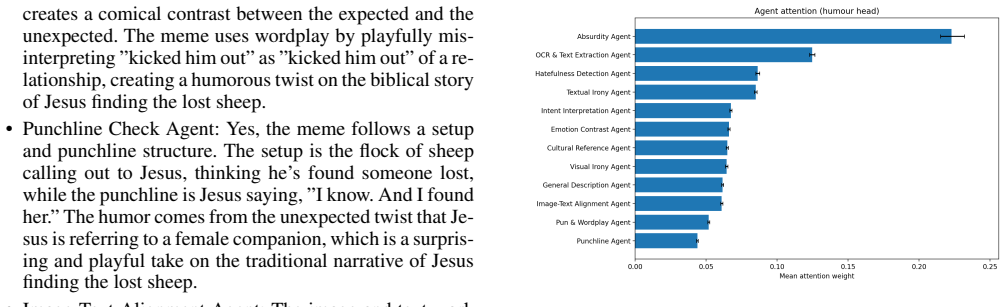
- The task-specific attention patterns (absurdity/OCR for humor; hatefulness/intent for hate) indicate the framework learns interpretable divisions of labor that could be inspected by moderators.
Where Pith is reading between the lines
- Because attention is learned only from classification loss, the faithfulness claim would be strengthened by an intervention test — e.g., removing or corrupting a high-weight perspective's reasoning and checking whether prediction and explanation shift as expected; without such a test, the alignment metric may just reflect the explainer mirroring the weights it was explicitly given.
- The twelve perspectives are a fixed set derived from standard humor/hate theory; culturally adaptive or region-specific lenses could improve coverage of slang, local references, and evolving meme conventions (the paper itself flags this as a limitation).
- The explanation stage is single-turn; an iterative, multi-turn synthesis that can ask clarifying questions about cultural references might close the gap on hateful-and-humorous memes, which scored lowest on informativeness.
- The paper reports results from a single fixed-seed run (seed 42) without error bars; repeated-seed experiments would clarify whether the accuracy gains are stable across random initializations.
Editorial analysis
A structured set of objections, weighed in public.
Referee Report
Summary. The paper presents MAR-12, a three-stage framework for meme classification and explanation. Stage 1 prompts a frozen VLM (Qwen-VL) to generate twelve theory-inspired reasoning traces (foundational, humor, safety). Stage 2 encodes these traces with per-role embeddings and aggregates them via a learned soft-gated attention, then classifies with a cosine prototype head. Stage 3 prompts the VLM to synthesize an explanation conditioned on the predicted label, the twelve rationales, and the learned attention weights. The paper reports accuracy/AUC/F1 on PrideMM and Memotion for both humor and hate detection, claiming state-of-the-art performance, and presents GPT-4 and human evaluations of explanation quality together with a quantitative 'Alignment' faithfulness analysis. The central claims are that MAR-12 outperforms prior unimodal, multimodal, and reasoning-based baselines, and that its explanations are 'process-level faithful' because they are conditioned on the same attention weights used by the classifier.
Significance. The problem is timely and practically important: memes frequently combine humor and hate, and moderation systems need both accurate detection and interpretable justifications. The multi-angle decomposition is a plausible and novel way to avoid collapsing all cues into a single embedding, and the paper is commendably concrete: it provides the full set of twelve prompts, implementation details, a code link, and an honest limitations discussion. If the faithfulness claim were substantiated, the work would be a solid contribution to explainable multimodal classification. However, the paper's two headline claims are not yet established: the accuracy advantage rests on a single run with no error bars, and the faithfulness evidence is largely circular because the explainer is explicitly instructed to mirror the attention-weighted rationales that the Alignment metric then scores. The efficiency claim is also muddled by counting only the 1.31M trainable head while excluding the substantial frozen VLM/encoders. The core idea is valuable and the necessary fixes are local, so with careful additional analysis the paper could meet its claims.
major comments (4)
- [Sec. 'Explanation Synthesizer', Eq. (6); Sec. 'Quantitative Faithfulness', Table 9] The 'process-level faithfulness' claim is not supported. The explainer prompt explicitly instructs the model to summarize the attention-weighted rationales and cite high-α agents, so the Alignment metric—textual overlap between the explanation and those same weighted rationales—largely measures prompt compliance, not whether α reflects the classifier's actual evidence use. α is trained only by the classification loss (Eq. 3–5), and many α assignments can yield nearly identical h_agg and predictions. No control condition (no weights, uniform weights, shuffled weights) and no intervention on α is reported. The near-zero correlation between alignment and correctness only rules out label-chasing. Please add causal tests: e.g., zero out the top-α agent and measure the prediction change, or compare against an explainer that receives the same rationales without the weights. Without such tests,
- [Checklist 4(c); Table 3] All results are from a single run with a fixed random seed (42), as explicitly stated in the checklist and appendix. The reported SOTA margins are small (e.g., PrideMM humor ACC 80.08 vs. MemeCLIP 78.30; Memotion hate AUC 74.04 vs. MiND 68.46). Single-run numbers without error bars or significance tests cannot establish that MAR-12 outperforms the baselines, especially in a setting with known high variance. Please report mean±std over at least 5 seeds and, if feasible, paired significance tests against the top baselines.
- [Table 4; Sec. 'Implementation Details'] The parameter count for MAR-12 (1.31M) counts only the attention and prototype head, excluding the frozen Qwen-VL, CLIP, and T5 encoders that are essential parts of the pipeline. Comparing this number to LoReHM's 34B total parameters, as Table 4 does, misrepresents the actual computational footprint. The paper calls MAR-12 'extremely lightweight' and 'orders of magnitude smaller' than baselines; this is only true for trainable parameters. Please report total parameters including all frozen components (e.g., Qwen-VL size, CLIP, T5) and make the efficiency comparison consistent.
- [Table 5; Sec. 'Ablation Studies'] The ablation results are suspicious: removing the humor group and removing the safety group both yield exactly 76.41% ACC / 50.00 AUC for humor, and 61.47% / 50.03 for hate. This exact equality indicates that the Stage-2 model collapses to majority-class prediction whenever any of the three groups is removed, rather than learning a degraded decision boundary. The paper frames this as evidence of indispensability, but it also suggests the training procedure is extremely fragile—the role-aware attention and prototype head fail to learn anything at all with a reduced perspective set. Please analyze the training dynamics, report learning curves, and consider whether the collapse is an artifact of class imbalance or initialization rather than a meaningful property of the perspectives.
minor comments (6)
- [Sec. 'Quantitative Faithfulness' / Appendix] The Alignment metric is never formally defined. The text says 'textual alignment between the explanator's explanation and the 12 agents' reasonings, weighted by the model's learned attention,' but no similarity measure (ROUGE, BERTScore, cosine, etc.), tokenization, or weighting formula is given. Without a precise definition, Table 9 and Table 13 cannot be interpreted or reproduced.
- [Sec. 'Models' / Table 2] The VLM backbone selection experiment (Table 2) is only reported for humor classification. Since MAR-12 is also evaluated for hate detection, please provide the same comparison (or a justification for why it is not needed) for the hate task.
- [Sec. 'Methodology', Eq. (3)] The role embedding e_i is not described. Is it a learned vector per perspective, a fixed function of the prompt, or something else? Specify how e_i is obtained and whether it is initialized randomly or derived from a text embedding of the role name.
- [Throughout] Several typos and formatting glitches: 'ocusing' (Models section), 'ExplanatorAgent' (Appendix heading), 'Judemeny' (Figure 2 caption), 'LoReHM (LLaV A-34B)' spacing, and 'Qwen2.5-VL-32B ' trailing space. A careful proofread is needed.
- [Appendix 'Interpreting Agent-Level Attention'] Figures 8–13 and Table 11 are not referenced in the main text. Please add references so readers know where to find this analysis, or integrate the key conclusions into the main text.
- [Sec. 'Human Evaluation'] The human evaluation uses five university students from the authors' own institution, with no IRB approval or compensation details. This is a limitation, but it is acknowledged only obliquely. Please state this explicitly in the main text and temper the claim that human evaluation 'confirms' explanation quality.
Circularity Check
Faithfulness result reduces to prompt compliance: Alignment metric measures overlap with the same attention-weighted rationales the explainer is instructed to mirror.
specific steps
-
self definitional
[Appendix 'ExplanatorAgent Alignment and Faithfulness (Extended Analysis)' / 'Explainer Prompt'; Section 'Quantitative Faithfulness' (Eq. 6, Table 9)]
"Process alignment by construction. Agents yield typed, local rationales; the attention head learns a sparse mixture over these; the explainer is instructed to mirror that mixture. ... Alignment: ... textual alignment between the explanator’s explanation and the 12 agents’ reasonings, weighted by the model’s learned attention. ... Given the prediction: [LABEL], and the following agent insights weighted by relevance(αi), summarize the reasoning behind the classification. Cite the most influential agents (higher α) and explain how their evidence supports the decision."
In Eq. (6), Explanation = Q_exp(ŷ, R_m, {α_i}), and the prompt template explicitly tells the model to summarize the weighted perspectives and cite high-α agents. The Alignment metric then measures textual overlap between the generated explanation and the very same attention-weighted rationales fed into the prompt. High alignment is therefore largely instruction-following, not an independent test of whether the explanation tracks the classifier's causal evidence. The appendix's own phrase 'Process alignment by construction' concedes this. Presenting this as 'Quantitative Faithfulness' that 'proves the synthesizer’s narrative is causally grounded in the model’s internal attention weights' turns a constructed prompt-output correspondence into evidence for a causal claim, which is circular.
full rationale
The paper's classification results on PrideMM and Memotion are evaluated against held-out test sets and are not themselves circular; the improvements over baselines stand or fall on the experimental setup. The self-citation to Liu et al. 2026 appears only in a related-work list and is not load-bearing. No uniqueness theorem or ansatz-by-citation pattern is present. The one substantive circularity concerns the explainability headline. The explainer is given the predicted label, the twelve rationales, and the learned attention weights, and is instructed to summarize the weighted rationales and cite high-α agents. The Alignment metric then measures textual overlap between the explanation and the same weighted rationales. Thus the reported 'faithfulness' result is, by the paper's own design, a measure of prompt compliance rather than an independent verification of internal evidence flow. The appendix explicitly labels this 'Process alignment by construction,' confirming that the property is built into the prompt. Because the paper then uses the resulting alignment statistics to claim the explanation is 'causally grounded' in attention weights, this specific evidence chain reduces to its own inputs. The explanation-quality evaluations (human and GPT-4 based) are not circular, so the overall circularity is partial rather than total, warranting a score of 6.
Axiom & Free-Parameter Ledger
free parameters (4)
- cosine prototype scale =
30
- margin ratio =
0.2
- dropout probabilities =
[0.1, 0.4, 0.2]
- trainable attention/prototype head weights =
1.31M parameters
axioms (4)
- domain assumption Qwen-VL's responses to the twelve role prompts are a reliable, content-based decomposition of each meme and do not inject the target label into the features.
- domain assumption Memotion 'offensive' labels can be reinterpreted as 'hateful' and the four-point humor scale collapsed to binary without changing the construct.
- domain assumption The twelve theory-derived perspectives form a sufficient coverage set for humor and hate reasoning; no critical dimension is omitted.
- domain assumption Learned attention weights {α_i} faithfully represent each perspective's causal contribution to the classification, so conditioning explanations on them provides 'process-level faithfulness'.
read the original abstract
Internet memes intertwine visual cues, textual content, and cultural context, making them particularly challenging to interpret in scenarios where humor, sarcasm, and harmful intent coexist. These complexities highlight the need for explainable meme understanding systems that can provide reliable and structured reasoning to support both accurate classification and human interpretability. However, existing multimodal classifiers either overlook these interdependencies or provide only limited interpretability. In this paper, we introduce MAR-12, a novel framework that leverages Vision Language Models (VLMs) for meme detection and understanding in settings where humorous and hateful elements may coexist. The framework first interprets each meme through twelve structured perspectives derived from humor and hate theories. It then applies a role-aware soft-gated attention mechanism to learn how much each perspective should contribute, followed by a prototype-based classifier for the final prediction. Finally, explanations are synthesized using both perspective-specific reasoning and learned attention weights, ensuring transparent and context-grounded justifications. We evaluate MAR-12 on the PrideMM and Memotion datasets, where it achieves up to 80.3% accuracy for humor detection and 75.9% accuracy for hate detection, outperforming state-of-the-art approaches. Furthermore, both human and GPT-4-based evaluations confirm that MAR-12 produces coherent and persuasive explanations, particularly for memes in which humorous and harmful cues co-occur.
Figures




Reference graph
Works this paper leans on
-
[1]
Journal of Managerial psychology , volume=
A meta-analysis of positive humor in the workplace , author=. Journal of Managerial psychology , volume=. 2012 , publisher=
2012
-
[2]
Advances in Neural Information Processing Systems , volume=
Hugginggpt: Solving ai tasks with chatgpt and its friends in hugging face , author=. Advances in Neural Information Processing Systems , volume=
-
[3]
Humor , volume=
Humor in organization: From function to resistance , author=. Humor , volume=. 2013 , publisher=
2013
-
[4]
Healthy humour: Using humour to cope at work , author=. K. 2009 , publisher=
2009
-
[5]
Journal of Children in Contemporary Society , volume=
Chapter 5: The contribution of humor to children's social development , author=. Journal of Children in Contemporary Society , volume=. 1989 , publisher=
1989
-
[6]
Proceedings of the National Academy of Sciences , volume=
Emotion and humor as misinformation antidotes , author=. Proceedings of the National Academy of Sciences , volume=. 2021 , publisher=
2021
-
[7]
The European Journal of Humour Research , volume=
‘Are we laughing at the same?’: a contrastive analysis of Covid-related memes in Czech, Chinese and Spanish , author=. The European Journal of Humour Research , volume=
-
[8]
Pragmatics of Internet Humour , pages=
Meme-Mediated Humorous Communication , author=. Pragmatics of Internet Humour , pages=. 2023 , publisher=
2023
-
[9]
Proceedings of the 2021 IEEE/ACM international conference on advances in social networks analysis and mining , pages=
Racism is a virus: Anti-Asian hate and counterspeech in social media during the COVID-19 crisis , author=. Proceedings of the 2021 IEEE/ACM international conference on advances in social networks analysis and mining , pages=
2021
-
[10]
Lingua , volume=
Funny but aversive: A large-scale survey of the emotional response to Covid-19 humor in the Italian population during the lockdown , author=. Lingua , volume=
-
[11]
Companion Proceedings of the ACM Web Conference 2023 , pages=
I’m out of breath from laughing! I think? A dataset of COVID-19 humor and its toxic variants , author=. Companion Proceedings of the ACM Web Conference 2023 , pages=
2023
-
[12]
2024 , publisher=
Linguistic theories of humor , author=. 2024 , publisher=
2024
-
[13]
2017 , publisher=
The game of humor: A comprehensive theory of why we laugh , author=. 2017 , publisher=
2017
-
[14]
International Journal of Cultural Studies , volume=
Living through it: Anger, laughter, and internet memes in dark times , author=. International Journal of Cultural Studies , volume=. 2021 , publisher=
2021
-
[15]
International Journal of Cultural Studies , pages=
Chinese medicine as a cure for gayness: Satire as countercultural resistance against heteronormative symbolic violence in digital public sphere , author=. International Journal of Cultural Studies , pages=. 2025 , publisher=
2025
-
[16]
It gets better
“It gets better”: Internet memes and the construction of collective identity , author=. New media & society , volume=. 2016 , publisher=
2016
-
[17]
LGBTQ+ activism in Central and Eastern Europe: Resistance, representation and identity , pages=
Putin as gay icon? Memes as a tactic in Russian LGBT+ activism , author=. LGBTQ+ activism in Central and Eastern Europe: Resistance, representation and identity , pages=. 2020 , publisher=
2020
-
[18]
Proceedings of the AAAI Conference on Artificial Intelligence , volume=
Well, now we know! unveiling sarcasm: Initiating and exploring multimodal conversations with reasoning , author=. Proceedings of the AAAI Conference on Artificial Intelligence , volume=
-
[19]
Proceedings of the International AAAI Conference on Web and Social Media , volume=
Demystifying hateful content: Leveraging large multimodal models for hateful meme detection with explainable decisions , author=. Proceedings of the International AAAI Conference on Web and Social Media , volume=
-
[20]
Artificial Intelligence Review , volume=
Computational humor recognition: a systematic literature review , author=. Artificial Intelligence Review , volume=. 2024 , publisher=
2024
-
[21]
Proceedings of the AAAI Conference on Artificial Intelligence , volume=
Multi-Granular Multimodal Clue Fusion for Meme Understanding , author=. Proceedings of the AAAI Conference on Artificial Intelligence , volume=
-
[22]
Advances in neural information processing systems , volume=
The hateful memes challenge: Detecting hate speech in multimodal memes , author=. Advances in neural information processing systems , volume=
-
[23]
Proceedings of the second workshop on trolling, aggression and cyberbullying , pages=
Multimodal meme dataset (MultiOFF) for identifying offensive content in image and text , author=. Proceedings of the second workshop on trolling, aggression and cyberbullying , pages=
-
[24]
International conference on machine learning , pages=
Learning transferable visual models from natural language supervision , author=. International conference on machine learning , pages=. 2021 , organization=
2021
-
[25]
International conference on machine learning , pages=
Vilt: Vision-and-language transformer without convolution or region supervision , author=. International conference on machine learning , pages=. 2021 , organization=
2021
-
[26]
arXiv preprint arXiv:1908.03557 , year=
Visualbert: A simple and performant baseline for vision and language , author=. arXiv preprint arXiv:1908.03557 , year=
Pith/arXiv arXiv 1908
-
[27]
Proceedings of the 31st ACM International Conference on Multimedia , pages=
Pro-cap: Leveraging a frozen vision-language model for hateful meme detection , author=. Proceedings of the 31st ACM International Conference on Multimedia , pages=
-
[28]
Proceedings of the IEEE/CVF International Conference on Computer Vision , pages=
Mapping memes to words for multimodal hateful meme classification , author=. Proceedings of the IEEE/CVF International Conference on Computer Vision , pages=
-
[29]
Proceedings of the Fourteenth Workshop on Semantic Evaluation , pages=
UPB at SemEval-2020 Task 8: Joint Textual and Visual Modeling in a Multi-Task Learning Architecture for Memotion Analysis , author=. Proceedings of the Fourteenth Workshop on Semantic Evaluation , pages=
2020
-
[30]
Bert: Pre-training of deep bidirectional transformers for language understanding , author=. Proceedings of the 2019 conference of the North American chapter of the association for computational linguistics: human language technologies, volume 1 (long and short papers) , pages=
2019
-
[31]
arXiv preprint arXiv:1909.11942 , year=
Albert: A lite bert for self-supervised learning of language representations , author=. arXiv preprint arXiv:1909.11942 , year=
Pith/arXiv arXiv 1909
-
[32]
arXiv preprint arXiv:1409.1556 , year=
Very deep convolutional networks for large-scale image recognition , author=. arXiv preprint arXiv:1409.1556 , year=
-
[33]
Proceedings of the IEEE conference on computer vision and pattern recognition , pages=
Densely connected convolutional networks , author=. Proceedings of the IEEE conference on computer vision and pattern recognition , pages=
-
[34]
arXiv preprint arXiv:1910.01108 , year=
DistilBERT, a distilled version of BERT: smaller, faster, cheaper and lighter , author=. arXiv preprint arXiv:1910.01108 , year=
Pith/arXiv arXiv 1910
-
[35]
Journal of Machine Learning Research , volume=
Palm: Scaling language modeling with pathways , author=. Journal of Machine Learning Research , volume=
-
[36]
arXiv preprint arXiv:2312.11805 , year=
Gemini: a family of highly capable multimodal models , author=. arXiv preprint arXiv:2312.11805 , year=
-
[37]
2018 , publisher=
The world made meme: Public conversations and participatory media , author=. 2018 , publisher=
2018
-
[38]
arXiv , author=
From generation to judgment: Opportunities and challenges of LLM-as-a-judge. arXiv , author=
-
[39]
arXiv preprint arXiv:2311.17371 , year=
Should we be going mad? a look at multi-agent debate strategies for llms , author=. arXiv preprint arXiv:2311.17371 , year=
-
[40]
arXiv preprint arXiv:2502.08788 , year=
If multi-agent debate is the answer, what is the question , author=. arXiv preprint arXiv:2502.08788 , year=
-
[41]
arXiv preprint arXiv:2406.04092 , year=
Reliable Decision-Making for Multi-Agent LLM Systems , author=. arXiv preprint arXiv:2406.04092 , year=
-
[42]
The Thirteenth International Conference on Learning Representations , year=
Breaking mental set to improve reasoning through diverse multi-agent debate , author=. The Thirteenth International Conference on Learning Representations , year=
-
[43]
arXiv preprint arXiv:2402.14320 , year=
Triad: A framework leveraging a multi-role LLM-based agent to solve knowledge base question answering , author=. arXiv preprint arXiv:2402.14320 , year=
-
[44]
arXiv preprint arXiv:2409.18996 , year=
From Linguistic Giants to Sensory Maestros: A Survey on Cross-Modal Reasoning with Large Language Models , author=. arXiv preprint arXiv:2409.18996 , year=
-
[45]
Proceedings of the AAAI conference on artificial intelligence , volume=
Bad actor, good advisor: Exploring the role of large language models in fake news detection , author=. Proceedings of the AAAI conference on artificial intelligence , volume=
-
[46]
Proceedings of the 2024 Conference on Empirical Methods in Natural Language Processing , pages=
Towards Low-Resource Harmful Meme Detection with LMM Agents , author=. Proceedings of the 2024 Conference on Empirical Methods in Natural Language Processing , pages=
2024
-
[47]
Proceedings of the 2024 Conference on Empirical Methods in Natural Language Processing , pages=
Encouraging Divergent Thinking in Large Language Models through Multi-Agent Debate , author=. Proceedings of the 2024 Conference on Empirical Methods in Natural Language Processing , pages=
2024
-
[48]
arXiv preprint arXiv:2110.00413 , year=
Detecting harmful memes and their targets , author=. arXiv preprint arXiv:2110.00413 , year=
-
[49]
Advances in Neural Information Processing Systems , volume=
Towards comprehensive detection of chinese harmful memes , author=. Advances in Neural Information Processing Systems , volume=
-
[50]
Proceedings of the 2024 Joint International Conference on Computational Linguistics, Language Resources and Evaluation (LREC-COLING 2024) , pages=
MUCH: A Multimodal Corpus Construction for Conversational Humor Recognition Based on Chinese Sitcom , author=. Proceedings of the 2024 Joint International Conference on Computational Linguistics, Language Resources and Evaluation (LREC-COLING 2024) , pages=
2024
-
[51]
Cats be outside, how about meow
“Cats be outside, how about meow”: multimodal humor and creativity in an internet meme , author=. Journal of Pragmatics , volume=. 2021 , publisher=
2021
-
[52]
arXiv preprint arXiv:2008.03781 , year=
SemEval-2020 Task 8: Memotion Analysis--The Visuo-Lingual Metaphor! , author=. arXiv preprint arXiv:2008.03781 , year=
Pith/arXiv arXiv 2020
-
[53]
Proceedings of the 2022 Conference on Empirical Methods in Natural Language Processing , pages=
Prompting for Multimodal Hateful Meme Classification , author=. Proceedings of the 2022 Conference on Empirical Methods in Natural Language Processing , pages=
2022
-
[54]
arXiv preprint arXiv:2305.16291 , year=
Voyager: An open-ended embodied agent with large language models , author=. arXiv preprint arXiv:2305.16291 , year=
-
[55]
arXiv preprint arXiv:2310.06272 , year=
Let models speak ciphers: Multiagent debate through embeddings , author=. arXiv preprint arXiv:2310.06272 , year=
-
[56]
arXiv preprint arXiv:2504.18875 , year=
Generative to agentic ai: Survey, conceptualization, and challenges , author=. arXiv preprint arXiv:2504.18875 , year=
-
[57]
Metagpt: Meta programming for multi-agent collaborative framework. arXiv 2023 , author=. arXiv preprint arXiv:2308.00352 , volume=
Pith/arXiv arXiv 2023
-
[58]
arXiv preprint arXiv:2308.03688 , year=
Agentbench: Evaluating llms as agents , author=. arXiv preprint arXiv:2308.03688 , year=
-
[59]
Advances in Neural Information Processing Systems , volume=
Self-refine: Iterative refinement with self-feedback , author=. Advances in Neural Information Processing Systems , volume=
-
[60]
arXiv preprint arXiv:2203.11171 , year=
Self-consistency improves chain of thought reasoning in language models , author=. arXiv preprint arXiv:2203.11171 , year=
-
[61]
arXiv preprint arXiv:2305.19118 , year=
Encouraging divergent thinking in large language models through multi-agent debate , author=. arXiv preprint arXiv:2305.19118 , year=
-
[62]
arXiv preprint arXiv:2308.07201 , year=
Chateval: Towards better llm-based evaluators through multi-agent debate , author=. arXiv preprint arXiv:2308.07201 , year=
-
[63]
Proceedings of the international AAAI conference on web and social media , volume=
Stance detection with collaborative role-infused llm-based agents , author=. Proceedings of the international AAAI conference on web and social media , volume=
-
[64]
arXiv preprint arXiv:2311.01876 , year=
Sentiment analysis through llm negotiations , author=. arXiv preprint arXiv:2311.01876 , year=
-
[65]
Forty-first International Conference on Machine Learning , year=
Improving factuality and reasoning in language models through multiagent debate , author=. Forty-first International Conference on Machine Learning , year=
-
[66]
Proceedings of the 48th International ACM SIGIR Conference on Research and Development in Information Retrieval , pages=
The truth becomes clearer through debate! multi-agent systems with large language models unmask fake news , author=. Proceedings of the 48th International ACM SIGIR Conference on Research and Development in Information Retrieval , pages=
-
[67]
arXiv preprint arXiv:2505.18596 , year=
Debate-to-Detect: Reformulating Misinformation Detection as a Real-World Debate with Large Language Models , author=. arXiv preprint arXiv:2505.18596 , year=
-
[68]
2025 13th International Symposium on Digital Forensics and Security (ISDFS) , pages=
Debate-Driven Multi-Agent LLMs for Phishing Email Detection , author=. 2025 13th International Symposium on Digital Forensics and Security (ISDFS) , pages=. 2025 , organization=
2025
-
[69]
arXiv preprint arXiv:2410.20140 , year=
LLM-Consensus: Multi-Agent Debate for Visual Misinformation Detection , author=. arXiv preprint arXiv:2410.20140 , year=
-
[70]
Proceedings of the ACM Web Conference 2024 , pages=
Towards explainable harmful meme detection through multimodal debate between large language models , author=. Proceedings of the ACM Web Conference 2024 , pages=
2024
-
[71]
arXiv preprint arXiv:2502.17924 , year=
Fact-audit: An adaptive multi-agent framework for dynamic fact-checking evaluation of large language models , author=. arXiv preprint arXiv:2502.17924 , year=
-
[72]
Proceedings of the 2024 Conference on Empirical Methods in Natural Language Processing , pages=
PREDICT: multi-agent-based debate simulation for generalized hate speech detection , author=. Proceedings of the 2024 Conference on Empirical Methods in Natural Language Processing , pages=
2024
-
[73]
arXiv preprint arXiv:2507.06908 , year=
MIND: A Multi-agent Framework for Zero-shot Harmful Meme Detection , author=. arXiv preprint arXiv:2507.06908 , year=
-
[74]
Proceedings of the ACM on Web Conference 2025 , pages=
Ask, acquire, understand: A multimodal agent-based framework for social abuse detection in memes , author=. Proceedings of the ACM on Web Conference 2025 , pages=
2025
-
[75]
Proceedings of the ACM on Web Conference 2025 , pages=
SAHSD: Enhancing Hate Speech Detection in LLM-Powered Web Applications via Sentiment Analysis and Few-Shot Learning , author=. Proceedings of the ACM on Web Conference 2025 , pages=
2025
-
[76]
Proceedings of the ACM web conference 2023 , pages=
Identifying creative harmful memes via prompt based approach , author=. Proceedings of the ACM web conference 2023 , pages=
2023
-
[77]
arXiv preprint arXiv:2303.08774 , year=
Gpt-4 technical report , author=. arXiv preprint arXiv:2303.08774 , year=
-
[78]
Proceedings of the ACM Web Conference 2024 , pages=
Capalign: Improving cross modal alignment via informative captioning for harmful meme detection , author=. Proceedings of the ACM Web Conference 2024 , pages=
2024
-
[79]
Proceedings of the ACM on Web Conference 2025 , pages=
Figurative-cum-Commonsense Knowledge Infusion for Multimodal Mental Health Meme Classification , author=. Proceedings of the ACM on Web Conference 2025 , pages=
2025
-
[80]
arXiv preprint arXiv:2507.01702 , year=
AdamMeme: Adaptively Probe the Reasoning Capacity of Multimodal Large Language Models on Harmfulness , author=. arXiv preprint arXiv:2507.01702 , year=
discussion (0)
Sign in with ORCID, Apple, or X to comment. Anyone can read and Pith papers without signing in.