REVIEW 3 major objections 4 minor 33 references
Score geospatial dataset FAIRness for $0.054 each
Reviewed by Pith at T0; open to challenge. T0 means a machine referee read the full paper against a public rubric. the ladder, T0–T4 →
T0 review · deepseek-v4-flash
2026-08-01 22:19 UTC pith:XIZSAQNL
load-bearing objection AgentFAIR is a genuinely useful, honestly limited feasibility study of LLM-based FAIR scoring for geospatial data; the 82% expert-alignment number is real but not yet independently testable, and the paper knows it. the 3 major comments →
AgentFAIR: A Multi-Agent Collaborative Framework for FAIRness Evaluation of Geospatial Datasets
The pith
A machine-rendered reading of the paper's core claim, the machinery that carries it, and where it could break.
Core claim
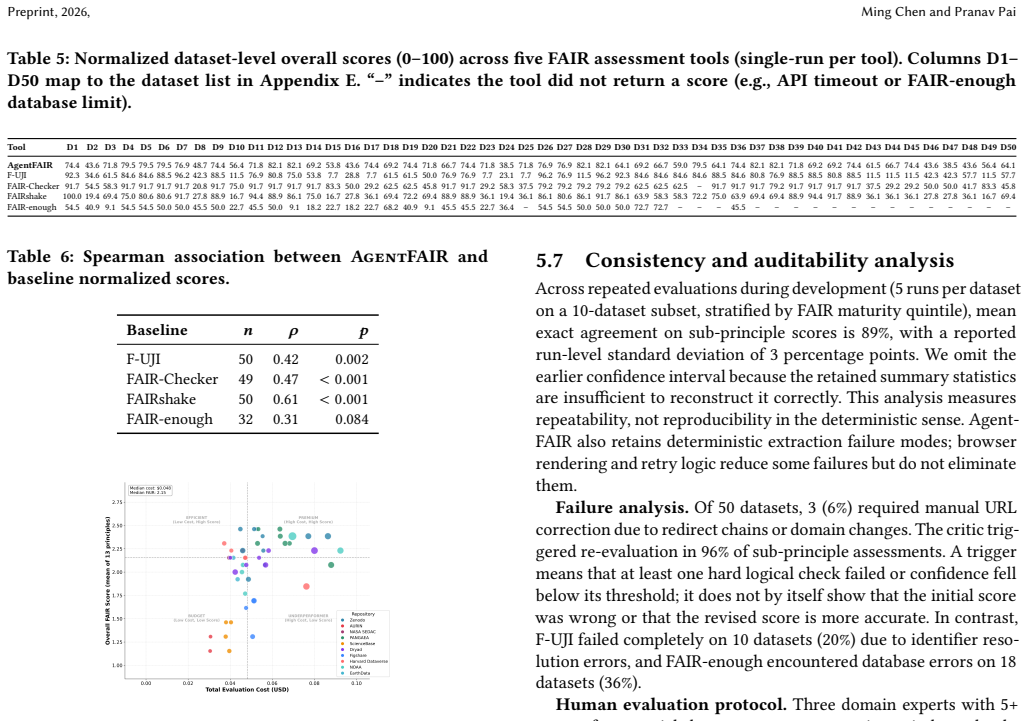
AgentFAIR is a three-stage pipeline that renders each dataset's landing page, extracts machine-readable metadata together with provenance-linked snippets, and then runs 13 sub-principle-specific LLM evaluators, each applying the same explicit 0–3 maturity rubric with geospatial indicators. Every non-zero score must cite observable evidence; a critic agent performs hard logical checks and cross-principle consistency checks and can trigger a targeted re-evaluation when evidence is missing or low-confidence. The paper reports mean dimension scores of 79.7% for Findability, 70.4% for Accessibility, 45.3% for Interoperability, and 72.0% for Reusability across 50 datasets; sub-principle agreement
What carries the argument
The load-bearing mechanism is the critic-driven feedback loop: 13 sub-principle-specific LLM agents, each governed by an explicit 0–3 maturity rubric (with geospatial indicators such as CRS/EPSG identifiers, ISO 19115 elements, and OGC endpoints), must attach provenance-linked evidence to every non-zero score. A critic agent then checks evidence sufficiency and cross-principle consistency, triggering targeted re-evaluation when hard checks fail or confidence is low. This critic is what lifts repeated-run sub-principle agreement from 71% to 89% in the reported ablation.
Load-bearing premise
The scores are only as valid as the author-defined 0–3 rubric and the LLM's reading of page snippets; if that rubric is not a faithful operationalization of FAIR for geospatial data, the whole measurement is off.
What would settle it
Run the same pipeline on a held-out set of geospatial datasets and have independent auditors score them with a rubric not designed by the authors. If AgentFAIR's alignment with the external rubric drops far below the reported 82%, or if repeated runs on JavaScript-heavy pages diverge by more than the reported standard deviation, the feasibility and auditability claims would be falsified.
If this is right
- If AgentFAIR's results hold across more datasets, geospatial repositories could deploy continuous, evidence-linked FAIR monitoring for roughly $0.05 per dataset, making stewardship decisions auditable and cheap.
- The consistently weak Interoperability scores (mean 45.3%, with I2 and I3 near the bottom) imply that geospatial FAIRness improvements depend on ecosystem-level vocabulary registration and typed-reference exposure, not just on dataset-level metadata quality.
- The critic's 18-percentage-point improvement in repeated-run agreement suggests that evidence-based consistency checking is a key ingredient for reliable LLM-based evaluation, not a minor add-on.
- The 82% agreement with expert consensus (experts themselves at Fleiss' kappa 0.71) suggests the 0–3 rubric captures a shared interpretation of geospatial FAIRness, at least within the paper's sample.
- The diagnostic finding that normalized scores across four existing evaluators vary by a mean per-dataset standard deviation of 15.0 points means FAIR scores remain tool-dependent; AgentFAIR provides one auditable signal rather than a universal ground truth.
Where Pith is reading between the lines
- Because the expert study and the automated system used the same author-defined rubric, the 82% alignment may partly reflect shared criteria rather than an external ground truth; a more decisive test would score the same datasets with an independent rubric.
- The paper's own I2 registry-count criterion is likely under-crediting valid community vocabularies; extending the rubric to include vocabulary documentation, resolvability, and governance could raise Interoperability scores without loosening standards.
- The critic's high trigger rate (96%) and the absence of trigger-type breakdown leave open whether it mainly corrects errors or mostly enforces consistency; a natural follow-up is to compare critic-revised scores against expert labels on the triggered cases alone.
- With mean processing time around 1,054 seconds per dataset, the pipeline is batch-oriented rather than interactive; caching evidence and using smaller models could make near-real-time FAIR monitoring feasible, though the paper does not explore this.
Editorial analysis
A structured set of objections, weighed in public.
Referee Report
Summary. The paper presents AgentFAIR, a multi-agent LLM-based framework for evaluating the 13 FAIR sub-principles of geospatial datasets. The pipeline combines Playwright-based crawling of JavaScript-rendered landing pages, structured metadata extraction, per-sub-principle GPT-4o-mini evaluators using a 0–3 maturity rubric, and a critic agent that checks evidence sufficiency and cross-principle consistency and may trigger re-evaluation. On 50 datasets across 10 repositories, the authors report mean Findability 79.7%, Accessibility 70.4%, Interoperability 45.3%, and Reusability 72.0%; a mean across-tool per-dataset standard deviation of 15.0 points; 89% repeated-run exact sub-principle agreement with the critic versus 71% without; 82% agreement with expert majority on 195 judgments across 15 datasets (Fleiss' kappa 0.71); and a mean API cost of USD 0.054 per dataset. The paper is careful to frame the cross-tool comparison as a disagreement and failure-mode analysis rather than as comparative accuracy, and it explicitly lists unresolved validity limitations.
Significance. If supported, the framework is a useful and honest contribution to automated FAIR assessment: it provides an evidence-linked audit trail, a transparent rubric, deterministic checks, and very low marginal cost. The open-source release and archived snapshot are clear strengths, as is the paper's repeated insistence that tool-score normalization does not establish accuracy. The main significance, however, is feasibility and auditability. The claimed accuracy link to expert judgment is weakened by the fact that the experts applied the same author-constructed rubric that the LLM prompts implement, and because the raw expert labels and repeated-run outputs are not released, the headline agreement statistics cannot be independently recomputed. The paper's own limitation sections acknowledge many of these issues; the task for revision is to make the validity claims match the available evidence.
major comments (3)
- [Sec. 5.6, 5.10, B.2, App. F] The 82% expert-alignment result is the only quantitative bridge between AgentFAIR outputs and an external criterion, yet it is not independently verifiable. The expert protocol used the same 0–3 rubric (Table 2) that the LLM prompts implement, and B.2 states that prompts were iteratively refined during development. Consequently, the agreement may partially reflect shared rubric and prompt tuning rather than independent FAIR correctness. Moreover, Appendix F states that raw expert labels, repeated-run outputs, ablation runs, and analysis notebooks are not released. The paper should either release the raw expert labels and confirm that prompts were frozen before any expert labels were collected, or explicitly reframe the 82% as agreement with expert application of the paper's rubric, not as validation of FAIR accuracy. As written, the abstract's accuracy narrative overstates what the evide
- [Sec. 5.2, Tables 3 and 5, Sec. 5.7] All dataset-level scores and the resulting means, correlations, and cost figures are based on a single representative run of an LLM pipeline at temperature 0.1. Repeated-run agreement is measured only on a stratified 10-dataset subset, so no run-level uncertainty is attached to the 50-dataset means (e.g., Findability 79.7%, Interoperability 45.3%) or to the Spearman correlations in Table 6. Because LLM stochasticity is acknowledged as inherent to the system, the manuscript should either provide multi-run interval estimates for the full 50-dataset sample or explicitly present all numerical summaries as estimates from one representative run rather than as stable population statistics.
- [Table 2 (II2), Sec. 5.3, 5.10, B.2] The headline finding that Interoperability is the weakest dimension is substantially driven by the I2 rubric, which counts vocabulary registry presence as the main evidence of FAIR vocabularies. The paper itself concedes (Sec. 5.10 and B.2) that this criterion can under-credit valid community vocabularies absent from generic registries, and the expert agreement on I2 is the lowest (kappa = 0.58). The mean Interoperability score of 45.3% should therefore be presented as rubric-dependent, and the authors should either provide a sensitivity analysis with a broader I2 operationalization or soften the cross-repository conclusion that geospatial interoperability is systematically weak.
minor comments (4)
- [Sec. 5.7] The sentence 'We omit the earlier confidence interval because the retained summary statistics are insufficient to reconstruct it correctly' is a self-referential editorial note about the writing process. It should be replaced with a clean statement of the reported summary statistics.
- [Sec. 4.4] The critic confidence thresholds (theta_p; 0.5 generally, 0.4 for I1) and the retry budget are free parameters. No sensitivity analysis is provided, so the reported 89% vs. 71% consistency difference could depend on these specific values. A brief discussion or supplementary experiment on threshold robustness would strengthen the ablation.
- [Table 3] The 50-column maturity matrix is visually dense. A machine-readable table in the supplement (beyond the raw code release) would make the per-dataset scores easier to audit and reuse.
- [App. F] The 'Missing research artifacts' list is important and should be surfaced in the main text or in a formal data-availability statement, since it directly affects whether the reported inferential statistics can be reproduced.
Circularity Check
No significant circularity: reported results are empirical measurements, not derivations from their inputs; the shared expert rubric is an acknowledged validity limitation, not a constructional identity.
full rationale
The paper's central claims are empirical: AgentFAIR produces 0-3 maturity scores from landing-page evidence via the rubric in Section 3.2/Table 2, and these scores are then compared with expert labels, baseline tools, and repeated runs. No equation defines the reported outputs in terms of expert labels or baseline scores, and no parameter is fitted to the target claims. The strongest possible circularity candidate is the 82% expert-alignment result in Section 5.7, since experts and LLM prompts both use the same author-constructed rubric. But this is not circularity in the required sense: the expert labels are independent human applications of the rubric, and agreement is not guaranteed by construction — LLM outputs could and do diverge from expert majority on 18% of judgments. The paper itself repeatedly disclaims this evidence as a definitive ground truth (B.2: 'the preliminary expert sample is not a definitive ground truth'), frames cross-tool comparisons as disagreement rather than accuracy (Section 5.5), and acknowledges that prompts were iteratively refined during development (B.2). Those are genuine validity and reproducibility limitations, not reductions of outputs to inputs. There are no load-bearing self-citations, no imported uniqueness theorems, no ansatz smuggled in via citation, and no renaming of a known result. Therefore no circular step meets the evidentiary bar required here.
Axiom & Free-Parameter Ledger
free parameters (3)
- critic confidence thresholds theta_p =
0.5 (0.4 for I1)
- LLM temperature =
0.1
- retry budget =
not specified
axioms (5)
- domain assumption The Table 2 rubric is a faithful operationalization of the FAIR Guiding Principles for geospatial data.
- domain assumption LLM outputs constrained by rubric and evidence rules are meaningful compliance measurements.
- domain assumption Expert majority labels using the same rubric are a valid reference for alignment.
- domain assumption Normalized 0-100 scores from heterogeneous tools can diagnose disagreement.
- standard math Statistical tests (Spearman, paired t-test, Fleiss kappa) are valid on the small samples used.
read the original abstract
Geospatial datasets support applications from urban planning to climate modeling, yet consistent assessment of FAIR compliance is difficult. Existing evaluators use different rubrics and evidence sources and may fail on JavaScript-rendered pages or repository-specific identifiers. For 50 datasets from 10 repositories, the standard deviation of normalized scores across available tools averages 15.0 percentage points and reaches 30.3 for one dataset. Because these outputs are not equivalent measurements, we use them to characterize disagreement and failure modes, not comparative accuracy. We present AgentFAIR, a multi-agent framework combining structured metadata extraction with 13 sub-principle-specific LLM evaluators. Each produces a 0-3 maturity score, cited evidence, and recommendations; a critic checks evidence and consistency and can request targeted re-evaluation. Mean Findability, Accessibility, Interoperability, and Reusability scores are 79.7%, 70.4%, 45.3%, and 72.0%. Rank correlations with four baseline tools range from 0.31 to 0.61; the FAIR-enough comparison is not statistically significant. On a 10-dataset repeated-run subset, sub-principle agreement averages 89% (standard deviation: 3 percentage points), versus 71% without the critic. A preliminary 15-dataset expert study yields Fleiss' kappa of 0.71 and 82% alignment with expert consensus. API cost is approximately USD 0.054 per dataset. These results support auditability and feasibility, while the limited benchmark, incomplete ablations, and single-model-family validation constrain claims about accuracy and generalization.
Figures



Reference graph
Works this paper leans on
-
[1]
Christiane Bahlo, Siddeswara Guru, Nicholas Car, and Lesley Wyborn. 2024. Ad- vancing FAIR Agricultural Data: The AgReFed FAIR Assessment Tool.Data Sci- ence Journal23, 1 (2024), 15. doi:10.5334/dsj-2024-018
-
[2]
Lennart Busch, Daniel Tebernum, and Gissel Velarde. 2025. Exploring LLM Ca- pabilities in Extracting DCAT-Compatible Metadata for Data Cataloging.arXiv preprint arXiv:2507.05282(2025). doi:10.48550/arXiv.2507.05282
work page internal anchor Pith review Pith/arXiv arXiv doi:10.48550/arxiv.2507.05282 2025
-
[3]
Leonardo Candela, Dario Mangione, and Gina Pavone. 2024. The FAIR Assess- ment Conundrum: Reflections on Tools and Metrics.Data Science Journal23, 1 (2024). doi:10.5334/dsj-2024-033
-
[4]
Daniel J. B. Clarke, Lily Wang, Alex Jones, Megan L. Wojciechowicz, Denis Torre, Kathleen M. Jagodnik, Sherry L. Jenkins, Peter McQuilton, Zachary Flamholz, Moshe C. Silverstein, et al. 2019. FAIRshake: Toolkit to Evaluate the FAIRness of Research Digital Resources.Cell Systems9, 5 (2019), 417–421. doi:10.1016/j. cels.2019.09.011
doi:10.1016/j 2019
-
[5]
Anusuriya Devaraju and Robert Huber. 2020. F-UJI FAIR Assessment Tool. https: //www.f-uji.net/ Accessed: 2026-01-08
2020
-
[6]
Vincent Emonet and Michel Dumontier. 2022. FAIR-enough: A Community- Governed FAIR Maturity Assessment Framework. https://github.com/ MaastrichtU-IDS/fair-enough
2022
-
[7]
Alban Gaignard, Thomas Rosnet, Frédéric De Lamotte, Vincent Lefort, and Marie-Dominique Devignes. 2023. FAIR-Checker: Supporting Digital Resource Findability and Reuse with Knowledge Graphs and Semantic Web Standards. Journal of Biomedical Semantics14, 1 (2023), 7. doi:10.1186/s13326-023-00289-5
-
[8]
Sirui Hong, Mingchen Zhuge, Jonathan Chen, Xiawu Zheng, Yuheng Cheng, Ceyao Zhang, Jinlin Wang, Zili Wang, Steven Ka Shing Yau, Zijuan Lin, Liyang Zhou, Chenyu Ran, Lingfeng Xiao, Chenglin Wu, and Jürgen Schmidhuber
-
[9]
Zezhou Huang and Eugene Wu. 2024. Cocoon: Semantic Table Profiling Using Large Language Models. InProceedings of the 2024 Workshop on Human-In-the- Loop Data Analytics (HILDA ’24). ACM, 1–7. doi:10.1145/3665939.3665957
arXiv 2024
-
[10]
International Organization for Standardization. 2014. ISO 19115-1:2014 Geo- graphic Information — Metadata Part 1: Fundamentals. https://www.iso.org/ standard/53798.html Published Edition 1, last reviewed and confirmed in 2019, with 2 amendments
2014
-
[11]
N. A. Krans, A. Ammar, P. Nymark, E. L. Willighagen, M. I. Bakker, and J. T. K. Quik. 2022. FAIR Assessment Tools: Evaluating Use and Performance.NanoIm- pact27 (2022), 100402. doi:10.1016/j.impact.2022.100402
arXiv 2022
-
[12]
Lang Chain Authors. 2026. LangGraph: Agent Orchestration Framework for Reliable AI Agents. https://www.langchain.com/langgraph. Accessed on: 2026- 02-08
2026
-
[13]
Lan Li, Liri Fang, and Vetle I. Torvik. 2024. Autodcworkflow: LLM-Based Data Cleaning Workflow Auto-Generation and Benchmark.arXiv preprint arXiv:2412.06724(2024). doi:10.48550/arXiv.2412.06724
-
[14]
Xiao Liu, Hao Yu, Hanchen Zhang, Yifan Xu, Xuanyu Lei, Hanyu Lai, Yu Gu, Hangliang Ding, Kaiwen Men, Kejuan Yang, Shudan Zhang, Xiang Deng, Aohan Zeng, Zhengxiao Du, Chenhui Zhang, Sheng Shen, Tianjun Zhang, Yu Su, Huan Preprint, 2026, Ming Chen and Pranav Pai Sun, Minlie Huang, Yuxiao Dong, and Jie Tang. 2024. AgentBench: Evaluating LLMs as Agents. InInt...
2026
-
[15]
Gengchen Mai, Chris Cundy, Kristy Choi, Yingjie Hu, Ni Lao, and Stefano Ermon
-
[16]
Avanika Narayan, Ines Chami, Laurel Orr, Simran Arber, Pengyu Rong, Mon- ica Shen, and Christopher Ré. 2024. Can Foundation Models Wrangle Your Data?Proceedings of the VLDB Endowment17, 5 (2024), 1212–1225. doi:10.14778/ 3641204.3641227
arXiv 2024
-
[17]
On the Opportunities and Challenges of Foundation Models for GeoAI. Comput. Surveys56, 10 (2024), 1–41. doi:10.1145/3653070
doi:10.1145/3653070 2024
-
[18]
Dominik Paprotny and Matthias Mengel. 2023. Population, Land Use and Eco- nomic Exposure Estimates for Europe at 100 m Resolution from 1870 to 2020. Scientific Data10, 1 (2023), 372. doi:10.1038/s41597-023-02282-0
-
[19]
Open Geospatial Consortium. 2022. OGC Disaster Pilot 2022: Integrating ISO and OGC Standards for FAIR Geospatial Data. https://www.ogc.org/initiatives/ disaster-pilot/ OGC Innovation Program
2022
-
[20]
Sakib, Kallol Naha, Sajratul Y
Syed N. Sakib, Kallol Naha, Sajratul Y. Rubaiat, and Hasan M. Jamil. 2025. A GenAI System for Improved FAIR Independent Biological Database Integration. ACM Journal of Data and Information Quality17, 4, Article 26 (2025), 29 pages. doi:10.1145/3770753
-
[21]
2018.Cost-benefit analysis for FAIR research data
PwC EU Services. 2018.Cost-benefit analysis for FAIR research data. Techni- cal Report. European Commission. https://op.europa.eu/en/publication-detail/- /publication/d375368c-1a0a-11e9-8d04-01aa75ed71a1
2018
-
[22]
TKFDM. 2023. FAIR Data Assessment Tool. https://www.ubs.uzh.ch/de/ TKFDM/Services/FAIR-Assessment.html University of Zurich
2023
-
[23]
Travis Thompson, Sweta Ojha, Christian D
P. Travis Thompson, Sweta Ojha, Christian D. Powell, Kelly G. Pennell, and Hunter N. B. Moseley. 2023. A Proposed FAIR Approach for Disseminating Geospatial Information System Maps.Scientific Data10, 1 (2023), 389. doi:10. 1038/s41597-023-02281-1
2023
-
[24]
Mark D. Wilkinson, Michel Dumontier, IJsbrand Jan Aalbersberg, Gabrielle Appleton, Myles Axton, Arie Baak, Niklas Blomberg, Jan-Willem Boiten, Luiz Bonino da Silva Santos, Philip E. Bourne, et al. 2016. The FAIR Guiding Principles for Scientific Data Management and Stewardship.Scientific Data3, 1 (2016), 1–9. doi:10.1038/sdata.2016.18
-
[25]
Lei Wang, Chen Ma, Xueyang Feng, Zeyu Zhang, Hao Yang, Jingsen Zhang, Zhiyuan Chen, Jiakai Tang, Xu Chen, Yankai Lin, Wayne Xin Zhao, Zhewei Wei, and Ji-Rong Wen. 2024. A Survey on Large Language Model Based Autonomous Agents.Frontiers of Computer Science18, 6 (2024), 186345. doi:10.1007/s11704- 024-40231-1
doi:10.1007/s11704- 2024
-
[26]
Mark D. Wilkinson, Michel Dumontier, Susanna-Assunta Sansone, Luiz Olavo Bonino da Silva Santos, Mario Prieto, Dominique Batista, Peter McQuilton, To- bias Kuhn, Philippe Rocca-Serra, Mercè Crosas, et al. 2019. Evaluating FAIR Ma- turity Through a Scalable, Automated, Community-Governed Framework.Sci- entific Data6, 1 (2019), 174. doi:10.1038/s41597-019-0184-5
-
[27]
Wilkinson, Michel Dumontier, and Luiz Olavo Bonino da Silva Santos
Mark D. Wilkinson, Michel Dumontier, and Luiz Olavo Bonino da Silva Santos
-
[28]
Zhiheng Xi, Wenxiang Chen, Xin Guo, Wei He, Yiwen Ding, Boyang Hong, Ming Zhang, Junzhe Wang, Senjie Jin, Enyu Zhou, Rui Zheng, Xiaoran Fan, Xiao Wang, Limao Xiong, Yuhao Zhou, Weiran Wang, Changhao Jiang, Yicheng Zou, Xi- angyang Liu, Zhangyue Yin, Shihan Dou, Rongxiang Weng, Wensen Cheng, Qi Zhang, Wenjuan Qin, Yongyan Zheng, Xipeng Qiu, Xuanjing Huang,...
-
[29]
Frank F. Xu, Yufan Wang, Boxuan Sharma, Hoang Peng, Hailey Hyunji Liu, Jerry Yang Chen, Shuyan Lin, Yunzhe Yang, Zijian Sun, Lun Du Zheng, Sida I. Ding, Ningxin Hou, Sophia Ni, John Hsu, Raghav Ramanujan, Yongjae Kim, Tan- ishq Bhasker, Chen Wu, and Xiang Xu. 2024. TheAgentCompany: Benchmarking LLM Agents on Consequential Real World Tasks. doi:10.48550/ar...
-
[30]
White, Doug Burger, and Chi Wang
Qingyun Wu, Gagan Bansal, Jieyu Zhang, Yiran Wu, Beibin Li, Erkang Zhu, Li Jiang, Xiaoyun Zhang, Shaokun Zhang, Jiale Liu, Ahmed Hassan Awadal- lah, Ryen W. White, Doug Burger, and Chi Wang. 2024. AutoGen: Enabling Next-Gen LLM Applications via Multi-Agent Conversation.arXiv preprint arXiv:2308.08155(2024). doi:10.48550/arXiv.2308.08155 Microsoft Research
-
[33]
Shuo Zhang, Zezhou Huang, and Eugene Wu. 2025. Data Cleaning Using Large Language Models. In2025 IEEE 41st International Conference on Data Engineering Workshops (ICDEW). IEEE, 28–32. doi:10.48550/arXiv.2410.15547 A Open-source artifact and prompt specifications A.1 Zenodo release and contents An archived software snapshot is available on Zenodo (https://...
-
[2019]
https://fairsharing.github
FAIR Evaluator: The FAIR Evaluation Services. https://fairsharing.github. io/FAIR-Evaluator-FrontEnd/ GO FAIR Foundation
-
[2024]
InInternational Conference on Learning Representations (ICLR)
MetaGPT: Meta Programming for A Multi-Agent Collaborative Frame- work. InInternational Conference on Learning Representations (ICLR). https: //openreview.net/forum?id=VtmBAGCN7o
discussion (0)
Sign in with ORCID, Apple, or X to comment. Anyone can read and Pith papers without signing in.