REVIEW 4 minor 34 references
This paper shows that two computational steps in Improved Kernel Partial Least Squares can be replaced by faster ones — a direct matrix-vector form for X rotations and a reuse of earlier quantities for Y loadings — without changing any outp
Reviewed by Pith at T0; open to challenge. T0 means a machine referee read the full paper against a public rubric. the ladder, T0–T4 →
T0 review · deepseek-v4-flash
2026-08-01 21:13 UTC pith:M7UOB4O4
load-bearing objection A narrow, honest, and correct algorithms paper: the Q-loading identity is a genuine new result with a clean proof, and the benchmarks are more candid than most.
Improving Improved Kernel PLS
The pith
A machine-rendered reading of the paper's core claim, the machinery that carries it, and where it could break.
Core claim
The central discovery is a pair of algebraic identities inside the IKPLS iterations. First, the loading r_a at component a satisfies r_a = w_a − R_{a−1}(P^T_{a−1}w_a), which is the same sum as the original recurrence but organized as one matrix-vector product. Second, the Y loading q_a can be recovered from quantities computed in step 2: when M=1, q_a = ||w̃_a||_2 / ||t_a||_2^2, and when 2≤M<K, q_a = √λ_a q̃_a / (||q̃_a||_2 ||t_a||_2^2), where λ_a and q̃_a are the leading eigenvalue and eigenvector of (X^T Y)_a^T (X^T Y)_a. The proof rests on Lemma 1, which states that P_a^T R_a = I, a consequence of the mutual orthogonality of the score columns. Theorem 1 shows these formulas equal the stan
What carries the argument
The workhorses are two identities. Lemma 1, P_a^T R_a = I, is an orthonormality relation between the PLS loading and rotation matrices that makes the deflation of X^T Y collapse in a controlled way, so that residual covariance with earlier components vanishes. Proposition 1 rewrites the recurrence for r_a as a single matrix-vector product R_{a−1}(P^T_{a−1}w_a). Theorem 1 uses these to show that (X^T Y)_a^T r_a = (X^T Y)_a^T w_a, and then that the step-2 quantities λ_a and q̃_a carry enough information to compute q_a in O(M) rather than O(KM) operations.
Load-bearing premise
The proofs assume the columns of the score matrix T are mutually orthogonal in exact arithmetic; if numerical rounding breaks this orthogonality, the simplified loading formula is no longer guaranteed to match the original, and the claimed 'identical outputs' are exact in the mathematical sense, not necessarily bit-for-bit in floating point.
What would settle it
Run IKPLS with the improved Q computation on a dataset with nearly collinear predictor variables (or with components that make T near-singular) and compare each q_a against the original Algorithm 2 to the last significant digit; any discrepancy beyond rounding would refute the drop-in identity claim. Alternatively, count operations on a dataset with M=1 and K≫1 and check that the Q step takes time independent of K, as predicted by the Θ(M) bound.
If this is right
- Any implementation of IKPLS that swaps in these two steps will produce exactly the same model matrices as the original, so the speedups come with no accuracy trade-off.
- In single-response (PLS1) and wide-data PLS2 (fewer responses than predictors), the per-component cost of computing Q drops by a factor of K, which matters for iterative procedures like cross-validation that fit many models.
- The improved R evaluation is always applicable (A≥2) and makes the rotation computation more parallel, benefiting GPU implementations disproportionately.
- The new Q formulas reuse the eigenvalue/eigenvector computed in step 2, eliminating the need to form the large intermediate (X^T Y)_a times r_a product in the common cases.
- The paper proves a property that an existing implementation had only guessed at in a source comment, meaning the same correction can be adopted there immediately.
Where Pith is reading between the lines
- By extension, the same orthogonality-based shortcut might carry over to nonlinear or kernel PLS variants, since the deflation structure that makes the O(M) loading computation possible is generic rather than specific to linear X.
- The 'identical outputs' claim is mathematical; on real hardware with rounding and ill-conditioned data, small deviations could appear, so practitioners should verify that the simplified loading formula remains within tolerance for their datasets.
- The reported speedups are for full fits; repeated cross-validation loops amortize the per-fit gains, potentially amplifying the 2–6× improvement substantially.
- The direct R evaluation, though asymptotically identical in multiplication count, changes the pattern of memory access and parallelism, so the observed speedup may shift as hardware evolves.
Editorial analysis
A structured set of objections, weighed in public.
Referee Report
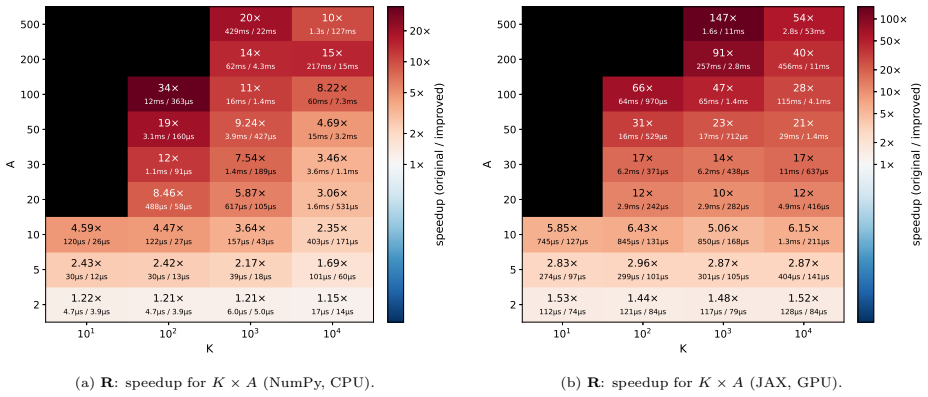
Summary. The paper proposes two improvements to the two IKPLS PLS algorithms. The first replaces the term-by-term accumulation in the Hoskuldsson recurrence for the X-rotation vectors r_a with a direct evaluation R_{a-1}(P_{a-1}^T w_a). The second, Algorithm 3, computes each Y-loading q_a directly from quantities already available from the step-2 eigen-decomposition in IKPLS (the norm of \tilde w_a in the PLS1 case, and the leading eigenvalue/eigenvector pair in the PLS2 case with M<K), reducing the per-loading cost from Θ(KM) to Θ(M) in those regimes. The paper proves exact-arithmetic correctness of both changes (Proposition 1; Theorem 1 and Corollary 1), gives operation counts (Propositions 2–9), and presents CPU/GPU benchmarks in the ikpls package showing large speedups on the isolated steps and 2–6× on full fits.
Significance. If the results hold, the Q improvement is a clean asymptotic speedup for the common PLS1 and PLS2-with-M<K cases, and the R improvement is a practical parallelization gain with no change to the computed mathematical quantities. The proofs are elementary, well structured, and I did not find a load-bearing flaw. A particular strength is that the paper connects the new Q formula to an unproved source-code question in the R pls package, answering it affirmatively. The benchmarks are careful (float64, median timings, CPU and GPU, both IKPLS variants), and the claims are mathematical equivalences rather than fitted predictions, so overfitting or circularity is not a concern.
minor comments (4)
- [Section 4.1, Lemma 1] The last equality, t_i^T t_j / ||t_i||^2 = δ_{i,j}, is justified by citing Hoskuldsson for mutual orthogonality of T. This property is standard, but it can be derived in one line from the algorithm's own recurrence: p_i^T r_j = t_i^T t_j / ||t_i||^2, and P_{a-1}^T R_{a-1} = I forces p_i^T r_j = 0 for i<j and 1 for i=j. Adding this derivation would make Lemma 1 self-contained and would remove any appearance of an unexamined external assumption.
- [Abstract / Theorem 1 / Corollary 1] The statement that the improved algorithms produce 'exactly the same' W, P, Q, R, and T should be qualified as 'in exact arithmetic.' Algorithm 3 evaluates different expressions (e.g., a scalar division by ||\tilde w_a||_2) than Algorithm 2, so floating-point round-off may differ at the last bits. This is not a correctness issue, but a one-sentence caveat would prevent misreading by implementers.
- [Section 4.2, Proposition 6] Writing Θ(M) = Θ(1) when M=1 is slightly nonstandard; the statement is clearer as simply 'requires Θ(1) operations.' This is purely stylistic.
- [Section 6.2, Figure 3] The panel headings in the figure appear garbled in the manuscript (e.g., 'T,e res) of ),e .K/L1 fi ) R Q'). This looks like an encoding/rendering artifact, and the labels should be fixed so the figure is readable on its own.
Circularity Check
No circularity: the R and Q improvements are proven algebraic equivalences; self-citations are contextual and not load-bearing.
full rationale
Every load-bearing step is an algebraic identity proved from the algorithm's own recurrences. Proposition 1 expands Eq. (2) into exactly the sum in Eq. (1), so the improved R computation is a re-association of the same multiplications. Theorem 1 proves that the qa computed by Algorithm 3 equals line 8 of Algorithm 2 by strong induction: the induction hypothesis supplies the supposition of Lemma 2 for previous components, and the deflation recurrence (4), Lemma 1, and the eigenvalue identity (9) yield the reduced formulas in the M=1 and 2<=M<K branches; the remaining branch is literally the original line 8. Lemma 1 uses T-column orthogonality, cited to Hoskuldsson as an external classical PLS property; this is not a self-citation, it is an explicit assumption shared by both algorithms, and it is not equivalent to the target result being proved. No parameter is fitted and then reported as a prediction; the claim of identical W, P, Q, R, and T is a mathematical equivalence in exact arithmetic, with floating-point differences explicitly outside the claim. Self-citations to the ikpls package and to prior cross-validation work appear only for software context and benchmarking, not as evidence for Theorem 1 or Corollary 1. The derivation is self-contained against the cited IKPLS definitions and external classical results, and I find no circular step.
Axiom & Free-Parameter Ledger
axioms (3)
- domain assumption The columns of the score matrix T are mutually orthogonal in exact arithmetic.
- domain assumption Extraction halts if (X^TY)_a becomes a zero matrix or t_a = 0_N, so every extracted component has nonzero covariance and nonzero score norm.
- standard math Symmetric positive-semidefinite matrices have real nonnegative eigenvalues and eigenvectors as used in the M<K branch.
read the original abstract
Improved Kernel Partial Least Squares (IKPLS) algorithms 1 and 2 are among the fastest PLS calibration algorithms. This article focuses on two shared steps, the computation of the $\mathbf{X}$ rotations, $\mathbf{R}$, and the $\mathbf{Y}$ loadings, $\mathbf{Q}$, and accelerates both. For $\mathbf{R}$, term-by-term accumulation is replaced by a direct evaluation strategy that requires the same number of multiplications but parallelizes better on modern hardware. For $\mathbf{Q}$, I identify - to the best of my knowledge, for the first time - equivalences showing that each $\mathbf{Y}$ loading is obtainable, up to explicitly derived constants, from quantities already computed earlier in the same iteration, and I exploit them in IKPLS to reduce the cost of each loading from $\Theta\left(KM\right)$ to $\Theta\left(M\right)$ operations whenever $M = 1$ or $2 \leq M < K$, with $K$ predictor variables (number of columns in $\mathbf{X}$) and $M$ response variables (number of columns in $\mathbf{Y}$). Both improvements provably yield exactly the same $\mathbf{W}$, $\mathbf{P}$, $\mathbf{Q}$, $\mathbf{R}$, and $\mathbf{T}$ as the original algorithms. Benchmarks with NumPy (CPU) and JAX (GPU) show speedups of up to two orders of magnitude for the isolated steps and of approximately $2\times$ (CPU) and $6\times$ (GPU) for entire fits. Both improvements are implemented in the free, open-source Python package \texttt{ikpls}.
Figures


Reference graph
Works this paper leans on
-
[1]
Comparison of PLS algorithms when number of objects is much larger than number of variables
Alin, A., 2009. Comparison of PLS algorithms when number of objects is much larger than number of variables. Statistical Papers 50, 711–
2009
-
[2]
A comparison of nine PLS1 algorithms
Andersson, M., 2009. A comparison of nine PLS1 algorithms. Journal of Chemometrics 23, 518–529. doi: 10.1002/cem.1248
-
[3]
Partial least squares for discrimination
Barker, M., Rayens, W., 2003. Partial least squares for discrimination. Journal of Chemo- metrics 17, 166–173. doi: 10.1002/cem.785
doi:10.1002/cem.785 2003
-
[4]
Account- ing for sampling weights in pls path mod- eling: Simulations and empirical examples
Becker, J.M., Ismail, I.R., 2016. Account- ing for sampling weights in pls path mod- eling: Simulations and empirical examples. European Management Journal 34, 606–617. doi:10.1016/j.emj.2016.06.009
-
[5]
Fast and stable partial least squares modelling: A benchmark study with theoretical com- ments
Bj¨ orck, ˚ A., Indahl, U.G., 2017. Fast and stable partial least squares modelling: A benchmark study with theoretical com- ments. Journal of Chemometrics 31, e2898. doi:10.1002/cem.2898. e2898 cem.2898
-
[6]
JAX: composable trans- formations of Python+NumPy programs
Bradbury, J., Frostig, R., Hawkins, P., John- son, M.J., Leary, C., Maclaurin, D., Necula, G., Paszke, A., VanderPlas, J., Wanderman-Milne, S., Zhang, Q., 2018. JAX: composable trans- formations of Python+NumPy programs. URL: http://github.com/google/jax
2018
-
[7]
Chemo- metrics in analytical chemistry—part II: mod- eling, validation, and applications
Brereton, R.G., Jansen, J., Lopes, J., Marini, F., Pomerantsev, A., Rodionova, O., Roger, J.M., Walczak, B., Tauler, R., 2018. Chemo- metrics in analytical chemistry—part II: mod- eling, validation, and applications. Analytical and Bioanalytical Chemistry 410, 6691–6704. doi:10.1007/s00216-018-1283-4
-
[8]
Partial least squares discriminant analysis: taking the magic away
Brereton, R.G., Lloyd, G.R., 2014. Partial least squares discriminant analysis: taking the magic away. Journal of Chemometrics 28, 213–225. doi:10.1002/cem.2609
-
[9]
Dayal, B.S., MacGregor, J.F., 1997. Improved PLS algorithms. Jour- nal of Chemometrics 11, 73–85. doi:10.1002/(SICI)1099-128X(199701)11:1<73::AID-CEM435>
-
[10]
Engstrøm, O.C.G., 2025. Near-infrared hy- perspectral imaging applications in food anal- ysis – improving algorithms and methodolo- gies. Ph.D. thesis. University of Copenhagen. doi:10.48550/arXiv.2510.13452
-
[11]
Engstrøm, O.C.G., Dreier, E.S., Jespersen, B.M., Pedersen, K.S., 2024. IKPLS: improved kernel partial least squares and fast cross- validation algorithms for Python with CPU and GPU implementations using NumPy and JAX. Journal of Open Source Software 9, 6533. doi:10.21105/joss.06533
-
[12]
Fast partition-based cross-validation with centering and scaling for XTX and XTY
Engstrøm, O.C.G., Jensen, M.H., 2025. Fast partition-based cross-validation with centering and scaling for XTX and XTY. Journal of Chemometrics 39, e70008. doi:10.1002/cem.70008
-
[13]
Array programming with NumPy
Harris, C.R., Millman, K.J., van der Walt, S.J., Gommers, R., Virtanen, P., Cournapeau, D., Wieser, E., Taylor, J., Berg, S., Smith, N.J., Kern, R., Picus, M., Hoyer, S., van Kerkwijk, M.H., Brett, M., Haldane, A., del R ´ ıo, J.F., Wiebe, M., Peterson, P., G´ erard-Marchant, P., Sheppard, K., Reddy, T., Weckesser, W., Ab- basi, H., Gohlke, C., Oliphant, ...
2020
-
[14]
H¨ oskuldsson, A., 1988. PLS regression meth- ods. Journal of Chemometrics 2, 211–228. doi:10.1002/cem.1180020306
-
[15]
The h-principle in modelling with applications to chemo- metrics
H¨ oskuldsson, A., 1992. The h-principle in modelling with applications to chemo- metrics. Chemometrics and Intelli- gent Laboratory Systems 14, 139–153. doi:10.1016/0169-7439(92)80099-P . pro- ceedings of the 2nd Scandinavian Symposium on Chemometrics. 13
-
[16]
SIMPLS: An alter- native approach to partial least squares regression
de Jong, S., 1993. SIMPLS: An alter- native approach to partial least squares regression. Chemometrics and Intelli- gent Laboratory Systems 18, 251–263. doi:10.1016/0169-7439(93)85002-X
-
[17]
Liland, K.H., Mevik, B.H., Wehrens, R.,
-
[18]
Liland, K.H., Stefansson, P., Indahl, U.G.,
-
[19]
The PLS package: Principal component and partial least squares regression in r
Mevik, B.H., Wehrens, R., 2007. The PLS package: Principal component and partial least squares regression in r. Journal of Statistical Software 18, 1–23. doi:10.18637/jss.v018.i02
-
[20]
Rinnan, ˚ A., van den Berg, F., Engelsen, S.B.,
-
[21]
Shenk, J.S., Westerhaus, M.O., Berzaghi, P.,
-
[22]
PLS discriminant plots
Sj¨ ostr¨ om, M., Wold, S., S¨ oderstr¨ om, B., 1986. PLS discriminant plots. Elsevier
1986
-
[23]
NIR data exploration and re- gression by chemometrics—a primer
Sørensen, K.M., van den Berg, F., Engelsen, S.B., 2021. NIR data exploration and re- gression by chemometrics—a primer. Near- Infrared Spectroscopy: Theory, Spectral Anal- ysis, Instrumentation, and Applications , 127– 189doi:10.1007/978-981-15-8648-4_7
-
[24]
Partial least squares analysis with cross-validation for the two-class problem: a monte carlo study
St ˚ ahle, L., Wold, S., 1987. Partial least squares analysis with cross-validation for the two-class problem: a monte carlo study. Journal of Chemometrics 1, 185–196. doi:10.1002/cem.1180010306
-
[25]
Estimation of principal com- ponents and related models by iterative least squares
Wold, H., 1966. Estimation of principal com- ponents and related models by iterative least squares. Multivariate analysis , 391–420
1966
-
[26]
Wold, S., Sj¨ ostr¨ om, M., Eriksson, L.,
-
[362]
doi: 10.1038/s41586-020-2649-2
-
[720]
doi: 10.1007/s00362-009-0251-7
-
[1222]
doi: 10.1016/j.trac.2009.07.007
-
[1997]
Jour- nal of Near Infrared Spectroscopy 5, 223–232
Investigation of a local calibration pro- cedure for near infrared instruments. Jour- nal of Near Infrared Spectroscopy 5, 223–232. doi:10.1255/jnirs.115
-
[2001]
Chemometrics and Intel- ligent Laboratory Systems 58, 109–130
PLS-regression: a basic tool of chemometrics. Chemometrics and Intel- ligent Laboratory Systems 58, 109–130. doi:10.1016/S0169-7439(01)00155-1. 14
-
[2009]
TrAC Trends in Analytical Chemistry 28, 1201–
Review of the most common pre- processing techniques for near-infrared spectra. TrAC Trends in Analytical Chemistry 28, 1201–
-
[2020]
Journal of Chemometrics 34, e3201
Much faster cross-validation in PLSR- modelling by avoiding redundant calcula- tions. Journal of Chemometrics 34, e3201. doi:10.1002/cem.3201
-
[2026]
URL: https://CRAN.R-project.org/package=pls
pls: Partial least squares and principal component regression. URL: https://CRAN.R-project.org/package=pls. r package version 2.9-0
discussion (0)
Sign in with ORCID, Apple, or X to comment. Anyone can read and Pith papers without signing in.