REVIEW 4 major objections 5 minor 61 references
Neural fields can transfer style from text or image to 2D, video, 3D, and 4D content with one shared recipe.
Reviewed by Pith at T0; open to challenge. T0 means a machine referee read the full paper against a public rubric. the ladder, T0–T4 →
T0 review · deepseek-v4-flash
2026-08-01 21:54 UTC pith:5LNQSLZA
load-bearing objection A clean, honest extension of CLIPGaussian to INR backbones; the temporal-consistency claim is plausible but under-validated, and the 4D evaluation is too thin to support the universal claim. the 4 major comments →
OmniStyle-INR: Universal and Multimodal Style Transfer for INRs
The pith
A machine-rendered reading of the paper's core claim, the machinery that carries it, and where it could break.
Core claim
On its own terms, the discovery is that the full-frame style objective — directional CLIP loss on whole renders, patch-level CLIP loss on random crops, VGG content loss, background regularization, and, for dynamic data, a masked temporal loss — transfers almost verbatim to implicit neural representations of any dimensionality. The key implementation move is to render complete frames in chunks during the loss pass, since CLIP and VGG need coherent spatial context that ray-based INR training does not provide. Stylization then becomes a fine-tuning step on the INR weights, so the original geometry and motion are preserved by construction while appearance changes are driven by the frozen vision
What carries the argument
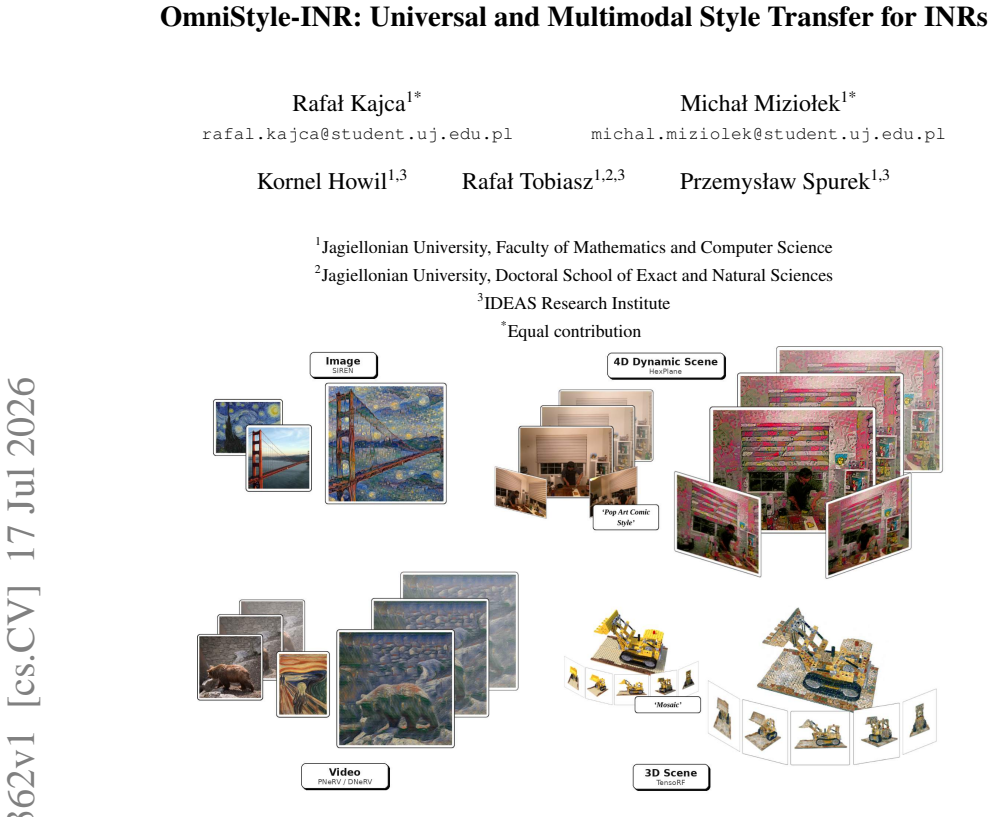
The central object is the INR as a shared stylization canvas: a per-modality coordinate network (SIREN for 2D images, PNeRV or DNeRV for video, TensoRF for static 3D, HexPlane for 4D dynamic scenes) that is first trained to reconstruct the original signal and then fine-tuned under a frozen CLIP/VGG-19 guidance objective. Because text and image conditions are encoded into the same CLIP space, one optimization loop serves both. For video and 4D, RAFT optical-flow fields and occlusion masks are precomputed from the original sequence; during stylization the next frame is warped back to the current frame's coordinates and a masked MSE penalizes deviations, enforcing temporal stability where the f
Load-bearing premise
The temporal loss aligns neighboring stylized frames using optical flow and occlusion masks computed on the original, un-stylized sequence; if stylization changes edges or texture enough to invalidate that flow, misaligned pixels are matched and ghosting or frozen artifacts appear, and the video/4D consistency claims ride on this alignment holding.
What would settle it
Take a video or 4D sequence with fast motion and heavy occlusions, stylize it with strong text prompts, and compute masked RMSE between adjacent frames warped with flow from the original sequence versus flow re-estimated on the stylized frames; if the error rises steeply with stylization strength (or shows visible ghosting at high-contrast edges), the fixed-flow temporal alignment is the point of failure. A cheaper check: run the video model with the temporal loss on and off and compare CLIP-CONS and flow endpoint error on the same clip.
If this is right
- Any future improvement to INR backbones (faster training, better compression, higher super-resolution quality) transfers directly to stylization, since the style module is a plug-in on top of the reconstruction.
- Text-prompt and reference-image stylization collapse into a single pipeline, because both conditions land in the shared CLIP embedding space.
- For video and 4D scenes, the precomputed-flow temporal loss reduces frame-to-frame flicker without re-estimating motion during stylization, at least while the original motion estimate stays valid.
- Stylized results inherit INR compression and can be rendered at arbitrary resolutions, which explicit point-based representations do not offer naturally for dense 2D/video domains.
- The approach preserves the exact structure of the input (no hallucinated content) and is limited mainly by the aesthetic ceiling of CLIP/VGG guidance versus large diffusion models.
Where Pith is reading between the lines
- Editorial inference: the center-bias advantage over the explicit baseline is plausibly an artifact of full-frame rendering versus the baseline's padding strategy; a reader should test the same objective on a full-image Gaussian renderer before attributing the uniformity to INR-ness.
- Editorial inference: the temporal loss as implemented is a pixel-space masked MSE on warped frames, which may over-smooth fine stylized texture; an LPIPS-based temporal term might keep detail and motion simultaneously.
- Editorial inference: the paper's own CLIP-CONS numbers for video are mixed (e.g., 0.66 vs 1.92 in the text-conditioned table), so the 'significantly improved temporal consistency' claim is metric-sensitive; a direct flicker-judgment study would be the decisive test.
- Editorial inference: the fixed-flow assumption inside the temporal loss is testable by re-estimating optical flow on the stylized frames — if the gap between original-flow warping error and stylized-flow warping error grows with style strength, the design's load-bearing premise would break.
Editorial analysis
A structured set of objections, weighed in public.
Referee Report
Summary. The paper proposes OmniStyle-INR, a style-transfer framework that fine-tunes pre-trained implicit neural representations (SIREN for images, PNeRV/DNeRV for video, TensoRF for 3D, HexPlane for 4D) using a weighted combination of CLIP directional and patch losses, a VGG content loss, a background loss, and, for dynamic inputs, an optical-flow-based temporal loss. The method supports both text and image style conditions. The authors evaluate each modality against a variety of baselines, with the main claimed contributions being universality across modalities and improved temporal consistency for video/4D, especially compared with CLIPGaussian.
Significance. If the claims held, the paper would offer a useful plug-in INR-based alternative to Gaussian-splatting style transfer, with the practical advantage of working on compact continuous representations and providing built-in temporal regularization. The authors also provide code, and the loss decomposition is clearly stated. However, the evidence is currently too thin to support the central 'universal, high-quality' claim: 4D evaluation is limited to one scene with no quantitative baseline comparison; 3D results trail CLIPGaussian on the main style metrics; and the temporal consistency evaluation shares its optical-flow assumption with the training loss. The CLIP-based metrics are also partially optimized by the CLIP losses. These issues are fixable, but they materially weaken the paper in its present form.
major comments (4)
- [§3.3, Eq. (5) and §A.1.8, §A.2.2] The temporal loss Lt warps the stylized next frame into the current frame using RAFT flow and occlusion masks computed from the original, un-stylized sequence. The same original-flow warping is then used to compute the consistency metrics in §A.2.2. This is load-bearing for the claimed advantage in Tables 1–2, but no experiment shows that the original flow remains the correct correspondence after stylization. If stylization changes edges/texture, the masked MSE can align wrong pixels and can be minimized by over-smoothing or freezing appearance. Please validate: estimate optical flow on stylized frames and report endpoint error vs. original flow, or use a correspondence-agnostic consistency metric, and ablate Lt with and without such validation.
- [§4.4, Figs. 7–8] The 4D evaluation uses a single sequence (coffee_martini) and provides no quantitative table comparing OmniStyle-INR against CLIPGaussian, 4DStyleGaussian, or Instruct 4D-to-4D. The statement that stylization quality is 'on par with CLIPGaussian' is therefore not substantiated. Please add quantitative results on at least 2–3 sequences with CLIP-based and consistency metrics, or explicitly label the 4D results as a proof-of-concept. Similarly, §4.3 evaluates 3D on only lego, hotdog, garden, and bonsai; this is too thin for the 'universal' claim.
- [§3.3 vs §A.2.1] CLIP-S, CLIP-SIM, and CLIP-CONS are computed with the same frozen CLIP encoder used in the directional loss Ld and patch loss Lp. The directional loss exactly maximizes CLIP-SIM, and the patch loss averages it over crops. Thus the main style-quality metrics are partially optimized by construction. Please report metrics that are not directly optimized by the loss (e.g., VGG/LPIPS-style similarity to the reference style, or human evaluation) or at minimum discuss this circularity when drawing conclusions against CLIPGaussian.
- [Table 3, §4.3] On text-conditioned 3D style transfer, OmniStyle-INR trails CLIPGaussian on CLIP-S (25.32 vs 26.86) and CLIP-SIM (21.16 vs 26.31); on image-conditioned style transfer it trails on CLIP-S (69.71 vs 72.65) and CLIP-SIM (19.04 vs 20.72). The conclusion that the method 'surpasses' CLIPGaussian on key metrics is not supported in the 3D setting. Please temper the claim or provide additional evidence/metrics where the advantage is clear.
minor comments (5)
- [§4, Tables 1–3] No standard deviations or number of runs are reported. Single-run differences of 0.1–1.5 CLIP points are hard to interpret as genuine improvements.
- [§3.3] The temporal loss is written as Lt = MSE(warp(R_{l+1}), R_l), but the actual loss in §A.1.8 is a masked MSE. This inconsistency should be fixed.
- [§3.1 and §A.1.6] The main text says optical flow is precomputed for video during Stage I, while §A.1.6 says video flow is computed dynamically during training. Clarify which procedure is used for the reported video results.
- [Appendix B, Tables 10–13] These tables appear as empty placeholders in the submitted version. If they are meant to contain qualitative ablation images, the images are missing.
- [Throughout] Minor typos: 'DA VIS' should be 'DAVIS'; the equation for Lp has mismatched parentheses and a stray 'I_l' after the sum.
Circularity Check
Two headline metrics are the training objectives themselves: CLIP-SIM = 100(1−Ld) and RMSE consistency is derived from Lt, so Tables 1–2 partly reward optimizing the evaluation criterion.
specific steps
-
fitted input called prediction
[§3.3 (Ld) vs §A.2.1 (CLIP-SIM)]
"Ld(Rl, Il) = 1−cos(ΦCLIP(Rl)−ΦCLIP(Il), ΦCLIP(S)−ΦCLIP(“Photo”)). CLIP-SIM(R, I,S) = 100·cos(ΦI_CLIP(R)−ΦI_CLIP(I), ΦCLIP(S)−ΦCLIP(S0)), where S0 is a neutral source-domain condition, such as “Photo”."
With S0="Photo" and the same frozen ViT-B/32 encoder, CLIP-SIM = 100(1−Ld) for the full render. Stage II minimizes Ld (and its patch version Lp), so the main style-quality metric in Table 1 is a rescaling of the training objective. A high CLIP-SIM is therefore forced by construction and does not independently verify style transfer quality; it directly reports how well the optimization minimized its own directional loss.
-
fitted input called prediction
[§3.3 (Lt) vs §A.2.2 (flow-warped RMSE)]
"Lt =M SE(warp(Rl+1), Rl). Given two stylized frames R_t and R_{t+∆}, we warp R_{t+∆} into the coordinate system of R_t using optical flow estimated on the original sequence and remove unreliable pixels with an occlusion mask M_t. The masked RMSE is computed as RMSE = sqrt( Σ_x M_t(x)||R_t(x)−W(R_{t+∆})(x)||^2 / 2 Σ_x M_t(x) )."
The short-range RMSE in Table 2 uses the same original-sequence optical flow, the same occlusion masks, and the same warping as the temporal loss Lt. For ∆=1 it is exactly sqrt(Lt) up to a constant. Since the paper's claimed advantage over CLIPGaussian is attributed to 'our explicit temporal loss,' the consistency numbers are the loss itself: they cannot validate the assumption that the pre-stylization flow remains correct after stylization, and they are biased toward the method that minimizes this exact objective.
full rationale
The core stylization procedure is not a derivation from its own conclusions: OmniStyle-INR genuinely fine-tunes INR weights under VGG content, patch/directional CLIP, background, and temporal losses, and it supplies qualitative comparisons and additional metrics. However, the two headline quantitative claims reduce by construction to the optimized objectives. CLIP-SIM is exactly 100(1−Ld) (same CLIP encoder, same "Photo" reference direction), and the short-range RMSE consistency metric is sqrt(Lt) (same flow, same masks, same warp). Hyperparameter choices are also selected on the same CLIP metrics (Tables 4–9), so the reported numbers are partly fitted. Independent evidence—CLIP-F, VGG-based content loss, qualitative figures, and the Farneback endpoint-error metric—keeps the paper from being wholly circular, and there is no load-bearing self-citation chain despite author overlap with CLIPGaussian. Score 6 reflects partial circularity in the evaluation of the paper's own claims.
Axiom & Free-Parameter Ledger
free parameters (4)
- λc, λp, λd, λb, λt (loss weights) =
2D: λd=10-20, λp=90; 3D: λd=48, λp=2160; 4D: λd=64-96, λp=480-600; λc=5; λb unstated
- patch_size, patch_num =
2D: 200/32; 3D: 256/100
- Occlusion threshold α, β in flow-consistency mask =
not reported
- Background loss weight λb and mask construction =
not specified
axioms (6)
- domain assumption Frozen CLIP (ViT-B/32) and VGG-19 embeddings are universal style/content supervisors for all four modalities.
- domain assumption Each per-modality INR (SIREN, PNeRV/DNeRV, TensoRF, HexPlane) reconstructs the source signal faithfully enough that fine-tuning only changes appearance.
- domain assumption Optimizing θ from θ0 with CLIP/VGG losses preserves geometry and motion while changing appearance.
- domain assumption Optical flow and occlusion masks from the original dynamic sequence are valid for the stylized sequence.
- domain assumption A single scene per modality or a few scenes is representative of the 'universal' claim.
- domain assumption CLIP text and image embeddings are comparable enough that one shared optimization works for both conditions.
Cite this review
Pith. "Pith review of OmniStyle-INR: Universal and Multimodal Style Transfer for INRs." pith.science (2026). https://pith.science/paper/5LNQSLZA
@misc{pith2026260716362,
  author       = {Pith},
  title        = {Pith review of: OmniStyle-INR: Universal and Multimodal Style Transfer for INRs},
  year         = {2026},
  howpublished = {\url{https://pith.science/paper/5LNQSLZA}},
  note         = {Machine review of arXiv:2607.16362}
}
read the original abstract
Style transfer remains a fundamental and highly important task across various data modalities, enabling creative manipulation conditioned by both reference images and textual descriptions. Recently, methods utilizing Gaussian Splatting have emerged as a unified representation for 2D images, video, 3D scenes, and 4D dynamics. However, representing videos and 2D images with Gaussian Splatting is structurally sub-optimal for dense continuous domains. The number of required Gaussians often approaches the total number of pixels, raising questions about the actual utility of such a representation for these specific modalities. In contrast, Implicit Neural Representations have established themselves as a much more popular and natural choice across all these data domains. Implicit Neural Representations naturally provide significant advantages, including data compression, inherent capabilities for super resolution, and seamless integration with deep generative models. To this end, we introduce OmniStyle-INR, a novel framework that leverages network-based continuous representations as a truly universal domain. Our approach successfully performs high-quality style transfer across all visual modalities, guided seamlessly by both text prompts and visual exemplars.
Figures


Reference graph
Works this paper leans on
-
[1]
Barron, Ben Mildenhall, Dor Verbin, Pratul P
Jonathan T. Barron, Ben Mildenhall, Dor Verbin, Pratul P. Srinivasan, and Peter Hedman. Mip-nerf 360: Unbounded anti-aliased neural radiance fields. InProceedings of the IEEE/CVF Conference on Computer Vision and Pattern Recognition, pages 5470–5479, 2022. 7, 12, 13, 14
2022
-
[2]
Hexplane: A fast representa- tion for dynamic scenes
Ang Cao and Justin Johnson. Hexplane: A fast representa- tion for dynamic scenes. InProceedings of the IEEE/CVF Conference on Computer Vision and Pattern Recognition, pages 130–141, 2023. 2, 3, 4, 12, 13
2023
-
[3]
Tensorf: Tensorial radiance fields
Anpei Chen, Zexiang Xu, Andreas Geiger, Jingyi Yu, and Hao Su. Tensorf: Tensorial radiance fields. InEuropean con- ference on computer vision, pages 333–350. Springer, 2022. 4, 7, 12, 13
2022
-
[4]
Nerv: Neural representations for videos.Advances in Neural Information Processing Systems, 34:21557–21568, 2021
Hao Chen, Bo He, Hanyu Wang, Yixuan Ren, Ser Nam Lim, and Abhinav Shrivastava. Nerv: Neural representations for videos.Advances in Neural Information Processing Systems, 34:21557–21568, 2021. 2, 3
2021
-
[5]
Hnerv: A hybrid neural representation for videos
Hao Chen, Matthew Gwilliam, Ser-Nam Lim, and Abhi- nav Shrivastava. Hnerv: A hybrid neural representation for videos. InProceedings of the IEEE/CVF Conference on Computer Vision and Pattern Recognition, pages 10270– 10279, 2023. 2, 3
2023
-
[6]
DGE: Di- rect Gaussian 3D Editing by Consistent Multi-view Editing
Minghao Chen, Iro Laina, and Andrea Vedaldi. DGE: Di- rect Gaussian 3D Editing by Consistent Multi-view Editing. InEuropean Conference on Computer Vision (ECCV), pages 74–92, 2024. 2, 7, 14, 17
2024
-
[7]
Learning continuous image representation with local implicit image function
Yinbo Chen, Sifei Liu, and Xiaolong Wang. Learning continuous image representation with local implicit image function. InProceedings of the IEEE/CVF conference on computer vision and pattern recognition, pages 8628–8638,
-
[8]
Stytr 2: Im- age style transfer with transformers
Yingying Deng, Fan Tang, Weiming Dong, Chongyang Ma, Xingjia Pan, Lei Wang, and Changsheng Xu. Stytr 2: Im- age style transfer with transformers. InProceedings of the IEEE/CVF Conference on Computer Vision and Pattern Recognition, pages 11326–11336, 2022. 5, 6
2022
-
[9]
Two-frame motion estimation based on polynomial expansion
Gunnar Farnebäck. Two-frame motion estimation based on polynomial expansion. InSCIA, pages 363–370, 2003. 12, 14
2003
-
[10]
Bermano, Gal Chechik, and Daniel Cohen-Or
Rinon Gal, Or Patashnik, Haggai Maron, Amit H. Bermano, Gal Chechik, and Daniel Cohen-Or. Stylegan-nada: Clip- guided domain adaptation of image generators.ACM Trans- actions on Graphics, 41(4):1–13, 2022. 7
2022
-
[11]
SGSST: Scaling Gaussian Splatting Style Transfer
Bruno Galerne, Jianling Wang, Lara Raad, and Jean-Michel Morel. SGSST: Scaling Gaussian Splatting Style Transfer. In Proceedings of the IEEE/CVF Conference on Computer Vi- sion and Pattern Recognition (CVPR), pages 26535–26544,
-
[12]
Im- age style transfer using convolutional neural networks
Leon A Gatys, Alexander S Ecker, and Matthias Bethge. Im- age style transfer using convolutional neural networks. In Proceedings of the IEEE conference on computer vision and pattern recognition, pages 2414–2423, 2016. 2, 3, 5, 6
2016
-
[13]
Two birds, one stone: A unified framework for joint learning of image and video style transfers
Bohai Gu, Heng Fan, and Libo Zhang. Two birds, one stone: A unified framework for joint learning of image and video style transfers. InProceedings of the IEEE/CVF Interna- tional Conference on Computer Vision, pages 23545–23554,
-
[14]
Instruct-nerf2nerf: Edit- ing 3d scenes with instructions
Ayaan Haque, Matthew Tancik, Alexei A Efros, Aleksander Holynski, and Angjoo Kanazawa. Instruct-nerf2nerf: Edit- ing 3d scenes with instructions. InProceedings of the IEEE/CVF international conference on computer vision, pages 19740–19750, 2023. 2, 3, 7, 14
2023
-
[15]
CLIPScore: A reference-free evaluation metric for image captioning
Jack Hessel, Ari Holtzman, Maxwell Forbes, Ronan Le Bras, and Yejin Choi. CLIPScore: A reference-free evaluation metric for image captioning. InProceedings of the 2021 Conference on Empirical Methods in Natural Language Pro- cessing, pages 7514–7528, 2021. 7
2021
-
[16]
Clip- gaussian: Universal and multimodal style transfer based on gaussian splatting.Advances in neural information process- ing systems, 38:112125–112168, 2026
Kornel Howil, Joanna Waczynska, Piotr Borycki, Tadeusz Dziarmaga, Marcin Mazur, and Przemysław Spurek. Clip- gaussian: Universal and multimodal style transfer based on gaussian splatting.Advances in neural information process- ing systems, 38:112125–112168, 2026. 2, 3, 4, 5, 6, 7, 8, 9, 14, 17, 18
2026
-
[17]
Arbitrary style transfer in real-time with adaptive instance normalization
Xun Huang and Serge Belongie. Arbitrary style transfer in real-time with adaptive instance normalization. InProceed- ings of the IEEE International Conference on Computer Vi- sion, pages 1501–1510, 2017. 5, 6
2017
-
[18]
Stylizednerf: consistent 3d scene stylization as styl- ized nerf via 2d-3d mutual learning
Yi-Hua Huang, Yue He, Yu-Jie Yuan, Yu-Kun Lai, and Lin Gao. Stylizednerf: consistent 3d scene stylization as styl- ized nerf via 2d-3d mutual learning. InProceedings of the IEEE/CVF conference on computer vision and pattern recognition, pages 18342–18352, 2022. 3
2022
-
[19]
Stylesplat: 3d object style transfer with gaussian splatting.arXiv preprint arXiv:2407.09473, 2024
Sahil Jain, Avik Kuthiala, Prabhdeep Singh Sethi, and Prakanshul Saxena. Stylesplat: 3d object style transfer with gaussian splatting.arXiv preprint arXiv:2407.09473, 2024. 3
Pith/arXiv arXiv 2024
-
[20]
Gainer: Geometry-aware implicit network representation.arXiv preprint arXiv:2511.20924, 2025
Weronika Jakubowska, Mikołaj Zieli ´nski, Rafał Tobiasz, Krzysztof Byrski, Maciej Zi˛ eba, Dominik Belter, and Prze- mysław Spurek. Gainer: Geometry-aware implicit network representation.arXiv preprint arXiv:2511.20924, 2025. 2, 3
arXiv 2025
-
[21]
Neural style transfer: A review
Yongcheng Jing, Yezhou Yang, Zunlei Feng, Jingwen Ye, Yizhou Yu, and Mingli Song. Neural style transfer: A review. IEEE transactions on visualization and computer graphics, 26(11):3365–3385, 2019. 2, 3
2019
-
[22]
Fresh: Frequency shift- ing for accelerated neural representation learning
Adam Kania, Marko Mihajlovic, Sergey Prokudin, Jacek Tabor, and Przemysław Spurek. Fresh: Frequency shift- ing for accelerated neural representation learning. InIn- ternational Conference on Learning Representations, pages 76383–76406, 2025. 2, 3
2025
-
[23]
Text2video-zero: Text- to-image diffusion models are zero-shot video generators
Levon Khachatryan, Andranik Movsisyan, Vahram Tade- vosyan, Roberto Henschel, Zhangyang Wang, Shant Navasardyan, and Humphrey Shi. Text2video-zero: Text- to-image diffusion models are zero-shot video generators. In Proceedings of the IEEE/CVF International Conference on Computer Vision, pages 15954–15964, 2023. 6, 7, 9
2023
-
[24]
G-style: Stylized gaussian splatting
Áron Samuel Kovács, Pedro Hermosilla, and Renata G Raidou. G-style: Stylized gaussian splatting. InComputer Graphics Forum, page e15259. Wiley Online Library, 2024. 2, 3, 7, 14, 18
2024
-
[25]
Clipstyler: Image style transfer with a single text condition
Gihyun Kwon and Jong Chul Ye. Clipstyler: Image style transfer with a single text condition. InProceedings of the IEEE/CVF Conference on Computer Vision and Pattern Recognition, pages 18062–18071, 2022. 5, 6
2022
-
[26]
Neural 3d video synthesis from multi-view video
Tianye Li, Mira Slavcheva, Michael Zollhöfer, Simon Green, Christoph Lassner, Changil Kim, Tanner Schmidt, Steven Lovegrove, Michael Goesele, Richard Newcombe, and Zhaoyang Lv. Neural 3d video synthesis from multi-view video. InProceedings of the IEEE/CVF Conference on Com- puter Vision and Pattern Recognition (CVPR), pages 5521– 5531, 2022. 7, 8, 9, 15
2022
-
[27]
4dstylegaussian: Generalizable 4d style transfer with gaussian splatting.Pattern Recognition, page 112422, 2025
Wanlin Liang, Hongbin Xu, Weitao Chen, Feng Xiao, and Wenxiong Kang. 4dstylegaussian: Generalizable 4d style transfer with gaussian splatting.Pattern Recognition, page 112422, 2025. 7
2025
-
[28]
Lawrence Zitnick
Tsung-Yi Lin, Michael Maire, Serge Belongie, James Hays, Pietro Perona, Deva Ramanan, Piotr Dollár, and C. Lawrence Zitnick. Microsoft coco: Common objects in context. In European Conference on Computer Vision, pages 740–755. Springer, 2014. 5, 6
2014
-
[29]
Stylerf: Zero-shot 3d style transfer of neural radiance fields
Kunhao Liu, Fangneng Zhan, Yiwen Chen, Jiahui Zhang, Yingchen Yu, Abdulmotaleb El Saddik, Shijian Lu, and Eric P Xing. Stylerf: Zero-shot 3d style transfer of neural radiance fields. InProceedings of the IEEE/CVF Conference on Computer Vision and Pattern Recognition, pages 8338– 8348, 2023. 3, 7
2023
-
[30]
Stylegaussian: Instant 3d style transfer with gaussian splatting
Kunhao Liu, Fangneng Zhan, Muyu Xu, Christian Theobalt, Ling Shao, and Shijian Lu. Stylegaussian: Instant 3d style transfer with gaussian splatting. InSIGGRAPH Asia 2024 Technical Communications, New York, NY , USA, 2024. As- sociation for Computing Machinery. 2, 3, 7, 14, 18
2024
-
[31]
AdaAttN: Revisit Attention Mechanism in Arbitrary Neural Style Transfer
Songhua Liu, Tianwei Lin, Dongliang He, Fu Li, Meiling Wang, Xin Li, Zhengxing Sun, Qian Li, and Errui Ding. AdaAttN: Revisit Attention Mechanism in Arbitrary Neural Style Transfer. InProceedings of the IEEE/CVF Interna- tional Conference on Computer Vision (ICCV), pages 6649– 6658, 2021. 6
2021
-
[32]
Wenjie Liu, Zhongliang Liu, Xiaoyan Yang, Man Sha, and Yang Li. ABC-GS: Alignment-Based Controllable Style Transfer for 3D Gaussian Splatting.arXiv preprint arXiv:2503.22218, 2025. 7, 14
arXiv 2025
-
[33]
Finer: Flexi- ble spectral-bias tuning in implicit neural representation by variable-periodic activation functions
Zhen Liu, Hao Zhu, Qi Zhang, Jingde Fu, Weibing Deng, Zhan Ma, Yanwen Guo, and Xun Cao. Finer: Flexi- ble spectral-bias tuning in implicit neural representation by variable-periodic activation functions. InProceedings of the IEEE/CVF Conference on Computer Vision and Pattern Recognition, pages 2713–2722, 2024. 2, 3
2024
-
[34]
Regs: Reference- based controllable scene stylization with gaussian splatting
Yiqun Mei, Jiacong Xu, and Vishal Patel. Regs: Reference- based controllable scene stylization with gaussian splatting. Advances in Neural Information Processing Systems, 37: 4035–4061, 2024. 3
2024
-
[35]
Srinivasan, Matthew Tancik, Jonathan T
Ben Mildenhall, Pratul P. Srinivasan, Matthew Tancik, Jonathan T. Barron, Ravi Ramamoorthi, and Ren Ng. Nerf: Representing scenes as neural radiance fields for view syn- thesis. InECCV, 2020. 3, 7, 12, 14, 17, 18, 19, 20
2020
-
[36]
Instruct 4d-to-4d: Editing 4d scenes as pseudo-3d scenes using 2d diffusion
Linzhan Mou, Jun-Kun Chen, and Yu-Xiong Wang. Instruct 4d-to-4d: Editing 4d scenes as pseudo-3d scenes using 2d diffusion. InProceedings of the IEEE/CVF Conference on Computer Vision and Pattern Recognition (CVPR), pages 20176–20185, 2024. 7
2024
-
[37]
Snerf: stylized neural implicit representations for 3d scenes.ACM Transac- tions on Graphics (TOG), 41(4):1–11, 2022
Thu Nguyen-Phuoc, Feng Liu, and Lei Xiao. Snerf: stylized neural implicit representations for 3d scenes.ACM Transac- tions on Graphics (TOG), 41(4):1–11, 2022. 3
2022
-
[38]
Vist3d: Video stylization with 3d cnn.Advances in Neural Information Processing Systems, 36:41651–41662, 2023
Ayush Pande and Gaurav Sharma. Vist3d: Video stylization with 3d cnn.Advances in Neural Information Processing Systems, 36:41651–41662, 2023. 6, 7
2023
-
[39]
A benchmark dataset and evaluation methodology for video object segmentation
Federico Perazzi, Jordi Pont-Tuset, Brian McWilliams, Luc Van Gool, Markus Gross, and Alexander Sorkine-Hornung. A benchmark dataset and evaluation methodology for video object segmentation. InProceedings of the IEEE Conference on Computer Vision and Pattern Recognition, pages 724– 732, 2016. 6, 7, 9
2016
-
[40]
D-nerf: Neural radiance fields for dynamic scenes
Albert Pumarola, Enric Corona, Gerard Pons-Moll, and Francesc Moreno-Noguer. D-nerf: Neural radiance fields for dynamic scenes. InProceedings of the IEEE/CVF con- ference on computer vision and pattern recognition, pages 10318–10327, 2021. 2, 3
2021
-
[41]
Learning Transferable Vi- sual Models From Natural Language Supervision
Alec Radford, Jong Wook Kim, Chris Hallacy, Aditya Ramesh, Gabriel Goh, Sandhini Agarwal, Girish Sastry, Amanda Askell, Pamela Mishkin, Jack Clark, Gretchen Krueger, and Ilya Sutskever. Learning Transferable Vi- sual Models From Natural Language Supervision. InIn- ternational Conference on Machine Learning (ICML), pages 8748–8763, 2021. 12
2021
-
[42]
Very deep con- volutional networks for large-scale image recognition
Karen Simonyan and Andrew Zisserman. Very deep con- volutional networks for large-scale image recognition. In 3rd International Conference on Learning Representations (ICLR), 2015. 12
2015
-
[43]
Implicit neural representa- tions with periodic activation functions.Advances in neural information processing systems, 33:7462–7473, 2020
Vincent Sitzmann, Julien Martel, Alexander Bergman, David Lindell, and Gordon Wetzstein. Implicit neural representa- tions with periodic activation functions.Advances in neural information processing systems, 33:7462–7473, 2020. 2, 3, 4
2020
-
[44]
Vegas: Video gaussian splatting.Information Sciences, page 123033, 2025
Weronika Smolak-Dy ˙zewska, Dawid Malarz, Kornel Howil, Jan Kaczmarczyk, Marcin Mazur, and Przemysław Spurek. Vegas: Video gaussian splatting.Information Sciences, page 123033, 2025. 2, 3
2025
-
[45]
Bingjie Song, Xin Huang, Ruting Xie, Xue Wang, and Qing Wang. Style3d: Attention-guided multi-view style transfer for 3d object generation.arXiv preprint arXiv:2412.03571,
-
[46]
Hy- pernetwork approach to generating point clouds
Przemysław Spurek, Sebastian Winczowski, Jacek Tabor, Maciej Zamorski, Maciej Zieba, and Tomasz Trzcinski. Hy- pernetwork approach to generating point clouds. InInterna- tional Conference on Machine Learning, pages 9099–9108. PMLR, 2020. 2
2020
-
[47]
Fastclipstyler: Optimisation-free text-based image style transfer using style representations
Ananda Padhmanabhan Suresh, Sanjana Jain, Pavit Noinongyao, Ankush Ganguly, Ukrit Watchareeruetai, and Aubin Samacoits. Fastclipstyler: Optimisation-free text-based image style transfer using style representations. InProceedings of the IEEE/CVF Winter Conference on Applications of Computer Vision, pages 7316–7325, 2024. 5, 6
2024
-
[48]
Raft: Recurrent all-pairs field transforms for optical flow
Zachary Teed and Jia Deng. Raft: Recurrent all-pairs field transforms for optical flow. InProceedings of the IEEE/CVF Conference on Computer Vision and Pattern Recognition, pages 402–419, 2020. 4, 6, 12
2020
-
[49]
Instruct-GS2GS: Editing 3D Gaussian Splats with Instructions.arXiv preprint, 2024
Cyrus Vachha and Ayaan Haque. Instruct-GS2GS: Editing 3D Gaussian Splats with Instructions.arXiv preprint, 2024. 7, 17
2024
-
[50]
Mirage: Editable 2d images using gaussian splatting
Joanna Waczynska, Tomasz Szczepanik, Piotr Borycki, Sla- womir Tadeja, Thomas Bohné, and Przemysław Spurek. Mirage: Editable 2d images using gaussian splatting. In Forty-second International Conference on Machine Learn- ing, 2025. 2, 3
2025
-
[51]
Nerf-art: Text-driven neural radiance fields stylization.IEEE Transactions on Visualiza- tion and Computer Graphics, 30(8):4983–4996, 2023
Can Wang, Ruixiang Jiang, Menglei Chai, Mingming He, Dongdong Chen, and Jing Liao. Nerf-art: Text-driven neural radiance fields stylization.IEEE Transactions on Visualiza- tion and Computer Graphics, 30(8):4983–4996, 2023. 3
2023
-
[52]
Consistent Video Style Transfer via Relaxation and Regular- ization.IEEE Transactions on Image Processing, 29:9125– 9139, 2020
Wenjing Wang, Shuai Yang, Jizheng Xu, and Jiaying Liu. Consistent Video Style Transfer via Relaxation and Regular- ization.IEEE Transactions on Image Processing, 29:9125– 9139, 2020. 6
2020
-
[53]
Tune-a-video: One-shot tuning of image diffusion models for text-to-video generation
Jay Zhangjie Wu, Yixiao Ge, Xintao Wang, Stan Weixian Lei, Yuchao Gu, Yufei Shi, Wynne Hsu, Ying Shan, Xiaohu Qie, and Mike Zheng Shou. Tune-a-video: One-shot tuning of image diffusion models for text-to-video generation. In Proceedings of the IEEE/CVF International Conference on Computer Vision, pages 7623–7633, 2023. 7
2023
-
[54]
Ccpl: Con- trastive coherence preserving loss for versatile style transfer
Zijie Wu, Zhen Zhu, Junping Du, and Xiang Bai. Ccpl: Con- trastive coherence preserving loss for versatile style transfer. InEuropean Conference on Computer Vision, pages 189–
-
[55]
Rerender a video: Zero-shot text-guided video-to-video translation
Shuai Yang, Yifan Zhou, Ziwei Liu, and Chen Change Loy. Rerender a video: Zero-shot text-guided video-to-video translation. InSIGGRAPH Asia 2023 Conference Papers, pages 1–11, 2023. 6, 7, 9
2023
-
[56]
Xin-Yi Yu, Jun-Xin Yu, Li-Bo Zhou, Yan Wei, and Lin-Lin Ou. Instantstylegaussian: Efficient art style transfer with 3d gaussian splatting.arXiv preprint arXiv:2408.04249, 2024. 3
Pith/arXiv arXiv 2024
-
[57]
Arf: Artistic radiance fields
Kai Zhang, Nick Kolkin, Sai Bi, Fujun Luan, Zexiang Xu, Eli Shechtman, and Noah Snavely. Arf: Artistic radiance fields. InEuropean conference on computer vision, pages 717–733. Springer, 2022. 3
2022
-
[58]
Dnerv: Model- ing inherent dynamics via difference neural representation for videos
Qi Zhao, M Salman Asif, and Zhan Ma. Dnerv: Model- ing inherent dynamics via difference neural representation for videos. InProceedings of the IEEE/CVF Conference on Computer Vision and Pattern Recognition, pages 2031– 2040, 2023. 3, 4, 13
2031
-
[59]
a photo of the [style_prompt]
Qi Zhao, M Salman Asif, and Zhan Ma. Pnerv: Enhanc- ing spatial consistency via pyramidal neural representation for videos. InProceedings of the IEEE/CVF Conference on Computer Vision and Pattern Recognition, pages 19103– 19112, 2024. 3, 4, 13 A. Implementation Details and Evaluation Protocol A.1. Implementation Details In this section, we elaborate on se...
2024
-
[206]
Springer, 2022. 6, 7, 9
2022
-
[1080]
Starry Night by Vincent van Gogh
For both text and image conditioned style transfer, patch_size= 256andpatch_num= 100yield the best overall performance. We additionally provide a visual representation of the study for the text conditioned setting in Figures 13 and 14. B.2.2. 4D Ablation Studies We further conduct ablation studies on a 4D scene (coffee_martini) from N3DV dataset [26] to a...
arXiv 1979
discussion (0)
Sign in with ORCID, Apple, or X to comment. Anyone can read and Pith papers without signing in.