REVIEW 3 major objections 5 minor 48 references
An open-shell cobalt complex's gas- and solvent-phase energetics are reproduced by sample-based quantum diagonalization on quantum hardware, including a charge-transfer avoided crossing.
Reviewed by Pith at T0; open to challenge. T0 means a machine referee read the full paper against a public rubric. the ladder, T0–T4 →
T0 review · deepseek-v4-flash
2026-08-01 21:07 UTC pith:BTKTL5J5
load-bearing objection A genuinely new hardware demonstration with one overstated line in the abstract and one unvalidated assumption about solvent-phase sampling; still worth refereeing. the 3 major comments →
Sample-based quantum diagonalization approach for open-shell transition-metal complexes in gas and implicit-solvent
The pith
A machine-rendered reading of the paper's core claim, the machinery that carries it, and where it could break.
Core claim
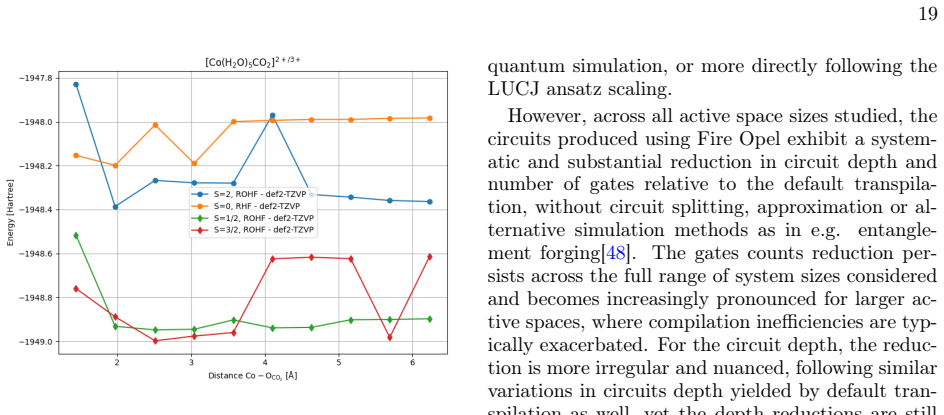
SQD, extended to open-shell systems via a restricted open-shell reference, an Sz-preserving configuration recovery loop, and an S^2 constraint, matches classical selected-CI and coupled-cluster benchmarks for a 3d transition-metal complex in the gas phase and in a dielectric continuum. The physical discovery is an avoided crossing in the high-spin Co(III) quintet along the Co-CO2 dissociation coordinate: the wavefunction switches from a localized {Co(H2O)5}3+ + CO2 description to a charge-separated {Co(H2O)5}2+ + CO2+ description, an electron transfer that the quintet manifold makes spin-allowed. Implicit solvation stabilizes the localized configuration more than the charge-separated one and
What carries the argument
Central machinery: SQD with the local unitary cluster Jastrow (LUCJ) ansatz—classical coupled-cluster amplitudes are loaded into a shallow circuit, measured bitstrings are repaired by a self-consistent configuration recovery (S-CORE) loop restoring electron number and Sz per spin channel, and the Hamiltonian is diagonalized in the resulting determinant subspace. In solvent, an outer IEF-PCM self-consistent reaction-field loop updates one-electron integrals from the SQD density (two-electron integrals frozen), reusing a single set of gas-phase-sampled bitstrings. The physics is a two-diabat competition—{Co(H2O)5}3+ + CO2 versus {Co(H2O)5}2+ + CO2+—whose avoided crossing shapes the quintet cur
Load-bearing premise
The solvent-phase results hinge on the assumption that bitstrings sampled once from a circuit parameterized by gas-phase coupled-cluster amplitudes cover the determinants that matter once the solvent potential is on; if that coverage fails, the solvated energies are artifacts of a gas-phase subspace rather than a genuine solvent response.
What would settle it
Re-run the solvent-phase SQD pipeline for the (30e,25o) quintet using bitstrings sampled from a LUCJ circuit parameterized by solvated (IEF-PCM) coupled-cluster amplitudes instead of gas-phase ones; if the resulting free energies differ from the reported values by more than the ~9 mEh benchmark gap, the one-shot gas-phase sampling does not span the solvated determinant space.
If this is right
- Open-shell SQD can serve as a benchmark-grade electronic structure tool for 3d transition-metal complexes within active spaces of up to 50 qubits on current quantum hardware.
- Implicit-solvent effects can be included by a purely classical self-consistent reaction-field post-processing loop, reusing one QPU sample set, at least when the solvent does not qualitatively change the important determinants.
- The gas-phase Co(III) quintet dissociation curve is non-monotonic because of a spin-allowed internal charge-transfer crossing; any single-reference or gas-phase-only method that misses this feature will misdescribe the dissociation.
- Solvation changes the relative stabilization of localized versus charge-separated fragments, flipping the qualitative shape of the potential energy surface; this environment responsiveness is captured by the SQD-IEF-PCM pipeline.
- Spin-state gaps in both oxidation states keep the high-spin state lower in energy and agree with benchmarks to within a few millihartrees or about one kcal/mol.
Where Pith is reading between the lines
- Beyond the paper: a dielectric-constant scan should move the avoided crossing monotonically to larger separations; this is a testable prediction of the two-diabat mechanism.
- Beyond the paper: the near-degeneracy at the crossing is a natural excited-state SQD testbed; computing the second root in the same subspace would give the diabatic coupling directly.
- Beyond the paper: the single geometry used for all spin states and oxidation states leaves relaxation out; state-specific geometries and zero-point corrections could shift gaps beyond the reported benchmark deviations.
- Beyond the paper: the largest deviations at 50 qubits are attributed by the authors to a fixed 48-hour post-processing cap, so an immediate test is whether more S-CORE iterations close the gap to the sub-mEh level seen at smaller active spaces.
Editorial analysis
A structured set of objections, weighed in public.
Referee Report
Summary. The paper extends sample-based quantum diagonalization (SQD) to open-shell transition-metal complexes in gas phase and implicit solvent, using the [Co(H2O)5CO2]2+/3+ system as a test bed. The authors sample bitstrings on an IBM Heron processor using a LUCJ ansatz whose parameters are fixed from classical CCSD/UCCSD amplitudes, then recover symmetry-respecting determinants via S-CORE and diagonalize the active-space Hamiltonian in the sampled subspace. For solvent, they wrap this loop in an outer IEF-PCM SCRF iteration, reusing the same QPU bitstrings. They report agreement with HCI and (U)CCSD(T) benchmarks across active spaces up to 50 qubits, identify a gas-phase charge-transfer avoided crossing in the Co(III) quintet curve, and observe that implicit solvation quenches this feature. The central claim is that SQD reproduces the benchmarks with a largest deviation below 9 mEh, establishing SQD as a viable quantum-centric method for transition-metal chemistry.
Significance. If the results hold, this would be the first hardware demonstration of SQD for an open-shell 3d transition-metal complex with a coupled spin-state/charge-transfer/solvation problem. The paper includes several strengths: a chemically sensible internal control (Co(II) states show no spurious bump), a detailed SI documenting circuit metrics and post-processing parameters, a GitHub repository for code and data, and a clear falsifiable prediction in the gas-phase quintet bump and its solvent quenching. The use of an independent HCI/IEF-PCM benchmark is a meaningful check, and the method's ability to reproduce the shape of the crossing region is nontrivial. However, the central quantitative claim is weakened by an internal inconsistency in the reported maximum deviation and by an under-converged largest active space.
major comments (3)
- [Abstract vs. Section III.A] The abstract claims a 'largest observed deviation below 9 mEh', but Section III.A reports a maximum deviation of 11.55 mEh for the singlet state at (30e,25o) relative to CCSD(T), and 11.30 mEh relative to HCI. This is a direct factual inconsistency. The claim should be corrected or qualified (e.g., by benchmark and active-space size). Given that the largest active space is the flagship result, the discrepancy is load-bearing for the paper's quantitative message.
- [Section II.G and Section III.B] The solvent-phase SQD protocol relies on the assumption that bitstrings sampled once from a gas-phase LUCJ ansatz span the solvated wavefunction. The paper states 'we have demonstrated the validity of this assumption', but the demonstration is only indirect: the solvent-phase SQD energies agree with HCI/IEF-PCM in Figs. 5 and 14 and Tables IV–V. While encouraging, this does not directly establish that the fixed gas-phase determinant subspace contains the configurations that become important when the reaction field changes the one-electron Hamiltonian. I request an explicit coverage comparison — e.g., the overlap or determinant-space overlap between the SQD subspace and the dominant HCI/IEF-PCM variational space — or a clear statement that the agreement is empirical and limited to this system/active-space range.
- [Section III.A, Tables II and VII] For the largest active space (30e,25o), the SQD gap in Table II differs from HCI by 8.5 mHa, and SI 3 shows only 7–13 S-CORE iterations were used due to the 48-hour post-processing budget. The paper attributes the increased errors to this under-convergence. This is reasonable, but it means the claim of 'quantitatively reliable results' across the full active-space range is not yet supported at 50 qubits. The authors should either report additional S-CORE iterations for the largest active space or soften the claim to reflect that convergence is not fully established there.
minor comments (5)
- [Abstract] Typo: 'implict solvent' should be 'implicit solvent'.
- [Figure 1, right panel] The figure caption uses 'mHa' while the text and abstract use 'mEh'; please standardize (they are the same unit, but the notation should be consistent).
- [Section II.E] The phrase 'fixed without optimization' could be clarified to 'fixed without variational optimization on the QPU'; the parameters are of course derived from classical CC amplitudes.
- [SI 2, Figure 17 caption] The caption notes that the largest active-space quintet data were 'lost in the process'. This data loss should be mentioned in the main text or SI introduction, as it affects reproducibility and completeness of the circuit metrics.
- [Section III.B, text after Table IV] The sentence 'the solvent stabilises both spin state systems' is ambiguous; the reported gap change (-1.18 kcal/mol for 25 orbitals) indicates the quintet is stabilized relative to the singlet. Please rephrase.
Circularity Check
Partial inherited-benchmark effect: LUCJ ansatz uses the same CC amplitudes that serve as a benchmark; HCI validation keeps the central claim independent.
specific steps
-
fitted input called prediction
[Section II.E (LUCJ ansatz) and Section III.A (Gas phase energetics)]
"LUCJ parameters are fixed without optimization from the t1, t2 amplitudes of a classical UCCSD/CCSD calculation on the same active space via double factorization[14, 18], so the ansatz is a shallow, hardware-efficient truncation of the classical coupled-cluster wavefunction. ... SQD energies sampled on ibm_pittsburgh after self-consistent configuration recovery convergence track the CCSD(T)/UCCSD(T) reference within 0.51, 0.72, 1.93, and 8.72 mEh"
By construction, the bitstring distribution that defines the SQD subspace is generated by an LUCJ circuit whose parameters are the t1/t2 amplitudes of the very UCCSD/CCSD calculation used as the benchmark. The sampled determinants are therefore concentrated on the determinants that dominate the CC wavefunction, and the subsequent variational diagonalization in that subspace is heavily biased to reproduce the CC energy. This makes the SQD-vs-CCSD(T) agreement partly inherited from the input amplitudes rather than an independent test. However, the HCI benchmark is computed without these amplitudes, and the solvent-phase SQD results are validated against HCI-IEF-PCM, so the central demonstration retains independent content.
full rationale
The paper's derivation chain is mostly self-contained against independent benchmarks. The one partial circularity is the LUCJ initialization: the ansatz used for QPU sampling is parameterized from the same UCCSD/CCSD amplitudes that are later quoted as a benchmark, so the SQD-CCSD(T) agreement is in part a consistency check of the ansatz rather than an independent prediction. I score this as a fitted-input-called-prediction effect (partial), not a full reduction: E_SQD is obtained by exact diagonalization in a sampled, S-CORE-recovered subspace, so it is not defined to equal E_CCSD, and the paper's central physics conclusions are additionally supported by HCI, which shares no amplitudes with the LUCJ circuit. The solvent-phase claim rests on bitstrings sampled once from gas-phase-initialized LUCJ and classical SCRF post-processing; the paper explicitly states the subspace-coverage assumption and supports it by agreement with independently computed HCI-IEF-PCM benchmarks, so this is an empirical validation rather than circularity. The only self-citation is Ref. [46] (first author's prior dissertation) used for the open-shell tau1 diagnostic threshold; this is interpretive and not load-bearing for the main results. No uniqueness theorem, renaming, or ansatz-smuggling pattern is present. The under-converged largest active space (7-13 S-CORE iterations, deviations up to 11.55 mEh) and the abstract's '<9 mEh' claim are correctness/consistency concerns, not circularity.
Axiom & Free-Parameter Ledger
free parameters (4)
- AVAS thresholds tau_occ and tau_vir
- LUCJ alpha-beta coupling period (every fourth orbital)
- S-CORE iteration counts =
7-50 depending on active space and spin
- Shot counts per data point =
2e5 (34q), 3e5 (38q), 5e5 (46q/50q)
axioms (6)
- standard math Born-Oppenheimer approximation and non-relativistic electronic Hamiltonian
- domain assumption IEF-PCM frozen-reaction-field approximation
- ad hoc to paper QPU-sampled bitstrings from the gas-phase LUCJ ansatz span the solvated wavefunction
- domain assumption Fixed geometry for all spin states and oxidation states
- domain assumption Mulliken population analysis on the ROHF 1-RDM reliably identifies charge localization
- domain assumption Soft S2 constraint in the PySCF selected-CI eigensolver mitigates spin contamination
Cite this review
Pith. "Pith review of Sample-based quantum diagonalization approach for open-shell transition-metal complexes in gas and implicit-solvent." pith.science (2026). https://pith.science/paper/BTKTL5J5
@misc{pith2026260716389,
  author       = {Pith},
  title        = {Pith review of: Sample-based quantum diagonalization approach for open-shell transition-metal complexes in gas and implicit-solvent},
  year         = {2026},
  howpublished = {\url{https://pith.science/paper/BTKTL5J5}},
  note         = {Machine review of arXiv:2607.16389}
}
read the original abstract
Open-shell $3d$ transition-metal complexes challenge electronic-structure methods because competing spin states, charge transfer, and solvation jointly determine their energetics. Here, we combine sample-based quantum diagonalization (SQD) with the integral-equation-formalism polarizable continuum model (IEF-PCM), extending SQD to correlated open-shell transition-metal systems in a dielectric environment. We investigate the octahedrally coordinated $\mathrm{[Co(H_2O)_5CO_2]^{2+/3+}}$ complex across two oxidation states, four spin multiplicities, and a metal-ligand dissociation coordinate. We study the Co(III) singlet and quintet states and the Co(II) doublet and quartet states, incorporating open-shell references into SQD-IEF-PCM through an outer self-consistent reaction-field loop. Using samples collected on an IBM Heron quantum processor and active spaces of up to 50 qubits, SQD reproduces coupled-cluster and heat-bath configuration-interaction benchmarks within the same active space in the gas phase and implicit solvent, with a largest observed deviation below 9 $mE_h$. Along the dissociation coordinate of high-spin quintet $\mathrm{[Co(H_2O)_5CO_2]^{3+}}$, SQD resolves an avoided crossing caused by internal charge transfer; this feature is absent in the singlet and the lower oxidation state of the complex. Relative to the gas phase, implicit solvation stabilizes for the quintet state the neutral CO$_2$ dissociation and suppresses the avoided-crossing feature. To our knowledge, this is the first hardware demonstration of SQD for an open-shell $3d$ transition-metal complex in gas phase and implict solvent. These results establish SQD as a robust quantum-centric approach for transition-metal chemistry where spin state ordering, charge transfer, and environmental effects are strongly intertwined.
Figures




Reference graph
Works this paper leans on
-
[1]
Y.; Njeri, E.; Silva, D.; Suib, S
Sahoo, S.; Wickramathilaka, K. Y.; Njeri, E.; Silva, D.; Suib, S. L. A Review on Transition Metal Oxides in Catalysis.Front. Chem.2024,12, 1374878
2024
-
[2]
M.; Gomes, Y.; Hansen, J
Abu-Rahman, P. M.; Gomes, Y.; Hansen, J. Metal Ions in Enzyme Catalysis: Structural and Func- tional Insights into Metalloenzyme Mechanisms.J. Mol. Sci.2023,33, 19–21
2023
-
[3]
C.; de Bruin, B.; Reek, J
James, C. C.; de Bruin, B.; Reek, J. N. H. Transi- tion Metal Catalysis in Living Cells: Progress, Chal- lenges, and Novel Supramolecular Solutions.Angew. Chem. Int. Ed.2023,62, e202306645
2023
-
[4]
R.; Sun, Q.; Chan, G
Sayfutyarova, E. R.; Sun, Q.; Chan, G. K.-L.; Knizia, G. Automated Construction of Molecular Active Spaces from Atomic Valence Orbitals.J. Chem. Theory Comput.2017,13, 4063–4078
2017
-
[5]
D.; Ma, D.; Olsen, J.; Gagliardi, W
Vogiatzis, K. D.; Ma, D.; Olsen, J.; Gagliardi, W. A., Laura; de Jong Pushing Configuration–Interaction to the Limit: Towards Massively Parallel MCSCF Calculations.J. Chem. Phys.2017,147, 184111
2017
-
[6]
A.; Tubman, N
Holmes, A. A.; Tubman, N. M.; Umrigar, C. J. Heat–Bath Configuration Interaction: An Efficient Selected Configuration Interaction Algorithm In- spired by Heat–Bath Sampling.J. Chem. Theory Comput.2016,12, 3674–3680
2016
-
[7]
P.; Rancurel, P
Huron, B.; Malrieu, J. P.; Rancurel, P. Iterative Per- turbation Calculations of Ground and Excited State Energies from Multiconfigurational Zeroth-Order Wavefunctions.J. Chem. Phys.1973,58, 5745– 5759
1973
-
[8]
M.; Freeman, C
Tubman, N. M.; Freeman, C. D.; Levine, D. S.; Hait, D.; Head-Gordon, M.; Whaley, K. B. Modern Approaches to Exact Diagonalization and Selected Configuration Interaction with the Adaptive Sam- pling CI Method.J. Chem. Theory Comput.2020, 16, 2139–2159
2020
-
[9]
Feynman, R. P. Simulating physics with computers. Int J Theor Phys1982,21, 467–488
-
[10]
S.; Lloyd, S
Abrams, D. S.; Lloyd, S. Quantum Algorithm Providing Exponential Speed Increase for Find- ing Eigenvalues and Eigenvectors.Phys. Rev. Lett. 1999,83, 5162–5165
1999
-
[11]
Yamamoto, K. et al. Quantum Error-Corrected Computation of Molecular Energies. 2025;https: //arxiv.org/abs/2505.09133. 23
Pith/arXiv arXiv 2025
-
[12]
J.; Aspuru-Guzik, A.; O’Brien, J
Peruzzo, A.; McClean, J.; Shadbolt, P.; Yung, M.- H.; Zhou, X.-Q.; Love, P. J.; Aspuru-Guzik, A.; O’Brien, J. L. A variational eingenvalue solver on a photonic quantum processor.Nature Communica- tions2014,5, 4213
-
[13]
R.; Hempel, C.; Love, P
Romero, J.; Babbush, R.; McClean, J. R.; Hempel, C.; Love, P. J.; Aspuru-Guzik, A. Strate- gies for quantum computing molecular energies us- ing the unitary coupled cluster ansatz.Quantum Sci. and Technol.2018,4, 14008
2018
-
[14]
Robledo-Moreno, J. et al. Chemistry Beyond the Scale of Exact Diagonalization on a Quantum- Centric Supercomputer.Science Advances2025, 11, eadu9991
-
[15]
Kanno, K.; Kohda, M.; Imai, R.; Koh, S.; Mitarai, K.; Mizukami, W.; Nakagawa, Y. O. Quantum-Selected Configuration Interaction: clas- sical diagonalization of Hamiltonians in subspaces selected by quantum computers. 2023;https:// arxiv.org/abs/2302.11320
Pith/arXiv arXiv 2023
-
[16]
J.; Whaley, K
Motta, M.; Sung, K. J.; Whaley, K. B.; Head- Gordon, M.; Shee, J. Bridging physical intuition and hardware efficiency for correlated electronic states: the local unitary cluster Jastrow ansatz for elec- tronic structure.Chemical Science2023,14, 11213– 11227
-
[17]
D.; Robledo-Moreno, J.; Job, J
Liepuoniute, I.; Doney, K. D.; Robledo-Moreno, J.; Job, J. A.; Friend, W. S.; Jones, G. O. Quantum- Centric Computational Study of Methylene Singlet and Triplet States.J. Chem. Theory Comput.2025, 21, 5062–5070
2025
-
[18]
Kaliakin, D.; Shajan, A.; Liang, F.; Merz, K. M. J. Implicit Solvent Sample-Based Quantum Diagonal- ization.The Journal of Physical Chemistry B2025, 129, 5788–5796, PMID: 40377433
-
[19]
A.; Das, S.; Sitdikov, I.; Mezza- capo,A.; Merz,K.M.,Jr.Accuratequantum-centric simulations of intermolecular interactions.Commu- nications Physics2025,8, 396
Kaliakin, D.; Shajan, A.; Liang, F.; Rob- ledo Moreno, J.; Li, Z.; Mitra, A.; Motta, M.; John- son, C.; Saki, A. A.; Das, S.; Sitdikov, I.; Mezza- capo,A.; Merz,K.M.,Jr.Accuratequantum-centric simulations of intermolecular interactions.Commu- nications Physics2025,8, 396
-
[21]
C.; Blunt, N
Sun, Q.; Berkelbach, T. C.; Blunt, N. S.; Booth,G.H.; Guo,S.; Li,Z.; Liu,J.; McClain,J.D.; Sayfutyarova, E. R.; Sharma, S.; Wouters, S.; Chan, G. K.-L. PySCF: The Python-Based Simu- lations of Chemistry Framework.J. Chem. Phys. 2020,153, 024109
2020
-
[22]
J.; Ellis, D
Baerends, E. J.; Ellis, D. E.; Ros, P. Self-Consistent Molecular Hartree–Fock–Slater Calculations. I. The Computational Procedure.Chem. Phys.1973,2, 41–51
1973
-
[23]
Whitten, J. L. Coulombic Potential Energy Inte- grals and Approximations.J. Chem. Phys.1973, 58, 4496–4501
1973
-
[24]
I.; Connolly, J
Dunlap, B. I.; Connolly, J. W. D.; Sabin, J. R. On SomeApproximationsinApplicationsofXαTheory. J. Chem. Phys.1979,71, 3396–3402
1979
-
[25]
On the Use of the Cluster Expansion and the Technique of Diagrams in Calculations of Corre- lation Effects in Atoms and Molecules.Adv
Čížek, J. On the Use of the Cluster Expansion and the Technique of Diagrams in Calculations of Corre- lation Effects in Atoms and Molecules.Adv. Chem. Phys.1969,14, 35–89
1969
-
[26]
Purvis,G.D.; Bartlett,R.J.AFullCoupled-Cluster Singles and Doubles Model: The Inclusion of Dis- connected Triples.J. Chem. Phys.1982,76, 1910– 1918
1982
-
[27]
E.; Schaefer, H
Scuseria, G. E.; Schaefer, H. F. I. Is Coupled Cluster SinglesandDoubles(CCSD)MoreComputationally Intensive than Quadratic Configuration Interaction (QCISD)?J. Chem. Phys.1989,90, 3700–3703
1989
-
[28]
Quantum Mechanical Continuum Solvation Models.Chemical Reviews2005,105, 2999–3093
Tomasi, J.; Mennucci, B.; Cammi, R. Quantum Mechanical Continuum Solvation Models.Chemical Reviews2005,105, 2999–3093
-
[29]
Mennucci, B.; Cancès, E.; Tomasi, J. Evaluation of Solvent Effects in Isotropic and Anisotropic Di- electrics and in Ionic Solutions with a Unified In- tegral Equation Method: Theoretical Bases, Com- putational Implementation, and Numerical Applica- tions.The Journal of Physical Chemistry B1997, 101, 10506–10517
-
[30]
Cancès,E.; Mennucci,B.; Tomasi,J.ANewIntegral Equation Formalism for the Polarizable Continuum Model: TheoreticalBackgroundandApplicationsto Isotropic and Anisotropic Dielectrics.The Journal of Chemical Physics1997,107, 3032–3041
-
[31]
Absorption and Emission Spectra of Solvated Molecules with the EOM–CCSD–PCM Method.Journal of Chemical Theory and Compu- tation2012,8, 4494–4502
Caricato, M. Absorption and Emission Spectra of Solvated Molecules with the EOM–CCSD–PCM Method.Journal of Chemical Theory and Compu- tation2012,8, 4494–4502
-
[32]
Quantum Cluster Theory for the Polar- izable Continuum Model
Cammi, R. Quantum Cluster Theory for the Polar- izable Continuum Model. I. The CCSD Level with Analytical First and Second Derivatives.The Jour- nal of Chemical Physics2009,131, 164104
-
[33]
Caricato, M. Linear Response Coupled Cluster The- ory with the Polarizable Continuum Model within the Singles Approximation for the Solvent Re- sponse.The Journal of Chemical Physics2018,148, 134113
-
[34]
Quantum Simulation of Molecules in Solution.Jour- nal of Chemical Theory and Computation2022,18, 7457–7469
Castaldo, D.; Jahangiri, S.; Delgado, A.; Corni, S. Quantum Simulation of Molecules in Solution.Jour- nal of Chemical Theory and Computation2022,18, 7457–7469
-
[35]
C.; Hawkins, G
Chambers, C. C.; Hawkins, G. D.; Cramer, C. J.; Truhlar, D. G. Model for Aqueous Solvation Based on Class IV Atomic Charges and First Solvation Shell Effects.The Journal of Physical Chemistry 1996,100, 16385–16398
1996
-
[36]
V.; Cramer, C
Marenich, A. V.; Cramer, C. J.; Truhlar, D. G. Uni- versal Solvation Model Based on Solute Electron Density and on a Continuum Model of the Solvent Defined by the Bulk Dielectric Constant and Atomic Surface Tensions.The Journal of Physical Chem- istry B2009,113, 6378–6396
-
[37]
2026;https://q-ctrl.com/ fire-opal, Accessed: 2026-05-17
Q-CTRL Fire Opal. 2026;https://q-ctrl.com/ fire-opal, Accessed: 2026-05-17. 24
2026
-
[38]
C.; Blunt, N
Sun, Q.; Berkelbach, T. C.; Blunt, N. S.; Booth,G.H.; Guo,S.; Li,Z.; Liu,J.; McClain,J.D.; Sayfutyarova, E. R.; Sharma, S.; Wouters, S.; Chan, G. K. L. PySCF: the Python-based simu- lations of chemistry framework.Wiley Interdisci- plinary Reviews: Computational Molecular Science 2018,8, Publisher Copyright:©2017 Wiley Peri- odicals, Inc
2018
-
[39]
2021;https://github
Sharma group pyscf/shciscf: An interface to SHCI program Dice for PySCF. 2021;https://github. com/pyscf/shciscf
2021
-
[40]
J.; Lishman, J.; Gacon, J.; Martiel, S.; Nation, P
Javadi-Abhari, A.; Treinish, M.; Krsulich, K.; Wood, C. J.; Lishman, J.; Gacon, J.; Martiel, S.; Nation, P. D.; Bishop, L. S.; Cross, A. W.; John- son, B. R.; Gambetta, J. M. Quantum computing with Qiskit. 2024
2024
-
[41]
2023;https://doi.org/10
The Qiskit Nature developers and contributors Qiskit Nature 0.6.0. 2023;https://doi.org/10. 5281/zenodo.7828768
2023
-
[42]
Sung, K. J. et al. ffsim: Faster simulation of fermionic quantum circuits. 2026;https://arxiv. org/abs/2605.03123
Pith/arXiv arXiv 2026
-
[43]
A.; Barison, S.; Fuller, B.; Garrison, J
Saki, A. A.; Barison, S.; Fuller, B.; Garrison, J. R.; Glick, J. R.; Johnson, C.; Mezzacapo, A.; Robledo- Moreno, J.; Rossmannek, M.; Schweigert, P.; Sit- dikov, I.; Sung, K. J. Qiskit addon: sample- based quantum diagonalization.https://github. com/Qiskit/qiskit-addon-sqd, 2024
2024
-
[44]
J.; Rice, J
Lee, T. J.; Rice, J. E.; Scuseria, G. E.; Schae- fer, I., Henry F. Theoretical Investigations of Molecules Composed Only of Fluorine, Oxygen and Nitrogen: Determination of the Equilibrium Struc- tures of FOOF, (NO)2 and FNNF and the Transi- tion State Structure for FNNF Cis–Trans Isomer- ization.Theor. Chim. Acta1989,75, 81–98
-
[45]
J.; Taylor, P
Lee, T. J.; Taylor, P. R. A Diagnostic for Determin- ing the Quality of Single-Reference Electron Corre- lation Methods.Int. J. Quantum Chem.: Quantum Chem. Symp.1989,23, 199–207
1989
-
[46]
Development of Local Coupled Clus- ter Response Methods for High-Spin Open-Shell Molecules
David, D. Development of Local Coupled Clus- ter Response Methods for High-Spin Open-Shell Molecules. Ph.D. Dissertation, Universität Regens- burg, 2020
2020
-
[47]
SQD.https:// github.com/Kowalikov/SQD, 2026; GitHub reposi- tory, accessed: 2026-07-08
Pathak, V.; David, D.; Kowalik, M. SQD.https:// github.com/Kowalikov/SQD, 2026; GitHub reposi- tory, accessed: 2026-07-08
2026
-
[48]
P.; Motta, M.; Link, B.; Liepuoniute, I.; Friedhoff, T.; Nishimura, H.; Nguyen, N.; Williams, K
Smith, T.; Gujarati, T. P.; Motta, M.; Link, B.; Liepuoniute, I.; Friedhoff, T.; Nishimura, H.; Nguyen, N.; Williams, K. S.; Moreno, J. R.; John- son, C.; Sung, K. J.; Saki, A. A.; Kagele, M. Quantum-centric simulation of hydrogen abstrac- tion by sample-based quantum diagonalization and entanglement forging. 2026;https://arxiv.org/ abs/2508.08229
Pith/arXiv arXiv 2026
-
[49]
Ezzell, N.; Pokharel, B.; Tewala, L.; Quiroz, G.; Li- dar, D. A. Dynamical decoupling for superconduct- ing qubits: A performance survey.Physical Review Applied2023,20
discussion (0)
Sign in with ORCID, Apple, or X to comment. Anyone can read and Pith papers without signing in.