REVIEW 4 major objections 3 minor 25 references
Task alignment—finding out what an underspecified user actually wants before acting—is a measurable ability current LLMs largely lack, with intended-task recovery of 22–32% versus 48% for humans.
Reviewed by Pith at T0; open to challenge. T0 means a machine referee read the full paper against a public rubric. the ladder, T0–T4 →
Under ambiguous user requests, current LLMs recover the intended task only 22–32% of the time, well below human accuracy of 48%, and post-training only partially closes the gap.
T0 review reviewed 2026-08-01 challenge →
load-bearing objection The framework is a real contribution; the 22–32% headline numbers are simulator-dependent and should be read with that caveat. the 4 major comments →
Interactive Task Alignment as a POMDP
The pith
A machine-rendered reading of the paper's core claim, the machinery that carries it, and where it could break.
The reading
Core claim
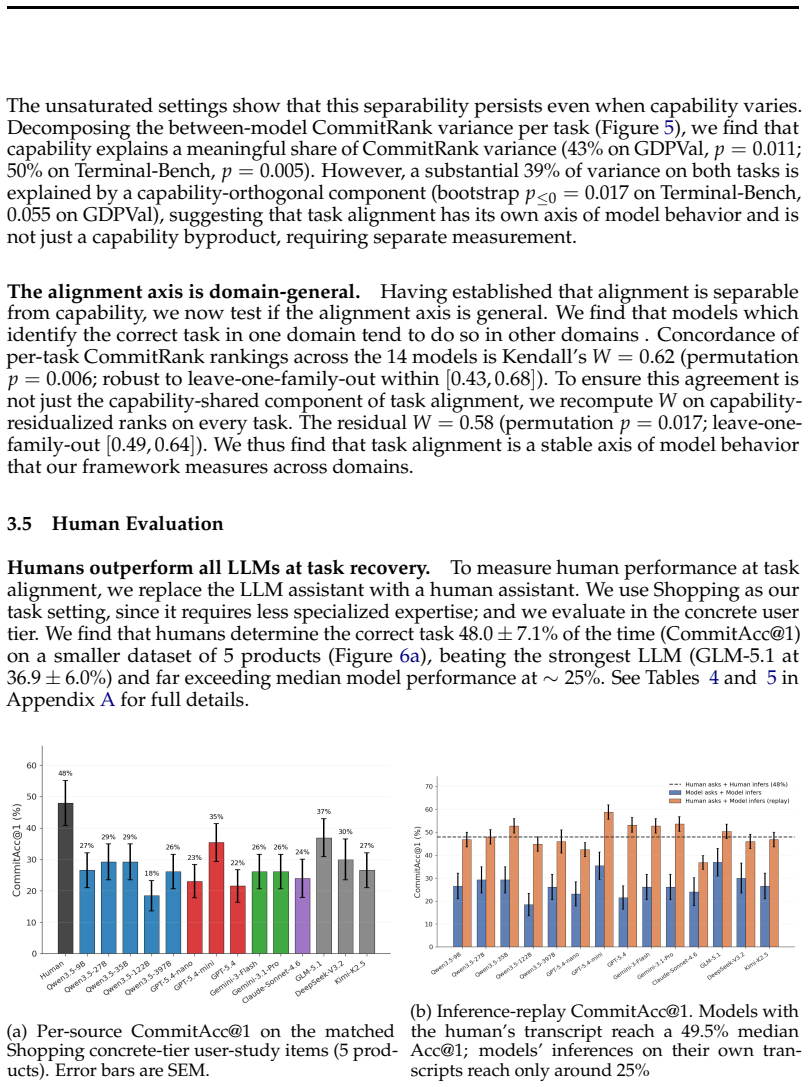
The paper claims that task alignment is a measurable, separable ability distinct from task capability: across shopping, coding, and professional-work settings, 14 state-of-the-art LLMs recover the user's intended specification only 22–32% of the time when the user starts from abstract intent, even though the same models largely succeed once the task is fully specified. Humans in the same shopping setting reach 48.0%. The paper further claims that the human advantage is communication, not inference: when LLMs are given the human assistant's transcripts, median task recovery rises to 49.5%, close to the human level. Finally, post-training Qwen3.5-9B with SFT and RL roughly doubles CommitReward
What carries the argument
The central object is a POMDP with a latent task specification x* and a stateful user-intent process. At each episode the ground-truth x* is hidden; a user simulator with privileged access to x* starts from an abstract, moderate, or concrete intent seed and updates its intent via an "intent evolver" E that moves toward x* only as fast as the conversation justifies. The assistant observes only the dialogue history and must choose (a) a free-form response, (b) a stop/commit signal that ends the episode, and (c) a ranking ρt over a fixed set of 15 candidate specifications (containing x*) produced in a separate thread. This ranking is the measurement instrument: it exposes the assistant's curren
Load-bearing premise
The LLM-based user simulator, with its intent evolver that gradually reveals a privileged ground-truth task, faithfully models how real users expose and change their goals; the headline numbers are measured against this simulator, and the paper's own ablation shows the evolver design materially changes results.
What would settle it
Run identical task-alignment episodes with real human users who hold genuinely abstract, novel goals (not recalled purchases) as the user role, and measure the assistant's CommitAcc@1 against the simulator-based figure. If human-user recovery is substantially above 22–32%, the simulator overstates the failure; if rates are near or below, the numbers hold.
If this is right
- Existing capability benchmarks likely overstate real-world utility: a model that can execute a task once specified may still fail as an agent because it cannot identify the user's goal.
- Task alignment can be measured and trained separately from task capability; it appears domain-general, so improvements in one domain may transfer to others.
- Post-training on alignment (SFT/RL) reduces confidently-wrong behavior and increases honest uncertainty, providing a concrete training signal (CommitReward) for more reliable agents.
- Human-level interactive alignment (~48%) sets a target that current models remain far from, suggesting interaction skill—not reasoning—is the current bottleneck.
- The framework applies to any benchmark with specifiable tasks, so existing evaluation suites can be converted into interactive alignment tests without new task design.
Where Pith is reading between the lines
- Since the intent evolver ablation materially changes measured performance on every assistant, real-user intent evolution is likely even more variable; the 22–32% figures should be read as tied to this simulator design rather than as canonical numbers.
- The confidence/entropy metrics are available only for a subset of models, so the four-quadrant taxonomy may be partly an artifact of which model families emit logprobs; a standardized calibration protocol across all models would clarify this.
- The human-transcript replay result suggests an asymmetric opportunity: improving the assistant's question-asking policy may yield larger gains than improving the underlying inference model, and human assistant transcripts could serve as training data.
- Measuring alignment against a closed 15-candidate set of plausible tasks may underestimate real-world difficulty, where the space of possible tasks is open-ended; if so, the reported gap is conservative.
Editorial analysis
A structured set of objections, weighed in public.
Referee Report
Summary. The paper proposes a POMDP-based framework for evaluating task alignment: given a fully specified benchmark task x*, it constructs an underspecified interaction with an LLM user simulator whose latent intent evolves from abstract to concrete, and asks an assistant to identify x* among 15 candidates before committing. The framework is instantiated on Shopping-MMLU, GDPVal, and Terminal-Bench with 14 LLMs. The paper reports abstract-tier CommitAcc@1 between 22% and 32% for models, 48% for humans on a small Shopping subset; argues that task alignment is separable from task capability and domain-general; shows that SFT/RL on Qwen3.5-9B improves alignment; and performs a post hoc human validation of the simulator.
Significance. If the results hold, the paper makes a useful contribution: it operationalizes a capability that most benchmarks ignore, separates task discovery from execution, and offers metrics that distinguish guessing from genuine uncertainty resolution. Strengths include the explicit POMDP formulation, the empty-conversation probe for candidate-set leakage, the inference-replay ablation isolating communication from inference, and the authors' candor in the Limitations section. The qualitative finding that LLMs under-resolve ambiguous requests is credible and supported by several ablations. However, the headline numeric claims rely on an abstract-tier user simulator that has no direct human validation, and the human comparisons are statistically underpowered; the exact magnitudes should be treated as provisional until the robustness analyses are added.
major comments (4)
- [§3.2, Table 2; Limitations; Appendix A.3, Table 7] The headline '22–32% recovery' is a property of the authors' LLM user simulator, not a model-independent measurement. The Limitations section states that the absolute numbers are 'tied to a particular simulator design rather than a canonical user model,' and the evolver ablation shows that removing the intent evolver raises CommitReward by roughly 0.19–0.28 on the concrete tier (e.g., GPT-5.4: 0.98→1.22). Since the human validation (Appendix A.2) covers only the concrete tier and the authors state that abstract intent cannot be captured in humans, the abstract-tier simulation—the source of the headline range—has no direct external check. Please provide a robustness analysis over plausible evolver/user-policy variants, or re-center the claims on relative/qualitative comparisons that are stable across simulator choices.
- [§3.5, Tables 4–5] The claim that 'humans outperform all evaluated models' is not backed by a statistical test. The human mean is 48.0±7.1% and the best model (GLM-5.1) is 36.9±6.0%; the difference is roughly 1.2 standard errors of the difference and is not significant at conventional levels. Moreover, the comparison is based on only 5 products; per-item human scores range from 18.2% to 66.7%, and several models achieve 100% on the 'dog treats' item, so the aggregate is highly sensitive to item selection. Report a paired or mixed-effects test across items/participants, or soften the claim to a descriptive finding.
- [Appendix A.2, Table 6] The claim that human and simulated users are 'comparable and within 1 SEM' holds only after pooling. For gpt-5.4, human CommitReward is 1.15±0.04 versus simulated 0.98±0.05, a difference of about 2.6 pooled SEM; CommitAcc@1 is 50.0 versus 36.5. The pooled comparison hides a substantial per-assistant discrepancy. Report per-assistant tests and justify whether the aggregate 'within 1 SEM' conclusion is appropriate, or qualify the simulator-validation claim accordingly.
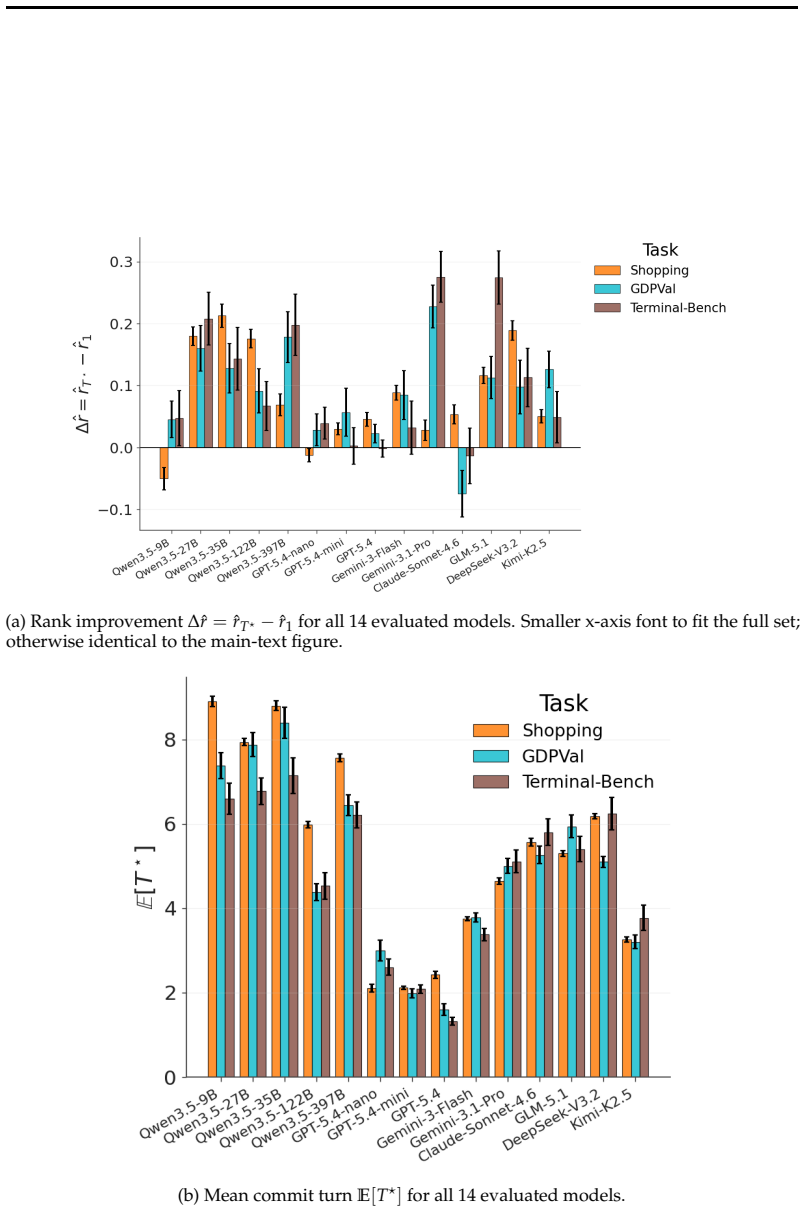
- [§3.4, Figure 5] The capability-orthogonal component of CommitRank variance is reported as 39% with bootstrap p=0.055 on GDPVal, which is not significant at the 0.05 level. While the Shopping control and residual Kendall's W provide supporting evidence for separability, the text's phrasing '39% of variance on both tasks' overstates the GDPVal result. Report the confidence interval and interpret the GDPVal point estimate with the appropriate caveat.
minor comments (3)
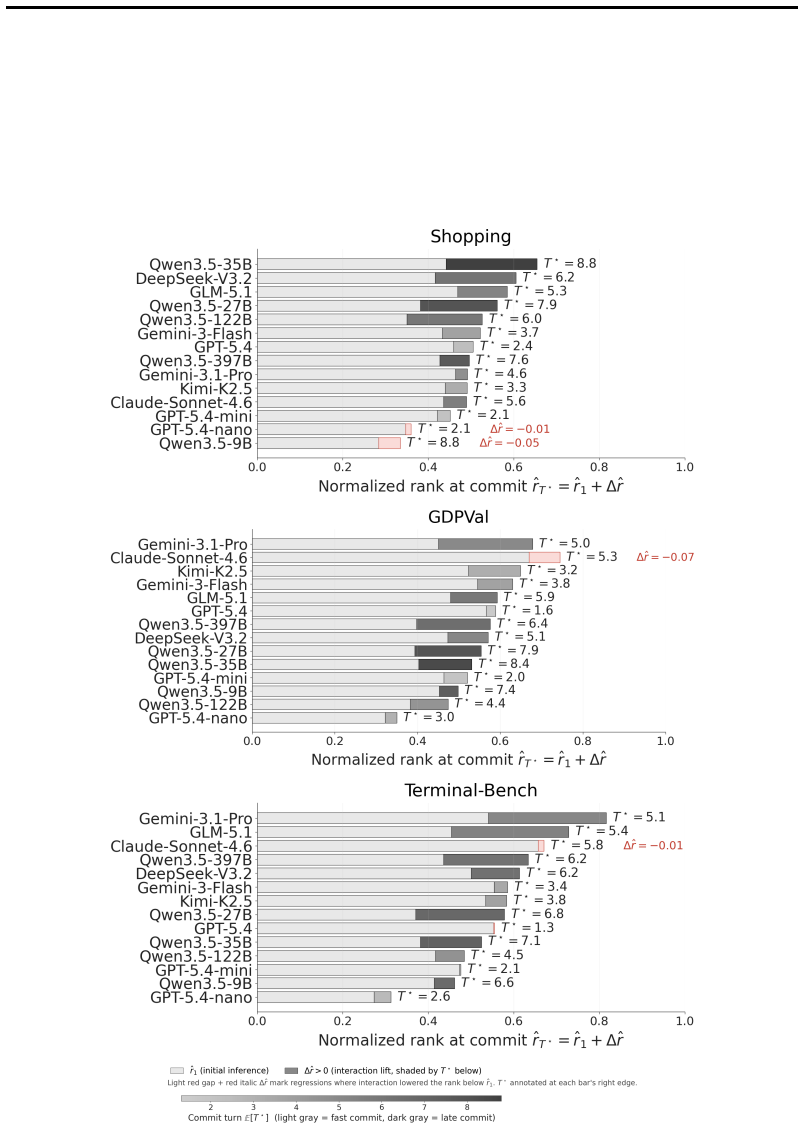
- [§2.2, Eq. for CommitRank] The 'normalized rank' metric is inverted: a higher value means a better (lower) rank position. Consider calling it 'normalized inverse rank' or explicitly noting the inversion to avoid confusion.
- [Appendix A.3, spec-token coverage] The definition of 'content tokens' should be pinned down (e.g., stopword removal, tokenization scheme). As written, the metric depends on an unspecified preprocessing choice.
- [Throughout] Minor typos and phrasing issues, e.g., 'Figure 3 showcases a subset models' behavior' should read 'a subset of models' behavior'; several references to 'Figure 3' appear before the figure is introduced. A careful proofread is recommended.
Circularity Check
No significant circularity: the headline recovery rates are simulator-dependent measurements, not results forced by definition; the main caveat is external validity, not circularity.
full rationale
The paper's derivation chain is an evaluation pipeline, not a derivation that re-imports its conclusion. Task alignment is operationalized as a POMDP with latent x* and an LLM user simulator; CommitAcc@1/CommitRank/CommitReward are defined as functions of the model's ranking of x* in candidate set C. The 22–32% figure is an empirical measurement of 14 models under that simulator, not an equation-level identity: nothing in the metric definitions forces a particular recovery rate, and no parameter is fitted to the reported values and then renamed a prediction. The 'separable axis' claim is supported by a variance decomposition (capability explains 43%/50%, orthogonal component 39%) and the 'domain-general' claim by Kendall's W=0.62 residual W=0.58; these are empirical statistics. The human study is an independent external check at the concrete tier, and the inference-replay ablation is a controlled comparison. The paper itself flags the one genuine weakness: Limitations (2) states 'it is not possible to capture abstract intent in humans' and 'our absolute numbers are tied to a particular simulator design rather than a canonical user model,' and the intent-evolver ablation (Table 7) shows the simulator design materially changes CommitReward. That makes the abstract-tier headline vulnerable to simulator choice, but it is a construct-validity/robustness problem, not circularity: the headline does not reduce to the framework's inputs by construction, and there is no load-bearing self-citation chain. Post-training results are standard held-out evaluations (train on concrete tier, evaluate on abstract tier) and are not self-referential predictions. Accordingly no circular step is exhibited.
Axiom & Free-Parameter Ledger
free parameters (5)
- CommitReward coefficients α, λ =
α=1.5, λ=0.02 (evaluation); α=1.0, λ=0 (RL training)
- Candidate set size |C|=15, N=14 distractors =
15 / 14
- Interaction cap of 15 turns =
15 user + 15 assistant turns
- Intent tier definitions (abstract/moderate/concrete) =
word/character constraints in prompts
- Low/high entropy median split =
median across all rollouts
axioms (6)
- domain assumption LLM user simulator with intent evolver faithfully emulates how real users gradually specify their goals
- domain assumption Letter-shuffle logprob softmax provides a valid estimate of assistant belief over candidates
- domain assumption Candidate sets do not leak the ground-truth task
- domain assumption Reused capability baselines from the Artificial Analysis leaderboard are comparable across models
- domain assumption Human users specifying a past purchase approximates the concrete intent tier
- standard math Standard POMDP formalism
Cite this review
Pith. "Pith review of Interactive Task Alignment as a POMDP." pith.science (2026). https://pith.science/paper/KDZC7ZC4
@misc{pith2026260716412,
  author       = {Pith},
  title        = {Pith review of: Interactive Task Alignment as a POMDP},
  year         = {2026},
  howpublished = {\url{https://pith.science/paper/KDZC7ZC4}},
  note         = {Machine review of arXiv:2607.16412}
}
read the original abstract
Current benchmarks for language models primarily evaluate execution on fully specified tasks. However, real user tasks are often ambiguous. Users arrive with incomplete, exploratory, or even inconsistent goals, requiring the assistant to first determine the intended task before carrying it out. We study this problem as task alignment: the ability to align with a user on their intended task. We introduce a general framework for converting specified tasks into underspecified interactions, formalized as a POMDP in which the model must infer a latent task from partial and evolving user intent. We validate our user simulator post hoc with a human user study. Across shopping, coding, and professional work settings, we find that while models often perform well once the task is specified, models still struggle with task alignment: current models act prematurely, interact ineffectively, and fail to resolve ambiguous requests. Models on average recover the user's intended task only 22-32% of the time under ambiguity. In a human study in the same setting, humans reach 48%, outperforming all evaluated models. We show that post-training with supervised fine-tuning and reinforcement learning improves task alignment, but models still lag behind humans in resolving uncertainty through interaction. Together, our results suggest that current models still lack key interaction abilities required for reliable agency.
Figures








Reference graph
Works this paper leans on
-
[1]
Star-gate: Teaching language models to ask clarifying questions
Chinmaya Andukuri, Jan-Philipp Fr \"a nken, Tobias Gerstenberg, and Noah D Goodman. Star-gate: Teaching language models to ask clarifying questions. arXiv preprint arXiv:2403.19154, 2024
Pith/arXiv arXiv 2024
-
[2]
Learning to clarify: Multi-turn conversations with action-based contrastive self-training
Maximillian Chen, Ruoxi Sun, Tomas Pfister, and Sercan Arik. Learning to clarify: Multi-turn conversations with action-based contrastive self-training. In International Conference on Learning Representations, volume 2025, pp.\ 32244--32279, 2025
2025
-
[3]
Clark and Susan E
Herbert H. Clark and Susan E. Brennan. Grounding in communication, 1991. URL https://psycnet.apa.org/record/1991-98452-006
1991
-
[4]
Kunal Handa, Yarin Gal, Ellie Pavlick, Noah Goodman, Jacob Andreas, Alex Tamkin, and Belinda Z. Li. Bayesian preference elicitation with language models, 2024. URL https://arxiv.org/abs/2403.05534
Pith/arXiv arXiv 2024
-
[5]
Teaching language models to gather information proactively
Tenghao Huang, Sihao Chen, Muhao Chen, Jonathan May, Longqi Yang, Mengting Wan, and Pei Zhou. Teaching language models to gather information proactively. Findings of the Association for Computational Linguistics: EMNLP 2025, pp.\ 15588--15599, 2025
2025
-
[6]
Jimenez, John Yang, Alexander Wettig, Shunyu Yao, Kexin Pei, Ofir Press, and Karthik Narasimhan
Carlos E. Jimenez, John Yang, Alexander Wettig, Shunyu Yao, Kexin Pei, Ofir Press, and Karthik Narasimhan. Swe-bench: Can language models resolve real-world github issues?, 2024. URL https://arxiv.org/abs/2310.06770
Pith/arXiv arXiv 2024
-
[7]
Shopping mmlu: A massive multi-task online shopping benchmark for large language models, 2024
Yilun Jin, Zheng Li, Chenwei Zhang, Tianyu Cao, Yifan Gao, Pratik Jayarao, Mao Li, Xin Liu, Ritesh Sarkhel, Xianfeng Tang, Haodong Wang, Zhengyang Wang, Wenju Xu, Jingfeng Yang, Qingyu Yin, Xian Li, Priyanka Nigam, Yi Xu, Kai Chen, Qiang Yang, Meng Jiang, and Bing Yin. Shopping mmlu: A massive multi-task online shopping benchmark for large language models...
Pith/arXiv arXiv 2024
-
[8]
Discoverllm: From executing intents to discovering them, 2026
Tae Soo Kim, Yoonjoo Lee, Jaesang Yu, John Joon Young Chung, and Juho Kim. Discoverllm: From executing intents to discovering them, 2026. URL https://arxiv.org/abs/2602.03429
Pith/arXiv arXiv 2026
-
[9]
Belinda Z. Li, Been Kim, and Zi Wang. Questbench: Can llms ask the right question to acquire information in reasoning tasks?, 2025 a . URL https://arxiv.org/abs/2503.22674
arXiv 2025
-
[10]
Prefpalette: Personalized preference modeling with latent attributes
Shuyue Stella Li, Melanie Sclar, Hunter Lang, Ansong Ni, Jacqueline He, Puxin Xu, Andrew Cohen, Chan Young Park, Yulia Tsvetkov, and Asli Celikyilmaz. Prefpalette: Personalized preference modeling with latent attributes. arXiv preprint arXiv:2507.13541, 2025 b
Pith/arXiv arXiv 2025
-
[11]
Sichun Luo, Yi Huang, Mukai Li, Shichang Meng, Fengyuan Liu, Zefa Hu, Junlan Feng, and Qi Liu. Clarifymt-bench: Benchmarking and improving multi-turn clarification for conversational large language models, 2025. URL https://arxiv.org/abs/2512.21120
arXiv 2025
-
[12]
Mike A. Merrill, Alexander G. Shaw, Nicholas Carlini, Boxuan Li, Harsh Raj, Ivan Bercovich, Lin Shi, Jeong Yeon Shin, Thomas Walshe, E. Kelly Buchanan, Junhong Shen, Guanghao Ye, Haowei Lin, Jason Poulos, Maoyu Wang, Marianna Nezhurina, Jenia Jitsev, Di Lu, Orfeas Menis Mastromichalakis, Zhiwei Xu, Zizhao Chen, Yue Liu, Robert Zhang, Leon Liangyu Chen, An...
Pith/arXiv arXiv 2026
-
[13]
Asking clarifying questions for preference elicitation with large language models, 2025
Ali Montazeralghaem, Guy Tennenholtz, Craig Boutilier, and Ofer Meshi. Asking clarifying questions for preference elicitation with large language models, 2025. URL https://arxiv.org/abs/2510.12015
arXiv 2025
-
[14]
Tejal Patwardhan, Rachel Dias, Elizabeth Proehl, Grace Kim, Michele Wang, Olivia Watkins, Simón Posada Fishman, Marwan Aljubeh, Phoebe Thacker, Laurance Fauconnet, Natalie S. Kim, Patrick Chao, Samuel Miserendino, Gildas Chabot, David Li, Michael Sharman, Alexandra Barr, Amelia Glaese, and Jerry Tworek. Gdpval: Evaluating ai model performance on real-worl...
Pith/arXiv arXiv 2025
-
[15]
Tell me more! towards implicit user intention understanding of language model driven agents
Cheng Qian, Bingxiang He, Zhong Zhuang, Jia Deng, Yujia Qin, Xin Cong, Zhong Zhang, Jie Zhou, Yankai Lin, Zhiyuan Liu, et al. Tell me more! towards implicit user intention understanding of language model driven agents. In Proceedings of the 62nd Annual Meeting of the Association for Computational Linguistics (Volume 1: Long Papers), pp.\ 1088--1113, 2024
2024
-
[16]
Ambig-swe: Interactive agents to overcome underspecificity in software engineering, 2026
Sanidhya Vijayvargiya, Xuhui Zhou, Akhila Yerukola, Maarten Sap, and Graham Neubig. Ambig-swe: Interactive agents to overcome underspecificity in software engineering, 2026. URL https://arxiv.org/abs/2502.13069
arXiv 2026
-
[17]
Ragen: Understanding self-evolution in llm agents via multi-turn reinforcement learning
Zihan Wang, Kangrui Wang, Qineng Wang, Pingyue Zhang, Linjie Li, Zhengyuan Yang, Xing Jin, Kefan Yu, Minh Nhat Nguyen, Licheng Liu, et al. Ragen: Understanding self-evolution in llm agents via multi-turn reinforcement learning. arXiv preprint arXiv:2504.20073, 2025 a
Pith/arXiv arXiv 2025
-
[18]
Position: Humans are missing from ai coding agent research, 2025 b
Zora Zhiruo Wang, John Yang, Kilian Lieret, Alexa Tartaglini, Valerie Chen, Yuxiang Wei, Zijian Wang, Lingming Zhang, Karthik Narasimhan, Ludwig Schmidt, et al. Position: Humans are missing from ai coding agent research, 2025 b
2025
-
[19]
Browsecomp: A simple yet challenging benchmark for browsing agents, 2025
Jason Wei, Zhiqing Sun, Spencer Papay, Scott McKinney, Jeffrey Han, Isa Fulford, Hyung Won Chung, Alex Tachard Passos, William Fedus, and Amelia Glaese. Browsecomp: A simple yet challenging benchmark for browsing agents, 2025. URL https://arxiv.org/abs/2504.12516
Pith/arXiv arXiv 2025
-
[20]
Collabllm: From passive responders to active collaborators, 2025
Shirley Wu, Michel Galley, Baolin Peng, Hao Cheng, Gavin Li, Yao Dou, Weixin Cai, James Zou, Jure Leskovec, and Jianfeng Gao. Collabllm: From passive responders to active collaborators, 2025. URL https://arxiv.org/abs/2502.00640
Pith/arXiv arXiv 2025
-
[21]
Aligning llms with individual preferences via interaction, 2024
Shujin Wu, May Fung, Cheng Qian, Jeonghwan Kim, Dilek Hakkani-Tur, and Heng Ji. Aligning llms with individual preferences via interaction, 2024. URL https://arxiv.org/abs/2410.03642
Pith/arXiv arXiv 2024
-
[22]
Webshop: Towards scalable real-world web interaction with grounded language agents, 2023
Shunyu Yao, Howard Chen, John Yang, and Karthik Narasimhan. Webshop: Towards scalable real-world web interaction with grounded language agents, 2023. URL https://arxiv.org/abs/2207.01206
Pith/arXiv arXiv 2023
-
[23]
Michael J. Q. Zhang, W. Bradley Knox, and Eunsol Choi. Modeling future conversation turns to teach llms to ask clarifying questions, 2025. URL https://arxiv.org/abs/2410.13788
Pith/arXiv arXiv 2025
-
[24]
Clarify when necessary: Resolving ambiguity through interaction with lms
Michael JQ Zhang and Eunsol Choi. Clarify when necessary: Resolving ambiguity through interaction with lms. In Findings of the Association for Computational Linguistics: NAACL 2025, pp.\ 5526--5543, 2025
2025
-
[25]
Do llms recognize your preferences? evaluating personalized preference following in llms, 2025
Siyan Zhao, Mingyi Hong, Yang Liu, Devamanyu Hazarika, and Kaixiang Lin. Do llms recognize your preferences? evaluating personalized preference following in llms, 2025. URL https://arxiv.org/abs/2502.09597
Pith/arXiv arXiv 2025
This paper was first reviewed by deepseek-v4-flash on August 1, 2026.
discussion (0)
Sign in with ORCID, Apple, or X to comment. Anyone can read and Pith papers without signing in.