REVIEW 3 major objections 4 minor 91 references
This paper argues that wave-optics gravitational microlensing — diffraction of a gravitational wave by a compact object — can make a perfectly general-relativistic signal look like a 4 to 4.5-sigma violation of general relativity when stand
Reviewed by Pith at T0; open to challenge. T0 means a machine referee read the full paper against a public rubric. the ladder, T0–T4 →
T0 review · deepseek-v4-flash
2026-08-01 20:53 UTC pith:NWKG3MBX
load-bearing objection Careful, internally consistent injection study showing wave-optics microlensing can create ~4–4.5σ false GR deviations, but the headline numbers rest on a single source configuration and are resolution floors, not measured peaks. the 3 major comments →
Biases in Tests of General Relativity from Microlensed Gravitational-Wave Signals
The pith
A machine-rendered reading of the paper's core claim, the machinery that carries it, and where it could break.
Core claim
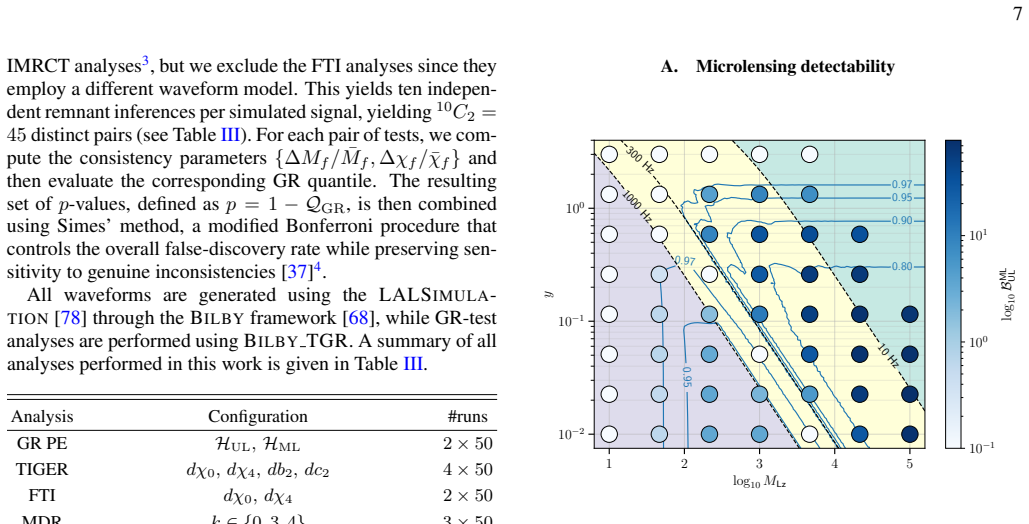
The central claim is that wave-optics gravitational microlensing is an unmodeled astrophysical systematic that can bias the standard suite of theory-agnostic tests of general relativity. For GW150914-like binaries lensed by point masses of 10 to 10^5 solar masses, recovering the signals with unlensed waveform families produces statistically significant false deviations from GR — up to about 4 sigma for parameterized and modified-dispersion tests and about 4.5 sigma for inspiral-merger-ringdown consistency and meta-consistency tests — despite the injections being fully GR. The effect is driven by diffraction: when the characteristic microlensing frequency falls where the signal carries power
What carries the argument
The analytical point-mass lens amplification factor — an exact wave-optics solution built from a confluent hypergeometric function — multiplies the unlensed frequency-domain waveform and imprints frequency-dependent amplitude and phase modulations. Its companion scale is the microlensing frequency, which separates the long-wavelength, wave-optics, and geometric-optics regimes. To compare tests with different numbers of deviation parameters, the paper introduces a unified significance statistic derived from the GR quantile — the posterior volume enclosed by the contour through the GR prediction — which maps to a Gaussian-equivalent number of sigma for both one- and two-dimensional deviation p
Load-bearing premise
The headline numbers rest on zero-noise, GW150914-like injections at a fixed network signal-to-noise ratio of 30 with a three-detector network; if real events differ in mass, spin, inclination, signal-to-noise ratio, or noise realization, the size and occurrence of the false deviations could change.
What would settle it
Repeat the injection and recovery for a specific wave-optics case (lens mass around 10^3 solar masses, impact parameter around 0.115 Einstein radii) with a different waveform family or sampler: the claimed bias of at least 4 sigma in the merger-phase deviation parameter should reproduce. Also rerun the 50-injection grid at network signal-to-noise ratios of 15 and 60; the GR-bias mechanism predicts the significance grows with signal-to-noise ratio, so a flat or inverted dependence would falsify it.
If this is right
- An unlensed recovery of a wave-optics-lensed GR signal can look like a 4 to 4.5-sigma GR violation in standard parameterized, dispersion, and consistency tests; such events would be misclassified as beyond-GR candidates.
- The false deviations appear only when diffraction modulations overlap the signal band; long-wavelength and geometric-optics lensing leave GR tests largely unaffected.
- Lensing detectability measured by Bayes factors is a poor veto: events with strong lensing support can show little GR bias, and weakly lensed events can show large bias.
- Running the same tests on an unlensed signal yields deviations no larger than about 0.7 sigma, so the pipelines themselves are not generating the apparent violations.
- For next-generation observatories with higher signal-to-noise ratios and higher-redshift sources, microlensing-induced biases will be a larger hazard, so propagation effects need to be included in waveform models or marginalized over.
Where Pith is reading between the lines
- Beyond the paper, the same diffraction mechanism could bias tests the authors did not run, such as ringdown-only tests or polarization tests, because those also depend on specific phase and amplitude projections of the waveform.
- Beyond the paper, the weak correlation with lensing detectability suggests that building a lensing veto into GR-violation searches will not clean the catalog; a more reliable safeguard would be joint inference over lens parameters or a population-level prior that accounts for the probability of lensing.
- Beyond the paper, if microlensing can mimic the dispersive phase of modified dispersion relations, current single-event bounds on graviton mass and Lorentz violation could be systematically overconfident whenever diffraction is present; a population stacking analysis would reveal this as a net offset.
- Beyond the paper, the 300 Hz threshold is source dependent, so the dangerous lens-mass range shifts with source mass; extending the grid to heavier or lighter binaries is a direct test of how common the bias is.
Editorial analysis
A structured set of objections, weighed in public.
Referee Report
Summary. The paper studies whether wave-optics gravitational microlensing of compact-binary GW signals can bias standard LVK null tests of general relativity. The authors generate 50 GW150914-like zero-noise injections lensed by isolated point masses across lens masses 10–10^5 M_sun and normalized impact parameters 0.01–3, then recover them with unlensed templates and run TIGER, FTI, modified-dispersion, IMRCT, and meta-IMRCT tests. They introduce a unified Gaussian-equivalent GR-deviation significance based on the GR quantile, Eq. (19). The main result is that apparent GR violations reaching the resolution-limited levels of roughly 4σ in 1D tests and 4.5σ in 2D tests occur only in the wave-optics regime, that these false deviations do not correlate strongly with microlensing Bayes factors, and that an unlensed baseline shows no deviations above 0.71σ. The paper concludes that wave-optics microlensing is an important astrophysical systematic for present and future GR tests.
Significance. If accepted, this is a valuable existence proof: an unmodeled, physically motivated propagation effect can masquerade as a statistically significant GR violation in several standard tests simultaneously. The study's strengths include the use of the analytical point-mass lensing amplification factor, a systematic comparison across many GR tests with a common significance measure, same-waveform-family injection/recovery to avoid waveform-model systematics, zero-noise injections to isolate lensing effects, and a clean unlensed baseline. The finding that lensing detectability does not predict GR-test bias is an important and nontrivial caution for observational analyses. However, the quantitative headline — ~4σ/4.5σ — is measured for a single source configuration and is censored by finite posterior sampling, so the paper's broader claim that microlensing is an 'important astrophysical systematic' needs either additional population-level support or a more cautious framing.
major comments (3)
- [Sec. III A / Appendix A / Sec. V] The headline 4–4.5σ biases are established for one representative source configuration: a GW150914-like binary with fixed network SNR=30, zero noise, and HLV at O5 sensitivity. The paper itself notes in Appendix A that the practical f_ML ~ 300 Hz threshold is source-dependent, and the injection grid is not an astrophysical population (Sec. III A). Thus the abstract's claim that the results 'establish wave-optics gravitational lensing as an important astrophysical systematic for present and future precision tests' goes beyond what the simulations demonstrate. The study is a clean existence proof, but the population-level importance — e.g., what fraction of realistic events would show >3σ biases — is untested. I recommend either adding a modest parameter sweep across total mass/SNR or revising the abstract and conclusions to say 'can produce' rather than implying a typical or frequent effe
- [Sec. IV B / Eq. (19) and surrounding text] The quoted values '~4σ' and '~4.5σ' are not measured maxima of the bias distribution; they are the largest significances resolvable with approximately 2×10^4 posterior samples, as the text states. This means the true biases may be larger, and the figures' markers at σ >= 4 are censored. Presenting the results as 'reaching ~4σ' in the abstract, when the actual posteriors often saturate the resolution limit, is misleading. Please report these as 'at least ~4σ' or 'exceeding the maximal resolvable significance,' and mark the censoring explicitly in Figs. 4–7. This is not a purely cosmetic issue because the magnitude of the effect is a central quantitative claim.
- [Sec. III D / Fig. 7] The meta-IMRCT result combines p-values from 10C2 = 45 pairwise tests that are not independent: all pairs are derived from the same 10 PE runs on the same data, and many posteriors overlap or are strongly correlated through shared source parameters. Simes' procedure is applied assuming a controlled false-discovery rate, but its validity for dependent p-values requires conditions (e.g., positive regression dependence) that are not checked. The claim that meta-IMRCT 'acts as a coherence test' and the specific numbers of events above 3σ in Fig. 7 could be affected by this correlation. Please either justify the applicability of Simes' combination to these highly correlated p-values or add an explicit caveat and a sensitivity check.
minor comments (4)
- [Sec. IV A / Fig. 1] The criterion for excluding 'strong-lensing' configurations — 'the relative time delay between multiple images exceeds the chirp time' — is mentioned but not formalized. Please define the exact condition used to exclude those injections.
- [Sec. III B] The sampler settings (nlive=1000, naccept=60) are modest for 16-dimensional parameter spaces. The authors note rerunning broader priors for a few injections, but a convergence diagnostic or effective-sample-size estimate for the GR deviation parameters would strengthen confidence in the reported σ_QGR values.
- [Sec. IV B / Sec. V] The claim that GR-test significance 'does not correlate strongly' with Bayes factors is based on visual scatter. A quantitative measure, such as a Spearman rank correlation with an uncertainty, would make the claim more precise and reproducible.
- [Throughout] There are a few typographical and grammar issues, e.g., 'microlensing as an astrophysical source of waveform systematics that can bias' in Sec. V. A careful proofread is recommended.
Circularity Check
No significant circularity: microlensing bias result follows from forward injection/recovery simulations, not from fitted parameters or self-citations.
full rationale
The derivation is self-contained. The lensing transfer function used to create injections is the standard point-mass wave-optics result (Eq. 2, from Takahashi & Nakamura 2003), an external analytical result independent of the paper's conclusions. The apparent GR deviations are measured by injecting fully GR-compatible lensed signals and recovering them with unlensed templates; the reported σ_QGR values are computed from the resulting posterior distributions via Eq. (19), not imposed by construction. No parameter is fit to the headline 4σ/4.5σ numbers and then 'predicted' as a deviation, so none of the six circularity patterns applies. The self-references [23] and [40] are prior-work context and a conventions/package reference, not load-bearing justifications. The finite-sampling cap on resolvable significance (~4.05σ/4.45σ) and the source-dependence caveat in Appendix A are explicitly stated limitations on generalizability/resolution, not circularity.
Axiom & Free-Parameter Ledger
axioms (5)
- domain assumption The point-mass lens amplification factor F(ω,y) in Eq. (2) correctly describes wave-optics microlensing.
- domain assumption The unlensed GR waveform models IMRPhenomXPHM and SEOBNRv4ROM are accurate for GW150914-like binaries.
- domain assumption The stationary Gaussian-noise likelihood and zero-noise injections isolate the lensing systematic.
- ad hoc to paper The conversion Eq. (19) from GR quantile Q_GR to Gaussian-equivalent σ is a valid common significance measure.
- domain assumption NR-calibrated fits [74–76] correctly map inferred binary parameters to remnant mass and spin.
read the original abstract
Gravitational-wave (GW) observations of compact binary mergers enable precision tests of general relativity (GR) in the strong-field regime, but their reliability depends on accurate waveform modeling. Unmodeled physical effects can induce systematic biases that mimic deviations from GR. Here we study the impact of GW microlensing on standard LIGO-Virgo-KAGRA tests of GR using GW150914-like simulated signals lensed by isolated point-mass objects with masses in the range $10-10^{5}M_\odot$. We perform Bayesian parameter estimation with unlensed waveform templates and quantify biases in parameterized tests, modified dispersion relation tests, the inspiral-merger-ringdown consistency test (IMRCT) and the meta-IMRCT framework. To compare these tests with a common discriminator, we introduce a unified GR-deviation significance statistic based on the GR quantile, applicable to both one- and multi-dimensional deviation parameters. We find that microlensing-induced waveform distortions can produce significant false deviations from GR, reaching $\sim4\sigma$ in one-dimensional tests and $\sim4.5\sigma$ in two-dimensional consistency tests, despite the injected signals being fully GR-compatible. These false deviations arise mainly in the wave-optics regime, where diffraction induces frequency-dependent amplitude and phase modulations, while signals in the long-wavelength and geometric-optics regimes remain largely consistent with GR. We also find that the significance of these apparent deviations does not correlate strongly with microlensing detectability as measured by Bayes factors, showing that GR tests probe waveform projections not captured by global lensing diagnostics. Our results establish wave-optics gravitational lensing as an important astrophysical systematic for present and future precision tests of GR and highlight the need to model propagation effects in next-generation GW analyses.
Figures


Reference graph
Works this paper leans on
-
[1]
K. G. Arun and A. Pai, Tests of General Relativity and Alterna- tive theories of gravity using Gravitational Wave observations, Int. J. Mod. Phys. D22, 1341012 (2013), arXiv:1302.2198 [gr- qc]
Pith/arXiv arXiv 2013
-
[2]
N. V . Krishnendu and F. Ohme, Testing General Relativity with Gravitational Waves: An Overview, Universe7, 497 (2021), arXiv:2201.05418 [gr-qc]
Pith/arXiv arXiv 2021
-
[3]
Yunes, X
N. Yunes, X. Siemens, and K. Yagi, Gravitational-wave tests of general relativity with ground-based detectors and pulsar- timing arrays, Living Rev. Rel.28, 3 (2025)
2025
-
[4]
B. P. Abbottet al.(LIGO Scientific, Virgo), GWTC-1: A Gravitational-Wave Transient Catalog of Compact Binary Mergers Observed by LIGO and Virgo during the First and Second Observing Runs, Phys. Rev. X9, 031040 (2019), arXiv:1811.12907 [astro-ph.HE]
Pith/arXiv arXiv 2019
-
[5]
R. Abbottet al.(LIGO Scientific, Virgo), GWTC-2: Compact Binary Coalescences Observed by LIGO and Virgo During the First Half of the Third Observing Run, Phys. Rev. X11, 021053 (2021), arXiv:2010.14527 [gr-qc]
Pith/arXiv arXiv 2021
-
[6]
R. Abbottet al.(LIGO Scientific, VIRGO), GWTC-2.1: Deep extended catalog of compact binary coalescences observed by LIGO and Virgo during the first half of the third observing run, Phys. Rev. D109, 022001 (2024), arXiv:2108.01045 [gr-qc]
Pith/arXiv arXiv 2024
-
[7]
R. Abbottet al.(KAGRA, VIRGO, LIGO Scientific), GWTC- 3: Compact Binary Coalescences Observed by LIGO and Virgo during the Second Part of the Third Observing Run, Phys. Rev. X13, 041039 (2023), arXiv:2111.03606 [gr-qc]
Pith/arXiv arXiv 2023
-
[8]
A. G. Abacet al.(LIGO Scientific, VIRGO, KAGRA), GWTC- 4.0: Updating the Gravitational-Wave Transient Catalog with Observations from the First Part of the Fourth LIGO-Virgo- KAGRA Observing Run, (2025), arXiv:2508.18082 [gr-qc]
Pith/arXiv arXiv 2025
-
[9]
A. G. Abacet al.(LIGO Scientific, VIRGO, KAGRA), GWTC- 5.0: An Introduction to Version 5.0 of the Gravitational-Wave Transient Catalog, (2026), arXiv:2605.27223 [gr-qc]
Pith/arXiv arXiv 2026
-
[10]
B. P. Abbottet al.(LIGO Scientific, Virgo), Tests of General Relativity with the Binary Black Hole Signals from the LIGO- Virgo Catalog GWTC-1, Phys. Rev. D100, 104036 (2019), arXiv:1903.04467 [gr-qc]
Pith/arXiv arXiv 2019
-
[11]
R. Abbottet al.(LIGO Scientific, Virgo), Tests of general rel- ativity with binary black holes from the second LIGO-Virgo gravitational-wave transient catalog, Phys. Rev. D103, 122002 (2021), arXiv:2010.14529 [gr-qc]
Pith/arXiv arXiv 2021
-
[12]
Abbottet al.(LIGO Scientific, VIRGO, KAGRA), Tests of General Relativity with GWTC-3, Phys
R. Abbottet al.(LIGO Scientific, VIRGO, KAGRA), Tests of General Relativity with GWTC-3, Phys. Rev. D112, 084080 (2025), arXiv:2112.06861 [gr-qc]
Pith/arXiv arXiv 2025
-
[13]
A. G. Abacet al.(LIGO Scientific, VIRGO, KAGRA), GWTC- 4.0: Tests of General Relativity. I. Overview and General Tests, (2026), arXiv:2603.19019 [gr-qc]
Pith/arXiv arXiv 2026
-
[14]
A. G. Abacet al.(LIGO Scientific, VIRGO, KAGRA), GWTC- 4.0: Tests of General Relativity. II. Parameterized Tests, (2026), arXiv:2603.19020 [gr-qc]
Pith/arXiv arXiv 2026
-
[15]
A. G. Abacet al.(LIGO Scientific, VIRGO, KAGRA), GWTC- 4.0: Tests of General Relativity. III. Tests of the Remnants, (2026), arXiv:2603.19021 [gr-qc]
Pith/arXiv arXiv 2026
-
[16]
A. Guptaet al., Possible causes of false general relativity vi- olations in gravitational wave observations 10.21468/SciPost- PhysCommRep.5 (2024), arXiv:2405.02197 [gr-qc]
Pith/arXiv arXiv 2024
-
[17]
P. Saini, M. Favata, and K. G. Arun, Systematic bias on parametrized tests of general relativity due to neglect of orbital eccentricity, Phys. Rev. D106, 084031 (2022), arXiv:2203.04634 [gr-qc]
Pith/arXiv arXiv 2022
-
[18]
S. A. Bhat, P. Saini, M. Favata, and K. G. Arun, Systematic bias on the inspiral-merger-ringdown consistency test due to ne- glect of orbital eccentricity, Phys. Rev. D107, 024009 (2023), arXiv:2207.13761 [gr-qc]
Pith/arXiv arXiv 2023
-
[19]
P. Narayan, N. K. Johnson-McDaniel, and A. Gupta, Ef- fect of ignoring eccentricity in testing general relativity with gravitational waves, Phys. Rev. D108, 064003 (2023), arXiv:2306.04068 [gr-qc]
Pith/arXiv arXiv 2023
-
[20]
M. A. Shaikh, S. A. Bhat, and S. J. Kapadia, A study of the inspiral-merger-ringdown consistency test with gravitational- wave signals from compact binaries in eccentric orbits, Phys. Rev. D110, 024030 (2024), arXiv:2402.15110 [gr-qc]
Pith/arXiv arXiv 2024
-
[21]
C. J. Moore, E. Finch, R. Buscicchio, and D. Gerosa, Test- ing general relativity with gravitational-wave catalogs: The in- sidious nature of waveform systematics, iScience24, 102577 (2021), arXiv:2103.16486 [gr-qc]
Pith/arXiv arXiv 2021
-
[22]
P. Narayan, N. K. Johnson-McDaniel, and A. Gupta, Effect of type II strong gravitational lensing on tests of general relativity, Phys. Rev. D113, 044007 (2026), arXiv:2412.13132 [gr-qc]
arXiv 2026
-
[23]
A. Mishra, N. V . Krishnendu, and A. Ganguly, Unveiling mi- crolensing biases in testing general relativity with gravitational 16 waves, Phys. Rev. D110, 084009 (2024), arXiv:2311.08446 [gr-qc]
Pith/arXiv arXiv 2024
-
[24]
Einstein, Lens-Like Action of a Star by the Deviation of Light in the Gravitational Field, Science84, 506 (1936)
A. Einstein, Lens-Like Action of a Star by the Deviation of Light in the Gravitational Field, Science84, 506 (1936)
1936
-
[25]
Zwicky, Nebulae as gravitational lenses, Phys
F. Zwicky, Nebulae as gravitational lenses, Phys. Rev.51, 290 (1937)
1937
-
[26]
L. Dai and T. Venumadhav, On the waveforms of gravitationally lensed gravitational waves, (2017), arXiv:1702.04724 [gr-qc]
Pith/arXiv arXiv 2017
-
[27]
J. M. Ezquiaga, D. E. Holz, W. Hu, M. Lagos, and R. M. Wald, Phase effects from strong gravitational lensing of gravitational waves, Phys. Rev. D103, 064047 (2021), arXiv:2008.12814 [gr-qc]
Pith/arXiv arXiv 2021
-
[28]
J. Janquart, E. Seo, O. A. Hannuksela, T. G. F. Li, and C. V . D. Broeck, On the Identification of Individual Gravitational-wave Image Types of a Lensed System Using Higher-order Modes, Astrophys. J. Lett.923, L1 (2021), arXiv:2110.06873 [gr-qc]
Pith/arXiv arXiv 2021
-
[29]
A. Vijaykumar, A. K. Mehta, and A. Ganguly, Detection and parameter estimation challenges of type-II lensed bi- nary black hole signals, Phys. Rev. D108, 043036 (2023), arXiv:2202.06334 [gr-qc]
Pith/arXiv arXiv 2023
-
[30]
T. T. Nakamura and S. Deguchi, Wave Optics in Gravitational Lensing, Prog. Theor. Phys. Suppl.133, 137 (1999)
1999
-
[31]
R. Takahashi and T. Nakamura, Wave effects in gravitational lensing of gravitational waves from chirping binaries, Astro- phys. J.595, 1039 (2003), arXiv:astro-ph/0305055
Pith/arXiv arXiv 2003
-
[32]
M. Agathos, W. Del Pozzo, T. G. F. Li, C. Van Den Broeck, J. Veitch, and S. Vitale, TIGER: A data analysis pipeline for testing the strong-field dynamics of general relativity with grav- itational wave signals from coalescing compact binaries, Phys. Rev. D89, 082001 (2014), arXiv:1311.0420 [gr-qc]
Pith/arXiv arXiv 2014
-
[33]
A. K. Mehta, A. Buonanno, R. Cotesta, A. Ghosh, N. Sennett, and J. Steinhoff, Tests of general relativity with gravitational- wave observations using a flexible theory-independent method, Phys. Rev. D107, 044020 (2023), arXiv:2203.13937 [gr-qc]
Pith/arXiv arXiv 2023
-
[34]
S. Mirshekari, N. Yunes, and C. M. Will, Constraining Generic Lorentz Violation and the Speed of the Graviton with Gravitational Waves, Phys. Rev. D85, 024041 (2012), arXiv:1110.2720 [gr-qc]
Pith/arXiv arXiv 2012
-
[35]
A. Ghosh, A. Ghosh, N. K. Johnson-McDaniel,et al., Testing general relativity using golden black-hole binaries, Phys. Rev. D94, 021101(R) (2016), arXiv:1602.02453 [gr-qc]
Pith/arXiv arXiv 2016
-
[36]
A. Ghosh, N. K. Johnson-Mcdaniel, A. Ghosh, C. K. Mishra, P. Ajith, W. Del Pozzo, C. P. L. Berry, A. B. Nielsen, and L. London, Testing general relativity using gravitational wave signals from the inspiral, merger and ringdown of bi- nary black holes, Class. Quant. Grav.35, 014002 (2018), arXiv:1704.06784 [gr-qc]
Pith/arXiv arXiv 2018
-
[37]
S. S. Madekar, N. K. Johnson-McDaniel, A. Gupta, and A. Ghosh, A meta inspiral–merger–ringdown consistency test of general relativity with gravitational wave signals from compact binaries, Class. Quant. Grav.42, 165011 (2025), arXiv:2405.05884 [gr-qc]
arXiv 2025
-
[38]
Schneider, J
P. Schneider, J. Ehlers, and E. E. Falco,Gravitational Lenses, Astronomy and Astrophysics Library (Springer, 1992)
1992
-
[39]
A. Liu, R. S. Chandramouli, O. A. Hannuksela, N. Yunes, and T. G. F. Li, Millilensing induced systematic biases in parametrized tests of general relativity, Phys. Rev. D112, 064043 (2025), arXiv:2410.21738 [gr-qc]
Pith/arXiv arXiv 2025
-
[40]
A. Mishra, A. K. Meena, A. More, and S. Bose, Exploring the impact of microlensing on gravitational wave signals: Biases, population characteristics, and prospects for detection, Mon. Not. Roy. Astron. Soc.531, 764 (2024), arXiv:2306.11479 [astro-ph.CO]
Pith/arXiv arXiv 2024
-
[41]
J. M. Diego, O. A. Hannuksela, P. L. Kelly, T. Broadhurst, K. Kim, T. G. F. Li, G. F. Smoot, and G. Pagano, Obser- vational signatures of microlensing in gravitational waves at LIGO/Virgo frequencies, Astron. Astrophys.627, A130 (2019), arXiv:1903.04513 [astro-ph.CO]
Pith/arXiv arXiv 2019
-
[42]
A. Mishra, A. K. Meena, A. More, S. Bose, and J. S. Bagla, Gravitational lensing of gravitational waves: effect of microlens population in lensing galaxies, Mon. Not. Roy. Astron. Soc. 508, 4869 (2021), arXiv:2102.03946 [astro-ph.CO]
Pith/arXiv arXiv 2021
-
[43]
Blanchet and B
L. Blanchet and B. S. Sathyaprakash, Signal analysis of gravi- tational wave tails, Class. Quant. Grav.11, 2807 (1994)
1994
-
[44]
Blanchet and B
L. Blanchet and B. S. Sathyaprakash, Detecting the tail effect in gravitational wave experiments, Phys. Rev. Lett.74, 1067 (1995)
1995
-
[45]
K. G. Arun, B. R. Iyer, M. S. S. Qusailah, and B. S. Sathyaprakash, Probing the non-linear structure of general rela- tivity with black hole binaries, Phys. Rev. D74, 024006 (2006), arXiv:gr-qc/0604067
Pith/arXiv arXiv 2006
-
[46]
K. G. Arun, B. R. Iyer, M. S. S. Qusailah, and B. S. Sathyaprakash, Testing post-Newtonian theory with gravita- tional wave observations, Class. Quant. Grav.23, L37 (2006), arXiv:gr-qc/0604018
Pith/arXiv arXiv 2006
-
[47]
N. Yunes and F. Pretorius, Fundamental Theoretical Bias in Gravitational Wave Astrophysics and the Parameterized Post- Einsteinian Framework, Phys. Rev. D80, 122003 (2009), arXiv:0909.3328 [gr-qc]
Pith/arXiv arXiv 2009
-
[48]
C. K. Mishra, K. G. Arun, B. R. Iyer, and B. S. Sathyaprakash, Parametrized tests of post-Newtonian theory using Advanced LIGO and Einstein Telescope, Phys. Rev. D82, 064010 (2010), arXiv:1005.0304 [gr-qc]
Pith/arXiv arXiv 2010
-
[49]
T. G. F. Li, W. Del Pozzo, S. Vitale, C. Van Den Broeck, M. Agathos, J. Veitch, K. Grover, T. Sidery, R. Sturani, and A. Vecchio, Towards a generic test of the strong field dynamics of general relativity using compact binary coalescence, Phys. Rev. D85, 082003 (2012), arXiv:1110.0530 [gr-qc]
Pith/arXiv arXiv 2012
-
[50]
T. G. F. Li, W. Del Pozzo, S. Vitale, C. Van Den Broeck, M. Agathos, J. Veitch, K. Grover, T. Sidery, R. Sturani, and A. Vecchio, Towards a generic test of the strong field dynamics of general relativity using compact binary coalescence: Fur- ther investigations, J. Phys. Conf. Ser.363, 012028 (2012), arXiv:1111.5274 [gr-qc]
Pith/arXiv arXiv 2012
-
[51]
J. Meidamet al., Parametrized tests of the strong-field dynam- ics of general relativity using gravitational wave signals from coalescing binary black holes: Fast likelihood calculations and sensitivity of the method, Phys. Rev. D97, 044033 (2018), arXiv:1712.08772 [gr-qc]
Pith/arXiv arXiv 2018
-
[52]
S. Roy, M. Haney, G. Pratten, P. T. H. Pang, and C. Van Den Broeck, Improved parametrized test of general relativity using the IMRPhenomX waveform family: Including higher harmonics and precession, Phys. Rev. D113, 024016 (2026), arXiv:2504.21147 [gr-qc]
arXiv 2026
-
[53]
A. Pai and K. G. Arun, Singular value decomposition in parametrised tests of post-Newtonian theory, Class. Quant. Grav.30, 025011 (2013), arXiv:1207.1943 [gr-qc]
Pith/arXiv arXiv 2013
-
[54]
C. M. Will, Bounding the mass of the graviton using gravita- tional wave observations of inspiralling compact binaries, Phys. Rev. D57, 2061 (1998), arXiv:gr-qc/9709011 [gr-qc]
Pith/arXiv arXiv 2061
-
[55]
A. Samajdar and K. G. Arun, Projected constraints on the dis- persion of gravitational waves using advanced ground- and space-based interferometers, Phys. Rev. D96, 104027 (2017), arXiv:1708.00671 [gr-qc]
Pith/arXiv arXiv 2017
-
[56]
L.-V .-K. S. Collaboration, Noise curves used for simulations in the update of the observing scenarios paper (2022)
2022
-
[57]
B. P. Abbottet al.(KAGRA, LIGO Scientific, Virgo), Prospects for observing and localizing gravitational-wave transients with 17 Advanced LIGO, Advanced Virgo and KAGRA, Living Rev. Rel.19, 1 (2016), arXiv:1304.0670 [gr-qc]
Pith/arXiv arXiv 2016
-
[58]
F. Acerneseet al.(VIRGO), Advanced Virgo: a second- generation interferometric gravitational wave detector, Class. Quant. Grav.32, 024001 (2015), arXiv:1408.3978 [gr-qc]
Pith/arXiv arXiv 2015
-
[59]
Capoteet al., Advanced LIGO detector performance in the fourth observing run, Phys
E. Capoteet al., Advanced LIGO detector performance in the fourth observing run, Phys. Rev. D111, 062002 (2025), arXiv:2411.14607 [gr-qc]
Pith/arXiv arXiv 2025
-
[60]
S. Soniet al.(LIGO), LIGO Detector Characterization in the first half of the fourth Observing run, Class. Quant. Grav.42, 085016 (2025), arXiv:2409.02831 [astro-ph.IM]
arXiv 2025
-
[61]
B. P. Abbottet al.(LIGO Scientific, Virgo), GW150914: First results from the search for binary black hole coales- cence with Advanced LIGO, Phys. Rev. D93, 122003 (2016), arXiv:1602.03839 [gr-qc]
Pith/arXiv arXiv 2016
-
[62]
L.-V . S. Collaboration, Gwtc-2.1: Deep extended catalog of compact binary coalescences observed by ligo and virgo during the first half of the third observing run - parameter estimation data release (2022)
2022
-
[63]
G. Prattenet al., Computationally efficient models for the dominant and subdominant harmonic modes of precess- ing binary black holes, Phys. Rev. D103, 104056 (2021), arXiv:2004.06503 [gr-qc]
Pith/arXiv arXiv 2021
-
[64]
J. Veitchet al., Parameter estimation for compact binaries with ground-based gravitational-wave observations using the LAL- Inference software library, Phys. Rev. D91, 042003 (2015), arXiv:1409.7215 [gr-qc]
Pith/arXiv arXiv 2015
-
[65]
D. S. Sivia and J. Skilling,Data Analysis: A Bayesian Tutorial, 2nd ed., Oxford Science Publications (Oxford University Press, Oxford, UK, 2006)
2006
-
[66]
Skilling, Nested sampling for general bayesian computation, Bayesian Analysis1, 833 (2006)
J. Skilling, Nested sampling for general bayesian computation, Bayesian Analysis1, 833 (2006)
2006
-
[67]
E. Thrane and C. Talbot, An introduction to Bayesian inference in gravitational-wave astronomy: parameter estimation, model selection, and hierarchical models, Publ. Astron. Soc. Austral. 36, e010 (2019), [Erratum: Publ.Astron.Soc.Austral. 37, e036 (2020)], arXiv:1809.02293 [astro-ph.IM]
Pith/arXiv arXiv 2019
-
[68]
G. Ashtonet al., BILBY: A user-friendly Bayesian inference library for gravitational-wave astronomy, Astrophys. J. Suppl. 241, 27 (2019), arXiv:1811.02042 [astro-ph.IM]
Pith/arXiv arXiv 2019
-
[69]
I. M. Romero-Shawet al., Bayesian inference for compact bi- nary coalescences with bilby: validation and application to the first LIGO–Virgo gravitational-wave transient catalogue, Mon. Not. R. Astron. Soc.499, 3295 (2020), arXiv:2006.00714 [astro-ph.IM]
Pith/arXiv arXiv 2020
-
[70]
J. S. Speagle, dynesty: a dynamic nested sampling package for estimating Bayesian posteriors and evidences, Mon. Not. Roy. Astron. Soc.493, 3132 (2020), arXiv:1904.02180 [astro- ph.IM]
Pith/arXiv arXiv 2020
-
[71]
T. A. Apostolatos, Search templates for gravitational waves from precessing, inspiraling binaries, Phys. Rev. D52, 605 (1995)
1995
-
[72]
N. Cornish, L. Sampson, N. Yunes, and F. Pretorius, Gravita- tional Wave Tests of General Relativity with the Parameterized Post-Einsteinian Framework, Phys. Rev. D84, 062003 (2011), arXiv:1105.2088 [gr-qc]
Pith/arXiv arXiv 2011
-
[73]
T. Baka, B. Cirok, K. Haris, J. Noller, and N. V . Krishnendu, Testing general relativity with gravitational waves: Improving and extending modified dispersion relation tests, Phys. Rev. D 113, 064064 (2026), arXiv:2511.00497 [gr-qc]
arXiv 2026
-
[74]
F. Hofmann, E. Barausse, and L. Rezzolla, The final spin from binary black holes in quasi-circular orbits, Astrophys. J. Lett. 825, L19 (2016), arXiv:1605.01938 [gr-qc]
Pith/arXiv arXiv 2016
-
[75]
J. Healy and C. O. Lousto, Remnant of binary black-hole merg- ers: New simulations and peak luminosity studies, Phys. Rev. D95, 024037 (2017), arXiv:1610.09713 [gr-qc]
Pith/arXiv arXiv 2017
-
[76]
X. Jim ´enez-Forteza, D. Keitel, S. Husa, M. Hannam, S. Khan, and M. P ¨urrer, Hierarchical data-driven approach to fitting nu- merical relativity data for nonprecessing binary black holes with an application to final spin and radiated energy, Phys. Rev. D95, 064024 (2017), arXiv:1611.00332 [gr-qc]
Pith/arXiv arXiv 2017
-
[77]
C. Hoy and V . Raymond, PESummary: the code agnostic Parameter Estimation Summary page builder, SoftwareX15, 100765 (2021), arXiv:2006.06639 [astro-ph.IM]
Pith/arXiv arXiv 2021
-
[78]
LIGO Scientific Collaboration, Virgo Collaboration, and KA- GRA Collaboration, LVK Algorithm Library - LALSuite, Free software (GPL) (2018)
2018
-
[79]
R. Bondarescu, H. Ubach, O. Bulashenko, and A. P. Lund- gren, Compact binaries through a lens: Silent versus de- tectable microlensing for the LIGO-Virgo-KAGRA gravita- tional wave observatories, Phys. Rev. D108, 084033 (2023), arXiv:2211.13604 [gr-qc]
Pith/arXiv arXiv 2023
-
[80]
J. C. L. Chan, E. Seo, A. K. Y . Li, H. Fong, and J. M. Ezquiaga, Detectability of lensed gravitational waves in matched-filtering searches, Phys. Rev. D111, 084019 (2025), arXiv:2411.13058 [gr-qc]
Pith/arXiv arXiv 2025
discussion (0)
Sign in with ORCID, Apple, or X to comment. Anyone can read and Pith papers without signing in.