REVIEW 3 major objections 4 minor 48 references
Bond reconstruction and vacancy clustering in monolayer silicon carbide from first principles
T0 review · 3 major / 4 minor · reviewed 2026-08-01 · deepseek-v4-flash
Pith's one-line read A four-vacancy cluster in monolayer silicon carbide acts as a stable infrared color center with a triplet ground state.
desk verdict Clean, honest DFT prediction of a new triplet color-center candidate in monolayer SiC; the main caveat is the unverified restricted cluster search, though the paper overclaims less than the stress test suggests. read the letter →
The pith
A machine-rendered reading of the paper's core claim, the machinery that carries it, and where it could break.
The reading
What carries the argument
The central mechanism is bond reconstruction around vacancy sites, analyzed by electron localization function topology and projected crystal-orbital Hamiltonian population (IpCOHP) descriptors, which together classify each near-defect bond as covalent, reconstructed, or dangling. On this basis, the paper constructs a restricted aggregation search starting from monovacancy seeds and removing or substituting atoms that carry dangling or reconstructed bonds, then ranks the resulting clusters by formation and binding energy. The stability and optical behavior of the VSi3VC cluster follow from the complete reconstruction of all silicon dangling bonds into bonds comparable in strength to bulk sili
What would settle it
An unbiased, exhaustive enumeration of all compact four-vacancy (and five-defect) configurations in monolayer silicon carbide would settle whether VSi3VC is truly the most stable aggregate; if any alternative geometry had a lower formation energy, the central claim would be overturned. Experimentally, the absence of a near-infrared emission near 0.52 eV with the predicted hyperfine and phonon sidebands in monolayer SiC samples would also contradict the prediction.
Extended reading notes
Core claim
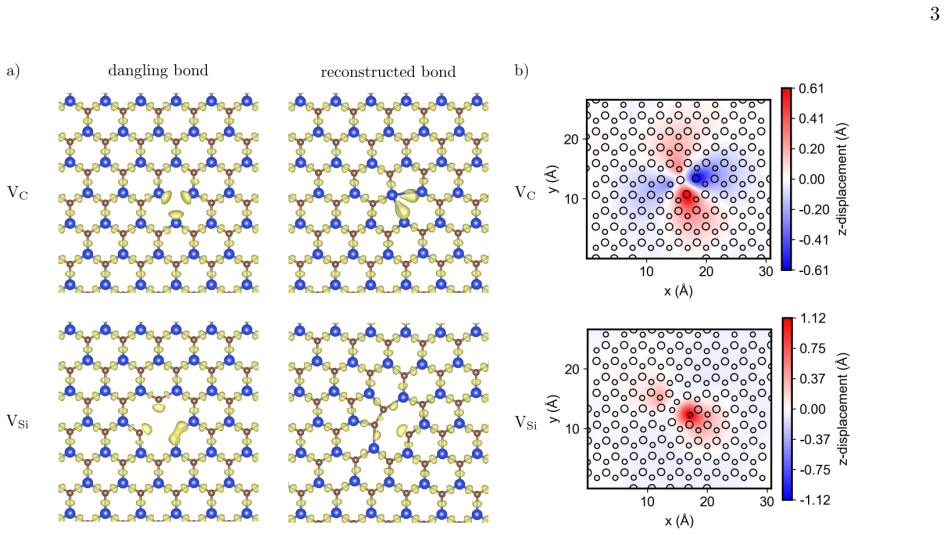
The paper's central claim is that the VSi3VC defect—one silicon vacancy surrounded by three carbon vacancies—is a thermodynamically favored, fully reconstructed compact vacancy cluster in monolayer silicon carbide. In its neutral charge state it has an S=1 (triplet) ground state originating from a half-filled doubly degenerate orbital; its first excited state is reached by an electric-dipole-allowed transition with a calculated transition dipole moment of 12.5 D and a zero-phonon line of 0.521 ± 0.003 eV after finite-size extrapolation. The defect also shows a total Huang-Rhys factor of 0.59 (Debye-Waller factor 0.55), two highly localized optically active vibrational modes near 89 and 101 m
Load-bearing premise
The search for stable vacancy clusters only examined geometries built by removing or substituting atoms that displayed dangling or reconstructed bonds around a starting monovacancy; if a lower-energy compact cluster exists outside this construction, the claimed stability of VSi3VC could be wrong.
Editorial extensions
If this is right
- A neutral, optically active, spin-triplet defect in monolayer SiC is available without deliberate doping, since the charge-state diagram gives a wide Fermi-level window for the neutral state.
- The 0.521 eV zero-phonon line and the two sharp localized vibrational modes at roughly 89 and 101 meV constitute a concrete optical signature for identifying VSi3VC in future experiments.
- The hyperfine parameters, especially the anisotropic couplings on the nearest silicon shell, provide a predicted spin-resonance fingerprint for qubit readout and quantum memory applications.
- Because single carbon vacancies are optically dark, future searches for color centers in monolayer SiC should focus on compact vacancy aggregates with full bond reconstruction.
- The aggregation-energy trend, which favors the VSi-plus-nVC path with a local minimum at n=3, suggests that elevated-temperature processing can naturally generate VSi3VC clusters.
Reading between the lines
- The same seed-and-aggregate construction might predict stable color centers in other honeycomb binary monolayers, but the paper does not demonstrate transferability.
- A small zero-field splitting of 214 MHz implies weak dipolar spin-spin interaction; applications requiring addressable spin states under modest magnetic fields may face practical challenges not discussed in the paper.
- If strain or electric fields can tune the 0.521 eV transition, the defect could connect to existing telecom or sensing platforms; this remains an untested extrapolation.
- Annealing electron-irradiated monolayer SiC while tracking the predicted 0.52 eV emission would provide a direct test of the aggregation scenario.
Signed reviews
Editorial analysis
A structured set of objections, weighed in public.
Referee Report
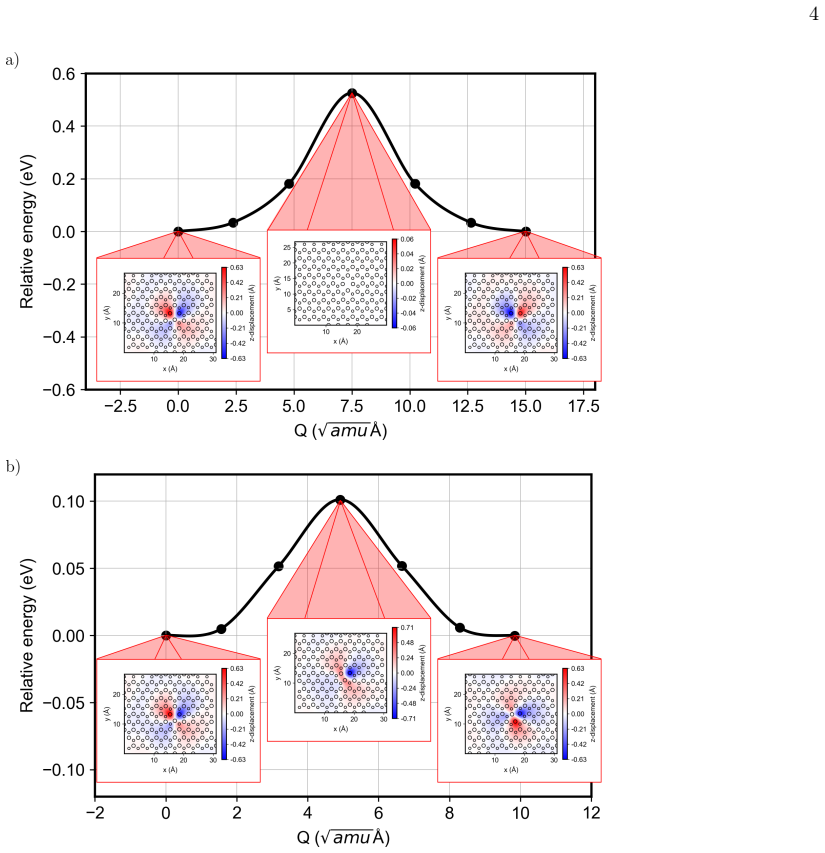
Summary. The paper uses DFT (PBE for structure search, phonons, and NEB; HSE06 for electronic and optical properties) to study bond reconstruction in monovacancy defects and compact vacancy clusters in monolayer SiC. It finds that bond reconstruction and out-of-plane distortions stabilize monovacancies, that the reconstructed C monovacancy is optically inactive due to a dissociative excited state, and that a compact cluster VSi3VC (three C vacancies around one Si vacancy) is a local minimum in the vacancy aggregation process, has a triplet ground state, a zero-phonon line at 0.521 eV, a Debye-Waller factor of 0.55, and characteristic hyperfine and vibrational fingerprints. The paper proposes VSi3VC as a promising infrared color-center and qubit defect candidate.
Significance. If the central claims hold, the paper identifies a new, computationally well-characterized defect candidate for quantum technology in a 2D material, with concrete experimental fingerprints (ZPL energy, hyperfine couplings, local vibration modes, Debye-Waller factor). The authors use standard, carefully described methods: HSE06 for electronic structure, PBE for phonons and NEB, 10x10 supercells, 20 Å vacuum, Freysoldt charge corrections, and a finite-size extrapolation for the ZPL. The phonon-sideband analysis and the use of ELF/IpCOHP to quantify bond reconstruction are strengths. The main weakness is the unvalidated restricted search space for vacancy clusters, which underpins the selection of VSi3VC as the preferred aggregate.
major comments (3)
- [§III B, Fig. 5] The vacancy-cluster search is restricted to configurations generated by removing or substituting atoms with dangling or reconstructed bonds around a monovacancy seed. The statement that 'we can safely assume that the resulting models sample the energetically most favorable structures' is not supported by any benchmark against an unbiased search or alternative construction. The central claim that VSi3VC is the thermodynamically preferred compact aggregate depends directly on this search completeness. If a lower-energy cluster not reachable by this construction exists, the stability proposal collapses. Please provide evidence of coverage, for example by enumerating all vacancy subsets within a cutoff radius for cluster sizes up to four, or by comparing with additional seed geometries, or explicitly reframe the conclusion as a claim within the constructed family.
- [§III B and Fig. 6] The search is restricted a priori to neutral charge states. While neutral stability ranges are later shown for selected candidates, the selection itself is made from neutral configurations only. Charged vacancy clusters could be lower in formation energy at relevant Fermi levels and could dominate aggregation products. The physical motivation (modelling an impurity-free insulating state) is reasonable, but it does not establish that neutral clusters are the only relevant ones. Please justify the neutral-only restriction more quantitatively, or discuss the possible impact of charged clusters on the stability ranking.
- [§III B, Fig. 5 vs §III C, Fig. 6] The initial screening of cluster formation and binding energies is performed at the PBE level, while the final electronic properties are HSE06. Relative energies of vacancy clusters can be functional-dependent. Since the selection of VSi3VC as the most favorable aggregate is based on the PBE minima in Fig. 5, it would be reassuring to see HSE06 total-energy calculations for the lowest-lying competing clusters (e.g., VSiVC, VSi2VC, and VC+nVC series near the minimum) to confirm that the PBE ranking is preserved. If HSE06 energies reorder the candidates, the central selection may change.
minor comments (4)
- [§III A] The text says 'in two interactions' in the description of chirality-swapping NEB calculations; this should presumably read 'iterations' or 'paths'.
- [§III C] The ZPL is reported as '0.521±0.003 eV' from the finite-size fit, with a later caveat that the actual method uncertainty can be 0.1 eV. The larger uncertainty should be presented alongside the headline value so that the predicted ZPL is not over-interpreted.
- [Fig. 4 and Fig. 5] The notation '3V C → VSi3VC' and 'VSi +nV C' is somewhat confusing; defining cluster composition explicitly in the caption or legend would improve readability.
- [General] Numerical formation and binding energies for VSi3VC are not explicitly given in the text or tables; reporting them would make the paper more self-contained and facilitate comparison with future work.
Circularity Check
No circularity: the reported defect properties are DFT outputs, not fitted targets.
full rationale
The derivation chain is self-contained first-principles computation. The VSi3VC defect is selected from a restricted but explicitly described vacancy-aggregation search using PBE formation and binding energies (Eqs. 1-2), and its spin, ZPL, hyperfine, and phonon parameters are then calculated with HSE06/PBE; none of these target quantities is used as an input or fit constraint. The ZPL is extrapolated to the infinite-supercell limit via a linear 1/N fit of the authors' own supercell results, a standard finite-size correction rather than a fit to experiment, and the paper states the method uncertainty is about 0.1 eV. The only flagged limitation is the Sec. III B assumption that seed-based removal/substitution "safely" samples the most favorable compact clusters; this bears on search completeness and robustness, not on circularity, because the paper's claims are computed, not folded back into the model definition. Self-citations to the author's earlier hBN and 2D-SiC work [4,13,26] are contextual or provide starting geometries that are recalculated and partly revised here; they do not carry the central derivation. No equation reduces to a fitted parameter or to a self-citation.
Assumptions & free parameters
free parameters (1)
- Zero-phonon-line finite-size intercept =
0.521 ± 0.003 eV
assumptions (5)
- domain assumption DFT with PBE/HSE06 functionals accurately describes the relative energies, spin states, and phonons of defect structures in monolayer SiC.
- domain assumption A 10x10 supercell with 20 Å vacuum and Γ-only sampling is sufficient for converged defect energetics and electronic structure.
- ad hoc to paper The restricted search space, built by removing/substituting atoms with dangling or reconstructed bonds around a monovacancy seed, contains the most favorable compact vacancy clusters.
- domain assumption Restricting the preliminary cluster search to the neutral charge state is valid for identifying the most stable aggregates.
- domain assumption The ∆SCF method with constrained orbital occupations describes the excited states relevant to optical transitions and non-radiative relaxation.
Cite this review
Pith. "Pith review of Bond reconstruction and vacancy clustering in monolayer silicon carbide from first principles." pith.science (2026). https://pith.science/paper/Y3RKBGNX
@misc{pith2026260716483,
  author       = {Pith},
  title        = {Pith review of: Bond reconstruction and vacancy clustering in monolayer silicon carbide from first principles},
  year         = {2026},
  howpublished = {\url{https://pith.science/paper/Y3RKBGNX}},
  note         = {Machine review of arXiv:2607.16483}
}
read the original abstract
Bond reconstruction in vacancy-related structures affects their formation energies, symmetries, and electronic and optical properties. Using density functional theory, we investigate bond reconstruction mechanisms of monovacancies and vacancy aggregates in monolayer silicon carbide. Multiple bond descriptors reveal that isolated monovacancies undergo both in-plane reconstruction and out-of-plane distortion, which together shape their stability and electronic structure. For compact vacancy aggregates, we show that bond reconstruction acts as a key stabilization mechanism. However, in carbon monovacancy, reconstruction suppresses optical activity. In contrast, a highly stable aggregate composed of three carbon vacancies surrounding a silicon vacancy emerges as a promising infrared color-center candidate, combining a triplet ground state with a favorable Debye-Waller factor of the emission. These results highlight the role of bond reconstruction in defining the quantum properties of vacancy defects in two-dimensional silicon carbide.
Figures

Figures from the paper (4 more)


Reference graph
Works this paper leans on
-
[1]
The first excited state of the defect is reached by promoting an electron to the unoccupiedA′′ 1 level
The half-filled double degenerate orbital results in theS= 1ground state. The first excited state of the defect is reached by promoting an electron to the unoccupiedA′′ 1 level. This transition is electric-dipole allowed, with a calculated TDM of 12.5 D. The excited state is Jahn-Teller (JT) unstable, and it is relaxed in C2v symmetry. For the cal- culati...
-
[2]
Xiaolong Liu and Mark C. Hersam. 2d materials for quantum information science.Nature Reviews Materials, 4(10):669–684, Oct 2019
2019
-
[3]
Montblanch, Matteo Barbone, Igor Aharonovich, Mete Atatüre, and Andrea C
Alejandro R.-P. Montblanch, Matteo Barbone, Igor Aharonovich, Mete Atatüre, and Andrea C. Ferrari. Lay- ered materials as a platform for quantum technologies. Nature Nanotechnology, 18(6):555–571, Jun 2023
2023
-
[4]
Spin defects in hbn as promising temperature, pressure and magnetic field quantum sen- sors.Nature Communications, 12(1):4480, Jul 2021
Andreas Gottscholl, Matthias Diez, Victor Soltamov, Christian Kasper, Dominik Krauße, Andreas Sperlich, Mehran Kianinia, Carlo Bradac, Igor Aharonovich, and Vladimir Dyakonov. Spin defects in hbn as promising temperature, pressure and magnetic field quantum sen- sors.Nature Communications, 12(1):4480, Jul 2021
2021
-
[5]
A planar defect spin sensor in a two-dimensional material susceptible to strain and electric fields.npj Computational Materials, 9(1):150, Aug 2023
Péter Udvarhelyi, Tristan Clua-Provost, Alrik Durand, JiahanLi, JamesH.Edgar, BernardGil, GuillaumeCass- abois, Vincent Jacques, and Adam Gali. A planar defect spin sensor in a two-dimensional material susceptible to strain and electric fields.npj Computational Materials, 9(1):150, Aug 2023
2023
-
[6]
Martin, Demid Sychev, Alexei S
Xiaohui Xu, Zachariah O. Martin, Demid Sychev, Alexei S. Lagutchev, Yong P. Chen, Takashi Taniguchi, Kenji Watanabe, Vladimir M. Shalaev, and Alexandra Boltasseva. Creating quantum emitters in hexagonal boron nitride deterministically on chip-compatible sub- strates.Nano Letters, 21(19):8182–8189, 2021. PMID: 34606291
2021
-
[7]
Nanoindentation for tailored single-photon emitters in hbn: Influence of annealing on defect stability.ACS Nano, 19(41):36302–36312, 2025
Safa L Ahmed, Lukas Harsch, Csongor Imre, Ioan- nis Karapatzakis, Luis Kussi, Jeremias Resch, Marcel Schrodin, Ines Häusler, Tolga Wagner, Christoph T Koch, Christoph Sürgers, and Wolfgang Wernsdorfer. Nanoindentation for tailored single-photon emitters in hbn: Influence of annealing on defect stability.ACS Nano, 19(41):36302–36312, 2025. PMID: 41063526
2025
-
[8]
Deterministic formation of carbon-functionalized quantum emitters in hexagonal boron nitride.Nature Communications, 16(1):11450, Dec 2025
Manlin Luo, Junyu Ge, Pengru Huang, Yi Yu, In Cheol Seo, Kunze Lu, Hao Sun, Jian Kwang Tan, Beng Kang Tay, Sejeong Kim, Weibo Gao, Hong Li, and Donguk Nam. Deterministic formation of carbon-functionalized quantum emitters in hexagonal boron nitride.Nature Communications, 16(1):11450, Dec 2025
2025
Show all 48 references
-
[9]
Carin Gavin, Hsun-Jen Chuang, Anushka Dasgupta, Moumita Kar, Kathleen M
S. Carin Gavin, Hsun-Jen Chuang, Anushka Dasgupta, Moumita Kar, Kathleen M. McCreary, Sung-Joon Lee, M. Iqbal Bakti Utama, Chunxi Zhou, Xiangzhi Li, George C. Schatz, Tobin J. Marks, Mark C. Hersam, Berend T. Jonker, and Nathaniel P. Stern. High- temperaturesingle-photonemissi...
2025
-
[10]
Defect engineering of two- dimensional transition metal dichalcogenides.2D Ma- terials, 3(2):022002, apr 2016
Zhong Lin, Bruno R Carvalho, Ethan Kahn, Ruitao Lv, Rahul Rao, Humberto Terrones, Marcos A Pimenta, and Mauricio Terrones. Defect engineering of two- dimensional transition metal dichalcogenides.2D Ma- terials, 3(2):022002, apr 2016
2016
-
[11]
Fu, and Kyeong- jae Cho
Yeonghun Lee, Yaoqiao Hu, Xiuyao Lang, Dongwook Kim, Kejun Li, Yuan Ping, Kai-Mei C. Fu, and Kyeong- jae Cho. Spin-defect qubits in two-dimensional transition metal dichalcogenides operating at telecom wavelengths. Nature Communications, 13(1):7501, Dec 2022
2022
-
[12]
Ford, Milos Toth, and Igor Aharonovich
Toan Trong Tran, Kerem Bray, Michael J. Ford, Milos Toth, and Igor Aharonovich. Quantum emission from hexagonal boron nitride monolayers.Nature Nanotech- nology, 11(1):37–41, Jan 2016
2016
-
[13]
Single photon sources in atomically thin materials.Annual Review of Physical Chemistry, 70(Volume 70, 2019):123–142, 2019
Milos Toth and Igor Aharonovich. Single photon sources in atomically thin materials.Annual Review of Physical Chemistry, 70(Volume 70, 2019):123–142, 2019
2019
-
[14]
Durand, T
A. Durand, T. Clua-Provost, F. Fabre, P. Kumar, J. Li, J. H. Edgar, P. Udvarhelyi, A. Gali, X. Marie, C. Robert, J. M. Gérard, B. Gil, G. Cassabois, and V. Jacques. Op- 9 tically active spin defects in few-layer thick hexagonal boron nitride.Phys. Rev. Lett., 131:116902, Sep 2023
2023
-
[15]
C. M. Polley, H. Fedderwitz, T. Balasubramanian, A. A. Zakharov, R. Yakimova, O. Bäcke, J. Ekman, S. P. Dash, S. Kubatkin, and S. Lara-Avila. Bottom-up growth of monolayer honeycomb sic.Phys. Rev. Lett., 130:076203, Feb 2023
2023
-
[16]
Controlled fabrication of freestanding monolayer sic by electron irradiation.Chinese Physics B, 33(8):086802, aug 2024
Yunli Da, Ruichun Luo, Bao Lei, Wei Ji, and Wu Zhou. Controlled fabrication of freestanding monolayer sic by electron irradiation.Chinese Physics B, 33(8):086802, aug 2024
2024
-
[17]
Bekaroglu, M
E. Bekaroglu, M. Topsakal, S. Cahangirov, and S. Ciraci. First-principles study of defects and adatoms in silicon carbide honeycomb structures.Phys. Rev. B, 81:075433, Feb 2010
2010
-
[18]
Yakobson
Zhiming Shi, Zhuhua Zhang, Alex Kutana, and Boris I. Yakobson. Predicting two-dimensional silicon carbide monolayers.ACS Nano, 9(10):9802–9809, 2015. PMID: 26394207
2015
-
[19]
Two-dimensional sil- icon carbide: Emerging direct band gap semiconductor
Sakineh Chabi and Kushal Kadel. Two-dimensional sil- icon carbide: Emerging direct band gap semiconductor. Nanomaterials, 10(11), 2020
2020
-
[20]
Neutral vacancy-defect-induced magnetism in sic mono- layer.Physica E: Low-dimensional Systems and Nanos- tructures, 42(9):2451–2454, 2010
Xiujie He, Tao He, Zhenhai Wang, and Mingwen Zhao. Neutral vacancy-defect-induced magnetism in sic mono- layer.Physica E: Low-dimensional Systems and Nanos- tructures, 42(9):2451–2454, 2010
2010
-
[21]
A. A. Kuzubov, N. S. Eliseeva, P. O. Krasnov, F. N. Tomilin, A. S. Fedorov, and A. V. Tolstaya. Calculating the energy of vacancies and adatoms in a hexagonal sic monolayer.Russian Journal of Physical Chemistry A, 86(7):1091–1095, Jul 2012
2012
-
[22]
Hassanzada, I
Q. Hassanzada, I. Abdolhosseini Sarsari, A. Hashemi, A. Ghojavand, A. Gali, and M. Abdi. Theoretical study of quantum emitters in two-dimensional silicon carbide monolayers.Phys. Rev. B, 102:134103, Oct 2020
2020
-
[23]
Mahendiran and P
D. Mahendiran and P. Murugan. The role of defects presenting in graphitic sic sheets and their consequences in the exfoliation of layers – a first principles approach. Physical Chemistry Chemical Physics, 24(7):4262–4269, 02 2022
2022
-
[24]
The structural, mechanical and electrical properties of 2d sic with c-related point defects and substitution of c by foreign atoms.Vacuum, 208:111700, 2023
Lingqin Huang, Haoyu Liu, Xuliang Deng, and Wenwen Cui. The structural, mechanical and electrical properties of 2d sic with c-related point defects and substitution of c by foreign atoms.Vacuum, 208:111700, 2023
2023
-
[25]
Defect-driven tunable electronic and optical proper- ties of two-dimensional silicon carbide.Phys
Arushi Singh, Vikram Mahamiya, and Alok Shukla. Defect-driven tunable electronic and optical proper- ties of two-dimensional silicon carbide.Phys. Rev. B, 108:235311, Dec 2023
2023
-
[26]
C W Oktavina, N Fajariah, M Fadlliyana, A D Nugra- heni, and Sholihun. New 5-6-6-5 (fourfold) and 5-9-6 defect configurations in g-sic (graphene-like hexagonal monolayer silicon carbide).Journal of Physics: Confer- ence Series, 2866(1):012037, oct 2024
2024
-
[27]
Mohseni, I
M. Mohseni, I. Abdolhosseini Sarsari, S. Karbasizadeh, Péter Udvarhelyi, Q. Hassanzada, T. Ala-Nissila, and A.Gali. Vacancy-relatedcolorcentersintwo-dimensional silicon carbide monolayers.Phys. Rev. Mater., 8:056201, May 2024
2024
-
[28]
First-principles investigation of point defects in two-dimensional sic as single-photon sources.Phys
Jijun Huang, Qiang Ke, and Xueling Lei. First-principles investigation of point defects in two-dimensional sic as single-photon sources.Phys. Rev. B, 112:085303, Aug 2025
2025
-
[29]
Mahfuzul Haque and Sajid Muhaimin Choudhury
Md. Mahfuzul Haque and Sajid Muhaimin Choudhury. Tailoring electronic and optoelectronic properties of 2d- sic via defects and doping: a first-principles study to- wardefficientwhitelight-emittingdiodes.RSC Advances, 15(36):29335–29366, 08 2025
2025
-
[30]
Kresse and J
G. Kresse and J. Hafner.Ab initiomolecular dynamics for liquid metals.Phys. Rev. B, 47:558–561, Jan 1993
1993
-
[31]
Kresse and J
G. Kresse and J. Furthmüller. Efficient iterative schemes forab initiototal-energy calculations using a plane-wave basis set.Phys. Rev. B, 54:11169–11186, Oct 1996
1996
-
[32]
Kresse and J
G. Kresse and J. Furthmüller. Efficiency of ab-initio total energy calculations for metals and semiconductors using a plane-wave basis set.Comput. Mater. Sci., 6(1):15 – 50, 1996
1996
-
[33]
Paier, M
J. Paier, M. Marsman, K. Hummer, G. Kresse, I. C. Ger- ber, and J. G. Ángyán. Screened hybrid density function- als applied to solids.J. Chem. Phys., 124(15):154709, 2006
2006
-
[34]
P. E. Blöchl. Projector augmented-wave method.Phys. Rev. B, 50:17953–17979, Dec 1994
1994
-
[35]
Kresse and D
G. Kresse and D. Joubert. From ultrasoft pseudopoten- tials to the projector augmented-wave method.Phys. Rev. B, 59:1758–1775, Jan 1999
1999
-
[36]
Johnson, and Graeme Henkelman
Daniel Sheppard, Penghao Xiao, William Chemelewski, Duane D. Johnson, and Graeme Henkelman. A general- ized solid-state nudged elastic band method.The Journal of Chemical Physics, 136(7):074103, 02 2012
2012
-
[37]
Uberuaga, and Hannes Jóns- son
Graeme Henkelman, Blas P. Uberuaga, and Hannes Jóns- son. A climbing image nudged elastic band method for finding saddle points and minimum energy paths. The Journal of Chemical Physics, 113(22):9901–9904, 12 2000
2000
-
[38]
Perdew, Kieron Burke, and Matthias Ernzerhof
John P. Perdew, Kieron Burke, and Matthias Ernzerhof. Generalized gradient approximation made simple.Phys. Rev. Lett., 77:3865–3868, Oct 1996
1996
-
[39]
Krukau, Oleg A
Aliaksandr V. Krukau, Oleg A. Vydrov, Artur F. Izmaylov, and Gustavo E. Scuseria. Influence of the exchange screening parameter on the performance of screened hybrid functionals.J. Chem. Phys., 125(22):224106, 2006
2006
-
[40]
Richard Dronskowski and Peter E. Bloechl. Crystal or- bital hamilton populations (cohp): energy-resolved visu- alization of chemical bonding in solids based on density- functional calculations.The Journal of Physical Chem- istry, 97(33):8617–8624, 1993
1993
-
[41]
Deringer, Geoffroy Hautier, and Richard Dronskowski
RykyNelson, ChristinaErtural, JanineGeorge, VolkerL. Deringer, Geoffroy Hautier, and Richard Dronskowski. Lobster: Local orbital projections, atomic charges, and chemical-bonding analysis from projector-augmented- wave-based density-functional theory.Journal of Com- putational...
1931
-
[42]
Deringer, Andrei L
Volker L. Deringer, Andrei L. Tchougréeff, and Richard Dronskowski. Crystal orbital hamilton population (cohp) analysis as projected from plane-wave basis sets.The Journal of Physical Chemistry A, 115(21):5461–5466,
-
[43]
Van de Walle
Christoph Freysoldt, Jörg Neugebauer, and Chris G. Van de Walle. Fully ab initio finite-size corrections for charged-defect supercell calculations.Phys. Rev. Lett., 102:016402, Jan 2009
2009
-
[44]
First- principles calculations for charged defects at surfaces, in- terfaces, and two-dimensional materials in the presence of electric fields.Phys
Christoph Freysoldt and Jörg Neugebauer. First- principles calculations for charged defects at surfaces, in- terfaces, and two-dimensional materials in the presence of electric fields.Phys. Rev. B, 97:205425, May 2018
2018
-
[45]
Yihuang Xiong and Geoffroy Hautier.δscf inVASPfor excited-statedefectcomputations: tipsandpitfalls, 2025. 10
2025
-
[46]
Vasp band unfolding.https://github
Qujing Zheng. Vasp band unfolding.https://github. com/QijingZheng/VaspBandUnfolding
-
[47]
Koichi Momma and Fujio Izumi.VESTA3for three- dimensional visualization of crystal, volumetric and morphology data.Journal of Applied Crystallography, 44(6):1272–1276, Dec 2011
2011
-
[48]
Silvi and A
B. Silvi and A. Savin. Classification of chemical bonds based on topological analysis of electron localization functions.Nature, 371(6499):683–686, Oct 1994
1994
Reviewed August 1, 2026 · model on record in the stance chip above.
Discussion (0). Continue with ORCID to comment.