REVIEW 3 major objections 5 minor 48 references
This paper claims that in a cooperative multi-agent RL benchmark, role-decodable representation geometry follows direct observation of role identity, not the choice between individual and shared rewards, and that reward attribution shows up
Reviewed by Pith at T0; open to challenge. T0 means a machine referee read the full paper against a public rubric. the ladder, T0–T4 →
2026-08-01 20:42 UTC pith:MVQDM5AH
load-bearing objection A useful negative result with an honest confound warning, but the masked-baseline residual and thin statistics mean the strongest claim needs more evidence before it should be relied on. the 3 major comments →
Feedback Attribution and Representation Geometry: Metrics for Comparing Individual and Shared Rewards in MARL
The pith
A machine-rendered reading of the paper's core claim, the machinery that carries it, and where it could break.
Core claim
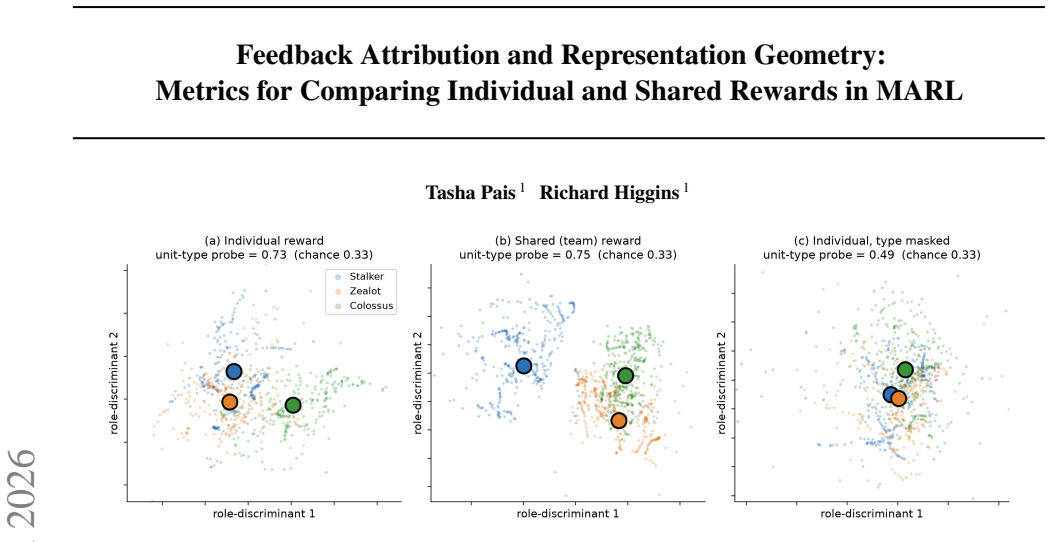
In SMACv2 protoss_5_vs_5 with a fully shared GRU policy, the paper finds that role-geometry in the encoder is explained by the observation, not by reward attribution. Individual damage-contribution reward and shared team reward yield statistically similar EffRank/n (0.29±0.02 vs 0.31±0.03) and unit-type probe accuracy (0.73±0.05 vs 0.75±0.05), while D_act leans higher under individual reward (1.23±0.06 vs 1.07±0.20). When each agent's own unit-type bits are masked, the probe drops to 0.49 in both reward arms, only about 0.16 above chance, and the role clusters merge; individual reward still improves behavior (win rate 0.39±0.02 vs 0.24±0.07 and higher D_act) but does not recover the geometry
What carries the argument
The diagnostics are EffRank/n, the effective rank of the per-agent time-averaged embedding centroids normalized by agent count, and D_act, the mean pairwise KL divergence between agents' action distributions. The role probe is a logistic classifier fit on the frozen encoder's embeddings with leave-one-agent-slot-out cross-validation, checking whether role labels generalize across slots. Together these are meant to separate observation-driven role geometry from reward-attribution-driven specialization in a shared encoder.
Load-bearing premise
Masking each agent's own unit-type bits is assumed to remove direct role observation without otherwise altering the learning problem, but unit type still leaks through dynamics such as speed and attack range, so the masked conditions do not fully isolate reward-driven geometry from observation-driven geometry.
What would settle it
Train the same four conditions but additionally mask all unit-type-correlated features (speed, attack range, and weapon cooldowns) beyond the type bits; if probe accuracy under individual reward stays at chance level (1/3) while D_act still rises, the paper's claim that geometry follows observation is confirmed, and if probe stays above chance only under individual reward, reward-driven geometry exists.
If this is right
- Role-decode probe accuracy in MARL cannot be read as evidence of reward-driven specialization unless the role identity is not present in the observation.
- Shared team reward does not necessarily compress a shared encoder below the dimensionality needed for role separation, at least in this benchmark.
- Behavioral diagnostics such as D_act and win rate are more sensitive than embedding geometry to the individual-vs-shared reward choice.
- Future tests of credit-assignment effects on representations should use persistent roles that are hidden from observation.
- EffRank/n and D_act are cheap enough (under 5% overhead) to include as routine diagnostics in large-scale MARL training.
Where Pith is reading between the lines
- If this observation-dominates-geometry result generalizes, some earlier findings of role-decodable representations in shared-reward MARL could be detecting input features rather than emergent specialization.
- The residual masked probe of 0.49, above the chance level of 1/3, leaves room for a weak reward-driven geometric effect, but the masking ablation is confounded by unit-type leakage through dynamics; masking speed and attack-range features would cleanly separate the two.
- The win-rate gap between masked individual (0.39) and masked shared (0.24) suggests individual rewards better maintain competence when role information is removed; a natural extension is to test whether persistent but hidden roles let reward attribution rebuild geometry over time.
- Since D_act moves while EffRank/n does not, action diversity may be the more direct carrier of attribution effects; comparing trajectory-level entropy or mutual information between agent actions could sharpen this behavioral signal.
Editorial analysis
A structured set of objections, weighed in public.
Referee Report
Summary. This paper introduces two low-overhead diagnostics—EffRank/n (effective rank of per-agent embedding centroids normalized by agent count) and D_act (mean pairwise KL divergence of action distributions)—intended to compare representation geometry and behavioral diversity under individual versus shared reward in multi-agent RL. The main experiment is a 2x2 design in SMACv2 protoss_5_vs_5: unit type observed versus masked, crossed with individual damage-contribution reward versus shared team reward, using a single fully shared MAPPO policy. The headline result is that the unit-type probe and EffRank/n are nearly identical across reward arms when unit type is observed (probe 0.73 vs 0.75; EffRank/n 0.29 vs 0.31), that masking unit type reduces probe accuracy to 0.49 in both arms, and that D_act and win rate lean higher under individual reward. The paper concludes that on SMACv2 the observation, not reward attribution, explains the role geometry, and that reward attribution shows up mainly in behavior. A smaller 48-agent Tribal Village experiment is included. The writing is appropriately hedged and the limitation of the masked residual is acknowledged, but not controlled.
Significance. The potential contribution is a useful caution: role-decoding probes can be confounded by directly observed role features, so geometric diagnostics must include an observation mask or hidden-role condition. The 2x2 design and leave-one-agent-slot-out probe are clear strengths, and the proposed metrics are cheap to compute. However, the evidence as presented is not yet sufficient. The central 'behavior, not geometry' conclusion depends on the unmeasured interpretation of the masked-probe residual, and the behavioral differences are not statistically established. The paper would be significantly stronger with an observation-level probe control, significance tests, and a positive control for EffRank/n sensitivity.
major comments (3)
- [Sec. 5, Table 2] The manuscript's main conclusion—that 'observation explains the geometry and reward attribution shows up mainly in behavior'—rests on interpreting the masked-probe residual (0.49 in both arms vs. 1/3 chance) as leakage of unit type through dynamics such as speed and attack range. No control measures this leakage. If a linear probe fit to the masked observation features (or to a randomly initialized policy under the same masked observations) already yields ~0.49, the interpretation is supported; if not, the residual could reflect reward-driven geometry. Because the masked arms also differ in win rate (0.39±0.02 vs. 0.24±0.07), the arms are not matched on competence, making the coincidental 0.49-vs.-0.49 comparison hard to interpret. This is a load-bearing gap.
- [Sec. 5, Tables 1 and 2] The claim that individual rewards improve behavior is based on D_act and win rate. In Table 1, D_act is 1.23±0.06 vs. 1.07±0.20; in Table 2 masked D_act is 1.13±0.08 vs. 0.98±0.18. These uncertainties are large relative to the differences, and observed win rates also overlap (0.48±0.18 vs. 0.39±0.07). No significance tests, effect sizes, or per-seed values are reported. With three seeds and 32 evaluation episodes per seed, the behavioral difference is not firmly established. The paper should report bootstrapped confidence intervals for the difference or a paired test before asserting 'mainly in behavior.'
- [Sec. 3, Eq. (1); Sec. 5] EffRank/n is proposed as a diagnostic for role collapse, but in all four SMACv2 conditions it is essentially flat (0.29–0.31) while the probe varies from 0.75 to 0.49. Without a positive control—e.g., a deliberately collapsed encoder or single-action policy where EffRank/n is known to drop—it is unclear whether the metric would detect the collapse the paper is designed to measure. As presented, all geometric conclusions rest on the probe accuracy, not on EffRank/n. Please add a validation/ablation or explicitly demote EffRank/n to a screening metric.
minor comments (5)
- [Eq. (2)] The normalization in the D_act equation appears garbled; it should be 1 / C(n,2), i.e., one over the binomial coefficient.
- [Abstract] The phrase 'both ≫1/3 chance' is too strong given the reported standard deviation of 0.05; 'well above' would be more accurate.
- [Figure 1] Please specify the projection method (e.g., LDA, PCA) and clarify whether the centroids are computed on the three fitting slots or the two held-out slots; the caption should also define 'per-timestep embeddings' versus the time-averaged centroids used for EffRank/n.
- [Sec. 5, Tribal Village] The contribution-group classifier results (0.820 vs. 0.873) are reported without a chance level, training details, or a table; this makes the 48-agent result hard to interpret.
- [Throughout] No code or data availability statement and no full hyperparameter list are provided; this limits reproducibility of the proposed diagnostics.
Circularity Check
No significant circularity: the diagnostic metrics are measurements, the probe is validated on held-out agent slots, and the paper explicitly owns its observation confound.
full rationale
The paper's claims stand on direct measurements, not on parameters fitted to the outcome being explained. EffRank/n is computed from singular values of GRU embeddings (Eq. 1) and D_act from action distributions (Eq. 2); neither is fit to reward-arm results. The role probe is a logistic regression, but validation is leave-one-agent-slot-out ('the probe must generalize unit-type information to agent slots not used for fitting'), so probe accuracy is an out-of-sample measurement rather than a fitted input repackaged as a prediction. The central finding — that masking unit type drops the probe while reward attribution moves behavior — is an experimental result that could have gone the other way; the paper even notes its own prior expectation ('If reward attribution drives the observed role geometry, shared reward should erase or weaken it') was falsified for geometry. The paper explicitly identifies the main confound ('Above-chance accuracy still has to be read against observation: if role identity was observed, decoding it does not prove a reward-attribution effect') and flags the masked-condition caveat ('plausibly because unit type leaks through dynamics such as speed and attack range, but the three clusters merge toward one another'). The unresolved questions — how much of the 0.49 masked probe is observation leakage and whether the 0.39 vs 0.24 masked win-rate gap confounds reward-arm comparisons — are empirical validity and interpretation risks, not circular reductions: no equation or fitted quantity is equivalent by construction to the conclusions drawn. There are no load-bearing self-citations (the reference list contains no author-overlapping work), no imported uniqueness theorems, and no ansatz smuggled via citation. The derivation chain is self-contained against an external benchmark (SMACv2), so per the stated criteria the honest finding is no significant circularity.
Axiom & Free-Parameter Ledger
free parameters (5)
- MAPPO training hyperparameters
- Probe logistic-regression hyperparameters
- EffRank/n centroid time-averaging window
- D_act action-availability filter
- Individual reward scaling
axioms (6)
- domain assumption SMACv2 unit type is the relevant role label and is encoded in each agent's observation through unit-type bits.
- domain assumption Zeroing each agent's own unit-type bits removes direct role observation without otherwise changing the learning problem.
- domain assumption Fully shared MAPPO policy with no agent-specific parameters forces any role structure to live inside the shared encoder.
- domain assumption Switching only reward attribution (individual damage contribution vs shared team reward) isolates the attribution effect.
- ad hoc to paper EffRank/n ceiling of k/n for clean role representation and values near 1/n indicate collapse.
- standard math Linear probe with leave-one-agent-slot-out validation measures decodable role information.
Cite this review
Pith. "Pith review of Feedback Attribution and Representation Geometry: Metrics for Comparing Individual and Shared Rewards in MARL." pith.science (2026). https://pith.science/paper/MVQDM5AH
@misc{pith2026260716524,
  author       = {Pith},
  title        = {Pith review of: Feedback Attribution and Representation Geometry: Metrics for Comparing Individual and Shared Rewards in MARL},
  year         = {2026},
  howpublished = {\url{https://pith.science/paper/MVQDM5AH}},
  note         = {Machine review of arXiv:2607.16524}
}
read the original abstract
Cooperative multi-agent RL systems routinely use team-averaged rewards, a feedback-attribution choice that gives each agent the team outcome regardless of its individual contribution. We ask whether this leaves a measurable signature, geometric or behavioral, on learned representations. We propose EffRank/$n$ (effective rank normalized by agent count) and $D_\text{act}$ (mean pairwise KL divergence between agents' action distributions) as low-overhead diagnostics for reward-attribution effects, then test them on competent MAPPO agents in SMACv2 \texttt{protoss\_5\_vs\_5}, where unit type is encoded in the observation. In an observation $\times$ reward-attribution comparison (unit type observed vs.\ masked; individual damage-contribution reward vs.\ shared team reward), geometry follows observation rather than reward. With unit type observed, shared and individual rewards have similar EffRank/$n$ ($0.31{\pm}0.03$ vs.\ $0.29{\pm}0.02$) and probe accuracy ($0.75{\pm}0.05$ vs.\ $0.73{\pm}0.05$, both $\gg 1/3$ chance), while $D_\text{act}$ leans higher under individual rewards ($1.23{\pm}0.06$ vs.\ $1.07{\pm}0.20$). Masking unit type cuts the above-chance probe signal by more than half, to $0.49$ in both reward arms. In short: individually rewarded agents are competent and separable by role, but on SMACv2 the observation explains the geometry and reward attribution shows up mainly in behavior. Thus geometric diagnostics must control for observed role information and test persistent roles that are not directly observed. EffRank/$n$ and $D_\text{act}$ add $<$5\% overhead.
Figures


Reference graph
Works this paper leans on
-
[1]
Advances in Neural Information Processing Systems , volume=
The Surprising Effectiveness of PPO in Cooperative Multi-Agent Games , author=. Advances in Neural Information Processing Systems , volume=
-
[2]
International Conference on Machine Learning , pages=
QMIX: Monotonic Value Function Factorisation for Deep Multi-Agent Reinforcement Learning , author=. International Conference on Machine Learning , pages=. 2018 , organization=
2018
-
[3]
Advances in Neural Information Processing Systems , volume=
Multi-Agent Actor-Critic for Mixed Cooperative-Competitive Environments , author=. Advances in Neural Information Processing Systems , volume=
-
[4]
International Conference on Learning Representations , year=
High-Dimensional Continuous Control Using Generalized Advantage Estimation , author=. International Conference on Learning Representations , year=
-
[5]
arXiv preprint arXiv:2212.07489 , year=
SMACv2: An Improved Benchmark for Cooperative Multi-Agent Reinforcement Learning , author=. arXiv preprint arXiv:2212.07489 , year=
-
[6]
2025 , howpublished=
MettaGrid: A Multi-Agent Grid Environment for Emergent Coordination , author=. 2025 , howpublished=
2025
-
[7]
arXiv preprint arXiv:2112.04716 , year=
DR3: Value-Based Deep Reinforcement Learning Requires Explicit Regularization , author=. arXiv preprint arXiv:2112.04716 , year=
-
[8]
arXiv preprint arXiv:1707.09183 , year=
A Survey of Learning in Multiagent Environments: Dealing with Non-Stationarity , author=. arXiv preprint arXiv:1707.09183 , year=
-
[9]
Proceedings of the 17th International Conference on Autonomous Agents and MultiAgent Systems , pages=
Value-Decomposition Networks For Cooperative Multi-Agent Learning Based On Team Reward , author=. Proceedings of the 17th International Conference on Autonomous Agents and MultiAgent Systems , pages=
-
[10]
Proceedings of the AAAI Conference on Artificial Intelligence , volume=
Counterfactual Multi-Agent Policy Gradients , author=. Proceedings of the AAAI Conference on Artificial Intelligence , volume=
-
[11]
arXiv preprint arXiv:2003.08039 , year=
ROMA: Multi-Agent Reinforcement Learning with Emergent Roles , author=. arXiv preprint arXiv:2003.08039 , year=
Pith/arXiv arXiv 2003
-
[12]
Advances in Neural Information Processing Systems , volume=
MAVEN: Multi-Agent Variational Exploration , author=. Advances in Neural Information Processing Systems , volume=
-
[13]
arXiv preprint arXiv:2006.07869 , year=
Benchmarking Multi-Agent Deep Reinforcement Learning Algorithms in Cooperative Tasks , author=. arXiv preprint arXiv:2006.07869 , year=
Pith/arXiv arXiv 2006
-
[14]
arXiv preprint arXiv:2012.03542 , year=
A Survey of Multi-Agent Reinforcement Learning with Communication , author=. arXiv preprint arXiv:2012.03542 , year=
Pith/arXiv arXiv 2012
-
[15]
International Conference on Machine Learning , pages=
Mean Field Multi-Agent Reinforcement Learning , author=. International Conference on Machine Learning , pages=
-
[16]
arXiv preprint arXiv:1810.09202 , year=
Graph Convolutional Reinforcement Learning , author=. arXiv preprint arXiv:1810.09202 , year=
-
[17]
International Conference on Machine Learning , pages=
Off-Belief Learning , author=. International Conference on Machine Learning , pages=. 2021 , organization=
2021
-
[18]
International Conference on Learning Representations , year=
Discovering Diverse Multi-Agent Strategic Behavior via Reward Randomization , author=. International Conference on Learning Representations , year=
-
[19]
Advances in Neural Information Processing Systems , volume=
Deep Reinforcement Learning at the Edge of the Statistical Precipice , author=. Advances in Neural Information Processing Systems , volume=
-
[20]
Proceedings of the AAAI Conference on Artificial Intelligence , volume=
Deep Reinforcement Learning That Matters , author=. Proceedings of the AAAI Conference on Artificial Intelligence , volume=
-
[21]
International Conference on Machine Learning , pages=
A Simple Framework for Contrastive Learning of Visual Representations , author=. International Conference on Machine Learning , pages=. 2020 , organization=
2020
-
[22]
arXiv preprint arXiv:1807.03748 , year=
Representation Learning with Contrastive Predictive Coding , author=. arXiv preprint arXiv:1807.03748 , year=
-
[23]
International Conference on Machine Learning , pages=
CURL: Contrastive Unsupervised Representations for Reinforcement Learning , author=. International Conference on Machine Learning , pages=. 2020 , organization=
2020
-
[24]
International Conference on Machine Learning , pages=
Decoupling Representation Learning from Reinforcement Learning , author=. International Conference on Machine Learning , pages=. 2021 , organization=
2021
-
[25]
International Conference on Machine Learning , pages=
The Dormant Neuron Phenomenon in Deep Reinforcement Learning , author=. International Conference on Machine Learning , pages=. 2023 , organization=
2023
-
[26]
Nature , volume=
Loss of Plasticity in Deep Continual Learning , author=. Nature , volume=
-
[27]
Proceedings of the AAAI Conference on Artificial Intelligence , year=
Attention-Guided Contrastive Role Representations for Multi-Agent Reinforcement Learning , author=. Proceedings of the AAAI Conference on Artificial Intelligence , year=
-
[28]
Han, Haolin and Gu, Pengqin and Jiang, Chao and Lu, Zhengcai and Peng, Bei , booktitle=
-
[29]
Suarez, Joseph and Du, Yilun and Zhu, Clare and Mordatch, Igor and Isola, Phillip , booktitle=. Neural
-
[30]
The Neural
Suarez, Joseph and Bhatt, Siddhartha and others , journal=. The Neural
-
[31]
2007 15th European Signal Processing Conference , pages=
The effective rank: A measure of effective dimensionality , author=. 2007 15th European Signal Processing Conference , pages=. 2007 , organization=
2007
-
[32]
arXiv preprint arXiv:2602.06476 , year=
PRISM: Spectral Parameter Sharing for Multi-Agent Reinforcement Learning , author=. arXiv preprint arXiv:2602.06476 , year=
-
[33]
Suarez, Joseph and Du, Yilun and Isola, Phillip and Mordatch, Igor , journal=. Neural
-
[34]
Proceedings of the 18th International Conference on Autonomous Agents and MultiAgent Systems , pages=
The StarCraft Multi-Agent Challenge , author=. Proceedings of the 18th International Conference on Autonomous Agents and MultiAgent Systems , pages=
-
[35]
International Conference on Machine Learning , pages=
Policy Diagnosis via Measuring Role Diversity in Cooperative Multi-Agent Reinforcement Learning , author=. International Conference on Machine Learning , pages=. 2022 , organization=
2022
-
[36]
Journal of Machine Learning Research , volume=
System Neural Diversity: Measuring Behavioral Heterogeneity in Multi-Agent Learning , author=. Journal of Machine Learning Research , volume=
-
[37]
Advances in Neural Information Processing Systems , volume=
Celebrating Diversity in Shared Multi-Agent Reinforcement Learning , author=. Advances in Neural Information Processing Systems , volume=
-
[38]
Advances in Neural Information Processing Systems , volume=
Shared Experience Multi-Agent Reinforcement Learning , author=. Advances in Neural Information Processing Systems , volume=
-
[39]
Low-Rank Agent-Specific Adaptation (
Zhang, Beining and Kapoor, Aditya and Sun, Mingfei , journal=. Low-Rank Agent-Specific Adaptation (
-
[40]
Michael Downes and Barbara Beeton , organization =. The
-
[41]
Cristophe Fiorio , year = 2015, month = oct, note =
2015
-
[42]
The algorithms bundle , author =
-
[43]
The Listings Package , author =
-
[44]
Publication quality tables in
Simon Fear , year = 2005, month = apr, note =. Publication quality tables in
2005
-
[45]
The subcaption package , author =
-
[46]
A package to create a nomenclature , author =
-
[47]
User Manual for glossaries.sty v4.44 , author =
-
[48]
David Carlisle , month = oct, year = 2004, note =. The
2004
This paper was first reviewed by deepseek-v4-flash on August 1, 2026.
discussion (0)
Sign in with ORCID, Apple, or X to comment. Anyone can read and Pith papers without signing in.