REVIEW 4 major objections 6 minor 36 references
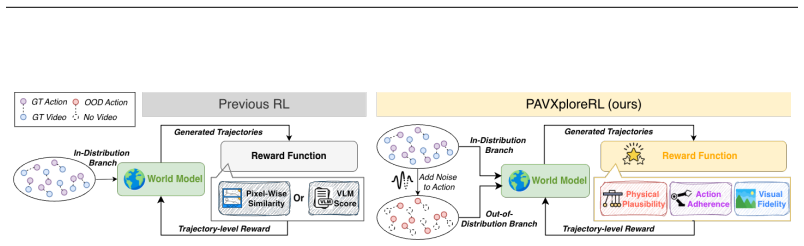
Action-conditioned world models get better as policy simulators when post-trained with reinforcement learning that explicitly rewards physical plausibility, action adherence, and visual fidelity.
Reviewed by Pith at T0; open to challenge. T0 means a machine referee read the full paper against a public rubric. the ladder, T0–T4 →
T0 review · deepseek-v4-flash
2026-08-01 20:26 UTC pith:GVNCXMYH
load-bearing objection A useful RL post-training recipe for action-conditioned world models, but the headline PAV gains are partly an artifact of rewarding and evaluating with the same VJEPA-2 model. the 4 major comments →
PAVXploreRL: Physical-Action-Visual World Model Reinforcement Learning with Action Exploration
The pith
A machine-rendered reading of the paper's core claim, the machinery that carries it, and where it could break.
Core claim
The paper's central claim is that explicit, reward-driven optimization of Physical Plausibility, Action Adherence, and Visual Fidelity—rather than implicit pixel-level reconstruction—is what an action-conditioned world model needs to generalize beyond expert data. The authors build a world model from a video diffusion backbone with action conditioning and history frames, supervise-fine-tune it, then post-train with RL. The reward uses three signals: an encoder-based VJEPA-2 similarity for in-distribution pairs, a predictor-based VJEPA-2 latent forecast for out-of-distribution actions where ground-truth frames are unavailable, and a battery of no-reference visual fidelity metrics; a static-mo
What carries the argument
The load-bearing mechanism is the reward function built on a fine-tuned, action-conditioned VJEPA-2 latent video model, which provides supervision without ground-truth frames: for in-distribution trajectories the encoder compares predicted and real latents, and for out-of-distribution actions the predictor forecasts the future latent from the start frame and actions, with a static-motion penalty. A parallel embodiment-focused branch, computed on robot-segmented frames, targets action adherence explicitly. The world model itself is a video diffusion model with action embeddings injected via adaptive layer normalization and history frames compressed by a Framepack strategy; RL updates only the
Load-bearing premise
The paper's load-bearing premise is that the fine-tuned VJEPA-2 latent model is a trustworthy judge of physical plausibility and action adherence, so that increasing its similarity scores constitutes genuine world-model improvement rather than optimization of a learned proxy.
What would settle it
A concrete check: gather human or real-robot assessments of world-model rollouts and compare them with VJEPA-2 reward rankings; if VJEPA-2 gives high scores to videos that humans or physical sensors judge as implausible or non-adherent, or if the world model's policy success estimates diverge from real-robot outcomes after RL, the reward is being gamed and the central claim fails.
If this is right
- Post-training with the PAV reward improves visual quality, flow consistency, and VJEPA-based losses on both Agibot and DROID, with an average 5.6% gain over the pretrained model.
- World models trained with OOD action exploration yield policy success estimates closer to real-world rollouts and reduce overestimation bias relative to expert-only models like Ctrl-World.
- The method works from a single view and does not require paired videos for OOD actions, so it can be applied to unseen actions generated by perturbing expert trajectories.
- Moderate OOD exploration (αOOD around 0.05) is optimal; larger proportions degrade performance.
- Because RL updates only the action encoder and LoRA parameters on a frozen base model, the pipeline is model-agnostic and can be applied to other world model architectures.
Where Pith is reading between the lines
- If VJEPA-2's physical understanding is general, this approach could make learned simulators trustworthy enough to replace a fraction of real-robot rollouts in policy development; the reward-model dependence also raises a reward-hacking risk that the authors do not directly test.
- The paper's own stated limitations—long training time and lack of multi-view consistency—suggest the next natural experiments are to pair this RL reward with multi-view or physics-constrained world models, and to test whether the reward can be optimized without the heavy RL phase.
- The static-motion regularization findings hint that without an explicit anchor, latent-similarity rewards collapse toward static outputs; a similar collapse could occur for other object permanence violations not captured by VJEPA-2.
- A direct testable extension would be to use the same reward function to post-train a world model on tasks with sparse rewards or long horizons, where overestimation bias is most damaging.
Editorial analysis
A structured set of objections, weighed in public.
Referee Report
Summary. The paper proposes PAVXploreRL, a reinforcement-learning post-training method for action-conditioned world models. It builds on a pretrained video-diffusion world model (Wan2.2-TI2V-5B with action conditioning) and fine-tunes VJEPA-2 on robot data to provide latent rewards for physical plausibility, action adherence, and visual fidelity. The reward function combines pixel-level metrics, VJEPA encoder/predictor losses, embodiment-focused VJEPA rewards, and a reference-free visual-fidelity reward. Training uses both in-distribution action-video pairs and out-of-distribution (OOD) actions generated by perturbing expert actions, without paired video supervision. Experiments on Agibot and DROID report consistent gains over the pretrained baseline (5.6% average improvement across benchmarks) and a policy-evaluation experiment showing reduced overestimation compared to Ctrl-World. The paper claims that RL post-training explicitly optimizes PAV objectives and yields higher-quality PAV properties.
Significance. If the central claim holds, the paper would provide a practical recipe for improving action-conditioned world models as policy evaluators, which is an important problem in embodied AI. The paper has several concrete strengths: it releases code, performs ablations over reward components and coefficients, reports validation curves showing that RL gains are not from additional SFT alone, and includes an independent (if small) real-robot/world-model correlation experiment. The policy-evaluation result (Fig. 4) is encouraging and less affected by the reward-evaluation overlap. However, the headline claim of 'higher-quality PAV properties' rests on metrics that are largely the same VJEPA-2 losses used as rewards, so the significance of that specific claim is currently not established.
major comments (4)
- [§3.2, Eq. (7)–(10); Table 1] The central claim of improved Physical Plausibility and Action Adherence is supported by metrics that are partly circular. r_VJEPA-E (Eq. 7) and r_VJEPA-P (Eq. 8) are negative L1 distances in the same VJEPA-2 embedding space used for the reward, and Table 1 reports 'VJEPA Loss Enc/Pred' as evaluation metrics. Improving those metrics during RL is expected by construction. The non-circular metrics in Table 1 (PSNR, SSIM, LPIPS, EPE, COS) do improve, but they measure low-level visual and optical-flow fidelity, not physical plausibility or action adherence. Without an external yardstick — e.g., human evaluation, object-permanence/contact-consistency checks, or inverse-dynamics action reconstruction — the paper's strongest claim is unsupported. Please provide independent evidence or soften the claim accordingly.
- [Table 1; §4.3, Fig. 4] No error bars, confidence intervals, or significance tests are reported for any quantitative result. In Table 1, several differences are small (e.g., VJEPA Enc loss 0.524→0.521 on Agibot; SSIM 0.812 vs 0.793 on DROID), and without variance over validation clips or training seeds it is unclear whether these are robust. The VLA evaluation uses only 10 episodes per task across 5 tasks, and Fig. 4 reports no uncertainty. Given that the main claims rely on modest average gains, the absence of variance reporting is load-bearing.
- [Appendix A.5, Table 5; §4.2] The reward-coefficient selection is performed on an offline diagnostic (assigning highest reward to GT video among 12 variants) rather than on the actual RL objective. In the best configuration the diagnostic accuracy is only 82%, meaning the reward function misranks GT video in 18% of cases. Moreover, the same validation distribution is used to select coefficients and to report main results, so there is a risk of selection bias. Since λ_static=0.8, λ_emb=0.5, λ_VF=0.1 are chosen from this diagnostic and then fixed for the full 5K-step RL, the paper should demonstrate that these choices also optimize the final RL evaluation metrics, or provide a held-out validation split for coefficient selection.
- [§1, Conclusion; §4 title] The paper calls the method 'model-agnostic' and 'general,' but experiments use a single base world model (Wan2.2-TI2V-5B) and a single reward evaluator (VJEPA-2 fine-tuned on the same robot datasets). The claim of model-agnosticism is not tested. Please either test on a second architecture or restrict the claim to the demonstrated setting.
minor comments (6)
- [References] Several references are self-citations or unpublished preprints with incomplete author lists (e.g., 'rew, 2026', 'Wang et al., 2026a', 'min, 2026'). Please provide full citations and DOIs where available.
- [§4.3] The list of five tasks duplicates numbering: '(4) stack-bowls (purple) and (4) stack-bowls (beige)' should be (4) and (5).
- [Table 2 header] The header 'VJPEA-' is a typo for 'VJEPA-'.
- [Appendix A.4] The text refers to 'Figure 4' for the ablation table, but the table is Table 4.
- [General notation] The abbreviation 'PA V' appears with inconsistent spacing throughout (e.g., 'PA V' vs 'PAV'). Please standardize.
- [§3.2, Eq. (4)] The Bernoulli-like sampling scheme with α_OOD = 0.05 is not described in terms of how the random draw is scheduled; later ablations vary α_OOD but not the schedule. Clarify whether the sampling is i.i.d. per rollout or per optimization step.
Circularity Check
PAV improvements are partly measured with the same VJEPA-2 objective used as the RL reward, so the headline PAV gain is partially circular.
specific steps
-
fitted input called prediction
[Section 3.2, Eqs. (8)-(11); Section 4 evaluation; Table 1 ('VJEPA Loss' rows)]
"rVJEPA-P(A) =− E( ˆIt∈(i,i+T] )−P E(Ii), At∈[i,i+T) 1 ... rOOD = (1−λ VF)r VJEPA-P +λ VF rVF ... We further report VJEPA-2-based losses, including encoder loss under GT actions and predictor loss under the same suboptimal actions."
The OOD RL branch is trained to maximize rVJEPA-P, which is the negative L1 distance between the world model's encoded predictions and VJEPA-2's action-conditioned latent prediction. Table 1 then reports 'VJEPA Loss Enc↓/Pred↓' as evidence of improved PAV properties. The Pred row is exactly the quantity the OOD reward maximizes, and the Enc row matches the ID reward rVJEPA-E from Eq. (7). Thus the reported improvement on these rows is enforced by the training objective rather than being independent evidence of physical plausibility or action adherence.
-
self definitional
[Section 2 (PAV evaluation) and Section 4.1/Conclusion]
"To align with our task, we train an action-conditioned VJEPA-2 (Assran et al., 2025) on our robot data and use it to measure the physical plausibility. ... To maintain consistency, we use the embodiment segmentation strategy of (Chi et al., 2025) to adapt the action-conditioned VJEPA-2 to explicitly measure alignment between robot motion and actions."
The paper operationalizes the P and A properties using the same VJEPA-2 model that supplies the RL rewards: physical plausibility is 'measured' by action-conditioned VJEPA-2 and action adherence by the embodiment-adapted VJEPA-2. The conclusion that RL produces 'superior physical plausibility, action adherence' is therefore a self-consistency check between the reward model and its own metric. The offline diagnostic in Appendix A.5 shows this judge is imperfect (best GT-selection accuracy 82%), so the overlap is not a harmless technicality.
full rationale
The paper does contain genuine independent content: the pixel-level and flow metrics (PSNR, SSIM, LPIPS, EPE, COS) improve after RL, and those are not the optimized VJEPA losses. The VLA evaluator experiment (Fig. 4) is also partly independent, since it compares world-model rollouts against real-world rollouts and shows reduced overestimation. However, the paper's strongest central claim—'producing higher-quality PAV properties'—is not independently validated. The P and A components are quantitatively judged by VJEPA-2-based losses, and those losses are the same quantities that the RL reward maximizes (Eqs. 7-11). The visual-fidelity component is the only PAV pillar measured with non-circular metrics, and even that is combined with VJEPA rewards during training. The absence of an external physical metric (object permanence, contact consistency, inverse-dynamics action reconstruction) or human study means the PAV claim rests in part on reward/evaluation overlap. This is partial circularity rather than full circularity, because the non-VJEPA metrics and the real-world VLA comparison provide independent supporting evidence.
Axiom & Free-Parameter Ledger
free parameters (7)
- alpha_OOD =
0.05
- lambda_VJEPA =
0.2
- lambda_VF =
0.1
- lambda_static =
0.8
- lambda_emb =
0.5
- OOD perturbation amplitudes =
temporal shift +/-0.6s, magnitude bias +/-0.15, Gaussian noise sigma=0.02
- motion threshold for non-static segments
axioms (5)
- domain assumption VJEPA-2 latent prediction accurately reflects physical plausibility
- ad hoc to paper The unified linear reward (Eq. 11) with group-level normalization (Eq. 6) induces the intended PAV trade-off
- domain assumption The three OOD perturbations produce behaviorally distinct suboptimal actions representative of real policy failures
- domain assumption DiffusionNFT implicit denoising targets (Eq. 2-3) provide valid RL updates for this diffusion world model
- domain assumption Embodiment-only segmentation (GroundingDINO+SAM) isolates the robot sufficiently for action-adherence scoring
read the original abstract
Action-conditioned world models are a key component of embodied AI, serving as scalable policy evaluators that reduce reliance on expensive real-world rollouts. To accurately capture diverse action-induced dynamics, such models should satisfy three key objectives-Physical Plausibility (P), Action Adherence (A), and Visual Fidelity (V), collectively referred to as PAV-while remaining robust to both in-distribution (ID) expert demonstrations and out-of-distribution (OOD) actions. However, existing methods primarily rely on ID action-video pairs and pixel-level reconstruction losses, which do not explicitly optimize PAV objectives and generalize poorly beyond expert data. To address this, we propose PAVXploreRL, a reinforcement learning framework built on a pretrained latent world model that explicitly optimizes PAV objectives through reward-driven training. To improve action generalization, our method jointly leverages ID trajectories and noise-driven OOD action exploration, without paired video supervision. Experiments show that PAVXploreRL consistently outperforms pretrained baselines, achieving a 5.6% average gain across benchmarks and producing higher-quality PAV properties. As a policy evaluator, it also yields more reliable performance estimates and reduces the overestimation bias of prior expert-only world models such as Ctrl-World. Code: https://github.com/Social-AI-Studio/PAVXploreRL
Figures


Reference graph
Works this paper leans on
-
[4]
Homanga Bharadhwaj, Debidatta Dwibedi, Abhinav Gupta, Shubham Tulsiani, Carl Doersch, Ted Xiao, Dhruv Shah, Fei Xia, Dorsa Sadigh, and Sean Kirmani. Gen2act: Human video generation in novel scenarios enables generalizable robot manipulation.arXiv preprint arXiv:2409.16283,
-
[5]
Q. Bu, J. Cai, L. Chen, X. Cui, Y . Ding, S. Feng, J. Zhu, et al. Agibot world colosseo: A large-scale manipulation platform for scalable and intelligent embodied systems.arXiv preprint arXiv:2503.06669,
-
[6]
Y . Chen, R. Chen, D. Huo, Y . Yang, D. Qi, H. Liu, et al. Abot-physworld: Interactive world foun- dation model for robotic manipulation with physics alignment.arXiv preprint arXiv:2603.23376,
-
[7]
Wow: Towards a world omniscient model through embodied interaction.arXiv preprint arXiv:2509.22642,
Xiaowei Chi, Peidong Jia, Chun-Kai Fan, Xiaozhu Ju, Weishi Mi, Kevin Zhang, Zhiyuan Qin, Wanxin Tian, Kuangzhi Ge, Hao Li, and et al. Wow: Towards a world omniscient model through embodied interaction.arXiv preprint arXiv:2509.22642,
-
[8]
Yao Feng, Hengkai Tan, Xinyi Mao, Guodong Liu, Shuhe Huang, Chendong Xiang, Hang Su, and Jun Zhu. Vidar: Embodied video diffusion model for generalist bimanual manipulation.arXiv preprint arXiv:2507.12898,
-
[9]
Gigaworld-0: World models as data engine to empower embodied ai.arXiv preprint arXiv:2511.19861,
10 Team G., Ye A., Wang B., Ni C., Huang G., Zhao G., Zhu Z., and et al. Gigaworld-0: World models as data engine to empower embodied ai.arXiv preprint arXiv:2511.19861,
-
[10]
Chongkai Gao, Haozhuo Zhang, Zhixuan Xu, Zhehao Cai, and Lin Shao. Flip: Flow-centric genera- tive planning as a general-purpose manipulation world model.arXiv preprint arXiv:2412.08261,
-
[11]
S. Gao, W. Liang, K. Zheng, A. Malik, S. Ye, S. Yu, et al. Dreamdojo: A generalist robot world model from large-scale human videos.arXiv preprint arXiv:2602.06949,
-
[12]
Quentin Garrido, Nicolas Ballas, Mahmoud Assran, Adrien Bardes, Laurent Najman, Michael Rab- bat, others, and Yann LeCun. Intuitive physics understanding emerges from self-supervised pre- training on natural videos.arXiv preprint arXiv:2502.11831,
-
[13]
Y . Guo, L. X. Shi, J. Chen, and C. Finn. Ctrl-world: A controllable generative world model for robot manipulation.arXiv preprint arXiv:2510.10125,
-
[15]
Z. Jiang, S. Zhou, Y . Jiang, Z. Huang, M. Wei, Y . Chen, ..., and D. Zhao. Wovr: World models as reliable simulators for post-training vla policies with rl.arXiv preprint arXiv:2602.13977,
-
[16]
Droid: A large-scale in-the-wild robot manipulation dataset.arXiv preprint arXiv:2403.12945,
Alexander Khazatsky, Karl Pertsch, Suraj Nair, Ashwin Balakrishna, Sudeep Dasari, Siddharth Karamcheti, Soroush Nasiriany, Mohan Kumar Srirama, Lawrence Yunliang Chen, Kirsty El- lis, et al. Droid: A large-scale in-the-wild robot manipulation dataset.arXiv preprint arXiv:2403.12945,
-
[17]
Segment anything.arXiv preprint arXiv:2304.02643,
Alexander Kirillov, Eric Mintun, Nikhila Ravi, Hanzi Mao, Chloe Rolland, Laura Gustafson, Tete Xiao, Spencer Whitehead, Alexander C Berg, Wan-Yen Lo, Piotr Doll ´ar, and Ross Girshick. Segment anything.arXiv preprint arXiv:2304.02643,
-
[19]
Junbang Liang, Ruoshi Liu, Ege Ozguroglu, Sruthi Sudhakar, Achal Dave, Pavel Tokmakov, Shuran Song, and Carl V ondrick. Dreamitate: Real-world visuomotor policy learning via video genera- tion.arXiv preprint arXiv:2406.16862,
-
[20]
Yue Liao, Pengfei Zhou, Siyuan Huang, Donglin Yang, Shengcong Chen, Yuxin Jiang, Yue Hu, Jingbin Cai, Si Liu, Jianlan Luo, and et al. Genie envisioner: A unified world foundation platform for robotic manipulation.arXiv preprint arXiv:2508.05635,
-
[21]
URLhttps://openreview.net/forum? id=DS5qRs0tQz. D. McAllister, S. Ge, B. Yi, C. M. Kim, E. Weber, H. Choi, and A. Kanazawa. Flow matching policy gradients.arXiv preprint arXiv:2507.21053,
-
[23]
A. K. Sharma, Y . Sun, N. Lu, Y . Zhang, J. Liu, and S. Yang. World-gymnast: Training robots with reinforcement learning in a world model.arXiv preprint arXiv:2602.02454,
-
[24]
Anypos: Automated task-agnostic actions for bimanual manipulation.arXiv preprint arXiv:2507.12768,
Hengkai Tan, Yao Feng, Xinyi Mao, Shuhe Huang, Guodong Liu, Zhongkai Hao, Hang Su, and Jun Zhu. Anypos: Automated task-agnostic actions for bimanual manipulation.arXiv preprint arXiv:2507.12768,
-
[25]
R. Team, Z. Gao, Q. Wang, Y . Zeng, J. Zhu, K. L. Cheng, ..., and H. Ouyang. Advancing open-source world models.arXiv preprint arXiv:2601.20540,
-
[26]
T. Wan, A. Wang, B. Ai, B. Wen, C. Mao, C. W. Xie, others, and Z. Liu. Wan: Open and advanced large-scale video generative models.arXiv preprint arXiv:2503.20314, 2025a. Team Wan, Ang Wang, Baole Ai, Bin Wen, Chaojie Mao, Chen-Wei Xie, Di Chen, Feiwu Yu, Haiming Zhao, Jianxiao Yang, and et al. Wan: Open and advanced large-scale video generative models.arX...
-
[28]
G. Ye, Boyuan Wang, Chaojun Ni, Guan Huang, Guosheng Zhao, Haoyun Li, Jie Li, Jia- gang Zhu, Lv Feng, Peng Li, Qiuping Deng, Runqi Ouyang, Wenkang Qin, Xinze Chen, Xi- aofeng Wang, Yang Wang, Yifan Li, Yilong Li, Yiran Ding, Yuan Xu, Yun Ye, Yukun Zhou, Zhehao Dong, Zhenan Wang, Zhichao Liu, and Zheng Zhu. Gigabrain-0: A world model- powered vision-langua...
-
[29]
semanticscholar.org/CorpusID:282272674
URLhttps://api. semanticscholar.org/CorpusID:282272674. S. Ye, Y . Ge, K. Zheng, S. Gao, S. Yu, G. Kurian, others, and J. Jang. World action models are zero-shot policies.arXiv preprint arXiv:2602.15922,
-
[30]
J. Yuan, X. Zhang, F. Friedrich, N. Beltran-Velez, M. Hall, R. Askari-Hemmat, ..., and A. Romero- Soriano. Inference-time physics alignment of video generative models with latent world models. arXiv preprint arXiv:2601.10553,
-
[31]
12 J. Zhang, Z. Huang, C. Gu, Z. Ma, and L. Zhang. Reinforcing action policies by prophesying.arXiv preprint arXiv:2511.20633, 2025a. Jiahui Zhang, Ze Huang, Chun Gu, Zipei Ma, and Li Zhang. Reinforcing action policies by proph- esying.ArXiv, abs/2511.20633, 2025b. URLhttps://api.semanticscholar.org/ CorpusID:283250621. Jianke Zhang, Yanjiang Guo, Yucheng...
-
[32]
Z. Zhang, H. Ren, Y . Sun, Y . Sheng, H. Wang, H. Lin, ..., and Y . Yu. Towards practical world model-based reinforcement learning for vision-language-action models.arXiv preprint arXiv:2603.20607, 2026b. Qingqing Zhao, Yao Lu, Moo Jin Kim, Zipeng Fu, Zhuoyang Zhang, Yecheng Wu, Zhaoshuo Li, Qianli Ma, Song Han, Chelsea Finn, and et al. Cot-vla: Visual ch...
-
[33]
K. Zheng, H. Chen, H. Ye, H. Wang, Q. Zhang, K. Jiang, ..., and M. Y . Liu. Diffusionnft: Online diffusion reinforcement with forward process.arXiv preprint arXiv:2509.16117, 2025a. Ruijie Zheng, Jing Wang, Scott Reed, Johan Bj ¨orck, Yu Fang, Fengyuan Hu, Joel Jang, Kaushil Kundalia, Zongyu Lin, Loic Magne, and et al. Flare: Robot learning with implicit ...
-
[34]
Chuning Zhu, Raymond Yu, Siyuan Feng, Benjamin Burchfiel, Paarth Shah, and Abhishek Gupta. Unified world models: Coupling video and action diffusion for pretraining on large robotic datasets.arXiv preprint arXiv:2504.02792,
-
[35]
Irasim: Learning interactive real-robot action simulators.arXiv preprint arXiv:2406.14540,
Fangqi Zhu, Hongtao Wu, Song Guo, Yuxiao Liu, Chilam Cheang, and Tao Kong. Irasim: Learning interactive real-robot action simulators.arXiv preprint arXiv:2406.14540,
-
[36]
The full pipeline is described in Section 3.3. Figure 6: VJEPA-2 training pipeline.Stage 1:VJEPA-2 is trained on raw frames with one-step prediction.Stage 2:It extends to autoregressive multi-step prediction over a horizonT, iteratively propagating from an initial frame using frames sampled from raw or embodiment-focused views. 14 Training Steps 10 12 14 ...
2000
-
[2004]
Zhou Wang, Tian Wang, Hao Zhang, Xin Zuo, Jiaya Wu, Han Wang, ..., and Zhen Zhao. Worldcom- pass: Reinforcement learning for long-horizon world models.arXiv preprint arXiv:2602.09022, 2026b. Ji Wu, Shuo Yin, Nannan Feng, and Meng Long. Rlvr-world: Training world models with re- inforcement learning. InAdvances in Neural Information Processing Systems, vol...
-
[2010]
Yucheng Hu, Yanjiang Guo, Pengchao Wang, Xiaoyu Chen, Yen-Jen Wang, Jianke Zhang, Koushil Sreenath, Chaochao Lu, and Jianyu Chen. Video prediction policy: A generalist robot policy with predictive visual representations.arXiv preprint arXiv:2412.14803,
-
[2013]
Evaluating robot policies in a world model.arXiv preprint arXiv:2506.00613,
Julian Quevedo, Percy Liang, and Sherry Yang. Evaluating robot policies in a world model.arXiv preprint arXiv:2506.00613,
-
[2018]
Unified video action model.arXiv preprint arXiv:2503.00200,
Shuang Li, Yihuai Gao, Dorsa Sadigh, and Shuran Song. Unified video action model.arXiv preprint arXiv:2503.00200,
-
[2024]
J. Bardhan, P. Drozdik, J. Sivic, and V . Petrik. Persistent robot world models: Stabilizing multi-step rollouts via reinforcement learning.arXiv preprint arXiv:2603.25685,
-
[2025]
URLhttps://doi.org/10.48550/arXiv.2506.09985. A. Bardes, Q. Garrido, J. Ponce, X. Chen, M. Rabbat, Y . LeCun, ..., and N. Ballas. Revisiting feature prediction for learning visual representations from video.arXiv preprint arXiv:2404.08471,
-
[2026]
N. Agarwal, A. Ali, M. Bala, Y . Balaji, E. Barker, T. Cai, others, and A. Zolkowski. Cosmos world foundation model platform for physical ai.arXiv preprint arXiv:2501.03575, 2025a. Niket Agarwal, Arslan Ali, Maciej Bala, Yogesh Balaji, Erik Barker, Tiffany Cai, Prithvijit Chat- topadhyay, Yongxin Chen, Yin Cui, Yifan Ding, and et al. Cosmos world: Foundat...
discussion (0)
Sign in with ORCID, Apple, or X to comment. Anyone can read and Pith papers without signing in.