REVIEW 3 major objections 5 minor 35 references
Counterfactual Shapley Credit Assignment
T0 review · 3 major / 5 minor · reviewed 2026-08-01 · deepseek-v4-flash
Pith's one-line read This paper claims that rewards can be redistributed as counterfactual Shapley values, giving dense, causal credit to actions while provably preserving the optimal policy.
desk verdict The empirical recipe is interesting and the writing is clear, but the paper's central theoretical claim—that the phi-MDP preserves optimal policies—is false under the self-baseline used in the algorithm, and fixing that will require reworking the theory sections substantially. read the letter →
The pith
A machine-rendered reading of the paper's core claim, the machinery that carries it, and where it could break.
The reading
What carries the argument
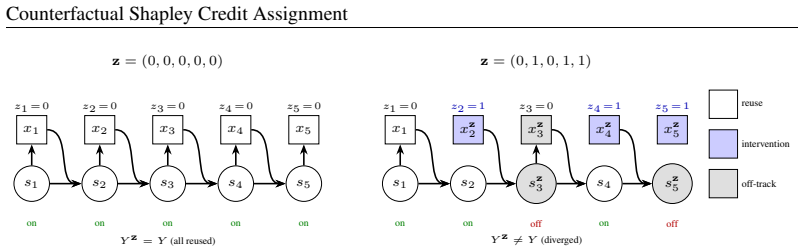
The central object is the Counterfactual Shapley Value (ϕ-value): for a trajectory, the Shapley value of each action with respect to the game f(z) = Y − Y_z, where Y is the observed discounted return and Y_z is the return of a counterfactual trajectory in which the actions in coalition z are replaced by a baseline policy. The paper computes these values through counterfactual simulation in an SCM representation of the MDP, reusing observed transitions when the counterfactual state-action pair matches and resampling otherwise. The ϕ-MDP, obtained by replacing the reward r(s,x) with r^ϕ_π(s,x) = E[ϕ_t | s_t=s, x_t=x], is the mechanism that turns these values into learning signals. The consiste
What would settle it
Take a simple two-step MDP where a shared noise variable influences both the transition and the reward, and where the state-action pair diverges in the counterfactual. Compute the exact counterfactual natural total effect by conditioning on the posterior noise P(U|τ) and compare it with the value produced by the paper's Algorithm 2, which resamples noise whenever the counterfactual pair differs from the observed pair. Any gap between the two for a fixed trajectory disproves the consistency claim; an experiment that measures this gap on a grid of noise strengths would settle it.
Extended reading notes
Core claim
The paper claims that the Counterfactual Shapley Value (ϕ-value), which is the Shapley value of a game whose value is the counterfactual natural total effect of a coalition of actions on the discounted return, constitutes a complete causal credit assignment function. It satisfies four desiderata: non-causes get zero credit, causes get nonzero credit, credit scales with departure from a baseline policy, and larger effects get larger credit. Building on this, the paper defines the ϕ-MDP, in which the environment reward is replaced by the per-step expected ϕ-value, and proves in Theorem 3.7 that this MDP has the same optimal policies as the original. The paper further claims that ϕ-PPO, the alg
Load-bearing premise
The load-bearing premise is that counterfactual trajectories can be simulated while holding the realized environment noise fixed at the values that produced the observed trajectory; if the noise cannot be reused or conditioned on, the computed ϕ-values do not match the defined counterfactual effects.
Editorial extensions
If this is right
- If the optimal-policy equivalence holds, any policy-gradient method can be trained on ϕ-rewards instead of environment rewards without changing what the optimal policy is, while receiving dense per-step signal.
- In environments where few actions are causal, the gradient variance is reduced by roughly the ratio of causal actions to horizon length, since non-causal actions receive zero credit.
- In high-stochasticity environments, the shared exogenous noise cancels in the counterfactual difference, so the variance of each credit estimate scales with (1−ρ_Y), potentially much smaller than the return variance.
- Delayed-reward credit reaches all timesteps in a single episode through counterfactual simulation, bypassing the O(T)-episode backward propagation of tabular TD(0).
- The experimental claim is that ϕ-PPO converges where prior credit assignment methods fail, on the SkillLuck and Combinatorial Lock benchmarks.
Reading between the lines
- The reliance on a resettable simulator means the framework is most directly applicable in model-based or simulated settings; a natural extension would be to pair it with a learned world model, but the paper does not test this.
- Because ϕ-values are defined relative to a baseline policy, the credit attributions are not absolute properties of the environment; changing the baseline changes the causal story, which is a feature for explanation but a caution for comparing attributions across settings.
- The variance-reduction argument assumes that counterfactual trajectories can be simulated under the same exogenous noise as the observed trajectory; if noise cannot be shared or correlated across steps, the empirical gains would shrink.
- A testable extension would be to apply ϕ-values as an interpretability tool: the computed per-action scores could be used to audit whether a trained policy relies on skill or luck, without retraining.
Editorial analysis
A structured set of objections, weighed in public.
Referee Report
Summary. The paper proposes Counterfactual Shapley Credit Assignment, a reward-redistribution method for RL that attributes per-action credit via Shapley values of a counterfactual natural total effect (NTE) game. The authors define a φ-MDP, claim it preserves the original optimal policy (Theorem 3.7), derive an O(T)-per-episode estimator with an optimal coalition-sampling proposal, and introduce φ-PPO with Prioritized Trajectory Replay (PTR). Experiments on SkillLuck, Combinatorial Lock, and DoorKey benchmarks show improved sample efficiency over existing credit-assignment baselines.
Significance. If the core theoretical claims held, the paper would offer a principled causal solution to temporal credit assignment: dense, unbiased reward redistribution that does not alter the optimal policy. The paper also contributes a tractable estimator (amortized O(T) per episode), a variance-reduction proposal distribution, and a substantial empirical comparison. However, the central optimal-policy-preservation theorem is internally inconsistent with the paper's chosen self-baseline, and the proof conflates a score-function identity with the gradient of a θ-dependent reward. The empirical results are interesting and may be salvageable, but the theoretical framing as stated is not tenable.
major comments (3)
- [Theorem 3.7 / Appendix D.3] The central optimal-policy-equivalence claim is false under the paper's self-baseline. Section 3.1 states 'We use self-baseline throughout training' (π_base = π_θ). By Shapley efficiency, Σ_t φ_t = Y − Y^{σ1}. Under self-baseline, Y^{σ1} is a fresh rollout of the same policy from the same initial state, so E_{π_θ}[Y^{σ1}] = E_{π_θ}[Y], hence E_{π_θ}[Σ_t φ_t] = 0 for every θ. The φ-MDP objective is identically zero, so every policy is optimal for it; the claimed equality of arg max sets in Theorem 3.7 fails whenever J(θ) is non-constant. The proof in Appendix D.3 argues that E[Y^1] has zero gradient because 'Y^1 is independent of the realized actions X_t, so E[Y^1∇logπ]=0'. This conflates the score-function identity for a fixed reward with the gradient of E[Y^1] when Y^1 itself depends on θ through π_base = π_θ. In a one-step Bernoulli MDP, E[Y^1]=θ, ∇E[Y^1]=1, while E[Y^1∇logπ]=0. Thus t
- [Algorithm 2 / Eq. (4)] The counterfactual simulation in Algo. 2 resamples transition and reward noise whenever the counterfactual state-action pair differs from the observed pair (lines 10–14). Equation (4) defines the NTE using the posterior P(U|τ) with the realized exogenous u fixed. These are different operations unless the environment is deterministic or Assumption 3.3 is interpreted as an independent-noise-per-parent SCM representation. The text asserts that 'when parents differ, we resample' as a consequence of Assumption 3.3, but it never proves that Algo. 2 is a valid Monte Carlo estimator of Eq. (4). Since the consistency and bias results (Theorems 4.2 and 4.4) rest on this equivalence, the paper should provide a rigorous derivation or clarify the exact relationship between the simulated quantity and the defined NTE.
- [Theorem 3.2 / Appendix C-D] Contribution 1 claims that φ-values satisfy the four causal credit-assignment desiderata D1–D4. The proof in Appendix D.3 is not self-contained: for D3 (Causal Normality) and D4 (Causal Effect Scaling) it invokes monotonicity properties of the NTE game without formal justification, and the core attribution framework is delegated to Lee et al. (2025), a same-group technical report. As a result, the paper does not independently establish that φ-values 'align precisely to the ground truth causes of task rewards'—a central interpretive claim. The authors should either provide a complete, self-contained proof or clearly mark Theorem 3.2 as an imported result and adjust the contribution claims accordingly.
minor comments (5)
- [Theorem 4.2] The statement says 'variance-minimizing proposal', but the proof minimizes an upper bound on the second moment (uniform bound on Var[f(z)]) rather than the exact variance, which may depend on the coalition size k. The wording should be relaxed to 'minimizes a worst-case bound' or the proof should handle heteroskedastic f(z).
- [Section 3.1 / Eq. (4)] The text says 'we condition on the observed trajectory, giving the conditional causal contribution f(z)=Y−Y^{σz}', but Eq. (4) defines an expectation over posterior and prior noise. These are not identical unless the expectation is implicit. Clarify whether f(z) is a random variable or an expectation.
- [Notation] The symbol λ is used both for NTE mixing (Eq. 10) and GAE mixing (Eq. 13). Although Table 2 defines both, the dual use is confusing in Sections 4 and Appendix B. Consider renaming one of them.
- [Appendix F] Assumption 3.3 is described both as a genuine assumption ('excluding correlated exogenous noise') and as a representation choice that 'does not constrain the MDP'. These two statements are in tension and should be reconciled.
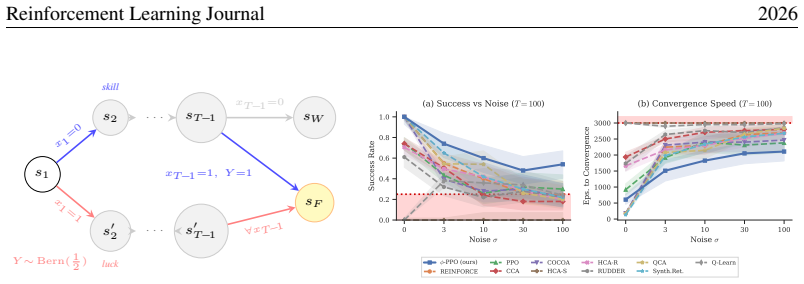
- [Figure 5] At σ=0 the paper admits several baselines match or exceed φ-PPO; the abstract's blanket claim of 'superior sample efficiency' is too strong. Consider qualifying the abstract to reflect the stochastic regime.
Circularity Check
Optimal-policy preservation reduces to the definition of φ under self-baseline; causal validity is imported from the authors' own technical report.
-
self citation load bearing
[Section 3, Theorem 3.2; Contribution 1; Table 5 caption]
"We apply the Counterfactual Shapley Value (ϕ-value) framework Lee et al. (2025) to RL temporal credit assignment, showing that ϕ-values yield a reward redistribution that preserves the optimal policy and concentrates credit on causal actions."
The central claim that ϕ-values are causal (Theorem 3.2) is delegated to Lee et al. (2025), a Columbia technical report co-authored by two of the present authors (Kai-Zhan Lee and Elias Bareinboim). The desiderata D1–D4 are introduced as 'following the axiomatic framework of Lee et al. (2025)' (Table 5 caption), and no independent machine-checked or externally verifiable source is provided. The paper explicitly frames its contribution as applying that framework, so the load-bearing premise 'ϕ-values are causal' rests on a same-group self-citation rather than a first-principles derivation in this paper.
-
self definitional
[Section 3.2 (undiscounted ϕ-return); Appendix D.3 (proof of Theorem 3.7)]
"Explicitly, by Shapley efficiency, Jϕ(θ)=J(θ)−Eπθ[Y^1]. The term Eπθ[Y^1] (expected baseline return under self-baseline) has zero gradient by the same argument as Lemma 3.5: Y^1 is independent of the realized actions X_t, so E[Y^1∇logπ]=0."
Under the self-baseline actually used throughout training (π_base=π), Y^1 is a fresh rollout of the same policy from the same initial state, so Eπθ[Y^1]=Eπθ[Y]. Combined with Shapley efficiency, Σ_t ϕ_t = Y−Y^1, this makes Eπθ[Σ_t ϕ_t]=0 for every θ. The φ-MDP objective is then identically zero, so the claimed arg-max equality is vacuous. The proof's step from E[Y^1∇logπ]=0 to ∇Eπθ[Y^1]=0 is invalid when Y^1 depends on θ through π_base=π. The 'optimal policy preservation' result is therefore an artifact of the definition of ϕ as Y−Y^1 plus the chosen baseline, not an independent theorem.
full rationale
The empirical portion of the paper (SkillLuck, Combinatorial Lock, Fork MDP, ablations) is a genuine benchmark comparison and is not circular; the estimator derivations (Theorems 4.2 and 4.4) are self-contained given the stated assumptions. However, the two central theoretical guarantees have circular or definitional structure. First, the causal validity of ϕ-values (Theorem 3.2) is imported from Lee et al. (2025), a same-group technical report, and the desiderata themselves are 'following the axiomatic framework of Lee et al. (2025)'. Second, the optimal-policy-preservation theorem is built into the construction: Shapley efficiency gives Σ_t ϕ_t = Y − Y^1, and under the self-baseline actually used, Eπθ[Y^1] = Eπθ[Y], forcing Eπθ[Σ_t ϕ_t] = 0 for all θ. The appendix proof's move from E[Y^1∇logπ]=0 to ∇Eπθ[Y^1]=0 is invalid when the baseline return is generated by the current policy. The limitations section flags only Assumption 3.3 and simulator access, not this collapse of the optimality claim. Because the main theoretical guarantee reduces to a definitional identity and the causal-validity premise is self-cited, while the empirical comparisons and estimation analysis retain independent content, the circularity is partial but material.
Assumptions & free parameters
free parameters (5)
- Coalition samples M =
M=1 (SkillLuck, Fork), M=16 (Combinatorial Lock)
- NTE mixing lambda =
lambda=1.0 (pure MC)
- Self-baseline pi_base=pi =
pi_base = current policy
- GAE mixing lambda_phi =
0.95
- PTR priority exponent alpha_ptr =
0.6
assumptions (6)
- domain assumption Any MDP admits an SCM with independent exogenous noise and the same optimal policy (Assumption 3.3).
- ad hoc to paper The NTE game f(Z)=Y-Y^z plus Shapley axioms defines correct causal credit (D1-D4).
- domain assumption Finite second moment E[Y_t^2] <= sigma^2 (Assumption 3.8).
- domain assumption Simulator access for counterfactual rollouts.
- standard math Shapley value axioms, Markov property, score function identity, TD(lambda) convergence, Chebyshev and Cauchy-Schwarz inequalities.
- domain assumption PTR importance-sampling corrections anneal sufficiently fast to yield unbiased gradients.
invented entities (2)
-
phi-MDP M^phi_pi
-
Prioritized Trajectory Replay (PTR)
Cite this review
Pith. "Pith review of Counterfactual Shapley Credit Assignment." pith.science (2026). https://pith.science/paper/4GCHNYWX
@misc{pith2026260716999,
  author       = {Pith},
  title        = {Pith review of: Counterfactual Shapley Credit Assignment},
  year         = {2026},
  howpublished = {\url{https://pith.science/paper/4GCHNYWX}},
  note         = {Machine review of arXiv:2607.16999}
}
abstract
The Credit Assignment Problem (CAP) is fundamental to developing efficient and explainable Reinforcement Learning (RL) agents. Existing frameworks, whether relying on temporal contiguity or hindsight-conditioned reward reweighting, frequently fail to attribute properly between an agent's policy (skill) and environmental stochasticity (luck). A principled approach to CAP must isolate the true causal drivers of observed outcomes from spurious correlations and environmental randomness. We introduce Counterfactual Shapley Credit Assignment, a novel framework grounded in causal theory that attributes credit and blame via the Counterfactual Shapley Value ($\phi$-value). By redistributing environmental rewards, $\phi$-values enhance temporal credit assignment across three critical dimensions: sparse causality, high stochasticity, and delayed rewards, all while preserving the optimal policy. We derive a consistent estimator that computes $\phi$-values efficiently, enabling a new class of policy gradient methods, $\phi$-PPO, combined with Prioritized Trajectory Replay (PTR). Empirical results demonstrate that $\phi$-values align precisely to the ground truth causes of task rewards with superior sample efficiency in challenging environments where prior state-of-the-art methods fail to converge.
Figures


Figures from the paper (5 more)



Reference graph
Works this paper leans on
-
[1]
Stratified sampling reduces variance in the fresh/replay ratio compared to per-trajectory Bernoulli sampling
and collect nfresh = clamp(⌊ξB⌋,1, B−1)fresh rollouts. Stratified sampling reduces variance in the fresh/replay ratio compared to per-trajectory Bernoulli sampling. Importance-sampling corrections.The IS correction depends on the trajectory source. Both fresh and replay trajectories use the PPO ratio for multi-epoch updates: rj,t =π θ(xj,t |s j,t)/πθold (...
2026
-
[2]
The exponent αptr controls priority sharpness; ϵptr prevents starvation
This prioritizes states where (i) actions have consistent causal impact (high |µ|), and (ii) the action choice matters but the policy has not yet converged (high σ with µ≈0 ). The exponent αptr controls priority sharpness; ϵptr prevents starvation. Priority decay.Priorities become stale as the policy improves. Each iteration, all priorities decay by pj ←γ...
2017
-
[3]
The action’s causal effect is ϕ= 1 with zero variance, while Var[Y] = 2500
Discount factorγ0.99 Trajectory length (chunk size)T chunk 128 Batch size (trajectories)B64 Policy epochsK4 Coalition samplesM1 NTE mixingλ1.0 (pure MC) GAE mixingλ ϕ 0.95 PPO clipϵ clip 0.2 Value loss coefficientc 1 0.5 ϕ-value loss coefficientc 2 0.5 Entropy coefficientc 3 0.01 Gradient clip normg max 0.5 Exploration decayγ ξ 0.99 PTR (Appendix D.5) Pri...
1992
-
[6]
Lili Chen, Kevin Lu, Aravind Rajeswaran, Kimin Lee, Aditya Grover, Michael Laskin, Pieter Abbeel, Aravind Srinivas, and Igor Mordatch
URL https://proceedings.mlr.press/v139/chang21b.html. Lili Chen, Kevin Lu, Aravind Rajeswaran, Kimin Lee, Aditya Grover, Michael Laskin, Pieter Abbeel, Aravind Srinivas, and Igor Mordatch. Decision transformer: Reinforcement learning via sequence modeling. In Marc’Aurelio Ranzato, Alina Beygelzimer, Yann N. Dauphin, Percy Liang, and Jennifer Wortman Vaugh...
2021
-
[7]
Maxime Chevalier-Boisvert, Lucas Willems, and Suman Pal
URL https://proceedings.neurips.cc/paper/ 2021/hash/7f489f642a0ddb10272b5c31057f0663-Abstract.html. Maxime Chevalier-Boisvert, Lucas Willems, and Suman Pal. Minimalistic gridworld environment for gymnasium,
2021
-
[10]
In contrast, ϕ-redistribution computes ϕt for all t from a single trajectory via O(T·M δ,ϵ) counterfac- tual simulations
φ-PPO (ours) REINFORCE PPO Figure 8:Fork MDP results( n=1,000 runs per condition; shaded bands are 95% CIs).Left:MDP structure; only the first c actions affect the terminal reward.Top row (a–c):Success rate across noise σ, horizonT, and causal stepsc.Bottom row (d–f):Mean episodes to convergence. In contrast, ϕ-redistribution computes ϕt for all t from a ...
2026
-
[12]
Hsiao-Ru Pan and Bernhard Schölkopf
URL http://arxiv.org/abs/ 1910.07113. Hsiao-Ru Pan and Bernhard Schölkopf. Skill or luck? return decomposition via advantage functions. InThe Twelfth International Conference on Learning Representations,
arXiv 1910
-
[14]
Daniel J Russo, Benjamin Van Roy, Abbas Kazerouni, Ian Osband, and Zheng Wen
URL https://arxiv.org/abs/2102.12425. Daniel J Russo, Benjamin Van Roy, Abbas Kazerouni, Ian Osband, and Zheng Wen. A tutorial on thompson sampling.Foundations and Trends in Machine Learning, 11(1):1–96,
Show all 35 references
-
[16]
URL http://arxiv.org/abs/1511.05952. Julian Schrittwieser, Ioannis Antonoglou, Thomas Hubert, Karen Simonyan, Laurent Sifre, Simon Schmitt, Arthur Guez, Edward Lockhart, Demis Hassabis, Thore Graepel, Timothy Lillicrap, and David Silver. Mastering Atari, Go, chess and shogi by...
-
[18]
Jordan, and Pieter Abbeel
John Schulman, Philipp Moritz, Sergey Levine, Michael I. Jordan, and Pieter Abbeel. High- Dimensional Continuous Control Using Generalized Advantage Estimation. In Yoshua Ben- gio and Yann LeCun (eds.),4th International Conference on Learning Representations, ICLR 2016, San Ju...
2016
-
[19]
John Schulman, Filip Wolski, Prafulla Dhariwal, Alec Radford, and Oleg Klimov
URL http://arxiv.org/abs/1506.02438. John Schulman, Filip Wolski, Prafulla Dhariwal, Alec Radford, and Oleg Klimov. Proximal policy optimization algorithms.arXiv preprint arXiv:1707.06347,
-
[20]
Lloyd S Shapley
URL http://arxiv.org/abs/ 1912.10944. Lloyd S Shapley. A value for n-person games. In Harold W. Kuhn and Albert W. Tucker (eds.), Contributions to the Theory of Games II, pp. 307–317. Princeton University Press, Princeton,
1912 arXiv
-
[25]
Chao Yu, Jiming Liu, and Shamim Nemati
URLhttps://arxiv.org/abs/2505.09388. Chao Yu, Jiming Liu, and Shamim Nemati. Reinforcement learning in healthcare: A survey,
-
[27]
1, which controls bootstrapping depth)
to theϕ-MDP: Aϕ t = T−tX ℓ=0 (λϕ)ℓδϕ t+ℓ,(13) where λϕ ∈[0,1] controls the bias-variance tradeoff (distinct from λ in Algo. 1, which controls bootstrapping depth). Theϕ-return is Gϕ t = T−tX ℓ=0 ˆϕt+ℓ,(14) which serves as the training target for V ϕ ω (Eq. 22). Shapley efficie...
2018
-
[30]
Alice arriving
correct for the prioritized sampling distribution, ensuring unbiased gradient estimates. Hyperparameters are in Table 3; proofs in Appendix D.4. C Theory Details Definition C.1(Functional Dependence).Given world(M,u), the functional dependence ofYon Xunder baselinez= (x ′,z ′)...
2026
-
[31]
Reinforcement Learning Journal 2026 Table 2: Notation glossary Symbol Meaning SCM and MDP V,UEndogenous, exogenous variables τTrajectory:(s 1:T , x1:T , y1:T ) St, Xt, Yt State, action, reward at timet π(x|s)Policy (action distribution given state) γ∈(0,1)Discount factor THori...
2026
-
[32]
These samples are drawn independently of the observed actions X1:T
Under any baseline policy πbase (including self-baseline), the counterfactual Y 1 replaces all observed actions with fresh samples X 1 1:T ∼π base(· |S1 1:T ). These samples are drawn independently of the observed actions X1:T . We claim Y 1 ⊥X t |S t. By the Markov property o...
2026
-
[33]
Sampling selects (trajectory, starting timestep) pairs proportionally to pt using the Gumbel-max trick for efficient vectorized sampling
of squared Shapley estimates, αptr controls priority sharpness, and ϵptr prevents starvation. Sampling selects (trajectory, starting timestep) pairs proportionally to pt using the Gumbel-max trick for efficient vectorized sampling. When the buffer reaches capacity, the traject...
2026
-
[36]
Reinforcement Learning Journal 2026 Table 4: Credit assignment methods: expressions and descriptions
2For clarity, prior uses of the term ’counterfactual’ in this literature refer to hindsight conditioning not counterfactuals defined in the causal theory (Pearl, 2009). Reinforcement Learning Journal 2026 Table 4: Credit assignment methods: expressions and descriptions. Method...
2009
-
[1988]
DOI: 10.1023/A:1022633531479
ISSN 0885-6125. DOI: 10.1023/A:1022633531479. URL https: //doi.org/10.1023/A:1022633531479. Richard S Sutton and Andrew G Barto.Reinforcement Learning: An Introduction. A Bradford Book, second edition,
-
[1992]
Daya Guo, Dejian Yang, Haowei Zhang, Junxiao Song, Peiyi Wang, Qihao Zhu, Runxin Xu, Ruoyu Zhang, Shirong Ma, Xiao Bi, Xiaokang Zhang, Xingkai Yu, Yu Wu, Z
ISSN 0025-1909. Daya Guo, Dejian Yang, Haowei Zhang, Junxiao Song, Peiyi Wang, Qihao Zhu, Runxin Xu, Ruoyu Zhang, Shirong Ma, Xiao Bi, Xiaokang Zhang, Xingkai Yu, Yu Wu, Z. F. Wu, Zhibin Gou, Zhihong Shao, Zhuoshu Li, Ziyi Gao, Aixin Liu, Bing Xue, Bingxuan Wang, Bochao Wu, Be...
1909
-
[1997]
DOI: 10.1109/9. 580874. Akash Velu, Skanda Vaidyanath, and Dilip Arumugam. Hindsight-DICE: Stable credit assignment for deep reinforcement learning,
-
[1999]
URL https://doi.org/10.1016/ S0004-3702(99)00052-1
DOI: 10.1016/S0004-3702(99)00052-1. URL https://doi.org/10.1016/ S0004-3702(99)00052-1. Richard S. Sutton, Joseph Modayil, Michael Delp, Thomas Degris, Patrick M. Pilarski, Adam White, and Doina Precup. Horde: a scalable real-time architecture for learning knowledge from unsup...
-
[2009]
Eduardo Pignatelli, Johan Ferret, Matthieu Geist, Thomas Mesnard, Hado van Hasselt, and Laura Toni
DOI: 10.1017/CBO9780511803161. Eduardo Pignatelli, Johan Ferret, Matthieu Geist, Thomas Mesnard, Hado van Hasselt, and Laura Toni. A survey of temporal credit assignment in deep reinforcement learning.Transactions on Machine Learning Research,
-
[2015]
DOI: 10.1038/nature14236. OpenAI, Ilge Akkaya, Marcin Andrychowicz, Maciek Chociej, Mateusz Litwin, Bob McGrew, Arthur Petron, Alex Paino, Matthias Plappert, Glenn Powell, Raphael Ribas, Jonas Schneider, Nikolas Tezak, Jerry Tworek, Peter Welinder, Lilian Weng, Qiming Yuan, Wo...
-
[2016]
Hindsight credit assignment
Anna Harutyunyan, Will Dabney, Thomas Mesnard, Mohammad Gheshlaghi Azar, Bilal Piot, Nicolas Heess, Hado van Hasselt, Gregory Wayne, Satinder Singh, Doina Precup, and Rémi Munos. Hindsight credit assignment. In Hanna M. Wallach, Hugo Larochelle, Alina Beygelzimer, Florence d’A...
2019
-
[2017]
DOI: 10.1038/nature24270
ISSN 1476-4687. DOI: 10.1038/nature24270. URLhttps://www.nature.com/articles/nature24270;. Richard S. Sutton. Learning to predict by the methods of temporal differences.Mach. Learn., 3(1):9–44, August
-
[2018]
Michael Chang, Sid Kaushik, Sergey Levine, and Tom Griffiths
DOI: 10.1007/s11229-016-1247-1. Michael Chang, Sid Kaushik, Sergey Levine, and Tom Griffiths. Modularity in reinforcement learning via algorithmic independence in credit assignment. In Marina Meila and Tong Zhang (eds.),Proceedings of the 38th International Conference on Machi...
-
[2019]
Counterfactual Shapley Credit Assignment Ilze Amanda Auzina, Joschka Strüber, Sergio Hernández-Gutiérrez, Shashwat Goel, Ameya Prabhu, and Matthias Bethge
URL https://arxiv.org/ abs/1806.07857. Counterfactual Shapley Credit Assignment Ilze Amanda Auzina, Joschka Strüber, Sergio Hernández-Gutiérrez, Shashwat Goel, Ameya Prabhu, and Matthias Bethge. Intrinsic credit assignment for long horizon interaction,
-
[2020]
Reinforcement Learning Journal 2026 Supplementary Materials The following content was not necessarily subject to peer review
URLhttps://arxiv.org/abs/1908.08796. Reinforcement Learning Journal 2026 Supplementary Materials The following content was not necessarily subject to peer review. Appendix Contents A Counterfactual Simulation Bϕ-PPO C Theory Details D Proofs E Additional Experiments F Limitati...
1908 arXiv
-
[2021]
URL https://ojs.aaai.org/index.php/AAAI/article/view/16772
DOI: 10.1609/aaai.v35i7.16772. URL https://ojs.aaai.org/index.php/AAAI/article/view/16772. Sander Beckers and Joost Vennekens. A principled approach to defining actual causation.Synthese, 195(2):835–862,
-
[2022]
URLhttps://dl.acm.org/doi/book/10.1145/3501714
ISBN 9781450395861. URLhttps://dl.acm.org/doi/book/10.1145/3501714. Sander Beckers. The counterfactual ness definition of causation.Proceedings of the AAAI Conference on Artificial Intelligence, 35(7):6210–6217, May
-
[2023]
Ratio measures how much Xt increased the proba- bility of observingU ′
P π(U ′ |S t, Xt) P π(U ′ |S t) −1U ′: encoding of a future step (S′, X′, Y′); typically U ′=Y ′ (reward). Ratio measures how much Xt increased the proba- bility of observingU ′. Estimated by supervised learning D. Ours: counterfactual simulation ϕ-valuesY−Y z,sharedU Replay t...
2025
-
[2025]
DOI: 10.1038/s41586-025-09422-z
ISSN 1476-4687. DOI: 10.1038/s41586-025-09422-z. URL http://dx.doi.org/10.1038/s41586-025-09422-z. Joseph Y Halpern.Actual causality. MiT Press,
-
[2026]
Elias Bareinboim, Juan D Correa, Duligur Ibeling, and Thomas Icard
URL https://arxiv.org/abs/2202.06793. Elias Bareinboim, Juan D Correa, Duligur Ibeling, and Thomas Icard. On pearl’s hierarchy and the foundations of causal inference. InProbabilistic and causal inference: the works of judea pearl, pp. 507–556. Association for Computing Machin...
Reviewed August 1, 2026 · model on record in the stance chip above.
Discussion (0). Continue with ORCID to comment.