REVIEW 3 major objections 5 minor 64 references
A machine-learning potential that couples a central magnetic moment to its spin-lattice environment via tensor products claims data-efficient learning of magnetic potential energy surfaces, reproducing phonons, magnons, polaron spectra, and
Reviewed by Pith at T0; open to challenge. T0 means a machine referee read the full paper against a public rubric. the ladder, T0–T4 →
T0 review · deepseek-v4-flash
2026-08-01 18:55 UTC pith:7S4FDJGS
load-bearing objection STEP is a genuinely plausible magnetic MLIP architecture, but the paper never specifies the constrained-moment DFT protocol, leaving its data-efficiency claims ungrounded until that gap is closed. the 3 major comments →
STEP: Spin Tensor Equivariant Potential for Data-Efficient Learning of Magnetic Potential Energy Surfaces
The pith
A machine-rendered reading of the paper's core claim, the machinery that carries it, and where it could break.
Core claim
STEP treats local magnetic moments as continuous geometric vectors, mapped through solid spherical harmonics into an equivariant neural network. Its defining operation, the Center-Environment Tensor Product, multiplies the central atom's spin feature with an aggregated neighborhood spin-lattice field; since V1⊗V1 decomposes into scalar, vector, and rank-2 channels, the model automatically has symmetry-allowed channels for isotropic exchange, antisymmetric Dzyaloshinskii-Moriya-like coupling, and anisotropic interactions. The authors show that higher-order tensor channels and multiple layers of these couplings give steep learning curves for energy, force, and magnetic force on monolayer CrI3,
What carries the argument
The Center-Environment Tensor Product (Center-Env TP), Eq. (9): a learnable bilinear map that couples the aggregated environmental message (summed edge messages from neighbors, weighted by distance-dependent radial functions) with the central atom's own equivariant feature. It generates irreducible tensor channels for scalar, vector, and rank-2 couplings, providing a physics-informed inductive bias for magnetic interactions while preserving translational invariance and SO(3) equivariance. Time-reversal symmetry is enforced at the feature level by averaging scalar channels from forward and globally spin-reversed passes before readout.
Load-bearing premise
The entire training and spin-dynamics pipeline treats the DFT+U local-moment reference (and its energy gradients with respect to moments) as physically meaningful for non-collinear and finite-temperature configurations; if those reference magnetic forces are unreliable—plausible for itinerant Fe or for the large-U Fe2Mo3O8 calculation—the claimed data efficiency and Curie temperatures lose their quantitative foundation.
What would settle it
Take a magnetic material not in the training set (e.g., NiO or α-Fe2O3), generate a dense set of non-collinear spin configurations with DFT+U, and compare STEP's predicted magnetic forces to the reference. If the angular distribution of magnetic-force errors is systematically biased (e.g., wrong torque directions) or the energy error grows sharply away from training spin states, the central claim of transferable data-efficient learning is falsified.
If this is right
- Compact datasets (900 CrI3, 5000 Fe, 97 Fe2Mo3O8 configurations) suffice to train a potential that reproduces phonon and magnon spectra, implying magnetic MLIPs need far fewer costly non-collinear DFT calculations.
- Because the same differentiable energy surface yields forces, stresses, and magnetic forces, STEP can drive spin-lattice dynamics and linear-response calculations without constructing an explicit spin Hamiltonian.
- The learned CrI3 magnon gaps at Γ, K, K′ show the model captures anisotropic exchange and spin-orbit-coupling-driven interactions beyond isotropic Heisenberg exchange.
- Including longitudinal spin fluctuations in generalized Langevin dynamics lowers the predicted bcc Fe Curie temperature from roughly 1500 K to 1000 K, matching experiment and highlighting the importance of variable-moment dynamics for itinerant magnets.
- Magnon-polaron anticrossings in Fe2Mo3O8 emerge directly from the Hessian of the learned energy surface, indicating the potential encodes spin-lattice cross-derivatives.
Where Pith is reading between the lines
- If STEP transfers across magnetic materials without architectural retraining, it could replace spin Hamiltonians as the default interface between ab initio magnetism and atomistic simulation; a natural next test is a multi-material training set with mixed spin orders.
- The reliance on a system-specific reference moment S_ref for scaling suggests a potential failure mode for strongly itinerant systems where moment magnitudes vary widely; one testable extension is to make S_ref a learnable per-species parameter.
- The success on Fe2Mo3O8 with only 97 configurations hints that the Center-Environment Tensor Product is especially sample-efficient when spin-lattice coupling is strong; a controlled ablation removing the bilinear coupling would quantify how much of this efficiency comes from the tensor product versus other architecture choices.
Editorial analysis
A structured set of objections, weighed in public.
Referee Report
Summary. The manuscript introduces STEP, an SO(3)-equivariant machine-learning interatomic potential for magnetic systems. The central architectural innovation is a Center-Environment Tensor Product that couples the on-site spin representation to an aggregated local spin-lattice environment, with feature-level time-reversal symmetrization obtained by averaging scalar projections over +S and -S passes. Energy, atomic forces, virial stress, and magnetic forces are all obtained by automatic differentiation of the learned energy. The authors report benchmarks on public FeAl, CrN, and elemental Fe datasets, learning-curve analyses on monolayer CrI3, compact-data reproductions of phonon and magnon spectra in CrI3, a magnon-polaron spectrum for Fe2Mo3O8, and Langevin spin-dynamics Curie temperatures for CrI3 and bcc Fe. The claims are that STEP is highly data-efficient and provides a unified, spin-Hamiltonian-free description of spin-lattice energetics and finite-temperature magnetism.
Significance. If the claims hold, STEP is a significant advance: it offers a physically transparent way to inject magnetic spin-lattice coupling into equivariant neural potentials, and its reported data efficiency on CrI3 and Fe2Mo3O8 would make it attractive for systems where non-collinear DFT data are expensive. The architecture is described in enough detail to be reimplemented, and the public FeAl/CrN benchmarks provide an external check on the method. The ablation study in Fig. 7 and Table IV, showing that higher-order tensor channels and iterative center-environment couplings steepen learning curves, is a valuable contribution in its own right. However, the new DFT datasets on which the headline applications rest are not documented at the level needed to establish that the training labels are well-defined functions of the spin inputs.
major comments (3)
- [Sec. II E, Eq. (26); Appendix A; Appendix B] The loss in Eq. (26) uses magnetic forces F^M_j = -∂E/∂M_j as reference labels, and Eq. (22) defines model magnetic forces by differentiation with respect to the input moment vectors. For the new CrI3 and Fe2Mo3O8 datasets, the paper only states that random spin configurations were 'created' (Appendix A) or that structures were 'initialized with a fully random orientation' (Appendix B). Standard noncollinear VASP calculations treat initial moments as guesses; absent a constrained-moment protocol, the self-consistent magnetization relaxes, so the converged energy is not a function of the prescribed {M_j}, and no well-defined reference magnetic force exists. If constraints were used, the protocol (penalty function, constraining field, or Liechtenstein-type torque method) must be stated, together with how F^M labels were computed. Without this, the CrI3 and Fe2Mo3O8 trainings, and all downs
- [Sec. III D, Fig. 9; Abstract] The abstract states that STEP provides a 'quantitative description of magnon-phonon hybridization' in Fe2Mo3O8, but Sec. III D explicitly characterizes the result as 'semi-quantitative' and notes that U=6 eV softens both phonon and magnon spectra. Fig. 9 shows only the uncoupled and hybridized STEP spectra, with no comparison to the experimental spectra from Refs. [37,38] or to an independent first-principles calculation. The existence of an avoided crossing demonstrates that the learned Hessian has nonzero spin-lattice coupling, but it does not substantiate a quantitative reproduction of the experimental magnon-polaron dispersion. Please add a quantitative comparison to experiment or temper the abstract/conclusion wording.
- [Sec. III A 3, Table III] The Fe benchmark comparison is explicitly not a controlled head-to-head: the DeePSPIN-DZP values are reported training errors, while STEP models are evaluated over the complete original dataset with different train/validation splits. The paper acknowledges this, but the abstract and conclusions cite 'competitive or improved accuracy' without carrying this caveat through. Since the sample-efficiency claim for Fe rests substantially on this comparison, the uncontrolled nature of the evaluation should be prominently restated wherever the Fe numbers are used to argue for data efficiency.
minor comments (5)
- [Sec. III B, Table IV] The fitted power-law exponents are presented without error bars or multi-seed statistics. Given the random seeds are fixed, reporting a single run per configuration makes the scaling exponents fragile; adding repeated-seed estimates, at least for the control model, would strengthen the learning-curve comparison.
- [Appendix C, Eq. (C6)] The precession matrix J is said to be 'determined by the local spin precession convention' but is never explicitly defined. Please provide its explicit form, including how the transverse basis {e_i1, e_i2} is constructed and how the sign convention for the AFM sublattices is handled.
- [Sec. II B, Eq. (9)] The Center-Environment Tensor Product is described abstractly through equivariant linear maps and a bilinear map B^(t). The tensor-product channel coupling rules (which input irreps couple to which output irreps) are not fully specified. Since reproducing the architecture requires this information, a detailed tensor-product coupling table or pseudocode would be helpful.
- [General] No data or code availability statement is provided. Making the new CrI3 and Fe2Mo3O8 datasets available, even as curated subsets, would substantially increase the reproducibility of the data-efficiency claims.
- [Sec. III C, Fig. 8(c)] The phonon comparison for CrI3 is said to agree with 'the DFT phonon spectrum,' but the source of the DFT reference and the computational parameters used for that phonon calculation are not given (only the training DFT setup in Appendix A). Please clarify whether the reference spectrum was computed in this work, and if so, how.
Circularity Check
Minor self-definitional scaling statement; central STEP claims and benchmark predictions are not circular.
specific steps
-
self definitional
[Section III B (Data Efficiency and Empirical Scaling Analysis), Fig. 7(a-c) caption and accompanying text]
"With the network depth fixed at L=2, a pure scalar network (lmax = 0) fails to reduce the magnetic force error as more data is provided (α≈0.000), indicating that invariant scalar representations are insufficient for mapping the complex, orientation-dependent magnetic force landscape."
By construction, when all latent/input angular channels are ℓ=0 (Eqs. (3)-(7), (18)), the predicted energy is a function only of rotational invariants such as distances and |S_i|^2; no orientation-dependent spin vector enters the scalar readout. Since the magnetic force is defined as -∂E/∂M_j (Eq. (22)), the orientation-dependent (transverse) part of the predicted magnetic force is identically zero for every configuration, so the magnetic-force MAE cannot decrease with training-set size and α≈0 is forced. The observed 'failure to resolve magnetic force scaling' is therefore a restatement of the model's representational limitation rather than an independent empirical discovery.
full rationale
No significant circularity was found in the paper's main derivation chain. STEP is trained on DFT energies, forces, stresses, and magnetic forces, while the headline results—CrI3 phonon and magnon dispersions, bcc Fe phonon/magnon spectra, the Fe2Mo3O8 magnon-polaron spectrum, and Curie temperatures—are not explicit loss targets; they are obtained from the trained potential energy surface by differentiation, linearized Hessians, or spin dynamics. Benchmarks against public FeAl, CrN, and Fe datasets are external and the parity plots are evaluated on those datasets, providing independent grounding. No load-bearing self-citation chain is present: the architecture cites standard equivariant libraries and public benchmarks, and the one private communication ([26]) is only a qualitative phonon comparison, not part of the derivation. The only mild self-definitional element is the lmax=0 magnetic-force scaling statement described above, which is a construction-level sanity check rather than a load-bearing claim. Separately, the manuscript omits a detailed constrained-moment DFT protocol for the non-collinear training labels; if the converged VASP energies are not functions of the prescribed spin vectors {M_j}, the magnetic-force targets would be ill-defined. This is a correctness/support risk, not a circularity of the kind counted here, so it does not raise the circularity score beyond the minor value assigned.
Axiom & Free-Parameter Ledger
free parameters (5)
- S_ref (spin normalization scale) =
dataset max magnetic moment + safety padding
- Loss weights (λ_E, λ_F, λ_V, λ_M) =
tuned per system, values not reported
- Interaction depth L and angular cutoff l_max =
L=2–3, l_max=1–3 depending on system
- Cutoff radius r_cut =
5.0 Å (FeAl/CrN), 4.5 Å (Fe), 8.0 Å (CrI3)
- Species energy shift E_shift_zi =
from training set reference energies
axioms (5)
- domain assumption DFT+U PBE+SOC reference energies, forces, and magnetic forces are sufficiently accurate for the target physics.
- domain assumption Local magnetic moment vectors are valid continuous collective degrees of freedom and E({S_i}) has well-defined derivatives with respect to them.
- domain assumption Global time-reversal invariance E({S}) = E({-S}) holds in the absence of external fields.
- standard math SO(3) equivariance and Clebsch-Gordan tensor products provide a sufficient inductive bias.
- domain assumption Random 90/10 split and nested training subsets give representative generalization estimates.
read the original abstract
Accurate and efficient modeling of magnetic potential energy surfaces remains challenging because spin-polarized first-principles calculations for diverse non-collinear spin-lattice configurations are computationally demanding. Here we introduce the Spin Tensor Equivariant Potential (STEP), a magnetic machine-learning interatomic potential that treats vector magnetic moments as continuous geometric degrees of freedom and embeds them in an equivariant representation. By coupling the central spin representation to its local spin-lattice environment through a Center-Environment Tensor Product, STEP introduces a physics-informed bias while preserving translational invariance and $\mathrm{SO}(3)$ equivariance and supporting feature-level time-reversal symmetrization. Learning-curve analysis on monolayer CrI$_3$ shows that STEP achieves pronounced data efficiency, with higher-order tensor channels and iterative center-environment couplings leading to steep learning curves for energy, force, and magnetic force errors. On public FeAl, CrN, and Fe benchmarks, STEP achieves competitive or improved accuracy compared with recent magnetic machine-learning potentials. Using a compact but representative CrI$_3$ dataset, STEP reproduces phonon dispersions and magnon spectra with high fidelity, capturing subtle anisotropic magnetic interactions. For Fe$_2$Mo$_3$O$_8$, STEP further provides a quantitative description of magnon--phonon hybridization and reproduces its characteristic magnon polaron dispersion. Finally, spin dynamics simulations driven by STEP yield Curie temperatures for monolayer CrI$_3$ and bcc Fe in good agreement with experiments. These results establish STEP as a physically informed, data-efficient, and scalable framework for modeling spin-lattice coupling, magnetic excitations, and finite-temperature magnetic behavior.
Figures



Reference graph
Works this paper leans on
-
[1]
FeAl We evaluate STEP on the publicly available FeAl benchmark dataset [15] and compare its performance with the reported results of mMTP[8], MACE[5], and mMACE[11]. To facilitate comparison, we choose the ar- chitectural hyperparameters of STEP to be as close as possible to those used in the reported benchmark, es- pecially in terms of hidden feature dim...
-
[2]
CrN We further evaluate STEP on the publicly available CrN benchmark dataset[14] and compare its performance with the reported results of mMTP[8], MACE[5], and mMACE[11]. To maintain consistency and facilitate comparison, we use the identical capacity-controlling ar- chitectural hyperparameters as detailed for the bench- mark on FeAl, including the intera...
1911
-
[3]
Fe To evaluate STEP on elemental Fe, a prototypical itinerant magnetic system, we use the publicly avail- able dataset reported in Ref. [16]. The dataset contains approximately 35,000 configurations generated through structural and magnetic perturbations and active learn- ing, covering diverse atomic environments and variations in both orientations and ma...
-
[4]
Monolayer CrI 3 20 40 60 T emperature (K) 1 2Magnetization ( B) (a) CrI3 0 500 1000 1500 T emperature (K) 0 1 2Magnetization ( B) (b) Fe with LF without LF FIG. 10. Magnetization per magnetic atom of (a) monolayer CrI3 and (b) bcc Fe. For bcc Fe, results with and without longitudinal fluctuations (LF) are both presented for com- parison. We first examine ...
-
[5]
To explicitly consider the effect of LSF, we performed generalized Langevin spin dynam- ics simulations [41]
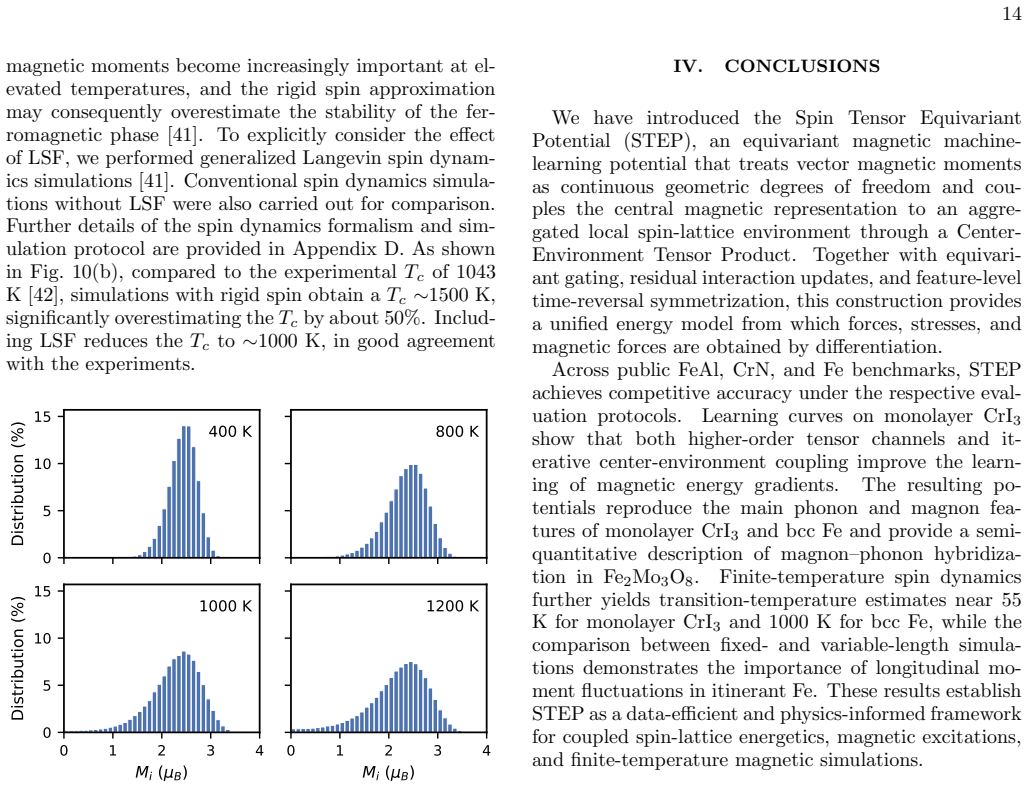
bcc Fe Since bcc Fe is an itinerant ferromagnet, longitudi- nal spin fluctuations (LSF) in the magnitudes of local 14 magnetic moments become increasingly important at el- evated temperatures, and the rigid spin approximation may consequently overestimate the stability of the fer- romagnetic phase [41]. To explicitly consider the effect of LSF, we perform...
-
[6]
The in-plane lattice constant was 6.9685 ˚A
CrI 3 For monolayer CrI3, a 20×20×1 supercell containing 3200 atoms was employed. The in-plane lattice constant was 6.9685 ˚A. The simulation cell length along the out- of-plane direction was 20.7559 ˚A, providing vacuum sep- aration between periodic images of the monolayer. Rigid spin dynamics was employed, with the magnitude of each local magnetic momen...
-
[7]
Longitudinal fluctuations of local magnetic moments were included using the generalized Langevin spin-dynamics formalism
bcc F e For bcc Fe, a 10×10×10 supercell constructed from the conventional cubic unit cell was employed, corre- sponding to a cubic simulation cell with a side length of 28.6304 ˚A. Longitudinal fluctuations of local magnetic moments were included using the generalized Langevin spin-dynamics formalism. The local magnetic moment is decomposed as mi =m iˆsi...
-
[8]
Behler and M
J. Behler and M. Parrinello, Generalized neural-network representation of high-dimensional potential-energy sur- faces, Phys. Rev. Lett.98, 146401 (2007)
2007
-
[9]
A. P. Bart´ ok, M. C. Payne, R. Kondor, and G. Cs´ anyi, Gaussian approximation potentials: The accuracy of quantum mechanics, without the electrons, Phys. Rev. Lett.104, 136403 (2010)
2010
-
[10]
Zhang, J
L. Zhang, J. Han, H. Wang, R. Car, and W. E, Deep potential molecular dynamics: A scalable model with the accuracy of quantum mechanics, Phys. Rev. Lett.120, 143001 (2018)
2018
-
[11]
Batzner, A
S. Batzner, A. Musaelian, L. Sun, M. Geiger, J. P. Mailoa, M. Kornbluth, N. Molinari, T. E. Smidt, and B. Kozinsky, E (3)-equivariant graph neural networks for data-efficient and accurate interatomic potentials, Nature communications13, 2453 (2022)
2022
-
[12]
Batatia, D
I. Batatia, D. P. Kovacs, G. Simm, C. Ortner, and G. Cs´ anyi, Mace: Higher order equivariant message pass- ing neural networks for fast and accurate force fields, Advances in neural information processing systems35, 11423 (2022)
2022
-
[13]
T. S. Kostiuchenko, A. V. Shapeev, and I. S. Novikov, Interatomic interaction models for magnetic materials: recent advances, Chinese Physics Letters41, 066101 (2024)
2024
-
[14]
Z. Yuan, Z. Xu, H. Li, X. Cheng, H. Tao, Z. Tang, Z. Zhou, W. Duan, and Y. Xu, Equivariant neural net- work force fields for magnetic materials, Quantum Fron- tiers3, 8 (2024)
2024
-
[15]
Novikov, B
I. Novikov, B. Grabowski, F. K¨ ormann, and A. Shapeev, Magnetic moment tensor potentials for collinear spin- polarized materials reproduce different magnetic states of bcc fe, npj Computational Materials8, 13 (2022)
2022
-
[16]
Drautz, Atomic cluster expansion of scalar, vectorial, and tensorial properties including magnetism and charge transfer, Physical Review B102, 024104 (2020)
R. Drautz, Atomic cluster expansion of scalar, vectorial, and tensorial properties including magnetism and charge transfer, Physical Review B102, 024104 (2020). 18
2020
-
[17]
T. Yang, Z. Cai, Z. Huang, W. Tang, R. Shi, A. Godfrey, H. Liu, Y. Lin, C.-W. Nan, M. Ye,et al., Deep learn- ing illuminates spin and lattice interaction in magnetic materials, Physical Review B110, 064427 (2024)
2024
-
[18]
C. H. Ho, C. van der Oord, J. P. Darby, T. Keane, R. L. Benson, C. R. Espinoza, R. Kulkarni, E. Spinu, M. Pa- panikolaou, R. Tomsett,et al., Equivariant many-body message passing interatomic potentials for magnetic ma- terials, arXiv preprint arXiv:2604.08143 (2026)
Pith/arXiv arXiv 2026
-
[19]
H. Yu, B. Liu, Y. Zhong, L. Hong, J. Ji, C. Xu, X. Gong, and H. Xiang, Physics-informed time-reversal equivariant neural network potential for magnetic materials, Physical Review B110, 104427 (2024)
2024
-
[20]
M. Geiger and T. Smidt, e3nn: Euclidean neural net- works, arXiv preprint arXiv:2207.09453 (2022)
Pith/arXiv arXiv 2022
-
[21]
A. S. Kotykhov, M. Hodapp, C. Tantardini, K. Kravtsov, I. Kruglov, A. V. Shapeev, and I. S. Novikov, Actively trained magnetic moment tensor potentials for mechan- ical, dynamical, and thermal properties of paramagnetic crn, Physical Review B111, 094438 (2025)
2025
-
[22]
A. S. Kotykhov, K. Gubaev, M. Hodapp, C. Tantar- dini, A. V. Shapeev, and I. S. Novikov, Constrained dft- based magnetic machine-learning potentials for magnetic alloys: a case study of fe–al, Scientific reports13, 19728 (2023)
2023
-
[23]
Zheng, X
D. Zheng, X. Peng, Y. Huang, Y. Wang, D. Zhang, Z. Huang, Z. Cai, L. Zhang, M. Chen, B. Xu,et al., In- tegrating deep-learning-based magnetic model and non- collinear spin-constrained method: methodology, imple- mentation and application, npj Computational Materials (2026)
2026
-
[24]
L. D. Landau and E. M. Lifshitz,Statistical physics: vol- ume 5, Vol. 5 (Elsevier, 2013)
2013
-
[25]
N. Thomas, T. Smidt, S. Kearnes, L. Yang, L. Li, K. Kohlhoff, and P. Riley, Tensor field networks: Rotation-and translation-equivariant neural networks for 3d point clouds, arXiv preprint arXiv:1802.08219 (2018)
Pith/arXiv arXiv 2018
-
[26]
Weiler, M
M. Weiler, M. Geiger, M. Welling, W. Boomsma, and T. S. Cohen, 3d steerable cnns: Learning rotationally equivariant features in volumetric data, Advances in Neu- ral information processing systems31(2018)
2018
-
[27]
T. L. Gilbert, A phenomenological theory of damping in ferromagnetic materials, IEEE transactions on magnetics 40, 3443 (2004)
2004
-
[28]
D. P. Kingma and J. Ba, Adam: A method for stochastic optimization, arXiv preprint arXiv:1412.6980 (2014)
Pith/arXiv arXiv 2014
-
[29]
S. J. Reddi, S. Kale, and S. Kumar, On the convergence of adam and beyond, arXiv preprint arXiv:1904.09237 (2019)
Pith/arXiv arXiv 1904
-
[30]
B. T. Polyak and A. B. Juditsky, Acceleration of stochas- tic approximation by averaging, SIAM journal on control and optimization30, 838 (1992)
1992
-
[31]
I. T. Jolliffe and J. Cadima, Principal component anal- ysis: a review and recent developments, Philosophical transactions of the royal society A: Mathematical, Phys- ical and Engineering Sciences374, 20150202 (2016)
2016
-
[32]
Imbalzano, A
G. Imbalzano, A. Anelli, D. Giofr´ e, S. Klees, J. Behler, and M. Ceriotti, Automatic selection of atomic finger- prints and reference configurations for machine-learning potentials, The Journal of chemical physics148(2018)
2018
-
[33]
Xu, (2026), private communication
B. Xu, (2026), private communication
2026
-
[34]
Pajda, J
M. Pajda, J. Kudrnovsk` y, I. Turek, V. Drchal, and P. Bruno, Ab initio calculations of exchange interactions, spin-wave stiffness constants, and curie temperatures of fe, co, and ni, Physical Review B64, 174402 (2001)
2001
-
[35]
Buczek, A
P. Buczek, A. Ernst, and L. M. Sandratskii, Different di- mensionality trends in the landau damping of magnons in iron, cobalt, and nickel: Time-dependent density func- tional study, Physical Review B—Condensed Matter and Materials Physics84, 174418 (2011)
2011
-
[36]
A. I. Liechtenstein, M. Katsnelson, V. Antropov, and V. Gubanov, Local spin density functional approach to the theory of exchange interactions in ferromagnetic met- als and alloys, Journal of Magnetism and Magnetic Ma- terials67, 65 (1987)
1987
-
[37]
J. Kaplan, S. McCandlish, T. Henighan, T. B. Brown, B. Chess, R. Child, S. Gray, A. Radford, J. Wu, and D. Amodei, Scaling laws for neural language models, arXiv preprint arXiv:2001.08361 (2020)
Pith/arXiv arXiv 2001
-
[38]
Dillon Jr and C
J. Dillon Jr and C. Olson, Magnetization, resonance, and optical properties of the ferromagnet cri3, Journal of Ap- plied Physics36, 1259 (1965)
1965
-
[39]
Huang, G
B. Huang, G. Clark, E. Navarro-Moratalla, D. R. Klein, R. Cheng, K. L. Seyler, D. Zhong, E. Schmidgall, M. A. McGuire, D. H. Cobden,et al., Layer-dependent ferro- magnetism in a van der waals crystal down to the mono- layer limit, Nature546, 270 (2017)
2017
-
[40]
Sarkar and P
S. Sarkar and P. Kratzer, Magnetic exchange interactions in bilayer cr x 3 (x= cl, br, and i): A critical assessment of the dft+ u approach, Physical Review B103, 224421 (2021)
2021
-
[41]
Chen, J.-H
L. Chen, J.-H. Chung, B. Gao, T. Chen, M. B. Stone, A. I. Kolesnikov, Q. Huang, and P. Dai, Topological spin excitations in honeycomb ferromagnet cri 3, Physical Re- view X8, 041028 (2018)
2018
-
[42]
Bertrand and H
D. Bertrand and H. Kerner-Czeskleba, ´Etude structurale et magn´ etique de molybdates d’´ el´ ements de transition, Journal de Physique36, 379 (1975)
1975
-
[43]
McAlister and P
S. McAlister and P. Strobel, Magnetic order in m2mo3o8 single crystals (m= mn, fe, co, ni), Journal of Magnetism and Magnetic Materials30, 340 (1983)
1983
-
[44]
Bao, Z.-L
S. Bao, Z.-L. Gu, Y. Shangguan, Z. Huang, J. Liao, X. Zhao, B. Zhang, Z.-Y. Dong, W. Wang, R. Kajimoto, et al., Direct observation of topological magnon polarons in a multiferroic material, Nature Communications14, 6093 (2023)
2023
-
[45]
F. Wu, S. Bao, J. Zhou, Y. Wang, J. Sun, J. Wen, Y. Wan, and Q. Zhang, Fluctuation-enhanced phonon magnetic moments in a polar antiferromagnet, Nature Physics19, 1868 (2023)
2023
-
[46]
Huang, G
B. Huang, G. Clark, E. Navarro-Moratalla,et al., Layer- dependent ferromagnetism in a van der waals crystal down to the monolayer limit, Nature546, 270 (2017)
2017
-
[47]
Rzepkowski, M
B. Rzepkowski, M. Kupczynski, P. Potasz, and A. Wos, Dmrg and monte carlo studies of cri 3 magnetic phases and the phase transition, Physical Review B (2022)
2022
-
[48]
Ma and S
P.-W. Ma and S. L. Dudarev, Longitudinal magnetic fluc- tuations in langevin spin dynamics, Phys. Rev. B86, 054416 (2012)
2012
-
[49]
Crangle and G
J. Crangle and G. M. Goodman, The magnetization of pure iron and nickel, Proceedings of the Royal Society of London. A. Mathematical and Physical Sciences321, 477 (1971)
1971
-
[50]
Kresse and J
G. Kresse and J. Furthm¨ uller, Efficiency of ab-initio total energy calculations for metals and semiconductors using a plane-wave basis set, Computational materials science 6, 15 (1996). 19
1996
-
[51]
Kresse and J
G. Kresse and J. Furthm¨ uller, Efficient iterative schemes for ab initio total-energy calculations using a plane-wave basis set, Physical Review B54, 11169 (1996)
1996
-
[52]
P. E. Bl¨ ochl, Projector augmented-wave method, Physi- cal Review B50, 17953 (1994)
1994
-
[53]
Kresse and D
G. Kresse and D. Joubert, From ultrasoft pseudopoten- tials to the projector augmented-wave method, Physical Review B59, 1758 (1999)
1999
-
[54]
J. P. Perdew, K. Burke, and M. Ernzerhof, Generalized gradient approximation made simple, Physical review let- ters77, 3865 (1996)
1996
-
[55]
Grimme, S
S. Grimme, S. Ehrlich, and L. Goerigk, Effect of the damping function in dispersion corrected density func- tional theory, Journal of computational chemistry32, 1456 (2011)
2011
-
[56]
S. L. Dudarev, G. A. Botton, S. Y. Savrasov, C. Humphreys, and A. P. Sutton, Electron-energy-loss spectra and the structural stability of nickel oxide: An lsda+ u study, Physical Review B57, 1505 (1998)
1998
-
[57]
Cococcioni and S
M. Cococcioni and S. De Gironcoli, Linear response ap- proach to the calculation of the effective interaction pa- rameters in the lda+ u method, Physical Review B71, 035105 (2005)
2005
-
[58]
C. Chen, Y. Li, R. Zhao, Z. Liu, Z. Fan, G. Tang, and Z. Wang, Neptrain and neptrainkit: Automated ac- tive learning and visualization toolkit for neuroevolution potentials, Computer Physics Communications , 109859 (2025)
2025
-
[59]
K. Song, R. Zhao, J. Liu, Y. Wang, E. Lindgren, Y. Wang, S. Chen, K. Xu, T. Liang, P. Ying,et al., General-purpose machine-learned potential for 16 ele- mental metals and their alloys, Nature Communications 15, 10208 (2024)
2024
-
[60]
K. Xu, H. Bu, S. Pan, E. Lindgren, Y. Wu, Y. Wang, J. Liu, K. Song, B. Xu, Y. Li,et al., Gpumd 4.0: a high-performance molecular dynamics package for ver- satile materials simulations with machine-learned poten- tials, Materials Genome Engineering Advances3, e70028 (2025)
2025
-
[61]
A. I. Liechtenstein, V. I. Anisimov, and J. Zaanen, Density-functional theory and strong interactions: Or- bital ordering in mott-hubbard insulators, Phys. Rev. B 52, R5467(R) (1995)
1995
-
[62]
Chang, Y
Y. Chang, Y. Weng, Y. Xie, B. You, J. Wang, L. Li, J.-M. Liu, S. Dong, and C. Lu, Colossal linear magne- toelectricity in polar magnet fe 2mo3o8, Phys. Rev. Lett. 131, 136701 (2023)
2023
-
[63]
J. H. Mentink, M. V. Tretyakov, A. Fasolino, M. I. Kat- snelson, and T. Rasing, Stable and fast semi-implicit in- tegration of the stochastic landau–lifshitz equation, J. Phys.: Condens. Matter22, 176001 (2010)
2010
-
[64]
A. P. Thompson, H. M. Aktulga, R. Berger, D. S. Bolin- tineanu, W. M. Brown, P. S. Crozier, P. J. in ’t Veld, A. Kohlmeyer, S. G. Moore, T. D. Nguyen, R. Shan, M. J. Stevens, J. Tranchida, C. Trott, and S. J. Plimpton, LAMMPS: A flexible simulation tool for particle-based materials modeling at the atomic, meso, and continuum scales, Computer Physics Commu...
2022
discussion (0)
Sign in with ORCID, Apple, or X to comment. Anyone can read and Pith papers without signing in.