REVIEW 3 major objections 5 minor 69 references
Feature-guided diffusion solves inverse rendering without gradients, and it escapes local minima that stall differentiable renderers.
Reviewed by Pith at T0; open to challenge. T0 means a machine referee read the full paper against a public rubric. the ladder, T0–T4 →
T0 review · deepseek-v4-flash
2026-08-01 18:01 UTC pith:DE6TZUY3
load-bearing objection Solid method paper that overclaims 'no specific initialization' and 'global minimum'; the core feature-guided diffusion idea is worth a serious look. the 3 major comments →
Feature-Guided Diffusion for Non-Differentiable Inverse Rendering
The pith
A machine-rendered reading of the paper's core claim, the machinery that carries it, and where it could break.
Core claim
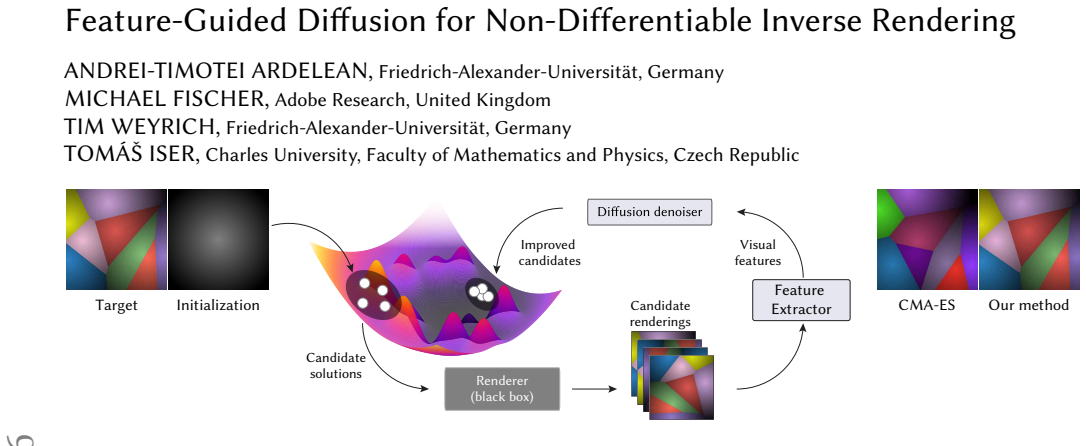
The central claim is that feature guiding—conditioning an online-trained diffusion proposer on dense visual features of rendered images rather than on scalar loss values—turns a challenging black-box inverse problem into a tractable one. FIDE treats the renderer as an opaque function, learns a mapping between image features and the parameters that produced them, and combines this with CMA-ES's covariance adaptation to narrow the search. The paper argues this resolves both the information bottleneck of scalar losses and the mode-averaging problem of direct inverse predictors, and supports it with experiments showing convergence across spline, robot-arm, camera-plus-light, Voronoi, and glass-b
What carries the argument
The carrying mechanism is a closed loop between two components: a diffusion denoiser (a small transformer with cross-attention over image feature tokens) that is trained online on the rendered population to predict clean parameters from noisy ones, conditioned on ViT features (DINOv3) of the target image; and CMA-ES, which supplies the anisotropic Gaussian search distribution used both to sample candidates and to set per-parameter noise during diffusion training. Only half of each iteration's samples are denoised before rendering, preserving diversity and preventing mode collapse. The synergy is that CMA-ES shrinks the region the denoiser must model, while the denoiser seeds CMA-ES with bett
Load-bearing premise
The claim that FIDE needs no specific initialization rests on the assumption that a fixed initial Gaussian centered at the midpoint of the normalized parameter domain, with standard deviation 1/6 so the whole domain lies within three sigmas, gives the search enough probability mass on the global optimum; the paper never varies this starting point across experiments.
What would settle it
Apply FIDE to a benchmark whose global optimum is a narrow valley near a corner or boundary of the normalized parameter space, using the paper's default initialization (mean 0.5, sigma 1/6). If FIDE consistently fails to find it while succeeding from a hand-placed initial mean near that corner, then the 'no specific initialization' claim is falsified. A simpler check: rerun the five reported tasks with the CMA-ES initial mean shifted to 0.9 in every coordinate and record any convergence collapse.
If this is right
- Gradient-free inverse rendering becomes practical for small-to-medium parameter counts, removing the need to derive or implement differentiable renderers.
- Feature guiding, not just the loss function, drives convergence: the method succeeds under MSE, LPIPS, and LOI losses, including tasks where all baselines fail under MSE.
- A single generic initialization suffices across diverse tasks, while a differentiable renderer diverges from the same starting point on the Beads task.
- Convergence scales smoothly to about 60 parameters, with 80 parameters requiring more than double the render budget; runtime per iteration stays roughly constant.
Where Pith is reading between the lines
- Because the denoiser is trained online, it effectively builds a local inverse model of the specific scene being optimized, a property that could enable warm-starting on subsequent targets in the same scene—an extension the paper does not test.
- The feature-guiding principle is likely transferable to other black-box functions with structured, spatial output (audio spectrograms, meshes, point clouds), provided a suitable feature extractor exists.
- The paper's fixed initialization means its 'no specific initialization' claim is really a claim about a reasonably broad default Gaussian; a task with a tiny global basin near the domain boundary would stress-test that claim more severely than the five benchmarks do.
- A natural next experiment is to ablate the ViT feature extractor against task-specific or cheaper features on higher-dimensional problems, since the paper shows graceful degradation but not whether learned features close the gap to pretrained ones.
Editorial analysis
A structured set of objections, weighed in public.
Referee Report
Summary. The paper proposes Feature-Informed Diffusion Evolution (FIDE), a black-box optimization method for inverse rendering. FIDE alternates between (i) a diffusion-model candidate proposer conditioned on dense visual features of rendered images (extracted by a frozen ViT) and (ii) a CMA-ES evolutionary update that refines the search distribution. The method treats the renderer as an opaque image-producing function and does not compute gradients. The authors claim that FIDE 'requires no gradients or specific initialization' and 'is able to converge to a global minimum, even in the presence of many local minima' (Sec. 1). The method is evaluated on five tasks (spline, robot arm, camera/light in San Miguel, Voronoi shader, and glass beads in a Cornell box) against CMA-ES, dual annealing, DiBO, and ZeroGrads, using MSE, LPIPS, and LOI losses, with 10 seeds per setup and median/quantile plots. Ablations cover feature extractors, training epochs, dimensionality, and a dual-annealing variant. The paper includes a supplementary with implementation details and additional results.
Significance. If the empirical results are accepted as stated, FIDE is a meaningful contribution to derivative-free inverse rendering: it is, to my knowledge, the first method to condition a generative diffusion proposer on dense image features extracted from a frozen pretrained network, and the idea of using CMA-ES's covariance to define the diffusion noise model is neat. The evaluation is broad and mostly careful: it includes several tasks, multiple loss functions, multiple baselines, 10 seeds, quantile plots, and ablations of feature extractors, epochs, and dimensionality. The paper does not ship machine-checked proofs or code, but the algorithmic description is sufficiently detailed to be replicable. The main weaknesses are that the strong claims of 'no specific initialization' and 'global minimum convergence' are not supported by the evidence as presented: the initialization is fixed to a centered broad Gaussian for all tasks, and no task with a known unique optimum is included. These issues are local and fixable, so the appropriate recommendation is major revision.
major comments (3)
- [Sec. 1 / Supplement S1] The claim that FIDE 'requires no specific initialization' and 'is robust to far-from-optimum initialization' is not supported by the experiments. Supplement S1 states that all tasks use the same initialization: mean 0.5 and sigma0 = 1/6, with the justification that the entire parameter space [0,1] is within 3 sigma. This is a strong, problem-specific prior centered at the middle of the domain. Moreover, in d dimensions a Gaussian with per-coordinate sigma = 1/6 concentrates most of its mass in a shell of radius roughly sqrt(d)/6; for d=40 the mass near the corners or boundaries of [0,1]^d is vanishingly small. If the optimum lies near a boundary or in a narrow basin outside this initial distribution, the method's claim of not requiring a specific initialization would break. The manuscript never varies the initial mean or initial covariance. I ask for an ablation that varies mu_0 (e.g., 0
- [Sec. 1 and Fig. 5/6] The statement that FIDE 'is able to converge to a global minimum, even in the presence of many local minima' is an empirical overreach. For the Spline task, the target is an ampersand font glyph that cannot be exactly reproduced by the optimized B-spline; the notion of 'global minimum' is therefore not defined (or at least not verifiable) for that task. For the other tasks, the paper reports only image losses (MSE/LPIPS/LOI), not parameter recovery error relative to a known ground truth. The evidence supports 'achieves lower image loss than baselines' or 'consistently finds better solutions', but not 'converges to a global minimum'. Please either remove the global-minimum claim or add an experiment with a known unique optimum and report parameter error.
- [Sec. 4.2 / Fig. 7] The comparison to differentiable rendering in Fig. 7 is used to support the broad conclusion that 'gradient-based methods require informed initialization' (Sec. 4.3). The figure shows four runs of Mitsuba 3's prb_projective integrator on the Beads task, all of which diverge, but the number of runs and the exact initialization are not specified in the text. This is acceptable as a motivating example, but it is not a systematic comparison; for a fair comparison, the paper should report the variance over seeds and the initialization used for Mitsuba, or soften the conclusion to 'on this task, the tested gradient-based method diverges'. As written, the claim 'gradient-based methods require informed initialization' is too broad for the evidence.
minor comments (5)
- [Fig. 5 / general] The legend 'Our overall best result' in Fig. 5 is unclear: it is not defined in the caption or text whether this is an oracle best over seeds, a separate curve, or something else. Please clarify.
- [Sec. 4.3 / statistical analysis] The evaluation reports medians and quantiles over 10 seeds, but no significance tests or confidence intervals. Given that the performance differences are visually substantial on some tasks, this is not a blocking issue, but adding a simple paired test (e.g., Wilcoxon) over the 10 runs would strengthen the claim.
- [Supplement S1] The supplement says source code will be released 'upon acceptance'. For a method whose main novelty is algorithmic, I would encourage the authors to release code with the revision or at least a reference implementation, since the paper would be much easier to build upon with code available.
- [Sec. 3.2 / Algorithm 1] Line 8 says 'Noise is sampled during training using Sigma', but the exact relationship between the CMA covariance matrix and the diffusion timestep is only described in the supplement (S1). Please include a brief explanation in the main text so that the algorithm is self-contained.
- [Sec. 4.3 / Fig. 9] The 'simple patch embedding' is a learnable, one-layer patch embedding. The text calls the degradation 'graceful', but the quantitative gap on San Miguel and Beads appears substantial. Please add a sentence quantifying the final LPIPS gap.
Circularity Check
No circular derivation; central claims are empirical against external baselines; fixed-center initialization is an unverified robustness claim, not a definitional reduction.
full rationale
The paper's central result is empirical: FIDE is compared against external baselines (CMA-ES, dual annealing, DiBO, ZeroGrads) under the same render-call budget, with shared hyperparameters stated in Supplement S1 ('we use the same hyperparameters across all five inverse rendering tasks ... population size k=500, number of evolution cycles N=50, initial standard deviation sigma=1/6'). The diffusion proposer is trained online on parameter-rendering pairs produced by the black-box renderer (Algorithm 1, line 8) and conditioned at inference on frozen DINOv3 features of the target (Algorithm 1, line 5); the target features are not part of the training loss, so the target-conditioned prediction is not a refit of the reported data. No parameter is fitted to the target image and then reported as a prediction. The closest thing to a circularity concern is the 'no specific initialization' claim: Supplement S1 fixes the CMA-ES mean at 0.5 and sigma0=1/6 so that 'the entire parameter space [0,1] is within 3 sigma of the initialization,' and no experiment varies the starting mean or initial covariance. That makes the robustness claim an unsupported generalization rather than a circular derivation; it is a correctness/evidence gap, not a definitional reduction. The paper contains self-citations (e.g., Fischer and Ritschel 2023/2024; Ardelean and Weyrich 2024), but they are contextual and not load-bearing for the main result; the differentiable-rendering comparison is independently demonstrated in Fig. 7. Accordingly, no specific circular step can be exhibited, and the appropriate finding is no significant circularity.
Axiom & Free-Parameter Ledger
free parameters (6)
- initial mean mu_0 =
0.5 (center of normalized [0,1] domain)
- initial standard deviation sigma_0 =
1/6
- diffusion Euler steps and schedule =
3 steps, schedule [0.3, 0.2, 0.1]
- population size k and iterations N =
k=500, N=50 (25,000 render calls)
- online training epochs =
20 epochs (Adam, lr 1e-3)
- denoising fraction =
50% of CMA samples denoised
axioms (4)
- domain assumption Frozen DINOv3 features provide a dense, informative conditioning signal for rendered images across all five task domains.
- domain assumption The renderer f and losses L are such that CMA-ES's Gaussian update is a reasonable model of the local loss landscape.
- domain assumption A small transformer denoiser trained online on k samples per iteration can learn a useful local inverse f^{-1} on the current CMA region.
- standard math Standard diffusion/ODE theory and the x-pred objective (Li and He 2025) apply to the anisotropic noise model with per-parameter timesteps.
read the original abstract
Inverse rendering is traditionally solved via differentiable renderers and gradient descent, which requires substantial problem-specific engineering and is prone to getting stuck in local minima due to ambiguities. Derivative-free approaches alleviate engineering requirements, but often heavily depend on a good problem initialization. In this work, we propose Feature-Informed Diffusion Evolution (FIDE), a fully black-box framework that requires no gradients or specific initialization: the renderer is treated as an opaque function whose only requirement is to produce images. Our key insight is feature guiding: rather than reducing each candidate rendering to a scalar loss value, we use a Vision Transformer (ViT) to extract dense visual features from it. We subsequently use these features to train a diffusion-based candidate proposal model, allowing the network to use visual cues to predict parameters that would match the target image. The candidate solutions proposed by this diffusion model are then refined in a closed loop with a CMA evolution strategy, continuously narrowing the proposal region as optimization progresses. We validate across diverse inverse problems from path tracing, vector splines, Voronoi shaders, and robotics, and demonstrate that feature-guiding substantially improves convergence over scalar-loss baselines and reliably escapes local minima where gradient-based methods stall.
Figures


Reference graph
Works this paper leans on
-
[1]
Advances in Neural Information Processing Systems , volume=
Autoinverse: Uncertainty aware inversion of neural networks , author=. Advances in Neural Information Processing Systems , volume=
-
[2]
Advances in neural information processing systems , volume=
Amortized synthesis of constrained configurations using a differentiable surrogate , author=. Advances in neural information processing systems , volume=
-
[3]
Advances in neural information processing systems , volume=
Improved techniques for training gans , author=. Advances in neural information processing systems , volume=
-
[4]
1994 , publisher=
Mixture density networks , author=. 1994 , publisher=
1994
-
[5]
arXiv preprint arXiv:1905.10108 , year=
Learning surrogate losses , author=. arXiv preprint arXiv:1905.10108 , year=
Pith/arXiv arXiv 1905
-
[6]
ACM Transactions on Graphics (TOG) , volume=
Differentiable monte carlo ray tracing through edge sampling , author=. ACM Transactions on Graphics (TOG) , volume=. 2018 , publisher=
2018
-
[7]
Proceedings of ICNN'95-international conference on neural networks , volume=
Particle swarm optimization , author=. Proceedings of ICNN'95-international conference on neural networks , volume=. 1995 , organization=
1995
-
[8]
Computer Graphics Forum , volume=
Goal-based caustics , author=. Computer Graphics Forum , volume=. 2011 , organization=
2011
-
[9]
IEEE transactions on automatic control , volume=
Multivariate stochastic approximation using a simultaneous perturbation gradient approximation , author=. IEEE transactions on automatic control , volume=. 2002 , publisher=
2002
-
[10]
Proceedings of the IEEE/CVF Conference on Computer Vision and Pattern Recognition , pages=
Nerf analogies: Example-based visual attribute transfer for nerfs , author=. Proceedings of the IEEE/CVF Conference on Computer Vision and Pattern Recognition , pages=
-
[11]
Proceedings of the IEEE/CVF International Conference on Computer Vision , pages=
Neural inverse rendering of an indoor scene from a single image , author=. Proceedings of the IEEE/CVF International Conference on Computer Vision , pages=
-
[12]
ACM Transactions on Graphics , volume=
Many-Worlds Inverse Rendering , author=. ACM Transactions on Graphics , volume=. 2025 , publisher=
2025
-
[13]
2009 , publisher=
Introduction to derivative-free optimization , author=. 2009 , publisher=
2009
-
[14]
Proceedings of the Computer Vision and Pattern Recognition Conference , pages=
Lirm: Large inverse rendering model for progressive reconstruction of shape, materials and view-dependent radiance fields , author=. Proceedings of the Computer Vision and Pattern Recognition Conference , pages=
-
[15]
arXiv preprint arXiv:2112.05814 , volume=
Deep vit features as dense visual descriptors , author=. arXiv preprint arXiv:2112.05814 , volume=
-
[16]
arXiv preprint arXiv:2304.07193 , year=
Dinov2: Learning robust visual features without supervision , author=. arXiv preprint arXiv:2304.07193 , year=
-
[17]
Proceedings of the IEEE/CVF international conference on computer vision , pages=
Emerging properties in self-supervised vision transformers , author=. Proceedings of the IEEE/CVF international conference on computer vision , pages=
-
[18]
Proceedings of the IEEE/CVF Conference on Computer Vision and Pattern Recognition , pages=
A sliced wasserstein loss for neural texture synthesis , author=. Proceedings of the IEEE/CVF Conference on Computer Vision and Pattern Recognition , pages=
-
[19]
arXiv preprint arXiv:1508.06576 , year=
A neural algorithm of artistic style , author=. arXiv preprint arXiv:1508.06576 , year=
-
[20]
arXiv preprint arXiv:2502.16824 , year=
Posterior inference with diffusion models for high-dimensional black-box optimization , author=. arXiv preprint arXiv:2502.16824 , year=
-
[21]
Proceedings of the IEEE conference on computer vision and pattern recognition , pages=
The unreasonable effectiveness of deep features as a perceptual metric , author=. Proceedings of the IEEE conference on computer vision and pattern recognition , pages=
-
[22]
arXiv preprint arXiv:1409.1556 , year=
Very deep convolutional networks for large-scale image recognition , author=. arXiv preprint arXiv:1409.1556 , year=
-
[23]
Diff-BBO: Diffusion-Based Inverse Modeling for Black-Box Optimization , author=
-
[24]
ACM SIGGRAPH 2024 Conference Papers , year=
RGBX: Image decomposition and synthesis using material- and lighting-aware diffusion models , author=. ACM SIGGRAPH 2024 Conference Papers , year=
2024
-
[25]
2025 IEEE/CVF Conference on Computer Vision and Pattern Recognition (CVPR) , year=
DiffusionRenderer: Neural Inverse and Forward Rendering with Video Diffusion Models , author=. 2025 IEEE/CVF Conference on Computer Vision and Pattern Recognition (CVPR) , year=
2025
-
[26]
ACM Transactions on Graphics (ToG) , volume=
Modular primitives for high-performance differentiable rendering , author=. ACM Transactions on Graphics (ToG) , volume=. 2020 , publisher=
2020
-
[27]
2022 , school=
Path-space differentiable rendering , author=. 2022 , school=
2022
-
[28]
d: Fast, modular and differentiable shader programming , author=
Slang. d: Fast, modular and differentiable shader programming , author=. ACM Transactions on Graphics (TOG) , volume=. 2023 , publisher=
2023
-
[29]
ACM Transactions on Graphics (TOG) , volume=
Reparameterizing discontinuous integrands for differentiable rendering , author=. ACM Transactions on Graphics (TOG) , volume=. 2019 , publisher=
2019
-
[30]
Proceedings of the IEEE/CVF Conference on Computer Vision and Pattern Recognition , pages=
Plateau-reduced differentiable path tracing , author=. Proceedings of the IEEE/CVF Conference on Computer Vision and Pattern Recognition , pages=
-
[31]
arXiv preprint arXiv:2404.09758 , year=
Transforming a non-differentiable rasterizer into a differentiable one with stochastic gradient estimation , author=. arXiv preprint arXiv:2404.09758 , year=
-
[32]
Proceedings of the Computer Vision and Pattern Recognition Conference , pages=
Locally Orderless Images for Optimization in Differentiable Rendering , author=. Proceedings of the Computer Vision and Pattern Recognition Conference , pages=
-
[33]
Proceedings of the IEEE/CVF International Conference on Computer Vision , pages=
Stochastic Gradient Estimation for Higher-order Differentiable Rendering , author=. Proceedings of the IEEE/CVF International Conference on Computer Vision , pages=
-
[34]
ACM Transactions on Graphics (TOG) , volume=
ZeroGrads: Learning Local Surrogates for Non-Differentiable Graphics , author=. ACM Transactions on Graphics (TOG) , volume=. 2024 , publisher=
2024
-
[35]
arXiv preprint arXiv:2006.15059 , year=
Computing light transport gradients using the adjoint method , author=. arXiv preprint arXiv:2006.15059 , year=
Pith/arXiv arXiv 2006
-
[36]
ACM Transactions on Graphics (TOG) , volume=
Radiative backpropagation: An adjoint method for lightning-fast differentiable rendering , author=. ACM Transactions on Graphics (TOG) , volume=. 2020 , publisher=
2020
-
[37]
ACM Transactions on Graphics (TOG) , volume=
Differentiable vector graphics rasterization for editing and learning , author=. ACM Transactions on Graphics (TOG) , volume=. 2020 , publisher=
2020
-
[38]
International Conference on Machine Learning , pages=
Diffusion models for black-box optimization , author=. International Conference on Machine Learning , pages=. 2023 , organization=
2023
-
[39]
Towards a new evolutionary computation: Advances in the estimation of distribution algorithms , pages=
The CMA evolution strategy: a comparing review , author=. Towards a new evolutionary computation: Advances in the estimation of distribution algorithms , pages=. 2006 , publisher=
2006
-
[40]
arXiv preprint arXiv:2511.13720 , year=
Back to basics: Let denoising generative models denoise , author=. arXiv preprint arXiv:2511.13720 , year=
-
[41]
Physica A: Statistical Mechanics and its Applications , volume=
Generalized simulated annealing , author=. Physica A: Statistical Mechanics and its Applications , volume=. 1996 , publisher=
1996
-
[42]
Journal of global optimization , volume=
Differential evolution--a simple and efficient heuristic for global optimization over continuous spaces , author=. Journal of global optimization , volume=. 1997 , publisher=
1997
-
[43]
SIAM journal on computing , volume=
Genetic algorithms and the optimal allocation of trials , author=. SIAM journal on computing , volume=. 1973 , publisher=
1973
-
[44]
arXiv preprint arXiv:2508.10104 , year=
Dinov3 , author=. arXiv preprint arXiv:2508.10104 , year=
-
[45]
Mitsuba 3 renderer , author =
-
[46]
Transactions on Graphics (Proceedings of SIGGRAPH) , volume =
Delio Vicini and Sébastien Speierer and Wenzel Jakob , title =. Transactions on Graphics (Proceedings of SIGGRAPH) , volume =. 2021 , month = aug, doi =
2021
-
[47]
Transactions on Graphics (Proceedings of SIGGRAPH) , volume =
Vicini, Delio and Speierer, Sébastien and Jakob, Wenzel , title =. Transactions on Graphics (Proceedings of SIGGRAPH) , volume =. 2022 , month = jul, pages =
2022
-
[48]
Transactions on Graphics (Proceedings of SIGGRAPH Asia) , volume =
Ziyi Zhang and Nicolas Roussel and Wenzel Jakob , title =. Transactions on Graphics (Proceedings of SIGGRAPH Asia) , volume =. 2023 , month = dec, doi =
2023
-
[49]
ACM Trans
Unbiased Warped-Area Sampling for Differentiable Rendering , author =. ACM Trans. Graph. , volume =. 2020 , publisher =
2020
-
[50]
ACM Trans
Warped-Area Reparameterization of Differential Path Integrals , author=. ACM Trans. Graph. , volume=. 2023 , pages=
2023
-
[51]
Kirk\-patrick and C
S. Kirk\-patrick and C. D. Gelatt and M. P. Vecchi , title =. Science , volume =. 1983 , doi =
1983
-
[52]
Proceedings of the 15th annual conference companion on Genetic and evolutionary computation , pages=
Bi-population CMA-ES agorithms with surrogate models and line searches , author=. Proceedings of the 15th annual conference companion on Genetic and evolutionary computation , pages=
-
[53]
2024 , url=
Yicong Hong and Kai Zhang and Jiuxiang Gu and Sai Bi and Yang Zhou and Difan Liu and Feng Liu and Kalyan Sunkavalli and Trung Bui and Hao Tan , booktitle=. 2024 , url=
2024
-
[54]
European Conference on Computer Vision , year=
Perceptual losses for real-time style transfer and super-resolution , author=. European Conference on Computer Vision , year=
-
[55]
2017 , publisher=
Derivative-free and blackbox optimization , author=. 2017 , publisher=
2017
-
[56]
Advances in neural information processing systems , volume=
Imagenet classification with deep convolutional neural networks , author=. Advances in neural information processing systems , volume=
-
[57]
Proceedings of the IEEE conference on computer vision and pattern recognition , pages=
High-resolution image synthesis and semantic manipulation with conditional gans , author=. Proceedings of the IEEE conference on computer vision and pattern recognition , pages=
-
[58]
European conference on computer vision , pages=
Neural point-based graphics , author=. European conference on computer vision , pages=. 2020 , organization=
2020
-
[59]
Entropy , volume=
Improving image super-resolution based on multiscale generative adversarial networks , author=. Entropy , volume=. 2022 , publisher=
2022
-
[60]
International conference on machine learning , pages=
Learning transferable visual models from natural language supervision , author=. International conference on machine learning , pages=. 2021 , organization=
2021
-
[61]
Proceedings of the IEEE/CVF Winter Conference on Applications of Computer Vision , pages=
High-fidelity zero-shot texture anomaly localization using feature correspondence analysis , author=. Proceedings of the IEEE/CVF Winter Conference on Applications of Computer Vision , pages=
-
[62]
European conference on computer vision , pages=
Neural codes for image retrieval , author=. European conference on computer vision , pages=. 2014 , organization=
2014
-
[63]
Computer graphics forum , volume=
Flexible svbrdf capture with a multi-image deep network , author=. Computer graphics forum , volume=. 2019 , organization=
2019
-
[64]
IEEE Robotics & Automation Magazine , volume=
The Franka Emika robot: a standard platform in robotics research [survey] , author=. IEEE Robotics & Automation Magazine , volume=. 2024 , publisher=
2024
-
[65]
2023 , version =
Nikolaus Hansen and Youhei Akimoto and Petr Baudis , title =. 2023 , version =
2023
-
[66]
Proceedings of the AAAI conference on artificial intelligence , volume=
Film: Visual reasoning with a general conditioning layer , author=. Proceedings of the AAAI conference on artificial intelligence , volume=
- [67]
-
[68]
2024 , url =
Genesis Authors , title =. 2024 , url =
2024
-
[69]
and Haberland, Matt and Reddy, Tyler and Cournapeau, David and Burovski, Evgeni and Peterson, Pearu and Weckesser, Warren and Bright, Jonathan and
Virtanen, Pauli and Gommers, Ralf and Oliphant, Travis E. and Haberland, Matt and Reddy, Tyler and Cournapeau, David and Burovski, Evgeni and Peterson, Pearu and Weckesser, Warren and Bright, Jonathan and. Nature Methods , year =
discussion (0)
Sign in with ORCID, Apple, or X to comment. Anyone can read and Pith papers without signing in.