REVIEW 3 major objections 4 minor 67 references
Gravitational wave propagation in Ho\v{r}ava-Lifshitz gravity
T0 review · 3 major / 4 minor · reviewed 2026-08-01 · deepseek-v4-flash
Pith's one-line read Horava-Lifshitz gravity predicts that gravitational waves acquire a frequency-dependent amplitude correction and a phase that grows with distance, while the polarization content remains identical to general relativity.
desk verdict The propagation waveform is derived cleanly and the LVK bound is a fair translation, but the luminosity/chirp section imports GR flux without justification and likely misses same-order corrections, so the paper needs revision before it is fully reliable. read the letter →
The pith
A machine-rendered reading of the paper's core claim, the machinery that carries it, and where it could break.
The reading
What carries the argument
The key object is the retarded Green function of the modified wave operator ∂_t² − ∇² + α∇⁴. Expanding the dispersion frequency Ω_k = k√(1+αk²) to first order in α, the Green function becomes a local combination of δ(t−r), δ″(t−r), and δ‴(t−r) supported on the GR light cone; convolving with the source produces the amplitude renormalization and the fifth-derivative term that, once resummed into an exponential, yields the accumulated phase −½αω³r. This phase resummation is what preserves the 1/r falloff and makes the propagation effect distinct from a local radiative contribution.
What would settle it
Derive the gravitational-wave energy-momentum tensor directly from the quadratic action (Eq. 10) to first order in α and compute the total luminosity for a quasi-circular binary. If the resulting chirp rate differs from f_dot = (96/5)π^{8/3}(GM_c)^{5/3} f^{11/3}(1 − 16π²αf²) by a term of order αω², the paper's luminosity and chirp predictions are incomplete. Alternatively, a numerical relativity simulation of a binary inspiral with the modified action that measures the phase evolution to order α would settle whether the propagation-phase formula is the whole story.
Extended reading notes
Core claim
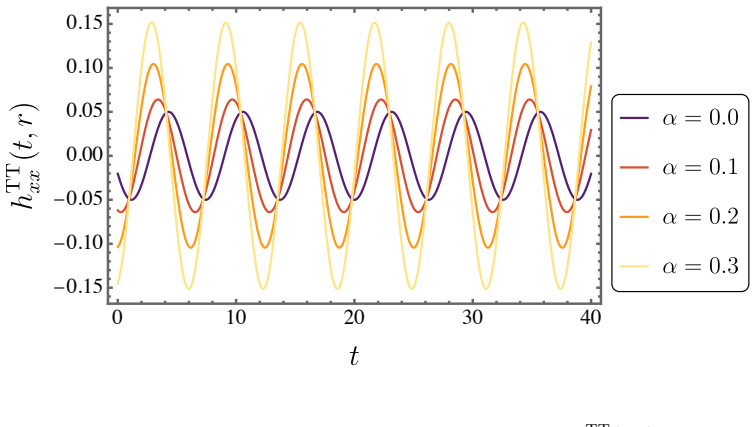
The central result is a one-parameter modification of the gravitational-wave waveform in the radiation zone: h̃_A(f,r) ≈ h̃_A^GR(f,r) (1 − 8π²αf²) exp(−4iπ³αf³r), where α is the coefficient of the k⁴ term in the tensor dispersion relation. The phase accumulates over the source–observer distance, while the amplitude correction is local and frequency dependent. For a quasi-circular binary, the fractional corrections to the luminosity and chirp rate are both −16π²αf², and the accumulated generation phase behaves like a relative third post-Newtonian contribution. The paper also shows that the correction acts diagonally on the two tensor polarizations, so it does not produce polarization mixing,
Load-bearing premise
The luminosity and chirp results assume that the gravitational-wave energy flux is given by the GR formula dP/dΩ = r²/(16πG)⟨ḣ₊² + ḣₓ²⟩ and that energy balance P = −dE_orb/dt holds, without deriving the flux from the Horava-Lifshitz action; the α(∇²h)² term contributes to the energy-momentum tensor at the same fractional order αω² as the claimed corrections, so the chirp evolution may be missing a same-order term.
Editorial extensions
If this is right
- Every compact-binary signal in Horava-Lifshitz gravity carries a phase shift −4π³αf³r, so distant high-frequency sources are the most sensitive probes: the bound improves with both catalog size and source distance.
- The polarization content stays identical to general relativity, so current tests of polarization and birefringence cannot discriminate this truncation; only amplitude, phase, and chirp measurements can.
- The derived GWTC-4.0 interval translates to a characteristic length scale ℓ_α = √|α| ≲ 4.9×10⁻⁶ m and energy scale Λ_α ≳ 4.0×10⁻² eV, which is far below the Planck scale but within reach of accumulated-phase measurements.
- In the LVK band the local expansion parameter |α|(2πf)² is below 10⁻²⁰, so the only observable effect is the distance-accumulated phase; local corrections are negligible.
- If the chirp correction −16π²αf² is confirmed, the inspiral rate itself carries the signature, providing a consistency check across independent channels.
Reading between the lines
- The paper imports the general-relativistic quadrupole energy-flux formula to compute luminosity and chirp. A first-principles derivation of the flux from the action (Eq. 10) would likely add a same-order αω² contribution to the energy-momentum tensor, so Eq. (99) may not be the complete leading-order chirp correction.
- The parity-odd k⁵ term, which the paper leaves to future work, would break the +/× degeneracy and produce helicity-dependent phase; the framework developed here can be extended to constrain that term separately in the same LVK parametrization.
- Because the phase shift grows linearly with distance, a single loud, high-redshift binary at high frequency could rival the combined bound of many nearby events; targeted searches for dephasing in far sources are a natural follow-up.
Editorial analysis
A structured set of objections, weighed in public.
Referee Report
Summary. This paper studies linearized tensor gravitational waves in the leading parity-even infrared truncation of Hořava–Lifshitz gravity, characterized by the modified wave equation (∂_t² − ∇² + α∇⁴) h_ij = 0. The authors construct the retarded Green function (Sec. IV.A), derive the radiation-zone waveform to first order in α (Sec. IV.B), and obtain the phase-resummed frequency-domain form h̃_A(f,r) ≃ h̃_A^GR(f,r) (1 − 8π²α f²) exp(−4iπ³α f³ r). They apply this to a circular binary, give polarization waveforms for arbitrary inclination, compute luminosity and adiabatic chirp corrections ΔP/P_GR = Δḟ/ḟ_GR = −16π²α f², and map α to the LVK β = 4 modified-dispersion parameter, obtaining −6.2×10² eV⁻² < α < 1.9×10² eV⁻² at 90% credibility from GWTC-4.0. The paper also discusses amplitude, chirp, and generation-phase constraints and their limitations.
Significance. Section IV is the strongest part of the manuscript: the Green-function computation is explicit, the distributional identities check, and the phase-resummed representation correctly avoids expanding the accumulated propagation phase. The mapping to the LVK dispersion framework (Sec. VI.A-B) is straightforward and yields a clean constraint on the Hořava–Lifshitz coefficient. The paper is also appropriately cautious in Sec. VI.E about not converting the amplitude and chirp relations directly into catalog bounds. However, the luminosity and chirp results (Sec. V.B-C) are not yet on the same footing: they import the GR energy-flux formula without deriving it from the Hořava–Lifshitz action, and the printed energy-balance chain contains inconsistencies. If those derivations are repaired, the paper would be a solid contribution to the gravitational-wave phenomenology of Hořava–Lifshitz gravity.
major comments (3)
- [Section V.B, Eq. (96)] The luminosity is obtained by substituting the modified waveform into the standard GR flux formula dP/dΩ = r²/(16πG)⟨ḣ_+² + ḣ_ײ⟩ (Maggiore). This formula is not derived from the Hořava–Lifshitz action (10). The quadratic action contains a term α(∇²h_ij)²; for a mode of frequency f each extra spatial derivative brings a factor k ∼ 2πf, so the energy-momentum/flux current receives contributions at relative order αω² — the same order as the claimed ΔP/P = −16π²αf². Without an explicit derivation of the energy flux from the action, Eqs. (97)-(99) are not established. The propagation-phase results in Eqs. (68)-(69) and (109) are unaffected, but the abstract's luminosity/chirp claims require either a proper flux derivation or an explicit statement that these results are heuristic under the GR flux prescription.
- [Section V.C, Eqs. (98)-(99)] The energy-balance chain as printed is internally inconsistent. Integrating Eq. (97) over solid angle yields a factor π^{10/3}, so Eq. (98) is missing π^{10/3} in (GM_c f_gw)^{10/3}. Moreover, the displayed orbital energy E_orb = −(G² M_c^5 ω_gw)^{1/3} has the wrong scaling: for a circular orbit the binding energy scales as ω_gw^{2/3}, not ω_gw^{1/3}, up to numerical factors. Starting from the printed P and E does not produce the quoted chirp equation (99). The standard form of Eq. (99) suggests the preceding factors are typographical, but as printed the derivation is not reproducible. Please correct the factors and show the full derivation, including the α correction, so that Eq. (99) actually follows.
- [Section VI.E, Eqs. (140)-(142)] The 'generation phase' correction δΨ_gen and the ppE coefficient β_ppE are obtained by applying the stationary-phase approximation to Eq. (134), which inherits both the unverified luminosity derivation and the inconsistencies of Eqs. (98)-(99). Until the chirp equation is re-derived from the action, the numerical coefficient and the claimed 3PN relative scaling in Eq. (142) should be regarded as provisional. The propagation-phase constraint (Eq. 144) is independent and can stand, but the generation-phase channel should be presented only after the energy-flux issue is resolved.
minor comments (4)
- [Section V headings] Sections V.A and V.B both carry the title 'Polarization waveforms for an arbitrary observation direction'. The second should be retitled (e.g., 'Energy flux and luminosity').
- [Section VI.D] The phrase 'after accounting conservatively for the possible' is duplicated in the sentence preceding Eq. (127).
- [Section VI.A] Typo: 'first=-order' should be 'first-order'.
- [Section V.C, Eq. (100)] Once Eq. (99) is re-derived consistently, the sign and coefficient of the α correction in the solution (100) should be rechecked; the solution is quoted without derivation.
Circularity Check
No significant circularity: waveform and phase corrections are derived from the assumed HL dispersion relation; the LVK constraint is an external posterior mapping; self-citations are not load-bearing.
full rationale
The central derivation is self-contained rather than circular. The retarded Green function (Eqs. 28-48) is constructed from the assumed modified wave operator ∂t² - ∇² + α∇⁴, and the radiation-zone waveform (Eqs. 60-69) follows by distributional convolution; the accumulated propagation phase δΨα = -1/2 αϖ³r (Eq. 70) is a direct expansion of the dispersion-relation phase, not a fitted or renamed input. The observational constraint (Sec. VI) is an explicit mapping A4 = α onto the externally reported GWTC-4.0 posterior, so no parameter of this paper is fitted to its own formulas. The self-references [50-54] (including refs. [51-53] by the same authors) appear only in the introductory survey of related work and are not used to justify the wave operator, Green function, or waveform; hence they are not load-bearing. The one substantive gap is the energy-flux/chirp section: Eq. (96) imports the GR flux formula dP/dΩ = r²/(16πG)⟨ḣ₊² + ḣₓ²⟩ from Maggiore without deriving it from the HL quadratic action (Eq. 10), so the α(∇²h)² term could contribute at the same order as the claimed ΔP/P and Δḟ/ḟ corrections. This is a potential correctness or omission issue, not a circular reduction: the α dependence in P and ḟ still follows from the independently derived waveform amplitudes, and no fitted parameter is being relabeled as a prediction. Overall, no equation reduces to its own input by construction, and the central propagation-phase claim is benchmarked against an external LVK posterior rather than against the paper's own fitted values.
Assumptions & free parameters
free parameters (1)
- alpha (Horava-Lifshitz k^4 coefficient) =
90% credible interval -6.2 x 10^2 to 1.9 x 10^2 eV^-2
assumptions (4)
- domain assumption The TT tensor sector of the leading parity-even HL truncation is governed by (partial_t^2 - nabla^2 + alpha nabla^4) h_ij = 16 pi G T_TT with the GR coupling strength.
- ad hoc to paper The gravitational-wave energy flux is given by the GR quadrupole formula dP/dOmega = r^2/(16 pi G) < h_dot_+^2 + h_dot_x^2 > applied to the modified waveform.
- domain assumption The binary evolves adiabatically through quasi-circular orbits with energy balance P_total = -dE_orb/dt_r.
- domain assumption The LVK modified-dispersion parametrization with beta=4, A_4=alpha and the group-velocity prescription is the correct mapping of the HL dispersion to the GWTC-4.0 posterior.
Cite this review
Pith. "Pith review of Gravitational wave propagation in Ho\v{r}ava-Lifshitz gravity." pith.science (2026). https://pith.science/paper/MZASXDJQ
@misc{pith2026260717431,
  author       = {Pith},
  title        = {Pith review of: Gravitational wave propagation in Ho\vrava-Lifshitz gravity},
  year         = {2026},
  howpublished = {\url{https://pith.science/paper/MZASXDJQ}},
  note         = {Machine review of arXiv:2607.17431}
}
abstract
We investigate the generation and propagation of gravitational waves in the leading parity-even infrared truncation of Ho\v{r}ava-Lifshitz gravity, characterized by the modified tensor dispersion relation $\omega^{2}=k^{2}+\alpha k^{4}$. Working in the transverse-traceless sector, we show that the higher-spatial-derivative correction preserves the conventional plus and cross polarizations and introduces neither polarization mixing, helicity splitting, nor gravitational birefringence. We construct the retarded Green function of the modified wave operator and derive the radiation-zone waveform to first order in $\alpha$. The resulting signal exhibits a frequency-dependent amplitude renormalization together with a dispersive propagation phase that accumulates over the source-observer distance. We apply the formalism to a binary black hole system in a quasi-circular orbit and obtain the polarization waveforms for an arbitrary observation direction. We further derive the corresponding energy flux, total luminosity, and adiabatic chirp evolution. In terms of the observed gravitational wave frequency $f$, the leading corrections satisfy $\Delta h_{A}/h_{A}^{\mathrm{GR}}=-8\pi^{2}\alpha f^{2}$ and $\Delta P/P_{\mathrm{GR}} =\Delta\dot{f}/\dot{f}_{\mathrm{GR}} =-16\pi^{2}\alpha f^{2}$, while the accumulated generation phase has the frequency dependence of a relative third post-Newtonian contribution. By mapping the Ho\v{r}ava-Lifshitz coefficient to the LIGO-Virgo-KAGRA modified-dispersion parametrization, we obtain $-6.2\times10^{2}\,\mathrm{eV}^{-2} <\alpha< 1.9\times10^{2}\,\mathrm{eV}^{-2}$ at $90\%$ credibility from the GWTC-4.0 posterior.
Figures


Figures from the paper (3 more)


Reference graph
Works this paper leans on
-
[51]
Gravitational-wave constraints on lorentz and parity violations in gravity: High-order spatial-derivative cases,
C. Gong, T. Zhu, R. Niu, Q. Wu, J.-L. Cui, X. Zhang, W. Zhao, and A. Wang, “Gravitational-wave constraints on lorentz and parity violations in gravity: High-order spatial-derivative cases,”Phys. Rev. D, vol. 105, p. 044034, 2022
2022
-
[1]
When it is not satisfied, the exact frequency Ω k should be retained rather than expanded inside the oscillatory functions
This additional condition is particularly relevant for propagation over large distances. When it is not satisfied, the exact frequency Ω k should be retained rather than expanded inside the oscillatory functions. The coordinate space kernel follows from the inverse spatial Fourier transformation. For an isotropic function ofk, we obtain Gret(t, r) = 1 2π2...
-
[2]
Quantum Gravity at a Lifshitz Point,
P. Horava, “Quantum Gravity at a Lifshitz Point,”Phys. Rev. D, vol. 79, p. 084008, 2009
2009
-
[3]
Renormalization of higher-derivative quantum gravity,
K. S. Stelle, “Renormalization of higher-derivative quantum gravity,”Phys. Rev. D, vol. 16, pp. 953– 969, 1977
1977
-
[4]
Phenomenologically viable lorentz-violating quantum gravity,
T. P. Sotiriou, M. Visser, and S. Weinfurtner, “Phenomenologically viable lorentz-violating quantum gravity,”Phys. Rev. Lett., vol. 102, p. 251601, 2009
2009
-
[5]
Spectral Dimension of the Universe in Quantum Gravity at a Lifshitz Point,
P. Horava, “Spectral Dimension of the Universe in Quantum Gravity at a Lifshitz Point,”Phys. Rev. Lett., vol. 102, p. 161301, 2009
2009
-
[6]
Hoˇ rava–lifshitz gravity: A status report,
T. P. Sotiriou, “Hoˇ rava–lifshitz gravity: A status report,”J. Phys. Conf. Ser., vol. 283, p. 012034, 2011
2011
-
[7]
Hoˇ rava–lifshitz cosmology: A review,
S. Mukohyama, “Hoˇ rava–lifshitz cosmology: A review,”Class. Quant. Grav., vol. 27, p. 223101, 2010
2010
Show all 67 references
-
[8]
Strong coupling in extended hoˇ rava–lifshitz gravity,
A. Papazoglou and T. P. Sotiriou, “Strong coupling in extended hoˇ rava–lifshitz gravity,”Phys. Lett. B, vol. 685, pp. 197–200, 2010
2010
-
[9]
Strong coupling in hoˇ rava gravity,
C. Charmousis, G. Niz, A. Padilla, and P. M. Saffin, “Strong coupling in hoˇ rava gravity,”JHEP, vol. 08, p. 070, 2009
2009
-
[10]
Models of non-relativistic quantum gravity: The good, the bad and the healthy,
D. Blas, O. Pujol` as, and S. Sibiryakov, “Models of non-relativistic quantum gravity: The good, the bad and the healthy,”JHEP, vol. 04, p. 018, 2011
2011
-
[11]
Consistent extension of hoˇ rava gravity,
D. Blas, O. Pujol` as, and S. Sibiryakov, “Consistent extension of hoˇ rava gravity,”Phys. Rev. Lett., vol. 104, p. 181302, 2010. 31
2010
-
[12]
Renormalization of hoˇ rava gravity,
A. O. Barvinsky, D. Blas, M. Herrero-Valea, S. M. Sibiryakov, and C. F. Steinwachs, “Renormalization of hoˇ rava gravity,”Phys. Rev. D, vol. 93, p. 064022, 2016
2016
-
[13]
Extended hoˇ rava gravity and einstein–aether theory,
T. Jacobson, “Extended hoˇ rava gravity and einstein–aether theory,”Phys. Rev. D, vol. 81, p. 101502, 2010
2010
-
[14]
Renormalization group flow of projectable hoˇ rava gravity in (3 + 1) dimensions,
A. O. Barvinsky, A. V. Kurov, and S. M. Sibiryakov, “Renormalization group flow of projectable hoˇ rava gravity in (3 + 1) dimensions,” 2024
2024
-
[15]
Hoˇ rava gravity is asymptotically free in 2 + 1 dimensions,
A. O. Barvinsky, D. Blas, M. Herrero-Valea, S. M. Sibiryakov, and C. F. Steinwachs, “Hoˇ rava gravity is asymptotically free in 2 + 1 dimensions,”Phys. Rev. Lett., vol. 119, p. 211301, 2017
2017
-
[16]
The status of hoˇ rava gravity,
M. Herrero-Valea, “The status of hoˇ rava gravity,” 2023
2023
-
[17]
Hoˇ rava gravity at a lifshitz point: A progress report,
A. Wang, “Hoˇ rava gravity at a lifshitz point: A progress report,”Int. J. Mod. Phys. D, vol. 26, p. 1730014, 2017
2017
-
[18]
Chiral primordial gravitational waves from a lifshitz point,
T. Takahashi and J. Soda, “Chiral primordial gravitational waves from a lifshitz point,”Phys. Rev. Lett., vol. 102, p. 231301, 2009
2009
-
[19]
Scale-invariant cosmological perturbations from hoˇ rava–lifshitz gravity without in- flation,
S. Mukohyama, “Scale-invariant cosmological perturbations from hoˇ rava–lifshitz gravity without in- flation,”JCAP, vol. 06, p. 001, 2009
2009
-
[20]
Polarizing primordial gravitational waves by parity viola- tion,
A. Wang, Q. Wu, W. Zhao, and T. Zhu, “Polarizing primordial gravitational waves by parity viola- tion,”Phys. Rev. D, vol. 87, p. 103512, 2013
2013
-
[21]
Vector and tensor perturbations in hoˇ rava–lifshitz cosmology,
A. Wang, “Vector and tensor perturbations in hoˇ rava–lifshitz cosmology,”Phys. Rev. D, vol. 82, p. 124063, 2010
2010
-
[22]
Gw170817: Observation of gravitational waves from a binary neutron star inspiral,
LIGO Scientific Collaboration and Virgo Collaboration, “Gw170817: Observation of gravitational waves from a binary neutron star inspiral,”Phys. Rev. Lett., vol. 119, p. 161101, 2017
2017
-
[23]
Observation of gravitational waves from a binary black hole merger,
LIGO Scientific Collaboration and Virgo Collaboration, “Observation of gravitational waves from a binary black hole merger,”Phys. Rev. Lett., vol. 116, p. 061102, 2016
2016
-
[24]
Gwtc–5.0: Ob- servations from the second part of the fourth ligo–virgo–kagra observing run and updates to the gravitational-wave transient catalog,
LIGO Scientific Collaboration and Virgo Collaboration and KAGRA Collaboration, “Gwtc–5.0: Ob- servations from the second part of the fourth ligo–virgo–kagra observing run and updates to the gravitational-wave transient catalog,” 2026
2026
-
[25]
Gravi- tational waves and gamma-rays from a binary neutron star merger: Gw170817 and grb 170817a,
LIGO Scientific Collaboration and Virgo Collaboration and Fermi GBM and INTEGRAL, “Gravi- tational waves and gamma-rays from a binary neutron star merger: Gw170817 and grb 170817a,” Astrophys. J. Lett., vol. 848, p. L13, 2017
2017
-
[26]
Ultraviolet modifications of dispersion relations in effective field theory,
R. C. Myers and M. Pospelov, “Ultraviolet modifications of dispersion relations in effective field theory,”Physical Review Letters, vol. 90, no. 21, p. 211601, 2003. 32
2003
-
[27]
Gwtc–4.0: Tests of general relativity. ii. parameterized tests,
LIGO Scientific Collaboration and Virgo Collaboration and KAGRA Collaboration, “Gwtc–4.0: Tests of general relativity. ii. parameterized tests,” 2026
2026
-
[28]
Planck-scale modified dispersion relations and finsler geom- etry,
F. Girelli, S. Liberati, and L. Sindoni, “Planck-scale modified dispersion relations and finsler geom- etry,”Physical Review D—Particles, Fields, Gravitation, and Cosmology, vol. 75, no. 6, p. 064015, 2007
2007
-
[29]
Modified dispersion relation, photon‘s velocity, and unruh effect,
B. R. Majhi and E. C. Vagenas, “Modified dispersion relation, photon‘s velocity, and unruh effect,” Physics Letters B, vol. 725, no. 4-5, pp. 477–480, 2013
2013
-
[30]
Modified dispersion relations from the renor- malization group of gravity,
F. Girelli, S. Liberati, R. Percacci, and C. Rahmede, “Modified dispersion relations from the renor- malization group of gravity,”Classical and Quantum Gravity, vol. 24, no. 16, pp. 3995–4008, 2007
2007
-
[31]
Planck-scale-modified dispersion relations in frw spacetime,
G. Rosati, G. Amelino-Camelia, A. Marciano, and M. Matassa, “Planck-scale-modified dispersion relations in frw spacetime,”Physical Review D, vol. 92, no. 12, p. 124042, 2015
2015
-
[32]
Modified dispersion relations in extra dimensions,
A. Sefiedgar, K. Nozari, and H. R. Sepangi, “Modified dispersion relations in extra dimensions,” Physics Letters B, vol. 696, no. 1-2, pp. 119–123, 2011
2011
-
[33]
Modified dispersion relations and black hole physics,
Y. Ling, B. Hu, and X. Li, “Modified dispersion relations and black hole physics,”Physical Review D—Particles, Fields, Gravitation, and Cosmology, vol. 73, no. 8, p. 087702, 2006
2006
-
[34]
Thermal analysis of photon-like particles in rainbow gravity,
J. Furtado, H. Hassanabadi, J. A. A. S. Reis,et al., “Thermal analysis of photon-like particles in rainbow gravity,”arXiv preprint arXiv:2305.08587, 2023
2023 arXiv
-
[35]
Particle production induced by a Lorentzian non-commutative spacetime,
A. A. Ara´ ujo Filho, “Particle production induced by a Lorentzian non-commutative spacetime,”An- nals Phys., vol. 481, p. 170167, 2025
2025
-
[36]
Thermodynamical properties of an ideal gas in a traversable wormhole,
A. A. Ara´ ujo Filho, J. Furtado, J. A. A. S. Reis, and J. Silva, “Thermodynamical properties of an ideal gas in a traversable wormhole,”Classical and Quantum Gravity, vol. 40, no. 24, p. 245001, 2023
2023
-
[37]
Particles in loop quantum gravity formalism: a thermodynamical description,
A. A. Ara´ ujo Filho, “Particles in loop quantum gravity formalism: a thermodynamical description,” Annalen der Physik, vol. 534, no. 12, p. 2200383, 2022
2022
-
[38]
A. A. Ara´ ujo Filho,Thermal aspects of field theories. Amazon. com, 2022
2022
-
[39]
How does geometry affect quantum gases?,
A. A. Ara´ ujo Filho and J. A. A. S. Reis, “How does geometry affect quantum gases?,”International Journal of Modern Physics A, vol. 37, no. 11n12, p. 2250071, 2022
2022
-
[40]
Scattering and absorption by extra-dimensional black holes with GUP,
M. A. Anacleto, J. A. V. Campos, F. A. Brito, E. Maciel, and E. Passos, “Scattering and absorption by extra-dimensional black holes with GUP,”Nucl. Phys. B, vol. 1006, p. 116617, 2024
2024
-
[41]
Implications of a simpson–visser solution in verlinde’s framework,
A. A. Ara´ ujo Filho, “Implications of a simpson–visser solution in verlinde’s framework,”The European Physical Journal C, vol. 84, no. 1, p. 73, 2024
2024
-
[42]
Noncommutative correction to the entropy of Schwarzschild black hole with GUP,
M. A. Anacleto, F. A. Brito, S. S. Cruz, and E. Passos, “Noncommutative correction to the entropy of Schwarzschild black hole with GUP,”Int. J. Mod. Phys. A, vol. 36, no. 03, p. 2150028, 2021
2021
-
[43]
Quasinormal modes and shadow of a Schwarzschild black hole with GUP,
M. A. Anacleto, J. A. V. Campos, F. A. Brito, and E. Passos, “Quasinormal modes and shadow of a Schwarzschild black hole with GUP,”Annals Phys., vol. 434, p. 168662, 2021
2021
-
[44]
Quantum-corrected scattering and 33 absorption of a Schwarzschild black hole with GUP,
M. A. Anacleto, F. A. Brito, J. A. V. Campos, and E. Passos, “Quantum-corrected scattering and 33 absorption of a Schwarzschild black hole with GUP,”Phys. Lett. B, vol. 810, p. 135830, 2020
2020
-
[45]
Noncommutative correction to the entropy of BTZ black hole with GUP,
M. A. Anacleto, F. A. Brito, B. R. Carvalho, and E. Passos, “Noncommutative correction to the entropy of BTZ black hole with GUP,”Adv. High Energy Phys., vol. 2021, p. 6633684, 2021
2021
-
[46]
Testing local lorentz invariance with gravitational waves,
V. A. Kosteleck´ y and M. Mewes, “Testing local lorentz invariance with gravitational waves,”Phys. Lett. B, vol. 757, pp. 510–514, 2016
2016
-
[47]
Constraining lorentz-violating, modified dispersion relations with gravitational waves,
S. Mirshekari, N. Yunes, and C. M. Will, “Constraining lorentz-violating, modified dispersion relations with gravitational waves,”Phys. Rev. D, vol. 85, p. 024041, 2012
2012
-
[48]
Testing general relativity with gravi- tational waves: Improving and extending modified dispersion relation tests,
T. Baka, B. Cirok, K. Haris, J. Noller, and N. V. Krishnendu, “Testing general relativity with gravi- tational waves: Improving and extending modified dispersion relation tests,” 2025
2025
-
[49]
Modified gravitational-wave propagation with higher modes and its degeneracies with lensing,
J. M. Ezquiaga, W. Hu, M. Lagos, M.-X. Lin, and F. Xu, “Modified gravitational-wave propagation with higher modes and its degeneracies with lensing,”JCAP, vol. 08, p. 016, 2022
2022
-
[50]
Modified gravitational-wave propagations in linearized gravity with lorentz and diffeomorphism violations and their gravitational-wave constraints,
Q. Wang, J.-M. Yan, T. Zhu, and W. Zhao, “Modified gravitational-wave propagations in linearized gravity with lorentz and diffeomorphism violations and their gravitational-wave constraints,” 2025
2025
-
[52]
Gravitational waves in a minimal gravitational SME,
A. A. Ara´ ujo Filho, N. Heidari, and I. P. Lobo, “Gravitational waves in a minimal gravitational SME,” Phys. Lett. B, vol. 875, p. 140350, 2026
2026
-
[53]
Propagation effects of Lorentz violation in gravita- tional waves,
A. A. Ara´ ujo Filho, N. Heidari, and I. P. Lobo, “Propagation effects of Lorentz violation in gravita- tional waves,”Eur. Phys. J. C, vol. 86, no. 6, p. 630, 2026
2026
-
[54]
Gravitational waves effects in a Lorentz–violating scenario,
K. M. Amarilo, M. B. F. Filho, A. A. A. Filho, and J. A. A. S. Reis, “Gravitational waves effects in a Lorentz–violating scenario,”Phys. Lett. B, vol. 855, p. 138785, 2024
2024
-
[55]
Gravitational waves in metric–affine bumblebee gravity,
A. A. Ara´ ujo Filho, “Gravitational waves in metric–affine bumblebee gravity,”Eur. Phys. J. C, vol. 86, no. 5, p. 578, 2026
2026
-
[56]
Gravitational waves and the polarizations in hoˇ rava gravity after gw170817,
Y. Gong, S. Hou, E. Papantonopoulos, and D. Tzortzis, “Gravitational waves and the polarizations in hoˇ rava gravity after gw170817,”Phys. Rev. D, vol. 98, p. 104017, 2018
2018
-
[57]
The trajec- tories remain circles centered at the origin because the two transverse–traceless components retain equal amplitudes and a phase difference ofπ/2
for details) h+(t;θ, ϕ) = G r h ¨I TT eff 11 (cos2 ϕ−sin 2 ϕcos 2 θ) + ¨I TT eff 22 (sin2 ϕ−cos 2 ϕcos 2 θ)− ¨I TT eff 33 sin2 θ − ¨I TT eff 12 sin 2ϕ(1 + cos2 θ) + ¨I TT eff 13 sinϕsin 2θ+ ¨I TT eff 23 cosϕsin 2θ i ,(89) 19 -0.04 -0.02 0.00 0.02 0.04 -0.04 -0.02 0.00 0.02 0.0...
2025
-
[58]
Gravitational radiation in hoˇ rava gravity,
D. Blas and H. Sanctuary, “Gravitational radiation in hoˇ rava gravity,”Phys. Rev. D, vol. 84, p. 064004, 2011
2011
-
[59]
Maggiore,Gravitational Waves
M. Maggiore,Gravitational Waves. Vol. 1: Theory and Experiments. Oxford University Press, 2007
2007
-
[60]
Goldstein, C
H. Goldstein, C. Poole, and J. Safko,Classical Mechanics. San Francisco, USA: Addison-Wesley, 3rd ed., 2002
2002
-
[61]
GWTC- 5.0: Observations from the Second Part of the Fourth LIGO–Virgo–KAGRA Observing Run and Updates to the Gravitational-Wave Transient Catalog,
The LIGO Scientific Collaboration, the Virgo Collaboration, and the KAGRA Collaboration, “GWTC- 5.0: Observations from the Second Part of the Fourth LIGO–Virgo–KAGRA Observing Run and Updates to the Gravitational-Wave Transient Catalog,” 2026
2026
-
[62]
GWTC- 4.0: Tests of General Relativity. II. Parameterized Tests,
The LIGO Scientific Collaboration, the Virgo Collaboration, and the KAGRA Collaboration, “GWTC- 4.0: Tests of General Relativity. II. Parameterized Tests,” 2026
2026
-
[63]
Constraining Lorentz-Violating, Modified Dispersion Rela- 34 tions with Gravitational Waves,
S. Mirshekari, N. Yunes, and C. M. Will, “Constraining Lorentz-Violating, Modified Dispersion Rela- 34 tions with Gravitational Waves,”Phys. Rev. D, vol. 85, p. 024041, 2012
2012
-
[64]
Modified Gravitational Wave Propagation with Higher Modes and Its Degeneracies with Lensing,
J. M. Ezquiaga, W. Hu, M. Lagos, M.-X. Lin, and F. Xu, “Modified Gravitational Wave Propagation with Higher Modes and Its Degeneracies with Lensing,”JCAP, vol. 08, p. 016, 2022
2022
-
[65]
Testing General Relativity with Gravitational Waves: Improving and Extending Modified Dispersion Relation Tests,
T. Baka, B. Cirok, K. Haris, J. Noller, and N. V. Krishnendu, “Testing General Relativity with Gravitational Waves: Improving and Extending Modified Dispersion Relation Tests,” 2025
2025
-
[66]
Gravitational Waves and Gamma-Rays from a Binary Neutron Star Merger: GW170817 and GRB 170817A,
LIGO Scientific Collaboration, Virgo Collaboration, Fermi GBM, and INTEGRAL, “Gravitational Waves and Gamma-Rays from a Binary Neutron Star Merger: GW170817 and GRB 170817A,”As- trophys. J. Lett., vol. 848, no. 2, p. L13, 2017
2017
-
[67]
Fundamental Theoretical Bias in Gravitational Wave Astrophysics and the Parameterized Post-Einsteinian Framework,
N. Yunes and F. Pretorius, “Fundamental Theoretical Bias in Gravitational Wave Astrophysics and the Parameterized Post-Einsteinian Framework,”Phys. Rev. D, vol. 80, p. 122003, 2009. 35
2009
Reviewed August 1, 2026 · model on record in the stance chip above.
Discussion (0). Sign in to comment.