REVIEW 3 major objections 5 minor 29 references
Retrieval-Augmented Interpretable Learning: Towards Task-Specific Zero-Shot Models in Healthcare
T0 review · 3 major / 5 minor · reviewed 2026-08-04 · deepseek-v4-flash
Pith's one-line read A natural-language description plus a memory of prior task predictors is enough to synthesize an interpretable linear clinical model, reaching about 73% accuracy with no task-specific labels.
desk verdict RAIL is a genuinely novel probabilistic framework for zero-shot interpretable predictors, but the headline 73.4% zero-shot accuracy is undermined by a likely patient-level overlap between source-task training and target-task evaluation that the paper never rules out. read the letter →
The pith
A machine-rendered reading of the paper's core claim, the machinery that carries it, and where it could break.
The reading
What carries the argument
The load-bearing object is the parametric memory: task embeddings as semantic keys and logistic-regression coefficients as values. Given a target description, a cosine-similarity retrieval prior defines a candidate set; a learned categorical retriever, regularized toward that prior by a KL term, produces retrieval weights; and a multi-head cross-attention generator reads the retrieved coefficient vectors and emits the mean and diagonal variance of a Gaussian coefficient prior. Variational inference with a weighted ELBO ties the pieces together: the likelihood term trains generated coefficients to predict labels, the coefficient KL anchors the posterior to the retrieved prior, and the retriev
What would settle it
Split the clinical database so that no patient appears in both the source-task training admissions and the zero-shot evaluation admissions, then rerun the held-out zero-shot protocol. If accuracy falls noticeably below the reported 73.4%, part of the claimed transfer comes from overlapping patients rather than from coefficient transfer between semantically related tasks; if accuracy stays near 73%, the retrieval mechanism is doing the work.
Extended reading notes
Core claim
The central claim, on the paper's own terms, is that coefficient-space transfer is a viable route to zero-shot clinical prediction. Each stored task is a pair: a text embedding of the procedure description and the coefficient vector of a logistic-regression model fit on shared diagnostic features. For a new task described only in text, RAIL uses cosine similarity to select candidate source tasks, a learned retriever to re-weight them, and a multi-head attention generator to synthesize a Gaussian prior over the target coefficients. In zero-shot deployment, the prior mean is the model; in few-shot mode, the posterior mean interpolates between this prior and a task-specific logistic-regression
Load-bearing premise
The whole mechanism rests on the assumption that procedures whose text descriptions are close in the embedding space also need similar coefficients in the 217-feature diagnostic space; the paper verifies this only within one hospital system's procedure list, and its own ablations show that random retrieval drops accuracy from 73.4% to 65.9%, so the semantic-retrieval assumption is doing real work.
Editorial extensions
If this is right
- Newly defined or rare procedures can receive a deployed, inspectable predictor immediately from their text description, without waiting for labels to accumulate.
- With only 2-4 labeled examples, RAIL keeps roughly 73% accuracy while task-specific logistic regression degrades to about 55%, so the method's value is concentrated exactly in the low-data tail.
- The method's success is bounded by the quality of the task-text embedding and the coverage of the memory; clinically informed embeddings outperform generic ones, and random retrieval collapses accuracy.
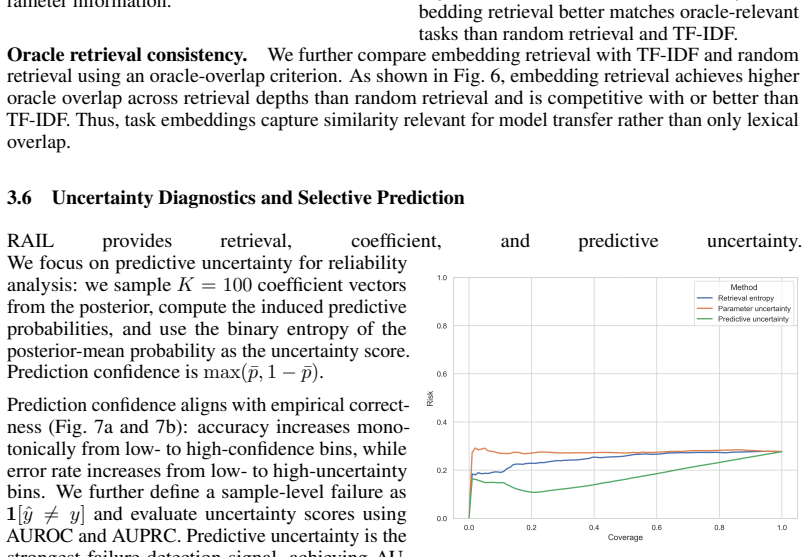
- RAIL's uncertainty estimates can support selective prediction: keeping only low-uncertainty predictions reduces risk as coverage shrinks, enabling deferral of uncertain cases to clinicians.
- Coefficient-level posterior intervals distinguish stable from unstable feature explanations, making the interpretability itself uncertainty-aware.
Reading between the lines
- A natural extension the paper leaves implicit: the same recipe should apply to any domain with a fixed feature space and a long-tailed label distribution, such as medication orders, imaging follow-ups, or non-clinical operational tasks, since nothing in the mechanism is procedure-specific.
- Because the generator outputs a distribution over coefficients rather than a point model, one testable extension is to use multiple sampled models as an ensemble at prediction time; the paper uses sampling mainly for uncertainty, not for accuracy gains.
- A consequence worth checking outside the reported data: if the text encoder is changed but still clinically informed, retrieval should stay useful as long as the embedding space preserves procedure semantics; the paper's compression experiments hint at this but do not test reordering or retraining the encoder.
- The selective-prediction result suggests a clinician-in-the-loop deployment protocol, but the paper does not measure the cost of false flags or the clinician time needed to review them.
Editorial analysis
A structured set of objections, weighed in public.
Referee Report
Summary. The paper introduces RAIL, a probabilistic meta-learning framework that generates task-specific interpretable linear predictors in a zero-shot manner from a natural-language task description and a memory of previously learned task-specific coefficients. A frozen text encoder embeds task descriptions; a learned retriever selects source tasks by cosine similarity plus a learned score; a multi-head cross-attention generator maps the retrieved coefficient values to a Gaussian prior over the target coefficients. Training uses an ELBO objective with retrieval and coefficient KL regularizers. The method is evaluated on MIMIC-IV clinical procedure prediction tasks across supervised, few-shot, and zero-shot regimes, reporting 73.4% zero-shot accuracy and 73.2% few-shot accuracy, with a range of ablations and uncertainty diagnostics. The authors also provide an ELBO derivation and a Rademacher-complexity generalization bound in the appendix.
Significance. If the empirical claims hold, RAIL is a meaningful contribution: it combines retrieval-augmented generation, meta-learning, and interpretable linear models in a way that produces inspectable, uncertainty-aware predictors for new clinical tasks without task-specific labels. The paper's strengths include a carefully specified probabilistic model, a complete ELBO derivation (Appendix F.1), a correct Rademacher bound (Appendix F.2), extensive ablations (retrieval perturbations, text encoders, embedding corruption), and uncertainty-based selective prediction analyses. The central claim, however, rests on the validity of the zero-shot evaluation and on the absence of patient-level information leakage between source-task training sets and target-task evaluation sets. The manuscript does not currently establish this, and the abstract's characterization of the few-shot supervised baseline as 'close to chance' is not supported by the reported numbers. These issues are load-bearing for the headline result, so the contribution is significant but conditional on a re-evaluation with proper patient-level splitting.
major comments (3)
- [§3.1, Appendix B] Patient-level leakage between source-task training and zero-shot evaluation is not ruled out. The dataset construction in Appendix B states that all tasks are built from the same admissions and that each task is split 50/50 within the task, but it does not partition admissions by patient identity. A single admission can have multiple procedures, so an admission used for zero-shot evaluation of target procedure A can appear in the training set of a retrieved source procedure B. The main text says 'target tasks are completely excluded from the retrieval memory: their descriptions, patient samples, labels, and task-specific coefficients are unseen during inference,' but this only excludes the target task's own samples from the memory; it does not prevent the same patients from entering the memory through other tasks' training sets. If such overlap exists, the reported 73.4% zero-shot accura
- [Abstract vs. Table 3] The abstract states that in the extreme few-shot regime (2–4 examples) 'supervised task-specific models perform close to chance.' This is contradicted by Table 3, which reports a task-specific LR oracle accuracy of 0.550 in the 2–4 regime, substantially above the 0.5 chance level, and an F1 of 0.424. While F1 is weaker, accuracy is not 'close to chance.' This overstatement appears in the paper's headline comparison and should be corrected; otherwise the claimed advantage of RAIL in the few-shot regime is misrepresented.
- [Appendix F.2, Eq. (33)] The generalization bound in Proposition 1 assumes the retrieval-conditioned prior mean µ_phi,t is fixed independently of the target-task sample. If, as described in Appendix B, the source-task training sets that determine µ_phi,t contain the same admissions as the target-task evaluation sample, this independence assumption is violated: the prior is then constructed from features of exactly the units being predicted. The bound therefore does not apply to the actual zero-shot evaluation under the current data construction. This is not an error in the Rademacher argument itself, but it is an omitted condition that must be stated and satisfied for the bound to support the paper's generalization claims.
minor comments (5)
- [§2.3–2.4] The retrieval hyperparameters S, k, tau_p, and tau_q appear in Eqs. (4), (8), and (9) but are never given concrete values in the main text or appendix. Since k and S control the retrieval mechanism and its computational cost, reporting their values would improve reproducibility.
- [Figure 1 caption] The caption contains garbled fragments such as 'Task emb. th' and 'Features and labels th Task pool'; these appear to be LaTeX artifacts and should be cleaned.
- [§3.2] The sentence 'RAIL remains comparatively stable, with F1 between 0.70 and 0.75' is not precisely consistent with Table 3, which reports F1=0.7129 in the 2–4 regime; the range is technically correct but the wording implies a tighter band. Clarify the intended claim.
- [Appendix F.1] The ELBO derivation is sound, but the phrase 'the exact set-valued view' followed by 'the closed-form categorical KL below corresponds to this implemented relaxation' is slightly confusing. A sentence clarifying that the objective is optimized over the categorical relaxation, not the set-valued distribution, would help the reader avoid misinterpretation.
- [§3.8] The limitations paragraph acknowledges dependence on task-memory coverage and the associational nature of the linear explanations. This is helpful, but it could be more specific: the paper does not characterize how performance degrades as the number of source tasks shrinks, nor does it test retrieval on out-of-domain task descriptions. A sentence noting this would be useful.
Circularity Check
No circularity: zero-shot targets are excluded from the memory, generated coefficients are a forward-pass function of description and retrieved source coefficients, not a fit to target labels.
full rationale
RAIL's zero-shot inference is not circular. Target tasks in zero-shot evaluation are explicitly excluded from the retrieval memory ('their descriptions, patient samples, labels, and task-specific coefficients are unseen during inference'), and the synthesized model is the prior mean μ_φ,t produced by a fixed generator-retriever from the target description and retrieved source entries. Neither retrieval weights nor generated coefficients are fitted to target labels, so the reported 73.4% accuracy is a genuine held-out evaluation rather than a refit. Source-task coefficients are inputs to a learned synthesis, not renamed target predictions; the comparison with Top-k averaging and retrieval-free baselines shows the synthesis adds content. The paper's self-citations [2,3,4] are motivational framing, not load-bearing uniqueness theorems or ansatz imports. The ablation diagnostics (random/distant retrieval) and the external MIMIC-IV benchmark make the central mechanism independently testable. The strongest concern in the manuscript—patient overlap between source and target admissions—is a data-leakage/correctness risk, not a definitional circularity, and is outside the circularity scoring rubric. No step reduces by construction to its input.
Assumptions & free parameters
free parameters (4)
- Generator/retriever neural network weights =
not disclosed
- Posterior gate alpha (Eq. 12) =
not disclosed
- KL weights beta_theta and beta_I (Eq. 30) =
not reported
- Retrieval hyperparameters S, k, tau_p, tau_q (Eqs. 4, 8-9) =
not reported
assumptions (5)
- domain assumption Cosine similarity in the frozen task-embedding space is a valid proxy for coefficient transferability
- domain assumption Procedure-administration decisions are approximately linear in the 217 lab features
- standard math Standard variational inference machinery (Jensen's inequality, mean-field factorization)
- standard math Standard Rademacher complexity and Lipschitz contraction inequalities
- domain assumption Frozen text encoders (MedEmbed-large-v0.1, DistilBERT) encode clinically meaningful task semantics
invented entities (1)
-
Retrieval latent I_t (set of S source-task memory entries)
Cite this review
Pith. "Pith review of Retrieval-Augmented Interpretable Learning: Towards Task-Specific Zero-Shot Models in Healthcare." pith.science (2026). https://pith.science/paper/DZWYDSL5
@misc{pith2026260717508,
  author       = {Pith},
  title        = {Pith review of: Retrieval-Augmented Interpretable Learning: Towards Task-Specific Zero-Shot Models in Healthcare},
  year         = {2026},
  howpublished = {\url{https://pith.science/paper/DZWYDSL5}},
  note         = {Machine review of arXiv:2607.17508}
}
read the original abstract
We introduce Retrieval-Augmented Interpretable Learning (RAIL), a probabilistic meta-learning framework for zero-shot generation of task-specific interpretable models that synthesizes coefficient-space structure from natural-language task descriptions and a memory of previously learned task-specific predictors. RAIL retrieves related source tasks, transfers structure through coefficient space, and generates a new predictor in the original diagnostic-feature space, enabling zero-shot and few-shot clinical procedure prediction with feature-level explanations. Its probabilistic formulation provides uncertainty over retrieval, model coefficients, and predictions, supporting reliability-aware deployment: uncertain predictions or unstable explanations can be flagged for additional clinical review rather than treated as automatic decisions. This makes RAIL particularly suited for healthcare settings, where prediction tasks are highly long-tailed, new clinical targets arise frequently, and models must remain inspectable, uncertainty-aware, and compatible with human oversight. Across long-tailed clinical procedure prediction tasks, RAIL maintains reliable performance across data-availability regimes: it achieves 73.4% accuracy in the held-out zero-shot settings, where no supervised task-specific model can be trained, and remains near 73.2% accuracy in the extreme few-shot regime with only 2-4 examples, where supervised task-specific models perform close to chance. RAIL further benefits from clinically informed task representations and yields retrieval, uncertainty, and coefficient-level diagnostics that make model behavior more transparent. These results suggest a path toward scalable clinical prediction systems that can adapt to new tasks while preserving interpretability and reliability.
Figures


Figures from the paper (13 more)




Reference graph
Works this paper leans on
-
[1]
Meta-learning in neural networks: A survey.IEEE transactions on pattern analysis and machine intelligence, 44(9):5149–5169, 2021
Timothy Hospedales, Antreas Antoniou, Paul Micaelli, and Amos Storkey. Meta-learning in neural networks: A survey.IEEE transactions on pattern analysis and machine intelligence, 44(9):5149–5169, 2021
2021
-
[2]
Contextualized machine learning.arXiv preprint arXiv:2310.11340, 2023
Benjamin Lengerich, Caleb N Ellington, Andrea Rubbi, Manolis Kellis, and Eric P Xing. Contextualized machine learning.arXiv preprint arXiv:2310.11340, 2023
arXiv 2023
-
[3]
Learning to estimate sample-specific transcriptional networks for 7,000 tumors.Proceedings of the National Academy of Sciences, 122(21):e2411930122, 2025
Caleb N Ellington, Benjamin J Lengerich, Thomas BK Watkins, Jiekun Yang, Abhinav K Adduri, Sazan Mahbub, Hanxi Xiao, Manolis Kellis, and Eric P Xing. Learning to estimate sample-specific transcriptional networks for 7,000 tumors.Proceedings of the National Academy of Sciences, 122(21):e2411930122, 2025
2025
-
[4]
Contextualized policy recovery: Modeling and interpreting medical decisions with adaptive imitation learning
Jannik Deuschel, Caleb Ellington, Yingtao Luo, Ben Lengerich, Pascal Friederich, and Eric P Xing. Contextualized policy recovery: Modeling and interpreting medical decisions with adaptive imitation learning. InForty-first International Conference on Machine Learning, 2024
2024
-
[5]
Large language models in medicine.Nature medicine, 29(8):1930–1940, 2023
Arun James Thirunavukarasu, Darren Shu Jeng Ting, Kabilan Elangovan, Laura Gutierrez, Ting Fang Tan, and Daniel Shu Wei Ting. Large language models in medicine.Nature medicine, 29(8):1930–1940, 2023
1930
-
[6]
Guiding pretraining in reinforcement learning with large language models, 2023
Yuqing Du, Olivia Watkins, Zihan Wang, Cédric Colas, Trevor Darrell, Pieter Abbeel, Abhishek Gupta, and Jacob Andreas. Guiding pretraining in reinforcement learning with large language models, 2023
2023
-
[7]
Lagr-seq: Language-guided reinforcement learning with sample-efficient querying, 2023
Thommen George Karimpanal, Laknath Buddhika Semage, Santu Rana, Hung Le, Truyen Tran, Sunil Gupta, and Svetha Venkatesh. Lagr-seq: Language-guided reinforcement learning with sample-efficient querying, 2023
2023
-
[8]
Adarefiner: Refining decisions of language models with adaptive feedback, 2024
Wanpeng Zhang and Zongqing Lu. Adarefiner: Refining decisions of language models with adaptive feedback, 2024
2024
Show all 29 references
-
[9]
Zero-shot robustification of zero-shot models, 2024
Dyah Adila, Changho Shin, Linrong Cai, and Frederic Sala. Zero-shot robustification of zero-shot models, 2024
2024
-
[10]
Causal discovery with language models as imperfect experts, 2023
Stephanie Long, Alexandre Piché, Valentina Zantedeschi, Tibor Schuster, and Alexandre Drouin. Causal discovery with language models as imperfect experts, 2023
2023
-
[11]
Discovery of the hidden world with large language models, 2024
Chenxi Liu, Yongqiang Chen, Tongliang Liu, Mingming Gong, James Cheng, Bo Han, and Kun Zhang. Discovery of the hidden world with large language models, 2024
2024
-
[12]
Health-llm: Personalized retrieval-augmented disease prediction system.arXiv preprint arXiv:2402.00746, 2024
Mingyu Jin, Qinkai Yu, Dong Shu, Chong Zhang, Lizhou Fan, Wenyue Hua, Suiyuan Zhu, Yanda Meng, Zhenting Wang, Mengnan Du, et al. Health-llm: Personalized retrieval-augmented disease prediction system.arXiv preprint arXiv:2402.00746, 2024. 10
2024 arXiv
-
[13]
Attention is all you need.Advances in neural information processing systems, 30, 2017
Ashish Vaswani, Noam Shazeer, Niki Parmar, Jakob Uszkoreit, Llion Jones, Aidan N Gomez, Łukasz Kaiser, and Illia Polosukhin. Attention is all you need.Advances in neural information processing systems, 30, 2017
2017
-
[14]
Mimic-iv, a freely accessible electronic health record dataset.Scientific data, 10(1):1, 2023
Alistair EW Johnson, Lucas Bulgarelli, Lu Shen, Alvin Gayles, Ayad Shammout, Steven Horng, Tom J Pollard, Sicheng Hao, Benjamin Moody, Brian Gow, et al. Mimic-iv, a freely accessible electronic health record dataset.Scientific data, 10(1):1, 2023
2023
-
[15]
What clinicians want: contextualizing explainable machine learning for clinical end use
Sana Tonekaboni, Shalmali Joshi, Melissa D McCradden, and Anna Goldenberg. What clinicians want: contextualizing explainable machine learning for clinical end use. InMachine learning for healthcare conference, pages 359–380. PMLR, 2019
2019
-
[16]
Learning sample-specific models with low-rank personalized regression.Advances in Neural Information Processing Systems, 32, 2019
Ben Lengerich, Bryon Aragam, and Eric P Xing. Learning sample-specific models with low-rank personalized regression.Advances in Neural Information Processing Systems, 32, 2019
2019
-
[17]
Meta-learning approaches for causal discovery in dynamic healthcare and robotics environments.Mesopotamian Journal of Artificial Intelligence in Healthcare, 2025:136–153, 2025
Hayder Abbood MD. Meta-learning approaches for causal discovery in dynamic healthcare and robotics environments.Mesopotamian Journal of Artificial Intelligence in Healthcare, 2025:136–153, 2025
2025
-
[18]
Metapred: Meta- learning for clinical risk prediction with limited patient electronic health records
Xi Sheryl Zhang, Fengyi Tang, Hiroko H Dodge, Jiayu Zhou, and Fei Wang. Metapred: Meta- learning for clinical risk prediction with limited patient electronic health records. InProceedings of the 25th ACM SIGKDD international conference on knowledge discovery & data mining, pag...
2019
-
[19]
Metacare++: Meta-learning with hierarchical subtyping for cold-start diagnosis prediction in healthcare data
Yanchao Tan, Carl Yang, Xiangyu Wei, Chaochao Chen, Weiming Liu, Longfei Li, Jun Zhou, and Xiaolin Zheng. Metacare++: Meta-learning with hierarchical subtyping for cold-start diagnosis prediction in healthcare data. InProceedings of the 45th International ACM SIGIR Conference ...
2022
-
[20]
Retrieval-augmented generation for knowledge-intensive nlp tasks.Advances in Neural Information Processing Systems, 33:9459–9474, 2020
Patrick Lewis, Ethan Perez, Aleksandra Piktus, Fabio Petroni, Vladimir Karpukhin, Naman Goyal, Heinrich Küttler, Mike Lewis, Wen-tau Yih, Tim Rocktäschel, et al. Retrieval-augmented generation for knowledge-intensive nlp tasks.Advances in Neural Information Processing Systems,...
2020
-
[21]
Retrieval-augmented generation for large language models: A survey.arXiv preprint arXiv:2312.10997, 2023
Yunfan Gao, Yun Xiong, Xinyu Gao, Kangxiang Jia, Jinliu Pan, Yuxi Bi, Yi Dai, Jiawei Sun, and Haofen Wang. Retrieval-augmented generation for large language models: A survey.arXiv preprint arXiv:2312.10997, 2023
2023 arXiv
-
[22]
Prism: Enhancing protein inverse folding through fine-grained retrieval on structure-sequence multimodal representations.arXiv preprint arXiv:2510.11750, 2025
Sazan Mahbub, Souvik Kundu, and Eric P Xing. Prism: Enhancing protein inverse folding through fine-grained retrieval on structure-sequence multimodal representations.arXiv preprint arXiv:2510.11750, 2025
2025
-
[23]
Bioadapt- mrc: adversarial learning-based domain adaptation improves biomedical machine reading comprehension task.Bioinformatics, 38(18):4369–4379, 2022
Maria Mahbub, Sudarshan Srinivasan, Edmon Begoli, and Gregory D Peterson. Bioadapt- mrc: adversarial learning-based domain adaptation improves biomedical machine reading comprehension task.Bioinformatics, 38(18):4369–4379, 2022
2022
-
[24]
Decision transformer: Reinforcement learning via sequence modeling, 2021
Lili Chen, Kevin Lu, Aravind Rajeswaran, Kimin Lee, Aditya Grover, Michael Laskin, Pieter Abbeel, Aravind Srinivas, and Igor Mordatch. Decision transformer: Reinforcement learning via sequence modeling, 2021
2021
-
[25]
Causal reasoning and large language models: Opening a new frontier for causality, 2024
Emre Kıcıman, Robert Ness, Amit Sharma, and Chenhao Tan. Causal reasoning and large language models: Opening a new frontier for causality, 2024
2024
-
[26]
Lmpriors: Pre-trained language models as task-specific priors, 2022
Kristy Choi, Chris Cundy, Sanjari Srivastava, and Stefano Ermon. Lmpriors: Pre-trained language models as task-specific priors, 2022
2022
-
[27]
Pre-trained language models for interactive decision-making.Advances in Neural Information Processing Systems, 35:31199–31212, 2022
Shuang Li, Xavier Puig, Chris Paxton, Yilun Du, Clinton Wang, Linxi Fan, Tao Chen, De-An Huang, Ekin Akyürek, Anima Anandkumar, et al. Pre-trained language models for interactive decision-making.Advances in Neural Information Processing Systems, 35:31199–31212, 2022
2022
-
[28]
Efficient reinforcement learning with large language model priors
Xue Yan, Yan Song, Xidong Feng, Mengyue Yang, Haifeng Zhang, Haitham Bou Ammar, and Jun Wang. Efficient reinforcement learning with large language model priors. In13th International Conference on Learning Representations Iclr 2025, pages 30818–30842. ICLR, 2025. 11
2025
-
[29]
Respiratory Ventilation, 24–96 Consecutive Hours,
Sebastian Bordt, Ben Lengerich, Harsha Nori, and Rich Caruana. Data science with llms and interpretable models, 2024. A Related Works Clinical predictive modeling often faces a data-scarcity problem: many clinically relevant tasks have limited supervision, yet the resulting mo...
2024
Reviewed August 4, 2026 · model on record in the stance chip above.
Discussion (0). Sign in to comment.