REVIEW 5 major objections 4 minor 55 references
Retrieval-head attention reveals how agents actually use memory during tasks, and feeding that signal back into memory refinement improves both task success and memory efficiency.
Reviewed by Pith at T0; open to challenge. T0 means a machine referee read the full paper against a public rubric. the ladder, T0–T4 →
T0 review · deepseek-v4-flash
2026-08-01 17:27 UTC pith:3MUBBGO5
load-bearing objection Real idea, decent gains, solid masking checks — but the only attention-removal ablation also changes the prompt and drops a whole LLM call, so the mechanistic claim is underdetermined. the 5 major comments →
Mechanistic Attention Guidance for Agent Memory Refinement
The pith
A machine-rendered reading of the paper's core claim, the machinery that carries it, and where it could break.
Core claim
The central claim is that retrieval-head attention is a faithful proxy for which memory segments an agent actually relies on, and that this signal can be turned into a structured diagnostic. By aggregating attention from the selected retrieval heads over memory segments and decision steps, the paper derives a context utilization matrix C. Across failed and successful executions, this matrix exposes interpretable memory-use patterns—misleading attended segments, missed relevant segments, distracting irrelevant segments, and weakly used redundant segments—each mapping to a distinct refinement strategy. AGMR uses those strategies to modify memory, then commits only updates that survive re-execu
What carries the argument
The context utilization matrix C: for each retrieved segmented trajectory memory, the agent aggregates attention from the top-5 retrieval heads to each memory segment at each decision step, rescaling by prompt length to form an (L+1)×(T+1) matrix. This matrix is the mechanistic evidence that drives the Attention-Guided Refiner's diagnosis and segment-level edit decisions.
Load-bearing premise
The load-bearing assumption is that the top-5 retrieval heads selected on a small supervision set are the primary channel through which memory is utilized across all test tasks and environments, yet the masking validation only covers ALFWorld and SciWorld and does not demonstrate that these heads are stable or sufficient on the full task distribution.
What would settle it
A reader could look for a direct contradiction by masking the selected retrieval heads on WebShop or on held-out ALFWorld/SciWorld tasks: if trajectory-memory gains persist when those heads are masked, or if a randomized control produces the same drop, the attention signal is not mechanistically tied to memory utilization. Alternatively, removing a segment that the attention matrix scores as high-utilization and observing no performance drop would undercut the claim that attention strength tracks segment usefulness.
If this is right
- If attention-based utilization is reliable, memory refinement no longer depends solely on model-generated reflection, which the paper argues can be post-hoc and unfaithful.
- Failed executions can be attributed to specific memory-use mechanisms—misleading content, missed retrieval, or attention competition—rather than to vague textual causes.
- Successful executions can be safely simplified by pruning segments that are both semantically redundant and weakly attended, reducing memory token counts without harming performance.
- Re-execution verification means harmful memory edits are rolled back, so improvements accumulate only when they demonstrably hold in the environment.
- The same attention-derived utilization matrix can be used to inspect how refined memory reshapes behavior, providing a tool for post-hoc analysis of agent decisions.
Where Pith is reading between the lines
- The selection of retrieval heads is the pivot: if the top-5 heads identified on a small supervision set do not remain the dominant memory-utilization channel on new tasks or environments, the whole utilization matrix loses its meaning. A direct test would mask those heads on WebShop—where the paper does not report masking validation—and compare memory-induced gains.
- Attention strength here is treated as utilization causality, but it could also be tracking tokens that are merely salient for other reasons. A useful check would compare the attention-derived ranking of segment importance against an independent causal ranking from counterfactual segment removal.
- The framework's dependence on re-execution verification makes it expensive in the loop, but a natural extension the paper leaves implicit is to train a lightweight predictor of verification outcome from the utilization pattern, potentially enabling online refinement without full re-execution.
- The SciWorld task filtering described in the appendix was introduced as an implementation constraint rather than a design choice; readers should note that the reported SciWorld numbers cover a subset of task types and not the full benchmark.
Editorial analysis
A structured set of objections, weighed in public.
Referee Report
Summary. The paper proposes Attention-Guided Memory Refinement (AGMR), a framework that extracts a context utilization matrix from the attention of a small set of 'retrieval heads' in an LLM, and uses this matrix to guide segment-level memory edits. The framework first selects retrieval heads using a supervised set of prompt–key-context pairs, then aggregates attention over memory segments during execution. For failed tasks, AGMR diagnoses one of three failure modes (attended-but-wrong, missed relevant memory, distracted by irrelevant memory) and performs targeted edits; for successful tasks, it prunes weakly utilized, semantically redundant segments. Each edit is verified by re-execution. Experiments on ALFWorld, ScienceWorld, and WebShop with two backbone LLMs report improvements over several text-only memory baselines, with supporting masking analyses and a short ablation.
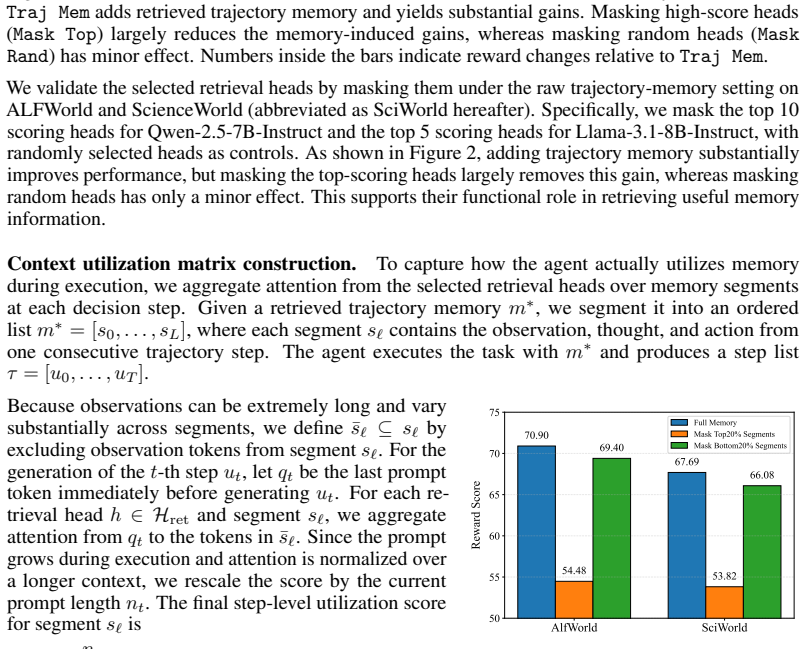
Significance. If the central claim holds, the paper makes a useful contribution: it connects mechanistic attention signals to memory utilization in agentic LLMs and demonstrates a concrete downstream use of that signal for memory refinement. The masking validations in Figures 2 and 3 are a clear strength: they provide behavioral evidence that high-scoring retrieval heads and high-attention segments are functionally important. The released code and reproducible experimental protocol are also positive. However, the present evidence does not yet establish that the attention-derived matrix is the causal driver of AGMR's improvements, and the evaluation has several unaddressed weaknesses (no error bars, a filtered SciWorld subset, head selection on the same task distribution). The core idea is promising, but the current manuscript requires additional controls and analyses to support the mechanistic claim.
major comments (5)
- [§4.2, Table 1] Table 1 reports performance, step counts, and memory tokens without error bars, confidence intervals, or significance tests. Since benchmarks like WebShop and SciWorld can have meaningful run-to-run variance, the claimed improvements—especially smaller ones, e.g., Qwen WebShop 63.86 vs. Traj 51.04, or Llama SciWorld 83.74 vs. Traj 76.18—cannot be assessed for reliability. Add multiple runs and report variance/significance for at least the central AGMR-vs-Traj comparison.
- [§4.4, Table 2] The w/o AGR ablation removes the entire Attention-Guided Refiner, including its structured prompt, the context utilization matrix C, and an extra Gemini LLM call. This confounds the effect of the attention mechanism with the presence of an additional analysis stage and a different prompt format. A control should feed a random or permuted C into the same Attention-Guided Refiner prompt, or otherwise replace the attention values with a non-informative baseline while keeping the prompt structure identical. Without such a control, the reported gains cannot be attributed specifically to the attention-derived signal.
- [§2.1, Appendix C.1] Retrieval heads are selected using supervision drawn from the same task distribution as the evaluation, and the annotation is generated by an LLM analyzer. The masking validation covers only ALFWorld and SciWorld, not WebShop, so it is unknown whether the selected heads are stable or sufficient for the WebShop mechanism. Add a WebShop head-masking experiment or otherwise justify that the head set transfers to WebShop.
- [Appendix E.1] The SciWorld evaluation uses a filtered test set that excludes seven task types with max_steps >= 60, including boil, freeze, melt, and chemistry-mix tasks. The paper states this was an early implementation constraint. Since the abstract and introduction claim improvements on 'interactive decision-making benchmarks' without this caveat, the filtered evaluation weakens the generality of the claim. Please report results on the full SciWorld test set using the fixed attention-hook implementation, or present the filtered-subset limitations prominently in the main text.
- [§3.1, Appendix E.2] Several refinement thresholds are set per benchmark without sensitivity analysis: 1.2 × median, the 3.5 ratio, 0.25 × global maximum, 0.9 × global maximum, and the reward-improvement thresholds. Since the Attention-Guided Refiner's decisions depend on these hand-set values, it is important to show that results are not brittle to threshold choices. Report a small sensitivity study or justify the chosen values.
minor comments (4)
- [Figure 2] The masking bars report reward changes but no error bars or number of tasks used per condition. Consider reporting variance or at least stating the evaluation size.
- [§2.2, Figure 4] The representative cases are drawn from ALFWorld training tasks. It would be clearer to state explicitly whether these examples were part of the supervision data used for head selection and/or threshold tuning; otherwise the examples may appear cherry-picked.
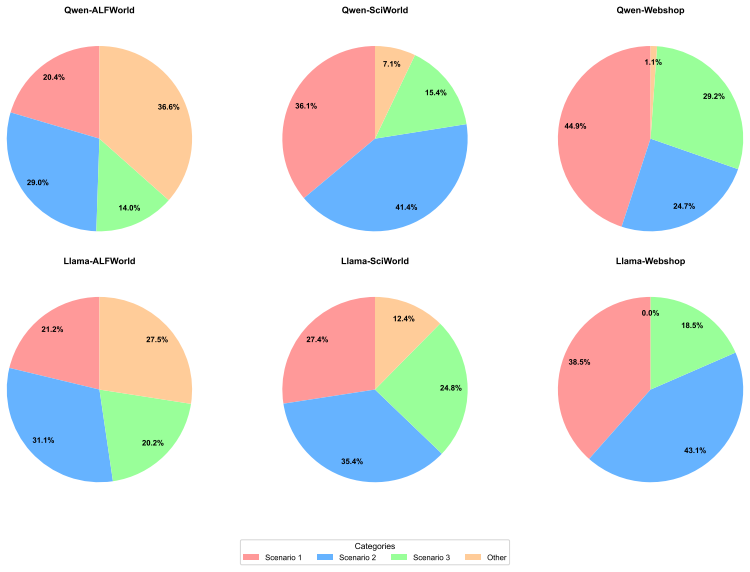
- [§4.2, Figure 7] Figure 7 groups tasks by the AGMR refiner's own diagnosis. This is useful descriptively but cannot by itself validate that the attention matrix caused the gains. Please add a sentence clarifying that this figure is descriptive and not causal evidence.
- [Appendix F] The prompt templates include 'omitted' placeholders for the actual trajectories and attention distributions. For reproducibility, include at least one fully filled example, even if shortened.
Circularity Check
No significant circularity: derivation is anchored by external task reward and behavioral masking checks.
full rationale
The paper's claimed derivation is: retrieval-head attention (selected by scoring heads on a small supervision set) is aggregated into a context utilization matrix C; C is validated by masking tests; AGMR uses C to guide refinement; final performance is measured by task reward on held-out test sets. None of these steps reduces to its own input by construction. The head-selection supervision (Appendix C.1) is a fitted input, but the paper does not present it as a prediction; the masking experiments (Figures 2 and 3) provide an independent behavioral check that the selected heads and high-attention segments are functionally important, and the final AGMR scores are external environment rewards. The w/o AGR ablation (Table 2) may be confounded with prompt/format changes, but that is a correctness/experimental-design concern, not a definitional circularity. No load-bearing self-citations are used: the mechanistic-interpretability citations [34, 40] are external prior work, and the scenario grouping in Figure 7 is a consistency check on the system's own diagnoses with external reward as the outcome. Per-benchmark thresholds (Appendix E.2) are hyperparameters, not renamed predictions. Therefore the derivation is self-contained and no circular step can be exhibited.
Axiom & Free-Parameter Ledger
free parameters (7)
- retrieval_head_count =
5
- ALFWorld_low_utilization_thresholds =
1.2×median(cmax) and cmax/c̄ < 3.5
- SciWorld_low_attention_threshold =
0.25×c_max_global_capped
- WebShop_low_attention_threshold =
0.9×c_max_global
- refinement_attempts =
3 for ALFWorld/SciWorld, 2 for WebShop
- reward_improvement_threshold =
0.3 for ALFWorld/SciWorld, 0.0 for WebShop
- high_attention_threshold_factors =
1.5×average and 0.5×global maximum
axioms (4)
- domain assumption Attention from the query token to memory segment tokens is a valid proxy for segment-level memory utilization.
- domain assumption The selected top-5 retrieval heads are the dominant heads through which memory is utilized on all test tasks.
- domain assumption The Semantic Reflector correctly localizes the earliest critical error and the supporting memory segment in failed runs.
- domain assumption Re-execution reward is a reliable measure of memory quality.
read the original abstract
Existing self-evolving memory systems mainly improve agent memory based on textual outputs, such as task trajectories and reflections. However, this text-based paradigm rarely incorporates internal mechanistic signals, leaving how retrieved memory is actually utilized during task execution underexplored. This limitation can lead to unreliable error attribution and hallucinated memory modifications. In this work, we show that retrieval-head attention provides a mechanistic signal for revealing segment-level memory utilization. By aggregating attention over memory segments and decision steps, we construct a context utilization matrix that exposes recurring memory-use patterns and indicates corresponding refinement strategies. Building on this observation, we propose Attention-Guided Memory Refinement (AGMR), a framework that uses utilization patterns revealed by attention to guide targeted segment-level memory updates. AGMR corrects or enhances memory for failed executions, simplifies memory for successful executions, and verifies each update through re-execution. Experiments on interactive decision-making benchmarks show that AGMR improves both task performance and memory efficiency over text-only memory refinement baselines. Code is available at https://anonymous.4open.science/r/AGMR_code-3262/
Figures




Reference graph
Works this paper leans on
-
[1]
Chirag Agarwal, Sree Harsha Tanneru, and Himabindu Lakkaraju. Faithfulness vs. plausi- bility: On the (un) reliability of explanations from large language models.arXiv preprint arXiv:2402.04614, 2024
Pith/arXiv arXiv 2024
-
[2]
Chain-of-thought reasoning in the wild is not always faithful.arXiv preprint arXiv:2503.08679, 2025
Iván Arcuschin, Jett Janiak, Robert Krzyzanowski, Senthooran Rajamanoharan, Neel Nanda, and Arthur Conmy. Chain-of-thought reasoning in the wild is not always faithful.arXiv preprint arXiv:2503.08679, 2025
Pith/arXiv arXiv 2025
-
[3]
Aviv Bick, Eric Xing, and Albert Gu. Understanding the skill gap in recurrent language models: The role of the gather-and-aggregate mechanism.arXiv preprint arXiv:2504.18574, 2025
Pith/arXiv arXiv 2025
-
[4]
Zhicheng Cai, Xinyuan Guo, Yu Pei, Jiangtao Feng, Jinsong Su, Jiangjie Chen, Ya-Qin Zhang, Wei-Ying Ma, Mingxuan Wang, and Hao Zhou. Flex: Continuous agent evolution via forward learning from experience.arXiv preprint arXiv:2511.06449, 2025
arXiv 2025
-
[5]
Zouying Cao, Jiaji Deng, Li Yu, Weikang Zhou, Zhaoyang Liu, Bolin Ding, and Hai Zhao. Remember me, refine me: A dynamic procedural memory framework for experience-driven agent evolution.arXiv preprint arXiv:2512.10696, 2025
Pith/arXiv arXiv 2025
-
[6]
Prateek Chhikara, Dev Khant, Saket Aryan, Taranjeet Singh, and Deshraj Yadav. Mem0: Building production-ready ai agents with scalable long-term memory.arXiv preprint arXiv:2504.19413, 2025
Pith/arXiv arXiv 2025
-
[7]
FaithLM: Towards faithful explanations for Large Language Models
Yu-Neng Chuang, Guanchu Wang, Chia-Yuan Chang, Ruixiang Tang, Shaochen Zhong, Fan Yang, Andrew Wen, Mengnan Du, Xuanting Cai, Vladimir Braverman, et al. FaithLM: Towards faithful explanations for Large Language Models. InProceedings of the 19th Conference of the European Chapter of the Association for Computational Linguistics (Volume 1: Long Papers), pag...
2026
-
[8]
Trajectory-informed memory generation for self-improving agent systems
Gaodan Fang, Vatche Isahagian, KR Jayaram, Ritesh Kumar, Vinod Muthusamy, Punleuk Oum, and Gegi Thomas. Trajectory-informed memory generation for self-improving agent systems. arXiv preprint arXiv:2603.10600, 2026
arXiv 2026
-
[9]
Memp: Exploring agent procedural memory.arXiv preprint arXiv:2508.06433, 2025
Runnan Fang, Yuan Liang, Xiaobin Wang, Jialong Wu, Shuofei Qiao, Pengjun Xie, Fei Huang, Huajun Chen, and Ningyu Zhang. Memp: Exploring agent procedural memory.arXiv preprint arXiv:2508.06433, 2025
Pith/arXiv arXiv 2025
-
[10]
Weizhi Fei, Xueyan Niu, Guoqing Xie, Yingqing Liu, Bo Bai, and Wei Han. Efficient prompt compression with evaluator heads for long-context transformer inference.arXiv preprint arXiv:2501.12959, 2025
Pith/arXiv arXiv 2025
-
[11]
The Llama 3 herd of models, 2024
Aaron Grattafiori, Abhimanyu Dubey, Abhinav Jauhri, Abhinav Pandey, Abhishek Kadian, Ahmad Al-Dahle, Aiesha Letman, Akhil Mathur, Alan Schelten, Alex Vaughan, et al. The Llama 3 herd of models, 2024
2024
-
[12]
Hia- gent: Hierarchical working memory management for solving long-horizon agent tasks with Large Language Model
Mengkang Hu, Tianxing Chen, Qiguang Chen, Yao Mu, Wenqi Shao, and Ping Luo. Hia- gent: Hierarchical working memory management for solving long-horizon agent tasks with Large Language Model. InProceedings of the 63rd Annual Meeting of the Association for Computational Linguistics (Volume 1: Long Papers), pages 32779–32798, 2025
2025
-
[13]
Memory in the age of ai agents.arXiv preprint arXiv:2512.13564, 2025
Yuyang Hu, Shichun Liu, Yanwei Yue, Guibin Zhang, Boyang Liu, Fangyi Zhu, Jiahang Lin, Honglin Guo, Shihan Dou, Zhiheng Xi, et al. Memory in the age of ai agents.arXiv preprint arXiv:2512.13564, 2025
Pith/arXiv arXiv 2025
-
[14]
Rap: Retrieval-augmented planning with contextual memory for multimodal llm agents, 2024
Tomoyuki Kagaya, Thong Jing Yuan, Yuxuan Lou, Jayashree Karlekar, Sugiri Pranata, Akira Kinose, Koki Oguri, Felix Wick, and Yang You. Rap: Retrieval-augmented planning with contextual memory for multimodal llm agents, 2024
2024
-
[15]
Patrick Kahardipraja, Reduan Achtibat, Thomas Wiegand, Wojciech Samek, and Sebastian Lapuschkin. The atlas of in-context learning: How attention heads shape in-context retrieval augmentation.arXiv preprint arXiv:2505.15807, 2025. 11
arXiv 2025
-
[16]
Why language models hallucinate.arXiv preprint arXiv:2509.04664, 2025
Adam Tauman Kalai, Ofir Nachum, Santosh S Vempala, and Edwin Zhang. Why language models hallucinate.arXiv preprint arXiv:2509.04664, 2025
Pith/arXiv arXiv 2025
-
[17]
SnapKV: LLM knows what you are looking for before generation.Advances in Neural Information Processing Systems, 37:22947–22970, 2024
Yuhong Li, Yingbing Huang, Bowen Yang, Bharat Venkitesh, Acyr Locatelli, Hanchen Ye, Tianle Cai, Patrick Lewis, and Deming Chen. SnapKV: LLM knows what you are looking for before generation.Advances in Neural Information Processing Systems, 37:22947–22970, 2024
2024
-
[18]
Zichang Liu, Aditya Desai, Fangshuo Liao, Weitao Wang, Victor Xie, Zhaozhuo Xu, Anastasios Kyrillidis, and Anshumali Shrivastava. Scissorhands: Exploiting the persistence of impor- tance hypothesis for llm kv cache compression at test time.Advances in Neural Information Processing Systems, 36:52342–52364, 2023
2023
-
[19]
Siru Ouyang, Jun Yan, I Hsu, Yanfei Chen, Ke Jiang, Zifeng Wang, Rujun Han, Long T Le, Samira Daruki, Xiangru Tang, et al. Reasoningbank: Scaling agent self-evolving with reasoning memory.arXiv preprint arXiv:2509.25140, 2025
Pith/arXiv arXiv 2025
-
[20]
MemGPT: towards LLMs as operating systems, 2023
Charles Packer, Vivian Fang, Shishir_G Patil, Kevin Lin, Sarah Wooders, and Joseph_E Gonza- lez. MemGPT: towards LLMs as operating systems, 2023
2023
-
[21]
Generative agents: Interactive simulacra of human behavior
Joon Sung Park, Joseph O’Brien, Carrie Jun Cai, Meredith Ringel Morris, Percy Liang, and Michael S Bernstein. Generative agents: Interactive simulacra of human behavior. InProceed- ings of the 36th annual acm symposium on user interface software and technology, pages 1–22, 2023
2023
-
[22]
Qwen2.5 technical report, 2025
Qwen, :, An Yang, Baosong Yang, Beichen Zhang, Binyuan Hui, Bo Zheng, Bowen Yu, Chengyuan Li, Dayiheng Liu, Fei Huang, Haoran Wei, Huan Lin, Jian Yang, Jianhong Tu, Jianwei Zhang, Jianxin Yang, Jiaxi Yang, Jingren Zhou, Junyang Lin, Kai Dang, Keming Lu, Keqin Bao, Kexin Yang, Le Yu, Mei Li, Mingfeng Xue, Pei Zhang, Qin Zhu, Rui Men, Runji Lin, Tianhao Li,...
2025
-
[23]
Towards understanding sycophancy in language models.arXiv preprint arXiv:2310.13548, 2023
Mrinank Sharma, Meg Tong, Tomasz Korbak, David Duvenaud, Amanda Askell, Samuel R Bowman, Newton Cheng, Esin Durmus, Zac Hatfield-Dodds, Scott R Johnston, et al. Towards understanding sycophancy in language models.arXiv preprint arXiv:2310.13548, 2023
Pith/arXiv arXiv 2023
-
[24]
Reflexion: Language agents with verbal reinforcement learning.Advances in neural information processing systems, 36:8634–8652, 2023
Noah Shinn, Federico Cassano, Ashwin Gopinath, Karthik Narasimhan, and Shunyu Yao. Reflexion: Language agents with verbal reinforcement learning.Advances in neural information processing systems, 36:8634–8652, 2023
2023
-
[25]
Mohit Shridhar, Xingdi Yuan, Marc-Alexandre Côté, Yonatan Bisk, Adam Trischler, and Matthew Hausknecht. ALFWorld: Aligning text and embodied environments for interactive learning.arXiv preprint arXiv:2010.03768, 2020
Pith/arXiv arXiv 2010
-
[26]
The hallucination tax of reinforcement finetuning
Linxin Song, Taiwei Shi, and Jieyu Zhao. The hallucination tax of reinforcement finetuning. arXiv preprint arXiv:2505.13988, 2025
Pith/arXiv arXiv 2025
-
[27]
Trial and Error: Exploration-based trajectory optimization of LLM agents
Yifan Song, Da Yin, Xiang Yue, Jie Huang, Sujian Li, and Bill Yuchen Lin. Trial and Error: Exploration-based trajectory optimization of LLM agents. InProceedings of the 62nd Annual Meeting of the Association for Computational Linguistics (Volume 1: Long Papers), pages 7584–7600, 2024
2024
-
[28]
Dynamic Cheatsheet: Test-time learning with adaptive memory
Mirac Suzgun, Mert Yuksekgonul, Federico Bianchi, Dan Jurafsky, and James Zou. Dynamic Cheatsheet: Test-time learning with adaptive memory. InProceedings of the 19th Conference of the European Chapter of the Association for Computational Linguistics (Volume 1: Long Papers), pages 7080–7106, 2026
2026
-
[29]
Language Models don’t always say what they think: Unfaithful explanations in Chain-of-Thought prompting.Advances in Neural Information Processing Systems, 36:74952–74965, 2023
Miles Turpin, Julian Michael, Ethan Perez, and Samuel Bowman. Language Models don’t always say what they think: Unfaithful explanations in Chain-of-Thought prompting.Advances in Neural Information Processing Systems, 36:74952–74965, 2023. 12
2023
-
[30]
Guanzhi Wang, Yuqi Xie, Yunfan Jiang, Ajay Mandlekar, Chaowei Xiao, Yuke Zhu, Linxi Fan, and Anima Anandkumar. V oyager: An open-ended embodied agent with Large Language Models.arXiv preprint arXiv:2305.16291, 2023
Pith/arXiv arXiv 2023
-
[31]
ScienceWorld: Is your agent smarter than a 5th grader? InProceedings of the 2022 Conference on Empirical Methods in Natural Language Processing, pages 11279–11298, 2022
Ruoyao Wang, Peter Jansen, Marc-Alexandre Côté, and Prithviraj Ammanabrolu. ScienceWorld: Is your agent smarter than a 5th grader? InProceedings of the 2022 Conference on Empirical Methods in Natural Language Processing, pages 11279–11298, 2022
2022
-
[32]
Quito: Accelerat- ing long-context reasoning through query-guided context compression
Wenshan Wang, Yihang Wang, Yixing Fan, Huaming Liao, and Jiafeng Guo. Quito: Accelerat- ing long-context reasoning through query-guided context compression. InChina Conference on Information Retrieval, pages 136–148. Springer, 2024
2024
-
[33]
Zora Zhiruo Wang, Jiayuan Mao, Daniel Fried, and Graham Neubig. Agent workflow memory. arXiv preprint arXiv:2409.07429, 2024
Pith/arXiv arXiv 2024
-
[34]
Retrieval head mecha- nistically explains long-context factuality
Wenhao Wu, Yizhong Wang, Guangxuan Xiao, Hao Peng, and Yao Fu. Retrieval head mecha- nistically explains long-context factuality. 2024
2024
-
[35]
A-mem: Agentic memory for LLM agents.arXiv preprint arXiv:2502.12110, 2025
Wujiang Xu, Zujie Liang, Kai Mei, Hang Gao, Juntao Tan, and Yongfeng Zhang. A-mem: Agentic memory for LLM agents.arXiv preprint arXiv:2502.12110, 2025
Pith/arXiv arXiv 2025
-
[36]
Sikuan Yan, Xiufeng Yang, Zuchao Huang, Ercong Nie, Zifeng Ding, Zonggen Li, Xiaowen Ma, Jinhe Bi, Kristian Kersting, Jeff Z Pan, et al. Memory-r1: Enhancing large language model agents to manage and utilize memories via reinforcement learning.arXiv preprint arXiv:2508.19828, 2025
Pith/arXiv arXiv 2025
-
[37]
Webshop: Towards scalable real-world web interaction with grounded language agents.Advances in Neural Information Processing Systems, 35:20744–20757, 2022
Shunyu Yao, Howard Chen, John Yang, and Karthik Narasimhan. Webshop: Towards scalable real-world web interaction with grounded language agents.Advances in Neural Information Processing Systems, 35:20744–20757, 2022
2022
-
[38]
React: Synergizing reasoning and acting in Language Models.arXiv preprint arXiv:2210.03629, 2022
Shunyu Yao, Jeffrey Zhao, Dian Yu, Nan Du, Izhak Shafran, Karthik Narasimhan, and Yuan Cao. React: Synergizing reasoning and acting in Language Models.arXiv preprint arXiv:2210.03629, 2022
Pith/arXiv arXiv 2022
-
[39]
Qizheng Zhang, Changran Hu, Shubhangi Upasani, Boyuan Ma, Fenglu Hong, Vamsidhar Ka- manuru, Jay Rainton, Chen Wu, Mengmeng Ji, Hanchen Li, et al. Agentic context engineering: Evolving contexts for self-improving language models.arXiv preprint arXiv:2510.04618, 2025
Pith/arXiv arXiv 2025
-
[40]
Query-focused Retrieval Heads improve long-context reasoning and re-ranking
Wuwei Zhang, Fangcong Yin, Howard Yen, Danqi Chen, and Xi Ye. Query-focused Retrieval Heads improve long-context reasoning and re-ranking. InProceedings of the 2025 Conference on Empirical Methods in Natural Language Processing, pages 23802–23816, 2025
2025
-
[41]
H2o: Heavy-hitter oracle for efficient generative inference of large language models.Advances in Neural Information Processing Systems, 36:34661–34710, 2023
Zhenyu Zhang, Ying Sheng, Tianyi Zhou, Tianlong Chen, Lianmin Zheng, Ruisi Cai, Zhao Song, Yuandong Tian, Christopher Ré, Clark Barrett, et al. H2o: Heavy-hitter oracle for efficient generative inference of large language models.Advances in Neural Information Processing Systems, 36:34661–34710, 2023
2023
-
[42]
Expel: LLM agents are experiential learners
Andrew Zhao, Daniel Huang, Quentin Xu, Matthieu Lin, Yong-Jin Liu, and Gao Huang. Expel: LLM agents are experiential learners. InProceedings of the AAAI Conference on Artificial Intelligence, volume 38, pages 19632–19642, 2024
2024
-
[43]
Leveraging attention to effectively compress prompts for long-context llms
Yunlong Zhao, Haoran Wu, and Bo Xu. Leveraging attention to effectively compress prompts for long-context llms. InProceedings of the AAAI Conference on Artificial Intelligence, volume 39, pages 26048–26056, 2025
2025
-
[44]
Synapse: Trajectory-as-exemplar prompting with memory for computer control
Longtao Zheng, Rundong Wang, Xinrun Wang, and Bo An. Synapse: Trajectory-as-exemplar prompting with memory for computer control. 2023
2023
-
[45]
Memorybank: Enhancing Large Language Models with long-term memory
Wanjun Zhong, Lianghong Guo, Qiqi Gao, He Ye, and Yanlin Wang. Memorybank: Enhancing Large Language Models with long-term memory. InProceedings of the AAAI conference on artificial intelligence, volume 38, pages 19724–19731, 2024. 13 A Related works Memory refinement in LLM agents.Memory has become a central component of LLM agents, enabling past interact...
2024
-
[46]
Construct an Optimal Trajectory based ONLY on the Expert Trajectory
-
[47]
Identify the FIRST erroneous step in the Agent Action Trajectory via stepwise alignment with the Optimal Trajectory.,→
-
[48]
Provide the Corrected Step that the agent should have taken, strictly grounded in the Expert Trajectory.,→
-
[49]
Identify the step in the Expert Trajectory that corresponds to the Corrected Step, and output it as the Expert Trajectory Reference.,→ ------------------------------------------------------------ Section 1 (MANDATORY): OPTIMAL TRAJECTORY CONSTRUCTION Before performing any failure analysis, you MUST first construct an Optimal Trajectory. Definition: The Op...
-
[50]
Analyze the attention distribution to determine which segments the LLM actually relied on when producing the erroneous Thought and Action.,→
-
[51]
Explain how this attention allocation led to the incorrect reasoning and behavior based on LLM Analysis Response and Erroneous Step Context.,→
-
[52]
[Erroneous Step Context] From [Task Trajectory]
Modify the relevant segment to prevent similar failures in future executions. [Erroneous Step Context] From [Task Trajectory]. Context window includes up to 3 Thought/Action/Observation groups immediately before the Erroneous Step.,→ Context window: 3 step(s) before the Erroneous Step. omitted === LLM Analysis Response === omitted ========================...
-
[53]
Attention Pattern Analysis: <Analyze which scenario applies based on the attention scores>
-
[54]
Root Cause Identification: <Identify why the LLM made the error at the mechanism level, and determine WHICH segment(s) require modification as a direct result of this error>,→
-
[55]
[/INST] Thought
Modification Strategy: <Explain HOW the identified segment(s) will be modified. The strategy should primarily focus on the erroneous *Thought* in the [Erroneous Step].,→ It should describe how the incorrect reasoning or intention expressed in that Thought can be corrected, constrained, or redirected, with the explanation grounded in both the attention pat...
discussion (0)
Sign in with ORCID, Apple, or X to comment. Anyone can read and Pith papers without signing in.