REVIEW 4 major objections 6 minor 65 references
MixDiffusion derives a training-free formula for combining any number of single-condition diffusion models into a multi-condition generator.
Reviewed by Pith at T0; open to challenge. T0 means a machine referee read the full paper against a public rubric. the ladder, T0–T4 →
T0 review · deepseek-v4-flash
2026-08-01 17:25 UTC pith:4MBOMRGU
load-bearing objection A workable training-free multi-control recipe, but the core fusion rule is composable diffusion in new clothes and the independence assumption is unvalidated. the 4 major comments →
MixDiffusion: Mixing Diffusion-based Uni-condition Text-to-Image Generation Models for Multi-condition Image Synthesis
The pith
A machine-rendered reading of the paper's core claim, the machinery that carries it, and where it could break.
Core claim
The central claim is a closed-form expression for the noise a hypothetical multi-condition diffusion model would predict, computed from the noises predicted by N single-condition models and a base model with no extra conditions: epsilon_joint = sum_i epsilon_i - (N-1)epsilon_base. The derivation starts from a product-of-experts Bayes rule under the assumption that each control condition is conditionally independent of the others given the current latent and the noise being predicted, then selects the mode (MAP estimate) of the fused Gaussian. With equal variances assumed, all normalizing factors cancel and the formula is exact. The paper further shows that when the equal-variance assumption
What carries the argument
The load-bearing object is the integration formula epsilon_joint = sum_i epsilon_i - (N-1)epsilon_base, derived from a product-of-experts fusion of Gaussian noise predictors. Each single-condition model is treated as a Gaussian expert N(epsilon; epsilon_i, sigma^2 I), the base unconditional model as N(epsilon; epsilon_base, sigma^2 I), and the multi-condition posterior is the normalized product of experts divided by the base raised to the (N-1)th power. Taking the maximum a posteriori sample yields the simple sum-minus-base rule. The same machinery is re-derived for velocity prediction in flow-matching models, producing a variance-weighted fusion formula that reduces to the original when var
Load-bearing premise
The result collapses if the different control conditions are not conditionally independent given the current noisy latent and the noise to be removed; conflicting or redundant controls break that premise, and the paper itself acknowledges this.
What would settle it
Construct a pair of conditions known to conflict—for example, a bounding box that places an object on the left and a keypoint or sketch that places it on the right—run MixDiffusion and a jointly trained two-condition model on identical prompts, base models, and schedulers, and measure how well each output tracks each individual constraint; a large divergence on conflicting pairs, while matching on complementary pairs, would localize the failure to the conditional-independence assumption.
If this is right
- Any pre-trained single-condition diffusion model can be plugged in as a new control channel; no retraining or dataset collection is needed to add a modality.
- The per-condition contribution does not shrink as more models are added, unlike simple interpolation, so control strength stays constant for arbitrary N.
- Because the text encoder and VAE can be shared and the denoisers run in parallel, the memory and inference-time overhead remain practical (the paper reports roughly 1.5 times the base inference time on one GPU).
- Condition adherence improves as complementary conditions are added, since the conditions mutually verify and constrain each other.
- The same derivation transfers to flow-matching models, so the training-free mixing approach can apply to next-generation generation backbones.
Where Pith is reading between the lines
- The paper itself concedes that conflicting conditions can yield ambiguous results; a direct test would compare MixDiffusion's output against a jointly trained two-condition model under deliberately contradictory inputs, which should expose the limits of the conditional-independence assumption.
- The integration-intensity schedule w=(t/T)^2 is chosen from the observation that early steps set layout and late steps set detail; a principled alternative could derive the schedule from each model's confidence or the signal-to-noise ratio at each step.
- The equal-variance assumption in the main formula is likely the first place to look for failure: the paper's own generalized weighted formula suggests that mixing models with very different reliability should use the variance-weighted form, and that could be validated by learning per-model uncertainty scalars.
- Because the fusion is modular, one could in principle mix not only control-condition models but also stylized or personalized base models that share the same latent space; this is a testable extension the paper does not explicitly explore.
Editorial analysis
A structured set of objections, weighed in public.
Referee Report
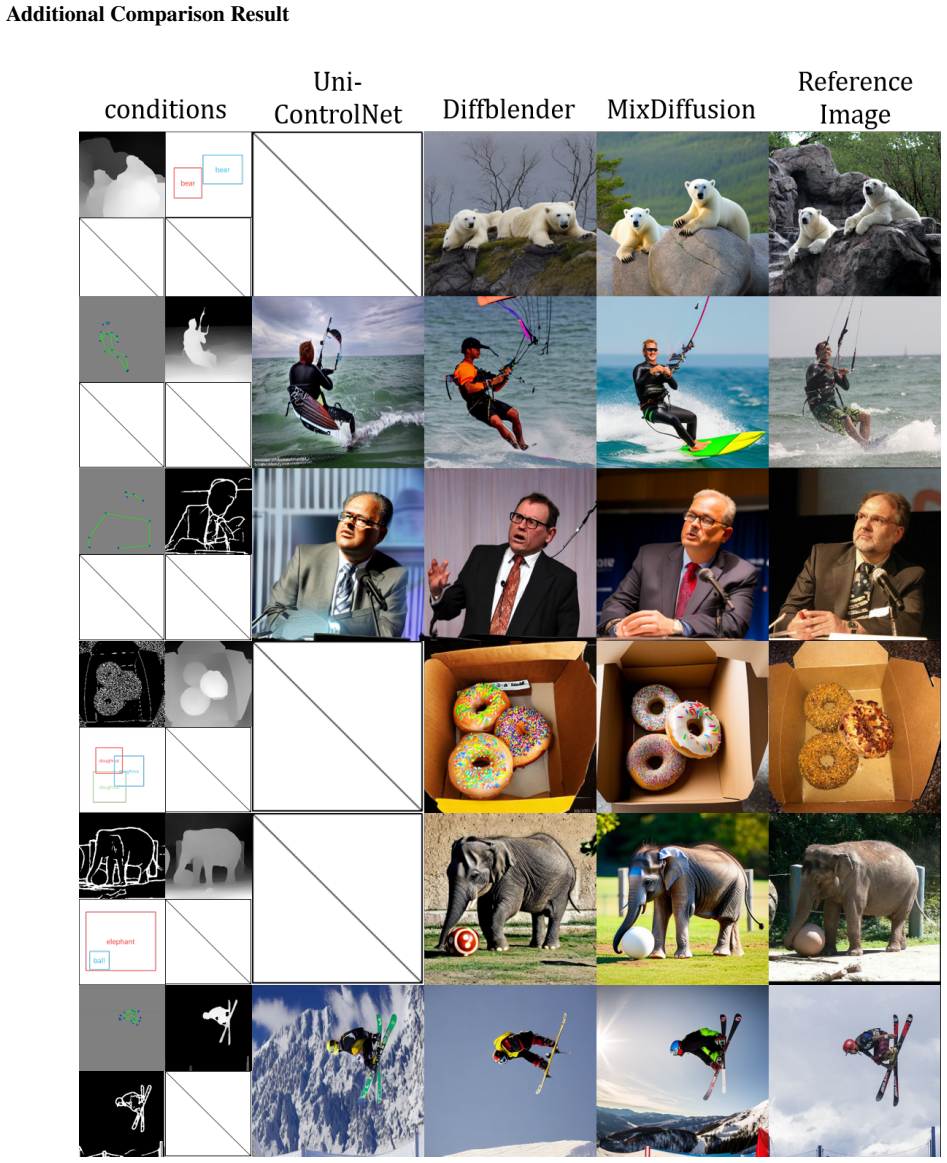
Summary. MixDiffusion proposes a training-free method for multi-condition text-to-image generation by composing pre-trained uni-condition diffusion models. At each denoising step, each condition-specific model predicts noise, and the predictions are fused via the closed-form rule epsilon_joint = sum_i epsilon_i - (N-1) epsilon_base, derived as a MAP estimate under a product-of-experts posterior (Eq. 7). A time-varying integration intensity w=(t/T)^2 blends the joint prediction with the base prediction (Eqs. 8-9). The method is evaluated on COCO with up to five control conditions (text, box, pose, depth, sketch, canny), comparing against trained multi-control baselines and reporting improved condition-adherence metrics. The paper also sketches a flow-matching extension.
Significance. If the derivation and results hold, MixDiffusion offers a practical and extensible way to combine existing condition-specific diffusion models without retraining. The explicit Bayesian derivation is a strength, as is the systematic ablation from two to five control conditions. The core contribution, however, rests on the conditional-independence assumption in Eq. (5), which is neither validated nor derived from the training procedure. The manuscript's own conclusion concedes that conflicting conditions can produce ambiguous results, directly qualifying the abstract's claim of 'arbitrary number of control conditions' and 'rigorous theory proof.' The empirical claims also lack statistical grounding. With additional validation and more careful claim-bounding, the approach could be a useful contribution to training-free multi-condition generation.
major comments (4)
- [Integration Module, Eq. (5)] The load-bearing assumption is Eq. (5): P(C_1,...,C_N | epsilon_{t-1}, z_t) = prod_i P(C_i | epsilon_{t-1}, z_t). The appendix justifies this by noting that each uni-condition model is trained independently, but independent training of predictors does not imply conditional independence of the conditioning variables given the noise and latent. For semantically coupled controls (e.g., a depth map and a sketch of the same scene, or a pose and a bounding box of the same person), the assumption is violated. The conclusion explicitly acknowledges this: 'conflicting conditions may lead to ambiguous results.' Thus the derivation is correct only under an unvalidated and often implausible assumption, and the abstract's 'arbitrary number of control conditions' overstates the result. Please validate Eq. (5) empirically on condition pairs with varying correlation/conflict, or substantially weaken the
- [Integration Module, base distribution] Eq. (6) requires a base distribution P(epsilon_{t-1} | z_t) from a model that 'does not accept any additional condition input.' However, the experimental section never specifies which model plays this base role. Six models are listed, including Stable Diffusion V1.5, which is a text-conditioned model, and text is one of the conditional inputs in every setting (T+B, T+B+D, etc.). If the base model is actually text-conditioned, then P(epsilon|z_t) is not the unconditional density used in the Bayes derivation. Please specify the exact base model, whether it is conditioned on text, and, if so, re-derive the integration formula with text treated as one of the C_i conditions.
- [Integration Intensity Strategy, Eq. (9)] The schedule w=(t/T)^2 is introduced as a 'mathematical formula' but is not derived from any principle; it is a hand-chosen free parameter. The ablation in Table 2 only toggles the intensity module on and off and does not compare alternative schedules (linear, cosine, constant, etc.). As a result, the specific quadratic form is not validated, and its contribution to the reported improvements is confounded with the choice of schedule. Please provide a sweep over intensity schedules or a principled derivation, and report results for the alternatives.
- [Experiment, Tables 1-3] All quantitative results are point estimates with no confidence intervals, standard errors, or significance tests, and the number of test samples per setting is not reported. The main comparison in Table 1, which supports the claim of superior control accuracy, relies on differences that may be within noise. Please report the dataset subset sizes, confidence intervals, and, where appropriate, significance tests for the headline comparisons. This is essential for the empirical claims given the absence of a training stage and the small number of conditions tested.
minor comments (6)
- [Figure 2 caption] Typo: 'deonising' should be 'denoising'.
- [Appendix, Experiment Settings] Typo: 'reproducable' should be 'reproducible'.
- [Eq. (24), Appendix] The denominator is written as a product from i=1 to N-1 of P(epsilon|z_t); this is just P(epsilon|z_t)^{N-1} and could be simplified for readability.
- [Table 2] The table formatting is garbled (e.g., '2 □' and '□2' symbols, checkmarks rendered as box characters); please reconstruct the table so that rows and columns are unambiguous.
- [Table 3] The metric 'artifact↓' is not defined in the text; please specify how artifact scores are computed and by which model/annotator.
- [Table 1] Rows for Uni-ControlNet and CnC contain '-' or missing entries without an explicit footnote in the main text. Add a note explaining which conditions each method does not support.
Circularity Check
No significant circularity: the integration formula is derived from an explicit independence assumption and is not a fitted input or self-citation chain.
full rationale
The central derivation chain is self-contained algebra from an explicit assumption. Equation (5) states the conditional independence assumption P(C_1,...,C_N | epsilon_{t-1}, z_t) = product_i P(C_i | epsilon_{t-1}, z_t); Equation (6) and the appendix derive the product-of-experts fusion by Bayes' rule, and Equation (7) follows by MAP estimation under Gaussian noise predictions. The fusion rule is therefore a consequence of the stated assumptions, not a renamed fit or a prediction forced by fitted parameters. The paper does not claim the independence assumption is derived; in fact, the Conclusion explicitly concedes 'The current formulation relies on a conditional independence assumption among different controls' and that 'conflicting conditions may lead to ambiguous results due to the competition between constraints.' The integration intensity schedule w=(t/T)^2 in Eq. (9) is presented as a heuristic ('we adopt'), and its ablation in Table 2 is an empirical comparison, not a fitted parameter that is then reported as a prediction. There are no load-bearing self-citations, no imported uniqueness theorem, and no ansatz smuggled in via citation. The 'rigorous theory proof' is conditional on an assumption, which is a validity/robustness concern rather than circularity. Accordingly, no circular step can be exhibited by the standards of this review.
Axiom & Free-Parameter Ledger
free parameters (1)
- integration intensity schedule w(t) =
w = (t/T)^2
axioms (4)
- domain assumption Conditional independence of control conditions given noise and latent: P(C_1,...,C_N | epsilon, z_t) = prod_i P(C_i | epsilon, z_t)
- domain assumption Each uni-condition model's predicted noise distribution is Gaussian with mean epsilon_i and shared variance sigma_t^2
- domain assumption The base model prediction epsilon_base corresponds to P(epsilon | z_t), a model without additional control conditions
- domain assumption DDIM scheduler with constant per-step variance and shared VAE/text encoder preserve performance
read the original abstract
Recent advances in text-to-image (T2I) generation have enabled controllable image synthesis by incorporating conditions beyond text. However, most existing diffusion-based methods are limited to a single type of control condition (e.g., bounding boxes or keypoints), which restricts their flexibility. To address this limitation, we propose MixDiffusion, a training-free diffusion framework for multi-condition T2I generation. MixDiffusion theoretically supports an arbitrary number of control conditions, including bounding boxes, keypoints, sketches, depth maps, reference images, and text, by collaboratively integrating multiple pre-trained uni-condition diffusion models. The key insight of the proposed approach is to derive the predicted noise distribution in each denoising step of the diffusion-based multi-condition image generation model from the predicted noise distributions of multiple diffusion-based uni-condition models with a derived integration formula, which is supported by rigorous theory proof. Owing to its training-free nature, MixDiffusion is easy to deploy and readily extensible to new control modalities.
Figures




Reference graph
Works this paper leans on
-
[1]
FirstName LastName , title =
-
[2]
FirstName Alpher , title =
-
[3]
Journal of Foo , volume = 13, number = 1, pages =
FirstName Alpher and FirstName Fotheringham-Smythe , title =. Journal of Foo , volume = 13, number = 1, pages =
-
[4]
Journal of Foo , volume = 14, number = 1, pages =
FirstName Alpher and FirstName Fotheringham-Smythe and FirstName Gamow , title =. Journal of Foo , volume = 14, number = 1, pages =
-
[5]
FirstName Alpher and FirstName Gamow , title =
-
[6]
Computer Science
Improving image generation with better captions , author=. Computer Science. https://cdn. openai. com/papers/dall-e-3. pdf , volume=
-
[7]
arXiv preprint arXiv:2204.06125 , volume=
Hierarchical text-conditional image generation with clip latents , author=. arXiv preprint arXiv:2204.06125 , volume=
-
[8]
Advances in neural information processing systems , volume=
Photorealistic text-to-image diffusion models with deep language understanding , author=. Advances in neural information processing systems , volume=
-
[9]
Proceedings of the IEEE/CVF conference on computer vision and pattern recognition , pages=
High-resolution image synthesis with latent diffusion models , author=. Proceedings of the IEEE/CVF conference on computer vision and pattern recognition , pages=
-
[10]
2023 , eprint=
SDXL: Improving Latent Diffusion Models for High-Resolution Image Synthesis , author=. 2023 , eprint=
2023
-
[11]
DreamPose: Fashion Image-to-Video Synthesis via Stable Diffusion , year=
Karras, Johanna and Holynski, Aleksander and Wang, Ting-Chun and Kemelmacher-Shlizerman, Ira , booktitle=. DreamPose: Fashion Image-to-Video Synthesis via Stable Diffusion , year=
-
[12]
Communications of the ACM , volume=
Generative adversarial networks , author=. Communications of the ACM , volume=. 2020 , publisher=
2020
-
[13]
Advances in neural information processing systems , volume=
Denoising diffusion probabilistic models , author=. Advances in neural information processing systems , volume=
-
[14]
arXiv preprint arXiv:2010.02502 , year=
Denoising diffusion implicit models , author=. arXiv preprint arXiv:2010.02502 , year=
Pith/arXiv arXiv 2010
-
[15]
Proceedings of the IEEE/CVF International Conference on Computer Vision , pages=
Boxdiff: Text-to-image synthesis with training-free box-constrained diffusion , author=. Proceedings of the IEEE/CVF International Conference on Computer Vision , pages=
-
[16]
arXiv preprint arXiv:2402.03290 , year=
InstanceDiffusion: Instance-level Control for Image Generation , author=. arXiv preprint arXiv:2402.03290 , year=
-
[17]
and Li, Ge , title =
Ren, Yurui and Yu, Xiaoming and Chen, Junming and Li, Thomas H. and Li, Ge , title =. Proceedings of the IEEE/CVF Conference on Computer Vision and Pattern Recognition (CVPR) , month =
-
[18]
Proceedings of the IEEE/CVF Conference on Computer Vision and Pattern Recognition (CVPR) , month =
Bhunia, Ankan Kumar and Khan, Salman and Cholakkal, Hisham and Anwer, Rao Muhammad and Laaksonen, Jorma and Shah, Mubarak and Khan, Fahad Shahbaz , title =. Proceedings of the IEEE/CVF Conference on Computer Vision and Pattern Recognition (CVPR) , month =. 2023 , pages =
2023
-
[19]
2024 , eprint=
Adversarial Supervision Makes Layout-to-Image Diffusion Models Thrive , author=. 2024 , eprint=
2024
-
[20]
2022 , eprint=
SceneComposer: Any-Level Semantic Image Synthesis , author=. 2022 , eprint=
2022
-
[21]
International conference on machine learning , pages=
Generative adversarial text to image synthesis , author=. International conference on machine learning , pages=. 2016 , organization=
2016
-
[22]
Advances in neural information processing systems , volume=
Learning what and where to draw , author=. Advances in neural information processing systems , volume=
-
[23]
The Twelfth International Conference on Learning Representations , year=
Matryoshka diffusion models , author=. The Twelfth International Conference on Learning Representations , year=
-
[24]
arXiv preprint arXiv:2310.00426 , year=
PixArt- : Fast Training of Diffusion Transformer for Photorealistic Text-to-Image Synthesis , author=. arXiv preprint arXiv:2310.00426 , year=
-
[25]
arXiv preprint arXiv:2403.04692 , year=
Pixart- sigma: Weak-to-strong training of diffusion transformer for 4k text-to-image generation , author=. arXiv preprint arXiv:2403.04692 , year=
-
[26]
Proceedings of the IEEE/CVF International Conference on Computer Vision , pages=
Scalable diffusion models with transformers , author=. Proceedings of the IEEE/CVF International Conference on Computer Vision , pages=
-
[27]
Advances in neural information processing systems , volume=
Diffusion models beat gans on image synthesis , author=. Advances in neural information processing systems , volume=
-
[28]
Proceedings of the IEEE/CVF Winter Conference on Applications of Computer Vision , pages=
More control for free! image synthesis with semantic diffusion guidance , author=. Proceedings of the IEEE/CVF Winter Conference on Applications of Computer Vision , pages=
-
[29]
International conference on machine learning , pages=
Learning transferable visual models from natural language supervision , author=. International conference on machine learning , pages=. 2021 , organization=
2021
-
[30]
arXiv preprint arXiv:2302.13971 , year=
Llama: Open and efficient foundation language models , author=. arXiv preprint arXiv:2302.13971 , year=
-
[31]
Journal of machine learning research , volume=
Exploring the limits of transfer learning with a unified text-to-text transformer , author=. Journal of machine learning research , volume=
-
[32]
Medical image computing and computer-assisted intervention--MICCAI 2015: 18th international conference, Munich, Germany, October 5-9, 2015, proceedings, part III 18 , pages=
U-net: Convolutional networks for biomedical image segmentation , author=. Medical image computing and computer-assisted intervention--MICCAI 2015: 18th international conference, Munich, Germany, October 5-9, 2015, proceedings, part III 18 , pages=. 2015 , organization=
2015
-
[33]
Advances in neural information processing systems , volume=
Attention is all you need , author=. Advances in neural information processing systems , volume=
-
[34]
Proceedings of the IEEE/CVF Conference on Computer Vision and Pattern Recognition , pages=
Reco: Region-controlled text-to-image generation , author=. Proceedings of the IEEE/CVF Conference on Computer Vision and Pattern Recognition , pages=
-
[35]
ECCV , year=
AnyControl: Create your artwork with versatile control on text-to-image generation , author=. ECCV , year=
-
[36]
arXiv , year =
Cocktail: Mixing Multi-Modality Controls for Text-Conditional Image Generation , author =. arXiv , year =
-
[37]
Proceedings of the IEEE/CVF International Conference on Computer Vision (ICCV) , month =
Zhang, Lvmin and Rao, Anyi and Agrawala, Maneesh , title =. Proceedings of the IEEE/CVF International Conference on Computer Vision (ICCV) , month =. 2023 , pages =
2023
-
[38]
Proceedings of the IEEE/CVF Conference on Computer Vision and Pattern Recognition , pages=
Diffusart: Enhancing line art colorization with conditional diffusion models , author=. Proceedings of the IEEE/CVF Conference on Computer Vision and Pattern Recognition , pages=
-
[39]
IEEE/CVF Conference on Computer Vision and Pattern Recognition (CVPR) , year =
Supreeth Narasimhaswamy and Uttaran Bhattacharya and Xiang Chen and Ishita Dasgupta and Saayan Mitra and Minh Hoai , title =. IEEE/CVF Conference on Computer Vision and Pattern Recognition (CVPR) , year =
-
[40]
Proceedings of the IEEE/CVF Conference on Computer Vision and Pattern Recognition (CVPR) , month =
Ge, Liuhao and Ren, Zhou and Li, Yuncheng and Xue, Zehao and Wang, Yingying and Cai, Jianfei and Yuan, Junsong , title =. Proceedings of the IEEE/CVF Conference on Computer Vision and Pattern Recognition (CVPR) , month =
-
[41]
Proceedings of the IEEE/CVF Conference on Computer Vision and Pattern Recognition , pages=
Gligen: Open-set grounded text-to-image generation , author=. Proceedings of the IEEE/CVF Conference on Computer Vision and Pattern Recognition , pages=
-
[42]
Proceedings of the IEEE/CVF Conference on Computer Vision and Pattern Recognition (CVPR) , month =
Zhang, Mengqi and Fu, Yang and Ding, Zheng and Liu, Sifei and Tu, Zhuowen and Wang, Xiaolong , title =. Proceedings of the IEEE/CVF Conference on Computer Vision and Pattern Recognition (CVPR) , month =. 2024 , pages =
2024
-
[43]
Advances in Neural Information Processing Systems , volume=
Textdiffuser: Diffusion models as text painters , author=. Advances in Neural Information Processing Systems , volume=
-
[44]
arXiv preprint arXiv:2311.16465 , year=
TextDiffuser-2: Unleashing the Power of Language Models for Text Rendering , author=. arXiv preprint arXiv:2311.16465 , year=
-
[46]
Proceedings of the IEEE/CVF Conference on Computer Vision and Pattern Recognition , pages=
Plug-and-play diffusion features for text-driven image-to-image translation , author=. Proceedings of the IEEE/CVF Conference on Computer Vision and Pattern Recognition , pages=
-
[47]
Proceedings of the 31st ACM International Conference on Multimedia , pages=
Sgdiff: A style guided diffusion model for fashion synthesis , author=. Proceedings of the 31st ACM International Conference on Multimedia , pages=
-
[48]
2024 , eprint=
MARIO Eval: Evaluate Your Math LLM with your Math LLM--A mathematical dataset evaluation toolkit , author=. 2024 , eprint=
2024
-
[49]
2020 , note=
Maximilian Seitzer , title=. 2020 , note=
2020
-
[50]
Advances in Neural Information Processing Systems , volume=
Uni-controlnet: All-in-one control to text-to-image diffusion models , author=. Advances in Neural Information Processing Systems , volume=
-
[51]
2023 , note=
SUN Zhengwentai , title=. 2023 , note=
2023
-
[52]
2023 , eprint=
ImageReward: Learning and Evaluating Human Preferences for Text-to-Image Generation , author=. 2023 , eprint=
2023
-
[53]
2024 , eprint=
RealCompo: Balancing Realism and Compositionality Improves Text-to-Image Diffusion Models , author=. 2024 , eprint=
2024
-
[54]
arXiv preprint arXiv:2207.12598 , year=
Classifier-free diffusion guidance , author=. arXiv preprint arXiv:2207.12598 , year=
-
[55]
arXiv preprint arxiv:2308.06721 , year=
IP-Adapter: Text Compatible Image Prompt Adapter for Text-to-Image Diffusion Models , author=. arXiv preprint arxiv:2308.06721 , year=
-
[56]
2023 , eprint=
Collaborative Diffusion for Multi-Modal Face Generation and Editing , author=. 2023 , eprint=
2023
-
[57]
arXiv preprint arXiv:2305.15194 , year=
Diffblender: Scalable and composable multimodal text-to-image diffusion models , author=. arXiv preprint arXiv:2305.15194 , year=
-
[58]
Proceedings of the AAAI Conference on Artificial Intelligence , volume=
T2i-adapter: Learning adapters to dig out more controllable ability for text-to-image diffusion models , author=. Proceedings of the AAAI Conference on Artificial Intelligence , volume=
-
[59]
Computer Vision--ECCV 2014: 13th European Conference, Zurich, Switzerland, September 6-12, 2014, Proceedings, Part V 13 , pages=
Microsoft coco: Common objects in context , author=. Computer Vision--ECCV 2014: 13th European Conference, Zurich, Switzerland, September 6-12, 2014, Proceedings, Part V 13 , pages=. 2014 , organization=
2014
-
[60]
2023 , note =
DreamShaper: A Text-to-Image Model Fine-Tuned on Stable Diffusion , author =. 2023 , note =
2023
-
[61]
GitHub repository , howpublished =
discus0434 and Sayan Goswami , title =. GitHub repository , howpublished =. 2025 , publisher =
2025
-
[62]
2025 , eprint=
DynamicControl: Adaptive Condition Selection for Improved Text-to-Image Generation , author=. 2025 , eprint=
2025
-
[63]
arXiv preprint arXiv:2401.09048 , year=
Compose and conquer: Diffusion-based 3d depth aware composable image synthesis , author=. arXiv preprint arXiv:2401.09048 , year=
-
[64]
2025 , eprint=
Can We Generate Images with CoT? Let's Verify and Reinforce Image Generation Step by Step , author=. 2025 , eprint=
2025
-
[65]
2024 , howpublished=
Black Forest Labs , title=. 2024 , howpublished=
2024
-
[66]
2025 , howpublished=
Black Forest Labs , title=. 2025 , howpublished=
2025
discussion (0)
Sign in with ORCID, Apple, or X to comment. Anyone can read and Pith papers without signing in.